
“Go any time, the mantas are always there” is the most misleading advice about a manta dive in Kona. Resident animals aren't a promise of a packed feeding area, and a popular travel month doesn't guarantee a better night. Plankton, site conditions and the way the group behaves matter more than a calendar shortcut.
A quiet evening can still deliver an exceptional encounter: a manta gliding into the light, turning above a settled group and returning without anyone pursuing it. Book for that kind of experience, not for a promised crowd of animals.
What a Kona Manta Dive Is and How the Night Unfolds
A manta emerges from the dark, its pale underside catching the lamps as it banks through the illuminated water. You're there to watch it feed, not to swim alongside it. A Kona manta dive is a guided nighttime encounter with reef manta rays, Mobula alfredi, feeding on zooplankton concentrated by underwater lights.
The lights attract the food rather than summon the animals on command. A genetic study of reef manta rays documents nighttime feeding on light-attracted zooplankton at Kona's Keauhou Bay and Makako Bay aggregation sites. That distinction explains both the repeatability of the experience and why the action can change from night to night.
Manta dive Kona core facts
| Detail | What to Know |
|---|---|
| Species | Reef manta rays (Mobula alfredi), which filter-feed on zooplankton |
| Main viewing site | Garden Eel Cove, a sandy plain with coral heads and lava rock |
| Access | Boat from Honokohau Harbor |
| Timing | After dark, when underwater lights draw plankton toward the surface |
| Who it suits | Certified divers and snorkelers comfortable in open water at night |
This isn't a recently invented attraction. Shoreline lights near Keauhou attracted plankton and feeding mantas in the 1970s, according to Kona Honu Divers' account of the encounter's origins. The modern guided experience grew around an existing local wildlife phenomenon.
How the evening works
Treat this as a typical sequence, not a fixed departure schedule. Some itineraries include an earlier reef dive, so the boat may leave before dark even though the manta encounter happens at night.
- Attend the harbor briefing. Listen for the entry procedure, light instructions, viewing position and hand signals. Shared signals matter when you can't lift your head and talk.
- Board at Honokohau Harbor. Organize your gear before the boat gets underway and keep the deck clear. Confirm the actual check-in time rather than planning around sunset alone.
- Enter when the crew directs you. The lights and viewing area need to be ready. On our Manta Ray Night Dive, experienced divemasters and instructors are in the water with divers.
- Settle beside the feeding path. Take the guide's assigned position at the sandy viewing area, using the positioning method covered in the briefing. Keep the illuminated corridor open rather than drifting into its center.
- Watch without following. A pass can be brief, and it's tempting to turn and kick after the animal. Stay put instead, allowing the manta room to complete its feeding loop.
- Return with the group. Follow the guide's exit instructions, leave room at the ladder and secure equipment before moving around the deck. Rinse gear where directed and discuss what the group observed.
The dive feels different from a roaming reef dive because patience is part of the technique. You don't improve it by covering more ground.
Practical rule: A good viewing position is one you can hold without entering the manta's route.
Repeated close passes with an orderly group can make a memorable night. No number of animals is guaranteed, and close range should always be the manta's choice.
Why Garden Eel Cove Is the Best Viewing Site
Garden Eel Cove is my preferred choice for the manta dive because its protected location, better viewing area and surrounding reefs suit the experience. Protection matters at night: when conditions are manageable, you can concentrate on the animals instead of constantly correcting your position.
That doesn't mean the cove is immune to swell or that every evening will be calm. A sheltered site is an advantage, not permission to ignore the forecast or the captain's assessment.
The bottom layout makes a difference
The Underwater Atlas profile of Garden Eel Cove describes a gently sloping sandy plain interrupted by coral heads and lava-rock formations, and identifies its alternate names as Manta Ray Heaven and Makako Bay. Those names refer to the same site, which helps when comparing different descriptions.
The open sand provides room for an organized viewing arrangement without treating living reef as seating. Nearby coral and lava structure also make this a reef-associated dive site, not just a patch of illuminated water.
For a diver, the useful combination is:
- Open viewing space: You can watch the feeding area without needing to weave through reef structure.
- A protected setting: Under suitable conditions, less water movement makes controlled positioning easier.
- Better surrounding reef terrain: The habitat gives the location interest beyond the manta viewing area itself.
Our manta charter often goes to Garden Eel Cove. It's a significant nighttime gathering location reached by boat from Honokohau Harbor, but the destination still needs to be confirmed for the departure you're booking.
Choose the site for the underwater experience, not just for the shortest boat ride.
A convenient departure doesn't compensate for a viewing arrangement that doesn't suit your comfort or expectations. Conversely, a preferred site isn't a reason to insist on running when the crew considers conditions unsuitable.
Before comparing other details, review the manta ray dive tour and confirm that your booking names Garden Eel Cove. Then check the departure location and what the itinerary includes.
When to Go and What Changes Your Odds
Year-round residency doesn't mean equally reliable encounters every month, and it certainly doesn't mean the same gathering every night. “Resident” describes repeated local use by animals, not a reservation they've made at the lights.
Separate two questions: whether you'll encounter a manta, and how many mantas will feed together. A strong answer to the first doesn't establish the second.
A 2025 University of Hawaiʻi study analyzed 13 years of community-sourced observations from 2010–2022, recording more than 23,000 sightings involving 167 individually identified reef mantas at Garden Eel Cove and Keauhou. The study found that aggregation size tracked zooplankton density and that Garden Eel Cove generally supported larger aggregations.
Judge the night, not just the month
Food availability gives you a more useful way to think about the experience than a simple summer-versus-winter rule. More feeding animals can make the scene spectacular, but a smaller gathering can leave you with an unobstructed view of individual feeding behavior.
Factors that change your odds on a given night
| Factor | Effect on Your Night | What You Can Do |
|---|---|---|
| Zooplankton density | Higher density supports more feeding mantas | Accept nightly variation and ask about recent conditions |
| Site choice | Garden Eel Cove generally supports larger aggregations | Book a trip that names the site |
| Calendar month | Residents appear year-round, but group size still changes | Plan for flexibility rather than a guaranteed peak |
| Weather and sea state | Rough water can shorten the viewing window | Watch the forecast and keep a backup night |
Manta sightings in Kona often exceed a 90% success rate, but that isn't a personal guarantee or a forecast of aggregation size. Don't convert a broad encounter rate into an expectation that every departure delivers the same show.
For travel planning, the practical question behind the best time to see manta rays in Kona is how much flexibility you've left yourself. Schedule the encounter early enough in your stay that another suitable evening remains possible.
Ask about recent plankton and viewing conditions when booking. Use the answer as context, not certainty, and keep a backup night rather than putting the whole experience on one immovable date.
Certification, Safety and Who Can Join
Choose scuba or snorkeling according to your actual comfort in the water, not which sounds more adventurous. Scuba adds equipment management and underwater communication; snorkeling removes those tasks but still requires confidence in open water after dark.
Most of our regular dive charters require at least an Open Water Diver certification from a recognized agency. Bring your certification card and logbook so the crew can check your qualifications and recent experience.
Requirements by participant type
| Participant | What Is Required | Practical Step |
|---|---|---|
| Certified scuba diver | Open Water Diver or equivalent certification from a recognized agency | Bring logbook and certification card |
| Snorkeler without certification | Comfortable swimming and floating in open water at night | Wear the flotation vest and follow the briefing |
| Guest with limited mobility | Able to board the boat and enter the water from the platform, with any assistance agreed in advance | Tell the operator before booking |
| Child or first-time guest | Parent or guardian present where applicable, and comfort in the water | Ask the operator for the minimum age |
Night comfort matters as much as the card
A certification doesn't tell the crew whether you've been diving recently or whether darkness makes you anxious. Be candid about a long break, difficulty equalizing, mask problems or concerns about descending at night.
For scuba, know how to operate your dive light before entering, keep hoses and accessories secured, and remain with the guide. Don't swim away to investigate another light or follow an animal outside the viewing area.
For snorkeling, use the flotation equipment provided and follow the crew's positioning instructions. Flotation isn't a substitute for swimming comfort, and being at the surface doesn't remove the need to listen closely.
The comparison between snorkeling and diving with manta rays is best settled before booking, not while standing on the swim platform.
Boarding, moving around the boat and returning from the water can be harder than watching the animals. Guests with limited mobility should discuss the ladder, platform, ride and assistance arrangements in advance, and everyone should check minimum-age rules and medical approval requirements before paying.
How to Choose a Reputable Manta Dive Operator
Compare operators against the same criteria before comparing prices. A cheaper fare isn't automatically poor value, but you need to know whether you're comparing equivalent supervision, equipment and itineraries.
Questions worth getting answered
- Credentials and experience: Who leads the dive, and what experience do they have managing nighttime groups? Look for clear answers rather than a vague claim about expertise.
- Boat room and layout: Consider gear storage, seating, boarding and the exit ladder. A comfortable ride matters less if the return from the water is awkward for you.
- Briefing quality: Expect instructions about light use, positioning, communication, separation and the return to the boat.
- Group management: Ask how guests are organized in the water and how guides keep track of them. Total passenger count alone doesn't explain supervision.
- Named destination: Check whether the listing identifies Garden Eel Cove and how conditions may affect the destination.
- Cancellation terms: Read both weather-cancellation and guest-cancellation policies before payment.
- Checkable reviews: Read recent Google reviews for comments about briefings, equipment and how crews handled problems, not just whether mantas appeared.
A polished listing can still leave practical questions unanswered. Look for enough detail to understand what happens when conditions are imperfect, not only when everything goes smoothly.
Confirm the company you're booking
Kona Honu Divers is separate from Kona Diving Company. Check the business name on your confirmation, especially if you've compared several similarly named listings; this guide to choosing between Kona dive companies can help prevent that confusion.
Our credentials include being the highest-rated and most-reviewed dive shop in Hawaii, with over 5,000 five-star Google reviews, and winning the Scuba Diving Magazine Reader's Choice Award for the best dive company in the Pacific. Verify award and ranking claims on an operator's own pages before relying on them, and still evaluate the departure against your needs.
Read the reviews directly, paying attention to the details that matter to your group.
Packing, Photography and Conservation Etiquette
Pack for the return trip as carefully as the water session. Wet gear, a phone without protection and no dry layer can turn an otherwise enjoyable evening into an uncomfortable ride.
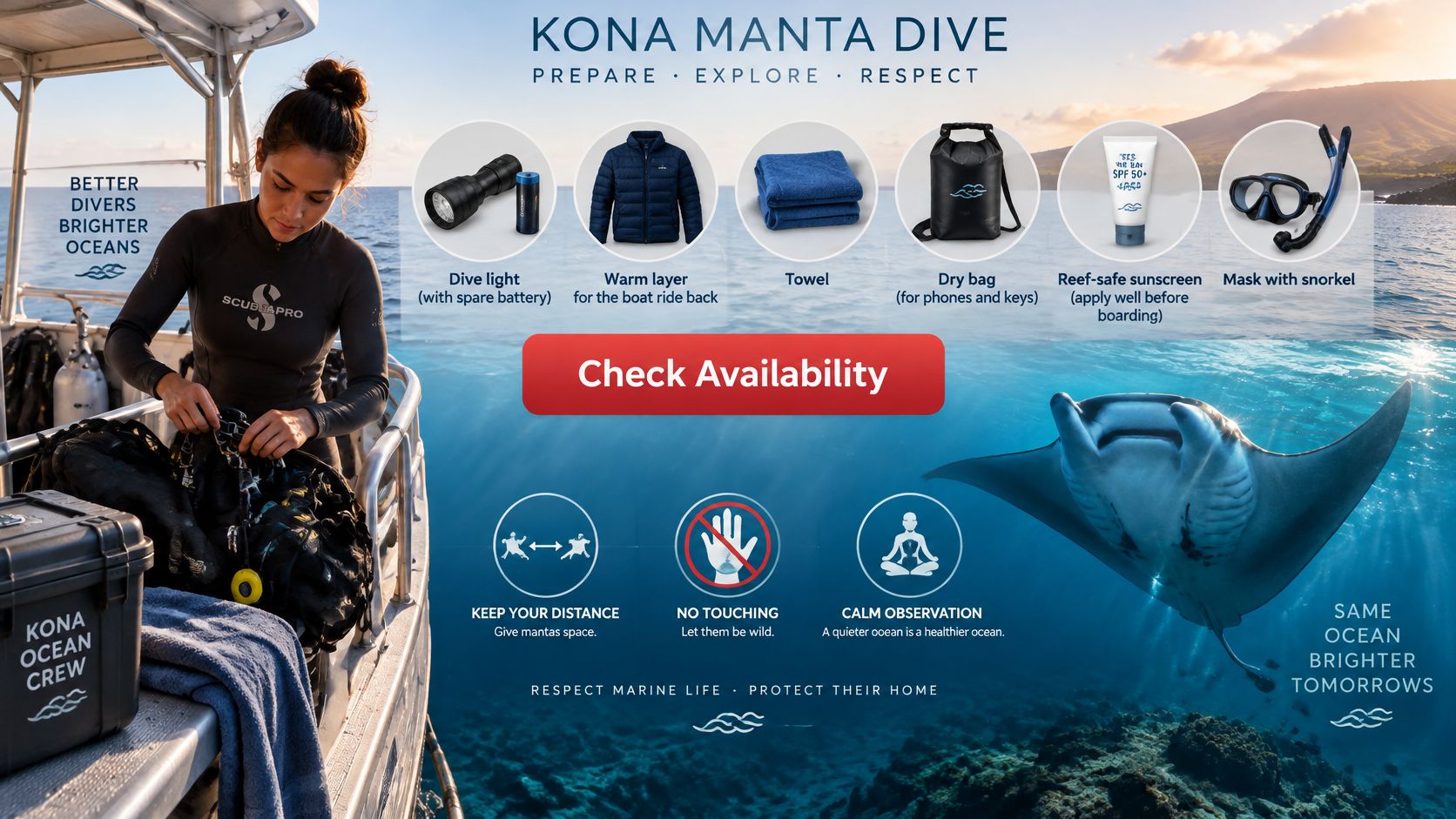
- Dive light and spare battery: Confirm what's supplied, test your light and keep spare batteries dry until needed.
- Warm layer: Bring something dry for the boat ride back rather than relying on a wet shirt.
- Towel: Keep it separate from wet equipment so it's useful after the dive.
- Dry bag: Protect your phone, keys and other small belongings, and keep them out of the working deck area.
- Reef-safe sunscreen: Apply it well before boarding if your itinerary includes daylight exposure. Clothing is also useful sun protection.
- Wide-angle camera setup: Choose a lens that lets you photograph a nearby animal without backing into another diver.
Make the picture without moving the animal
Set up the camera before entering. A secured housing, a manageable tray and controls you can operate without looking away for long are more useful than extra accessories you'll struggle to handle.
Frame wide and hold position. Let the manta move into the composition rather than stretching your camera into its route. Avoid repeatedly flashing at the same animal, and turn strobes off if they dazzle the rays or interfere with the group.
The photograph isn't worth taking if getting it requires leaving your position or blocking a feeding pass.
Maintain neutral buoyancy, never touch or chase a manta, and keep fins and equipment clear of reef and sand. The Dive Navigator guide to Garden Eel Cove emphasizes buoyancy control because accidental contact can disturb both habitat and animals.
Review responsible diver etiquette before bringing a camera into the group. Undisturbed natural behavior is the measure of a good encounter, not crowding or forced proximity.
Pricing, Logistics and How to Book
Compare the total evening cost, not just the advertised fare. Account for gear rental, any harbor or booking fees, and the gratuity you intend to leave. Ask which items are included, which are additional and whether gratuity is discretionary.
Current rates and logistics should come from the booking page for your actual date. Don't plan around an old blog price, and don't assume every itinerary with “manta” in its name includes the same amount of diving.
A practical booking sequence
- Choose candidate evenings. Keep alternative nights available so a weather change doesn't end your opportunity to go. Avoid making your only possible departure the final evening of your stay.
- Confirm the destination and harbor. Look for Garden Eel Cove and Honokohau Harbor, then check the meeting instructions carefully. A harbor name alone isn't a precise check-in location.
- Get an itemized total. Confirm rental needs, mandatory fees and what's supplied. Budget gratuity separately unless the booking explicitly includes it.
- Match the requirements to every guest. Check certification, swimming ability, age rules and any medical or mobility questions before entering payment details.
- Book and prepare for check-in. Save the confirmation offline, allow time for parking and unloading, and arrive at the stated check-in time ready for the briefing.
Use the full diving tour selection to compare available itineraries without assuming they're interchangeable. For practical questions before booking, call us at 808-324-4668.
Leave room around the departure
Don't stack a long island drive immediately before harbor check-in. Allow time to find the meeting point, assemble equipment and resolve a forgotten item without rushing.
The same applies afterward: avoid making a tight dinner reservation around an assumed return time. Read these dive travel planning tips while organizing the rest of your stay, particularly if you're combining diving with flights or other activities.
Book once the site, requirements and total price are clear. The strongest plan leaves enough flexibility to respond sensibly to the ocean rather than pressuring a crew to deliver a particular evening.
Manta Dive Kona FAQ
What if I see no mantas?
A no-sighting night is possible, even when the boat reaches the usual viewing area and the setup runs correctly. Keep another evening available, and read the operator's specific no-sighting terms rather than assuming a free return, refund or guaranteed place on another departure.
Do the lights harm the mantas?
A long-term study of Kona reef manta aggregations found that predictable nighttime feeding aggregations persisted despite sustained tourism and artificial-light-associated feeding conditions. That doesn't establish that lighting has no effects; the practical approach is a stable light field, calm divers and unobstructed feeding routes, not extra lights or attempts to manipulate an animal.
Can I take photos with a phone?
Yes, provided you use a housing rated for your planned water activity and know how to operate it before boarding. Use a wide frame, stay stationary and avoid repeated flashing; don't expect the phone to reproduce what your eyes can see in dark water, and don't sacrifice your position for a sharper image.
What happens if weather cancels the trip?
The operator's cancellation policy determines whether you're offered rescheduling, a refund or another arrangement. Check those terms before booking and keep a backup night available, because a weather cancellation doesn't automatically mean there's room on the next suitable departure.
Kona Honu Divers offers guided manta ray night dives with experienced divemasters and instructors in the water, with Garden Eel Cove as our go-to site. Visit Kona Honu Divers to choose your evening, confirm the requirements and plan a manta encounter built around patient, responsible viewing.