
You've found an open evening in your Kona itinerary, but the booking choices raise a practical question: should you scuba dive beneath the mantas or watch from the surface? Perhaps you're certified but haven't dived at night, or you're traveling with someone who swims well but has never used a snorkel in the ocean.
The best manta dive in Kona isn't automatically the most demanding option. It's the format that lets you breathe comfortably, stay in position, and enjoy the animals without struggling with equipment or darkness. Garden Eel Cove is my preferred site for the dive, but matching the outing to your abilities comes first.
Manta Night Dive Options at a Glance
| Option | Who It Suits | Experience Needed | Viewing Position |
|---|---|---|---|
| Manta Ray Night Snorkel | Non-divers, families, and first-timers | Confident open-water swimmer | At the surface, lights pointed down |
| Manta Ray Night Dive | Certified divers wanting a closer view from below | Open Water Diver certification and controlled buoyancy | On the bottom in a semicircle, lights pointed up |
| 2-Tank Manta Dive Snorkel | Guests wanting a daytime dive plus the manta encounter | Open Water Diver for scuba; confident swimming for snorkeling | Bottom for the scuba encounter; surface for the snorkel encounter |
| Blackwater Night Dive | Advanced divers seeking deep-water night diving | Advanced certification, subject to charter requirements | Open deep water, away from the reef |
For the manta formats, you're watching the same feeding animals with the same basic lighting approach. Your viewing position changes, not the wildlife's behavior: snorkelers look down while divers look up, leaving the space between them available for feeding passes. The manta encounter procedures describe surface positioning for snorkelers and a bottom semicircle for divers, with lights directed into the open water column.
Scuba isn't necessarily closer, and snorkeling isn't necessarily easier for every guest. Surface motion can bother a snorkeler, while equipment management can distract a diver; compare snorkeling versus diving with manta rays based on your comfort rather than the photographs you hope to take.
Choose scuba if you hold an Open Water Diver certification and can control buoyancy in darkness. Choose snorkeling if you're a confident open-water swimmer without certification. Neither option is a suitable shortcut for someone who's uncomfortable in the ocean.
Blackwater is a separate experience, not another way to watch the reef manta gathering. Use the full lineup of Kona diving tours to distinguish reef outings, manta encounters, and offshore night diving before choosing your charter.
Why Kona Is World-Class for Manta Night Dives
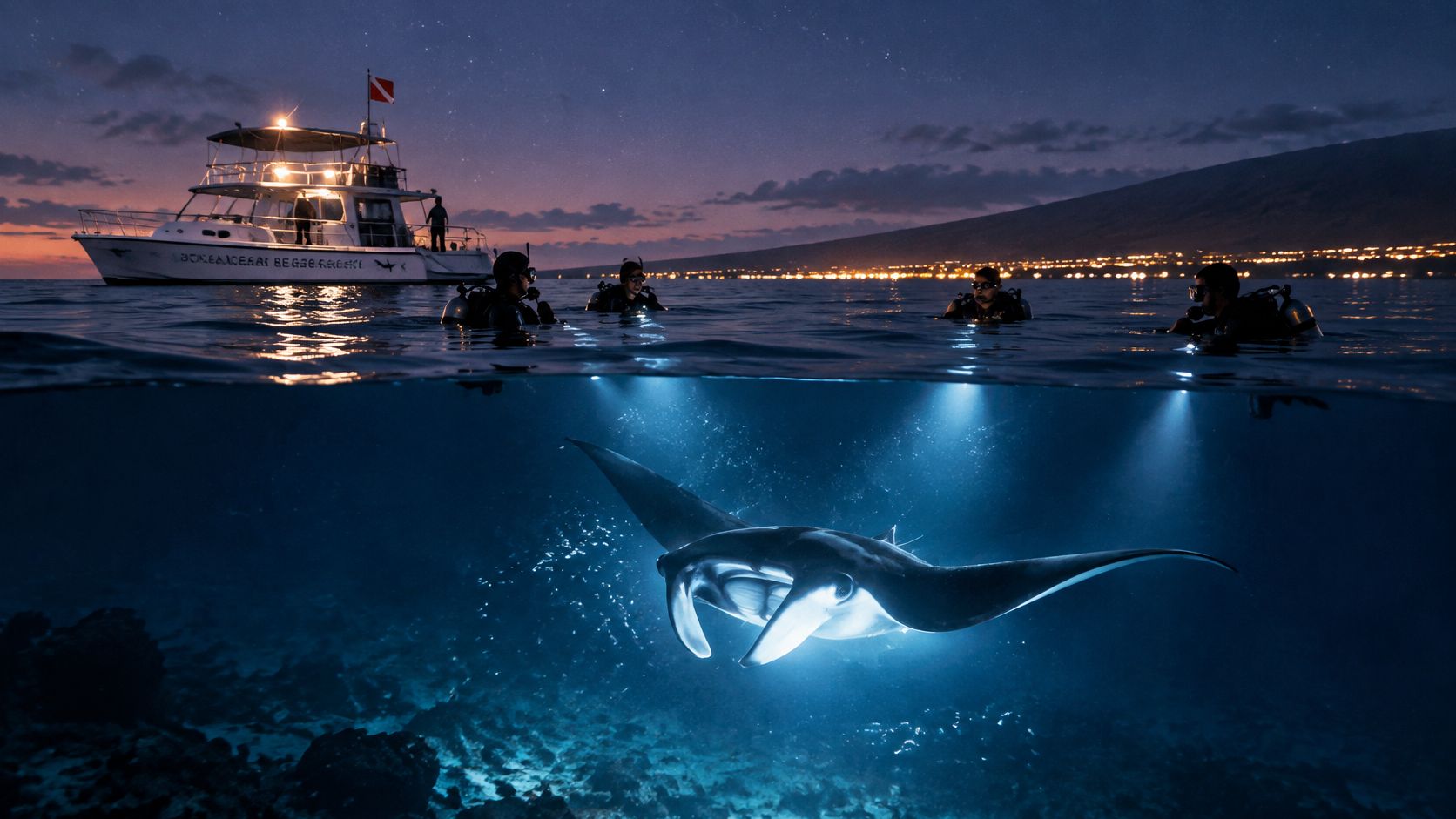
Kona's appeal is a recurring encounter with an identifiable resident population, rather than a lucky glimpse during an ordinary reef dive. Reef manta rays return to nighttime feeding areas, giving visitors a realistic opportunity to watch sustained feeding behavior instead of a distant animal disappearing into open water.
A NOAA-hosted manta monitoring document describes 3,208 surveys conducted between 1992 and 2007, primarily at Keauhou and Ho'ona Bay, historical identification of 154 manta rays, and a legislative estimate that the resident population probably numbered fewer than 200 individuals.
Those are historical baseline figures, not a current population census. Their practical significance is that visitors repeatedly encounter a relatively concentrated group of animals, so responsible behavior matters across successive outings, not just during your own dive.
What a reliable wildlife encounter actually means
Reliability means there's a well-established feeding opportunity. It doesn't mean a guide can summon a particular manta, promise a crowd of animals, or schedule a close pass over your mask.
You might watch an animal circle repeatedly through the illuminated water. You might have long pauses between appearances, or an evening when feeding happens beyond your viewing position. Arrive expecting wildlife behavior rather than a timed performance.
A useful expectation: Book for the opportunity to observe feeding mantas, not for a promised animal count or a guaranteed photograph.
The best moments often require very little activity from the diver. Once you're settled, the main tasks are monitoring breathing, checking your buddy and instruments, and maintaining awareness when an animal approaches from outside your immediate field of view.
Why stewardship belongs in the experience
A predictable gathering makes wildlife accessible, but it also concentrates boat traffic, lighting, and people around recurring feeding habitat. A visitor who interrupts a feeding route may leave shortly afterward; the manta remains part of the population using that habitat.
That's why a well-run encounter feels organized rather than improvisational. You should know where to position yourself, how the group will communicate, and how everyone will return to the boat.
Kona offers manta outings year-round. Expect the possibility of looping feeding passes through the lights, but leave room for the ocean and the animals to determine how the evening unfolds.
Why Garden Eel Cove Is the Better Viewing Site
| Site | Protection and Viewing | Aggregation Pattern | Best For |
|---|---|---|---|
| Garden Eel Cove | Protected location, wider viewing area, and better reefs | Larger, more variable groups | Divers and snorkelers wanting the most reliable viewing setup |
| Keauhou | Less protected; smaller viewing area than Garden Eel Cove | Smaller aggregations with a strongly female-leaning sighting pattern | Divers interested in a different pattern of site use |
Garden Eel Cove is the superior choice for the manta dive tour because the protected location, broader viewing area, and better surrounding reefs make a more complete outing. The advantage isn't the possibility of more mantas. It's having a good place to organize divers and enjoy the reef portion without treating the entire trip as a wait for darkness.
The published analysis of Kona's nighttime manta aggregations documented more than 23,000 sightings of 167 individually identified reef manta rays during 2010–2022, finding larger, more variable aggregations at Garden Eel Cove and smaller aggregations at Keauhou, where females comprised 91% of sightings.
That female percentage describes observations at Keauhou, not the sex ratio of Kona's entire manta population. Repeated visits by particular animals can strongly influence a site's sighting record.
Food explains the changing group size
The same analysis found that aggregation size increased with zooplankton density. Mantas are feeding, not assembling because a boat has arrived, so a good viewing location still needs favorable food conditions.
For a diver, the distinction matters. More animals can create more opportunities for repeated passes, but a smaller gathering can still produce an excellent encounter when the feeding route runs near your assigned position.
Choose Garden Eel Cove for the stronger overall viewing setup, not because anyone can guarantee it will have the most animals every night.
A protected location also isn't a promise of flat water. Swell direction, surface motion, and local conditions still influence whether a site is appropriate for a particular evening and group.
I would prioritize Garden Eel Cove, sensible conditions, and clear in-water organization over an advertised animal count. Keauhou remains an established feeding site with its own ecological pattern, but Garden Eel Cove offers the better combination for someone choosing a manta dive as part of a Kona diving trip.
Who Can Join and How to Prepare
Being medically fit doesn't automatically make you ready for a nighttime ocean encounter. A strong gym routine won't help much if you panic when water enters your mask or can't remain horizontal without constant movement.
The Love Big Island manta planning guide highlights practical participation requirements, including confident open-water swimming, boat-ladder access, surface stability, and certification for scuba. Some snorkeling arrangements may not use a conventional life jacket, so don't assume that every flotation setup works like a pool safety vest.
Check the skills you'll actually use
- Calm flotation: Can you float comfortably for several minutes without urgently needing to stand?
- Ocean confidence: Can you manage a little water in your mask while waves move around you?
- Darkness tolerance: Are you comfortable when you can't see the shoreline or bottom clearly?
- Boat access: Can you climb a ladder after swimming, including while the boat moves?
- Scuba control: Can you manage buoyancy, locate your gauges, and communicate without daylight?
- Motion tolerance: Do you have a workable plan for seasickness?
Most of our regular dive charters require at least an Open Water Diver certification from a recognized agency. Certification establishes a training baseline, but recent comfort matters too; a diver who hasn't used scuba for a long time may benefit from a refresher before adding darkness.
If you're uncertified, distinguish an introductory scuba experience from a regular certified-diver charter. Our explanation of scuba diving in Hawaii without certification helps separate those options.
Make the outing less stressful
Ask specifically about flotation support, ladder-assistance policies, and whether private instruction would help before joining a group. Discuss current conditions near departure rather than assuming a calendar date guarantees gentle water.
For motion sickness, ask a clinician or pharmacist about a suitable remedy and its timing, especially if you'll scuba dive. Don't experiment with an unfamiliar sedating medication immediately before entering the water.
Readiness beats determination: If you can't stay calm and maintain the required position, postpone the encounter rather than trying to push through it.
Older travelers and first-time snorkelers shouldn't be ruled out by labels alone. Actual swimming ability, mobility, and comfort give a better basis for choosing.
For experienced divers seeking a different challenge, consider the Blackwater Dive or Premium Advanced 2-Tank Trip, with readiness assessed for that specific outing.
How the Manta Night Dive Unfolds Step by Step
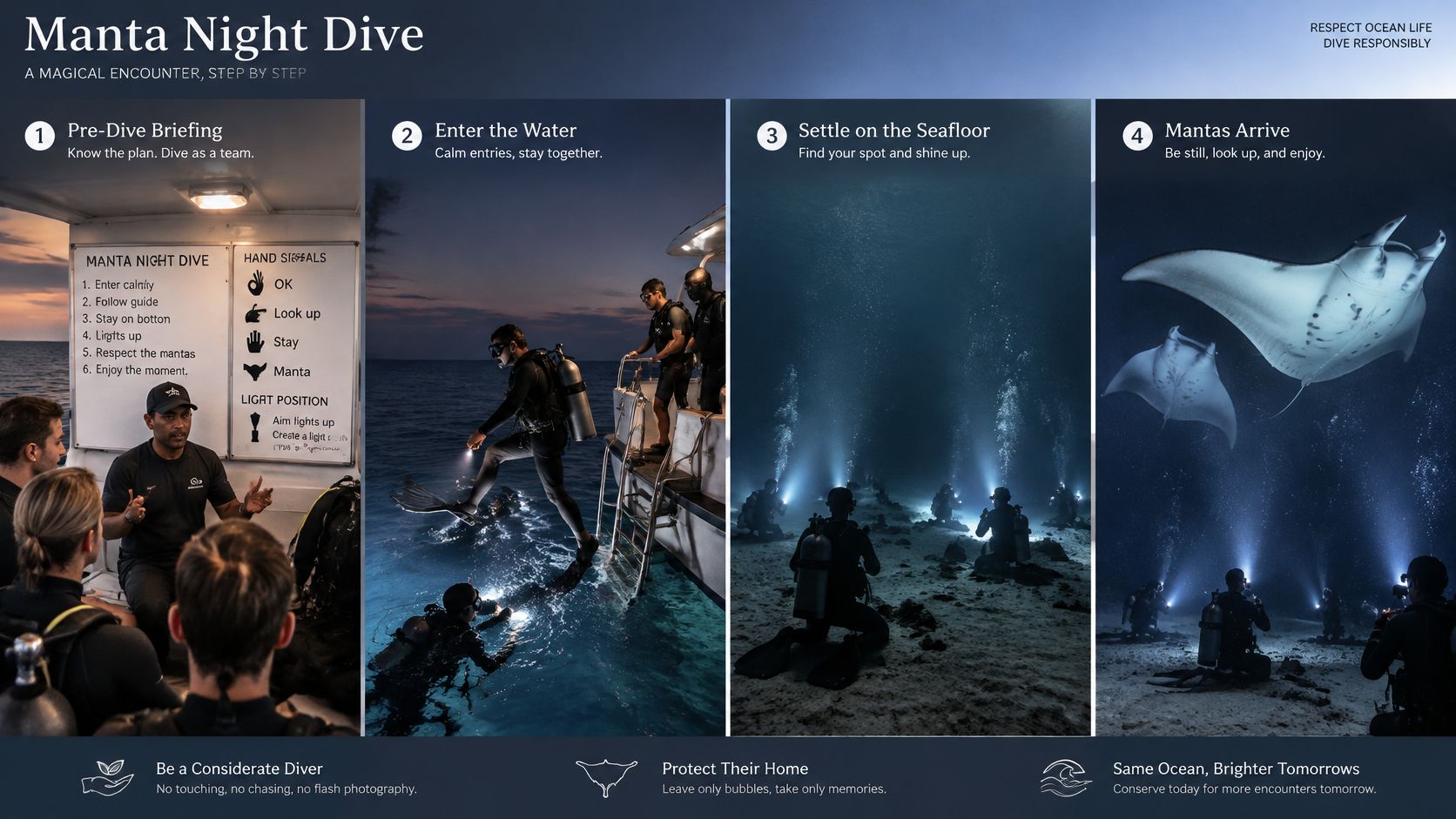
A manta dive works best when you know the sequence before entering the water. The exact timing and entry method depend on conditions, but the structure should leave you free to concentrate on your buddy, equipment, and surroundings.
From the briefing to the viewing position
Listen to the boat briefing. The crew explains lighting, hand signals, positioning, wildlife separation, and the return procedure. Pay particular attention to how you should signal a problem, because a waving light can confuse other divers.
During the boat ride around dusk, check your mask, exposure protection, and equipment configuration before the entry becomes busy. Establish a normal breathing rhythm and tell the guide about nerves now, not after the descent begins.
Enter and descend with the group. Follow the guide toward the designated sand, rubble, or boulder-bottom viewing area near the Garden Eel Cove reef, rather than selecting your own perch. Check your buddy in the dark and avoid settling on living coral.
Form the instructed semicircle and orient your light upward as directed. The arrangement keeps everyone facing the feeding area and makes it easier for the guide to monitor the group without people scattered around the site.
During the encounter and return
Allow time for the encounter to develop. Watch the illuminated water and its edges, where a manta may first appear as a moving silhouette. Feeding passes can develop into repeated loops, but an empty beam isn't a signal that you should leave your position to search.
Maintain your assigned position while continuing normal scuba checks. An animal passing overhead can absorb your attention, so deliberately keep track of your gas, buddy, and guide instead of looking upward continuously.
Leave when the guide signals. Ascend slowly with the group, follow the planned ascent and stop procedures, and retain enough attention for the boat approach and ladder. Once aboard, a debrief helps distinguish what you observed from what you only caught briefly in the lights.
For snorkeling, the entry and return briefing is just as important, but there's no scuba descent. You remain at the surface with the lights directed downward and follow the guide's instructions for staying with the viewing setup.
Our experienced divemasters and instructors are in the water with divers throughout the manta outing. That creates a steady structure, but it doesn't replace your responsibility to monitor your own equipment and communicate early if something feels wrong.
A good evening may include repeated passes, close turns, and clouds of plankton visible in the beam. It's still a successful piece of diving when the group maintains control throughout, rather than becoming distracted by the animals and struggling on the return.
Rules That Protect Manta Rays on Every Dive
Manta interaction rules protect animals that reproduce slowly. NOAA Fisheries' regional conservation guidance identifies an approximately 13-month gestation, low birth rate, and late sexual maturity as vulnerability factors, and identifies the giant manta ray as threatened under the U.S. Endangered Species Act.
Keep the species distinction clear: Kona's familiar nighttime reef mantas are Mobula alfredi, whereas the giant manta named in that federal listing is Mobula birostris. The listing shouldn't be presented as though those names describe the same species.
The working rules
Don't touch, grab, or ride a manta. A close approach isn't permission to make contact, even if the animal appears unconcerned. Keep your hands within your own space rather than reaching toward a passing wing.
Don't chase or swim toward feeding animals. Trying to obtain a better angle can put you directly into a route the manta was already using and can interfere with nearby participants.
Keep the flight path clear. Pay attention to low passes near the bottom as well as approaches from overhead. Your assigned viewing position is not a reason to stretch equipment into the space in front of you.
Streamline your equipment before entry. Secure alternate regulators, hoses, light attachments, and loose straps so they don't trail into the feeding corridor or snag as you reposition.
Use lighting only as the dive leader directs. Don't add a separate lighting arrangement or sweep your beam across other participants' faces. Predictable lighting and positioning make the encounter easier to manage.
Why these details matter
Crowding feeding or cleaning habitat, obstructing travel, and forcing an animal to change course can interrupt the activities it came to perform. A slowly reproducing population has limited capacity to replace individuals, making careful treatment of each animal important.
These rules also fit ordinary responsible and considerate diver etiquette: control your body, account for your equipment, and don't compromise another diver's space to improve your own view.
For beginners, keep one rule especially clear: if you feel the urge to move toward a manta, that's the moment to stop and wait. The animal decides the distance, not your camera.
Photography, Gear and Best Conditions
Historical monitoring summarized in this Kona manta encounter overview recorded sightings on approximately 80% of dives at Garden Eel Cove and on 92% of monitored nights at Manta Heaven from January 1, 2009, through December 31, 2014. These are separate historical measures, not a current forecast for your reservation.
Garden Eel Cove is also called Manta Heaven, so don't treat those names as competing sites. Nor should you combine the percentages into a single success rate.
Check conditions and simplify the camera
Ask about surface calm, swell, visibility, and the crew's assessment of plankton conditions. Year-round availability doesn't make every evening equally comfortable, and a guest prone to motion sickness should weigh the boat ride as seriously as the underwater view.
Use a wide-angle lens and a low, stable position. Start with the established dive lighting, avoid flash, and clear any additional camera lighting with the guide rather than assuming it's welcome.
A compact rig that you can control easily is better than an elaborate system that disrupts your buoyancy. Keep the camera close when you're not shooting, and use these Kona manta dive photography examples to think about composition before entering the water.
Pack for the boat as well as the dive
- Dry warmth: Bring a towel and a warm layer for the return ride.
- Protected belongings: Use a dry bag for your phone and dry clothes.
- Daylight protection: Pack reef-safe sunscreen if your outing begins before sunset.
- Personal preparation: Bring your usual suitable motion-sickness remedy, if needed.
- Comfortable equipment: Confirm mask fit and appropriate exposure protection before departure.
Don't sacrifice awareness for a shot. A clean photograph comes from anticipation and stable positioning, not following an animal out of the viewing area.
Frequently Asked Questions
What if no mantas show up?
An empty night is possible because this is a wildlife encounter, not a performance. Before paying, ask us to clarify the booking's no-sighting, rebooking, refund, and cancellation terms; don't assume those terms are interchangeable.
Is the manta dive the same every night?
No. Food availability and animal movements change the gathering and feeding routes, so evenings at the same site can feel different. For planning considerations, see the best time to see manta rays in Kona, but don't mistake seasonal advice for a guarantee.
Can I touch a manta if it swims close?
No. Keep your hands and equipment within your own space, even when an animal approaches closely. The wildlife rules apply regardless of whether you or the manta initiated the approach.
Can I combine the manta dive with a morning dive?
Yes, a morning reef outing can be paired with an evening manta plan, provided the schedule and your diving readiness allow it. Allow time for food, hydration, rest, and any necessary equipment changes rather than treating the gap as spare time to fill.
Book Your Manta Night Dive in Kona
Our go-to site for the Manta Ray Night Dive is Garden Eel Cove. Kona Honu Divers also offers the 2 Tank Local Morning Dive, Black Water Night Dive, Premium Advanced 2 Tank Trip, and Morning Introductory Scuba Dive, giving mixed-experience travelers different ways to plan their time underwater.
Call 808-324-4668 to discuss readiness before reserving. Check the live booking calendar for current per-person prices, group totals, and any listed family or private options; confirm equipment, lights, boat inclusions, and cancellation terms before payment.
- Choose your format based on actual skills.
- Confirm certification or swimming readiness.
- Reserve your place using the calendar.
- Arrive early enough to prepare without rushing.
The animals are the reason to go. Careful preparation and respectful rules are how this encounter stays worth repeating.
Kona Honu Divers offers guided manta night dives with experienced in-water divemasters and instructors, using Garden Eel Cove as its go-to site. Visit Kona Honu Divers to choose an outing that matches your certification and ocean comfort, then confirm availability for your Kona visit.