
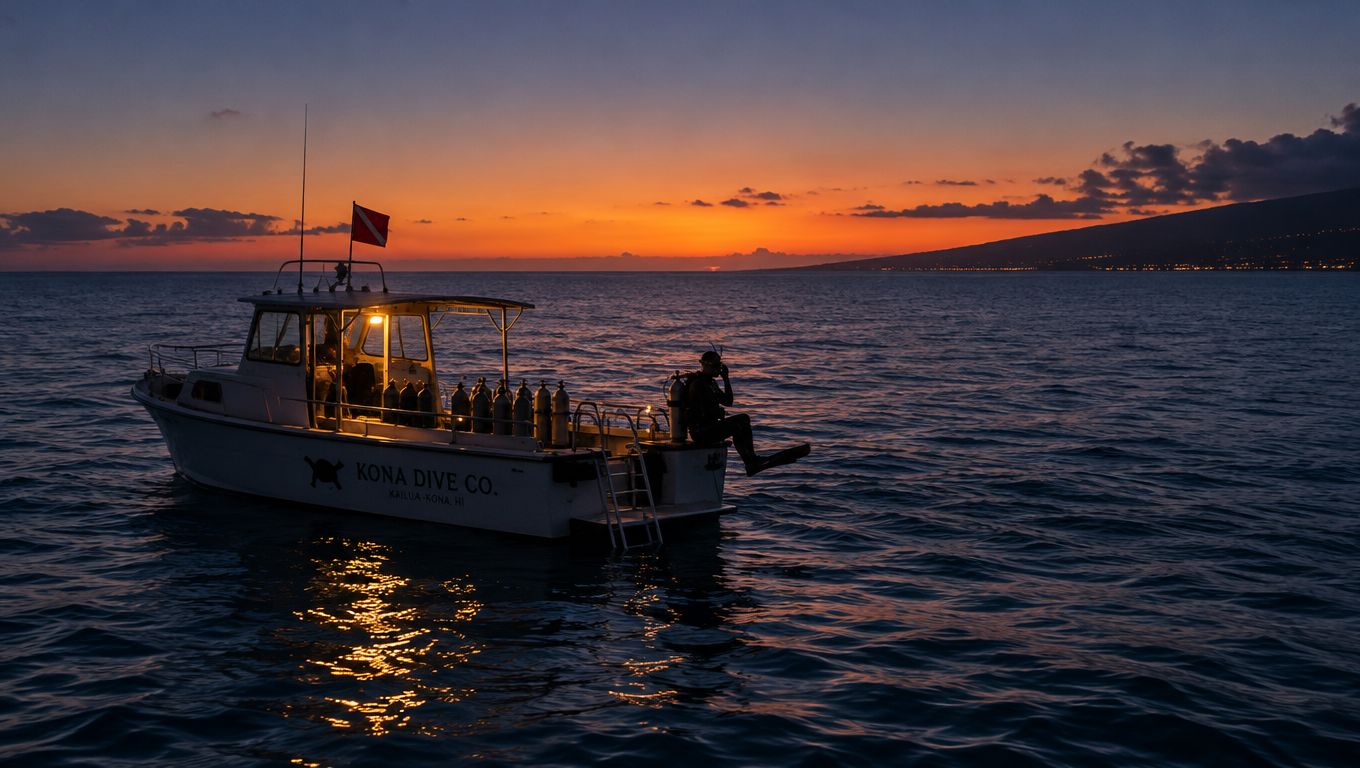
You're standing on a Kona boat at dusk, checking your mask while the last light fades behind the coast. The water looks ordinary until the crew switches on the underwater lamps. Plankton gathers in the illuminated water, and then a broad wing glides out of the darkness, turns beneath the boat, and disappears before returning on another silent pass.
That's the appeal of manta dive Hawaii. It isn't a staged wildlife show, and it isn't merely a nighttime swim. It's a carefully managed encounter with wild reef manta rays, where marine behavior, lighting, boat operations, and diver discipline all determine the quality of the experience.
Slipping Into the Dark Water
The boat ride changes character as the sun drops. Conversations quiet, regulators are checked, and the black surface begins reflecting only the deck lights and the first stars. After the briefing, you enter the water and descend into a darkness that feels much larger than it did from the boat.
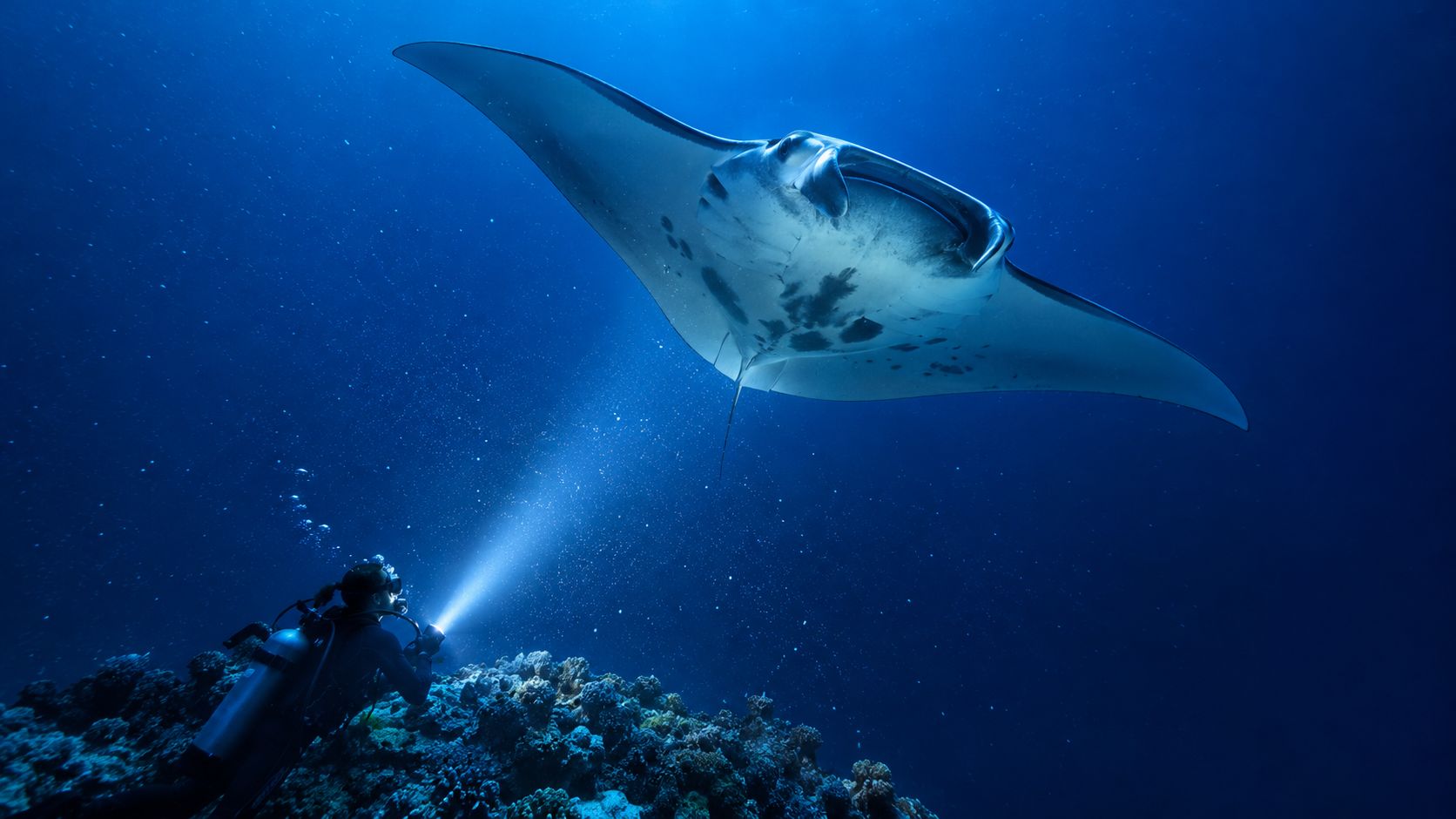
Your dive light cuts a narrow tunnel through the water. Around it, tiny organisms begin to appear. The artificial lights concentrate zooplankton in the water column, creating the feeding conditions that bring reef manta rays, Mobula alfredi, to established sites after sunset. The first manta may arrive as a distant shadow, then sweep upward through the beam with its mouth open, close enough for you to see the markings on its belly.
Kona's tradition began accidentally. In 1991, operators noticed that resort floodlights attracted plankton, which in turn attracted manta rays toward the shoreline. The first scheduled night dives were reportedly offered once a week, then expanded as manta viewing became a regular nightly activity. A second major site near Keahole Point was established in 1999, while the original Keauhou-area site was interrupted when the Kona Surf Hotel closed and its lights went out between 2000 and 2004. Manta activity resumed after new lighting was installed in 2004, showing how closely the feeding aggregation responds to localized plankton concentration. The history is documented in this account of Kona's manta viewing sites.
The important distinction: the lights attract plankton, not trained mantas. The rays choose the site because the feeding conditions work.
That distinction shapes how you should behave in the water. You're not trying to make a manta approach. You're positioning yourself where the feeding response already occurs, keeping still, and allowing the animal to decide how close it wants to come. A practical introduction to the environment is available in this guide to night diving in Kona.
The geography matters because Kona's two established viewing areas don't offer identical conditions. Garden Eel Cove, also called Manta Heaven or Makako Bay, sits offshore near Kona International Airport. Its location, bottom structure, and viewing layout make it the site I favor when comfort, visibility, and reef surroundings matter.
Why Garden Eel Cove Is the Superior Viewing Site
Garden Eel Cove offers a more controlled setting than the exposed Keauhou area. The site lies just offshore from Kona International Airport and is commonly reached by boat from Honokōhau Harbor. Its offshore position provides more shelter than exposed coastal alternatives, while the sandy bottom and daylight garden-eel colony give the site a distinct ecological character. This overview of Garden Eel Cove describes the combination of sheltered access, sandy habitat, and nighttime viewing area.
Keauhou remains an established manta location, but site familiarity shouldn't be confused with a superior dive environment. Garden Eel Cove gives divers a clearer vertical viewing area and a more comfortable bottom position. When the wind increases, that protection matters. A calmer boat operation also makes entries, exits, and surface supervision easier to manage.
The long-term observations support the practical preference. A 2025 University of Hawaiʻi study examined community-sourced observations from 2010 through 2022, covering more than 23,000 sightings of 167 individually identified reef manta rays at Garden Eel Cove and Keahou. The researchers found that Garden Eel Cove consistently supported larger aggregations, indicating that it functions as a particularly reliable feeding area. Those figures come from the University of Hawaiʻi research record.
Garden Eel Cove compared with Keauhou
| Consideration | Garden Eel Cove | Keauhou area |
|---|---|---|
| Setting | Offshore and more sheltered | More exposed coastal location |
| Bottom environment | Sandy bottom with garden eels visible by day | Established coastal viewing area |
| Viewing layout | Clear vertical arrangement for divers and snorkelers | Established but more constrained coastal setting |
| Aggregation pattern | Larger aggregations in the long-term study | Smaller aggregations in comparison |
| Best fit | Divers prioritizing comfort, habitat, and viewing space | Guests whose operator is directed there for current conditions |
Keahou also showed a notable ecological pattern in the same study. Females visited the site predominantly, with high female site fidelity, while males moved between locations more often. That means the two sites shouldn't be treated as interchangeable points on a map. They may serve different purposes for the local population.
For a manta dive tour, Garden Eel Cove is the superior choice because it combines a protected location, a better viewing area, and a stronger reef setting. Before booking, look for an operator that clearly identifies the destination and explains how the crew manages the site. A useful comparison of where to dive with manta rays should be part of that decision.
The Mechanics of the Night Dive Experience
At Garden Eel Cove, certified scuba divers generally settle on the seafloor at approximately 35 to 40 feet, while snorkelers remain above on illuminated flotation boards. Divers look upward. Snorkelers look down. Mantas travel through the illuminated water between both groups, using the plankton-rich column rather than responding to the people watching them. The physical arrangement is described in this Big Island scuba diving guide.
What divers should do
Once you reach the bottom, find the position assigned by the crew and establish neutral buoyancy. Keep your knees and fins clear of the bottom, secure loose equipment, and aim your light into the water column without sweeping it across other divers' faces.
Stationary divers get better encounters. A manta that's feeding can make repeated passes over the same light source, but chasing it changes the geometry of the interaction. Sudden finning also creates noise, bubbles, and movement that can cause the animal to alter its path.
The NOAA-archived research on Kona's Manta Village and Manta Heaven recorded 25,444 observations of 118 individually identified mantas during a six-year study. The monitored dives generally began immediately after sunset and lasted about one hour, with rays repeatedly approaching divers to within less than 1 meter. Researchers identified individuals through their ventral spot patterns, as explained in the NOAA archive.
The rules protect the encounter
Never touch, grab, block, or pursue a manta. Contact can damage or remove its protective mucus layer, and operators can remove guests from the dive for breaking the no-touch rule. Keep your hands and equipment off the animal even if it passes close enough to seem reachable.
- Hold your position: Let the manta choose its route through the light.
- Control your buoyancy: Avoid contact with the bottom and keep your fins away from other divers.
- Keep equipment compact: Dangling cameras, gauges, and straps can interfere with the animal's path.
- Follow the crew's signals: They're managing spacing, light placement, and the exit sequence.
The feeding response depends on plankton concentration and light geometry, not diver pursuit. Your best role is an unobtrusive one. Stay calm, observe the animal's direction, and leave a clear lane for the next pass.
Redefining Safety and Vessel Management
Swimming ability matters, but it isn't the main operational risk at a busy nighttime manta site. The harder problem is coordinating boats, divers, snorkelers, lights, entries, exits, and emergency procedures in a dark, confined area.
A Hawaiʻi County safety assessment identified inherent hazards associated with nighttime swimming and snorkeling around actively motoring vessels. It also noted that recreational and commercial in-water activity lacked location controls at the time of the assessment. A later local report citing a safety assessment after a fatal boating accident stated that increasing vessel and participant numbers raise accident likelihood and that effective capacity controls were absent. The primary document is available in the Hawaiʻi County boating operations and safety assessment.
What competent operations look like
Before entering the water, pay attention to whether the crew explains traffic patterns rather than giving only a generic snorkel briefing. You should know where to enter, where to exit, how the boat is positioned, and who watches the surface while guests are in the water.
Look for these controls:
- Surface lookout coverage: A crew member should actively monitor the surrounding water, not treat the boat deck as an unattended staging area.
- Controlled entry and exit: Divers and snorkelers should use a designated point rather than crossing randomly through propeller or boat traffic.
- Visible boat identification: Surface lighting should help other vessels locate the boat without overwhelming the underwater viewing area.
- Participant separation: Divers below and snorkelers above need different instructions because they face different traffic and visibility risks.
- Clear emergency planning: The crew should explain how a separated guest, distressed swimmer, or equipment problem is handled.
Practical rule: A safe manta operator manages the surface as carefully as the seafloor.
Scuba divers have reduced visibility to boats because they're below the surface and may be looking upward at the mantas. Snorkelers face surface congestion, fin traffic, and the possibility of being near moving vessels. Both groups should maintain controlled buoyancy, keep hands and equipment away from the rays, and enter or leave only through the designated traffic-controlled area.
Reef mantas are vulnerable to vessel strikes, fishing-gear entanglement, and disturbance. Steep drop-offs and upwelling zones are also recognized high-use habitat in Hawaiʻi's protected-species guidance, which is summarized by the Hawaiʻi Division of Aquatic Resources. Choosing a captain and crew who control movement, spacing, and surface traffic protects people and animals at the same time. You can learn more about the person responsible for vessel operations through this page on the dive boat captain.
Photography Tips for Low Light Giants
Night photography punishes unstable buoyancy. The scene contains bright artificial lights, reflective particles, black water, and a moving subject that can cross your frame in seconds. The best image usually comes from a calm diver who anticipates the manta's route rather than someone who chases every pass.
For a smartphone, use the camera's night or low-light mode only if it doesn't force a long exposure that blurs the animal. Lock focus and exposure when possible, keep the lens close to the viewing direction, and brace your elbows without touching the reef or a fellow diver. Continuous operator lights generally produce a more useful result than a phone flash.
Dedicated camera users should begin with a moderate shutter speed that freezes the manta without requiring aggressive movement from the photographer. Keep the strobe disabled when the plankton column is dense, because a flash illuminates suspended particles and creates backscatter. Use the continuous video lights provided by the operator when available, and adjust white balance after the dive if the footage carries a strong blue or green cast.
Compose from below
The most effective angle is often upward. A manta passing over the light can become a clean silhouette, with the surface glow outlining the cephalic fins and broad wings. Don't fill every frame with the animal. Include the light column, a diver's outline, or the edge of the viewing area to show scale and place.
- Hold position first: Stabilize your body before pressing the shutter.
- Leave room ahead: Mantas need space in the direction they're traveling.
- Shoot short sequences: Repeated passes give you more usable frames without constant movement.
- Review later: Checking the screen between every pass makes you miss the behavior happening around you.
Chasing a manta for a better angle disrupts feeding and can force other divers to move. A camera never outranks the animal's comfort or the crew's spacing instructions. For guests who want equipment and guidance integrated into the trip, review the Kona manta night dive with photo package.
The strongest manta image usually comes from the quietest diver.
Choosing the Right Kona Dive Operator
A boat can reach Garden Eel Cove and still deliver a poor dive. The useful questions concern what happens before, during, and after the boat ties into the viewing operation. Ask about group handling, gear condition, crew roles, surface lookout coverage, and whether the boat gives divers enough room to prepare without rushing.
A spacious custom boat can make a meaningful difference at night because guests need room to organize lights, cameras, masks, fins, and exposure protection. A crew that maintains gear proactively reduces distractions during entry and descent. Complimentary nitrox can also support divers who want additional bottom-time flexibility, provided they're certified and use the gas within appropriate planning limits.
Compare the operation, not just the rating
| Evaluation point | What to look for |
|---|---|
| Boat design | Stable boarding, uncluttered deck, and room for gear preparation |
| Crew experience | Clear briefings, active supervision, and confident handling of changing conditions |
| Maintenance | Rental equipment serviced proactively and checked before departure |
| Gas options | Air and nitrox availability explained accurately |
| Group management | Spacing that protects visibility and keeps movement controlled |
| Site selection | A clear explanation of why Garden Eel Cove is being used |
Kona Honu Divers offers custom spacious boats, proactive gear maintenance, complimentary nitrox, and a two-tank format combining an afternoon reef dive with a nighttime manta dive at Garden Eel Cove. The manta portion includes a guided dive of approximately 45 minutes, with tanks, weights, a dive light, and air or complimentary nitrox, according to the operator's product information.
The relevant trade-off is straightforward. A lower-cost trip may still get you to the animals, but a crowded deck or rushed crew can reduce your comfort and limit your ability to hold position once you're underwater. A smaller, well-managed group generally gives the crew more control over diver separation, light placement, and surface traffic. That doesn't guarantee a manta encounter, because these are wild animals, but it improves the conditions in which responsible observation can happen.
Logistics and Beyond the Manta Dive
Pack a swimsuit, towel, warm layer, and any camera you already know how to operate. Bring medication you've previously used safely for motion sickness if you need it, and tell the crew about relevant health concerns before departure. On the ride back, keep your exposure layer on until you're warm, then rinse and dry personal equipment according to the crew's instructions.
Certified scuba divers should confirm their certification status and recent diving experience when booking. The scuba position requires comfort with regulators, buoyancy, and a night environment. The snorkel option doesn't require scuba certification, but guests still need to follow the briefing, remain within the designated area, and be honest about their comfort in open water.
Meeting details depend on the booked departure, so verify the exact Honokōhau Harbor check-in time directly with the operator rather than relying on a generic itinerary. Boat access, parking, equipment preparation, and weather decisions all work better when guests arrive prepared and unhurried. The Big Island boat tours information can help you compare the wider departure options.
Build a larger Kona diving plan
The manta dive works well as the centerpiece of a Kona itinerary, but it doesn't have to be the only serious underwater experience. Divers who want to explore the water column after dark can consider the Kona blackwater night dive, where the focus shifts from a fixed feeding site to open-water animals that migrate vertically through the darkness.
Experienced divers can also look at premium advanced two-tank trips to remote lava formations and other demanding sites. Those trips require more self-management and a willingness to follow site-specific planning, while the manta dive rewards the opposite approach, calm buoyancy, stillness, and respect for an animal that controls every encounter.
The most responsible choice is to book around the conditions and your ability, not around a promise of a guaranteed wildlife performance. Garden Eel Cove provides the protected setting and viewing structure I'd choose for a manta tour, while careful vessel management determines whether that setting remains safe for everyone.
Kona Honu Divers offers guided Garden Eel Cove manta dives, reef diving, blackwater exploration, and advanced two-tank trips for divers with different experience levels. Visit Kona Honu Divers to review the available trips, confirm the current logistics, and reserve a place for a carefully managed manta dive in Kona.