
Thinking about learning to scuba dive? It's an incredible feeling, that moment you take your first breath underwater and realize a whole new world is opening up. Getting certified is your ticket to exploring the 71% of our planet that lies beneath the waves, and it's a journey from land-lover to confident underwater explorer. It's all about learning the right skills in a safe, structured way.
How to Start Your Underwater Adventure
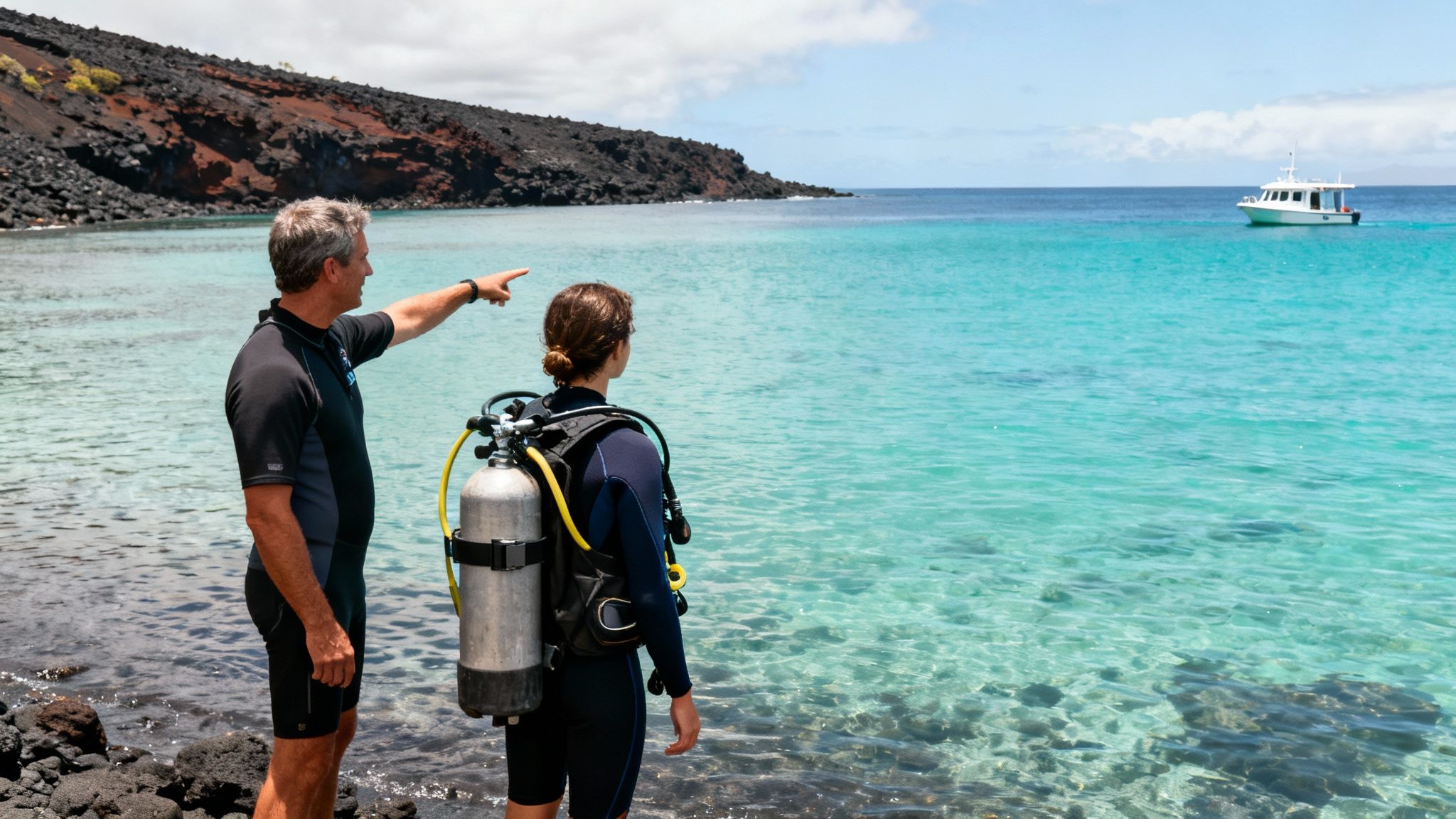
The dream of weightlessly gliding past coral reefs and colorful fish is what gets most people hooked on the idea of diving. But turning that dream into reality can feel a little intimidating. Where do you even start? Learning to dive is more than just a cool vacation activity; you're developing a unique skill set that prioritizes safety, builds confidence, and fosters a deep respect for the ocean.
The good news is that the process is designed to be incredibly empowering. Scuba education breaks everything down into simple, manageable steps. You’ll go from reading about dive theory to practicing skills in a pool before you ever dip a fin into the open ocean. It's a gradual, supportive process.
Choose Your Training Ground Wisely
Where you learn to dive makes a huge difference. A world-class spot like Kona, Hawaii, offers some of the best conditions imaginable for a beginner. The water here is calm, crystal-clear, and warm—basically, a perfect natural classroom. You won't have to battle strong currents or murky water, so you can focus entirely on mastering your skills and soaking in the amazing scenery.
Of course, the location is only half the equation. The dive shop you choose is just as crucial. A great operation provides more than just top-notch gear; it cultivates a culture of safety, patience, and genuine encouragement.
Your first instructor does more than just teach you how to clear a mask. They build the confidence and spark the passion that will stick with you for every dive you do in the future. That first experience truly sets the stage for a lifetime of adventure.
The Global Standard: PADI vs. SSI
To dive almost anywhere on the planet, you'll need a certification card. The two biggest names in the game, recognized and respected worldwide, are PADI (Professional Association of Diving Instructors) and SSI (Scuba Schools International). Both follow the same strict safety standards laid out by the World Recreational Scuba Training Council (WRSTC), but they have slightly different teaching philosophies.
- PADI is known for its highly standardized, step-by-step curriculum. It’s consistent no matter where in the world you learn.
- SSI often allows for more instructor flexibility, letting them adapt the order of skills to better suit a student's personal learning style.
Honestly, you can't go wrong with either. Both will make you a competent, safe diver. The real difference-maker is the individual instructor and the quality of the dive center. Here on the Big Island, we offer courses from both of these premier agencies, so your certification will be your passport to the underwater world. Check out our scuba diving tours in Kona, Hawaii, to see how we create the perfect learning environment.
Here’s what our divers have to say about their experience with us:
Choosing Your Scuba Course and Understanding Costs
Alright, this is the first big decision you'll make on your scuba journey, and it sets the stage for everything that follows. When you start looking into getting certified, you'll immediately see two names pop up everywhere: PADI (Professional Association of Diving Instructors) and SSI (Scuba Schools International).
Let's clear one thing up right away: both are fantastic, globally recognized agencies. A certification card from either one will be accepted anywhere you go, from the reefs of Hawaii to the wrecks of the Red Sea. They both follow the same high safety standards set by the World Recreational Scuba Training Council (WRSTC), so the core skills you learn will be identical.
The real difference is in how they teach. Think of PADI as being very methodical and linear—you master skill A before you're allowed to move on to skill B. It’s a tried-and-true system. SSI, on the other hand, often gives instructors more flexibility to tailor the sequence of skills to the student. If you’re picking something up quickly, you might move ahead, or if you need more time on a particular skill, your instructor can adjust.
Ultimately, the person teaching you and the dive shop's philosophy matter way more than the logo on your certification card.
PADI vs. SSI Open Water Certification At a Glance
So, which one is right for you? There's no single right answer, as it often comes down to your personal learning style. To help you decide, here’s a quick side-by-side look at the two major players.
| Feature | PADI (Professional Association of Diving Instructors) | SSI (Scuba Schools International) |
|---|---|---|
| Learning Philosophy | Prescriptive and linear. Students must master skills in a specific, standardized order. | Flexible approach. Instructors can adapt the skill sequence to student needs, as long as all requirements are met by the end. |
| Materials | Traditionally requires students to purchase their own manual or e-learning materials. | Often includes digital learning materials in the course fee, accessible through the SSI app. |
| Certification Card | Issues a physical card upon completion, with a digital version available for a fee. | Provides a free digital certification card immediately upon completion, with physical cards available as an optional purchase. |
Whichever path you choose, you'll end up a certified, competent diver. The most important thing is finding an instructor and a dive center that you feel comfortable with.
Breaking Down the Cost of Getting Certified
Let's talk money. It's probably the biggest question on your mind, and you deserve a straight answer. When you see a price for an Open Water Diver course, it should cover the essentials: your instructor's time, all the online learning materials, pool sessions (or confined water practice), and the four required open water dives.
But watch out for the hidden extras that some places don't advertise upfront.
- Gear Rental: Tanks and weights are almost always included, but what about the rest? Some shops will charge extra for your BCD, regulator, wetsuit, and mask.
- Boat Fees: If your dives are from a boat (and in Kona, they should be!), make sure the charter fees are part of the package price, not an added cost per trip.
- Logbook and Certification Card: Believe it or not, some places charge an extra processing fee just to get the card you earned.
Scuba diving is a booming industry. The equipment market alone was valued at $4.11 billion in 2025 and is projected to hit $7.90 billion by 2034. You can discover more insights about these market trends on amraandelma.com. With that kind of growth, it's more important than ever to choose a dive operator who is completely transparent with their pricing.
Here at Kona Honu Divers, we hate surprises as much as you do. Our Open Water course packages are genuinely all-inclusive. That means your high-quality rental gear, digital learning, and all boat fees are bundled into one clear price. No hidden charges, period. We even throw in perks like a free Nitrox certification, something that usually costs a couple of hundred dollars on its own.
For a deeper dive into the numbers, check out our guide on how expensive scuba diving is in Hawaii.
Pro Tip: Before you book with any dive shop, ask for an itemized list of what's included and what's not. A good, honest operator will have no problem breaking it all down for you so you can budget without any last-minute shocks.
Remember, investing in a high-quality education from a reputable instructor is the single most important "gear" purchase you'll ever make.
The Three Core Phases of Scuba Training
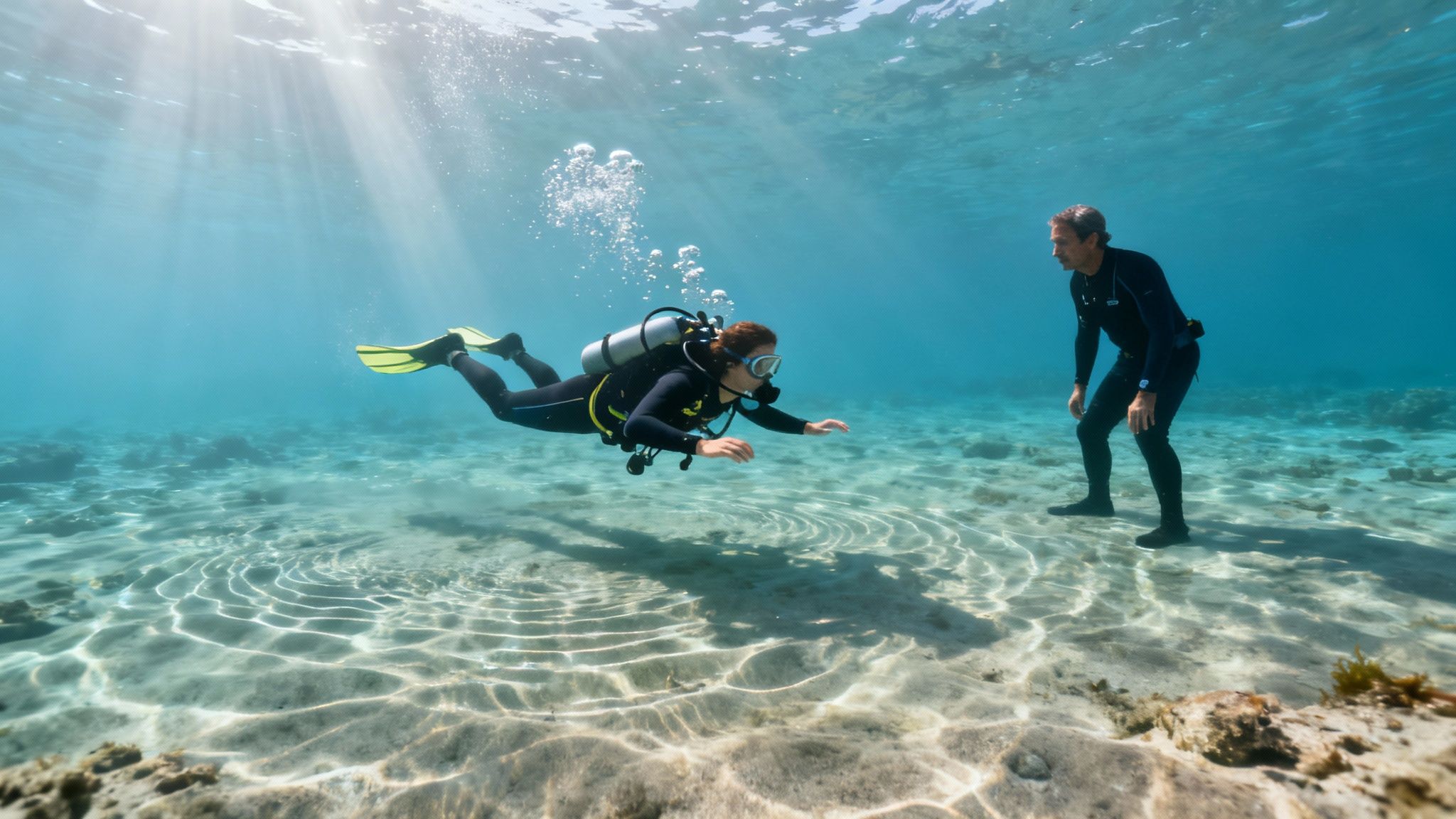
Every scuba certification course, no matter the agency, is built around three fundamental pillars. This isn't just a random curriculum; it's a time-tested approach that ensures you have a solid foundation of knowledge and practiced skills before you ever see your first coral reef.
Think of it like learning to drive a car. You start with the theory, then practice in an empty parking lot, and only then do you hit the open road. Each phase builds your competence and, just as importantly, your confidence. Let's break down what that journey looks like.
Phase 1: Knowledge Development
Before you even dip a toe in the water, you’ll start with the "why" behind it all. This is the knowledge development phase, where you get a handle on the essential theory of diving. But don't worry, the days of being stuck in a classroom on your vacation are long gone. Today, it’s all about flexible e-learning.
You can knock out the coursework from your couch, studying at your own pace. You’ll cover some fascinating topics that are crucial for safety and enjoyment:
- Dive Physics: Why do things look different underwater? How does pressure affect your body and gear?
- Physiology: How your body responds to being in a new environment.
- Equipment: Getting to know every piece of your life support system.
- Safety Procedures: The non-negotiable rules that keep every single dive fun.
Getting this done beforehand is a game-changer. You show up for your in-water training ready to focus on what matters most: actually diving.
Phase 2: Confined Water Dives
Now for the fun part! The confined water dives are your first time breathing underwater, but in a totally controlled and stress-free environment. This is usually a swimming pool or a super calm, shallow ocean area—like the protected coves we love to use here in Kona.
With your instructor right by your side, you'll gear up and take those first magical breaths. The whole point here is to practice the core skills until they become pure muscle memory. You’ll learn how to clear a flooded mask, retrieve your regulator if it pops out, and master that feeling of weightlessness called neutral buoyancy.
This is your playground. It’s a safe space to get comfortable, ask a million questions, and build the foundation you'll rely on out in the ocean.
Phase 3: Open Water Dives
You've got the theory down and the skills dialed in. It's time for the grand finale: your four open water dives. This is what it's all about—getting out into the real ocean and putting everything you've learned into practice.
These dives are so much more than just a test; they’re your first real underwater adventures. On each dive, your instructor will have you demonstrate a few skills you mastered in the pool, like clearing your mask at 20 feet or sharing air with a buddy. It's just to prove you can do it when it counts.
The rest of the time? It’s all about exploration. Here on the Big Island, that means cruising alongside graceful sea turtles and spotting schools of brilliant tropical fish. This is the moment you truly become a diver, and it’s the cornerstone of any quality scuba diving open water certification.
Once you nail these three phases, you’ve earned your Open Water Diver certification—a ticket to explore the other 71% of our planet for the rest of your life.
Your Gear and Health Checklist Before You Dive
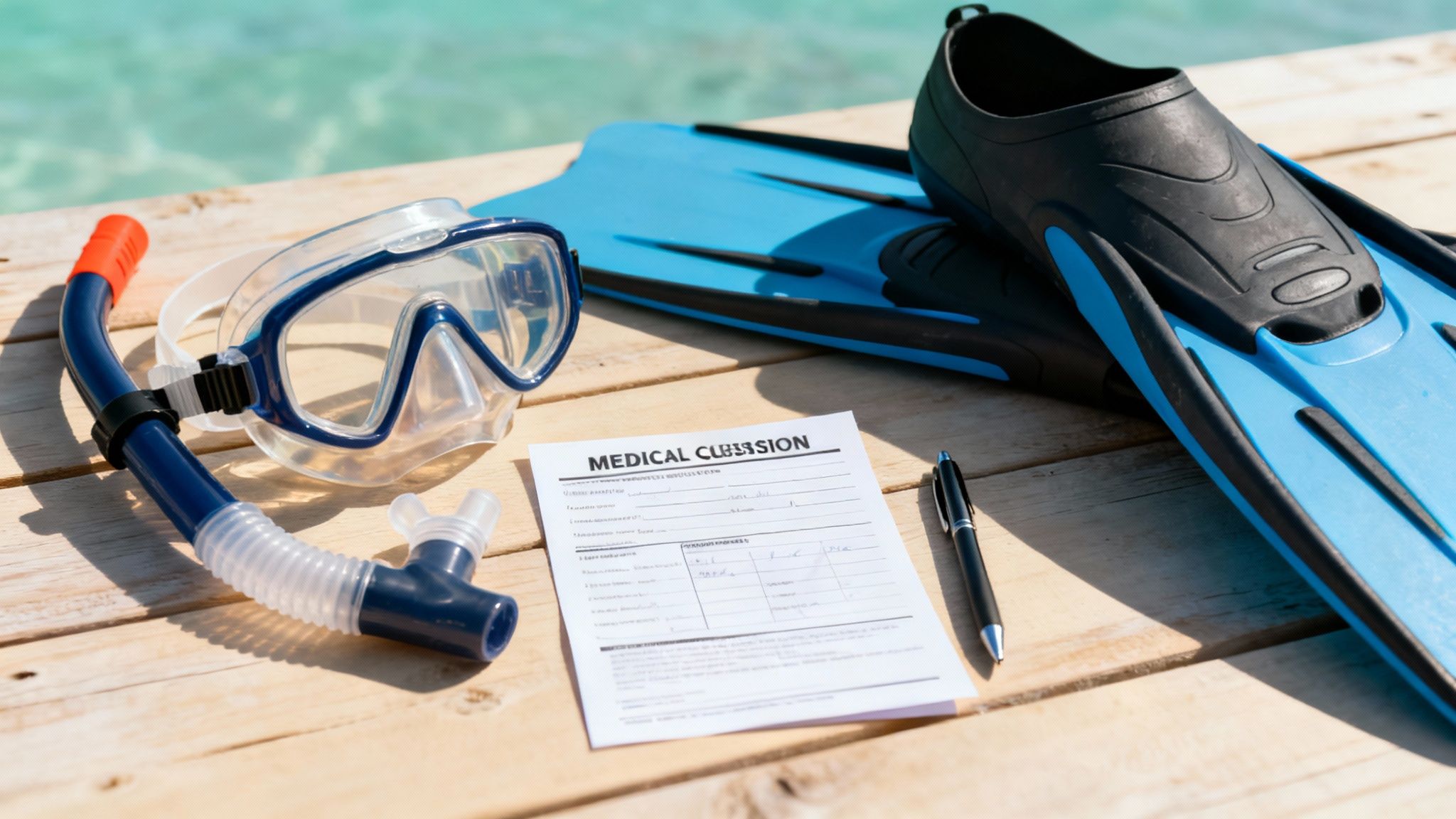
Before we can get you into the incredible underwater world, we need to take care of a few things on the surface. It all boils down to making sure you're safe and comfortable, which means looking at two things: your gear and your health. Getting this right lets you relax and soak in the fun once you hit the water.
When you're just starting, we provide all the critical life-support equipment. This includes the big-ticket items like your regulator (the octopus-looking thing you breathe from), buoyancy control device (BCD), and tank. This gear is expensive and needs regular, specialized servicing, so renting is the way to go for every new diver.
That said, there are a few personal items that can make a world of difference in your comfort. If you're thinking about buying any gear, this is where you should start.
Your First Gear Investments
Most seasoned divers will tell you to first buy the gear that touches your skin. A perfect fit is everything.
- Mask: Nothing ruins a dive faster than a leaky mask. The goal is a perfect seal. An old-school trick to check the fit in the shop is to put the mask to your face (without the strap) and gently inhale through your nose. If it sucks in and stays put, you’ve got a good seal.
- Snorkel: You won't use it much while you're actually scuba diving, but a snorkel is a lifesaver for those surface swims out to the boat or back to shore. It lets you keep your face in the water without using up the precious air in your tank.
- Fins: Think of fins as your engine underwater. They come in all shapes and stiffness levels. A good dive shop pro can help you find a pair that fits your kick style and leg strength, which goes a long way in preventing cramps and making you a much more efficient diver.
Owning your own mask, snorkel, and fins is the first step toward feeling truly at home in the water. It’s a small investment that pays huge dividends in comfort and confidence on every single dive.
For a deeper dive into equipment, check out our guide to the gear you will need for your Kona diving adventure.
The Scuba Medical Questionnaire
Safety is our top priority, which is why everyone must fill out a Diver Medical Questionnaire before any in-water training. This isn't just paperwork; it’s a crucial check to flag any health conditions that might be risky under pressure. You have to be completely honest here.
The form is a simple series of "yes" or "no" questions about your medical history, covering everything from your lungs and heart to your ears and sinuses.
Now, answering "yes" to a question doesn't mean you can't dive. It just means we need a doctor's signature confirming you're cleared for the activity.
Some conditions that almost always require a physician's okay include:
- Asthma or other chronic lung issues
- A history of heart conditions or heart surgery
- Epilepsy or seizures
- Uncontrolled high blood pressure
- Diabetes
As you think about your overall fitness for diving, it's also wise to be mindful of any respiratory symptoms. Understanding what causes shortness of breath can help you have an informed conversation with your doctor if needed.
Make sure to get this sorted out well before your course starts. The last thing anyone wants is a last-minute medical issue that keeps you out of the water. A clean bill of health is your green light for adventure.
Your First Dives and How to Avoid Common Mistakes
You’ve got that brand-new certification card in hand, and it feels like a ticket to explore the other 71% of the planet. And it is! But here’s a little secret from those of us who have been doing this for a while: the dives you do right after your course are where the real learning kicks into high gear.
This is when you shift from just performing skills for an instructor to actually being a diver. It’s a huge step, and the habits you build now will stick with you for years. Think of it as moving from practice drills to playing the actual game.
This is also why your first few guided dives are so important. Having an experienced divemaster at your side in a relaxed setting—like you’ll find here on the Big Island—is invaluable. They can offer those little tips and gentle corrections that transform your training into instinct. It’s even better when you’re on a boat that isn’t packed to the gills, giving you the space and personal attention to build confidence without feeling rushed.
If you want to see what that looks like in person, check out the scuba diving tours in Kona, Hawaii we run. We make it our mission to help new divers feel right at home in the water.
Getting a Handle on Your Buoyancy
If there's one skill that screams "experienced diver," it's rock-solid buoyancy control. It’s that magical feeling of being perfectly weightless, and it’s something you’ll refine for your entire diving career. The most common pitfall for new divers? Mashing the BCD inflator button like it's an elevator call button.
Stop thinking of your BCD as your primary tool for going up and down. Instead, start using your lungs.
Once you’re properly weighted and have just a small puff of air in your BCD to get you neutral, your breath does all the fine-tuning. A slow, deep inhale will lift you gently. A long, full exhale will let you sink. Go find a sandy patch on your next dive and just practice hovering this way. You’ll be amazed at how little you actually need to touch your inflator.
Sidestepping Those Common New Diver Hurdles
Look, we’ve all been there. Every single new diver makes a few of the same classic mistakes. Knowing what they are is the first step to skipping them entirely and becoming a safer, more relaxed diver from the get-go.
- Waiting Too Long to Equalize: Don't wait for the pain. Seriously. Your ears should never hurt. Start equalizing the second your head dips beneath the surface and do it constantly on your way down. If you feel even a hint of pressure, ascend a foot or two until it vanishes, then try again. Never, ever force it.
- Shooting to the Surface: Your dive computer beeps at you for a very good reason. A fast ascent is one of the biggest safety no-nos in diving. Keep a close eye on your ascent rate, stick with your buddy, and make your trip to the surface a slow, controlled one.
- Piling on the Lead: This is easily the most frequent mistake we see. Being over-weighted is a recipe for a frustrating dive. It wrecks your buoyancy, forces you to keep adding air to your BCD (which creates drag), and makes you suck down your air tank way too fast. On your next dive, ask your divemaster to help you do a proper weight check.
The real goal of any dive is to be safe, relaxed, and in control. When you focus on slow movements and mindful breathing, your confidence will soar. You'll find your air lasts longer, which means more time to enjoy the incredible world you came down here to see.
The crew here at Kona Honu Divers loves helping new divers dial in these skills. We pride ourselves on creating a fun, supportive vibe where you can build that confidence. But don't just take our word for it—see what other divers have to say about their experience with us.
Where Your Scuba Certification Can Take You
That brand-new Open Water certification card in your wallet isn't just a piece of plastic. It’s a passport. It’s your official ticket to explore the vast, silent world that covers over two-thirds of our planet.
The skills you just mastered are the key, and now the real journey begins. You can finally move beyond the training sites and start experiencing the incredible diversity the ocean truly holds.
Imagine gliding through the silent corridors of a sunken shipwreck, its history frozen in time. Picture yourself drifting effortlessly over a sprawling coral reef, a bustling city of vibrant fish and otherworldly creatures. This is what you worked for.
Discovering Kona’s World-Class Diving
Some dive destinations are just a cut above, offering experiences you can’t find anywhere else on Earth. The calm, clear, and creature-rich waters of the Big Island are a prime example. Now that you're a certified diver, you have a front-row seat to some of the most spectacular underwater shows imaginable.
These adventures are the perfect next step after learning to scuba, allowing you to build confidence while witnessing true magic.
Kona is globally renowned for its unique dive opportunities, which drive a significant part of the local economy. In fact, scuba diving contributes between $8.5 billion and $20.4 billion annually to the global economy. It’s no surprise that 70% of all marine dives happen in Marine Protected Areas like those in Hawaii, where vibrant life draws divers from all corners of the globe.
As you plan your adventures, you might want to explore various scuba diving travel services that can help book trips to incredible underwater locations around the world.
Experience the Manta Ray Night Dive
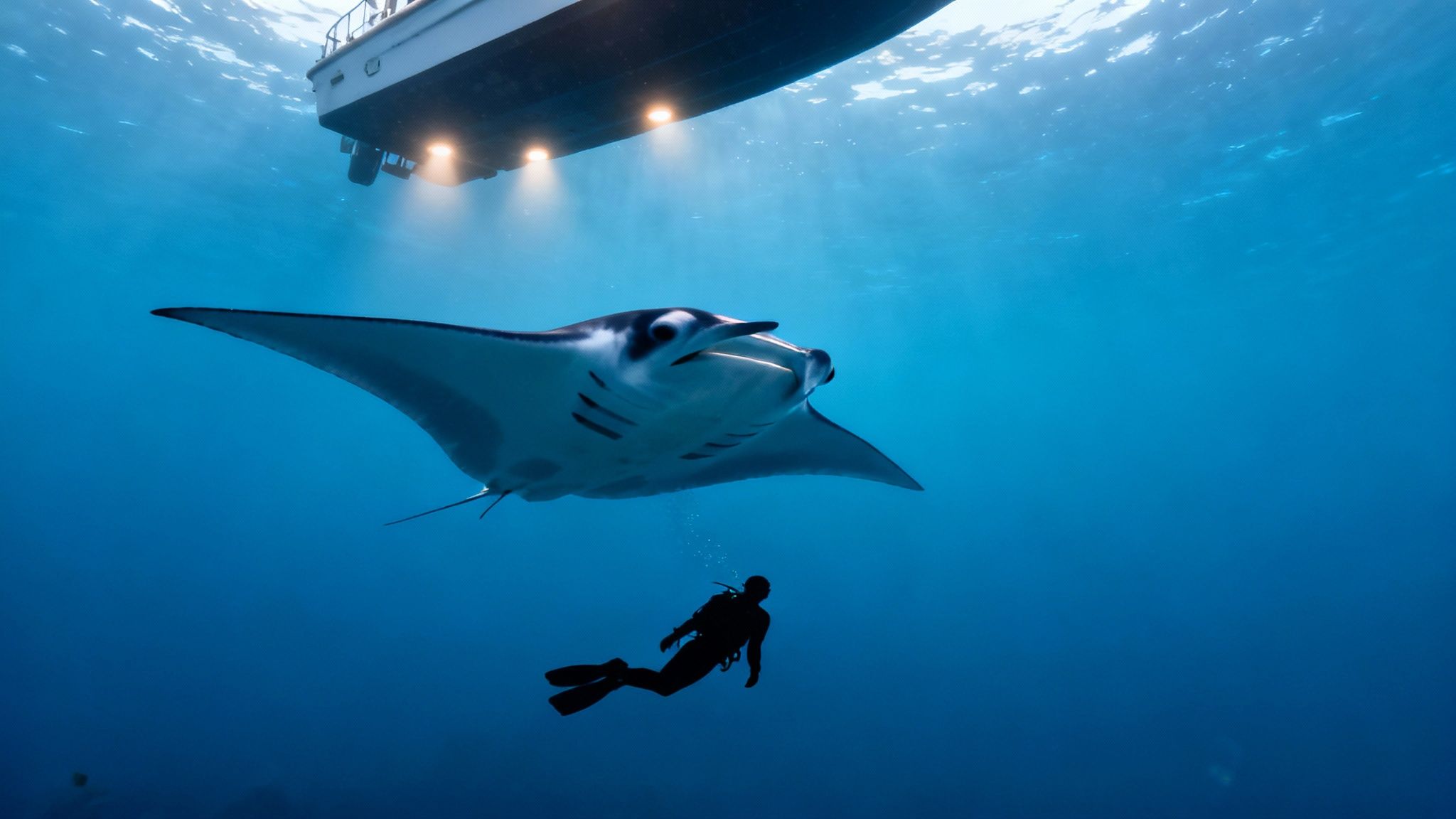
The undisputed crown jewel of diving in Hawaii is the world-famous Manta Ray Night Dive. This isn't just a dive; it's a profound, bucket-list encounter that will stick with you forever.
After sunset, you’ll descend to a designated viewing area on the ocean floor. We switch on powerful lights that attract swarms of plankton—the favorite meal of giant manta rays.
What happens next is pure enchantment. These gentle giants, with wingspans reaching up to 16 feet, swoop and barrel-roll just inches above your head, gracefully feeding in the light beams. It’s an awe-inspiring ballet that feels completely surreal. We believe Garden Eel Cove is the superior spot for this tour; its protected location shields it from rough seas, and the natural amphitheater-like viewing area provides a better, safer, and more intimate encounter.
Dare to Explore the Blackwater Dive
For those with an adventurous spirit, the Blackwater Dive is an experience unlike any other. This is a journey into the abyss. At night, we drift tethered in the deep, dark ocean miles offshore, suspended over thousands of feet of water.
Here, you’ll witness the largest migration on Earth as bizarre and beautiful deep-ocean creatures ascend toward the surface to feed. You'll see bioluminescent organisms and otherworldly larval creatures you’d never encounter on a reef. It’s a truly unique dive that turns the ocean’s dark depths into a gallery of alien art.
Continuing Your Diving Education
Your Open Water certification is just the beginning. As you gain experience, you'll naturally want to explore deeper sites, try new things, and fine-tune your skills. This is where continuing education comes in.
The Advanced Open Water course is the logical next step. It’s less about intense training and more about exploration. You’ll complete five "adventure dives," including a deep dive and a navigation dive, and then choose three others that spark your interest, such as:
- Night Diving
- Wreck Diving
- Peak Performance Buoyancy
- Underwater Photography
This course makes you a more capable and confident diver, opening up access to more experienced diving opportunities and deeper dive sites around the world. Your journey has just begun.
Ready to take the plunge and discover the incredible underwater world of Hawaii? From your first certification dive to the breathtaking manta ray encounter, Kona Honu Divers is here to guide you every step of the way. Explore our full range of scuba diving tours in Kona, Hawaii and start your adventure today.