
Ever felt that pull to see what lies beneath the surface? That feeling of wanting to float weightlessly through a world of vibrant coral and curious fish is the start of every diver's journey. Scuba diving isn't some extreme sport reserved for a select few; it's an incredible experience that's more accessible than you might think. This guide is here to break it all down and get you from dreaming about diving to actually doing it.
Why Your Underwater Adventure Should Start Now
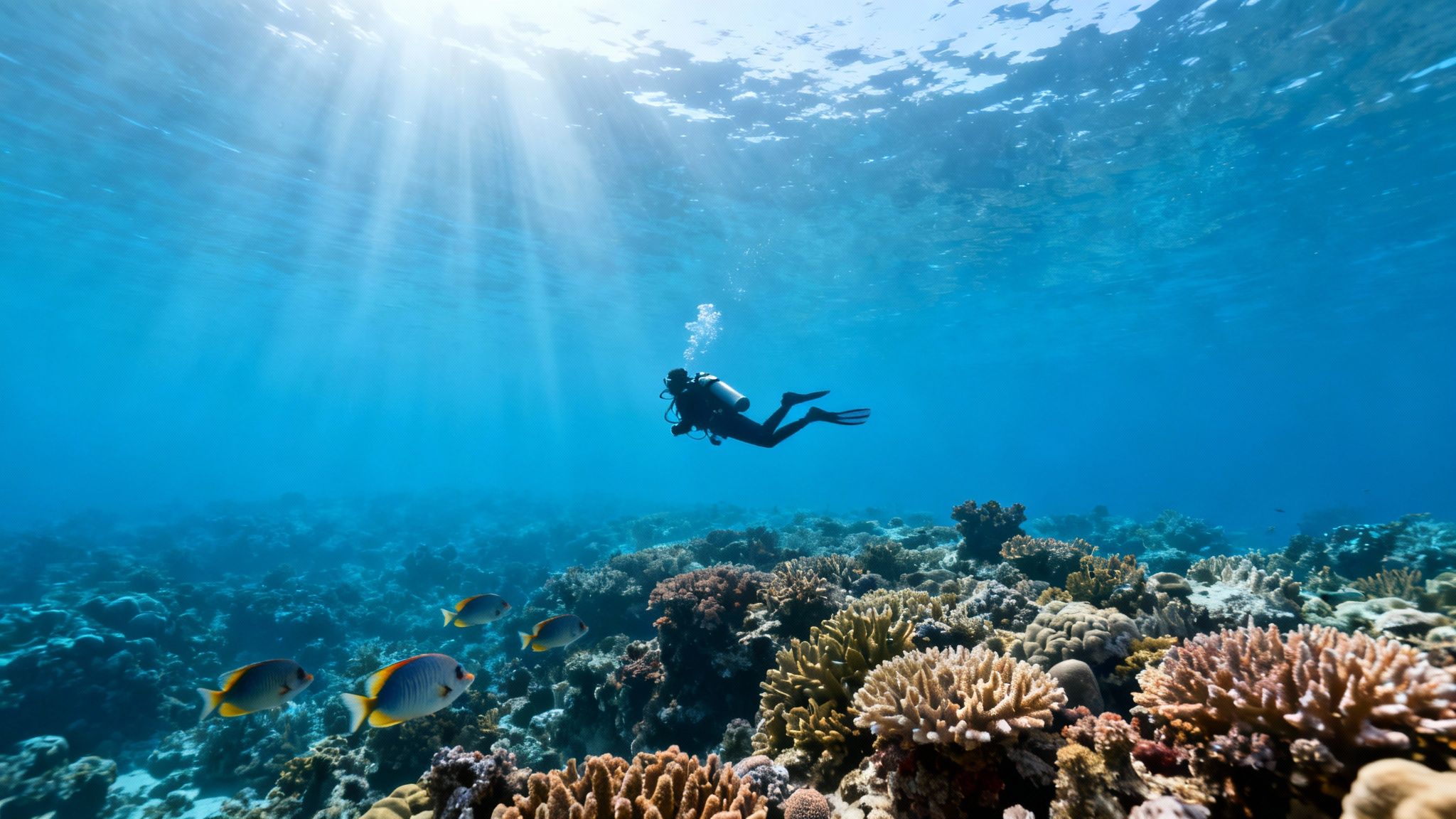
Let's be honest, the thought of breathing underwater for the first time can be a little intimidating. But modern scuba training is designed to build your confidence from the ground up. The whole process is incredibly structured and focused on your safety and comfort. You’ll never be pushed into something you’re not ready for. Instead, a professional instructor will guide you through each skill, one step at a time, until it becomes second nature.
The Ideal Environment for Learning
Where you learn to dive makes a huge difference. Think about it: trying to master new skills in cold, murky water with strong currents is a recipe for frustration. That's why a place like Kona, Hawaii, is about as perfect as it gets for new divers. The water here is consistently warm, calm, and crystal clear.
Those ideal conditions remove a lot of the common anxieties beginners face, letting you focus entirely on your skills and, of course, the amazing marine life.
The Big Island’s protected bays are like natural swimming pools, giving you a gentle and beautiful introduction to the ocean. You can expect:
- Excellent Visibility: No problem seeing your instructor, your gear, and the stunning coral reefs.
- Calm Waters: Forget about fighting currents or big waves. Here, it’s all about smooth, easy practice.
- Abundant Marine Life: It’s not unusual to spot sea turtles, schools of colorful fish, or even a pod of dolphins on your very first dives.
Learning to scuba isn't just about the skills—it's about gaining a passport to explore the 71% of our planet that lies hidden beneath the waves. It’s a whole new world waiting for you.
Choosing the Right Dive Operator
This is probably the most critical decision you'll make. A great dive shop does more than just check boxes on a list of skills; they ignite a real passion for the ocean. You want a team that not only has a stellar safety record but is known for being patient and supportive, especially with beginners.
That's the foundation we've built at Kona Honu Divers. Our crew brings together decades of local diving knowledge with a genuine love for sharing Kona's underwater world. We truly believe that learning to scuba should be one of the most exciting and memorable things you ever do. Our team is here to make sure every new diver feels safe, supported, and stoked to explore.
We’re ready to turn any hesitation you might have into pure excitement. The ocean is calling, and you're ready to answer.
Choosing Your First Dive Experience
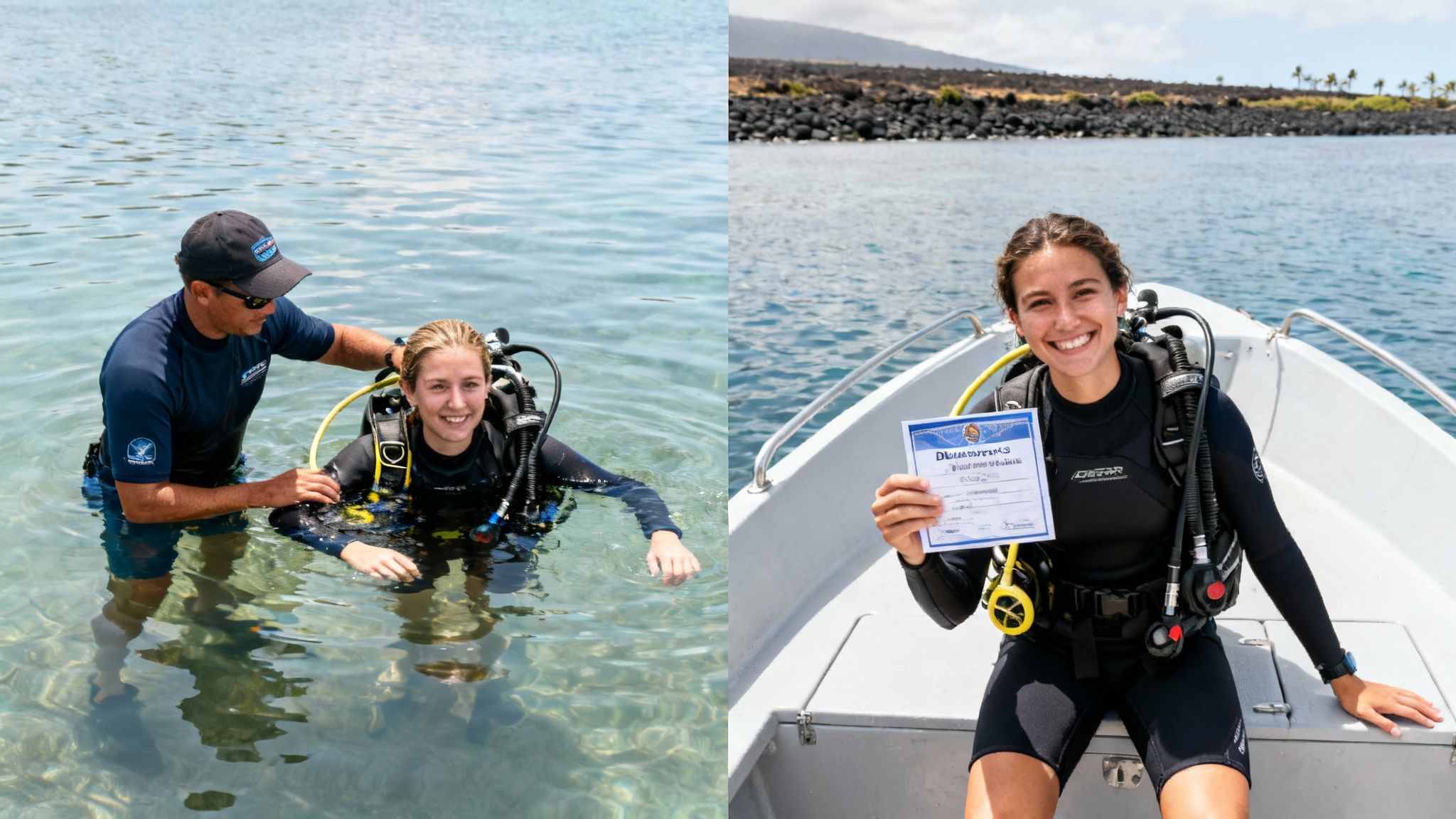
So, you're ready to breathe underwater. Awesome. But before you jump in, it’s good to know there’s more than one way to get your fins wet. When you decide to learn to scuba, you’ve got two main starting points, and each one is built for a different kind of adventurer.
Think of it this way: are you looking for a thrilling one-time experience, or are you ready to unlock a new world that you can explore for the rest of your life? Your choice will depend on your vacation time, budget, and whether you're just dipping a toe in or ready to dive headfirst into a new passion.
Let's look at your two options: the PADI Discover Scuba Diving experience and the full PADI Open Water Diver certification. Knowing the difference is key to picking the right first plunge.
The Taster: The PADI Discover Scuba Diving Experience
The PADI Discover Scuba Diving (DSD) is exactly what it sounds like—a chance to discover what scuba is all about. It’s the perfect low-commitment way to feel the incredible sensation of breathing underwater without signing up for a full course.
This isn’t a certification; it's a supervised underwater tour. You'll get a quick rundown on the gear and safety basics from a PADI Professional, practice a few simple skills in shallow water, and then you're off on a real dive under their direct supervision.
- Who it's for: Vacationers with a packed schedule, families looking for a cool activity, or anyone who's just a little curious and wants to try it out.
- Time Commitment: Only a few hours out of a single day.
- Outcome: An unforgettable memory and a fantastic intro to the underwater world. Plus, if you love it, the experience can often count toward your full Open Water certification.
The Full Ticket: PADI Open Water Diver Certification
If you've already been bitten by the scuba bug and know you want to explore the oceans, the PADI Open Water Diver course is your next step. This is the real deal—a complete training program that earns you a globally recognized, lifetime certification to dive anywhere in the world.
Once you’re certified, you and a buddy can explore down to a maximum depth of 18 meters (60 feet). The course is much more involved, covering dive theory, practicing skills in a pool (or calm, pool-like water), and completing four amazing dives in the ocean. The whole point is to make you a safe, confident, and independent diver.
Getting your Open Water certification isn't just learning to dive. It's earning a passport to a different planet—one that’s right here on Earth. It’s the key that unlocks adventures from the coral gardens of Hawaii to the shipwrecks of the Caribbean.
This is the path for anyone ready to make diving a part of their life. Here at Kona Honu Divers, we can get you fully certified in just a few days, making it an amazing and productive part of your trip. We even sweeten the deal with discounts and free nitrox on all our boat charters for certified divers, which adds incredible value to your diving journey right from the start.
Discover Scuba Diving vs. Open Water Certification
Still on the fence? This side-by-side comparison should help you decide which path is the right one for you right now.
| Feature | Discover Scuba Diving (DSD) | Open Water Certification |
|---|---|---|
| Commitment | Low – Just a half-day or full-day experience | High – A multi-day course, usually 3-4 days |
| Outcome | A supervised dive experience, not a certification | A globally recognized, lifetime scuba certification |
| Depth Limit | Maximum 12 meters (40 feet) with an instructor | Maximum 18 meters (60 feet) with a buddy |
| Independence | Always under the direct supervision of a PADI Professional | Can dive independently with a buddy after certification |
| Best For | Curious beginners, those short on time, or on a budget | Anyone ready to commit to becoming a lifelong certified diver |
Ultimately, there’s no wrong choice. Whether you opt for a quick taste or the full course, you’re about to see a side of Hawaii that most people miss. Check out the incredible diving tours available in Kona, Hawaii, and you’ll see exactly what’s waiting for you beneath the waves.
What Really Happens In An Open Water Course

So you’ve decided the PADI Open Water Diver course is your ticket to the underwater world. Awesome choice. But what does getting certified actually look like day-to-day? It’s not some grueling boot camp; it’s a smart, step-by-step process designed to build your confidence and make you a safe, competent diver.
The whole course breaks down into three distinct phases. The best part is that this proven structure lets you knock out your entire certification in just a few days of your vacation, especially in a place like Kona where conditions are perfect for learning.
Let's pull back the curtain and see exactly what you'll be doing.
Phase 1: Knowledge Development (The "Book Smarts")
This is where you build your foundation, and thankfully, it’s more flexible than ever. Forget spending beautiful, sunny days cooped up in a classroom. With PADI eLearning, you can finish all the theory online, on your own time, before you even start packing for Hawaii.
You’ll cover the essential principles every diver needs to know:
- Dive Physics: Simple concepts like how pressure affects your body and gear.
- Equipment Basics: What all that gear does and how to use it properly.
- Safety Procedures: The crucial rules for planning and executing safe, fun dives.
Doing this ahead of time is a total game-changer. It means when you show up in Kona, you’re ready to jump right into the water, already understanding the why behind the hands-on skills you're about to learn.
Phase 2: Confined Water Dives (The Pool Session)
This is where the real fun starts! "Confined water" just means a calm, controlled spot like a swimming pool or a shallow, protected bay where the water is flat. Here, your instructor is right by your side as you get comfortable with your gear and master the core skills of scuba diving.
You’ll start with the simple—but amazing—sensation of breathing underwater. From there, you'll practice essential skills like clearing a little water from your mask, retrieving your regulator if it pops out of your mouth, and learning how to move around effortlessly.
The most important skill you'll work on is buoyancy control. This is the art of becoming weightless, where you neither sink nor rise. Getting this right is the secret to graceful diving and protecting our beautiful coral reefs.
Your instructor will show you how to do every skill first, and you’ll get plenty of time to practice until it feels like second nature. This whole phase is about building muscle memory and confidence in a super safe environment before heading out into the big blue.
Phase 3: Open Water Dives (The Real Deal)
This is it—the final and most exciting part of your training. You'll complete four dives in the open ocean, putting everything you learned in the pool into practice in a real-world setting. Here in Hawaii, that means exploring stunning coral reefs from your very first dive.
Each dive is carefully planned. You'll start off in a shallow area to review a few skills you've already mastered, just to show you can do them in the ocean. After that, the rest of the dive is all about exploring and enjoying the incredible underwater scenery with your instructor as your guide.
The call to learn to scuba is getting louder worldwide. The dive training market is expected to grow by 7.5% each year from 2025 to 2030, mostly thanks to adventure tourism. This isn't just a niche hobby anymore; it's a mainstream adventure, making now the perfect time to get certified.
With every dive, you’ll feel your confidence skyrocket. Your skills will become automatic, and you’ll start to feel less like a student and more like a true diver. By the time you surface from your fourth dive, you'll have earned your PADI Open Water Diver certification—a lifelong passport to explore the other 71% of our planet.
You can get all the details on our Open Water certification process in Kona and see just how easy it is to start your adventure.
Getting Ready for Your First Dive Course
So, you're ready to take the plunge! Before you take that first magical breath underwater, there are a few simple things to sort out. Getting prepared for your dive course isn’t complicated, but knowing what’s coming will help you show up feeling confident and ready for the real fun to begin. We’ll walk through the essentials: making sure you're physically ready, getting familiar with the gear, and understanding the costs involved.
The Basics: Age, Swimming, and a Quick Medical Check
Let's get the practical stuff out of the way first. To start the PADI Open Water Diver course, you need to be at least 10 years old. You also don't need to be a competitive swimmer, but you do need to be comfortable in the water. We'll have you do a simple swim of 200 meters (or 300 if you're using a mask and fins) and a 10-minute float to make sure you're good to go.
The last step is filling out a medical questionnaire. It’s a standard safety check designed to flag any health conditions that might be a problem underwater. Your safety is always our number one priority.
The Scuba Medical Questionnaire
This form is a non-negotiable part of any legitimate scuba course, and for good reason. It asks straightforward questions about your health, focusing on anything related to your heart, lungs, ears, and sinuses.
Just be honest. The goal is absolutely not to keep you out of the water, but to make sure you can get in it safely. If you answer "yes" to any question, it just means you'll need a quick signature from your doctor giving you the green light to dive. If you have any pre-existing conditions you’re wondering about, having a chat with your physician beforehand is always a smart move.
Your Gear: Getting to Know Your Life Support System
Now we get to the cool part—the equipment! When you sign up, you'll be introduced to the gear that lets you breathe and move effortlessly underwater. It might look a little intimidating at first, but every piece has a clear and simple purpose.
- Mask & Fins: Your personal window to the incredible world below and the engine that propels you through it. A mask that fits your face well is the key to comfort.
- Buoyancy Control Device (BCD): Think of this as an adjustable life jacket. You can add or release air to float perfectly on the surface or achieve that awesome weightless feeling underwater.
- Regulator: This is the clever device you breathe from. It takes the highly compressed air in your tank and delivers it to you at a pressure you can breathe. It also has your gauges, showing you how much air you have left and how deep you are.
- Tank & Weights: The tank carries your air supply, and a few simple weights help you sink gently below the waves instead of bobbing on the surface.
Any good dive shop, including Kona Honu Divers, will include all of this gear rental in your course price. This is a huge plus for beginners because you get to learn on high-quality, professionally maintained equipment without having to buy anything. The appeal is obvious, and the numbers back it up: the global diving equipment market is expected to jump from $4.11 billion in 2025 to $7.90 billion by 2034, fueled by people just like you wanting to explore the ocean.
Insider Tip: While all our rental gear is top-notch, the first piece of equipment most new divers buy is their own mask. There's nothing like a mask that fits your face perfectly—it prevents annoying leaks and makes your first underwater experiences so much more comfortable and enjoyable.
A Clear Look at the Costs
Figuring out the cost of your certification should be simple, with no hidden fees. When you're comparing courses, always ask what’s included. A high-quality program will almost always bundle everything into a single, straightforward price.
Here at Kona Honu Divers, our course fee covers it all:
- eLearning Materials: Your online coursework and the digital certification card you'll receive upon completion.
- Instructor Time: Expert, patient guidance during all your pool sessions and open water dives.
- Full Gear Rental: Every piece of equipment we just talked about is included, no extra charges.
- Boat Charters: We do our open water dives from our custom dive boats, getting you to the best sites comfortably.
This all-inclusive model means what you see is what you pay. Knowing the full cost upfront lets you relax and focus on what really matters—the incredible adventure of learning to breathe underwater. You can explore our comprehensive scuba classes to see exactly how we set you up for success.
Life After Your Open Water Certification
Think of your new Open Water certification card less as a diploma and more as a passport. It’s your ticket to explore the other 71% of our planet—a world filled with surreal landscapes and creatures you have to see to believe. With this card in hand, the real adventure is just beginning.
As a newly certified diver, you’ve unlocked a lifetime of new possibilities. The question is no longer if you can dive, but where you’ll go next. And honestly, the answer can be found right here in the crystal-clear waters of the Big Island.
Your First Bucket-List Dive: The Manta Ray Night Dive
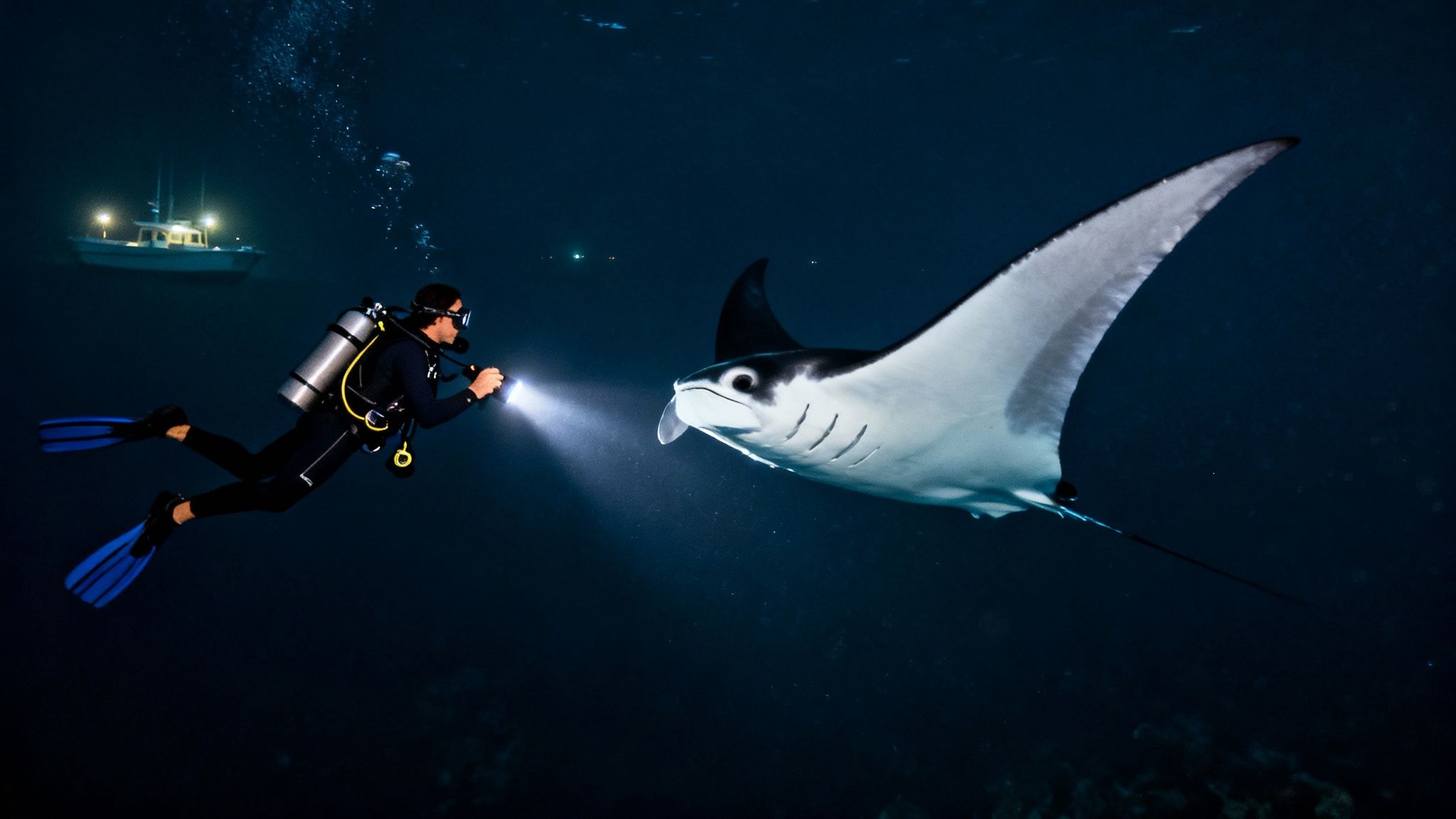
If there's one experience that belongs at the very top of every new diver's list, it's the world-famous Manta Ray Night Dive in Kona. Picture this: you're kneeling on the ocean floor in the gentle darkness as giant, graceful manta rays soar and somersault just inches above your head. It’s a breathtaking, almost spiritual encounter you will never forget.
To truly appreciate this spectacle, the location matters. We always point people toward Garden eel cove. This site is more protected and offers a superior, more intimate viewing area with better reefs, away from the bigger crowds. The experience is calmer, and the focus remains entirely on the majestic mantas. It's the perfect first "wow" dive to celebrate your new certification.
Continuing Your Education: The PADI Advanced Open Water
After a few fun dives, you might start feeling that familiar itch for more. More depth, more skills, more confidence. This is the perfect time to consider the PADI Advanced Open Water Diver course.
This isn't another round of intensive pool training. It’s all about diving. You’ll complete five different "Adventure Dives," each focused on a specific skill or environment.
- Deep Dive: You'll learn the techniques and safety procedures for diving deeper, down to 30 meters (100 feet).
- Underwater Navigation: Master using a compass and natural landmarks to find your way around a dive site like a pro.
- Three Electives: You choose the other three! Options often include Peak Performance Buoyancy, Night Diving, or Fish Identification.
Completing this course makes you a more capable and confident diver, opening up an even wider range of advanced dive tour sites around the globe. So many of the most interesting shipwrecks and geological formations are found in deeper water, and this certification gets you there safely.
For the Truly Adventurous: The Kona Blackwater Dive
Once you've gained more experience and feel completely at home in the water, a truly unique adventure awaits—the Kona Blackwater Dive. This isn't your typical reef dive. Here, you'll drift over thousands of feet of dark, open ocean at night, safely tethered to the boat.
You'll witness one of the largest migrations on Earth as tiny, bizarre, and often bioluminescent creatures rise from the deep to feed near the surface. It’s like floating through outer space, surrounded by alien life forms. It’s definitely an advanced dive, but it's an incredible goal to work toward as you build your skills.
Your certification is the key, but your curiosity is the engine. The path from an Open Water diver to a seasoned explorer is paved with incredible experiences, one dive at a time.
Globally, the scuba diving industry is a major force, contributing between $8.5 billion and $20.4 billion annually to the world economy and supporting up to 124,000 jobs across 170 countries. For beginners, this growth means dive tourism is a cornerstone of the 'Blue Economy,' promoting conservation in a way that doesn't harm reefs.
Making a Career Out of Your Passion
For some, the love of diving grows beyond a simple hobby. If you find yourself wanting to share this incredible world with others, the professional path might be for you. The first major step on that ladder is becoming a PADI Divemaster. This challenging and rewarding course teaches you leadership skills, dive theory at a professional level, and how to guide certified divers. Our guide on the PADI Divemaster certification can show you what it takes to go pro.
Once you've earned your card, the world's oceans become your playground. You can start planning trips to incredible diving hotspots, like finding the perfect all-inclusive Cayman Islands resorts to maximize your underwater adventures. Your new card truly is a global passport to exploration.
The journey to learn to scuba is just the first chapter. What comes next is up to you.
Your Top Questions About Learning to Scuba, Answered
Deciding to learn to scuba dive is a huge step, and it’s totally normal to have a head full of questions. In fact, after teaching thousands of new divers, we’vefound that the most curious students often become the best divers. Let's clear up some of the most common questions we hear all the time.
Getting these answers sorted out is the best way to turn any pre-dive jitters into pure excitement for the adventure that awaits.
Is Scuba Diving Dangerous?
This is probably the number one question we get, and for good reason. Here’s the straight answer: scuba diving has an incredible safety record, especially when you stack it up against other popular adventure sports. Organizations like PADI have spent decades perfecting their training programs to be as safe and effective as humanly possible.
Diving is all about managing risk through solid training, being aware of your surroundings, and sticking to the procedures you learn. It's a lot like learning to drive—you learn the rules of the road and how your car works to stay safe. Your most important move? Choose a reputable dive shop with experienced, safety-focused instructors. That one decision is the cornerstone of a safe and amazing diving journey.
How Long Does A PADI Certification Last?
This is the best news you'll hear all day: your PADI certification is good for life! Once you've earned it, that certification card is your permanent passport to the underwater world. It never expires and is recognized by dive operators everywhere, from our shores in Hawaii to the vibrant reefs of the Red Sea.
That said, diving skills can get a little dusty if you don't use them. If it's been a year or more since your last dive, we strongly recommend a quick refresher course. It’s a short, simple way to get back in the water with an instructor, brush up on the essentials, and get your confidence right back where it needs to be.
Do I Need To Be A Really Strong Swimmer?
You absolutely do not need to be a Michael Phelps to learn to scuba. What truly matters is being comfortable in the water. The swimming requirements are just there to make sure you have the basic water skills to be safe and confident.
To pass the PADI Open Water Diver course, you just need to do two things:
- A 10-minute float or tread: You'll show you can stay afloat for 10 minutes without any help from a floatie. You can lie on your back, tread water—whatever works for you.
- A basic swim: You'll complete a 200-meter swim without stopping. If you prefer, you can opt for a 300-meter swim using a mask, fins, and snorkel. There’s no time limit on either one. The goal is simply to show you can handle it.
What If I Get Scared Or Feel Claustrophobic?
This is a completely valid and common concern. Being underwater for the first time is a new sensation, and it's okay to feel a little hesitant. A great instructor is more than just a teacher; they're a coach who knows how to help you move past those feelings at your own pace.
We structure our training to build your confidence step-by-step, starting in the calm, controlled environment of a pool or a shallow, protected bay. You will never be rushed. Many divers are surprised to find that the quiet, weightless world underwater actually calms their nerves. The rhythmic sound of your own breathing becomes a kind of meditation, letting you relax and soak in the incredible beauty all around you.