
You've got a few mornings free in Kona, someone in your group wants mantas, and the dive sites all look appealing on a screen. The harder question is which trip fits your certification, recent experience and the water conditions when you arrive.
Good Kona scuba diving starts with that decision, not a list of famous sites. A boat charter can remove a difficult shoreline entry, but it doesn't remove swell. A shallow night dive can be more demanding than a deeper daytime reef dive. Choose the right format first, then let the day's conditions determine the site.
Kona Dive Trips at a Glance
Kona trips split into reef dives for certified divers, deeper advanced dives, night dives that depend on the animals, and introductory dives for people who have never breathed underwater.
Kona dive trip types compared
| Trip | Best for | Typical timing | Key feature |
|---|---|---|---|
| 2-tank morning dive | Certified divers | Morning, two dives | Coral gardens, lava tubes and arches |
| Advanced 2-tank trip | Experienced certified divers | Morning, two dives | Deeper sites and drift dives |
| Manta ray night dive | Certified divers and snorkelers | Shortly after sunset, about an hour underwater | Feeding reef mantas in shallow water |
| Blackwater night dive | Experienced night divers | Night, open water | Plankton and drifting animals over deep water |
| Introductory dive | Beginners with no certification | Morning, shallow reef | Instructor-led first dive |
| Private charter | Groups and families | Agreed schedule | Custom sites and pace |
Treat the timing as a trip format, not a departure confirmation. Night trips follow sunset, and the underwater portion isn't the full excursion. Check-in, transit, briefings and equipment preparation all need room in your schedule.
Start with the least complicated fit
For a certified visitor, a morning reef trip is the sensible starting point. You can check your weighting, settle into rental equipment and let the guide assess the group before considering something more demanding. Coral gardens, ancient lava tubes and dramatic arches provide variety without making depth the objective.
An arch isn't permission to enter an overhead environment. Stay outside any passage that exceeds your training, clearance or comfort, even when another diver goes through it.
The premium advanced dive trip suits experienced certified divers interested in deeper sites and drift diving. Choose it because you can manage buoyancy, gas and changing conditions comfortably, not because advanced sounds like the better holiday purchase.
Choose your night environment carefully
The manta dive and snorkel trip centers on a known feeding area. Divers watch from below while snorkelers observe from the surface. Being comfortable in darkness matters more than collecting another certification card.
A blackwater night dive is different. You drift over deep water, watching plankton and other small animals in the lights without a reef beneath you for reference. It's for divers who already feel composed in open water after dark.
Beginners should choose an instructor-led introduction rather than join a certified-diver charter. Private charters are ideal when a group requires a shared pace or customized schedule, but they don't override weather, training limits or passenger eligibility.
Before choosing, answer:
- Certification: What are you qualified and currently comfortable to do?
- Night comfort: Can you manage equipment and communicate without daylight?
- Available days: Is there room for a refresher, weather change or rest?
Certification and Course Options for Every Level
PADI course options and typical prerequisites
| Course | Who it is for | Typical prerequisite | Outcome |
|---|---|---|---|
| PADI Scuba Certification (Open Water) | Complete beginners | Medical screening; no prior certification | Independent buddy diving within training limits, generally to 18 m (60 ft) for adults |
| Open Water referral | Students who finished online theory | Completed knowledge development and referral documentation | Complete outstanding pool and open water sessions locally |
| Discover Scuba Diver | Non-certified people trying diving | No certification; medical and eligibility screening | Instructor-led shallow reef experience |
| Advanced Open Water | Certified divers | Open Water certification | Five adventure dives, with adult training to 30 m (100 ft) |
| Enriched Air Diver | Certified divers | Open Water certification or qualifying enrollment | Use nitrox up to 40% oxygen within certification limits |
| Peak Performance Buoyancy | Divers wanting better control | Open Water certification or qualifying certification | Improved buoyancy and trim |
| Deep Diver | Divers planning deeper dives | Advanced Open Water or qualifying adventure certification | Training for recreational dives to 40 m |
| Rescue Diver | Divers who want safety skills | Qualifying advanced training and current first aid and CPR | Rescue skills and problem management |
| Boat Diver | Divers using boats often | Open Water certification or qualifying certification | Boat entries, procedures and mooring awareness |
| Reactivate | Lapsed divers | Prior certification | Knowledge and skills refresh before diving again |
These are planning-level prerequisites, not a complete enrollment checklist. Age, medical clearance, qualifying certifications and the instructor's assessment can change what's appropriate. A depth qualification is a ceiling for suitable conditions, not a target every dive should reach.
If you've never dived
Choose between trying scuba and learning to plan dives as a certified buddy team. Discover Scuba Diver introduces breathing, equalization, equipment and basic skills in a calm setting before a supervised shallow reef experience. It isn't an independent-diving qualification.
Open Water is the better choice when you want diving to become part of future travel. You'll need time for knowledge development, confined-water practice and open water assessments. Don't squeeze the course between tightly booked activities and expect the instructor to hurry a skill that hasn't clicked.
A referral can reduce holiday classroom time. However, finishing online theory doesn't automatically mean every confined-water requirement is complete. Send your documentation before travel so the instructor can identify exactly what remains.
If you're certified or returning
Pick continuing education around the problem you want to solve. Advanced Open Water introduces different diving activities; Peak Performance Buoyancy concentrates on control. Enriched Air teaches gas-specific planning, but nitrox doesn't authorize greater depth or replace monitoring your computer.
Deep Diver belongs after you're comfortable managing ordinary reef dives. Rescue training shifts attention toward recognizing stress, preventing problems and helping other divers. Boat Diver is useful when vessel procedures, entries and pickups still feel unfamiliar.
Course choice: Better buoyancy often improves more of your diving than another depth qualification.
Returning divers should start with Reactivate when knowledge, equipment setup or emergency skills feel rusty. A certification card doesn't show whether you can currently clear a mask calmly or hold a controlled ascent.
Use the scuba classes page to compare training paths, then confirm prerequisites with the instructor before booking. Beginners need a foundation, active divers need relevant development, and returning divers need a comfortable restart.
Best Kona Dive Sites and When to Dive Them
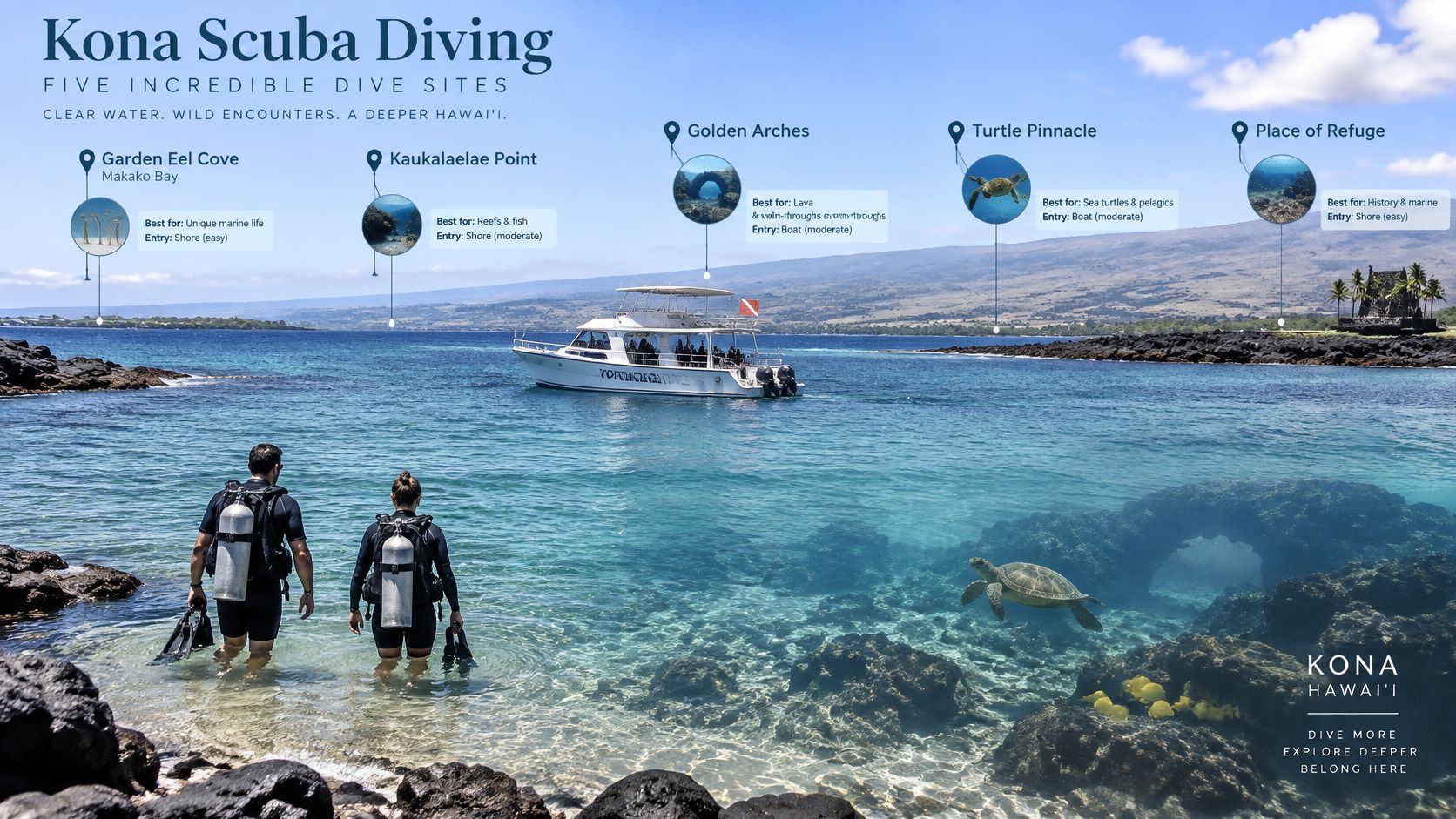
Kona dive sites by use and entry
| Site | Best for | Entry and conditions |
|---|---|---|
| Garden Eel Cove (Makako Bay) | Night manta viewing | State-recognized manta zone; protected bay, though calm water isn't guaranteed |
| Old Kona Airport MLCD | Protected reef with a designated no-boating zone | Shore entry over sharp lava; assess swell first |
| Kahaluʻu Beach Park | Beginners and shallow reef | Relatively straightforward shore access when seas are flat |
| Pawai Arches | Arches and reef life | Usually boat access; swell affects suitability |
| Waialea Bay | Shallow training dives | Gradual bottom slope; freshwater can reduce surface visibility |
Choose the site for its useful shelter
Garden Eel Cove isn't just a tour nickname. Hawaiʻi's Department of Land and Natural Resources identifies Makako Bay, also called Garden Eel Cove, and the shoreline fronting Sheraton Keauhou Bay Hotel as established nighttime manta-viewing locations where rays feed on plankton.
The same state management announcement considered anchoring restrictions, operator limits, vessel rafting restrictions and limits on live boating. Those were management proposals, not a reason to assume every measure is current law.
For the manta dive, Garden Eel Cove is my preferred choice because its protected location, better viewing area and better reefs make a stronger overall dive setting. That's a site-selection judgment, not a promise of calm seas or more animals on a particular evening.
Match shallow sites to visibility and access
Old Kona Airport rewards a different kind of planning. The state's conservation-district rules protect marine life, coral, shells, algae and geological features from removal or damage, prohibit feeding and attractants, and establish a designated no-boating zone with limited exceptions.
Protected doesn't mean physically easy. You still need a workable path across lava, and you shouldn't assume the entire conservation district is closed to boats.
At Kahaluʻu, shallow water can help a beginner stay oriented, but crowded access and moving water can still complicate a dive. At Pawai Arches, boat access removes the shoreline crossing, while surge can still make close approaches to rock formations unsuitable.
According to the state's Waialea Bay guidance, typical depths run about 10 to 30 feet, the bottom reaches approximately 30 feet outside the mouth, and an intermittent stream can reduce surface visibility through freshwater intrusion. That makes rainfall relevant even when the bay looks inviting from the beach.
Let the season inform, not decide
Kona's lee-side coast often offers warm, sheltered diving. Winter north swells and storms in either season can still change exposed entries, and an apparently mild day offshore can produce awkward movement against a lava shoreline.
Choose a boat-accessible sheltered site when shore surf is the limiting problem. Choose a shore entry only when the actual entry and exit are manageable. If neither option is safe, keep the day dry.
How Kona Manta Ray Night Dives Work
After sunset, the group descends to a known feeding area and settles into the guide's designated viewing position. Lights concentrate plankton, and reef mantas may arrive to feed through the illuminated water. The goal is to become a quiet observer, not to swim alongside an animal.
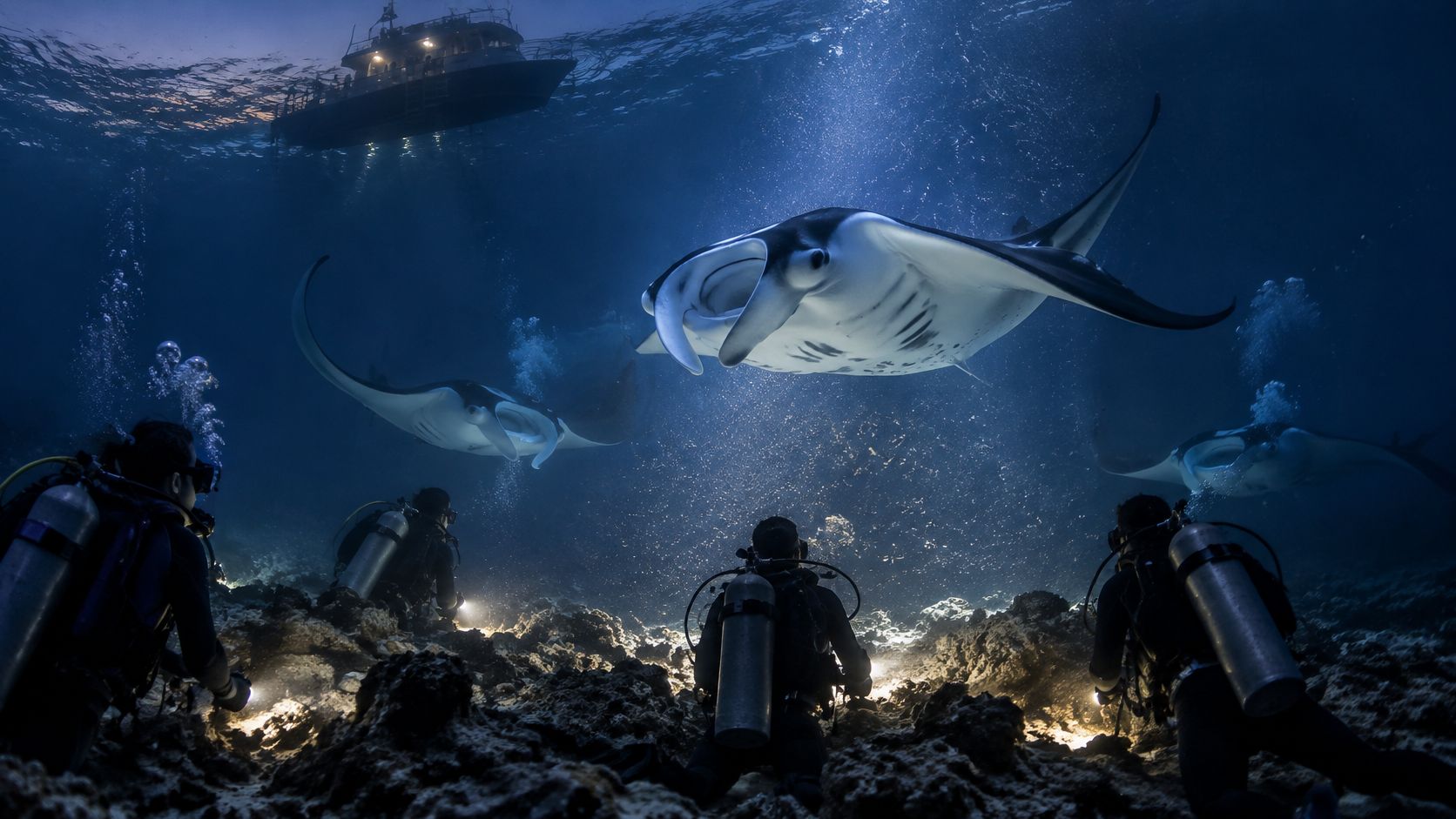
A NOAA-hosted study of observations from 2009 through 2014 recorded 118 individually identified reef mantas and found mantas at Manta Heaven on 92% of monitored nights, compared with 78% at Manta Village. Its observation dives generally began shortly after sunset, around 18:00, and lasted approximately one hour.
Those findings describe repeated use of localized feeding sites during a historical study. They aren't a forecast for your booking, and they don't guarantee an encounter. Wildlife can be absent even when the operation, conditions and timing are appropriate.
What happens before the first pass
Say you're comfortable on daytime reefs but haven't dived at night recently. Tell the guide before gearing up, check your light and backup, and agree on signals while everyone can still see clearly. Darkness makes an unfamiliar buckle or a leaking mask feel more consequential.
Confirm the day's sunset time and the actual meeting time on the booking page. Don't treat an approximate research start time as your boat's departure time. The Kona night manta dive guide provides more planning context for the experience.
Garden Eel Cove is the stronger choice for the overall dive setting when conditions support it. Its protected positioning and established viewing layout help a group stay organized, but a crowded viewing area still requires discipline. A good reef setting doesn't justify resting on coral or spreading equipment across the bottom.
Keep the encounter low impact
- Stay low and still. Use the assigned nonliving viewing area and keep fins and equipment clear of coral. If you can't hold position without grabbing the reef, signal the guide.
- Never touch, chase or block a manta. Leave its feeding route open, including the space above your head. Don't rise into a passing animal for a closer photograph.
- Keep personal lights away from the animals. Follow the guide's lighting plan rather than sweeping a beam across a manta's face at close range.
- Maintain spacing. Keep your buddy and guide identifiable without crowding another group. Avoid sudden fin kicks when a manta passes close.
- Follow the boat's mooring and pickup procedures. Enter and exit only on the crew's instruction, and stay away from engines and propellers.
A 2025 safety report on Kona manta tours described proposed rules requiring boats to use moorings rather than drift under power because spinning propellers endanger swimmers and mantas; it also described busy periods with hundreds of people entering the water. Ask about vessel positioning, group management and what happens if conditions require relocation or cancellation, rather than assuming popularity proves sustainability.
The best manta encounter gives the animal room to continue feeding without changing its path for you.
On a good evening, mantas circle through the light while divers remain settled beneath them. The exit should be equally controlled: identify the guide, follow the planned ascent and wait for the crew's instructions at the boat. A quiet ending matters more than stretching the dive for one final pass.
Shore Diving Safety and Go or No-Go Checks
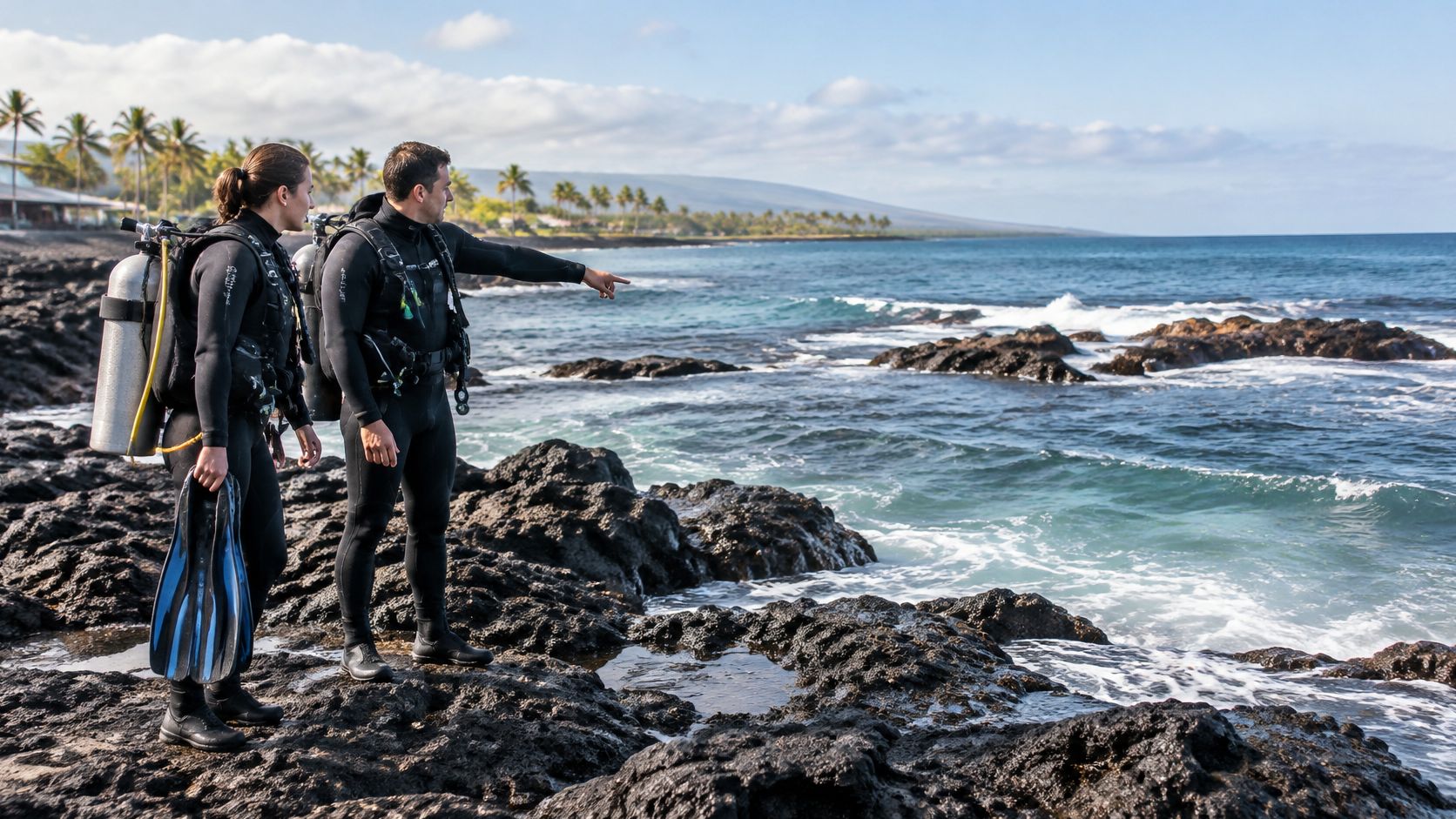
Kona isn't automatically easy because it's sheltered. A calm reef offshore can sit beyond an entry where surge pushes a fully equipped diver against sharp lava. Make the decision before you put the tank on, not after you've invested effort carrying everything down.
The Kona diving safety overview highlights sharp lava and coral entries, swell, surge, harbor traffic and added task loading at night; it also notes warnings for Old Kona Airport about dangerous storm swells and currents, sharp terrain and no lifeguard coverage.
Make the decision at the exit
Watch the shoreline long enough to see the larger sets, not just a convenient lull. Identify where you'll climb out with wet equipment and less energy than you have now. Snorkelers and freedivers face the same lava-entry hazard, even though they carry less equipment.
Use this go or no-go check:
- Compare swell size and direction with the forecast. Direction determines whether a particular shoreline receives the energy. Don't translate a favorable forecast for another coast into permission to enter here.
- Check wind and surface chop. Ask whether you could complete the return surface swim if the wind strengthened. A comfortable descent doesn't guarantee an easy swim back.
- Assess tide and surge at the entry. Look for water draining off shelves, breaking across footholds or repeatedly lifting divers against rock.
- Inspect visibility and runoff. Rainwater can obscure orientation and the route back. If you can't identify the exit from the water, reconsider.
- Confirm the exit and the effort required. Decide where fins come off, where your buddy waits and whether you can climb out without pulling on living reef.
- Agree on turnaround time and gas pressure. Base both on the route, workload and reserve needed for a difficult return, not on how long you hope to dive.
- Match the plan to the least experienced diver. Include fitness, recent experience and confidence on uneven terrain. The strongest person's comfort isn't the group standard.
Night changes the calculation
A familiar shore site looks different when the landmarks disappear. Carry a primary and backup light, review light signals, and make the buddy equipment check deliberate. Confirm how you'll identify the exit without relying on another group's lights.
Use the Big Island shore-diving guide for site planning, not as a substitute for looking at the water. Conditions can invalidate a reasonable plan after you arrive.
Go/no-go rule: If you can't explain how everyone will get out safely, don't enter.
When a check fails, move to a sheltered bay or a boat dive only if that alternative is independently safe. Otherwise, cancel the dive. Changing the plan is sound judgment, not a failed holiday.
Gear, Rentals and Underwater Photos
- Bring for fit: Your mask, fins and snorkel are worth packing when you already know they're comfortable.
- Rent for convenience: A regulator, buoyancy device, tank and weights save luggage space on a short trip.
- Bring for familiarity: Your own dive computer avoids learning unfamiliar menus during a briefing.
- Add for darkness: Carry a primary dive light and a backup, with compatible charged batteries.
Choose exposure protection for your cold tolerance, dive duration and repeated dives, not just the sunny air temperature. A thin wetsuit may suit you, while a rash guard alone provides little insulation during a stationary night encounter.
Check rentals before leaving shore
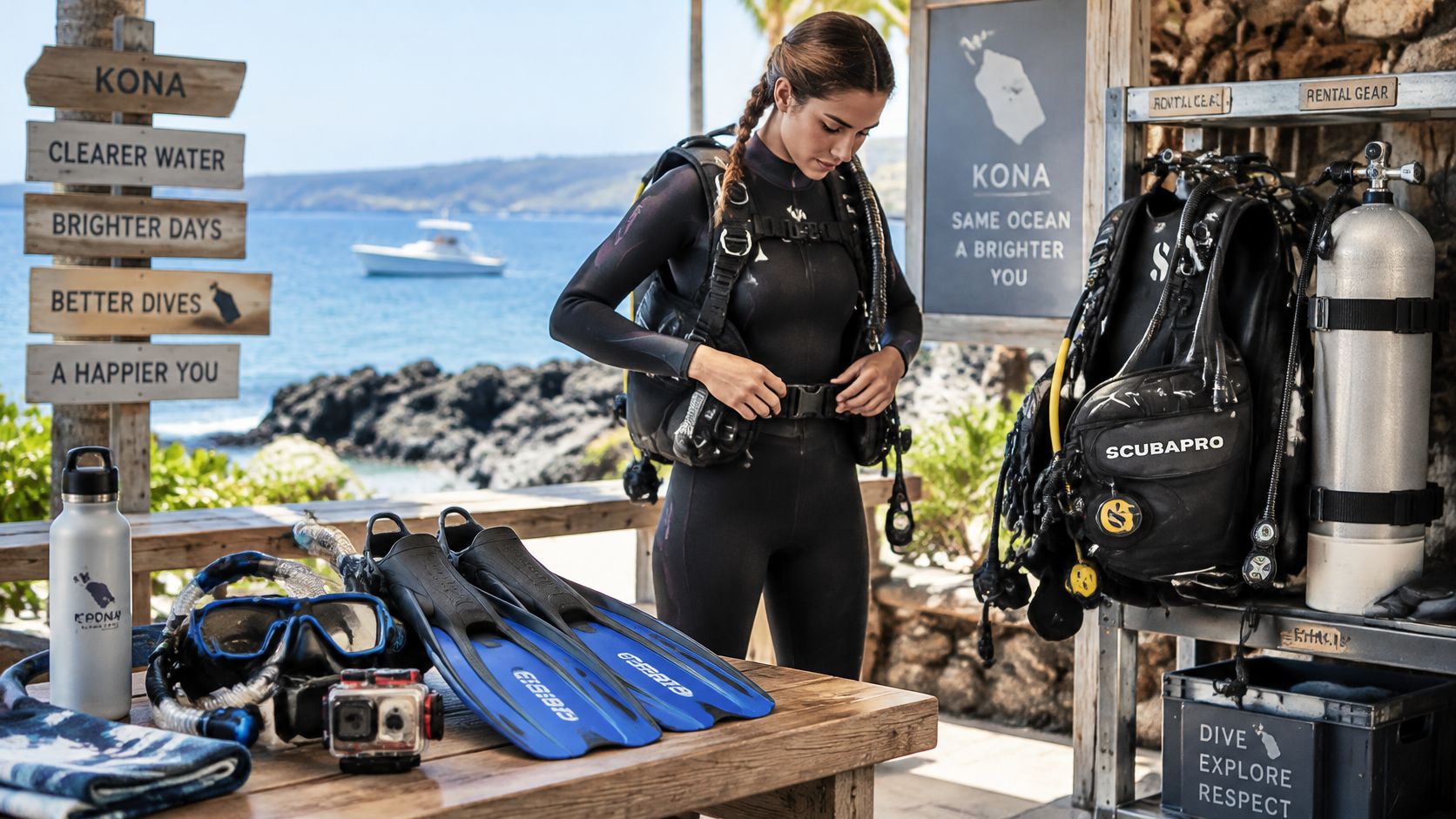
Put the buoyancy device on and adjust it with the exposure suit you'll wear. Check that the tank is secure, the inflator and dumps work, and you can locate weight releases without looking. Breathe from the primary and alternate regulators while watching the pressure gauge for unexpected movement.
Check the service date or maintenance record with the rental staff rather than judging condition by appearance. A clean regulator can still need attention, and a familiar model can have a different hose layout.
Arrange scuba equipment rentals before your dive day so fit and availability don't become dockside problems.
Keep rules and cameras separate
The Hawaiʻi fishing regulations require ocean divers to display a dive flag and remain within 100 feet of it except in an emergency, and prohibit capturing, entangling or killing sharks or rays. Plan the marker's position with the route, and treat wildlife encounters as observation rather than handling.
For mantas, a wide-angle lens lets you compose without pursuing the animal. Use diffused lighting where the guide permits it, and avoid close-range flash. Don't add a camera until you can remain properly positioned without touching the bottom.
A slow shutter can record more ambient light, but it also increases motion blur. Steady buoyancy helps with camera movement; it won't freeze a moving manta. If your camera hunts for focus or the animal passes outside your frame, let the shot go.
Before closing the housing, check:
- Housing: Inspect seals, latches and the leak detector.
- O-rings: Clean and seat them according to the manufacturer's directions.
- Lens port: Remove fingerprints and check attachment.
- Light: Test output and controls.
- Memory card: Confirm space and recording.
- Spare batteries: Keep them dry and protected aboard.
Three Sample Kona Dive Itineraries
Three-day Kona dive itineraries
| Plan | Day 1 | Day 2 | Day 3 |
|---|---|---|---|
| Certified diver | 2-tank morning dive | Advanced 2-tank trip or second morning dive | Manta ray night dive |
| New diver | Introductory dive with instructor | Classroom and pool sessions | Open water dives |
| Family with snorkelers | Morning reef snorkel | One dive for the certified adult | Sunset manta snorkel |
These are sample schedules, not guaranteed course completion plans. Put the most demanding dive on the calmest suitable morning, protect rest before night diving and leave room to rearrange activities. If possible, keep an additional day uncommitted rather than booking every available slot.
Certified divers and new students
For certified divers, the opening morning is a practical equipment and comfort check. Choose the advanced trip next only if the first outing leaves you comfortable with your weighting, gas use and guide procedures. Otherwise, another ordinary reef morning is a better use of the day.
Keep the final afternoon quiet before the manta trip. If fatigue has accumulated, replace the preceding dive day with rest. Don't force a night dive just because it's the last item left on the booking list.
For a new diver, the introductory experience helps answer whether you enjoy breathing underwater before committing to certification. The classroom, confined-water and open water sequence must then follow the instructor's schedule and your progress. Don't assume the sample plan contains enough time to finish every requirement.
Complete any assigned knowledge work beforehand. Learning equipment assembly while rushing through unfinished theory makes the holiday less relaxing and gives the instructor less flexibility.
Families need different kinds of downtime
Start with a reef snorkel so everyone can assess comfort in the ocean without committing to scuba. On the next day, the certified adult can dive while other family members choose an activity that suits them. Confirm passenger and snorkeler arrangements before assuming everyone can join the same departure.
A sunset manta snorkel can provide a shared finale, provided each participant is comfortable in open water after dark. It isn't automatically the right choice for someone who disliked the daytime snorkel.
Use the dive travel planning tips when coordinating diving with flights and inland travel. Leave appropriate surface intervals before flying or ascending to elevation, and confirm your individual plan with your instructor.
If swell rises, substitute a safe boat site for a shore dive. If you're tired, move the night outing to another evening rather than borrowing energy from the next day.
Choose Your First Kona Dive Trip
Choose a morning reef trip if you're certified, add mantas if you're comfortable at night, and start with an introductory dive or Open Water training if you're new. That's enough to narrow the decision without committing to a particular reef before the forecast is clear.
Compare the full descriptions on the diving tours page before choosing a date. The trip descriptions should settle questions about eligibility, equipment and the format of the outing, while your recent experience should determine whether it's a sensible fit.
Match the service to the holiday
At Kona Honu Divers, our lineup includes the 2 Tank Local Morning Dive, Premium Advanced 2 Tank Trip, Manta Ray Night Dive, Black Water Night Dive and Morning Introductory Scuba Dive. That breadth suits travelers who want a full-service experience without treating every dive as the same activity.
Our premium advanced trips take certified divers to remote sites, while the morning introductory option gives beginners a different starting point. We offer free nitrox with our dive packages, and our small-group approach emphasizes personal attention from the moment divers step aboard. Nitrox still requires the appropriate training, gas analysis and depth planning.
The review widget above lets you check recent Google reviews before committing. Read comments that match your situation, such as returning to diving, using rental equipment or joining a night trip, rather than relying only on the overall impression.
Book the appropriate trip, not the fullest schedule
- Pick the format that matches your certification. Include your recent experience and any discomfort with depth, darkness or open water when making the choice.
- Choose a date with room around it. Give yourself time to arrive rested and preserve flexibility if the forecast changes.
- Reserve through the availability button and confirm the meeting time. Check the exact location, required documents and equipment arrangements before the day of departure.
Check price, cancellation terms and package inclusions on the booking page before paying. Those details aren't fixed in this guide, and an attractive trip description doesn't tell you what happens when weather disrupts the plan.
You don't need to do every type of Kona scuba diving on one visit. A well-matched reef morning and a carefully planned night encounter can be more rewarding than a packed schedule of dives you're too tired to enjoy.
Kona Honu Divers offers guided reef trips, advanced outings, manta and blackwater night dives, and beginner training for different levels of experience. Visit Kona Honu Divers to choose a trip that fits your certification, compare the booking details and leave room for the ocean to set the final plan.