
Table of Contents
- Match the format to your group
- Follow the food through the light
- Leave room for the approach
- Check readiness, not just the certification card
- Pack for being wet after sunset
- From dock checks to the viewing area
- What a well-run encounter looks like
- Protect the opportunity to feed
- Why the setting makes a difference
- Ask questions that reveal operating standards
- Do I need certification?
- Will I definitely see a manta?
- Is the night dive safe for beginners?
- Can I take photos?
- How cold is the water?
- Can I dive at Keauhou Bay instead?
- What happens if no rays appear?
You're comparing manta tours, checking whether your certification is enough, and wondering if the dark water will feel intimidating. The photos make every trip look spectacular, but they don't tell you what matters most: where you'll be positioned, how the crew manages the group, and what happens when the mantas don't arrive.
A Kona night manta ray dive works best when you treat it as a wildlife encounter built around feeding, not a performance with a curtain time. Choose the right format for your comfort level, favor Garden Eel Cove's protected viewing setup, and book with a crew that explains the limits as clearly as the highlights.
Which Kona Night Manta Ray Dive Fits You
The crew places powerful lights on the seafloor. Divers settle onto designated sand below, while snorkelers float at the surface above the feeding area. That arrangement gives each group a different perspective without asking anyone to chase the animals.
The Manta Ray Night Dive is a signature Kona Honu Divers scuba experience, run at Garden Eel Cove. The first decision isn't which trip promises the most rays. It's which position in the water lets you relax and pay attention.
Kona manta options at a glance
| Option | Best for | Who can join | Site |
|---|---|---|---|
| Manta Ray Night Dive | Divers who want close, lit-up feeding passes | Certified divers | Garden Eel Cove |
| 2-Tank Manta Dive and Snorkel | Mixed groups wanting dive and snorkel time | Certified divers for scuba; snorkelers for surface viewing | Garden Eel Cove for the manta encounter |
| Manta snorkel | Snorkelers who want the rays from the surface | Snorkelers at beginner to advanced levels | Garden Eel Cove |
| 2-Tank Morning Dive | Divers wanting daytime reef dives | Certified divers | Kona Coast reefs selected for conditions |
Match the format to your group
- Choose the night dive if you're certified and want to watch feeding passes from below. You'll manage scuba equipment, but you won't spend the encounter swimming after mantas.
- Choose manta snorkel if you want the lights and rays from the surface without scuba. Comfort floating in open water still matters, even though certification isn't required.
- Choose the combined option if your group wants dive and snorkel time. Use the 2-Tank Manta Dive and Snorkel booking details to confirm which activities each guest will participate in.
A combined charter doesn't automatically mean every guest switches between scuba and snorkeling. Confirm the arrangement before booking, particularly when certified divers and nondivers travel together.
For a closer comparison of the viewing angles and equipment demands, use this guide to snorkeling versus diving with manta rays. Daytime reef diving is a different objective altogether, so compare the Kona diving tours if exploring the reef matters more than a stationary encounter.
How the Night Manta Dive Works, from Light to Feeding
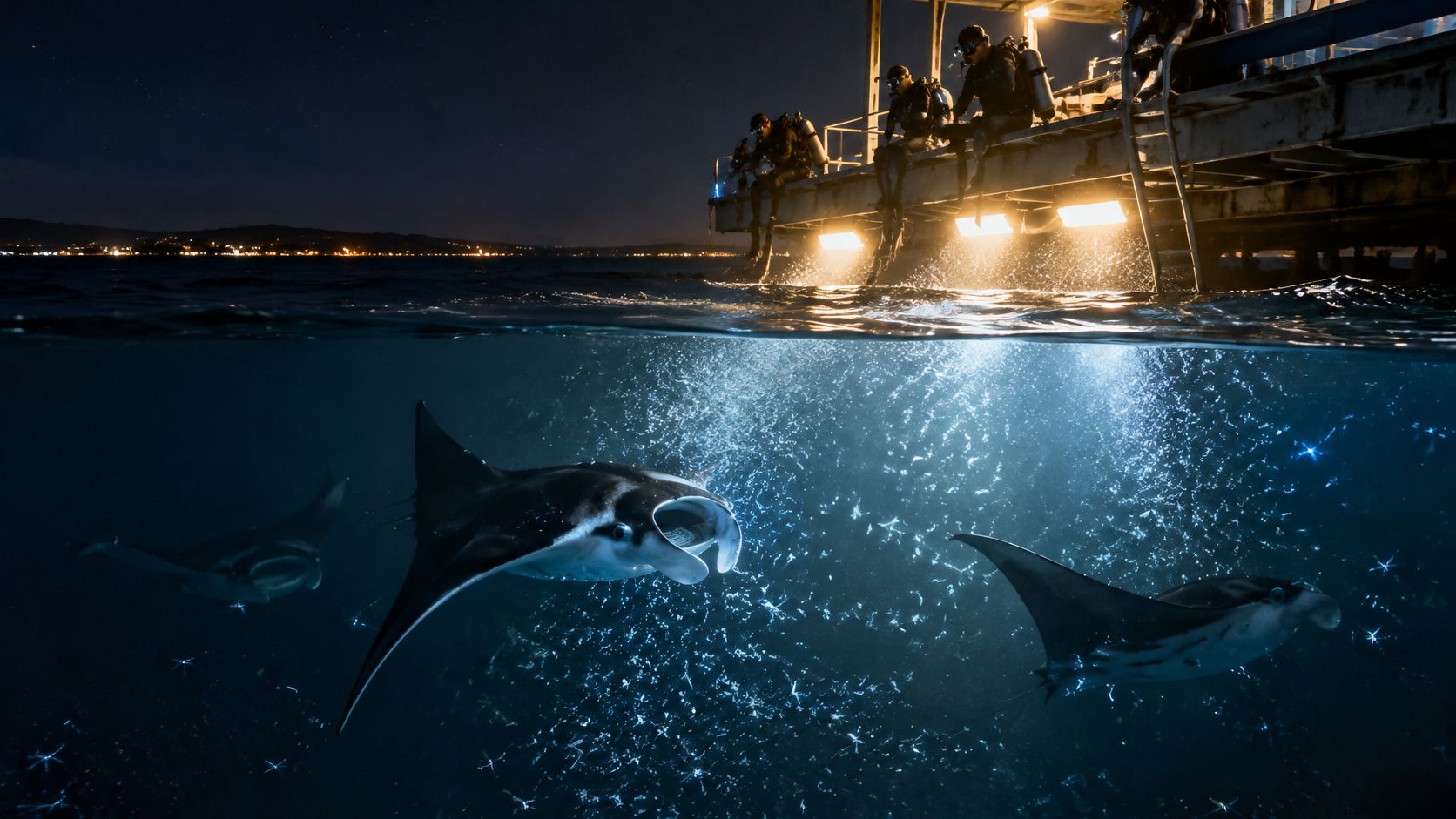
Think of a porch light drawing moths, followed by bats arriving to feed. The manta dive follows a similar chain, with zooplankton gathering in illuminated water and manta rays arriving for the food rather than the people.
That distinction changes how you interpret everything happening underwater. The lights establish an opportunity. The animals decide whether it's worth using.
Follow the food through the light
The Kona manta feeding explanation describes a predator-prey concentration system: artificial lights concentrate zooplankton in the water column, and reef manta rays, Mobula alfredi, enter that light field to filter-feed. Their cephalic fins, the flexible structures beside the mouth, guide prey-rich water inward; gill-raker structures retain plankton as water exits.
Say a manta approaches through the edge of the beam. It opens its mouth, travels through the concentrated food, and turns back toward another productive patch. A barrel roll isn't a trick for the cameras. It's a feeding movement that lets the ray work the same food-rich water again.
The same explanation identifies localized plankton biomass, tidal currents, island topography, internal waves, and surface convergence as reasons activity changes between nights. A familiar site can support sustained feeding one evening and much less activity the next.
Practical rule: Watch the feeding corridor, not the clock. A scheduled departure can get you to the site, but it can't schedule a wild animal's appetite.
Leave room for the approach
The animals aren't trained performers, and the encounter doesn't depend on offering them bait. They use predictable feeding areas, but that doesn't make them permanently stationed beneath the boat.
Your job is to remain a predictable part of the surroundings. Stay in your assigned position and let a ray complete its approach without finding a diver in its path. Swimming toward an approaching manta may seem like a way to improve your view, but it sacrifices the clear corridor that made the approach possible.
Who Can Go and What You Need to Bring
Scuba certification is required for the Manta Ray Night Dive. Both that dive and the 2-Tank Morning Dive are open to all certified divers, while manta snorkeling requires no scuba certification.
Certification and experience requirements by activity
| Activity | Certification needed | Experience level | In-water support |
|---|---|---|---|
| Manta Ray Night Dive | Certified diver | Beginner to advanced certified divers | Divemasters and instructors in the water |
| Manta snorkel | None, snorkelers | Beginner to advanced | Stationary, guided surface viewing |
| 2-Tank Morning Dive | Certified diver | All certified experience levels | Guided reef diving |
| Premium Advanced 2 Tank Trip | Scuba certification and operator approval for the itinerary | Advanced | Guided diving with itinerary-specific briefing |
Check readiness, not just the certification card
A beginner certification doesn't exclude you from the manta dive. Its stationary, closely supervised format can suit newer divers because there's less route-following than on a moving reef dive.
You still need to breathe comfortably through your regulator, clear your mask, monitor your gas, and respond to instructions. If those tasks feel rusty, tell the crew before departure rather than discovering the problem during descent. Review the practical differences involved in scuba diving at night so darkness isn't another unfamiliar task.
Confirm your buddy before entry. Make sure your certification documentation is available, review the medical questionnaire carefully, and resolve any required medical clearance before the trip. At the dock briefing, check cylinder security, regulator function, buoyancy equipment, weights, and light operation with your buddy and crew.
For divers seeking a more demanding itinerary rather than a stationary wildlife encounter, the Premium Advanced 2 Tank Trip is the step up to discuss. Confirm the experience requirements for the planned sites rather than assuming every certification qualifies.
Pack for being wet after sunset
- Swimsuit and rash guard: Arrive ready to change into exposure protection. A rash guard adds comfort but doesn't replace an appropriately fitted wetsuit.
- Reef-safe sunscreen: Bring it for daylight exposure and follow the product directions.
- Towel: Dry off before putting on your return-trip clothing.
- Dry warm layer: Keep a sweatshirt or wind-resistant jacket dry until you're out of the water.
- Snack: Pack something simple for before or after the in-water activity.
- Waterproof bag: Protect your phone, keys, and dry clothing from spray and wet equipment.
Ask whether masks, fins, and wetsuits are included or rented before arrival. Fit matters more than bringing unfamiliar equipment just because you own it.
For travelers choosing surface viewing instead of scuba, check the applicable snorkeling departure and participation requirements before reserving.
What Happens During the Night Dive
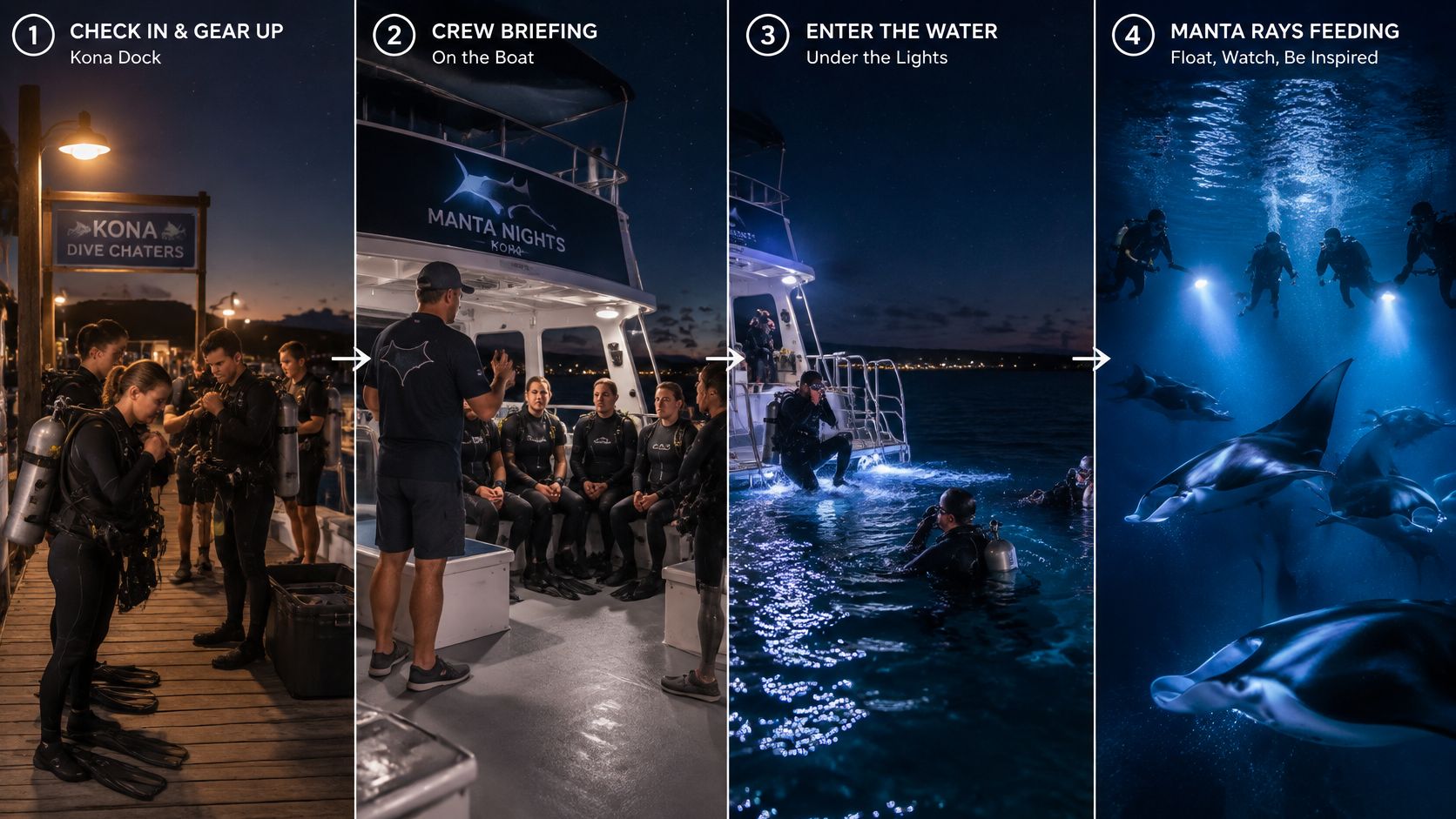
The encounter follows a deliberate sequence. Knowing your next task makes it easier to settle down without rushing, especially when the boat, equipment, and nighttime surroundings are unfamiliar.
From dock checks to the viewing area
Check in and gear up at the dock. Have your certification ready and flag equipment-fit problems while they're easy to fix. A slipping mask strap or awkward weight arrangement becomes harder to sort out once the group is entering.
Listen to the detailed crew briefing. Our briefing covers the science behind the dive and the golden rules of passive observation. Understanding why you shouldn't chase an animal makes the positioning instructions more useful than a simple list of prohibitions.
Complete your entry check. Check breathing, buoyancy, and buddy contact before moving toward the viewing area. Establish a steady position first, rather than trying to watch for mantas while still adjusting equipment.
Let the crew establish the lighting. Powerful seafloor lights create a large, bright circle, so divers aren't sitting in complete darkness. The Hawaii DLNR manta-viewing safety assessment documents lights concentrating zooplankton at both principal viewing sites, establishing the feeding opportunity rather than attracting mantas directly to people.
Take the assigned viewing position. Divers kneel on designated sandy bottom while snorkelers remain at the surface. Stay off living reef, keep equipment close, and use only the position the crew identifies as appropriate.
Maintain contact with the guides. Experienced divemasters and instructors are in the water managing our group. Keep checking your buddy and instruments, and signal early if you're cold, uncomfortable, or having trouble staying settled.
Watch without intercepting. Let the rays make their passes while you avoid sudden movement and keep their approach paths open. If a ray passes close overhead, resist the instinct to reach up or lift your camera into its route.
Exit with the group and debrief. Follow the crew's ascent and boarding instructions instead of lingering for a final photograph. Once aboard, explain any equipment or comfort issues so they can be addressed before another dive.
What a well-run encounter looks like
Repeated close passes through the illuminated water are the memorable outcome. A calm group that remains in position is the operational success underneath it.
Those aren't interchangeable measures. Even on a quiet night, the crew should maintain an orderly dive, monitor guests, and end the encounter appropriately. Good supervision matters whether the feeding area is busy or empty.
Sighting Odds, Conditions and Protecting Kona’s Mantas
Divers have seen manta rays on 92% of our Manta Ray Night Dive trips. That's an operator encounter figure, not a guarantee for your booking, a forecast of how many rays will appear, or a promise of close passes.
The population context matters just as much. Hawaii State legislative testimony reported that researchers identified 106 individual manta rays along the Kona Coast from 1992 through 2007 and estimated that the local population probably numbered fewer than 200 animals. Those are historical estimates, not a current census.
Reef mantas mature slowly and reproduce at low rates. A high encounter rate doesn't mean there's an unlimited supply of animals available to absorb disturbance.
Conditions that change the manta dive
| Factor | Effect on the dive | What to do |
|---|---|---|
| Zooplankton density | Drives how many rays gather each night | Expect a likely sighting, not a guaranteed one |
| Tides and currents | Shift the feeding zone and how close rays pass | Ask how the crew will adjust positioning |
| Surface convergence and internal waves | Change manta numbers from night to night | Confirm whether conditions support your booked window |
| Sea state | Calmer seas favor a steady viewing position | Check the forecast and weather policy |
Protect the opportunity to feed
- Aim lights into the water: Never deliberately shine them at the rays.
- Keep your distance: Don't touch, chase, or intercept an animal.
- Leave flash off: Set up your camera before entering and follow the crew's photography instructions.
- Quiet your hands and fins: Avoid unnecessary kicking or reaching.
- Follow positioning instructions: Don't move into an empty space just because it looks closer.
These are practical applications of responsible diver etiquette, not optional courtesies for less-confident guests. Calm, predictable groups leave feeding routes open and avoid adding unnecessary disturbance to a small local population.
The night dive runs year-round, so choose a date that fits your travel plans and the departure schedule. Confirm operating nights, available time windows, and the slow-night policy before paying.
Book Garden Eel Cove and Choose the Right Operator
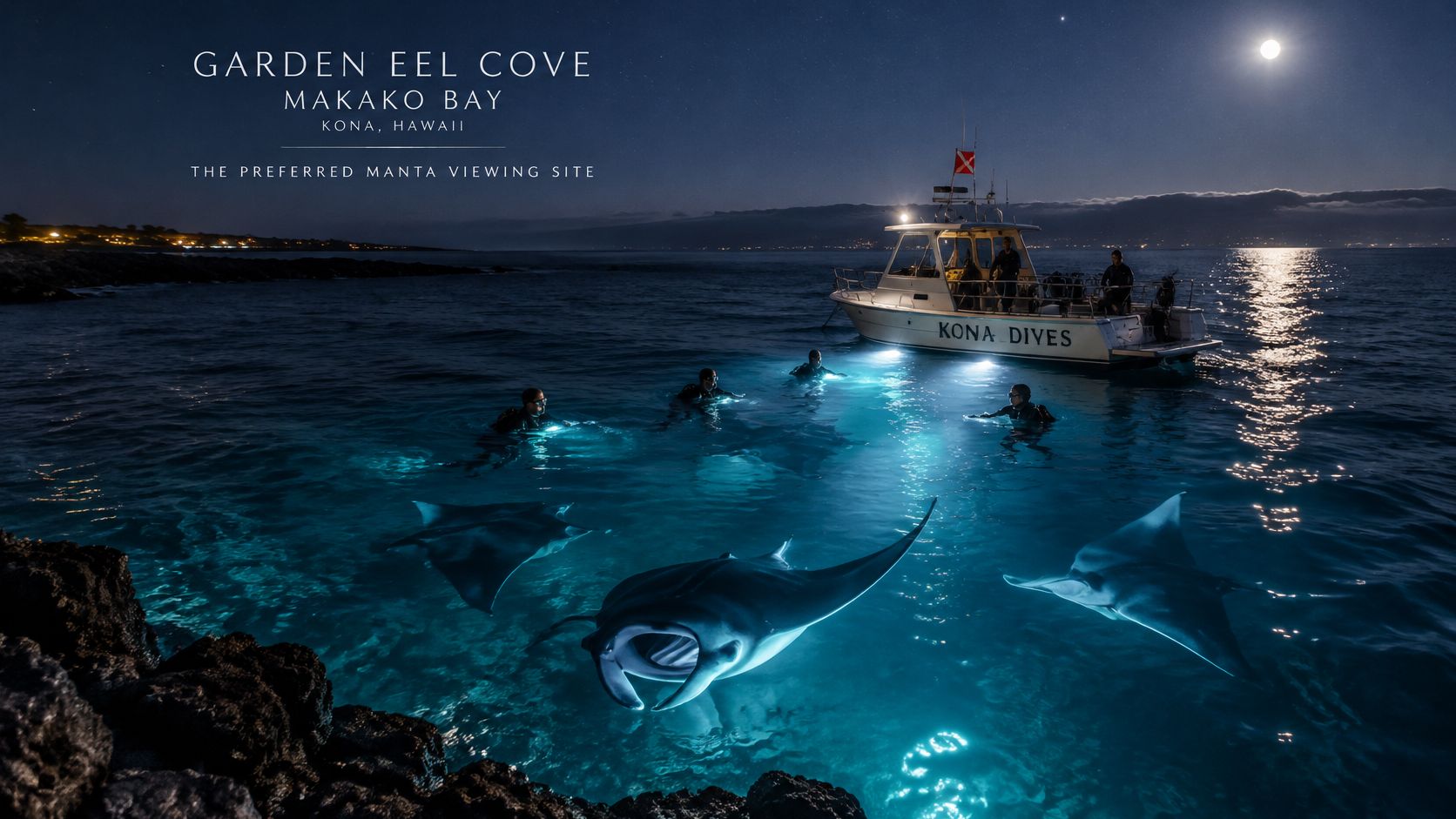
Garden Eel Cove is my recommendation for the manta dive. Its protected location, better viewing area, and healthier surrounding reef make it the stronger all-around choice for this style of stationary encounter.
The Hawaii Department of Land and Natural Resources identifies Makako Bay, locally called Garden Eel Cove, as one of two principal manta-viewing sites, immediately west of Kona International Airport and the Natural Energy Laboratory campus. It's separate from Keauhou Bay, also called Manta Village.
Why the setting makes a difference
Garden Eel Cove's generally calmer conditions help guests hold a steady position. Its defined viewing area makes it easier to organize divers below and surface viewers above without treating the feeding zone as somewhere to swim freely.
The reef is another reason to favor the site. When the itinerary includes reef exploration before the manta encounter, the surrounding habitat adds value beyond waiting for animals to appear. That matters because a worthwhile dive plan shouldn't rest entirely on an unpredictable arrival.
Protected doesn't mean immune to swell. A responsible captain can still change or cancel a plan when conditions aren't suitable.
Choose Garden Eel Cove for the quality of the setup, not because anyone can promise it will produce more mantas on your particular night.
Ask questions that reveal operating standards
- Site and reasoning: Our manta dive uses Garden Eel Cove. If comparing another departure, establish its actual destination rather than accepting a generic Kona coastline description.
- Guests per guide: Ask for the planned allocation, not just the boat's total passenger capacity.
- Viewing arrangement: Our divers use a specific viewing area. Confirm how the crew prevents crowding and keeps approach paths clear.
- No-ray outcome: Get the policy in writing before booking. Don't assume a refund or repeat trip.
- Equipment: Confirm included items, rental charges, and wetsuit sizing.
- Certification check: Have your documentation ready and disclose recent diving experience fully.
- Weather and cancellation terms: Understand who makes the operating decision and what happens if a departure can't proceed.
Use the dive-operator selection guide to compare those answers. Favor a Garden Eel Cove operator that keeps groups manageable and states a clear no-ray policy, rather than one that sells certainty.
Review the manta charter itinerary and reservation details, then book the format that fits your certification and comfort in the water.
Common Questions About the Kona Night Manta Dive
Do I need certification?
You need scuba certification to join as a diver, but not to participate in manta snorkeling. Use the certification table under Who Can Go and What You Need to Bring to match each traveler to the right activity.
Will I definitely see a manta?
No, these are wild animals, and our encounter figure isn't a guarantee. The Sighting Odds discussion explains the distinction; the guide to when to see manta rays in Kona can help with scheduling questions.
Is the night dive safe for beginners?
The stationary format and in-water divemasters and instructors can suit newer certified divers. Ocean diving still carries risk, and the readiness checks under Who Can Go matter more than holding a certification card.
Can I take photos?
Yes, but leave flash off and keep lights directed into the water rather than at the rays. Follow the positioning rules under What Happens During the Night Dive, and put the camera away if it interferes with your buoyancy or awareness.
How cold is the water?
Your comfort depends on exposure protection and how easily you chill, so confirm the wetsuit arrangement rather than packing around a guessed temperature. The packing checklist includes a rash guard and a dry warm layer for the ride back.
Can I dive at Keauhou Bay instead?
Keauhou Bay is an established manta-viewing location, but Garden Eel Cove is the recommended choice here. Use the operator checklist under Book Garden Eel Cove to confirm which site a particular departure uses.
What happens if no rays appear?
The answer comes from the operator's written no-ray policy, not the encounter rate. Confirm eligibility, availability, and any conditions attached to a repeat trip before booking.
Kona Honu Divers offers guided manta dives at Garden Eel Cove with a detailed briefing and divemasters and instructors in the water. Visit Kona Honu Divers to choose your departure, confirm equipment needs, and reserve the Kona night manta ray dive that fits your group.