
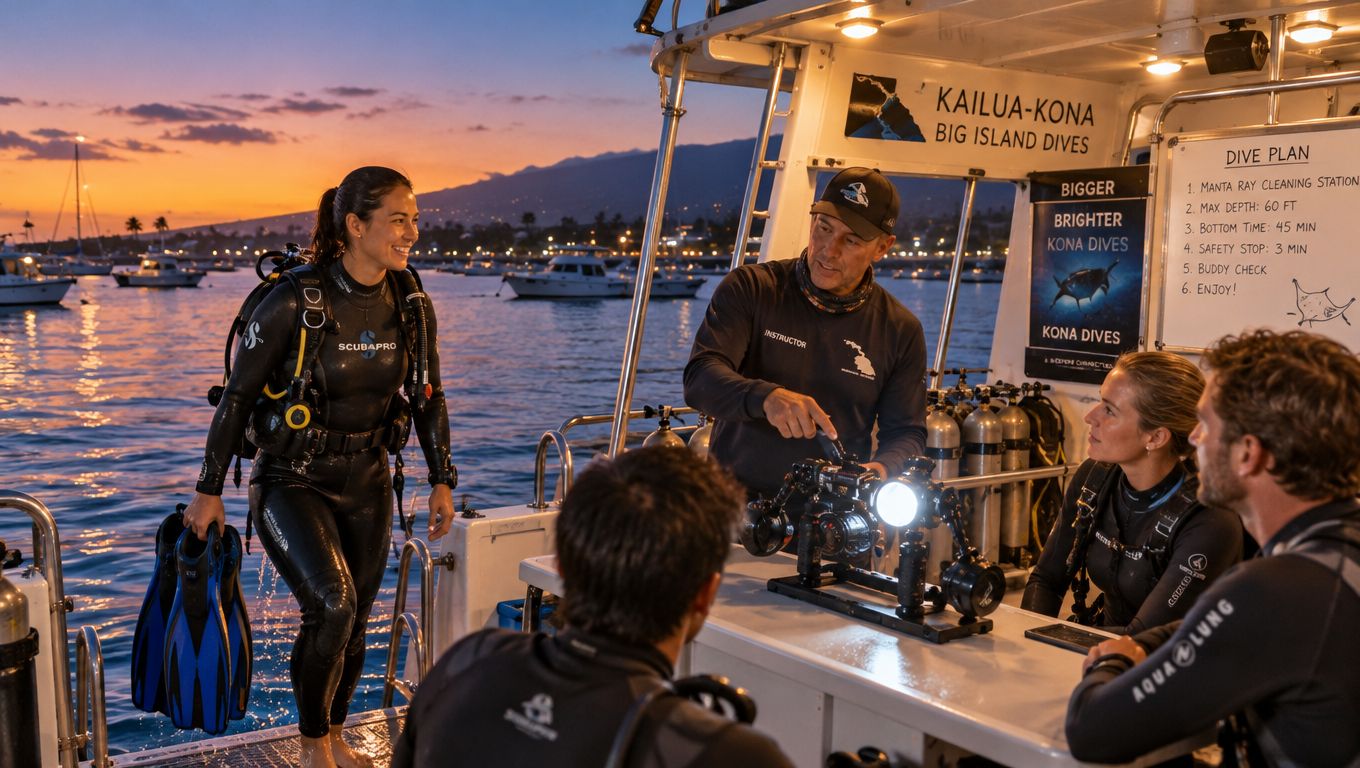
The boat leaves Kailua-Kona as the sky dims, and your first night-dive briefing begins before you're in the water. The crew explains where to enter, how to use the lights, and where the group will gather. You may be wondering whether mantas are attracted to divers, whether you need to chase them for a good view, or what you'll do once you descend. The answer starts with a simple chain: lights gather plankton, and plankton can draw feeding manta rays.
What the Kona Manta Ray Dive Actually Is
A Kona manta ray dive is a guided nighttime wildlife encounter, usually organized around an illuminated viewing area. Rather than searching a reef for mantas, divers follow the crew's instructions to a designated spot, settle into position, and watch as the animals make feeding passes through the light. Snorkelers can take part from the surface, where they hold onto illuminated flotation boards and look down into the same feeding area.
The tradition began by accident. In the early 1990s, coastal hotel lights illuminated the water, attracting plankton and, in turn, manta rays. Organized manta-focused excursions began around 1992, and nighttime encounters had become a regular part of Kona's visitor economy by the early 2000s. Historical monitoring recorded 3,208 surveys from 1992 through 2007 at Kona night-diving sites, primarily Keauhou and Ho'ona Bay, and reported manta sightings on about 80% of dives at Garden Eel Cove. These details are summarized in Kona's history of manta night diving.
The experience from boarding to surfacing
The boat briefing is where you learn the plan, not just the rules. The crew describes the entry and exit procedure, where divers will sit or kneel, how lights should be aimed, and what to do if you drift or need help. Once everyone is ready, divers enter with the crew's direction, descend to the viewing area, and settle into the group rather than swimming around to look for animals.
You don't need to chase or touch a manta to see it. The animals come to feed where plankton gathers, and your job is to stay calm, keep your position, and leave their path open. After the viewing portion, the crew manages the ascent and return to the boat.
Who can join
Certified scuba divers and snorkelers can both experience the event, though they take part from different positions in the water. A diver should be comfortable following a night-dive briefing and maintaining controlled buoyancy. A snorkeler needs to be comfortable in open water and able to follow the crew's directions from the surface. The shared principle is the same: stay where the crew places you, and let the mantas choose their route.
How Plankton, Light, and Mantas Actually Interact
The light doesn't summon a manta like a signal. It changes conditions in the water column, making it easier for small drifting organisms to gather in an illuminated area. That concentration of zooplankton creates a food patch, and reef manta rays, Mobula alfredi, may pass through it to feed. The mechanism is described in this overview of manta feeding in Hawaiʻi.
This distinction matters. The encounter isn't a performance arranged around divers, and the animals aren't responding to people waving lights or swimming after them. The mantas are following prey. When plankton is concentrated, they may repeatedly feed through the illuminated area; when it disperses, they can widen their search or leave.
Why mantas roll
A manta's open mouth and cephalic fins help channel plankton-laden water toward its gill-filtering apparatus. During feeding, a manta may roll as it repositions through a localized patch of prey. Those barrel rolls can look playful from below, but they're better understood as part of its feeding movement, not an invitation to interact.
The difference between watching and interfering is practical. If divers swim into the feeding path, turn lights unpredictably, or try to follow an animal, they can disrupt the viewing setup and increase the chance of a collision. Staying still gives mantas room to make their own passes.
Practical rule: Settle into the designated viewing position, keep your light under control, and don't pursue a manta that swims away.
Encounter quality depends on the prey patch, water movement, and where the lights are placed. Even a well-run trip can't guarantee that mantas will stay in one spot or approach a particular diver. A strong operator can create a clear, controlled viewing area, but the animals' feeding behavior determines what happens next.
Choosing Between Shore and Boat at Garden Eel Cove
A shore entry and a boat charter can both bring you to a manta viewing area, but they differ in the amount of coordination they require. A shore dive means arranging equipment and entry at the water's edge, then managing the swim and return in darkness. A boat trip gives you a crew to coordinate the water entry, group location, surface support, and return aboard. The right choice depends on your comfort with night navigation and on how much support you want around the dive.
| Aspect | Shore Entry | Boat Charter |
|---|---|---|
| Getting to the site | Enter from shore and make your way to the viewing area | Travel to the site aboard the boat |
| Group coordination | Divers need to manage the entry and stay together in the water | Crew briefs the group and coordinates entry and exit |
| Surface support | Depends on the shore operation and conditions | Boat crew can support the group from the surface |
| Gear handling | You manage gear around the shore entry | Gear is handled and organized aboard the boat |
| Best fit | Divers comfortable with night entries and navigation | Divers who prefer a crew-led plan and boat-based support |
Why Garden Eel Cove stands out
For a guided manta tour, Garden Eel Cove is the stronger choice because its viewing area is protected and naturally suited to a stationary group. The site's sandy-bottom amphitheater sits in approximately 35 feet of water, where certified divers generally position themselves on or near the seafloor and look upward. Snorkelers remain at the surface with illuminated flotation boards, so the two groups can watch the same feeding activity from separate levels.
The site isn't only an open patch of sand. Scattered coral heads and lava-rock formations surround a gently sloping sandy plain, giving divers reef structure to enjoy alongside the manta viewing area. Descriptions of the site characterize the surrounding reef as richer or healthier than at more exposed alternatives. The combination of a defined viewing spot and surrounding reef makes Garden Eel Cove a more appealing setting for a controlled encounter. More detail on the choice between the two experiences is available in this guide to snorkeling or diving with manta rays.
Certification, Skill, and Surface Safety
A manta night dive is a scuba dive, so a participant needs the certification required by the operator for the planned dive. Check the specific tour's eligibility rules before booking, including any stated age minimum or experience requirement. Some operators may also ask for additional qualifications, such as a Deep Diver or Nitrox certification, depending on their trip profile. Don't assume those credentials are required everywhere; confirm them directly with the operator.
Snorkelers don't need scuba certification, but they still need to be comfortable in the water and able to follow instructions in low light. A crew can explain how to hold the flotation board, where to position yourself, and how to return to the boat. If you're unsure about your comfort level, tell the operator before departure rather than waiting until you're on the water.
Why the surface plan matters
After dark, the risk isn't limited to ordinary scuba concerns. A Hawaiʻi County safety assessment identifies Makako Bay and Keauhou Bay among the principal manta-viewing areas and notes the hazard of nighttime swimming or snorkeling among actively motoring vessels without governing regulations. When people gather at a fixed site and boats maneuver nearby, darkness makes clear separation and signaling especially important. The county's manta-viewing boating safety assessment describes why surface operations need careful attention.
A capable crew should mark the dive site clearly, assign a surface-support and lookout role, explain vessel procedures before entry, and give direct instructions for exiting or handling an emergency. Divers also need to control buoyancy and ascent, remain with the group, and avoid drifting into boat transit lanes.
Staying with the group isn't just convenient for the guide. It helps keep you visible, accounted for, and away from vessel movement.
For more on the basics of diving after dark, review this guide to scuba diving at night. Then listen closely to the specific briefing on your boat, because local entry, exit, and emergency procedures take priority.
What to Bring and How to Prepare
Pack for a night on the water, not just for the time you'll spend underwater. Bring thermal protection appropriate to your comfort in the ocean, a properly fitted mask, and mask defog. A towel and dry layer make the ride back more comfortable. Keep personal items in a secure bag, and leave anything you don't need for the trip in your car or accommodation.
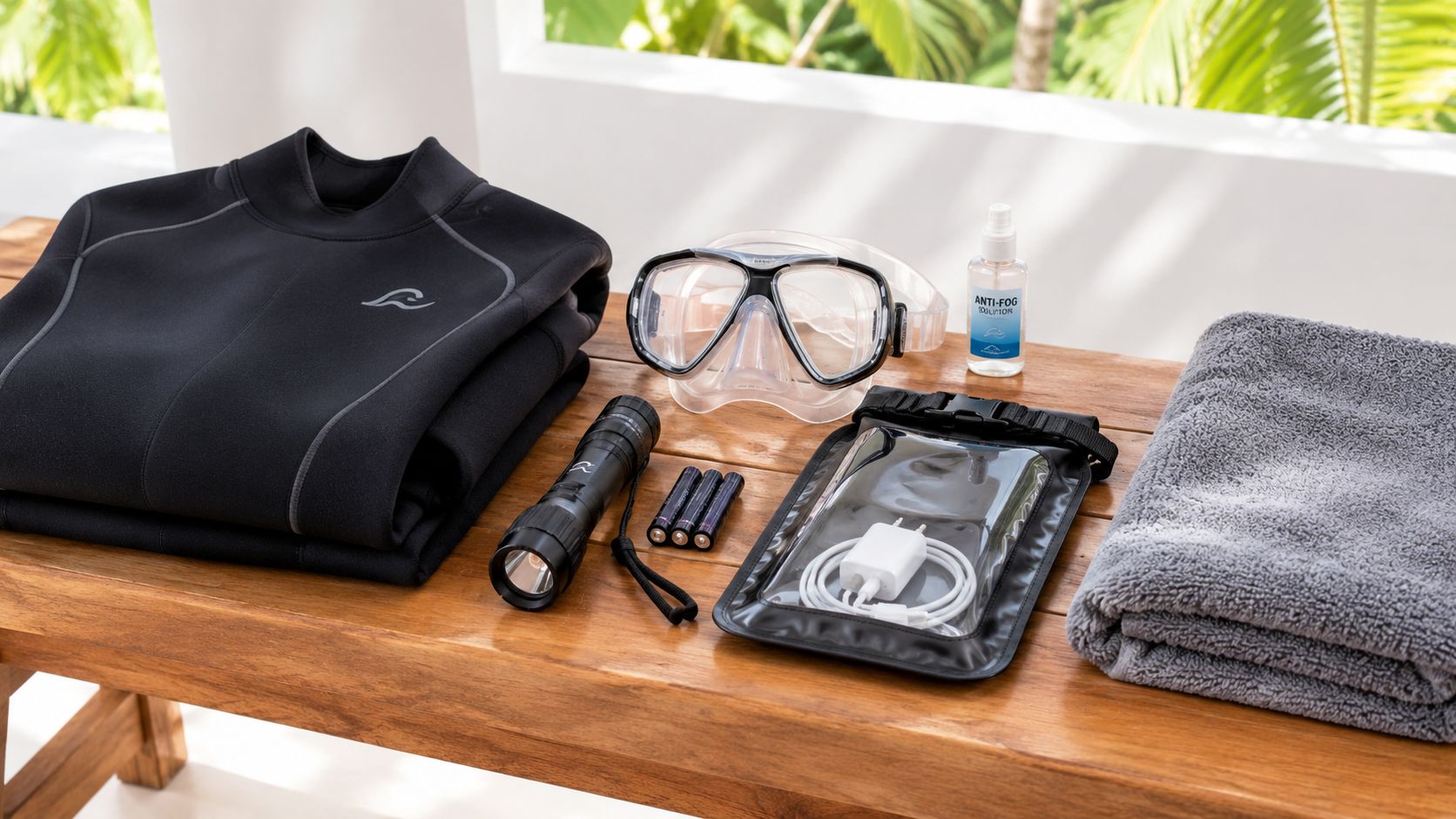
A simple pre-trip routine
- Confirm the operator's gear list: Ask what's included and whether you need to bring a mask, computer, or other personal equipment.
- Check camera batteries: Charge camera batteries and strobes or video lights beforehand. Bring a charger if you're continuing your trip afterward, but keep it out of the wet-gear area.
- Plan for motion sickness: If boat rides sometimes bother you, prepare in advance and ask a health professional or pharmacist about suitable options. This guide to managing seasickness on a boat offers practical preparation ideas.
- Keep essentials accessible: Put your towel, dry layer, and any personal medication where you can reach them without digging through wet dive gear.
- Defog before boarding: Apply mask defog as directed and keep the mask protected until you're ready to enter.
The operator should explain which lights are provided and how they're used. Don't bring an extra high-powered light just because you own one. Uncontrolled beams can make the viewing area less orderly, while the crew's setup is designed to direct light toward the water and the plankton patch.
Photographing a feeding manta
A wide-angle lens is usually more useful than a tight zoom because a manta can pass close and fill much of the frame. For compact cameras or action cameras, keep the setup simple enough that you can still hold position and follow the crew's instructions. A camera shouldn't become a reason to swim after an animal or block someone else's view.
Use controlled lighting. A red light or a beam-shaping approach can reduce unnecessary disturbance, but follow the operator's rules rather than improvising. If your camera allows manual white balance, test it under the actual dive lights, because the color cast underwater can make automatic settings unreliable. Plankton in the water can also reflect strobes and create backscatter, so avoid firing powerful lights directly through dense water when a shot doesn't need them. Above all, keep camera settings secondary to buoyancy, position, and awareness of the group.
Crowding, Etiquette, and Reading the Operation
A manta encounter can feel successful for a visitor while still putting avoidable pressure on the animals and people in the water. More boats and divers don't automatically mean a better view. If groups crowd the viewing area, people swim across feeding paths, or vessels drift into places divers need to keep clear, the experience becomes harder to manage for both wildlife and crew.
Research on Kona's principal viewing sites identifies crowding and user conflicts as concerns not fully resolved by voluntary guidelines. A proposed management framework included a 2.5-hour site-use limit, a maximum participant-to-guide ratio of 10:1, designated viewing areas, restrictions on anchoring and rafting, and limits on vessel lighting. These figures describe a proposed framework, not a guarantee that every operator follows those measures. The underlying discussion appears in this Hawaiʻi County testimony on manta-viewing management.
Questions to ask before booking
A useful conversation with an operator should go beyond asking whether the trip is sustainable. Ask how the crew manages the actual conditions you'll encounter:
- Group size: How many divers or snorkelers will be in the water, and how many guides will supervise them?
- Positioning: Does the crew keep divers in a defined viewing area and explain how to avoid the mantas' feeding route?
- Vessel control: What does the boat do while guests are underwater, and how does the crew manage nearby vessel movement?
- Lighting: Who controls the lights, and what guidance do guests receive about their own torches or cameras?
- Site limits: How does the operation respond when several boats converge or the viewing area becomes crowded?
- Anchoring and mooring: What practices does the crew follow to avoid unnecessary pressure on the site?
The answers tell you more than a general stewardship claim. A responsible operation can explain its briefing, surface lookout, group placement, and response to crowding in straightforward terms. Before entering, follow the crew's etiquette guidance on responsible and considerate diving, then put it into practice by staying still, keeping your gear close, and leaving the animals room to feed.
Seasonality, Pricing, and Why Book with Kona Honu Divers
Kona's manta encounters are based on feeding behavior, so no operator can promise that mantas will appear on a particular night or follow a predictable path. Light placement, water movement, and the distribution of plankton can affect where the animals feed and how long they remain in the viewing area. For trip timing, conditions, and planning advice, consult this guide to the best time to see manta rays in Kona.
Compare tour prices directly with operators, since costs and inclusions can differ. Check whether the trip includes the afternoon reef dive, tanks, weights, lights, a manta briefing, and the boat ride, and ask what equipment you'll need to provide. Kona Honu Divers offers a two-tank manta trip that pairs an afternoon reef dive with a guided manta night dive, with Garden Eel Cove among its Kona viewing locations. Its manta ray dive tours provide details to review before choosing a date.
Kona Honu Divers offers a guided manta night dive at Garden Eel Cove, with a crew-led plan for the boat, the viewing area, and the underwater encounter. Review the trip details, choose a date that fits your Kona plans, and visit Kona Honu Divers to book.