
Table of Contents
- Expect anticipation, not continuous action
- Why this isn't just luck
- Choose your perspective, not your proximity
- Garden Eel Cove vs Manta Village
- Better doesn't mean guaranteed
- Settle before the mantas arrive
- Ethical distance still matters
- The do-and-don't checklist
- What to prioritize
- A practical calendar summary
- Bring the essentials, confirm the rest
- Photograph the pass you get
- Confirm the package before paying
- Use your confirmation as the logistics sheet
- Are mantas the main danger?
- What certification do I need?
- What happens if no mantas appear?
- What local rules matter?
You've probably got a Kona manta dive tab open, a few competing tour descriptions, and one nagging question: is getting into the ocean after dark going to feel comfortable? My advice is to choose the site before you choose the deal. Garden Eel Cove is my pick for a first manta scuba dive, and flexible travel dates matter more than finding the perfect moon phase.
What a Kona Manta Night Dive Actually Feels Like
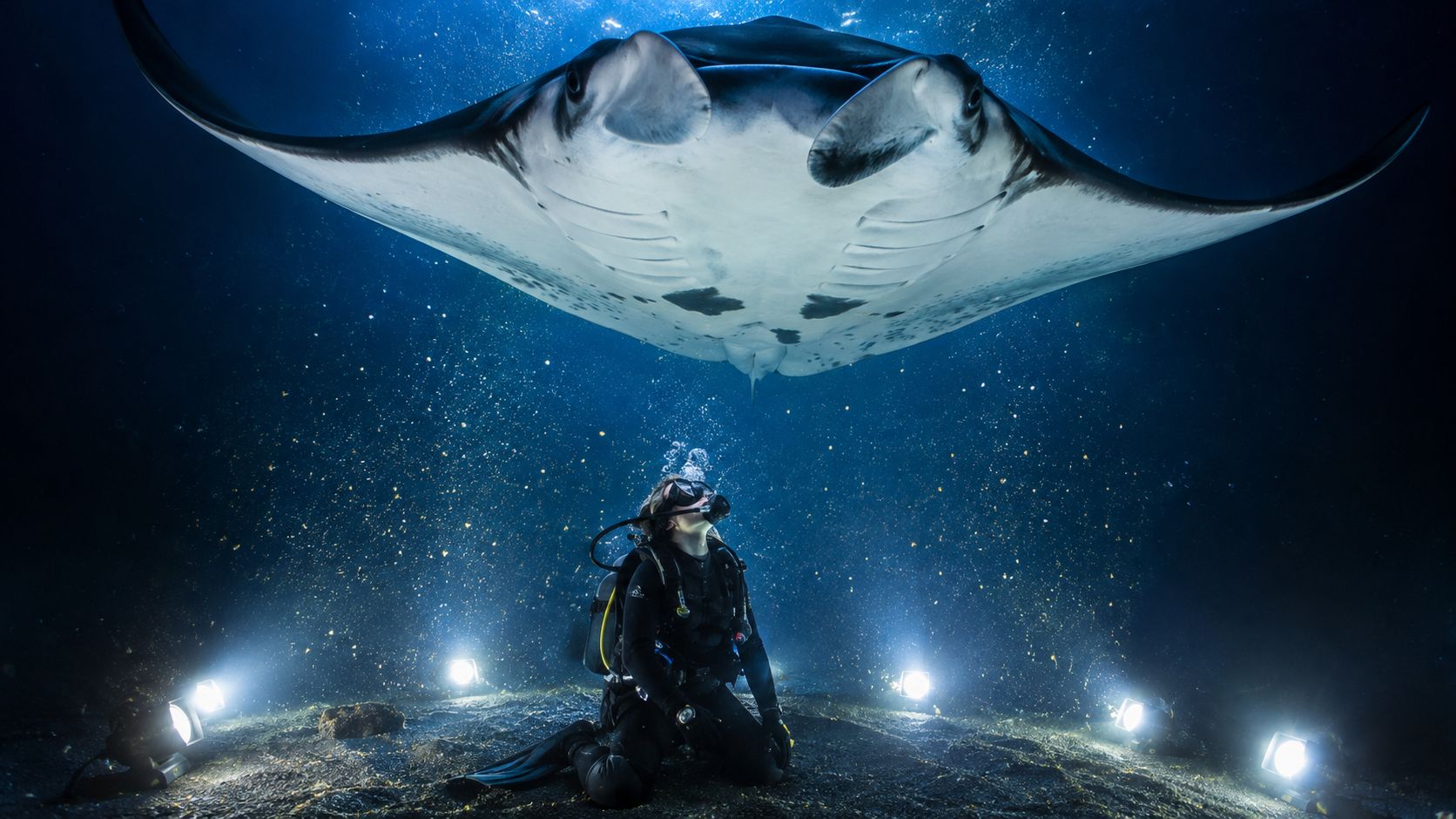
Think of yourself settled near the sand at Garden Eel Cove, watching particles drift through an upward-pointing beam. Beyond the light, the water looks black. Then a manta enters the illuminated area, opens its mouth, and glides overhead while you resist the instinct to lift your camera and follow.
That's the experience you're buying: a stationary wildlife observation dive, not a nighttime swim in pursuit of animals. Your job is to get comfortable, establish your position, and leave the feeding space open.
Expect anticipation, not continuous action
The waiting is part of it. You might see a shadow approach, disappear beyond the beam, then return from a different direction. Don't turn that uncertainty into a reason to move around.
I'd rather see a first-timer enjoy a quiet, controlled pass than spend the whole encounter wrestling with buoyancy or a camera. Arrive ready to listen, and tell the crew if night diving makes you nervous. That gives them something useful to work with before you enter the water.
Practical expectation: Book an opportunity to watch feeding behavior, not a guaranteed close pass or a guaranteed number of animals.
The format makes more sense once you understand the lights. The Kona night-diving overview explains that illumination gathers natural plankton rather than food supplied by divers. That's why the encounter happens after dark and why staying near the established viewing area beats swimming away.
Good preparation is straightforward: choose your site carefully, keep your schedule flexible, sort out your equipment, and understand the positioning rules before boarding.
How the Encounter Actually Works
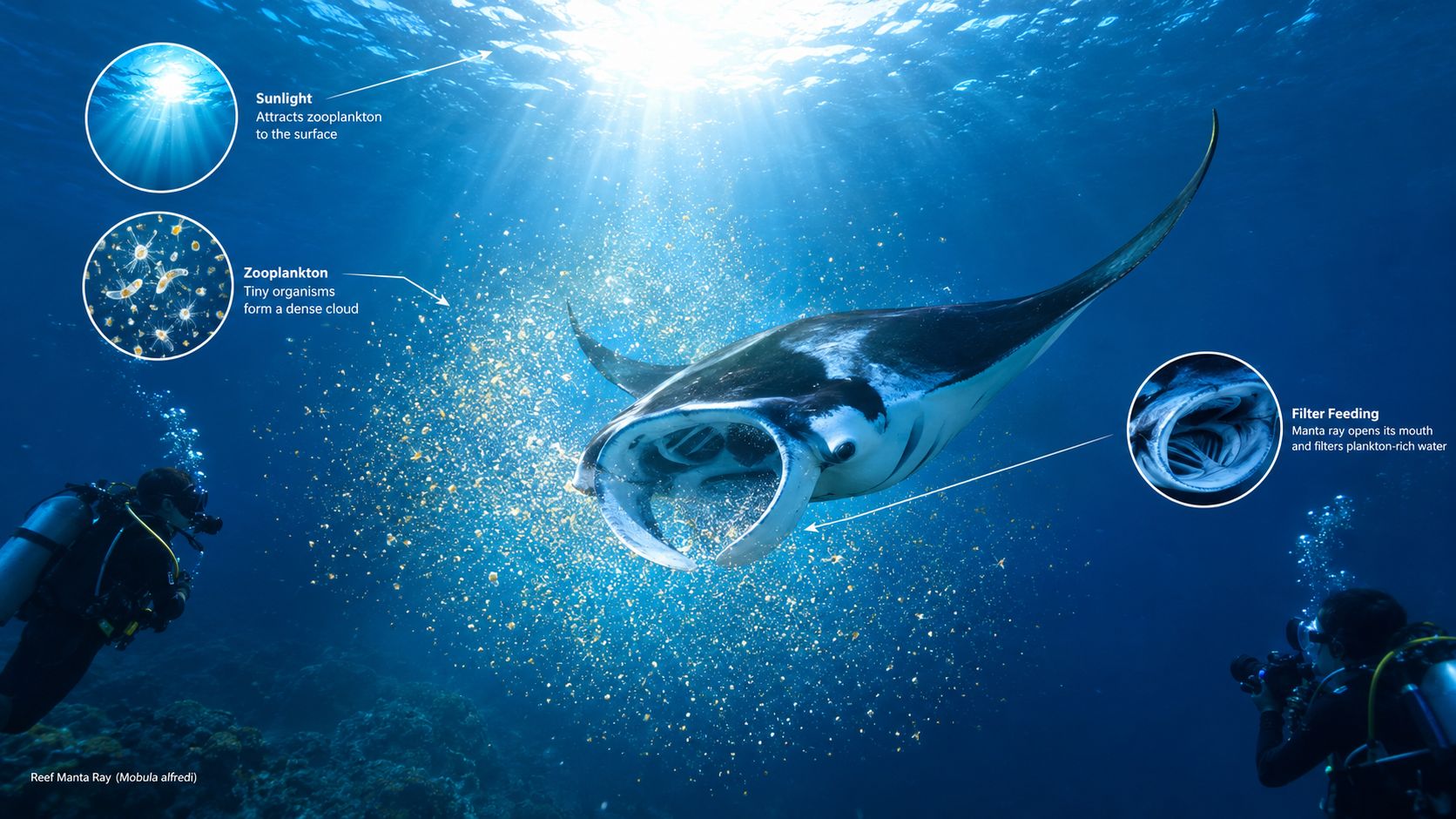
Kona manta diving works around a concentrated food patch. Underwater and surface lights increase illumination, zooplankton gathers in the lit water, and reef manta rays filter-feed through it. Divers don't hand-feed the animals, and the crew doesn't control their routes.
Research on Hawaiian reef mantas identifies attraction to zooplankton at established nighttime viewing sites as the principal mechanism. It also documents strong female reproductive philopatry and relatively limited exchange among Hawaiian island populations, which makes minimizing disturbance at these recurring sites important for conservation (Hawaiian reef manta genomic research).
Why this isn't just luck
Researchers recorded 25,444 observations of 118 individually identified reef manta rays at Manta Heaven and Manta Village from January 1, 2009, through December 31, 2014; 39 individuals appeared on more than 10% of study nights, demonstrating substantial repeat use of the sites (standardized Kona manta observation record).
Those are observations, not that many different animals. The distinction matters: the same identifiable mantas repeatedly returned to established feeding areas. You're visiting a recurring resident aggregation rather than hoping a passing animal happens to cross your path.
The practical lesson is to stop thinking of the light as a stage with a fixed performance. It's a feeding zone whose shape and usefulness can change with conditions. A manta might make repeated passes, change direction, or leave without doing anything wrong.
Choose your perspective, not your proximity
Scuba puts you below the feeding zone; surface viewing puts you above it. Neither perspective gives you permission to occupy the middle.
Use the comparison of snorkeling and diving with manta rays to decide which format suits your comfort and qualifications. My recommendation is simple: choose scuba because you're comfortable managing scuba equipment, not because you think it guarantees the closest encounter.
The animal should decide the distance. Your contribution is a predictable position and an unobstructed route.
Why Garden Eel Cove Is the Better Tour Site
Choose Garden Eel Cove for the dive version. Its advantage isn't just the possibility of seeing mantas. It's the combination of a protected setting, a defined bottom viewing area, and a better reef environment for the overall outing.
Also called Manta Heaven, Garden Eel Cove has a gently sloping layout with a sandy plain, scattered coral heads, and lava-rock formations. That layout gives divers a clear area to position themselves near the lights, and its protected setting supports a more comfortable viewing experience than more exposed alternatives (Garden Eel Cove site description).
Garden Eel Cove vs Manta Village
| Feature | Garden Eel Cove (Manta Heaven) | Manta Village (Keauhou) |
|---|---|---|
| Reef quality | My preferred choice for the reef setting | Choose primarily for the manta encounter |
| Exposure | Protected setting is a planning advantage | Assess the actual conditions before departure |
| Lighting setup | Defined bottom area supports organized positioning | Ask how the operator separates viewing and feeding areas |
| Viewing area | Sandy plain with nearby coral and lava formations | Ask about bottom placement and diver spacing |
| Typical manta group size | Larger nighttime aggregations in the comparative research | Smaller aggregations relative to Garden Eel Cove in that research |
| Human crowding | Ask about boat capacity and in-water organization | Ask the same questions; the site name doesn't establish crowd size |
The strongest biological comparison comes from a 2025 University of Hawaiʻi analysis covering 2010 through 2022, with more than 23,000 sightings of 167 unique reef mantas: Garden Eel Cove consistently supported larger nighttime aggregations than Keauhou, and aggregation size closely tracked zooplankton density (University of Hawaiʻi aggregation analysis).
Better doesn't mean guaranteed
Keauhou remains a legitimate manta site. The same research found female site fidelity there and connectivity between the sites, not completely separate populations.
But for a first scuba outing, I'd prioritize bottom layout, reef setting, and the stronger aggregation record together. Don't confuse a larger manta aggregation with a smaller tourist group, either. Ask the operator how many guests share the viewing area and how guides manage spacing.
Select a Garden Eel Cove departure when conditions support it, and accept a safety-driven change rather than insisting on a particular site regardless of the ocean.
Certification, Safety, and How to Behave in the Water
Your certification card is the starting point, not the whole readiness assessment. Before booking, tell the operator your qualification, when you last dived, whether you've done a night dive, and whether you can stay stable without sculling your hands or kicking constantly.
Get the current certification requirement directly from the operator. Don't rely on a general guide for a promised depth, visibility figure, or acceptance rule. Ask about the planned profile and whether your recent experience fits it.
Settle before the mantas arrive
Complete your buoyancy check before moving into the viewing area. Secure dangling equipment, identify your buddy, and make sure you can locate the guide without sweeping your torch through everyone's eyes.
NOAA-associated interaction guidance recommends that divers remain on or near the sand, rubble, or boulder bottom, hold lights above their heads pointing upward, and time exhalation to avoid directing bubbles into approaching mantas; surface users stay above and shine lights downward (manta diver-positioning and light-handling guidance).
Apply that guidance carefully. “Near the bottom” doesn't mean kneeling on coral, piling on weight, or making yourself negatively buoyant. Use the guide's designated substrate and maintain enough control to reposition gently when instructed.
Keep breathing normally and continuously. If a manta approaches, avoid a sudden burst of exhalation toward it when you can do so comfortably, but never hold your breath to improve a photograph or prevent bubbles.
Ethical distance still matters
Independent marine-fauna guidance recommends maintaining at least 3 meters (10 feet), staying passive, approaching from the side rather than the front, and never touching or chasing; it also summarizes evidence that tourism encounters can cause mantas to change course, avoid swimmers, or stop feeding (Marine Megafauna Foundation manta tourism guidance).
For this stationary encounter, don't interpret “approach from the side” as an invitation to swim toward a feeding ray. Set up with room available, then let the animal move.
Stay low, stay still, let the manta come to you.
The do-and-don't checklist
- Do stabilize early. Fix mask, trim, and equipment issues before you're beneath the feeding area.
- Do keep buddy contact. Agree on signals and what to do if either diver needs assistance.
- Do follow repositioning instructions. Move slowly and avoid disturbing the bottom.
- Don't rise for a closer view. Keep your body and camera outside the feeding corridor.
- Don't chase or reach. A departing manta isn't something to retrieve.
- Don't block a pass from behind. Turn your eyes or camera, not your whole position.
Review the responsible diver etiquette guidance before departure. The rules work best when they're habits, not decisions you first make with a manta overhead.
Best Time of Year and What Actually Changes Your Odds
Separate “the boat can run” from “many mantas will appear.” Those are different questions, and a useful operator should discuss them separately.
A calm departure can produce a modest encounter. A productive feeding night can coincide with conditions that prevent safe boarding, entry, or recovery. Neither outcome disproves Kona's resident-manta appeal.
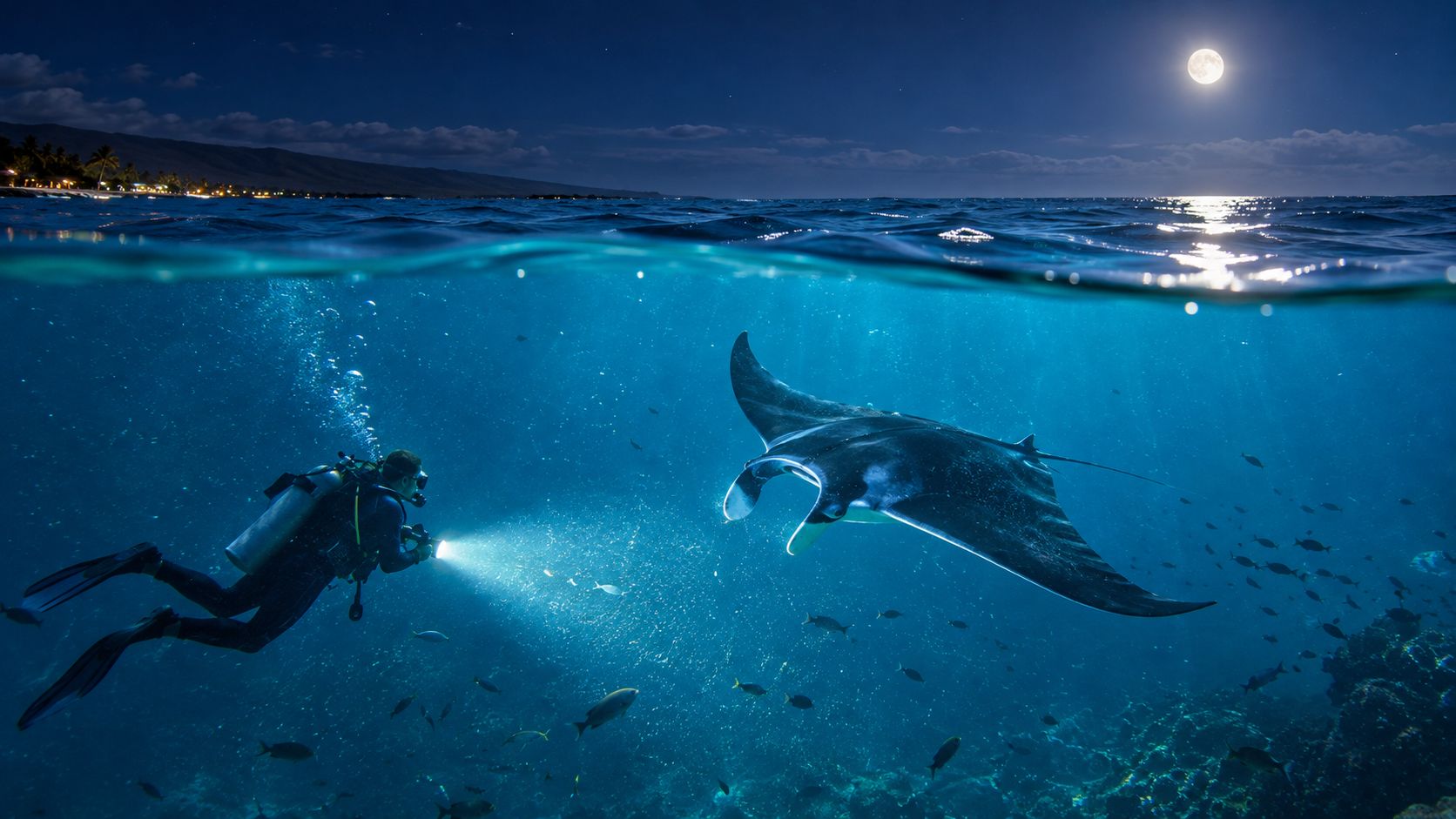
One 308-night observational dataset recorded manta presence on roughly 85–90% of nights, with counts ranging from zero to 37 and averaging 10.6; the relationship between lunar illumination and manta numbers was weak, with a correlation of 0.09, while the planning analysis identifies approximately April through October as a generally calmer window and winter swell as a cancellation concern (Kona manta conditions and moon-calendar analysis).
What to prioritize
- Plankton availability. This is the food-related variable, not something you can guarantee through a calendar reservation.
- Currents and water-column conditions. Ask the crew how these are affecting the feeding area.
- Wind and swell. These belong near the top of your departure and comfort questions.
- Water temperature. Ask about current conditions and exposure protection rather than assuming the night will feel warm.
- Moon phase. Treat it as a minor planning consideration, not a shortcut to a better encounter.
Don't convert that observational presence rate into a guarantee for your reservation. It describes recorded nights in a particular dataset, not every operator, departure, or future evening.
A clear forecast helps you plan a departure. It doesn't promise a large aggregation.
A practical calendar summary
For January, February, and March, leave room for weather changes. For April, May, June, July, August, September, and October, prioritize the generally calmer seasonal window without expecting identical conditions each month. For November and December, build flexibility back into the itinerary rather than treating a confirmed reservation as a confirmed departure.
I wouldn't assign a different manta forecast to each month without evidence. That would make the calendar look more precise than the underlying information supports.
Use the guide to the best time to see Kona mantas alongside current operator advice. Book earlier in your stay when practical, keep another evening open, and skip the elaborate new-moon itinerary.
What to Pack and How to Photograph Mantas
Pack for a controlled night dive and a damp ride back, not an underwater expedition. Confirm the rental inventory first, then bring personal equipment you know fits and works.
Don't buy a particular wetsuit thickness because a packing list names one. Tell the crew whether you get cold easily and ask what exposure protection suits current conditions.
Bring the essentials, confirm the rest
- Personal fit items. Your familiar mask, suitable exposure protection, and dive computer deserve priority.
- Night-dive equipment. Confirm arrangements for primary and backup lights, plus the surface-signaling equipment required for the trip.
- Secure storage. Bring a dry bag for your phone and belongings, and keep unnecessary valuables ashore.
- After-dive clothing. Pack a towel, dry shirt, and warm outer layer where they'll remain dry.
- Booking documents. Have your certification information and any required paperwork accessible before departure.
- Camera equipment. Bring only a housing, controls, and attachment system you already understand.
Ask whether tanks, weights, rental scuba equipment, exposure protection, and lights are included or separately charged. “Gear available” and “gear included” aren't interchangeable.
For seasickness concerns, speak with a pharmacist or clinician about suitability for diving before choosing a product. Retail options include Ship-EEZ Seasickness Patch, Dramamine pills, Bonine pills, Sea Band wristbands, and ginger chews; don't assume these products are equally effective or appropriate for you.
Photograph the pass you get
My camera recommendation is wide-angle framing, familiar controls, and minimal distraction. Test your housing before boarding, switch off unnecessary accessories, and keep the rig close enough that it doesn't project into the manta's route.
Use the available light as your starting point. Review a test image, then adjust exposure sensitivity and aperture within what your camera can handle. Don't copy a supposedly universal setting or assume a more expensive body will solve positioning problems.
Avoid aiming lights into other divers' faces, and ask the crew about permitted camera lighting. If the water contains visible particles, accept some haze rather than moving around to chase a clean background.
The manta night-dive photo-package information is worth checking if you'd rather watch than manage a housing. For a first night dive, leaving the photography to someone else can be the more sensible choice.
Booking With Kona Honu Divers and What to Expect
Start with the manta ray dive tour page, then check the live booking details rather than relying on an old price screenshot. My recommendation is to look for the Garden Eel Cove format and confirm what applies to your departure.
The important purchase isn't a list of impressive adjectives. It's a suitable trip, a clear equipment arrangement, a useful briefing, and an ocean plan the crew is willing to change when necessary.
Confirm the package before paying
Ask whether your selected booking combines an afternoon reef dive with the manta night dive, which site is planned, and what happens if conditions require a change. Confirm the diver and surface-viewing arrangements separately if your group has mixed qualifications.
Get specific about inclusions. Ask about guide arrangements, tanks, weights, lights, rental equipment, and exposure protection. If you want a photo package, request its current availability rather than assuming it comes with the booking.
Use the full diving tour selection to compare formats, not just headline prices. The dive-company selection guide can help you organize the questions that matter.
- Total price. Check the final checkout amount and any equipment or photography charges.
- Discount eligibility. Ask whether current early-booking or multi-trip offers apply to your specific reservation.
- Breathing gas. Confirm availability, charges, and qualification requirements before selecting anything other than your usual arrangement.
- Cancellation terms. Read both guest-cancellation and operator-cancellation policies.
- Wildlife terms. Ask what happens if the trip runs but no mantas appear.
Use your confirmation as the logistics sheet
Don't head to a harbor location from memory or assume a night dive means checking in after sunset. Follow the meeting location and time in your reservation, and contact the operator if anything is unclear.
Tell the crew about recent diving experience, equipment needs, and comfort concerns before departure. Ask how the briefing handles buoyancy, lighting, buddy procedures, and exits. You shouldn't have to improvise those decisions underwater.
Use the live availability calendar to choose a date with room elsewhere in your itinerary. A flexible reservation plan is more useful than squeezing the dive into your final available evening.
FAQs and Local Rules Worth Knowing
Are mantas the main danger?
They're filter-feeding animals, not animals you need to provoke or evade. Your attention belongs on equipment control, buddy awareness, conditions, and an orderly exit. A wildlife encounter still requires diving discipline.
What certification do I need?
Confirm the current requirement for the exact dive booking, and describe your recent experience. Don't substitute enthusiasm for readiness. If you're unsure about managing scuba equipment at night, discuss another viewing format with the operator.
What happens if no mantas appear?
Read the wildlife policy before paying. Don't assume a refund, partial refund, or return voucher exists. Also distinguish a weather cancellation from a completed trip without sightings, because those may be handled differently.
What local rules matter?
Hawaiʻi's Division of Boating and Ocean Recreation identifies mantas among protected marine species and advises against actions that injure or disturb them; the site guidance also emphasizes observation-only encounters, buddy contact, appropriate lights, and remaining in the illuminated viewing area (Garden Eel Cove wildlife and diving guidance).
Treat non-contact observation as a firm requirement, not something negotiable for a photograph. Confirm your trip details on the manta dive booking page, then choose your date through the availability button above.
Kona Honu Divers offers a manta ray dive tour for travelers planning this distinctive Kona night encounter. Visit Kona Honu Divers to check current departures, confirm the Garden Eel Cove plan and equipment arrangements, and reserve an evening with flexibility built into your stay.