
Table of Contents
- Why the lights matter
- How the dive unfolds
- What the long-term observations establish
- What to check before departure
- Separate the site recommendation from legal status
- Choose the viewing setup, not just the bay name
- Build a budget from inclusions
- Fit the diving around travel
- What you need to manage underwater
- What was proposed, not automatically made law
- Etiquette is necessary but not sufficient
- Look for operational answers
- Are mantas guaranteed?
- Should I touch the rays?
- Which site should I pick?
- Are the permit and guide-ratio limits law?
- What happens if rough seas cancel the trip?
- How much does a Kona manta dive cost?
- Can I combine it with other diving?
- Make the booking match your plan
- Pack for the water and the ride home
You're looking at Kona manta dive bookings, and the photos make the decision seem easy: bright lights, dark water, and a manta ray gliding overhead. The harder questions come next. Which site should you choose, how comfortable do you need to be at night, and what happens if the ocean or the mantas don't cooperate?
A good booking starts with clear expectations. Garden Eel Cove is the stronger choice for a scuba tour, but the experience still depends on ocean conditions, your readiness, and how the operator manages the viewing area. The aim is to watch feeding animals without getting in their way, not to make wildlife perform on schedule.
What a Kona Manta Dive Is and How the Night Works
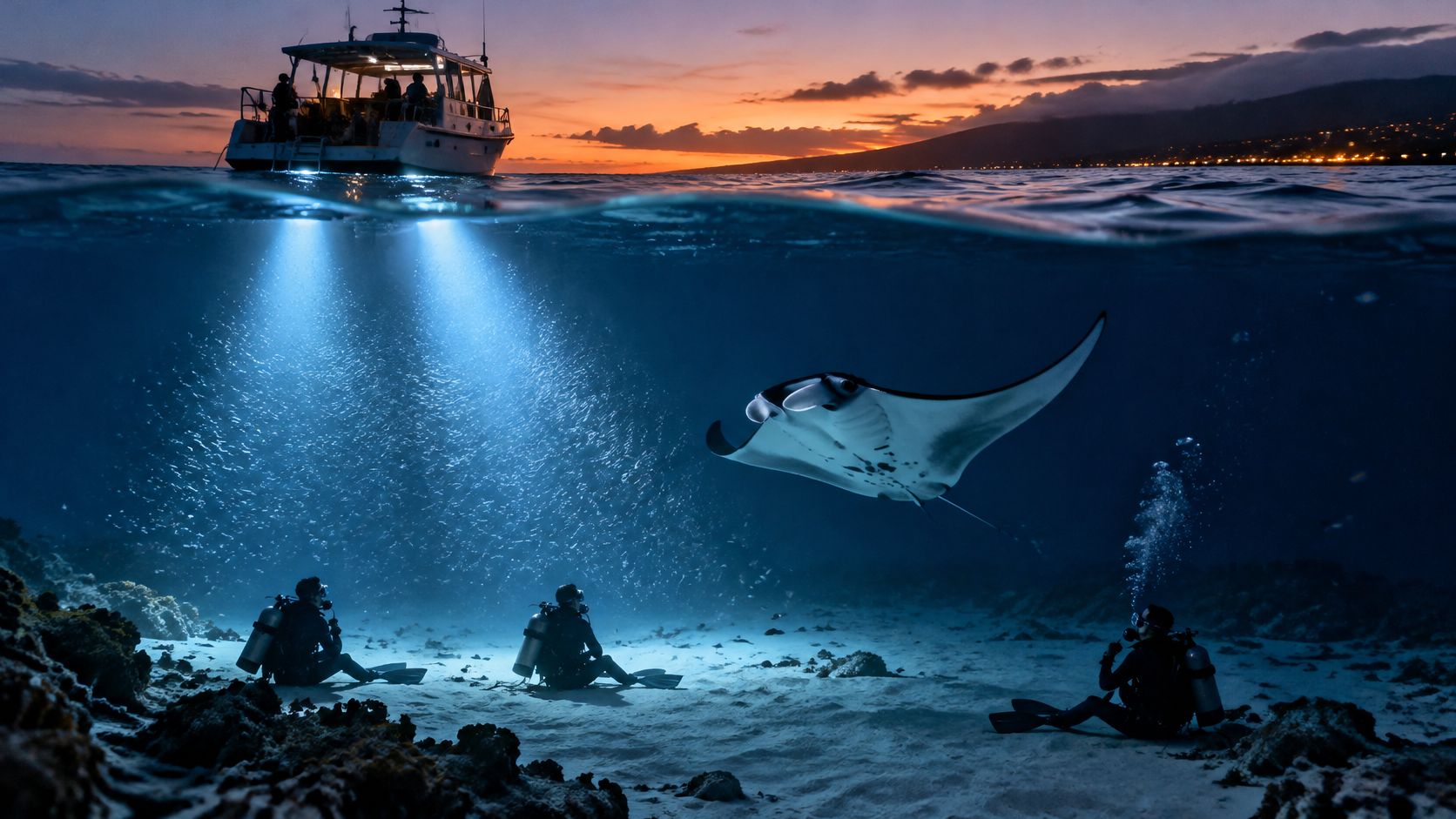
At dusk, your boat holds its position near the reef while the crew prepares the underwater lights. Once those lights switch on, tiny drifting organisms become visible in the beams. You're preparing to enter a feeding area, not follow a guide on a roaming reef tour.
The basic arrangement is straightforward. Divers settle at a designated bottom viewing area around the lights, leaving the water above them open for reef mantas, Mobula alfredi. The animals approach on their own terms, sometimes passing overhead before circling back.
Why the lights matter
The Needham and colleagues study on manta viewing describes the standard scuba format as divers seated around strong underwater lights while mantas feed above them, with lights concentrating the zooplankton the animals eat.
The light field works like a buffet under a spotlight, with the mantas as regular guests. The crew provides illumination, not a command for the animals to arrive. A working light array can still produce a quiet encounter if the surrounding water doesn't deliver much prey.
How the dive unfolds
- Before entering: Listen to the briefing, check your equipment with your buddy, and learn the signals for returning to the boat.
- During descent: Follow your guide to the designated viewing position. Don't settle on living coral or choose your own spot beneath an approaching manta.
- At the lights: Establish comfortable buoyancy, keep your fins controlled, and wait. Let the guide manage the light arrangement.
- On the return: Follow the agreed ascent procedure rather than leaving the group to pursue a final pass.
The quiet waiting is part of the dive. You may see plankton sparkling in the beam before a broad silhouette appears at its edge. When a manta turns overhead, resist the urge to rise toward it or reach up with your camera.
Practical rule: Your job is to hold a safe viewing position, not improve the encounter by moving closer.
Your perspective underwater is different from watching at the surface. If you're choosing between formats, this comparison of whether to snorkel or dive with manta rays helps clarify the experience. For a scuba booking, comfort with your equipment and calm, continuous breathing matter more than chasing a dramatic photograph.
When and Where Mantas Show Up Best
Calm, manageable water and a healthy plankton layer make a better combination than a supposedly perfect calendar date. Clear conditions help you enjoy the scene, but visibility alone doesn't tell you how much food is available to mantas. A comfortable dive and an active feeding aggregation are related considerations, not the same thing.
Use conditions to judge whether a trip is sensible, rather than treating them as a sighting formula.
Conditions that improve or reduce manta viewing
| Factor | Favorable | Less favorable |
|---|---|---|
| Sea state | Calm to light swell | Large swell or surge at the site |
| Current | Gentle or slack flow | Strong current across the dive area |
| Plankton | High zooplankton density under the lights | Thin prey layer, mantas disperse |
| Weather | Stable, clear conditions | Rough seas, trips may be cancelled |
What the long-term observations establish
That pattern explains why Kona supports organized manta viewing without making each departure predictable. These are repeatedly used feeding locations, but the amount of food in the illuminated water changes from night to night. You can have the same boat, lights, and dive plan on separate evenings and still get different animal activity. Plankton supply is the variable. Everything else stays constant.
Tides and lunar timing can influence the processes that move plankton around. They aren't a reliable promise that a particular departure will be better than another. Don't pay extra or rearrange your entire holiday around an unsupported claim about a guaranteed moon phase.
What to check before departure
The observations don't provide a fixed month-by-month sighting calendar for your trip. Recent activity and the actual marine forecast are more useful booking conversations than a broad claim about the best season. The practical discussion of the best time to see manta rays in Kona can help you frame those questions.
The day before departure, check:
- Swell and wind: Look at marine conditions, not just whether your weather app shows sunshine over town.
- Departure notices: Read the operator's messages and confirm where and when to check in.
- Cancellation terms: Know whether a weather cancellation leads to a refund, rebooking, or another arrangement.
- Schedule flexibility: Leave room for a replacement evening when practical.
A cancellation can be the correct decision even when the shore looks inviting. Boarding, exiting, and maintaining a stationary underwater group all need to be manageable.
Choosing Between Garden Eel Cove and Keauhou Bay
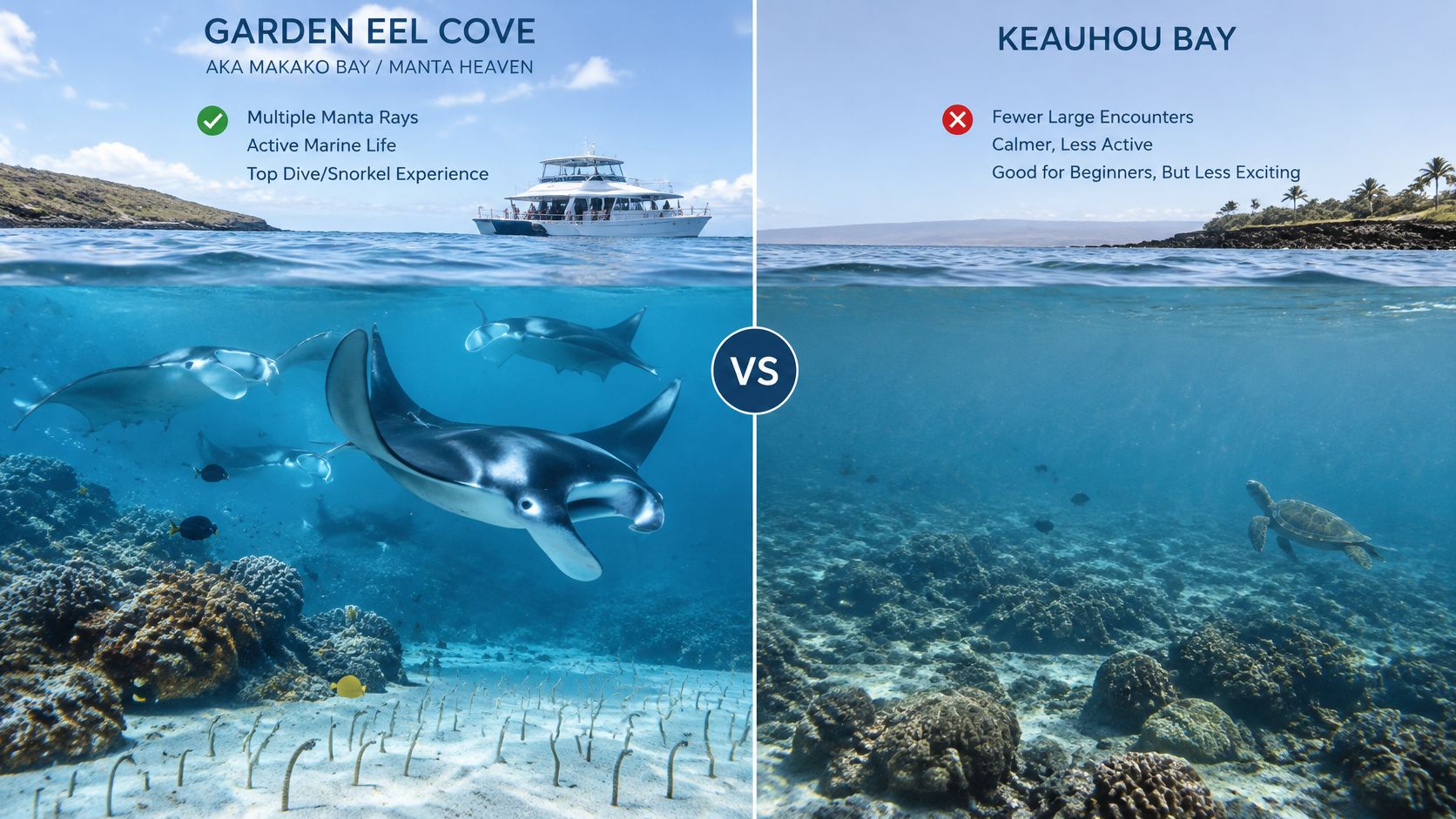
For a manta dive tour, Garden Eel Cove is the superior choice. Its protected location, better viewing area, and healthier surrounding reef make it the stronger scuba setting. Those advantages don't mean it's immune to swell, but they give the dive a more suitable base than choosing a site solely because it appears closer to your accommodation.
The DLNR manta-viewing boating and safety assessment identifies Garden Eel Cove, also called Makako Bay, and Keauhou Bay, also known as Kaukalaelae Point, as Kona's principal manta-viewing locations.
Garden Eel Cove and Keauhou Bay compared
| Site | Also known as | Commercial scuba authorized | Setting | Verdict for a dive tour |
|---|---|---|---|---|
| Garden Eel Cove | Makako Bay, Manta Heaven | Yes in the cited management framework | Protected location with a designated viewing zone | Best choice for a dive tour |
| Keauhou Bay | Kaukalaelae Point | No in the cited management framework | A separate nighttime feeding and viewing location | Second principal site, not the dive tour choice |
Separate the site recommendation from legal status
The DLNR short-form manta management document identifies Garden Eel Cove as the zone for commercial scuba operations and describes no anchoring, slow-no-wake speeds, and support vessels remaining in the zone while participants are in the water.
That document belongs to the proposed management framework, so it isn't, by itself, proof that every provision is currently enforceable law. The site comparison reflects the framework's allocation of scuba activity. Before relying on a restriction as current law, confirm the adopted rule and its effective status with DLNR.
This distinction matters because a sensible operating practice and a legal requirement aren't interchangeable. A crew can use careful vessel positioning and controlled approaches whether or not a particular proposal has become enforceable.
Choose the viewing setup, not just the bay name
A better viewing area lets the guide arrange divers without encouraging everyone to crowd the same opening. The surrounding reef also matters when your evening includes a separate reef dive, rather than only the feeding encounter.
Before paying, establish:
- The actual site: Confirm Garden Eel Cove rather than accepting a generic Kona manta description.
- The viewing arrangement: Ask how divers are positioned without contacting coral or blocking feeding paths.
- The shared space: Find out how the group is managed when other operators are present.
Keauhou remains important to understanding Kona's manta activity. It isn't the site to select for the scuba itinerary described here.
Sample Itineraries and Costs for a Manta Night
| Plan | Timing | What happens |
|---|---|---|
| Night manta dive only | Afternoon arrival, dusk departure | Check in, fit gear, rest before boarding, and leave the late evening open |
| Daytime reef dive, then night manta | Morning dive, dusk manta dive | Reef dive, surface interval, rest and meal, then the night dive |
| Two dive days with a rest day between | First dive day, rest day, second dive day | Manta evening on the first dive day, daytime diving after the intervening rest day |
These are planning examples, not published departure schedules. A night-only option must be offered before you build your day around it. Likewise, a package combining an afternoon reef dive and a night dive isn't the same itinerary as booking a separate morning charter.
Leave enough time after your return for changing, a shower, and food. Don't assume a particular return hour or reserve an inflexible late dinner until the operator confirms the expected schedule.
Build a budget from inclusions
There's no current retail price established by the cited sources. Confirm the live rate at booking, then check what that rate includes rather than comparing headline prices alone.
- Tour fee: Identify the exact itinerary and whether it includes a reef dive as well as the manta dive.
- Rental equipment: Confirm the BCD, regulator, exposure protection, mask, fins, and any required light.
- Additional diving: Price a separate charter separately unless it's explicitly part of a package.
- Photography: Check delivery, format, and inclusions when considering a Kona manta night dive with a photo package.
Bundling can simplify your day, but it doesn't automatically mean a lower total price. Compare the complete booking before deciding.
Leave your evening flexible enough that a slower equipment fitting, a changed departure, or a late return doesn't create a second problem on land.
Fit the diving around travel
Keep the morning before your manta trip light. Drink water, eat familiar food, and avoid heavy alcohol. Arriving tired after an overfilled sightseeing day makes a dark-water briefing harder to absorb.
Don't use a generic itinerary to decide when you can fly after scuba diving. Plan your required no-fly interval using your training, dive profile, computer guidance, and appropriate diving-medical advice.
For a workable sample day, check messages in the morning, rest during the afternoon, and arrive at the dock at the confirmed check-in time. Complete gear fitting before departure and leave the later evening uncommitted. Book your preferred evening early enough to preserve alternatives, especially if the manta dive is the main reason for your visit.
Certification, Rules and Safety for Night Diving
For the certified-diver scuba option, bring proof of recreational scuba certification and be ready to complete the operator's night-dive briefing. Certification establishes training history, not automatic readiness for every ocean condition. Tell the crew if you haven't dived recently or if darkness makes you uncomfortable.
If you still need foundational training, start with learning to scuba dive rather than treating a wildlife encounter as a substitute for basic skills. You should be able to clear your mask, recover your regulator, communicate an air problem, and control your position without relying on the bottom.
What you need to manage underwater
Keep your buddy within the agreed distance and identify the guide's light before descending. Ask how the group signals low air, discomfort, separation, and the end of the dive. Bright viewing lights don't remove the need for an individual exit plan.
- Light discipline: Keep your beam out of other divers' eyes and away from a manta's face. Use the orientation requested during the briefing.
- Air awareness: Check your pressure gauge even when the feeding activity holds your attention.
- Position control: Avoid unnecessary finning and don't use living coral as a handhold.
- Early communication: Signal discomfort promptly. You don't need to remain underwater because an animal has just arrived.
What was proposed, not automatically made law
The DLNR announcement of the proposed manta-viewing framework described up to 24 commercial permits in each designated zone, no more than 60 passengers for hire per vessel within a 24-hour period, two-hour operating shifts, an 8-to-1 guide-to-customer ratio, and viewing hours from 4:00 p.m. through 4:00 a.m. the following day.
Those figures describe a proposal. Publication of proposed limits doesn't make them automatically enforceable, and it doesn't prove the staffing or passenger load on your departure. Nor should a proposed passenger ceiling be mistaken for the group size you'll encounter around a light.
Use those categories to ask practical questions: how many divers a guide supervises, how the crew separates groups, and who makes the final go-or-cancel decision. We focus on small groups and personal attention, but you should still discuss any individual assistance you need before boarding.
Request the weather cancellation and rebooking terms in writing before payment. Ask specifically how swell, surge, current, and difficult boarding conditions affect the decision. A clear answer should describe the process without promising that a trip will run regardless of conditions.
Manta Welfare and Responsible Viewing
A Kona manta-viewing overview cites a monitoring period in which mantas appeared on about 92% of nights at Manta Heaven. That's useful evidence of repeated attendance. It isn't a measurement of stress, injury, feeding efficiency, or population health.
An animal returning to a feeding opportunity doesn't prove the activity has no cost. Equally, uncertainty about cumulative effects doesn't establish that every encounter causes harm. Responsible interpretation stays between those claims.
Etiquette is necessary but not sufficient
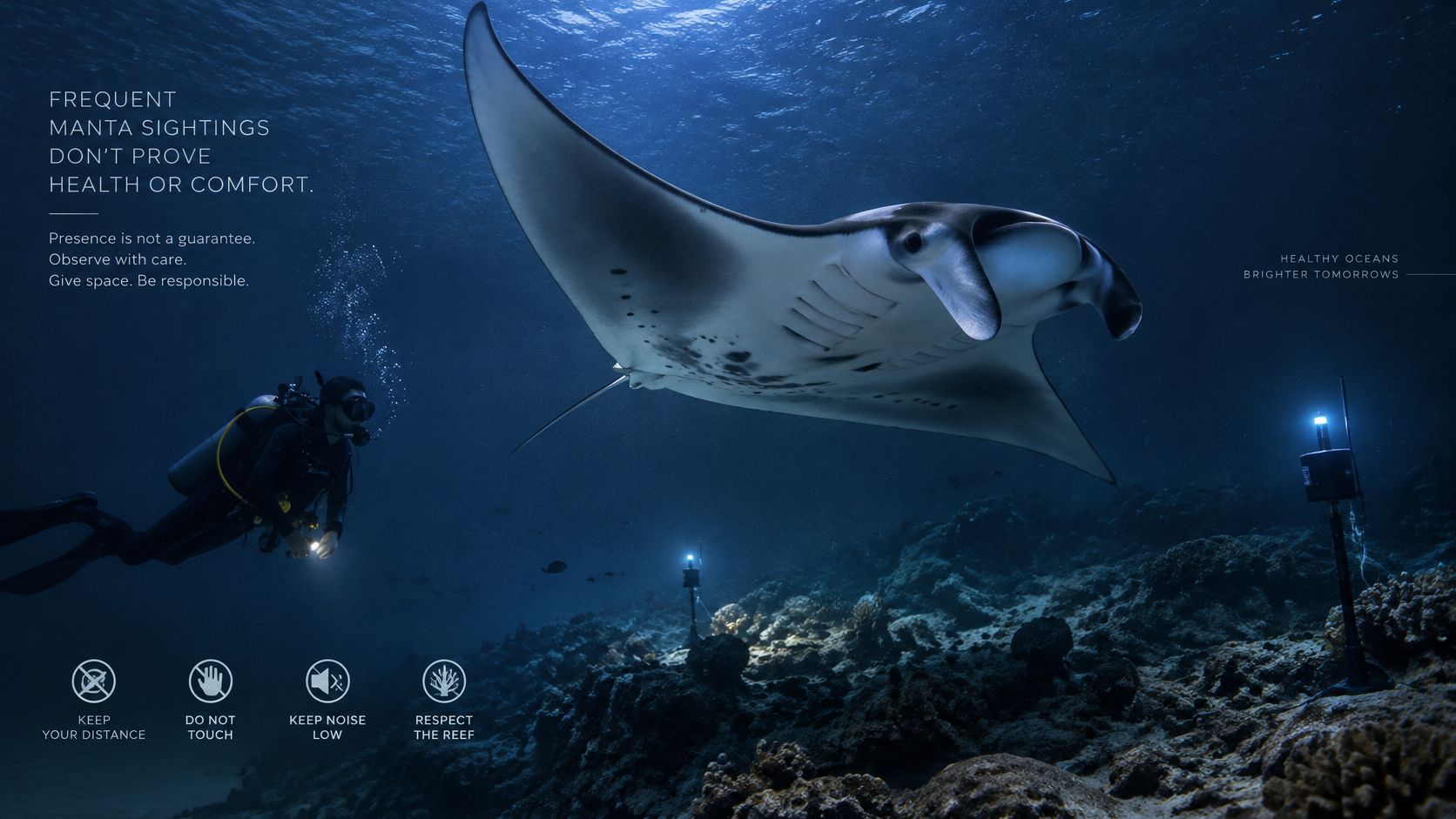
An operator can brief guests not to touch, chase, or obstruct mantas and intervene when someone ignores that instruction. Those are direct, observable actions. Good responsible diver etiquette helps you translate that principle into equipment control, positioning, and camera use.
The larger questions involve the whole viewing area. How much illuminated water is created? How many groups occupy it? Can boats and swimmers move without compressing the animals' feeding routes?
A no-touch briefing is a starting point for responsible wildlife viewing, not a complete sustainability assessment.
Repeated sightings can help document continued habitat use. They don't, on their own, tell you whether animals change their feeding schedules, spend more energy navigating people, or face increased collision risk. No long-term study cited here settles every behavioral and population-level consequence of this activity.
Look for operational answers
A responsible operator should explain how lights are coordinated, how divers are kept from spreading into feeding paths, and how vessels remain clear of people in the water. The crew should also be willing to change or abandon a plan when conditions make controlled viewing impractical.
Don't accept an eco-friendly label as the entire answer. Look for decisions you can understand and conduct you can observe.
Before booking, ask these questions:
- Shared lights: How many divers will use the same viewing light or arrangement?
- Vessel position: Where will the boat be relative to the viewing area and the people underwater?
- Cancellation decisions: Who assesses conditions, and what would cause the trip to be cancelled?
The most useful response is specific about the operation while honest about what remains uncertain.
Frequently Asked Questions About Kona Manta Dives
Are mantas guaranteed?
No. A reservation buys the guided trip, not an animal's attendance. Feeding activity responds to prey and water movement, so ask separately about the operator's no-sighting policy and its weather cancellation policy. Those policies address different situations.
Should I touch the rays?
No. Keep your hands and equipment close to your body, and let the manta choose its route. If you're filming, don't extend a camera pole into its path or leave your viewing position to follow it.
Which site should I pick?
Choose Garden Eel Cove for this scuba itinerary. Its protected setting and viewing layout are the practical reasons for the recommendation. Don't confuse the scuba allocation described in a management proposal with independently confirmed current legal status.
Are the permit and guide-ratio limits law?
The cited numerical limits were proposed framework provisions. They aren't a legal guarantee about your booking merely because they appear in a government announcement. Current enforceability requires an adopted rule, not just a proposal.
What happens if rough seas cancel the trip?
The answer comes from the booking terms you accept. Get the refund or rebooking arrangement in writing, including what happens if your remaining travel dates don't allow another attempt. Leave a spare evening when your itinerary permits.
How much does a Kona manta dive cost?
Check the current booking rate and equipment inclusions. A package price, a separate night charter, and an itinerary with photography aren't interchangeable comparisons. Make sure you're pricing the experience you intend to book.
Can I combine it with other diving?
Yes, provided the itinerary, surface intervals, and your readiness support it. Avoid packing your day so tightly that you arrive exhausted. Keep hydrated, allow time for a proper meal, and preserve the no-fly interval appropriate to your diving rather than scheduling around a hoped-for early return.
Book Your Manta Night Dive and What to Bring
Start with readiness, not the payment screen. Confirm your certification, consider how recently you've used your scuba skills, and tell us about equipment or comfort concerns before departure. Then choose dates that leave some flexibility if ocean conditions interrupt the plan.
Kona Honu Divers builds its manta night dive around Garden Eel Cove, a protected location with a good viewing area, healthier reef, and generally calmer conditions. We focus on small groups and personal attention from the moment divers step aboard.
Make the booking match your plan
Open the manta ray dive tour page, or browse the diving tours if you're coordinating your wider dive itinerary. Select the Garden Eel Cove experience, review the current availability and inclusions, and confirm the check-in instructions.
Before completing payment, request the weather policy and rebooking terms in writing. Confirm rental sizing and any equipment you intend to bring, so the crew can help resolve gaps before you reach the dock.
Pack for the water and the ride home
- Clothing: Wear a swimsuit and bring a towel, dry clothes, and a warm layer for after the dive.
- Personal equipment: Bring your mask and fins if you prefer your own, plus your certification information and dive computer.
- Exposure protection: Confirm the appropriate wetsuit. A rash guard isn't a substitute when you need greater insulation.
- Dive light: Bring one if you own it, but confirm the required setup and let the guide direct its use.
If you're prone to seasickness, discuss prevention with a pharmacist or clinician who understands that you'll be scuba diving. Medication that causes drowsiness may be unsuitable, and a patch marketed for motion sickness isn't automatically appropriate or effective for you.
Options sold for travel include the Ship-EEZ Seasickness Patch, Dramamine pills, Bonine pills, Sea Band wristbands, and ginger chews. Compare current prices and reviews rather than assuming a generic wristband is cheaper or better rated. If you choose an appropriate preventative, follow its directions before boarding and don't first test a sedating medicine on dive day.
Arrive rested, with your equipment questions answered and your evening free of unnecessary deadlines. That preparation lets you concentrate on the briefing and the underwater encounter.
Kona Honu Divers offers a guided manta night experience at Garden Eel Cove with small-group attention and a clear focus on preparation. Visit Kona Honu Divers to explore your dates, confirm the trip details, and plan a manta evening that fits your diving comfort and Hawaii itinerary.