
You're probably weighing the same question most divers ask before booking: will the mantas show, and what will the dive feel like once the boat lights disappear into the dark? A Kona manta night dive isn't a guaranteed performance. It's a wildlife encounter built around feeding conditions, a well-managed viewing area, and divers who can stay still while the animals choose their own path.
The difference between a memorable dive and a disorganized one often comes down to the site, the light and current, and your control in the water. Knowing how those pieces fit together helps you choose a tour and arrive ready for the actual experience, not an imagined one.
Table of Contents
- Arriving at the Kona Manta Ray Night Dive
- How the Manta Night Dive Works: The Feeding Mechanics
- Garden Eel Cove vs Manta Village
- Gear, Certification, and Preparation
- Safety, Rules, and the Operating Environment
- Booking With Kona Honu Divers
- Why This Dive Is Worth Doing Once and Again
Arriving at the Kona Manta Ray Night Dive
The sun drops behind the Kona coast while the crew finishes the gear check and lays out the light positions. At the site, the briefing is practical: where divers kneel, where snorkelers hold position, which lane stays open for feeding passes, and what to do if a manta turns toward you. Then you descend toward the glow. In the beam, a pale wing can materialize overhead, wheel once, and vanish back into black water.
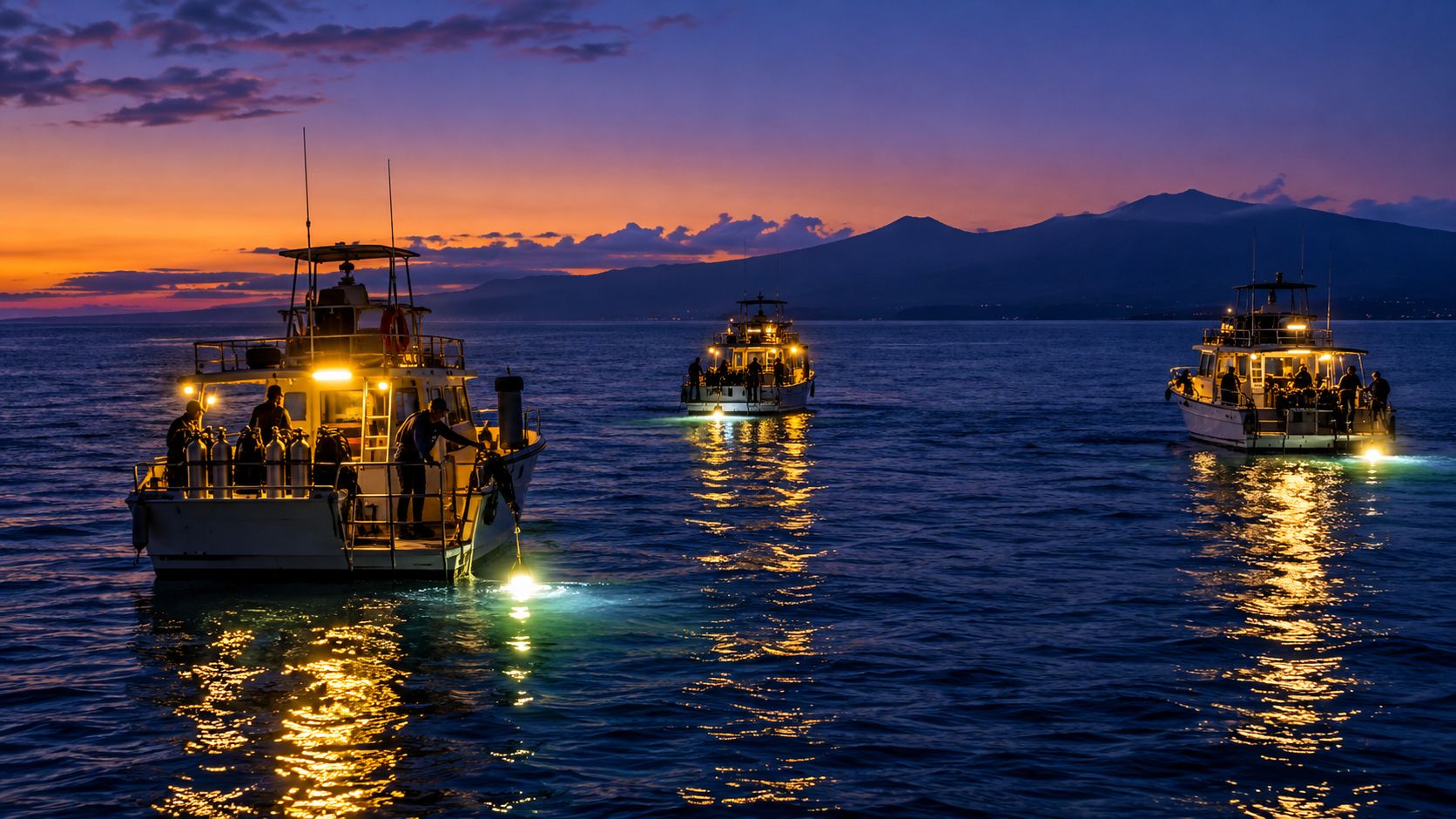
The activity began with an encounter, not a tourism plan. In 1985, marine naturalist Keller Laros encountered manta rays during a night scuba dive in Kona. He later began leading manta night dives, and in 1991 he started naming and cataloging individual rays. Early trips were small: one boat typically carried six to eight divers and visited the site several nights a week. By 1993, participation had grown to as many as five boats and approximately 50 people in the water. Historical reporting on Keller Laros and the early Kona manta dives describes the origins of an experience shaped by more than three decades of organized observation.
That history matters underwater. Kona isn't a place where visitors occasionally spot a manta. Individual identification and sustained observation have made the local encounters part of a longer relationship between wildlife, guides, researchers, and visitors. The principal viewing areas are Keauhou Bay, commonly called Manta Village, and Garden Eel Cove near Ho'ona Bay, commonly called Manta Heaven, both offshore from Kailua-Kona on Hawai'i Island's west coast.
The two sites behave differently once the lights go in. Garden Eel Cove's protected position, wider viewing area, and healthier reef give divers more room to settle without crowding the food patch. Keauhou can produce strong nights, but the window changes faster when wind, surge, or a packed sand line compresses the viewing space.
Before the boat leaves: If you're prone to motion discomfort, plan ahead rather than waiting until you're underway. These practical tips for avoiding seasickness can help you prepare for the ride and the time spent at the site.
The manta dive is a night in open water where wild animals choose the route. That distinction is part of what makes it compelling.
How the Manta Night Dive Works: The Feeding Mechanics
The whole encounter runs on a predator-prey mechanic that operators engineer on purpose. The details explain why some nights feel busy and others stay quiet.
First, the lights concentrate prey. Lamps set on the seafloor illuminate a patch of water, and zooplankton gathers in and around the beam: copepods, mysids, shrimp larvae, other planktonic organisms. The light isn't a signal that calls mantas in. It builds a feeding opportunity.
Then the mantas come to the food. Reef manta rays, Mobula alfredi, swim through the lit water with mouths open, filtering plankton as they loop and turn. The divers kneeling below aren't the attraction. The animals are feeding, and the people are observing from a fixed position underneath it all.
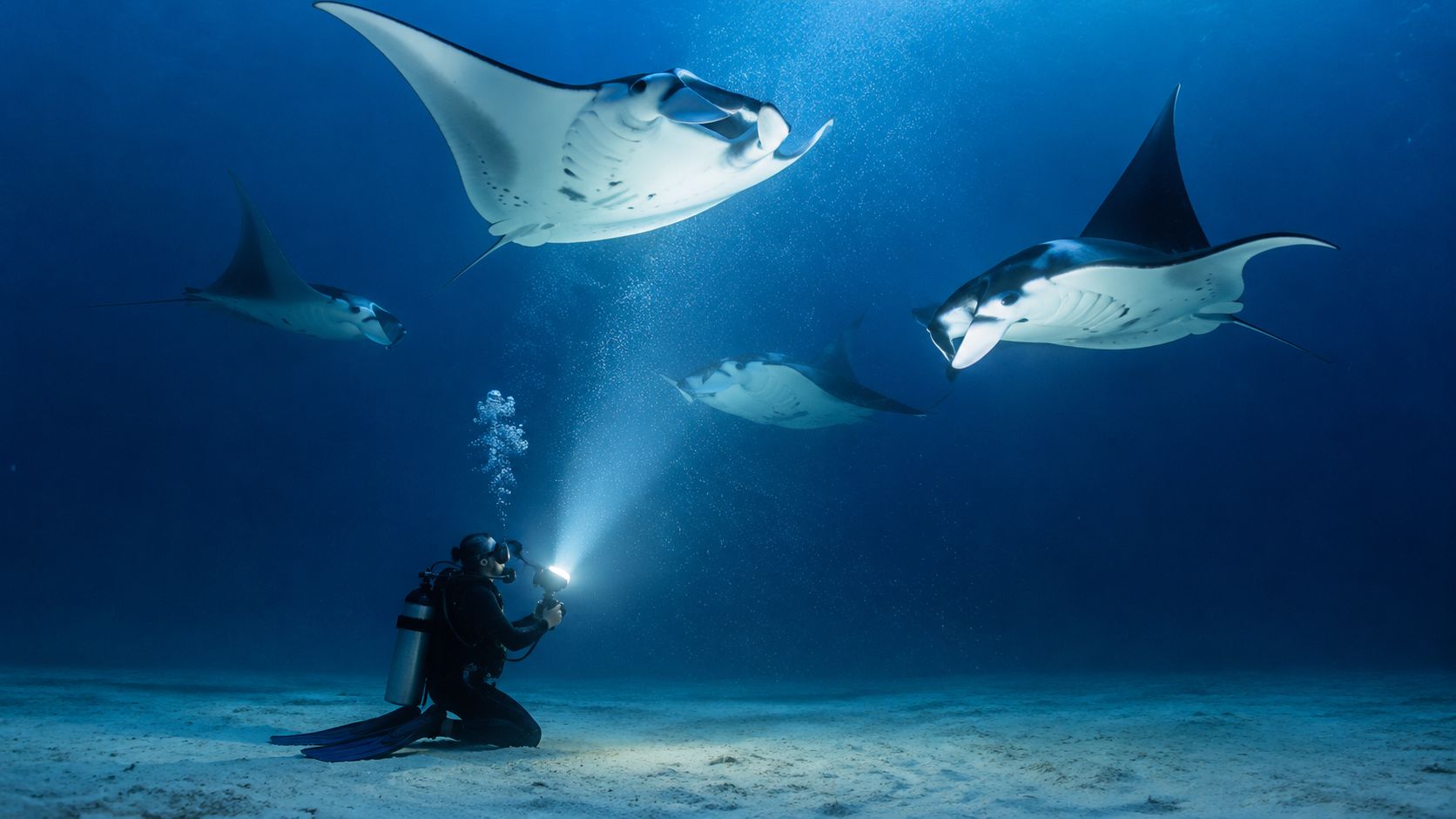
Finally, conditions set the table. Zooplankton density, current direction, and how well the site retains plankton decide how concentrated the patch becomes. More lights don't guarantee more mantas. I've watched the current carry the food off a site mid-dive and the rays follow it. On nights when the water holds still, the same patch can keep mantas circling until the lights go out.
That variability is why no responsible guide promises a fixed number of rays or a set pattern of passes. A 2025 University of Hawai'i study analyzed more than 23,000 community-sourced sightings from 2010 through 2022 and identified 167 individual reef manta rays at Garden Eel Cove and Keauhou. It found that aggregation size tracked zooplankton density, and that the aggregations stayed broadly stable across the observation period even as tourism grew.
The viewing setup stacks the water column deliberately. Divers stay on the seafloor around fixed lights while snorkelers float at the surface, creating a viewing corridor through the mid-water. That corridor only works if the divers hold the bottom. Finning upward puts you in the mantas' looping path and pushes a feeding animal off its line. Take the spot your guide assigns, keep your light angled as directed, and stay still. The calmest diver on the sand usually gets the closest pass overhead.
Garden Eel Cove vs Manta Village
Ask a Kona guide which site they would pick after a season of running both, and the answer is usually Garden Eel Cove. Keauhou Bay, known locally as Manta Village, is where the night encounter first took hold. Garden Eel Cove, also called Manta Heaven, sits in a more sheltered pocket of coastline, and that geography shapes everything from how the boat holds position to how calmly you can settle on the sand.
| Consideration | Garden Eel Cove | Manta Village |
|---|---|---|
| Location and layout | A more protected location with a larger, better-defined viewing area | A well-known viewing area at Keauhou Bay |
| Nighttime aggregations | Consistently supported larger aggregations in the 2025 study | Aggregations varied, with a different pattern of site use |
| Reef experience | A healthier reef setting adds interest beyond the illuminated feeding area | The experience centers on the established viewing site |
| Ecological pattern | Used as one of Kona's principal feeding areas | Visited predominantly by females in the study |
That protected position matters in the water. When the swell wraps around Kona's west-facing coastline, Garden Eel Cove tends to hold calmer conditions, so you spend the dive watching rays instead of being pushed back and forth across the bottom. Its larger viewing area also gives the group room to spread out, which keeps lights from stacking into a tight cluster and gives each diver a clearer lane of open water above them. The healthier reef around the site rounds out the night. While you wait for the rays, there is more to watch than an empty patch of sand.
The research backs up what guides see. The University of Hawai'i study introduced earlier found that Garden Eel Cove consistently supported larger nighttime aggregations, while Keauhou was visited predominantly by females. Across both sites, the overall sex ratio was approximately 1:1. Males showed greater movement between sites, while females displayed high site fidelity at Keauhou. The site-level findings show that each location has a distinct role, rather than one replacing the other.
For a manta ray dive tour, Garden Eel Cove is the stronger choice when the operator can take you there and conditions allow. That said, a bigger aggregation on paper promises nothing on a given night, and a prime site draws more boats. Careful positioning and light management matter more when the viewing area fills up. Ask which site your trip is scheduled to visit and how the crew decides. Weather, sea conditions, and other operators on the water all shape the call, and a good guide will tell you plainly why you are going where you are going.
Gear, Certification, and Preparation
The most useful preparation is the kind that keeps you warm, stable, and focused. A night dive asks for more than the ability to descend. You'll be working in low light, holding position near a group, and managing your equipment while manta rays move overhead.
Start with fit and warmth. Bring exposure protection appropriate to your comfort in the water, and ask the operator what they provide before packing extra gear. If you tend to feel cold, a hooded layer may help. Keep your fins and other equipment free of snags, secure anything that could dangle, and bring a primary dive light with a backup if the operator's briefing calls for them. Your computer or watch and surface signaling equipment should be in good working order.
Certification is only part of readiness. You'll need to meet the operator's certification requirements, but you should also be comfortable controlling buoyancy in a low-light setting. A diver who keeps rising, kicking hard, or drifting into the feeding corridor can disrupt the viewing area. If you're new to scuba or want to refresh fundamental skills, review what's involved in learning to scuba dive, then be candid with the crew about your experience.
Share health or comfort concerns before departure, including asthma, ear problems, or difficulty managing motion on boats. Those details help the operator discuss whether the dive is suitable and what adjustments might be needed. Don't hide a concern because you've already booked.
In the days before the trip, hydrate, get adequate rest, and avoid alcohol the night before. Eat early enough that you're comfortable on the boat, and decide in advance how you'll manage motion discomfort if it affects you. Arrive with time to check in, listen to the briefing, and ask questions without rushing. The goal isn't to arrive with the fanciest kit. It's to be rested, properly equipped, and ready to stay composed underwater.
Safety, Rules, and the Operating Environment
On a busy night at Garden Eel Cove you might share the water with a dozen boats, thirty snorkelers hovering overhead, and mantas passing within inches of your head. The site works because everyone holds a fixed position. Vessel movement, diver placement, surface traffic, lighting, and the animals' feeding path all shape both safety and the quality of the encounter.
Divers stay on the seafloor around the fixed lights while snorkelers hold position at the surface. That vertical separation gives each group a defined place, but it only holds when everyone follows the briefing. If you rise, fin hard, or move toward a manta, you can cross its feeding path and break the viewing geometry for everyone below you. Stay where the crew puts you, keep your gear tucked in, and let the rays choose their own route. Reviewing responsible and considerate diver etiquette before the trip makes the briefing easier to follow, because none of the rules feel arbitrary once you're kneeling in the dark.
Site layout decides how forgiving the night is. Garden Eel Cove's protected position inside the bay and its wider viewing area give boats room to spread out, which keeps surface traffic thinner above the divers. Exposed or narrower sites bunch everyone together, and we've watched crews at crowded locations spend half the dive repositioning people instead of watching mantas feed.
Hawai'i's operating rules put boundaries on vessel activity. The rules summarized in Kona's overview of the manta-viewing rules set a state viewing window of 4:00 p.m. to 4:00 a.m., require slow-no-wake speed inside the viewing area, and impose anchoring, mooring, and white-light visibility requirements. Once a vessel reaches its permitted mooring time limit, it must leave the viewing-zone boundaries for at least 30 minutes before returning.
Rules on paper don't remove congestion. A Hawai'i County boating-safety assessment identified severe hazards tied to manta-viewing operations at Makako Bay, and the state materials it cites noted that proposed site rules had sat unimplemented nearly six years after regulatory action began. That's why vessel spacing and clear emergency procedures matter when several boats work the same stretch of water.
Hawai'i law also protects the rays themselves. Under Hawai'i Revised Statutes §188-39.5, it's illegal to capture, take, possess, abuse, or entangle a ray in state marine waters, and an explanation of the state's ray protections reports penalties running from a $500 fine for a first offense up to $10,000, plus an additional administrative fine of up to $10,000 per animal. That's the legal weight behind the no-touch, no-chase briefing.
A crowded site isn't automatically a better encounter. If the crew asks you to wait, reposition, or adjust your equipment, follow the direction. Spacing protects both the people in the water and the feeding animals.
Booking With Kona Honu Divers
Price is the easy part. Ask whether the boat is going to Garden Eel Cove, the protected site with the larger viewing area and healthier reef, or to a more exposed stop where swell, crowd pressure, or a weak plankton line can flatten the night. Ask how the crew sets the light field, where divers are placed, and what happens if the mooring area is already busy.
Kona Honu Divers runs a two-tank manta trip to Garden Eel Cove, pairing an afternoon reef dive with the night encounter. Its published tour information lists guide services, tanks, weights, dive lights, and free nitrox for certified divers, along with custom dive boats, maintained gear, and a crew with over 200 years of combined industry experience. Those details matter when they show up as a tight briefing, working backup lights, and calm repositioning when another group drifts too close.
The company's manta dive and snorkel tour page is the place to review the current itinerary and inclusions. For a wider view of the operator's other trips, compare the tour descriptions directly and read its guide to choosing a Kona dive company. Confirm the site plan, what gear you should bring, and whether the two-tank format suits your group before reserving.
Before you go, confirm your certification and comfort with night diving, check your personal gear, and tell the crew about health or motion concerns. Arrive ready for the briefing, follow the assigned position, and be prepared for a natural variation in manta activity. A well-run trip gives you a clear plan, but the animals decide how the night unfolds.
Why This Dive Is Worth Doing Once and Again
The Kona manta night dive brings together a long-running wildlife encounter, a visible feeding process, and a carefully managed way to observe it. The history began with an accidental encounter and developed into organized viewing and individual identification. The research adds a useful perspective: Garden Eel Cove and Keauhou are distinct sites, manta activity shifts with food availability, and the animals aren't following a schedule set by tour boats.
That's why the best measure of a successful night isn't only how many rays pass overhead. A calm, well-positioned group gives mantas room to feed, lets divers see their natural looping behavior, and keeps the encounter from becoming a scramble. If you've only snorkeled before, compare the manta snorkel and scuba perspectives before deciding which position in the water suits you.
For a repeat visit, focus on the choices you can control: confirm where the tour plans to go, check that your certification and skills are current, and prepare for the boat and night conditions. Consider diving in a different season to experience how the feeding conditions vary, without assuming that any season guarantees a particular show. The mantas' unpredictability is not a flaw in the experience. It's the reminder that you're visiting a living feeding site, not watching a performance on demand.
Kona Honu Divers offers a two-tank manta trip to Garden Eel Cove with an afternoon reef dive followed by the night encounter. Review the Kona Honu Divers tour details, confirm the trip fits your certification and comfort level, and reserve your place for a respectful night with Kona's manta rays.