
You're standing at Honokōhau Harbor, coffee in hand, looking at three boats and trying to figure out which one won't waste your day. One crew is talking fast, another is loading gear like it's a factory shift, and the third looks like they know the reef they're heading to. For most Kona divers, the right call is the boat that keeps the group small, the briefing tight, and the dive plan matched to your comfort level. That's where Kona Honu Divers usually wins the decision, because the operation is built around divers first, not just boat traffic.
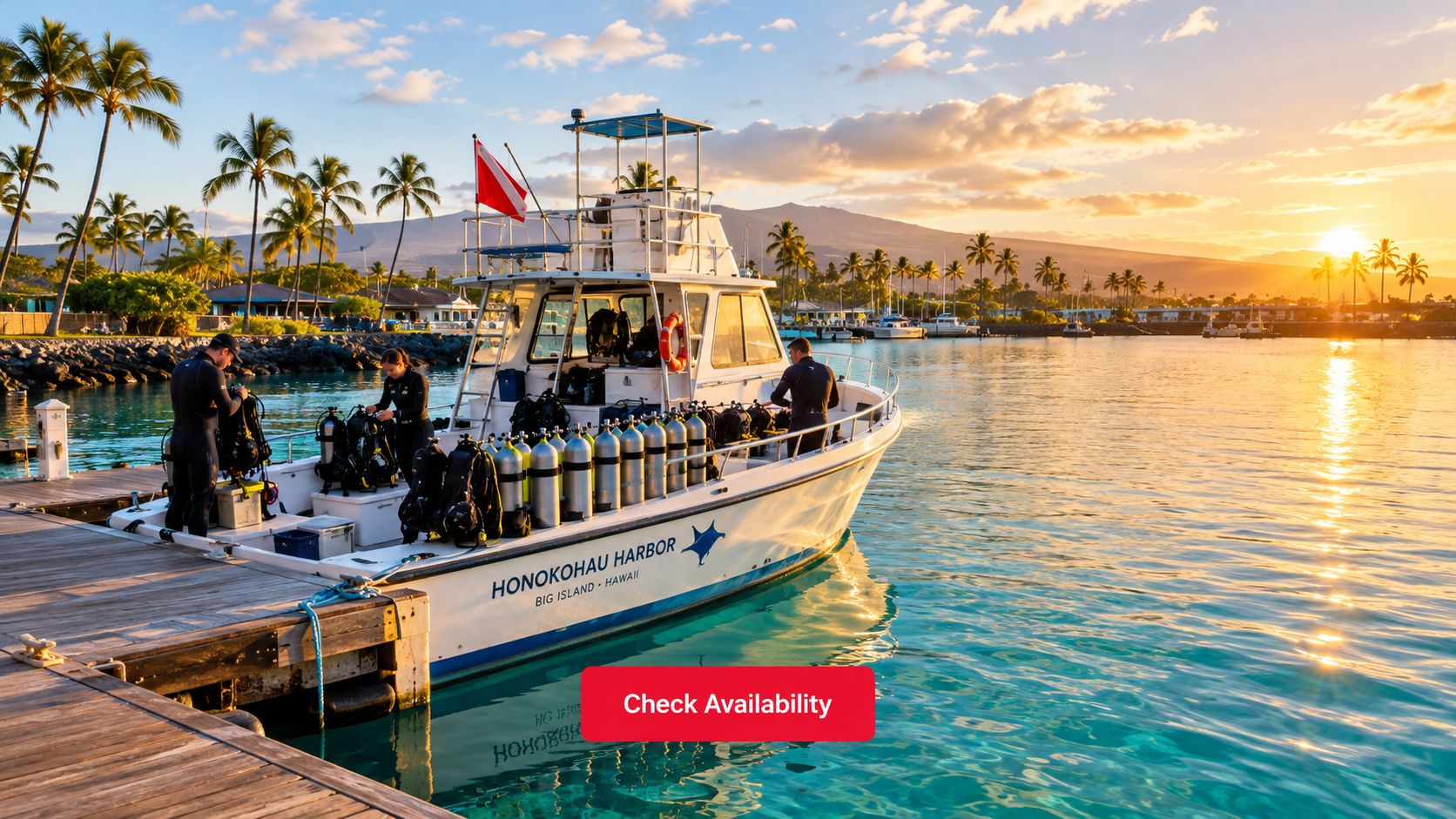
Why Kona Honu Divers Leads Big Island Diving
At Honokōhau Harbor, the difference shows before the boat leaves the dock. Some crews rush people aboard and sort things out later. Kona Honu Divers runs like a shop that expects the ocean to reward preparation, with more than 200 years of combined staff experience, thousands of five-star reviews, maintained boats, hot showers, shaded seating, and a lineup that covers reef trips, manta dives, blackwater excursions, training, rentals, and repairs.
The advantage is how little friction the operation creates for divers. Free nitrox for certified divers matters on a two-tank day. So does gear that is serviced before it becomes a problem, because a regulator that breathes cleanly and a BCD that has been inspected properly can turn a long boat day into an easy one.
The operation's background and credentials are laid out on the Kona dive company page.
What you feel on the boat
A well-run Kona boat feels calm. There is less crowding, less scrambling, and less guessing. That matters when you are gearing up for reef diving, night diving, or a more advanced profile. If the crew is organized and the briefing is clear, you notice it quickly. The first ten minutes tell you whether the day will feel controlled or messy.
Practical rule: pay for the operator that cuts friction. On Kona, that usually means better boat comfort, better briefings, and less wasted energy before the first descent.
Kona Honu Divers also works for a wide range of divers without watering down the experience. Beginners can get into the water through structured instruction, certified divers can choose reef or specialty trips, and serious divers can push into more technical territory without changing operators. That is the right frame for this guide. Match the trip to the diver in front of you, not to the postcard version of Kona.
The Signature Dive Menu at a Glance
If you're trying to decide what to book, start with the actual trip formats, not the brochure language. Kona's appeal comes from variety, but not every dive suits every diver. The right move is to pick the trip that fits your comfort, certification, and appetite for motion, depth, and night conditions.
The trips worth considering
The 2-tank morning reef trip is the workhorse. It suits certified divers who want healthy reef structure, steady boat rhythm, and a day that feels controlled rather than chaotic. The advanced two-tank itinerary is for experienced divers who want sharper topography and a little more challenge without stepping into true technical territory.
The manta night dive is the signature crowd-pleaser, but only if you're comfortable at night and willing to sit still while the mantas do the work. The blackwater Pelagic Magic dive is a completely different animal, open ocean, dark water, and a far more demanding mindset. If you're traveling with non-divers, the private and group charter options give you room to keep everyone together without forcing the whole party into the same dive.
Daytime snorkelers still have a reason to book, too. Mixed groups can stay on the same boat, and that's often the smartest choice for families, since not everyone needs the same depth or the same pace to enjoy the ocean.
| Trip | Depth | Skill Level | Best For |
|---|---|---|---|
| 2-tank morning reef | Varies by site, generally reef-focused | Certified beginners to intermediate | Easy boat diving and reef variety |
| Advanced two-tank | Deeper, more terrain-driven | Experienced certified divers | Divers who want stronger topography |
| Manta night dive | Usually around 30 to 35 feet | Certified divers comfortable at night | Signature wildlife encounters |
| Blackwater Pelagic Magic | Open ocean, tethered night profile | Strong, advanced divers | Serious night divers and macro hunters |
| Private or group charter | Custom depth and profile | Any level, depending on booking | Families, milestones, VIP groups |
| Snorkel tour | Surface-level | No certification needed | Mixed groups and non-divers |
The morning reef option is the best starting point for beginners because it gives you the clearest read on conditions and the crew. If the first day feels good, you can always go deeper, darker, or more specialized on the next booking. That's why the main dive tours page is useful, it lets you compare the lineup without guessing what fits your trip.
Manta Night Dive and Why Garden Eel Cove Wins
The manta dive gets oversold all the time, but the site choice still matters. Kona has two well-known manta locations, Manta Village near Kaukalaelae Point and Manta Heaven in Makako Bay, yet the better experience for most divers is Garden Eel Cove because the location is more protected, the viewing geometry is cleaner, and the surrounding reef gives the whole scene a better feel than a crowded, awkward setup. If you care about seeing the animals well and not just being part of a boat parade, this is the site to favor.
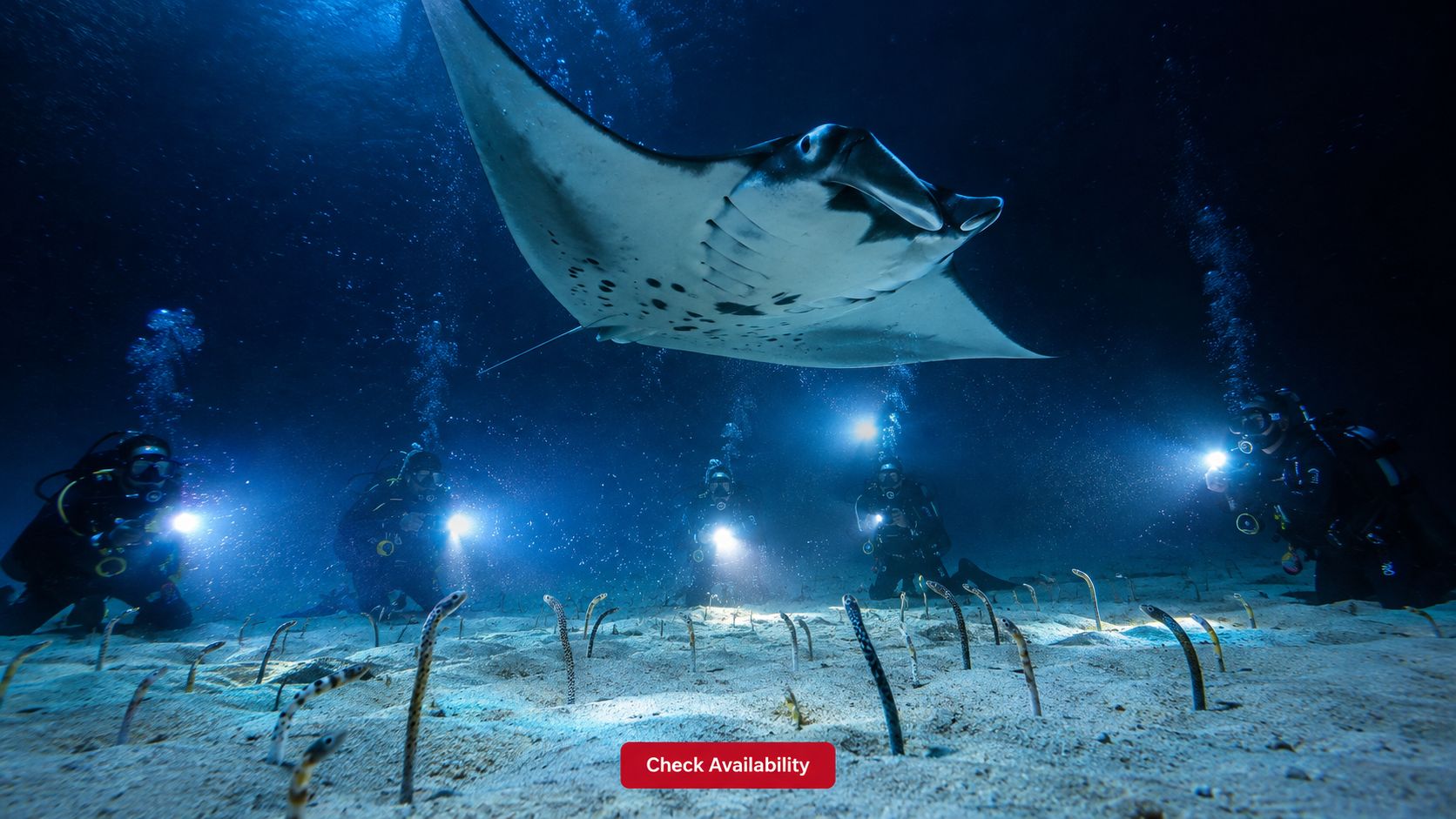
What the dive looks like
The rhythm is straightforward. Dives generally begin around 18:00, run for about one hour, and use underwater lighting at the surface and around 10 m to draw plankton into the water column. Divers settle on or near the sand at roughly 30 to 35 feet, then the mantas glide, pivot, barrel roll, and somersault overhead as they feed.
That's why the passive setup matters so much. If the lights are placed badly, or the group swims around like they're chasing fish, the whole thing gets messy. A well-run manta dive feels almost choreographed, but the animals are still wild, and the crew's job is to keep the water column open so the rays can move naturally.
Why this site beats the hype
Garden Eel Cove works because it gives the mantas room and gives divers a reliable viewing angle. In Kona, those two things are not the same. A crowded site can still produce manta action, but it's not the version I'd spend money on if I could choose.
If you want to book the actual manta experience, use the manta ray dive page and pick the operation that treats the animals and the reef like they matter.
Better manta diving isn't about chasing more boats. It's about choosing the site and the operator that keep the feeding lane open and the viewing clean.
What Drives the Manta Encounter
The manta dive works because of a simple food chain. Artificial lights pull zooplankton into the water column, the plankton gathers, and reef mantas feed on those patches. The 2025 University of Hawaiʻi study showed that the encounter depends on long-term site conditions, plankton density, and repeated local use, not on a fixed, on-demand appearance pattern University of Hawaiʻi study.
Why some nights are better than others
NOAA guidance matches what experienced Kona crews see on the water. Water movement, moonlight, light placement, and short-term plankton distribution all change how active the mantas are, even when the animals stay in the area NOAA research PDF. Good crews keep the dive passive, keep the water column open, and stop divers from turning the site into a chase.
The smartest diver behavior is boring. Stay near the bottom, point lights upward, and let the animal come to you. If you swim after a ray or crowd the feeding lane, you make the encounter worse for everyone in the water.
What the Kona record shows
Kona is a resident manta site with a real local population behind it. The 2025 study followed more than 23,000 sightings across 13 years, from 2010 through 2022, and identified 167 individual reef manta rays in the Kona area. The broader historical catalog also kept growing, with the Manta Pacific Research Foundation identifying more than 270 manta rays in Kona by 2021 Divers Alert Network Kona guide.
That is the part visitors usually miss. You are not booking a random migration event, you are booking a predictable local encounter shaped by the day's water and the site's conditions. Summer tends to be the easier season because conditions are calmer and manta counts tend to peak, but the dive still depends on reading what the ocean is doing that night.
Certifications, Rentals, and Nitrox
If you're not squared away on training or gear, fix that before you chase the signature dives. Kona Honu Divers supports the full path from Discover Scuba through Open Water, Advanced Open Water, Rescue, and Divemaster, plus refreshers for people who haven't been in the water for a while. That matters because a rusty diver burns through the day fast, and Kona is too good to waste on hesitation.
What to book if you need training
Start with the least ambitious option that still gets you where you want to go. A refresher is the right move if you're certified but out of practice. Discover Scuba is for people who want a supervised first taste, and the more advanced classes make sense only when you're ready to build comfort, not just collect another card.
Gear also needs to be part of the decision. Rental equipment should be checked, not just handed over, and this shop's approach is to keep regulators serviced, BCDs inspected, and wetsuits cleaned and rotated. That's the kind of unsexy detail that saves a trip.
Bottom line: bad gear ruins good water. If your regulator feels sticky or your port is leaking, deal with it before you board, not after the briefing.
Nitrox is worth using when you're certified for it and planning multiple dives or longer days in the water. It doesn't make you invincible, but it can make your schedule easier by shortening surface interval pressure when the dive plan supports it. For frequent divers, that's a practical advantage, not a gimmick.
If you want the certification path laid out cleanly, the enriched air certification page is the right place to look. Once your training and gear are sorted, you're ready to choose whether your next day should be easy reef time or something more specialized.
Blackwater and Advanced Reef Diving
Some trips are iconic because they're famous. Others earn the repeat business because they're different. Kona's blackwater Pelagic Magic dive falls into the second group, and if you're serious about diving, it's one of the few excursions that feels like a real field experience instead of a theme-park version of the ocean.
Why blackwater is its own category
Blackwater diving means you're suspended over deep ocean at night, not sitting on a shallow reef. The draw is the ocean's nocturnal vertical migration, when small pelagic organisms, larvae, and other deep-sea life rise toward the surface after dark. Kona's advantage is simple, the deep water sits close to shore and the sea is often calm enough to make the setup workable Blackwater overview.
That combination is what makes the dive special. You're not looking for reef creatures that happen to be active at night. You're watching the open water itself turn alive.
Who should take it and who shouldn't
The advanced two-tank style of reef diving is the other serious option, especially if you want lava tubes, pinnacles, and the possibility of sharper pelagic action on a day dive. It's a better fit for confident divers who are comfortable managing buoyancy, depth, and boat procedures without fuss.
Skip blackwater if you're anxious in open water, uncomfortable in the dark, or still sorting out neutral buoyancy. Skip the more advanced reef profiles if you're the diver who needs a line, a wall, or a fixed bottom reference to stay relaxed. These trips are professional-style experiences, not add-ons for people who barely made Open Water.
For divers who know they want a stronger profile, the advanced dive tour page is the logical next stop. For blackwater specifically, the blackwater tour page is the one to open first.
Matching the Right Trip to Your Diver
A lot of bad dive decisions start with ego. The right Kona trip depends on who's going underwater, what they've done before, and how much work they want from the day. If you match the trip correctly, everybody has a better time, including the crew.
Novices and first-timers
Book a reef-focused day or a supervised beginner program first. Skip the advanced night dives until you've proved you can stay calm with your own gear and a little motion. If day one goes well, upgrade to the manta dive before you try anything darker or deeper.
Certified divers
Start with the standard two-tank reef option, then move to manta if you want the signature Kona night experience. Skip blackwater unless you're already comfortable in open water after dark, because that trip punishes indecision.
Families and mixed groups
Private or group charters make the most sense when kids, snorkelers, and divers all want the same boat ride. Book the charter if you want flexibility, then let the ocean decide whether the day becomes reef time, snorkel time, or a slower sightseeing run.
Photographers and content-minded divers
Choose the reef or manta trip first, not blackwater, unless you already shoot night scenes well. The manta dive is the easier place to manage ambient light because the setup is controlled and the close passes are predictable enough to frame cleanly. For shallow reef work, look for macro-rich sites and a boat that isn't rushing your turnaround.
Freedivers and spearfishermen need a different conversation entirely. Freedivers should favor snorkel or shallow-water options where breathing patterns and surface control matter more than bottom time. Spearfishermen should treat the dive shop like a logistics base, not a sightseeing desk, and book the kind of trip that keeps their goals separate from the tourist crowd.
Booking Logistics, What to Bring, and FAQs
Show up ready and the day goes smoother. Bring a swimsuit, towel, reef-safe sunscreen, your certification card, and a light jacket for the ride back when the surface interval cools off. If you're prone to motion sickness, prep for it before you board, not after the horizon starts moving around.
What the shop covers and what you shouldn't overpack
Most of the heavy lifting is handled by the crew, so don't drag your whole garage to the harbor. The useful stuff is the personal gear that affects comfort and confidence, plus anything you need for sun, wind, or nausea.
- Certification card: If you're booking a certified dive, bring it and keep it accessible.
- Motion-sickness prep: Use the preventative you already trust, because the boat isn't the place to test a new remedy.
- Light layers: A jacket or hoodie earns its keep on the ride in and out.
- Minimal extras: Leave valuables behind unless you have a specific reason to bring them.
The practical part of seasickness control is simple. Pick your prevention before the trip, take it on time, and don't wait until you're already queasy. The boat crew can help with pacing and positioning, but they can't fix a stomach that's already revolting.
The questions people ask before they book
Weather windows matter more than wishful thinking. A good shop will call a dive or shift the plan if conditions aren't right, and that's a feature, not a flaw. Age and fitness requirements vary by trip, so if you're bringing a younger diver or someone who's been out of the water for years, ask before you commit.
Cancellation rules also matter, because Kona weather can move faster than an itinerary. Don't stack your dive on top of an unmovable flight or a once-only dinner reservation. Tipping the crew is still good form when they've kept the day organized and safe, especially on a trip with more gear, more weather, or more guest management.
Real reviews back the operation, and that should matter to you. A shop that's been consistently trusted by actual divers is usually the one that keeps its boats clean, its briefings tight, and its safety checks real. If you want to lock in a day that fits your skill level and your trip goals, make the booking before the calendar fills up.
If you want a Kona day that's matched to your diving, not just your wishlist, book with a crew that knows how to steer you toward the right boat, the right site, and the right pace. Kona Honu Divers offers reef trips, manta nights, blackwater dives, rentals, training, and private charters that fit the kind of dive you want. If you're coming to Kona, don't guess. Pick the trip that fits your skills and get it on the calendar.