
You've got a few open days on the Big Island, a list of manta videos saved on your phone, and a booking screen offering trips that sound nothing alike. A morning reef dive, a manta encounter, and an offshore blackwater drift may all leave from Kona, but they ask very different things of a diver.
The best approach to diving Kona, Big Island, is to choose the environment you can handle comfortably, then choose the wildlife experience. That means weighing certification and recent practice alongside crowding, reef condition, and the day's ocean forecast, not just booking the most adventurous description.
Kona Dive Trips Compared and Who Each Suits
Kona offers dives from a first breath underwater to advanced drift dives. The right trip depends on your certification and whether you want daylight reef exploration or nighttime encounters.
Kona dive trips compared by experience and timing
| Trip | Best for | Entry requirement | Timing | Highlights |
|---|---|---|---|---|
| 2 Tank Local Morning Dive | Certified divers wanting reef variety | Open Water certification and C-card | Morning | Coral gardens, ancient lava tubes, dramatic arches |
| Morning Introductory Scuba Dive | First-time divers | No certification needed; instructor-led participation | Morning | Guided first dive with instructor support |
| Manta Ray Night Dive | Divers and snorkelers wanting nighttime manta encounters | Certification for scuba; swimming comfort and activity briefing for snorkeling | Night, starting after sunset | Feeding manta rays at lit aggregation sites |
| Black Water Night Dive | Experienced night divers comfortable in open water | Open Water certification for most regular charters, plus trip-specific experience screening | Night | Open-ocean drift with deep-sea plankton |
| Premium Advanced 2 Tank Trip | Advanced certified divers | Certified divers with suitable experience | Daytime, two tanks | Deeper sites, drift dives, remote pristine locations |
| Private charter | Groups and tailored itineraries | Requirements match each participant's activity and planned sites | Custom | Custom route and schedule |
Our diving tours overview lets you compare these options without treating every charter as interchangeable. Kona Honu Divers offers the introductory, morning reef, manta, blackwater, advanced, and private-charter formats shown above.
A progression that works in practice
Use this rule of thumb: first dive, morning introduction; certified and seeking reef variety, morning two-tank; comfortable with darkness and buoyancy, manta dive; experienced at night in open water, blackwater. This is a progression of skills, not a requirement to complete every trip.
For a hypothetical comparison, a diver with about 20 logged dives might be ready to discuss a manta dive, while someone with about 60 logged dives, including drift and night experience, might be a better blackwater candidate. Those are examples, not admission standards. Recent practice, calm responses to problems, and reliable buoyancy matter more than a logbook total.
For most of our regular charters, we require at least an Open Water Diver certification from a recognized agency such as PADI, SSI, or NAUI, which allows diving to 60 feet (18 meters) with a buddy. Bring your C-card. Specialty trips can require additional screening, and a certification card alone doesn't establish readiness for every environment.
Daylight trips versus night encounters
The 2 Tank Local Morning Dive is the sensible starting point for a certified visitor who wants to understand Kona's underwater terrain. Coral gardens, ancient lava tubes, and dramatic arches offer variety without making darkness another task to manage.
Choose that format if you want time to settle weighting, work out rental-gear fit, or establish communication with an unfamiliar buddy. It's also a better first outing than a specialized night trip if you haven't been diving recently.
Lava formations need judgment. Looking into a tube from open water isn't the same as entering an overhead environment, and an attractive opening isn't permission to swim through it. Stay within your training and follow the guide's route.
The Morning Introductory Scuba Dive is for someone who hasn't earned certification. Instructor support lets you concentrate on breathing, equalizing, clearing your mask, and communicating discomfort before it becomes distress. An introductory experience isn't a substitute for certification or permission to dive independently afterward.
A manta trip changes the objective. You're trying to hold an appropriate viewing position while animals feed, rather than cover a long stretch of reef. Snorkeling can be the better choice for a nondiving partner, provided they're comfortable swimming at night and meet the activity's requirements.
Blackwater asks something else again: composure in open water without a reef beneath you. Don't choose it solely because you've already seen mantas.
When advanced or private trips make sense
The Premium Advanced 2 Tank Trip fits experienced divers seeking deeper sites, drift dives, and remote locations. The trade-off is less room for rusty skills: gas planning, depth control, and coordinated ascents must remain dependable when the scenery becomes distracting.
Private charters work best when a group needs a custom schedule or shared priorities. They don't remove weather limits, medical screening, or individual training restrictions. A mixed-experience group still needs an itinerary appropriate for its least-prepared participant.
When comparing Kona scuba dive shops, focus on the match between the trip and your actual abilities. Honest self-assessment beats chasing the most advanced departure.
Top Kona Dive Sites and Who Each Suits
Kona dive sites by type and experience
| Site | Dive type | Best for | Highlights |
|---|---|---|---|
| Garden Eel Cove | Night manta aggregation | Manta night dive guests | Protected location, better viewing area, better reefs |
| Manta Heaven | Night manta aggregation | Certified divers wanting frequent manta sightings | Highest sighting count of the two studied lit sites |
| Manta Village | Night manta aggregation | Divers considering an alternative manta site | Fewer sightings than Manta Heaven in the study |
| Old Kona Airport MLCD | Shore and boat dive inside a marine life conservation district | Beginners and shore divers in calm conditions | Partially protected cove and semiprotected basin |
| Keauhou | Manta observation area | Divers considering the southern manta area | Included in long-term University of Hawaiʻi observations |
| Open-ocean blackwater zone | Night drift over deep water | Experienced night divers | Deep offshore habitat and rising deep-sea plankton |
Garden Eel Cove is my preferred setting for a manta dive tour because its protected location, better viewing area, and better reefs make it the stronger overall choice. Protection is relative, though. A sheltered reputation doesn't override the conditions the crew finds that evening.
Garden Eel Cove is also known as Manta Heaven, so those table entries describe the same destination under commonly used names, not separate alternatives. Likewise, Keauhou is the southern area associated with Manta Village. Check the actual destination rather than assuming different names mean different sites.
The most useful beginner option
For an early shore dive, Old Kona Airport Marine Life Conservation District offers a more useful starting point than an exposed entry chosen for dramatic scenery. The Hawaiʻi Division of Aquatic Resources site guide describes a partially protected cove used by snorkelers and shore divers, plus a semiprotected basin suitable in calm to moderate conditions.
That makes it a good first-dive or shore-entry candidate, not an automatically safe entry. Assess footing, surge, exit access, and your ability to return with equipment before getting wet.
The district's protections matter underwater. Don't feed aquatic animals, collect shells or rocks, remove sand, or damage marine life. Boats can't anchor in the district, and commercial operations need authorization, so an apparently convenient patch of water isn't necessarily an available boat-diving location.
Site-selection rule: Choose shelter for early dives. Add exposure only when your experience, equipment handling, and the day's conditions support it.
Match the site to the task
An intermediate diver looking for a stationary wildlife encounter will usually get more from the manta setting than from an offshore drift. An advanced night diver who enjoys small, unusual animals may prefer blackwater, where the challenge is maintaining position rather than navigating terrain.
Keauhou's importance isn't just its popularity. A Los Angeles Times account of Kona's manta history, together with the long-term monitoring history, describes the connection between coastal lighting and repeatedly used feeding areas; University of Hawaiʻi observations also include Keauhou and Garden Eel Cove.
Kona diving is available year-round, with warm water and generally clear visibility in every season. Still, inspect the bay you'll dive. An exposed site can be manageable on Monday and rough on Tuesday, and a beautiful underwater photograph tells you nothing about today's exit.
Seasonal Conditions, Reef Health and Gear Services
Check swell direction, wind, entry conditions, and the return route on the day of your dive. A seasonal calendar helps with trip planning, but it can't tell you whether surge is sweeping across a particular lava shelf that morning.
Use this guide to the best months to scuba dive in Hawaiʻi as planning context, then let current conditions determine the site. If your schedule is rigid, leave room for a different location rather than insisting on a named reef.
Clear water doesn't prove a healthy reef
A recent USGS assessment comparing early-2000s imagery with 2022 surveys across three Kona-coast national parks found declining live-coral cover, with non-coral habitat increasing roughly 25% overall and nearly 90% at Puʻuhonua o Hōnaunau, as summarized in this Kona reef-condition overview. The assessment also found little relationship between depth and coral-cover change.
The practical consequence is straightforward: deeper doesn't automatically mean healthier. Ask which habitat is in suitable condition now, whether your goal is coral photography, volcanic structure, or fish behavior.
Over a stressed reef, keep your fins above the substrate and your camera housing away from living surfaces. Don't kneel for a photograph or grab coral to steady yourself. Choose a wider composition if the close-up requires contact.
Confirm these services before departure
- Rental fit: Reserve a correctly sized wetsuit, BCD, mask, fins, and regulator setup. A leaking mask or loose cylinder strap can consume attention you need for buoyancy.
- Nitrox eligibility: Enriched-air use requires the relevant certification. Know how to analyze the cylinder and set your computer for the actual mix.
- Photography setup: Confirm space and handling arrangements for a camera, low-light strobes, or video lights. A bulky rig shouldn't be your first unfamiliar item on a night dive.
- Night lighting: Carry a primary dive light and a usable backup, with batteries checked before boarding.
- Fixed schedules: Establish departure, return, and charter-timing constraints before arranging the rest of your day.
Fit and familiarity usually improve a dive more than adding another accessory.
How They Work and How to Keep Impact Low
The boat settles into position around sunset. Underwater, the guide establishes the viewing area, lights illuminate the water, and plankton gathers in the beams. When a manta arrives, the temptation is to swim toward it, but the better response is to stay still and leave its feeding route open.
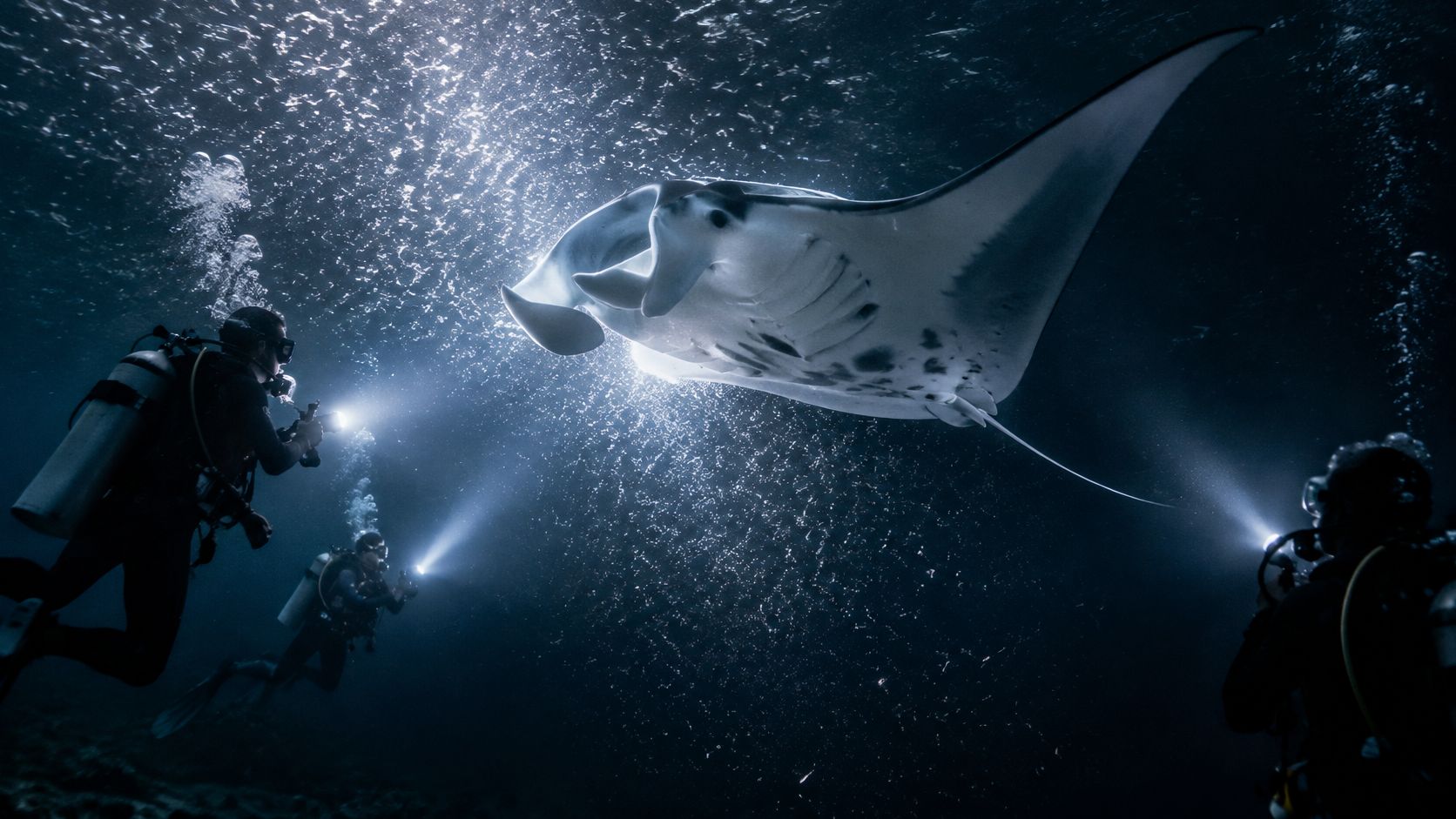
The mechanism is light-concentrated zooplankton, not bait offered directly to the rays. Reef mantas, Mobula alfredi, feed where prey becomes concentrated, which explains why disciplined positioning works better than searching widely across the reef.
A study held in NOAA's repository documented surface and seafloor illumination at approximately 10 meters at Manta Heaven and Manta Village, recording 25,444 sightings of 118 individually identified mantas over six years. In that same study, Manta Heaven accounted for 19,841 observations, compared with 5,603 at Manta Village, and typical dives began immediately after sunset and lasted about one hour.
Those are observation totals, not a guarantee of what you'll see on a booking. Repeated sightings can involve the same animals, and a historically productive location can still have a quiet evening.
Hold a position that leaves room for mantas
Say a manta turns toward your side of the viewing area. A diver who rises for a closer photograph can block the animal's route and force nearby divers to adjust. A diver who keeps the camera close and holds position allows the pass to continue without turning the encounter into a pursuit.
Use a simple sequence:
- Secure your light and establish a steady beam. Follow the guide's lighting instructions rather than sweeping it around in search of an animal.
- Take the assigned position at the edge of the lighted feeding area. Don't occupy the center of an active flight path because it appears to offer the best photograph.
- Minimize fin movement. Settle your buoyancy before the animals arrive, and avoid stirring sediment toward other divers or feeding mantas.
- Let each manta complete its pass. Don't reach, touch, chase, or reposition into its path. Keep an unobstructed route away from the group.
These are concrete applications of responsible diver etiquette. They also improve visibility and reduce the amount of last-minute movement within the group.
Garden Eel Cove's viewing layout makes it the superior choice for this style of encounter when conditions are appropriate. A good location, however, can't compensate for guests who crowd the feeding corridor or a group that can't hold its assigned position.
Crowding and conservation aren't the same question
Social carrying capacity concerns how much use people tolerate before an experience feels crowded or degraded. Biological carrying capacity concerns what the animals and habitat can sustain. A site can exceed the former before anyone has established the latter.
A Hawaiʻi County manta-management document reports problematic crowding at the principal sites and possible exceedance of social carrying capacity; related thesis findings summarized with the management evidence put surveyed users' average tolerance at 11 boats at Makako Bay, while NOAA status-review material describes low immigration and a historical estimate averaging 4.27 new pups entering the population annually.
The boat-tolerance figure isn't a legal ceiling or a scientifically established safe limit for mantas. Nor is the historical pup estimate a current annual census. Together, these findings argue for caution around a repeatedly used habitat and a comparatively closed population.
Frequent manta sightings don't prove that an unlimited number of boats, lights, and swimmers is harmless.
Stable encounters can coexist with a poor visitor experience, close approaches, or unresolved questions about animal behavior. Conversely, a crowded evening isn't by itself proof of population decline. Keep those claims separate.
Make crowding part of the booking decision
Before departure, establish how the group will be positioned, how diver and snorkeler areas are separated, and what happens if another group occupies the planned viewing space. Ask how the crew handles a guest who can't maintain position.
On arrival, count boats and look at usable space, not just total attendance. Watch for tangled light patterns, overlapping groups, blocked routes, and repeated contact. A small boat count can still produce a cramped encounter if everyone concentrates in the same opening.
If the site looks unsuitable, discuss an alternative or rescheduling with the crew before entry. Don't assume a refund or a different site is guaranteed; understand those arrangements when booking.
Use the manta ray dive tour page to check the trip format, then make your decision on readiness and site management rather than the promise of a close pass.
Blackwater Diving Without a Bottom Reference
Blackwater diving isn't a deeper version of a reef night dive. It's a controlled open-ocean drift where you watch small animals moving through the water column, often without any visible seabed.
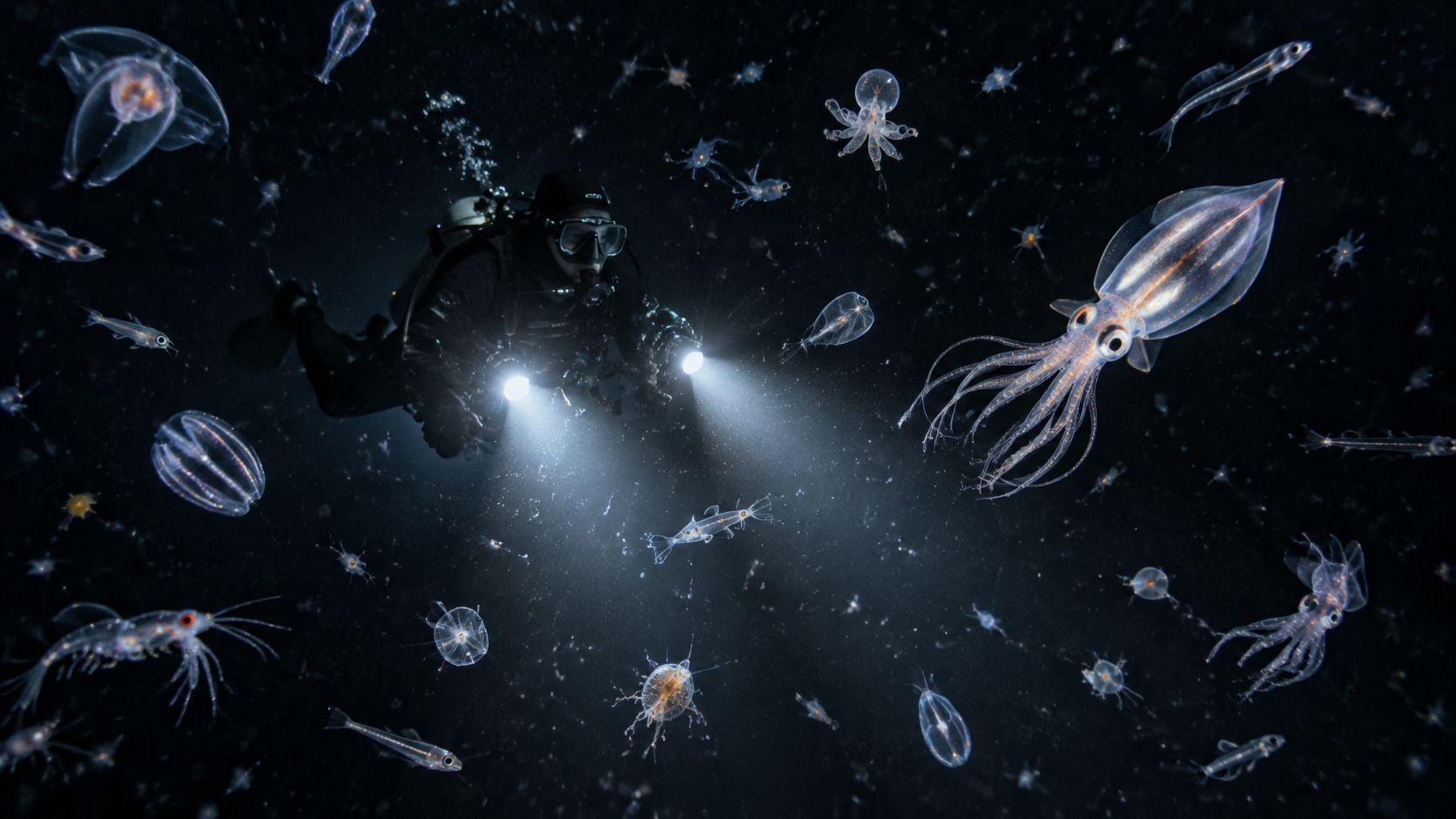
After sunset, gelatinous zooplankton, larval fishes, cephalopods, and other micronekton rise toward the surface to feed. This diel vertical migration brings life stages into view that you're unlikely to notice on an ordinary reef dive.
The Underwater Atlas Kona blackwater guide describes offshore waters exceeding 500 meters and reported temperatures around 25–28°C, where a 3 mm wetsuit is commonly suitable. You remain at recreational diving depth, but some animals originate much farther below; adjust exposure protection for duration, wind chill afterward, and your own cold tolerance.
Prepare for position control, not reef navigation
The absence of a bottom reference changes how you judge movement. You can follow an animal downward without feeling as though you're descending, particularly while looking through a camera.
- Check conditions and drift direction before entry. Understand the boat's system, any lines or tethers, the entry sequence, and the recovery procedure.
- Use redundant lights and secure loose equipment. Clip hoses, gauges, and camera accessories so they can't snag or strike fragile animals.
- Maintain disciplined buddy spacing. Stay close enough to communicate without crowding another diver's light beam or entangling equipment.
- Monitor depth and gas deliberately. Look at your instruments rather than relying on visual sensation or another diver's apparent position.
- Hold station with quiet fins. Let animals move through the observation area instead of chasing them out of the group's operating space.
Our blackwater diving guide provides additional context for deciding whether this environment fits your current skills.
Photograph without pursuing
Low-light strobes or video lights can help reveal transparent structures. Manual focus can be useful when autofocus hunts against a dark background, but camera technique comes after depth control.
Keep a conservative approach distance. Tiny gelatinous animals can be damaged by contact, a housing, or fin wash, and chasing a subject often produces both a worse photograph and a less controlled dive.
If framing the animal makes you stop checking depth, put the camera down and regain your position.
Choose the Black Water Night Dive only when open-water buoyancy and nighttime communication already feel routine.
Safety Rules, Gear and Medical Checks
Hawaiʻi requires a red-and-white diver's flag whenever snorkeling, freediving, or scuba diving is in progress. The DLNR snorkeling and diving rules set the flag distances, minimum dimensions, and nighttime illumination requirements shown below, affecting shore entries as well as boat-supported dives.
Dive safety rules and key values in Kona
| Requirement | Rule | Value |
|---|---|---|
| Dive flag distance, ocean | Surface within this distance of the flag | 100 feet |
| Dive flag distance, navigable stream | Surface within this distance of the flag | 50 feet |
| Dive flag minimum size | Flag must be at least this size | 12 by 12 inches |
| Dive flag at night | Must be clearly illuminated from sunset to sunrise | Required |
| Open Water depth limit with a buddy | Typical certification limit for most regular charters, not a statewide flag rule | 60 feet (18 m) |
A shared flag doesn't remove each participant's responsibility to stay within the applicable operating area. For an independent shore dive, plan its placement and your return route before entry.
The state's diving and snorkeling navigation rules also prohibit swimming or diving in navigation channels except during emergencies and prohibit unreasonable interference with vessel navigation. A flag marks active diving, not a general claim to a section of ocean, and it shouldn't remain displayed when diving has ended.
Pack for comfort and independent monitoring
- Exposure protection: Bring a wetsuit or rash guard appropriate to the water and planned duration. Include something dry for the boat ride afterward.
- Well-fitting personal equipment: Check the mask seal, fin straps, and snorkel attachment. Resolve discomfort before entering rather than assuming it will improve underwater.
- Night lights: Carry a primary light and a backup you can operate easily. Follow the briefing for illuminated identification equipment and light signals.
- C-card and logbook: Have proof of certification and a clear account of recent experience available at check-in.
- Sun protection: Apply reef-safe sunscreen before entry and use protective clothing where practical. A marketing label isn't permission to let sunscreen or other products contact coral.
- Dive computer: Use a computer that displays depth and time and that you understand. Check its settings, battery condition, and gas selection before descent.
A computer doesn't replace a dive plan. Agree on gas management, turnaround decisions, separation procedures, and ascent signals with your buddy.
Medical checks before you commit
Confirm fitness to dive and disclose medical conditions during screening. If the medical questionnaire calls for physician clearance, arrange it before the trip rather than arriving at the dock hoping the requirement can be waived.
Discuss medications and any changes in health with an appropriately qualified clinician. Don't enter the water with symptoms that could impair breathing, equalization, awareness, or physical effort.
Plan flights and travel to altitude around your diving schedule using your training agency's guidance and your actual dive profiles. Don't assume a drive into the island's high country is equivalent to staying at sea level.
Kona Honu Divers strongly recommends dive insurance. Check what your policy covers, including diving-related treatment and transport, rather than assuming ordinary travel coverage includes them.
Practice a controlled ascent and understand the purpose of a scuba safety stop. Legal rules provide the baseline; the operator's briefing establishes the procedures for that boat, site, and dive.
Booking Your Kona Dive Day With Confidence
- Choose the right trip: Use the comparison table to match your certification, recent experience, and preferred environment.
- Confirm your participation plan: Have your Open Water card ready, or select the introductory route if you haven't been certified.
- Check the ocean that morning: Review swell and wind, then follow the crew's site decision rather than holding them to an unsuitable location.
- Reserve online: Use the booking button below to check available departures and review the applicable terms.
- Discuss custom timing: Call 808-324-4668 if you need a private charter or have schedule constraints that a standard departure may not accommodate.
Build an itinerary with room to adapt
A good dive itinerary leaves space for weather changes, recovery, and honest reassessment. Start with a trip that lets you establish comfort before adding a more demanding environment.
For a newly certified visitor, that may mean staying with daylight reefs rather than trying to fit every signature encounter into the holiday. For an experienced diver, it may mean choosing between advanced daylight diving and blackwater rather than arriving tired for both.
An experienced diver considering deeper sites and drift dives on the advanced trip should describe recent conditions they've handled. Comfortable reef diving in still water doesn't necessarily translate into calm station-keeping during a drift.
Useful booking details include your last dive, experience with boat exits, comfort after dark, and whether you're bringing a camera. Tell the shop what concerns you as well as what interests you. That conversation helps avoid a mismatch that no amount of attractive scenery can fix.
Use credentials without outsourcing your judgment
Kona Honu Divers was voted best dive operator in Kona, Hawaiʻi, and won the Scuba Diving Magazine Reader's Choice Award for best dive company in the Pacific. Those credentials are useful context, but your own readiness still determines the appropriate trip.
The range from morning reef diving to advanced night environments makes a gradual itinerary possible. There's no need to treat the hardest dive as the best one, or to judge a successful holiday by how many specialty trips you complete.
Before confirming, review equipment inclusions, check-in instructions, medical paperwork, and cancellation terms. For a manta trip, clarify the planned viewing arrangement; for blackwater, confirm the current experience requirements and recovery system.
Book the dive you can enjoy while remaining an attentive buddy and a low-impact visitor. Choose your preferred departure below, and call the shop before paying if your experience or schedule needs a closer discussion.
Kona Honu Divers offers guided morning reef dives, manta encounters, advanced trips, and blackwater excursions for different experience levels. Visit Kona Honu Divers to choose a trip that matches your skills, then discuss recent experience and any equipment needs with the team before booking.