
You're probably staring at a phone with three tabs open, a flight to Kona half booked, and one question you can't quite answer. Should you spend your limited dive days on a morning reef, the famous manta night dive, or something stranger like blackwater, and are you qualified for the trip you want?
That's the right question for diving Hawaii Big Island style trips, because the Kona coast rewards good matching more than good luck. A reef dive, a lava tube, and a drift over deep water at night ask for different buoyancy, different comfort in the dark, and different tolerance for current. Pick the site that fits your certification and your recent logbook, and the dives feel easy. Pick by photo alone, and you'll spend the dive managing yourself instead of watching what's in front of you.
Wildlife adds a second layer of honesty here. Coral gardens and lava arches are reliably there. Mantas, turtles, and pelagic animals are not scheduled performers, even at sites with strong histories. I'll separate what's structurally reliable from what's probable, so you can book a plan you'll enjoy even on a quiet night.
Big Island Dive Sites at a Glance
Start by matching the site type to your training, not by chasing a name you've seen in photos. This table is the fastest way to narrow your choices for diving Hawaii Big Island waters.
| Site type | Example site | Access | Best for |
|---|---|---|---|
| Manta night site | Garden Eel Cove (Manta Heaven) | Boat | Night manta encounters |
| Protected bay reef | Kealakekua Bay | Boat | Coral and fish diversity inside a conservation district |
| Lava tube and arch reef | Two-tank morning sites | Boat | Coral gardens, lava tubes and arches |
| Offshore night drift | Kona blackwater site | Boat | Deep-sea animals rising into the light |
| Advanced deep site | Premium advanced sites | Boat | Deeper dives and drift dives for certified divers |
What Each Site Type Actually Feels Like
Garden Eel Cove, also called Manta Heaven, is a boat-access night site north of Kailua-Kona. You settle over sand at about 30 to 45 feet, stay still, and let lights concentrate plankton so mantas can feed through the beam. It's a stationary observation dive, not a swim. That stillness is the skill, because fin wash and wandering lights scatter the plankton you're there to watch.
Kealakekua Bay sits inside a marine life conservation district and earns its reputation from coral and fish diversity in a protected bay. It's the opposite tempo from a night dive. You're moving slowly over reef in daylight, looking for structure, endemic fish, and the small life that protected water lets accumulate. If your buddy loves reef ecology more than big animals, this is often the better morning.
The classic two-tank morning dive covers coral gardens, lava tubes, and dramatic arches reached by boat along the Kona coast. Lava tubes are where buoyancy control matters most. A tube that looks generous in a photo gets tight fast if you're bicycling, overweighted, or carrying a large camera rig. Stay at the entrance and look in if your trim isn't clean. Tube entry should stay firmly within your training.
A lava tube rewards divers who can hover, turn, and back out without touching anything. If you can't do that in open water yet, the tube will show you quickly.
Deep pinnacles are cliffs and columns that drop away from the reef. They give you the dramatic wall feeling, but depth and current can change the plan mid-dive. What starts as a gentle swim along a pinnacle can become a drift if water starts moving around the point. That's manageable with a briefed exit, a surface marker plan, and a guide who knows the site. It's a poor place to discover you're uncomfortable descending without a visual reference.
Blackwater and Advanced Sites
Blackwater diving is mechanically different from everything above. The Hawaii Guide overview of Hawaii scuba diving describes Kona blackwater as an offshore night dive where divers drift over deep water on a float line while pelagic animals rise toward the surface on their vertical migration. There's no reef, no sand patch, and no fixed viewing area. You control your position in blue water, keep your light disciplined, and watch small, strange animals drift through the beam.
Because there's nothing to orient against, I'd confirm experience requirements and sea-state limits before booking a blackwater dive, even if you're comfortable on night reef dives. If that sounds like your kind of strange, look at the Kona blackwater dive tour details before you commit.
Advanced trips reach deeper sites and drift dives that regular morning boats don't prioritize. If you have the logged dives and want more exposure, the premium advanced two-tank trip format fits that goal better than asking a mixed-level boat to stretch its plan for one diver.
Most of Kona's best dives are boat-based for a simple reason. Reefs, pinnacles, and the manta site sit off a rocky coast, and shore entries depend heavily on swell. Shore diving has its place here, and this guide to the best shore diving on the Big Island covers when it makes sense, but a boat gives you site choice on the day, easier entries, and a crew watching conditions.
Kona Honu Divers, which operates in Kona, Hawaii, on the Big Island, runs these trip types from its boats. You can scan the full Kona diving tours list to compare morning, manta, blackwater, and advanced options side by side.
Choose by certification, time of day, and comfort level first. The marine life tends to take care of itself once you're on a site where you can relax.
Certification and Experience Each Dive Requires
Most regular charters here share one baseline rule. For most of our regular dive charters, we require at least an Open Water Diver certification from a recognized agency such as PADI, SSI or NAUI, which allows diving to 60 feet (18 meters) with a buddy. Bring your C-card to check-in, physical or digital, because the crew can't put you on a certified diver trip on your word alone.
| Dive or trip | Minimum certification | Limits and notes |
|---|---|---|
| Manta ray night dive | Open Water Diver | Most charters allow 60 ft with a buddy |
| Two-tank morning dive | Open Water Diver | Depth limit 60 ft with a buddy |
| Premium advanced two-tank trip | Open Water Diver with logged experience | Deeper sites and drift dives |
| Blackwater night dive | Open Water Diver with night experience confirmed by the operator | Operator confirms experience and sea-state limits |
| Morning introductory scuba dive | None, course-based | Guided introduction for beginners |
Beyond the Card Itself
A card proves you passed a course. Your logbook proves what you've done since, so bring it or have your digital log ready. If your last dive was years ago in a quarry, be upfront when you book. A good crew would rather place you on a gentler morning boat or suggest a refresher than watch you struggle through a lava tube on your first ocean dive in a decade.
If you're not certified yet, you aren't shut out of the water. A morning introductory scuba dive is course-based and guided for beginners, and if you want the full credential, Big Island scuba certification courses run locally. This overview of Big Island scuba certification lays out the path before you arrive.
Insurance check: Confirm your personal policy actually covers scuba diving before you travel. We strongly recommend dive insurance, because a policy that excludes diving is useless on the one day you'd need it.
Snorkelers and non-diving companions can ride along on dive boats, which works well for mixed groups. Declare them when you book so the crew plans space, gear, and supervision correctly. A ride-along who appears unannounced at the dock creates a seating and safety problem the crew shouldn't have to solve at departure.
Do this three-step check before you pay for anything:
- Find your C-card and confirm the name and level are readable.
- Count your logged dives, especially recent ocean and night dives.
- Match both against the table row for the trip you want, and downgrade the trip if the match is shaky.
Why Garden Eel Cove Is the Best Manta Ray Dive
I'll make the case directly. Garden Eel Cove is the stronger manta night dive because of its protected location, better viewing area, and better reefs. The dive begins before dark with a reef and garden-eel observation, so your first tank is a real reef dive, not a holding pattern. After sunset, you take a fixed position on the sand at 30 to 45 feet while underwater lights concentrate plankton and mantas enter the beam to feed.
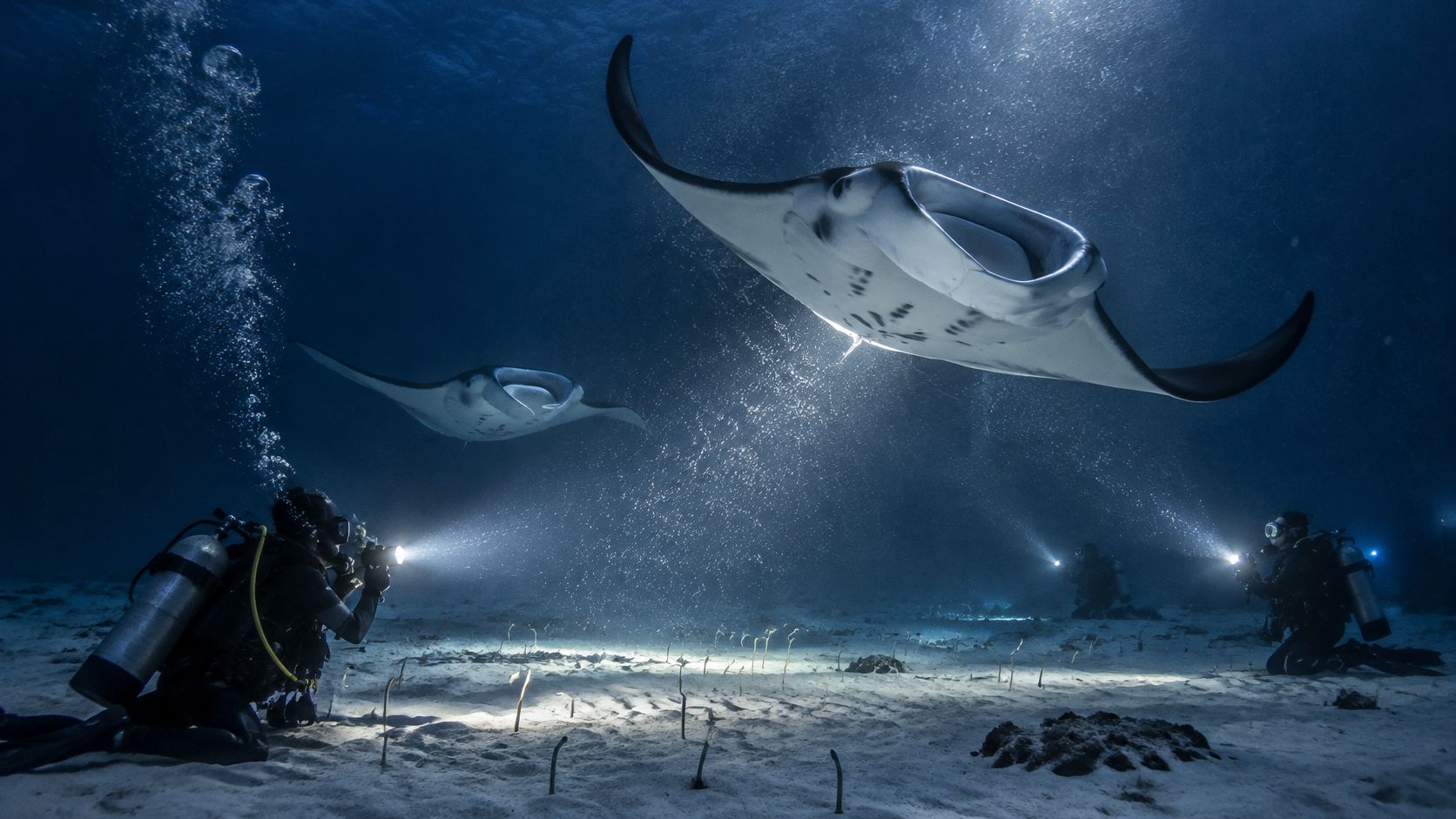
That fixed position is the whole mechanic. You don't chase animals, you don't swim into the light corridor, and you don't compete for angle. You stay low and still, keep your light pointed where the guide directs, and let the mantas decide how close the encounter gets. Divers who treat it like a regular night reef dive usually see less, because they stir the sand and break up the plankton concentration.
| Factor | Garden Eel Cove | Keauhou site |
|---|---|---|
| Aggregation size | Larger, more variable groups | Smaller groups |
| Sighting pattern | Aggregation size tracked zooplankton density | 91% female in the study analysis |
| Viewing setup | Protected, better viewing area | Smaller viewing area near Keauhou Bay |
| Reef quality | Better reefs | Reef dive is secondary to the manta site |
What the Long-Term Record Shows
The University of Hawaiʻi 13-year analysis in ScholarSpace covered more than 23,000 sightings of 167 individually identified reef mantas and found Garden Eel Cove generally supported larger, more variable aggregations, while Keauhou hosted smaller groups with 91% of sightings in the analysis female. Aggregation size tracked zooplankton density, which means food availability drives a given night more than the calendar does.
That finding cuts both ways, and you should hear it plainly. A manta sighting is a probability, not a guarantee. Current, plankton, turbidity, and weather can leave you watching an empty light beam for part of a dive. Seeing mantas at a distance also isn't the same as a close, prolonged pass, and nobody honest can promise you the second one.
I'd tell a friend booking this. A good manta dive doesn't require a large group. One animal feeding steadily through your light for twenty minutes beats a chaotic night with brief passes. Book the trip for the chance and for the reef dive that comes with it, and you'll surface happy on most nights.
If you're comparing formats, this breakdown of the night manta ray dive in Kona explains how the evening runs, and you can book the two-tank manta dive and snorkel tour once your dates are set.
Packing, Safety, Nitrox and Photography Tips
Pack for warm water that still steals heat over two tanks. Most divers are comfortable in a 3mm wetsuit here, and many add a hooded vest or step up in thickness during cooler months or on night dives. If you chill easily at home, you'll chill here too, just more slowly.
Your Packing Checklist
- C-card and logbook: The crew needs both at check-in, not back at your hotel.
- Thermal layer or rash guard: Warm-water protection still matters on a second tank and after sunset.
- Reef-safe sunscreen: Apply it before you board so it isn't washing straight into the water at the site.
- Towel and dry layer: The ride back after a night dive feels colder than the dive did.
- Dive computer: You can request one from us when booking, and we'll confirm availability and any small extra cost at that time.
Ask about rental gear before you travel, including whether it's serviced before each trip. Rental regulators and BCDs should be a non-issue on a well-run boat, but confirming sizes early matters if you're very tall, very small, or bringing your own mask and computer only.
For nitrox, ask whether it's available on your trip and how it's priced, then decide based on your profiles and multi-day plans. This primer on nitrox diving benefits helps if you're weighing the certification. Photographers should bring a wide-angle setup for clear-water days and mantas, plus macro capability for reef life, and mind their buoyancy near the bottom either way.
Safety and Wildlife Rules
- Dive with a buddy and stay within the depth limit for your certification.
- Follow the guide's briefing on entry, exit, and where to position yourself at night sites.
- Never touch, chase, feed, or block an animal, even for a photograph.
The NOAA sanctuary diving guidance tells divers to learn the specific rules for the sanctuary they're in and notes that some sanctuary regulations prohibit harassing or taking marine animals. The Hawaiian Islands Humpback Whale National Marine Sanctuary is habitat where you may encounter manta rays, green sea turtles, monk seals, dolphins, and white-tip sharks. Watching those animals doesn't authorize contact with them.
Confirm the current season's plankton and visibility conditions when you book, since operators update seasonal guidance as conditions shift.
Single-Day and Multi-Day Diving Itineraries
Build your schedule outward from one good day instead of stacking every trip type into forty-eight hours. Ears, sinuses, and simple fatigue set real limits, and a rested diver sees more than an exhausted one.
| Plan | Dive schedule | Best for | Planning note |
|---|---|---|---|
| Single day, certified | Two-tank morning dive | Divers wanting a full morning on the reef | Book early for morning boats |
| Single day, night | Manta ray night dive | Divers seeking wildlife after dark | Confirm the night tour time |
| Two days | Morning reef dive plus manta night dive | First visit with one night dive | Leave a rest period between dives |
| Three to five days | Morning dives, an advanced trip and a blackwater dive | Experienced divers wanting variety | Include at least one rest day |
| Week or longer | Daily dives with planned rest days | Divers building a broad site list | Check conditions and plan flexible days |
How a Typical Dive Day Runs
Our typical dive day follows a deliberate order. You'll move through arrival and gear setup, a briefing on site conditions and entry style, dive one at the deeper or more condition-sensitive site, a surface interval, then a more relaxed dive two.
- Arrival and gear setup: Check in, show your C-card, and get fitted before the boat leaves.
- Briefing: The guide covers site conditions, entry style, depth, and the exit plan.
- Dive one: The deeper or more condition-sensitive site comes first, while you're freshest.
- Surface interval: Rest, hydrate, and warm up on the boat.
- Dive two: A more relaxed profile to finish the morning.
That order isn't tradition. The harder dive belongs first because that's when your equalization, buoyancy, and attention are at their best. Putting the demanding site second, when you're tired and slightly cold, is how small problems stack up.
For a single day, certified divers usually get the most from a two-tank morning dive, while wildlife-focused divers may prefer saving themselves for the manta night dive. With two days, pair one morning reef day with one manta night and leave real rest between them. Three to five days lets experienced divers mix morning reefs, an advanced trip, and a blackwater night, as long as one rest day protects ear and body comfort.
Ask us whether a night dive can follow a morning dive on the same day before you assume it can, and confirm the boat schedule before booking flights or lodging around it. Choose the plan by your certification, goals, and time available, not by how many dives you can physically cram in.
Seasons, Visibility and Water Conditions
Diving in Kona is available year-round, with warm water and generally clear visibility in every season. That's a geography story before it's a marketing claim. Kona sits on Hawaii's leeward side, sheltered from the prevailing trade-wind seas that rough up windward coasts.
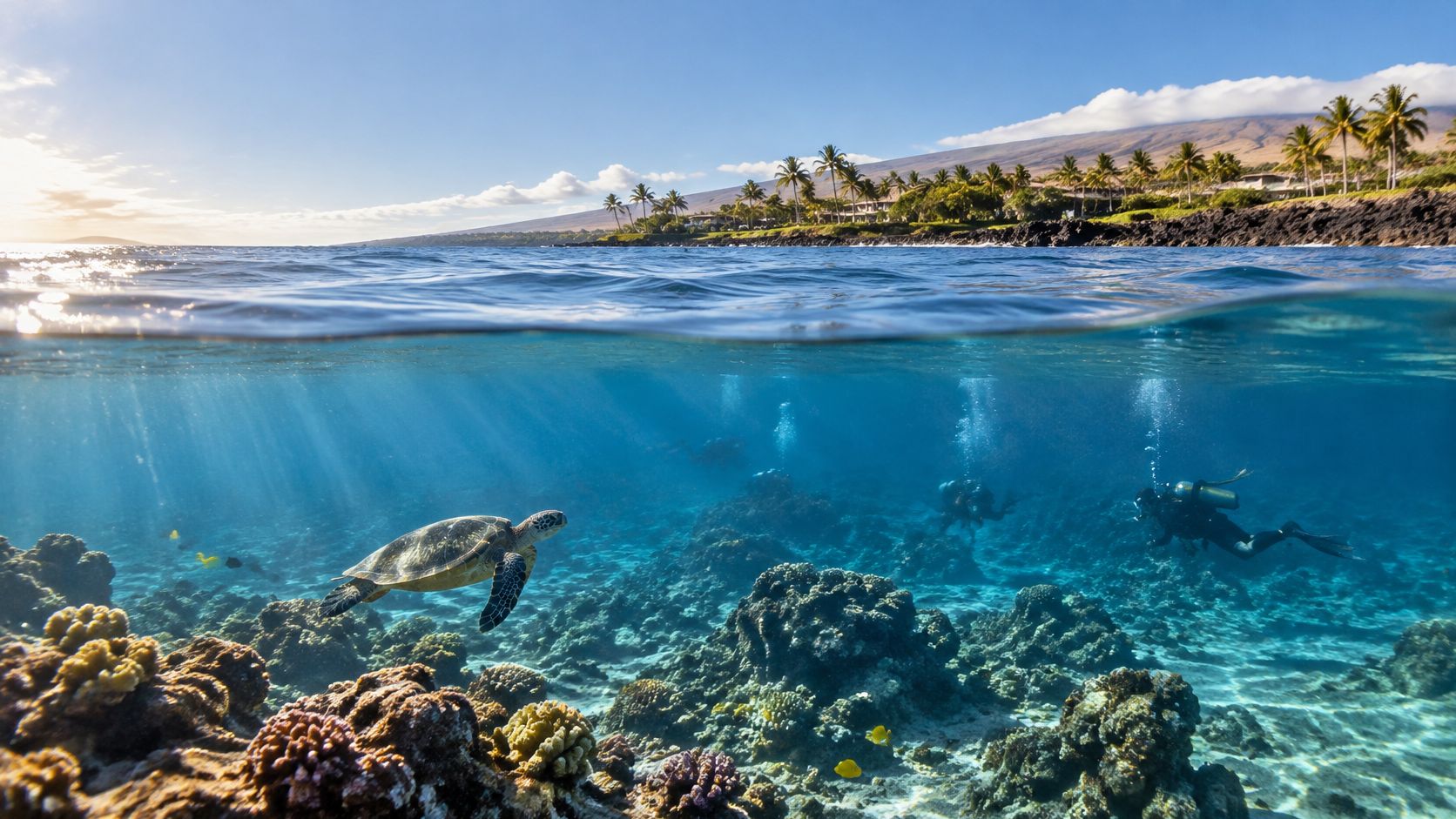
The Best Diving Hawaii seasonal guide places typical warm-season water temperatures near 78 to 83°F and commonly reports visibility exceeding 100 feet at protected sites. Treat those as operating ranges, not guarantees. North or northwest swell resuspends sediment and cuts visibility, and wind chop affects boat operations and your comfort during descent.
A calm surface doesn't prove calm water below. Surge, thermoclines, and suspended particles can change quickly around lava formations and exposed pinnacles.
That gap between surface and bottom surprises visiting divers. You can descend through glassy water and meet a surge zone at the reef that pushes you toward rock on every cycle. Good guides read that on arrival and move sites when they need to. A captain who relocates isn't being cautious for show. He's keeping your dive fun instead of athletic.
Four Practical Steps Before You Choose a Site
- Check swell and recent rainfall before picking a shallow reef or a photography-focused site.
- Wear thermal protection even in warm water, especially on second tanks and night dives.
- Save wide-angle photography for clear-water days, and shoot macro when particles fill the water.
- Ask the operator to switch sites if conditions change, rather than insisting on a named site.
Reef and manta dives both depend on current, plankton, and turbidity more than on the calendar month you picked. Flexible booking days are your best hedge. If you can shift a marquee dive by a day when swell drops, you'll usually get the better version of it.
Choose Your Operator and Book the Dive
Compare operators against a written checklist instead of a photo feed. Reefs look similar in everyone's marketing. Boats, crews, and standards don't.
What to Look For
- Certified, experienced staff: Ask who guides, who captains, and how groups are split by experience.
- Comfortable boat: Shade, shelter, and room to gear up matter on the ride out and back.
- Small groups: Fewer divers per guide means better positioning at manta and lava tube sites.
- Clear wildlife rules: The briefing should state plainly that nobody touches or chases animals.
- Serviced rental gear: Ask how rental regulators and BCDs are maintained.
- Nitrox availability: Confirm it early if your multi-day plan depends on it.
- Recent reviews: Read them in full, including how the shop handled bad weather days.
Check Kona Honu Divers against that list. It's the highest-rated and most-reviewed dive shop in all of Hawaii, and it suits divers who want broad trip variety and a premium full-service experience. If you're comparing shops across town, this rundown of Kona dive shops helps you line up the options.
Call us at 808-324-4668 with questions about group size, dive computers, or whether your experience fits an advanced or blackwater trip. A five-minute call prevents the most common booking mistake here, which is a capable diver on the wrong boat for their goals.
Handle the land logistics early too. Book rental cars or shuttles ahead in busy season, choose lodging reasonably close to the departure point so early check-ins don't hurt, and reserve night tours in advance because they fill. Permits and entry rules for protected areas change, so confirm current requirements before you travel rather than relying on an old forum post.
When your dates, certification, and site choices line up, book the trip and stop second-guessing it. The reef will be there either way.
Ready to match your certification to the right Kona reef, manta night, or blackwater trip instead of guessing from photos? Kona Honu Divers runs guided morning, manta, advanced, and blackwater dives on the Big Island with experienced crews and a full-service boat day. Visit us to pick your dates, confirm your trip fits your logbook, and get in the water.