
You've got Kona dive shops open in several browser tabs, and the trips look similar until you read the requirements. Match your certification and goal to a trip type first, then verify the shop feature that matters most for that trip before paying. A comfortable reef charter and an offshore night dive aren't interchangeable, even when both promise memorable marine life.
Quick Picks for Choosing a Kona Dive Shop
Start with the dive you can enjoy calmly, not the most dramatic booking photo. A Hawaiʻi state inventory identified at least 42 commercial operators visiting Kona's two principal nighttime manta sites in 2015, which makes a focused shortlist more useful than a long directory.
Traveler profiles matched to Kona trip types
| Traveler profile | Best trip type | Check first |
|---|---|---|
| Beginner seeking certification | Introductory or certification course | Instructor ratio and course length |
| Certified first-timer | 2-tank morning reef dive | Boat comfort and site variety |
| Certified diver seeking unique experiences | Blackwater night dive | Night-dive experience requirement |
| Advanced diver | Premium advanced 2-tank trip | Logged dives and depth experience |
| Family with snorkelers | Manta dive and snorkel or snorkel tour | Non-diver supervision |
| Gear-carrying diver | Rental service | Gear service records and sizing |
| Flexible group | Private charter | Group size and schedule control |
| Eco-conscious guest | Small-group manta trip | Guide ratio and crowding policy |
The first distinction is training versus touring. An introductory dive lets you try scuba under instruction; a certification course builds the skills needed for independent buddy diving within your training limits. Neither should be confused with a charter intended for already-certified divers.
For certified visitors, morning reef diving is a sensible starting point. You can settle your weighting, learn the boat procedures, and assess your comfort before adding darkness, deeper profiles, or unfamiliar equipment.
Mixed groups need a different filter. A boat accepting both divers and snorkelers doesn't automatically mean everyone receives the same supervision. Establish who leads the surface group and whether non-divers can comfortably participate in the planned conditions.
Booking rule: Compare shops offering the same kind of experience. A cheaper seat isn't better value if the site, supervision, or entry method doesn't suit you.
For gear arrangements, distinguish between renting a complete setup and supplementing your own equipment. A familiar regulator doesn't solve an ill-fitting rental BCD, and owning gear doesn't remove the need for a buoyancy check.
Shortlist two or three operators offering your preferred trip type. Then use the safety checklist below before committing, particularly if you're considering shore diving, advanced terrain, or a night charter.
The Services Kona Dive Shops Actually Offer
A full-service dive shop works more like a well-stocked outfitter than a single attraction. It can connect training, equipment, transport, and guiding, but you still need to establish which pieces your booking includes.
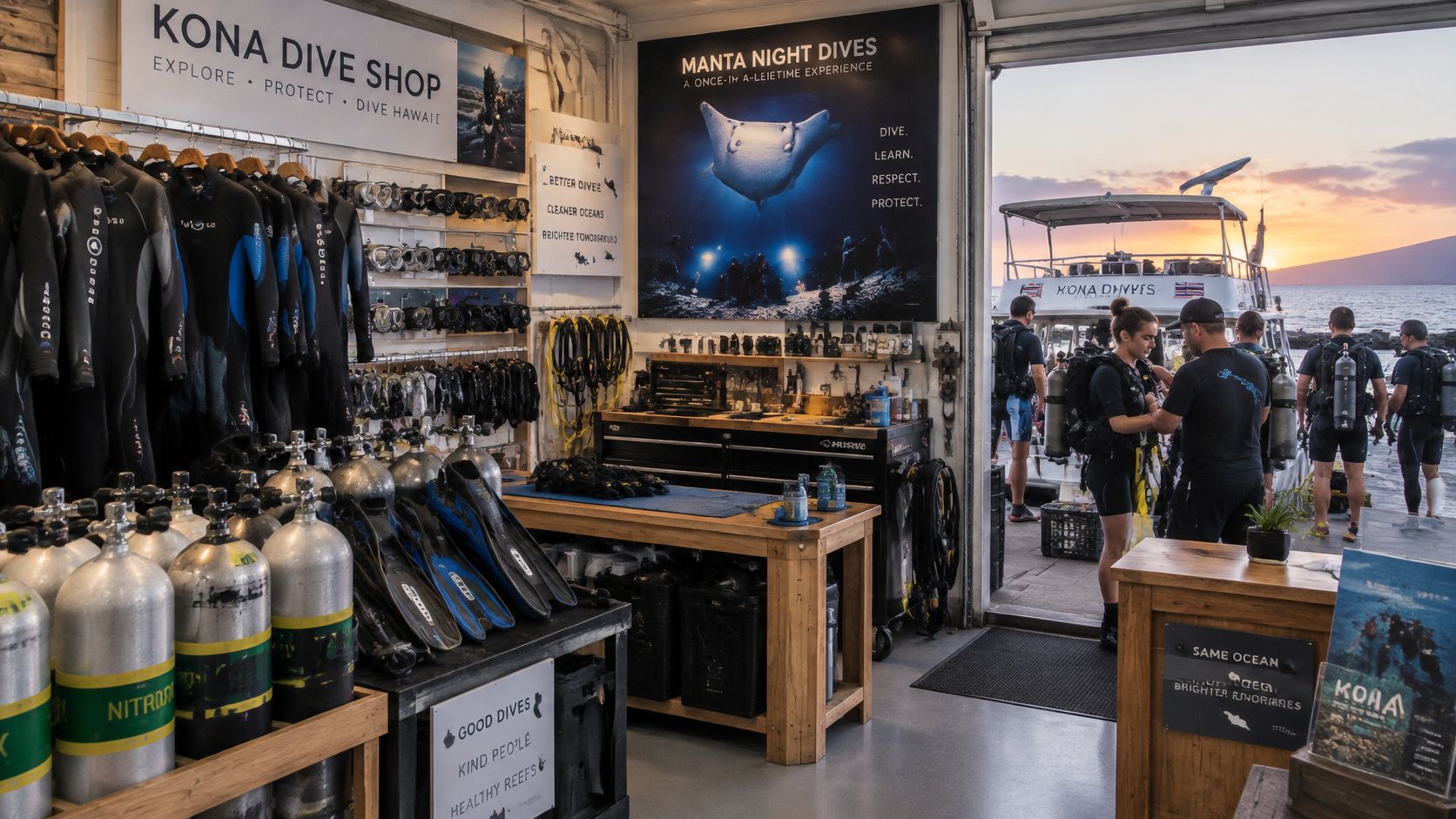
Guided trips and instruction
Manta night trips are organized wildlife encounters rather than ordinary reef tours. Lighting and guest positioning matter, so compare the operating procedure, not just the advertised chance of seeing animals.
Blackwater diving puts experienced divers in open water at night to observe animals around lights. Deep water beneath you doesn't mean the planned dive itself is a deep descent. Ask about the actual maximum depth, attachment system, and experience requirements.
Morning reef charters typically combine separate dives around coral gardens and volcanic terrain. Lava tubes and arches may appear on the itinerary, but access should depend on conditions and the group's abilities, not a promise to enter every feature.
Courses serve a different purpose. An introductory experience tests whether you enjoy scuba; certification develops a broader skill set. Freediving instruction addresses breath-hold technique and buddy procedures, not just how to descend farther.
Kona dive shop services and what to ask before booking
| Service | What You Get | Ask the Shop Before Booking |
|---|---|---|
| Manta night dive | Lit night dive or snorkel with plankton-feeding mantas | Guide ratio, lighting practice and crowding limits |
| Blackwater night dive | Open-water night dive over deep water for experienced divers | Required certification and night-dive experience |
| 2-tank morning dive | Two reef or lava-terrain dives in one morning | Number of sites and tank and weight handling |
| Rentals | Scuba or freediving gear for the trip | Sizing at check-in and service records |
| Courses | Introductory dives, certification and freediving classes | Instructor ratio and course length |
| Private charter | Dedicated boat for a family or group | Group size and schedule flexibility |
Rental equipment should be chosen by fit and function. Check the scuba rental options against what you're bringing, including your computer, exposure protection, and any unusual sizing needs.
Private charters give a group more control over the schedule, but they don't override weather or certification limits. For equipment owners, repair and retail services can be just as useful as another charter. Explain the fault clearly and allow time for assessment rather than expecting an immediate dockside fix.
Use the Big Island diving tours overview as a reference when comparing trip menus. Establish whether gear is included, whether nitrox is available to appropriately trained divers, and how guides divide the group.
The best value comes from matching a service to a clear goal, not choosing the operator with the longest list of options.
Matching a Shop to Your Skill Level and Goals
Cathedral Caves and Au Au Canyon illustrate why depth alone isn't enough to select a trip: a published Kona site guide lists the former as intermediate-to-advanced with a maximum depth of 60 feet, and the latter as advanced, reaching 130 feet. Both demand an honest assessment of your skills, but their profiles leave different margins for gas use and no-decompression time.
Matching a shop to your ability is like matching a trail to your hiking boots. Equipment and qualifications matter, but neither compensates for choosing terrain beyond your current comfort.
Give the booking desk a useful dive history
- Certification level: State your actual qualification, such as Open Water or Advanced Open Water, and any relevant specialty training.
- Logged experience: Describe the environments you've dived, not just the total in your logbook.
- Recent frequency: Explain whether you've been diving regularly or returning after a break.
- Depth comfort: Separate depths you've briefly reached from profiles you can manage without stress.
- Night experience: Mention whether you've stayed oriented and controlled buoyancy without daylight references.
Lava tubes, caverns, canyons, and pinnacles add task loading. You need controlled finning, reliable navigation, sensible gas reserves, and the ability to stop an ascent without grabbing the terrain. An advanced certification isn't permission to enter an overhead environment beyond your training.
Deeper profiles also shorten available no-decompression time and increase gas consumption. A guide can lead the route, but you remain responsible for monitoring your computer and communicating your remaining gas.
A suitable advanced trip challenges your observation and execution, not your ability to hide discomfort.
Choose training or specialization deliberately
Kona Honu Divers suits divers who want broad trip variety and a premium full-service experience.
Our morning trip is for certified divers, while our premium advanced trips explore remote sites with certified participants. Compare the premium advanced trip requirements with your recent experience; if there's a gap, consider scuba classes or a refresher rather than treating a demanding charter as practice.
Before booking advanced diving, verify certification acceptance, recent experience, site conditions, and operator requirements. Ask whether the itinerary includes drift diving or potential overhead features and whether an open-water alternative is available.
A full-service operator with boats, rentals, and teaching staff suits mixed groups and multi-day plans. A smaller specialist may better suit a narrowly defined advanced goal, while a snorkel-focused operator is often the simpler choice for an entirely non-diving group.
Safety and Certification Checks Before You Book
Kona's volcanic coastline can drop away rapidly, and a workable shore entry depends on swell, wind, surge, visibility, and your ability to negotiate uneven ground. The generally sheltered west coast can feel forgiving while lava terrain and difficult exits create problems that aren't obvious from the parking area.
Kona dive shop safety checklist
The Kona diving safety guide describes Hawaiʻi's requirement for ocean divers and freedivers to remain within 100 feet of a displayed dive flag except in an emergency, with nighttime flags identifiable from 100 feet; it also states that Kona has no recompression chamber, so serious decompression illness requires initial emergency care and evacuation to Honolulu.
| Check | What Good Looks Like | Red Flag |
|---|---|---|
| Operator identity | Booking company matches the boat operator, or any arrangement is clearly disclosed | An unexplained difference between booking name and boat operator |
| Dive flag rules | Divers follow the flag-distance requirement | Divers are encouraged to wander far from the flag |
| Night flags | Flags are identifiable at the required distance | Unlit or hard-to-see flags |
| Emergency plan | Written first-response and evacuation plan | Vague answers about decompression illness |
| Shore-entry judgment | Unsafe entry cancelled, relocated, or replaced by a suitable boat option | Pressure to dive regardless of conditions |
| Rental gear | Proactively serviced and sized at check-in | No maintenance information or fit check |
| Pre-dive briefing | Depth limits, turnaround pressure, and buddy plan explained | Briefing skipped or rushed |
| Certification check | Staff confirm certification and recent experience | No questions about qualifications |
Confirm who's operating your trip. Kona Honu Divers is a separate operator from Kona Diving Company. Similar names aren't evidence of shared staff, boats, or booking policies.
Test the plan, not just the equipment
Ask the crew how it would respond to a missing diver, an unconscious diver, or suspected decompression illness. A useful answer identifies communications, emergency oxygen, first aid responsibilities, and transfer arrangements. A written plan doesn't guarantee a good response, but vague reassurance tells you very little.
For shore diving, inspect the exit as carefully as the entry. You need a route you can manage while tired and carrying wet equipment. If breaking waves repeatedly cover the exit, don't assume it will improve before you return.
- Buddy readiness: Agree on separation procedures and who carries surface-signaling equipment.
- Equipment function: Test regulator breathing, BCD inflation and deflation, weight releases, and computer operation.
- Permission to stop: Either diver should be able to end the dive without argument.
A boat alternative is useful only when the boat site and boarding arrangements are themselves suitable. Sometimes cancellation is the correct decision, and a trustworthy shop won't make you feel unreasonable for accepting it.
Choosing a Responsible Manta or Blackwater Night Dive
I recommend Garden Eel Cove, also called Makako Bay, for a focused manta dive because its protected location, better viewing area, and better reef setting favor a controlled experience. Hawaiʻi's Department of Land and Natural Resources recognizes it as a principal nighttime aggregation site, where mantas gather to feed on plankton.
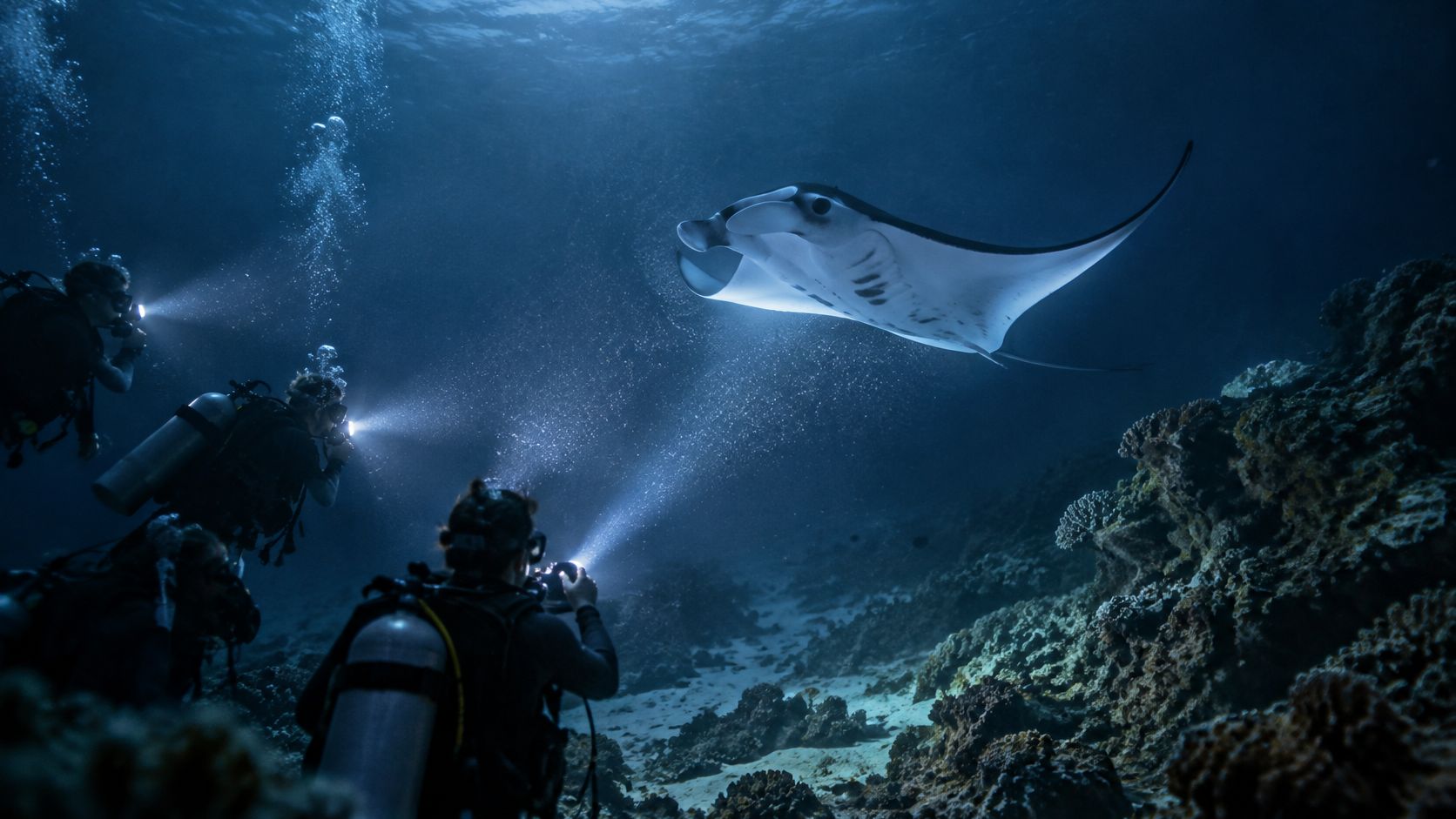
Lights concentrate plankton, and mantas feed through the illuminated water. Your job is to hold the assigned position without crowding their path, not swim after each animal.
Garden Eel Cove compared with Keauhou Bay for night manta dives
| Factor | Garden Eel Cove (Makako Bay) | Keauhou Bay (Manta Village) |
|---|---|---|
| Setting | Protected coastal setting with a defined viewing area | Principal viewing site shared with vessels and surface swimmers |
| Reef setting | Better reefs for a focused dive | Choose primarily for the manta encounter, not a claimed reef advantage |
| Historical encounter rate | Historical sightings documented, not guaranteed | No comparable rate established by the cited testimony |
| Location restrictions in the historical assessment | None recorded for boating, diving, or swimming | None recorded for boating, diving, or swimming |
The Hawaiʻi legislative testimony reported manta encounters on 80% of dives at Garden Eel Cove each year and 154 individually identified Kona Coast mantas since 1992. That's a historical observation rate, not a current guarantee, and repeated encounters can involve recognizable resident animals.
The state's 2013 boating and safety assessment named both principal sites and recorded no location restrictions on boating, diving, or swimming at the time. That historical condition shouldn't be mistaken for current permission to position a boat or group anywhere.
Crowd management is part of the experience
A Hawaiʻi County record describes a survey of 444 participants in which 82% felt crowded by snorkelers, 78% by boats, and 69% by scuba divers; its accompanying discussion describes proposed limits of 24 commercial permits per location, 60 passengers per operator per 24 hours, and one guide per eight participants. These are proposals, not a statement of enacted requirements.
A reliable wildlife encounter isn't automatically a low-impact encounter.
Choose smaller, well-supervised groups and ask how the operator handles crowding or relocation. Keep distance, never touch or chase a manta, and don't block its feeding route. Secure hoses and camera accessories, and follow the guide's lighting directions.
Compare the manta dive and snorkel trip with your preferred viewing style, and review responsible diver etiquette before boarding.
For experienced night divers, the blackwater night dive offers a different challenge. Without a reef beneath you as a visual reference, buoyancy, light discipline, and comfort in darkness matter more than enthusiasm alone.
Packing, Logistics and Sample Kona Itineraries
Pack for the underwater profile and the boat ride, not just the forecast outside your hotel.
- Exposure protection: Bring a rash guard or a 3 mm wetsuit as a starting option, then adjust to the shop's recommendation and your cold tolerance.
- Sun protection: Pack reef-safe sunscreen, a sun shirt, and a cover-up for boat time. Don't treat a reef-safe label as a guarantee of harmless ingredients.
- Dry storage: Use a dry bag for your phone, keys, and spare clothing.
- Dive records: Bring your certification card and logbook, including digital access that works without a signal.
- Camera equipment: Charge batteries, pack spares, and inspect housing seals before the departure rush.
Match exposure protection to the actual site
Water temperature varies with depth and season. NOAA's Hawaiian reef temperature monitoring program uses subsurface recorders at permanent sites, underscoring why a broad Hawaii-wide average isn't enough to choose exposure protection.
Ask what the planned site has felt like recently and explain whether you chill easily. A suit comfortable during an active daytime dive may feel inadequate while holding a position after dark.
Keep check-in straightforward
- Arrival: Arrive early enough to fit equipment and resolve paperwork without rushing.
- Departure timing: Confirm the meeting place and separate morning and night check-in times.
- Weather terms: Read cancellation, rebooking, and refund conditions before paying.
- Equipment handling: At Kona Honu Divers, we size any needed rental gear during check-in and handle tanks, weights, and the rental equipment you've arranged.
Sample Kona dive itineraries by trip length
These are suggested planning sequences, not promises that every activity fits every diver or departure schedule.
| Trip length | Sample sequence | Best for |
|---|---|---|
| 3 days | Morning 2-tank dive, manta night dive, snorkel or reef dive | First-time visitors |
| 5 days | Add a blackwater night dive and a second morning dive | Certified divers wanting night variety |
| 7 days | Add an advanced 2-tank trip, a freediving class and rest days between night dives | Divers wanting variety and recovery time |
Several dives in succession, especially late night departures, can add fatigue and complicate surface-interval planning. Spacing activities gives you more room to recover and keeps an ambitious itinerary from becoming a reason to ignore discomfort.
Don't place a freediving session immediately after scuba because both appear in your vacation plan. Have the instructor coordinate the sequence, and preserve appropriate no-fly and altitude intervals before flights or high-elevation outings.
Use these dive travel tips to organize the practical details. Leave enough flexibility to move a priority trip rather than filling every available morning and evening.
Questions Before You Book and Reserve Your Dive
You're ready to reserve when the trip suits your experience and the operating details are clear. Resolve the remaining questions before a booking confirmation makes the plan feel fixed.
Common booking questions
Q. Do I need scuba certification for a manta night dive?
A. For the scuba version, yes. A snorkel-based manta encounter doesn't require scuba certification, though swimming ability and comfort in nighttime ocean conditions still matter. Make sure the reservation identifies which activity you're booking rather than assuming a combined trip gives everyone access to both.
Q. How far ahead should I book?
A. Book once your travel dates and preferred trip are firm, particularly during busy travel periods. Check the booking system for current availability, but compare cancellation and weather terms before paying. Don't book a more demanding trip because your first choice has sold out.
Q. What happens if weather or swell cancels my trip?
A. Confirm whether the operator reschedules, offers a suitable alternative, or refunds the booking. A shore-entry replacement, boat substitution, and different wildlife trip aren't equivalent experiences, so establish whether accepting an alternative is optional.
Make the final comparison on fit
Choose your trip type, run the safety checks, and get a clear answer about group size and guide-to-guest ratio. Ask whether the ratio describes the entire boat or the divers assigned to your guide. Those aren't necessarily the same thing.
When comparing costs, use the guide to scuba diving expenses in Hawaii to identify what belongs in the total. Equipment, training needs, and the kind of charter matter more than a headline price viewed without context.
Kona Honu Divers is the highest-rated and most-reviewed dive shop in Hawaii, was voted best dive operator in Kona, and won the Scuba Diving Magazine Reader's Choice Award for best dive company in the Pacific. Those credentials are useful context, but your own trip still needs to match your current ability.
Kona Honu Divers booking option
We run the morning, manta, blackwater, and advanced trips described in this guide. Our boats are custom-built for Kona conditions, and our rental gear is proactively serviced. Call 808-324-4668 with questions about matching your experience to a departure.
Choose a departure you can approach rested, prepared, and comfortable with the planned conditions. A booking desk should welcome an honest account of your limitations, not encourage you to minimize them.
Confirm the date, activity, and cancellation policy before paying.
Kona Honu Divers offers reef charters, manta encounters, blackwater dives, advanced trips, and training to help you choose an experience that fits your skills. Visit Kona Honu Divers to compare the options and discuss your certification, recent diving, and preferred pace before reserving.