
You're on a lanai in Kona with a booking page open and four names to enter: yours, your partner's, a twelve-year-old, and a grandmother who swims but doesn't love deep water. The listing says no certification is needed, so it looks easy.
That gap between "no certification required" and "everyone in this group will be comfortable" is where most booking mistakes happen. A night manta snorkel is a dark-water, open-ocean, ladder-access activity, not a shallow reef wade.
The night involves what, how the two sites differ, and how to tell before you pay whether your group belongs in the water.
The Manta Ray Night Snorkel at a Glance
The captain cuts the engine a few hundred yards off the coast and the crew lowers a frame of lights over the side. The water beneath it turns from black to a pale green cone. You float face-down at the surface, mask in the water, hands on the float, and a shape wider than the boat slides into the light and banks back toward you.
That's the event. It runs after dark off the west coast of Hawaiʻi Island at two long-established feeding sites, and the entire trip is built to get you to that moment safely while keeping the animals' feeding lane open.
| Feature | What to Expect |
|---|---|
| Viewing sites | Garden Eel Cove (Makako Bay) or the Keauhou Bay coastline, off Kona's west coast |
| Timing | After dark, in a lit viewing area |
| Viewing position | Floating at the surface while mantas pass through the light |
| Certification | None for snorkelers; certified divers can choose the scuba version |
| Briefing | Crew briefing on the science of the activity and the rules of passive observation |
| Ages | Typically from age 5, with many operator limits set higher; confirm the minimum when you book |
| Boarding | A boat ladder, climbed without assistance |
Kona has been doing this a long time. The 2017 manta ray tourism assessment prepared for Hawaiʻi County traces organized snorkeling and scuba diving at these sites back to 1984, which makes Kona one of the earliest organized manta-viewing destinations anywhere. By the time of that assessment, at least 42 operators were running manta tours, and historical management reporting found the two sites could collectively host as many as 300 divers and snorkelers in a single night.
That volume explains the shape of the trip. Lighting is controlled, viewing areas are marked, and access is by boat. Formal state attention began in 2014, when a Hawaiʻi House resolution urged the Department of Land and Natural Resources to address overcrowding, safety and liability at the manta sites.
Before you pick a date, three things are worth confirming with the operator you're considering.
- No certification is needed to watch from the surface, so the snorkel trip is open to families and non-divers.
- The viewing area is lit by the boat, which is what gathers the plankton and the mantas along with it.
- You stay at the surface. Guests float and watch; certified divers on the scuba version kneel on sand below and look up.
How Lights and Plankton Bring Mantas Close
Nobody feeds the mantas on a Big Island manta ray night snorkel. The lights do the work, and the animals do the rest. Plankton rises in the water column after dark, the lamps concentrate it into a small bright column, and the mantas arrive to filter-feed through a patch of prey denser than anything else nearby.
The mechanics in one line: a porch light doesn't create moths, it moves them into a place where you can see them. The manta lamp does the same thing with plankton.
That distinction matters. Feeding the animals would change their behavior and put them at risk. Concentrating their natural prey leaves the encounter on their terms, which is also why the trip can't promise a fixed number of animals on any given night.
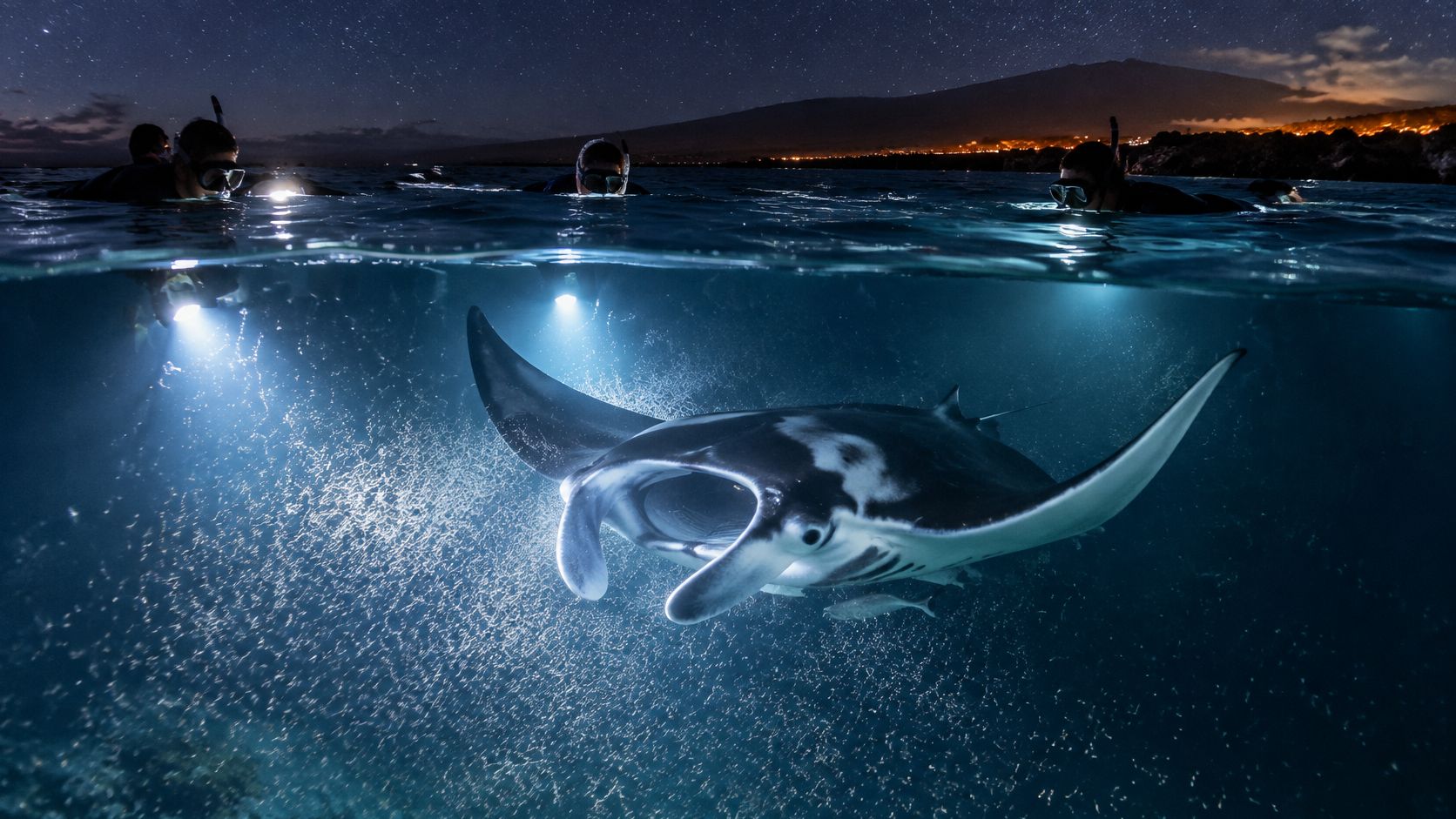
The feeding sequence runs in three steps you can watch from the surface.
- The plankton gathers. Reef manta rays are primarily nocturnal feeders, and their nighttime activity tracks zooplankton moving upward in the water column where it's easier to reach, as NOAA's manta ray education resource describes.
- The light concentrates it. Artificial underwater lighting holds that prey field in one place instead of letting it spread across open water.
- The manta funnels it in. The ray opens its mouth and uses its cephalic fins to steer plankton-rich water inward, where water passes across the gill plates and specialized structures retain the food.
What you see from the surface is the vertical movement. Snorkelers stay at the top while mantas rise through the lit column and drop back to the deeper viewing area, so the geometry of the lights and the position of the swimmers shape both visibility and animal behavior, according to 2018 Hawaiʻi County testimony on snorkeling and scuba diving with manta rays. That same 13-year analysis of Kona community observations found aggregation size was positively correlated with zooplankton density, and predictable nighttime feeding aggregations persisted through sustained tourism and artificial-light activity.
The practical translation is simple. A great night depends on plankton, not on luck or on which company you booked.
Some nights run eight animals past your mask for forty minutes. Some nights give you two passes and a long look at empty green water. Stay put in the designated lit area rather than swimming after a ray, because a stable group keeps the feeding lane open and a chasing group scatters the plankton field. If you want more background on the animals themselves, manta rays in Hawaii covers their biology and the local population.
Choosing Between Garden Eel Cove and Keauhou Bay
Garden Eel Cove is the stronger choice for most guests. It's a protected cove, and that protection buys you a controlled viewing area, calmer surface conditions, and direct access to reef habitat that an exposed, heavily trafficked shoreline can't offer. If you're choosing between the two, or asking an operator which one they run, this is the site to hope for.
Hawaiʻi's Department of Land and Natural Resources identifies both locations as places where manta rays congregate to feed on plankton, and it has described Garden Eel Cove as one of the established viewing areas, per the department's 2016 release on manta viewing site management. That same release outlines proposed measures intended to reduce hazards to people and rays: prohibiting anchoring, limiting commercial operators, prohibiting rafting, and restricting live boating.
| Site | Also Called | Setting | Best For |
|---|---|---|---|
| Garden Eel Cove | Makako Bay, Manta Heaven | Protected cove with a controlled viewing area and reef habitat | First-time guests and anyone who wants reef access |
| Keauhou Bay | Coastline fronting the Sheraton Keauhou Bay Hotel | Exposed, more heavily trafficked coastline | Guests whose operator confirms calm conditions on the night |
The difference shows up in the water, not on a brochure. A protected cove means less surge at the surface, and less surge means you can hold your position without working for it. Reef structure close to the viewing area also means there's something to look at before the first manta arrives.
Where Keauhou wins. Keauhou is the closer run from Kailua-Kona for some operators, and the setting in front of the hotel is iconic. On a flat night it delivers the same animals and the same lit-water viewing. It is less forgiving when the ocean has any push to it.
Ask two questions when you book, and ask them plainly: which site the boat is going to, and what the backup site is if the water turns.
Swell decides the answer more often than preference does. When the swell is up at one location, the operator moves the trip, sometimes to the other site and sometimes to another night entirely. That's a safety call, not a bait-and-switch, and a crew that tells you upfront has thought about it.
Confirm the site again on the day you sail. Conditions change between Tuesday's booking and Friday's departure, and the site that made sense when you paid may not be the one that makes sense at sunset.
Who Can Join and What Each Guest Needs
The question visitors ask most is whether they need a certification. The question that matters is whether they can swim.
No certification is required for the snorkel, and that gets misread as beginner-friendly. A nighttime open-ocean snorkel asks for more than a pool: competent open-water swimming, calm in deep darkness, the ability to hold position at the surface, and an unassisted climb up a boat ladder, according to independent visitor coverage of the Big Island manta ray night dive, which also notes that age limits and flotation policies vary by operator.
The screening question that matters: can you float face-down in dark water, breathing through a snorkel, and then climb a ladder back onto a rocking boat without help? A confident yes means you're ready. A hesitation means a phone call to the operator, not a cancelled trip.
| Guest Type | What They Need | Suggested Option |
|---|---|---|
| Confident open-water swimmer | Comfortable floating in darkness, holding position, using a ladder | Snorkel from the surface |
| Nervous swimmer | Calm in deep water and able to follow the guide | Ask for a short orientation and stay close to the guide |
| Non-swimmer | Flotation and the ability to stay near the surface | Ask about a ride-along or move to another night |
| Child | Age limits and flotation rules that vary by operator | Confirm the minimum age and flotation policy at booking |
| Older adult or guest with mobility limits | An unassisted ladder climb | Ask about boarding help or pick a different date |
Two rules apply to everyone in the water. Stay on the surface, and don't dive toward, touch, chase, or block a manta. Those aren't manners for their own sake. They reduce contact risk and preserve the animals' feeding paths, which is the reason the encounter works at all.
Global travelers get caught by the wording more often than locals do. The word "snorkel" suggests shallow, sunny, standing-distance water. This is dark, offshore, and reached by ladder, and the people who enjoy it most are the ones who knew that before they boarded.
The other factor is the dive version. If you're certified and want to watch from the sand instead of the surface, that's a different trip with different demands, and snorkeling versus diving with manta rays lays out which one suits which guest.
My advice is to call with your own profile before you pay. Describe the weakest swimmer in your group, ask what the crew expects of them, and ask what happens if the swell comes up.
Safety Rules and Etiquette on the Water
The rules on a manta night exist because two things are happening at once. People are floating in the dark in a group, and wild animals are feeding through the area where those people float. Concentration creates the spectacle and the risk together.
Crews manage the second half of that equation. On the manta ray night dive, experienced divemasters and instructors are in the water with divers to manage the group, and the briefing before entry covers how the feeding works and what guests may and may not do.
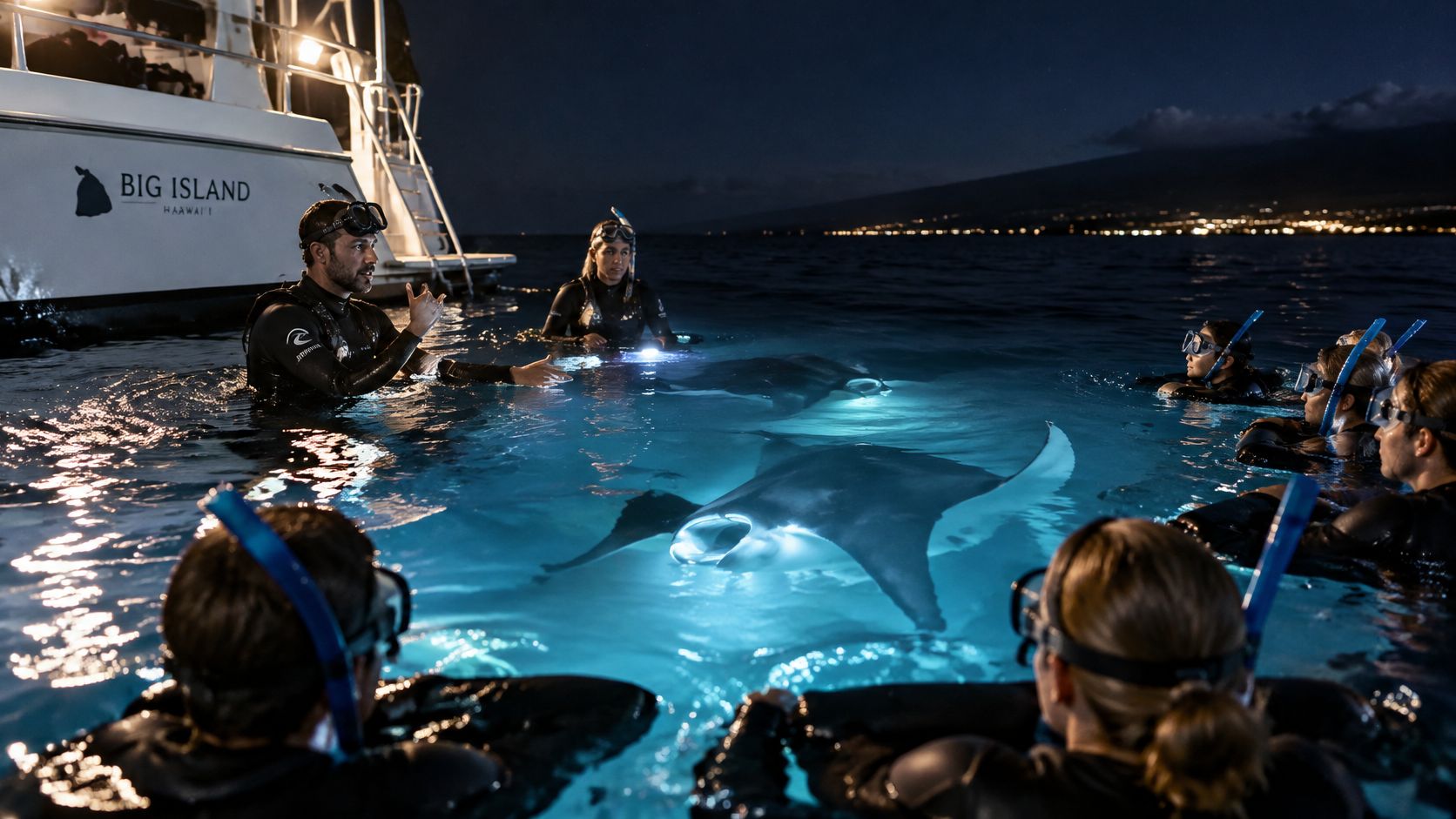
State-level management has been proposed in specific terms. The manta ray dive framework summarized in this operator overview describes two designated zones, no more than 24 commercial permits per zone, and a cap of 60 passenger-for-hire seats per vessel within a 24-hour period. It divides operations into two-hour shifts, sets an 8-to-1 guide-to-customer ratio, and defines viewing hours as 4:00 p.m. to 4:00 a.m. Additional provisions include vessel lighting, propeller guards or a dedicated safety lookout, and a ban on fishing inside the viewing zones during operating hours.
Treat those as proposed framework details rather than a confirmed final rule. They tell you what responsible management looks like, which is useful when you're comparing operators.
Here are the rules that apply to you in the water, whatever the regulation says.
- Stay on the surface. Snorkelers float and watch; dropping down cuts visibility for everyone behind you and puts you in the animals' path.
- Hands off. Don't touch, chase, or block a manta. A brush past happens; a reach does not.
- No flash photography. It disturbs the animals and ruins the lighting the whole group came for.
- Keep fins and hands to yourself. A fin kick near a face is the most common injury on these trips, and it's always accidental.
- Follow the guide's signals. Lights, hand signals, and a whistle mean something specific, and the briefing tells you what.
On the boat: a responsible operator briefs before anyone gets wet, keeps guides in the water rather than on the deck, and will cancel a trip that shouldn't run.
That last point is the true test. Ask what the cancellation and postponement policy is, and listen for whether the answer is easy or evasive. The rules behind responsible and considerate diver etiquette are the same ones that keep a manta lane open.
How to Book, Prepare, and Improve Your Chances
Work through this in order and most of the avoidable problems disappear before you reach the harbor.
- Check the swell the day before you book. A high swell cancels trips, and a booking made blind is a booking you may be moving. Ask about the postponement policy in the same conversation.
- Reserve a date, then ask where you're going. Confirm whether the boat is headed to Garden Eel Cove and what the backup site is. If the answer is vague, keep asking.
- Be honest about three things. Open-water swimming, calm in darkness, and the ladder. Nobody on the crew is impressed by a guest who overstates their comfort and needs a rescue at 10 p.m.
- Pack a dry layer. A rash guard or thin wetsuit, reef-safe sunscreen, a towel, dry clothes for the ride back, and a sealed bag for phone and keys. Cold hits hardest on the return leg, when you're wet and the boat is moving.
- Eat light and arrive early. A heavy meal and a rocking boat are a poor combination, and arriving early gets you a better spot in the briefing and a calmer boarding.
- Practise the float if you're nervous. Ten minutes in shallow water, face down, breathing through a snorkel, changes the whole night. Do it in a pool or at the beach the day before.
- Take one spot in the lit area and hold it. Board on the ladder, find your place, and stay there. A stable group keeps the feeding lane open and the light field intact.
- Keep your mask in the water. Breathe through the snorkel, look down, and watch for a manta turning in the light rather than lifting your head to chase it.
- Expect a slow start. Sightings follow plankton, so a quiet first fifteen minutes is normal. Stay for the full window and ask about a return night if nothing shows.
- Rinse the gear and use the policy. Fresh water on mask and snorkel, and if weather cancels you, take the postponement instead of pushing a crew to run.
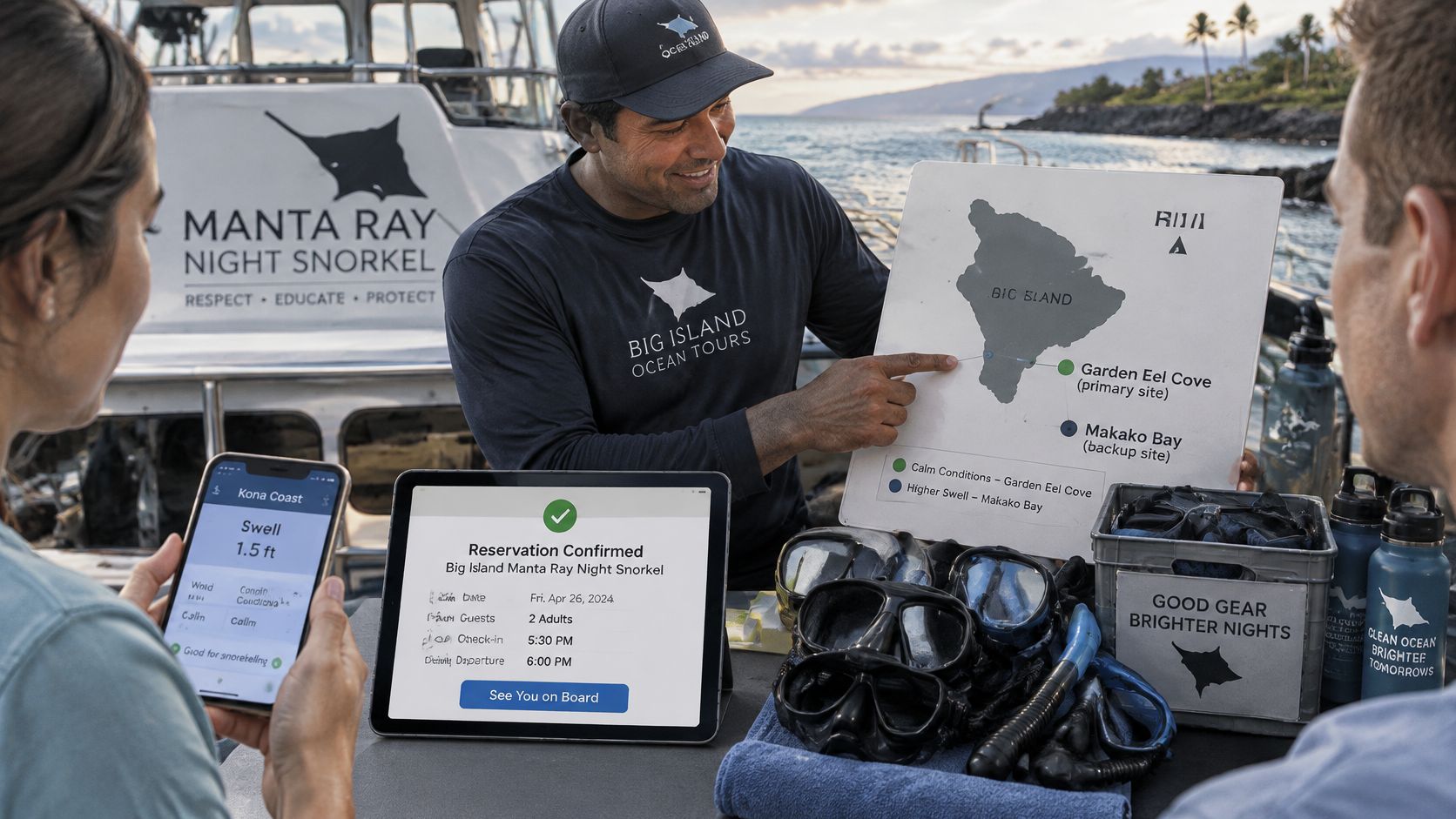
The three mistakes that come up most often are booking into a building swell, skipping the dry layer, and swimming after the animal. The first costs you a trip, the second costs you an hour of shivering, and the third costs the group its view.
Timing helps more than many expect. Moon phase, season, and even which night of the week you choose all shift the crowds and the light conditions, and the best time to see the manta rays in Kona covers how those trade off against each other.
Common Questions Before You Book
Do I need a certification? No. Snorkelers use a mask, snorkel, and flotation at the surface. The scuba version is a separate trip and requires a certification card.
Are sightings guaranteed? No, and anyone who promises them is selling rather than guiding. What Kona does have is a well-documented resident population. A long-term photo-identification study summarized in University of Hawaiʻi research on Kona's manta aggregation recorded 1,494 manta encounters and identified 290 unique individuals, and 13 years of community-sourced observations from 2010 through 2022 documented more than 23,000 sightings of 167 individual reef manta rays at Garden Eel Cove and Keauhou.
How long am I in the water? It varies by operator, so confirm the in-water window before you pay. Ask the same question about price, since what's included differs from boat to boat.
A quiet night isn't a failed trip. It's a night when the plankton wasn't thick, and the animals went where the food was.
Is it cold? You're wet, offshore, and out after dark, so plan for the ride back rather than the minutes in the water. A dry layer does more for your comfort than any other single item you bring.
Can mantas hurt me? Reef manta rays feed on plankton and have no stinger or barb. The actual risks are the ladder, the dark, a fin to the face, and cold. Whether manta rays can sting you answers the animal side in detail.
What if my group includes a non-swimmer? Say so at booking, not at the dock. Ride-along participation and postponement are both reasonable answers, and the operator decides which one fits the sea state.
Can I take photos? A waterproof camera without flash is fine when the crew allows it. Flash is off the table, for the animals and for everyone else's view.
Book Your Manta Night Snorkel with Kona Honu Divers
Book this trip if you can float confidently at the surface and want a supervised look at feeding mantas in lit water. Book early, because the two Kona sites fill and a swell can wipe out a date you've been planning for months. A backup night in your itinerary is worth more than a discount.
Kona Honu Divers runs the night around a stationary group, a briefing before entry, and guides in the water with guests to keep everyone safe and comfortable. Snorkelers stay at the surface and watch from above. The crew sets powerful lights on the seafloor, which creates a bright circle and draws plankton and mantas in, so nobody is ever floating in complete darkness.
When conditions allow, our go-to site is Garden Eel Cove, a protected location with a controlled viewing area, a healthier reef and generally calmer conditions than an exposed shoreline. It's the site that gives first-timers the best odds of a comfortable float and a clear look.
Read the swimming and ladder requirements before you commit, then pick a date and call with your own profile before you pay. Describe the weakest swimmer in the group and ask what the crew expects of them.
Full trip details, including the scuba option for certified divers, are on our 2-tank manta dive and snorkel page.
Kona Honu Divers takes small groups to Garden Eel Cove for the manta ray night dive and snorkel, with a full briefing on how the lights and the plankton do the work, guides in the water the whole time, and a stationary setup that keeps the feeding lane open. If your group can float at the surface and climb a ladder, the rest is watching. Visit Kona Honu Divers to pick a date and confirm the details with the crew before you book.