
You step onto the boat with a wetsuit on, a little salt on your lips, and a question you probably haven't said out loud yet, will this feel magical, or just dark and crowded? The big island manta ray night dive answers that question fast. The engine hum fades, the lights go underwater, and the black water turns into a living stage where patience, buoyancy, and a few clean habits matter more than bravado.
The beauty of the experience is that it doesn't ask you to chase anything. You settle into the water, look into the illuminated column, and wait for a giant filter-feeder to glide through the beam. That quiet shift, from boat noise to weightless stillness, is what makes the dive feel bigger than a simple tour.
The Magic of Floating in Kona Darkness
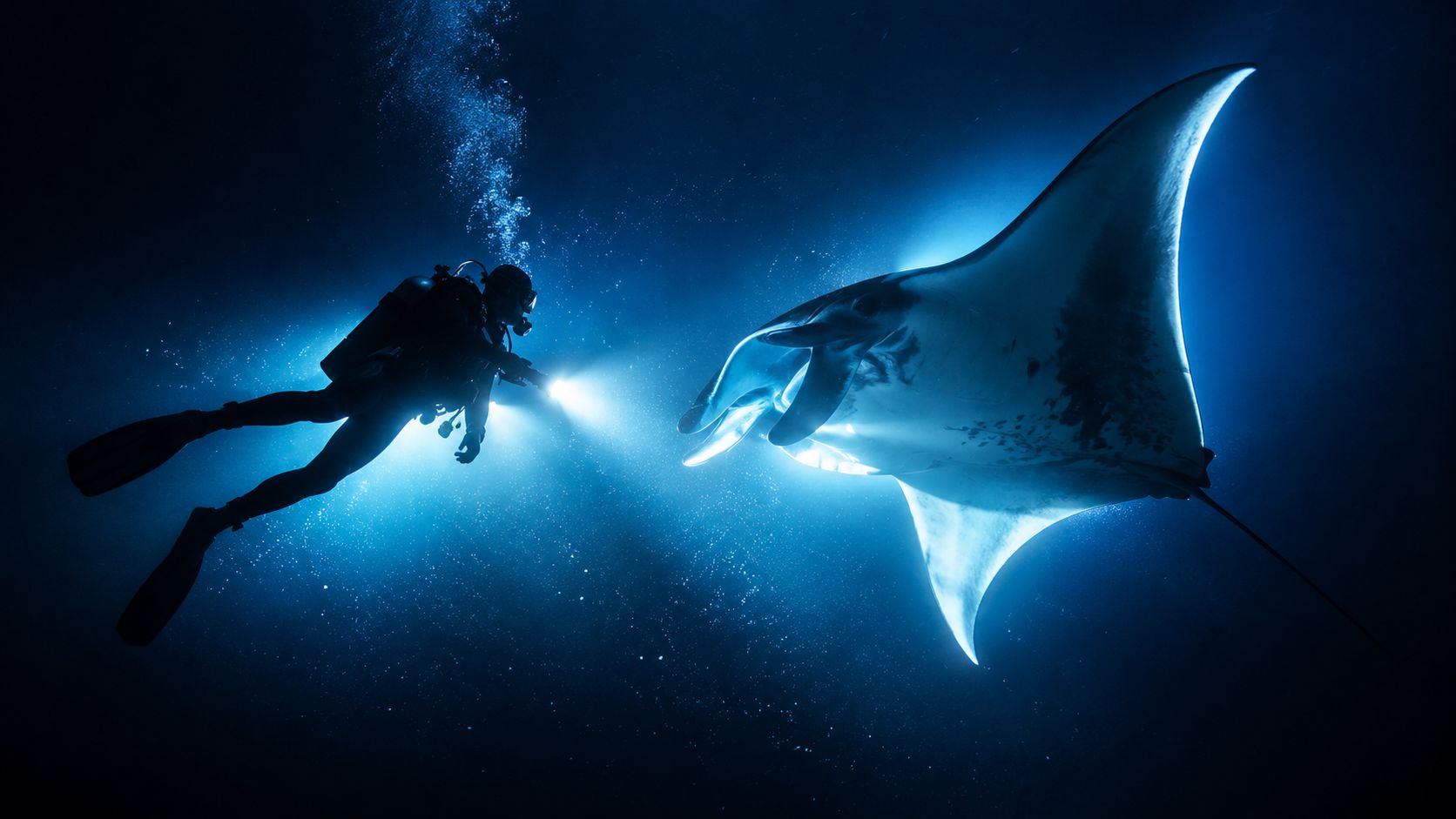
What catches your attention first is how quickly the noise disappears. Once you are in position, the ocean feels enormous and quiet, and the only real job is to stay calm while the light does its work. If you want the basic flow of the outing, this overview of the manta ray night swim experience gives a useful sense of the rhythm.
Waiting in the dark changes your sense of scale
On land, people tend to think of manta rays as big animals that move through space. Underwater at night, they feel more like passing architecture. A wingtip can appear out of nowhere, then the whole animal resolves above you in a few slow seconds.
That is why the darkness matters. It removes distractions, so the illuminated water becomes a single focal point, almost like a blue-white window suspended in black. You stop scanning the whole ocean and start reading the movement inside that window.
The emotional shift is real, especially for first-time divers. Anxiety usually comes from not knowing what the night will look like, but the experience rewards stillness, listening, and staying where your crew placed you.
Stay low, stay calm, and let the manta come to the light.
The encounter works because it feels unforced. You are not hunting for a sighting, you are holding position inside a carefully managed nighttime environment and letting the animals arrive on their own terms.
The Engineered Ecosystem Behind the Encounter
The big island manta ray night dive is not baiting. The setup is better understood as an engineered plankton concentration event, where strong dive lights illuminate the water column, attract zooplankton, and then draw reef manta rays into the viewing area. Research on Hawaiian manta sites confirms that mantas feed on zooplankton attracted to underwater lights, which is why the light itself is the center of the system, not piles of food or hand-feeding. For a broader dive-center explanation of the local setup, see manta rays in Hawaiʻi.
Why the lights matter more than the boat
The local history goes back a long way. A Hawaiʻi legislative testimony document says regular manta dives had been conducted along the Kona Coast since the late 1970s, and it records the move from observation to structured tourism in the early 1990s. The same document says researchers identified 106 individual manta rays along the Kona Coast between 1992 and 2007, with later reports citing 154 identified animals since 1992. Those figures show a long-running relationship between predictable nighttime feeding behavior and tourism, not a recent trend. Source
The important part is the food chain. Lights attract plankton, plankton gathers in the beam, and mantas feed through that concentrated patch of water. That is why the dive feels so elegant, the crew creates a feeding zone without feeding the animals.
This also explains why the site can support identification over time. The manta community is relatively small and repeatedly observed, so researchers and operators can recognize individuals across years. That kind of continuity is one reason responsible viewing behavior matters so much, because every night contributes to the long-term record.
Practical rule: if the light is aimed well and the water column stays open, the mantas have room to feed naturally.
The result is a wildlife encounter built around observation. You are watching an ecosystem respond to light, not watching animals perform for people.
Essential Gear and Safety Protocols
Good gear makes the dive calmer before you even enter the water. A well-fitting mask, a comfortable wetsuit, and gear that doesn't flap around all matter more at night, because you're already processing new sensations. If you're still early in your diving journey, the training and comfort basics covered on learning to scuba are worth reviewing before you go.
Keep your body quiet and your equipment tidy
The safest divers are the ones who move least. Stable buoyancy keeps you from drifting into the feeding corridor, and a low profile helps the crew keep the group organized. Divers should sit or hover where instructed, keep fins out of the manta's path, and never kneel on living substrate.
A protruding snorkel can create avoidable problems, so it should be secured or removed to prevent mask displacement. You should also avoid exhaling directly into an approaching manta's path, because bubble streams can startle or redirect the animal. Small habits like this matter more than dramatic gestures.
If seasickness is part of your normal travel story, plan ahead before boarding. Common options people use include Ship-EEZ Seasickness Patch, Dramamine pills, Bonine pills, Sea Band wristbands, and ginger chews. Choose the approach that matches your body and your doctor's advice, because a calm stomach makes it much easier to stay present.
Keep your lights vertical, your breathing steady, and your fins still.
That's the genuine safety formula. The more controlled you are, the more comfortable you feel, and the less likely you are to interrupt the feeding behavior you came to witness.
Choosing Your Viewing Platform
The two main ways to experience the dive feel different from the moment you enter the water. Snorkelers stay face-down at the surface, usually holding a rail or floating light board, while scuba divers sit or hover on the bottom and look up into the illuminated water column. Both setups are observation-based, not contact activities, and both depend on the same plankton-light-manta chain.
The choice often comes down to comfort with depth and breathing gear. Divers usually get a more stable low-angle view of the animals passing overhead, while snorkelers enjoy a surface perspective that can still be striking when the mantas rise close to the lights. If you prefer a boat option that helps frame the outing before you commit, Kona boat tours is a useful place to compare the broader trip style.
Site choice shapes the feel of the night
Kona has two principal manta-viewing areas, Garden Eel Cove, also called Manta Heaven, and Manta Village near Keauhou Bay. The site near Kona International Airport is widely favored when conditions and activity make it available because its protected bay setting helps reduce open-ocean swell and wind, and the sandy amphitheater gives mantas space to circle without forcing divers onto reef structure. Those physical traits make the viewing environment calmer and more forgiving.
That matters for families, newer divers, and anyone who wants a steadier water experience. A protected site can feel less hectic, and a wider sandy bottom gives the crew more room to place participants safely away from sensitive reef. For the manta ray dive, this is one reason Garden Eel Cove deserves serious attention.
The choice between sites should never be treated like a guarantee system. It's a wildlife encounter, so recent activity, weather, and visibility all matter. Still, the site geometry affects how relaxed the night feels once everyone is in the water.
Understanding Site Geography and Conditions
The smartest way to think about Kona's manta sites is as living habitats, not interchangeable venues. A recent University of Hawaiʻi study analyzed more than 23,000 sightings of 167 individual reef manta rays from 2010 to 2022 at Kona's two principal nighttime feeding sites. It found that aggregation size fluctuated seasonally and annually in close alignment with zooplankton density, which means prey availability drives presence as much as tour timing does. Source
What the science says about a “good night”
The same study found that Garden Eel Cove generally supported larger aggregations than Keauhou, while Keauhou was visited predominantly by females. That suggests the two sites may serve different ecological functions, which is a far more useful way to think about them than just “better” or “worse.” It also means a quieter night doesn't necessarily mean anything is wrong.
The long-term picture is reassuring in a careful, scientific way. The study reported broadly stable aggregations during the study period and found no observed decline in local population viability, while still emphasizing the need for site-specific monitoring. That is a helpful counterweight to alarmist coverage, because it shows that tourism and monitoring can coexist when the encounter is managed well.
Garden Eel Cove also helps explain why location matters on the practical side. Its protected bay setting reduces the slap of open water, and the sandy amphitheater creates room for both divers and rays to move without crowding the reef. If a family or newer diver is deciding where to book, those physical features are worth paying attention to before anything else.
| Site | Notable feature | What it means for guests |
|---|---|---|
| Garden Eel Cove | Protected bay and sandy amphitheater | Calmer conditions and more open viewing space |
| Keauhou | Different visitation pattern | Useful when the operator chooses it for recent activity |
The final decision should follow conditions, not assumptions. A strong operator reads recent manta behavior and ocean state before deciding where the night makes the most sense.
Booking Your Dive and Managing Expectations
People often book the manta dive like they're buying a show ticket. That mindset sets them up for disappointment, because wildlife doesn't run on a schedule. The better approach is to book a well-managed observation trip and treat any close pass as a gift, not a promise. If you want one operator example in the local market, Kona Honu Divers offers guided Big Island manta ray night dive tours and a two-tank package that combines a daytime reef dive with the night manta outing.
What to look for before you commit
A reputable dive center talks about site choice, crew placement, and safety behavior before anyone steps into the water. It should be clear about the difference between a high-quality evening and a guaranteed sighting, because honesty is part of responsible wildlife tourism. If a company overpromises, that's a warning sign, not a sales advantage.
The crew's job is to help you hold position, protect the reef, and keep the water column open for the mantas. Your job is to listen, stay with the group, and avoid crowding the lights or the animals. That shared discipline is what keeps the encounter workable over time.
A good manta night is measured by how respectfully the group behaves, not by how aggressively anyone tries to get close.
That's the mindset shift that makes the booking process easier. You are not buying control over an animal encounter, you are buying a chance to witness a feeding behavior in a managed environment.
The traditional signs of quality are simple, calm briefings, clear gear handling, and crew members who can explain why certain behaviors are required. If the operator speaks about distance, buoyancy, and light placement with confidence, you're probably in the right place.
Making the Most of Your Underwater Adventure
The dive goes best when you arrive ready to do less, not more. Bring gear that fits, follow the light instructions exactly, and keep your movements compact so you don't become part of the problem. The experience rewards the person who can float calmly, stay warm enough to relax, and let the encounter unfold on its own terms.
A simple checklist helps keep the night smooth:
- Secure your mask and snorkel: A loose snorkel can bump your face and distract you when a manta passes close.
- Hold your position politely: Stay in the area the crew gives you, and keep fins clear of the feeding corridor.
- Keep your breathing controlled: Calm, even exhalations help you stay steady and avoid surprising the animals.
- Respect the lights: Vertical light placement supports the plankton field that brings the mantas in.
- Accept natural variability: Some nights will be busier than others, and that's part of watching wildlife.
The Kona manta tradition has lasted because people learned to share the water with the animals instead of trying to dominate the encounter. That long history, from late-1970s local dives to a structured tourism activity in the 1990s, shows how much responsible behavior matters. Source
If you keep that in mind, the night becomes much more than a boat excursion. It becomes a calm, memorable lesson in how light, plankton, and patience can turn an ordinary dark ocean into one of Hawaiʻi's most distinctive marine experiences.
If you're ready to turn that knowledge into a real night on the water, visit Kona Honu Divers to look at manta ray dive options, ask about site conditions, and choose the trip that fits your comfort level. Their crew can help you prepare for the big island manta ray night dive with the kind of clear briefing and practical support that makes the whole experience feel easier from the start.