
Table of Contents
- How to choose between boat and shore diving
- Read conditions by dive type
- Bring evidence and describe your skills honestly
- Why Garden Eel Cove is the stronger choice
- Blackwater is a different kind of night dive
- A hypothetical reef-and-night-dive day
- Protect the departure day
- Check fit before the boat leaves
- Evaluate how the crew manages people
- Make your own conduct predictable
- Will I see manta rays on every night dive?
- Do I need my own dive light?
- How long should I wait before flying after diving?
- What if weather cancels my boat?
- Which certification card do I need?
- Does calm water mean a safe dive?
More than 300 participants were recorded at a single Kona manta-viewing site simultaneously in a county-hosted assessment of manta snorkeling and scuba diving. That's the figure to keep in mind when planning Big Island diving. The question isn't only which site has the most animals, but which operation gives you room to dive, a sensible entry and exit, and a clear plan around other boats.
Kona offers sheltered reefs, shore entries, manta encounters and open-ocean night dives. Those experiences demand different skills, and a calm-looking bay doesn't make them interchangeable. Choose your dive by site layout, conditions, certification and operator conduct, then let wildlife sightings be the reward rather than the entire measure of success.
Big Island Dive Sites Compared
Kona's west coast holds most of the Big Island's strongest scuba options, and the right site depends on the dive you want and your comfort in current. Start by separating daytime reef exploration, stationary manta viewing and open-ocean night diving.
Kona dive sites by experience and conditions
| Site | What You See | Typical Conditions | Best For |
|---|---|---|---|
| Garden Eel Cove (Makako Bay) | Reef manta rays at night, garden eels, sheltered reef | Protected bay, calmer water, with conditions checked before departure | Night manta viewing with a clear viewing area |
| Keauhou Bay (Manta Village) | Reef manta rays at night, often smaller groups | Coastal viewing area exposed to changing weather and vessel traffic | Manta encounters when the operator has a clear traffic-management plan |
| Kealakekua Bay | Captain Cook Monument above water, coral, reef fish and possible sea turtles below | Morning departures are a sensible starting point, subject to swell | Shallow reef exploration and history-focused trips |
| Two Step (Honaunau) | Lava-shelf entries, turtles and reef fish | Surge can complicate entry and exit, inspect conditions on the day | Shore dives for confident divers |
| Blackwater offshore of Kona | Pelagic animals, plankton and deep-water life at night | Open ocean after dark, without a reef reference | Experienced night divers |
The table describes planning characteristics, not promises. A protected bay can still have crowding, and an accessible shore entry can become unsuitable when waves wash across the exit. The relevant question is what the site looks like when you'll use it.
A 2025 Hawaii Tourism Authority visitor-activity report covered by KITV found that 2.4% of visitors participated in scuba diving, compared with 42.9% who participated in snorkeling. Most visitors experience the reef from above, while scuba lets qualified divers explore its contours. That doesn't guarantee solitude, especially at concentrated wildlife-viewing sites.
How to choose between boat and shore diving
A morning reef charter is the easiest starting point for most certified visitors. The crew can choose an appropriate site, explain the route and manage the boat pickup, leaving you to concentrate on buoyancy, gas use and your buddy.
Shore diving shifts more responsibility onto you. You need to assess the entry, identify an exit you can use after the dive, and account for changing surge while carrying equipment. Use this Big Island shore-diving guide to narrow your choices, not as a substitute for inspecting the shoreline.
Kona Honu Divers offers night and morning reef dives along the Kona Coast. Compare the full diving tour list, then match the site to your certification and current comfort rather than chasing the most famous name.
Best Seasons and Water Conditions for Diving
Kona seasons, water and visibility
| Season | Water Temperature | Visibility | Sea Conditions |
|---|---|---|---|
| Summer | Generally warmer, confirm the current reading | Often favorable when swell is low | Usually a useful starting point for calmer-water planning |
| Fall | Warm-water conditions can continue | Check recent reports after weather changes | Assess swell direction rather than relying on the season |
| Winter | Cooler, especially noticeable on repeated dives | Exposed sites can become less clear during swell | Larger west-coast swells are possible |
| Spring | Transitional conditions, ask about recent temperatures | Often favorable during settled weather | Wind and swell still determine site selection |
Diving in Kona is available year-round, with warm, clear water. Seasonal patterns help you choose dates, but they don't tell you whether a particular shoreline entry or boat route will be suitable.
Summer is a reasonable starting point if your priority is comfortable reef diving and less complicated surface conditions. Winter requires more flexibility because incoming swell can affect exposed sites even when the sky is clear. Fall and spring can offer excellent diving, but neither label replaces a marine forecast.
Read conditions by dive type
A shore diver should pay particular attention to waves crossing the entry shelf and the ability to exit with equipment. A boat diver needs to consider the ride, the ladder and the pickup procedure as well as conditions underwater.
For night diving, ask about the conditions expected at the return time, not just at departure. A comfortable afternoon crossing doesn't answer whether the crew expects wind, swell or difficult boarding after dark.
- Temperature: Request a recent water reading and choose exposure protection for the whole schedule, including repeated dives.
- Visibility: Ask whether reduced clarity affects the descent, group spacing or ability to locate the exit.
- Wind and swell: Confirm which conditions would trigger a site change or cancellation.
- Wildlife activity: Ask about recent manta sightings without treating recent success as a guarantee.
Plankton availability is particularly relevant to manta feeding. Don't choose a night solely because a calendar or moon-phase chart suggests it will be productive.
Planning rule: Choose the season around the diving you want, then protect the trip with a backup date.
The guide to the best months for scuba diving in Hawaii can help you compare travel windows. On the morning of your dive, let the actual ocean conditions make the final decision.
A cancellation is inconvenient, but it's also evidence that the crew is prepared to stop rather than force the itinerary. Don't build a holiday that depends on every departure running exactly as scheduled.
Certification and Skill Level You Need
For most of our regular charters, you need at least an Open Water Diver certification from a recognized agency such as PADI, SSI or NAUI. A certification card establishes training, but the dive also has to fit your recent experience and practical skills.
Minimum certification by dive type
| Dive Type | Minimum Certification | Experience Needed | Notes |
|---|---|---|---|
| Discover Scuba introductory dive | None | Beginner | Instructor-supervised and shallow, not a certification |
| Reef and morning two-tank dives | Open Water Diver | Certified divers with appropriate current skills | Required for most regular charters |
| Night manta dives | Open Water Diver, subject to operator acceptance | Comfortable managing equipment and signals after dark | Confirm the briefing and group rules |
| Advanced long-range trips | Advanced Open Water or an operator-accepted equivalent | Recent logged dives and relevant experience | Confirm the specific charter's prerequisites |
| Blackwater night dive | Operator-approved certification and experience | Experienced night divers with strong buoyancy | Obtain explicit acceptance before booking |
An introductory session isn't a shortcut onto a certified-diver charter. You may learn basic skills and enjoy a supervised ocean dive, but you haven't completed the training needed to plan and conduct ordinary recreational dives with a buddy.
Likewise, an advanced card doesn't automatically qualify you for every advanced itinerary. Depth experience, gas management, current, boat procedures and recent practice all matter. Check the eligibility requirements for the premium advanced two-tank trip against your actual logbook.
Bring evidence and describe your skills honestly
A useful booking conversation includes when you last dived, what conditions you're used to and whether you've completed night dives. Mention anything that could affect the plan, including trouble equalizing, anxiety during descents or difficulty climbing a boat ladder.
- Certification card: Bring a physical or accessible digital copy.
- Logbook: Include recent dives, conditions and relevant specialties.
- Medical paperwork: Complete the operator's screening and arrange clearance when requested.
- Refresher needs: Ask for a skills session if you're rusty, even if your card meets the entry requirement.
If it's been more than a year, I would discuss a refresher before committing to night or deeper diving. Don't use the first descent of a demanding charter to find out whether you remember your equipment.
The Big Island scuba certification guide explains the training route if you're starting from scratch or extending your skills.
If you can't clear your mask, hold buoyancy or manage a controlled ascent comfortably, choose practice before a more demanding dive.
That isn't a judgment about experience. It's a way to keep the dive enjoyable for you, your buddy and the guide responsible for the group.
Manta Ray and Blackwater Night Dives Explained
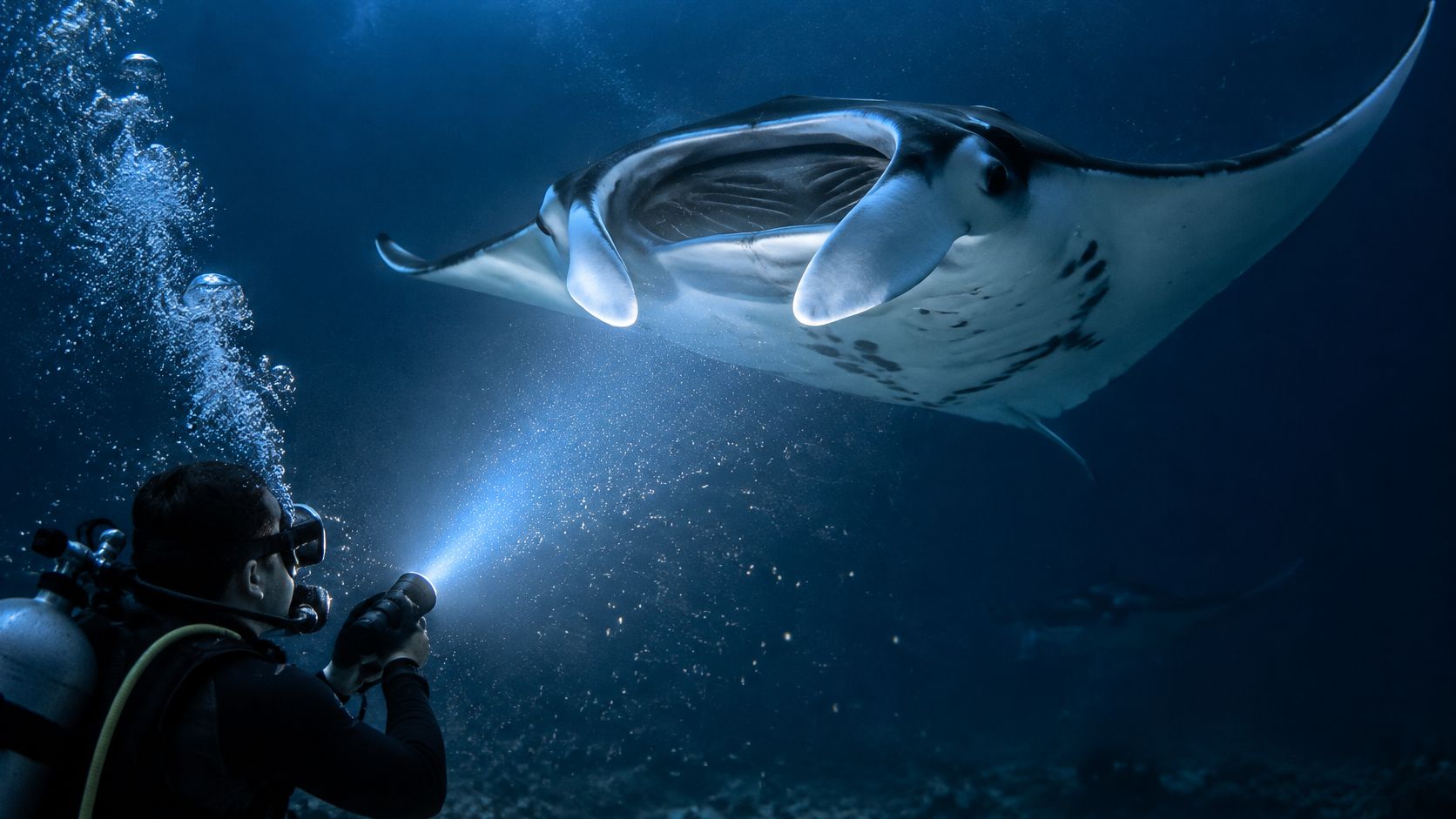
Underwater lights concentrate plankton, and manta rays arrive to feed. They filter plankton-rich water rather than taking bait from a guide, a feeding mechanism described in NOAA's manta conservation material.
A typical viewing sequence is simple: descend with the group, settle into the assigned position and let the animals move through the illuminated water. The skill isn't swimming after a manta. It's staying composed while something large passes close overhead.
Why Garden Eel Cove is the stronger choice
For a manta-focused scuba tour, Garden Eel Cove is the superior choice because its protected location, dedicated viewing area and established reef habitat give the operator a better setting for organizing divers. State testimony identifying the site as Makakō Bay reported manta sightings on approximately 80% of dives, a historical finding rather than a guarantee for your booking, in testimony submitted to the Hawaii Legislature.
The better reefs matter because a worthwhile visit shouldn't depend entirely on a crowded feeding encounter. They also create a responsibility to avoid damaging the habitat while positioning divers and equipment.
A long-term study published in Environmental Biology of Fishes found that Garden Eel Cove generally supported larger and more variable manta aggregations, while Keauhou had smaller aggregations with a strongly female-biased pattern. Larger potential groups don't mean predictable attendance. The animals respond to feeding opportunities, not departure schedules.
Compare the manta ray dive tour with your comfort level, and use the Big Island manta night-dive guide to prepare for the viewing format.
Blackwater is a different kind of night dive
A Kona blackwater night dive takes place offshore rather than at a reef viewing area. Animals that move upward through the water column after dark may appear in the lights, including delicate pelagic life and larval forms.
There's no reassuring reef beneath you to use as a visual reference. You must manage your position, depth and equipment without becoming so absorbed in a small animal that you lose awareness of the group or attachment system.
- Choose mantas if you want an organized wildlife-viewing position with a defined site layout.
- Choose blackwater if you already manage night diving confidently and want to observe open-ocean life.
- Choose a reef night dive first if darkness alone is still a substantial new task.
Hawaii's DLNR manta-management assessment identifies Makako Bay as the designated site for commercial scuba manta operations under its management framework and flags congestion and entanglement concerns. Ask which bay your departure uses and how the crew separates divers, surface participants and equipment.
Keep your handheld light directed down and away from other divers unless the guide assigns a specific orientation. Leave fixed attraction lighting to the crew, and judge the trip by its briefing, positioning and conduct rather than the number of animals in your photographs.
Sample Itineraries and Day Plans
A three-day beginner plan
Day one: Start with orientation and an instructor-supervised Discover Scuba session. Use it to assess comfort, not to assume you're ready for a certified-diver charter.
Day two: Arrange another supervised morning reef experience, or continue a properly scheduled certification course. If you're already newly certified, choose an easy guided reef dive.
Day three: Make the morning another low-task-load reef session. Add an evening manta dive at Garden Eel Cove only if you've earned the required certification, meet the operator's prerequisites and feel comfortable with the additional demands.
A five-day certified-diver plan
Day one: Take a morning two-tank reef trip to establish weighting, equipment fit and comfort.
Day two: Rest, stay near sea level and enjoy a low-effort day.
Day three: Schedule the manta night dive without filling the afternoon with strenuous activities.
Day four: Consider blackwater only if your experience meets the operator's requirements and you're rested.
Day five: Choose a morning two-tank trip to a deeper site only if it fits your training, accumulated dive exposure and onward travel schedule. Otherwise, make it a nondiving day.
A hypothetical reef-and-night-dive day
This is a planning example, not a charter timetable or a promised dive duration.
| Time | Example Plan |
|---|---|
| 6:30 a.m. | Breakfast, hydration and gear check |
| 7:30 a.m. | Morning charter check-in |
| Morning | Reef dives with the crew's planned surface interval |
| Midday | Lunch, equipment rinse and rest |
| 4:00 p.m. | An early meal |
| 5:30 p.m. | Night-dive check-in, if confirmed for your departure |
| Around 9:00 p.m. | Possible return, subject to the actual schedule |
Don't plan on fixed underwater times. Gas consumption, depth, conditions and the guide's plan determine when you ascend. Leave enough room between charters that a delayed return doesn't turn your rest period into a rushed transfer.
Protect the departure day
For these repetitive-dive itineraries, leave at least 18 hours after your final dive before flying, and extend the interval when your training, computer guidance or dive profile calls for it. That's a minimum planning buffer, not a guarantee against decompression illness.
Also discuss driving to elevation with the crew before setting your route. A nondiving afternoon isn't automatically suitable for a mountain excursion.
Kona Honu Divers is located in Kona, Hawaii, on the Big Island. Build in driving time from your lodging, confirm the departure location, and leave a flexible day before your final no-dive travel buffer so a weather cancellation has somewhere to move.
What to Pack and Gear Considerations
- Documents: Certification card, logbook and any required medical clearance.
- Personal instruments: A dive computer you understand, with its battery and settings checked.
- Fit-critical equipment: Mask, snorkel and correctly sized fins.
- Exposure protection: A wetsuit suitable for current temperatures, repeated dives and your cold tolerance.
- Night equipment: Primary light, backup light and the operator-approved identification or surface marker.
- Boat essentials: Towel, dry bag, drinking water, rash guard and a layer for the ride home.
- Sun protection: Shade, protective clothing and sunscreen that meets Hawaii's ingredient restrictions.
Renting makes sense for occasional visitors who don't want to fly with heavy equipment. Owning makes more sense when frequent diving justifies the cost and familiarity, especially for a mask and computer.
Check fit before the boat leaves
A rental regulator should breathe smoothly, and its alternate air source should be accessible rather than buried behind another hose. With the cylinder open, check the pressure gauge while breathing and listen for leaks.
The BCD should hold the cylinder securely without restricting your breathing. Test inflation, deflation and the releases you'll need in an emergency, then locate the weight-release system with your hands rather than just looking at it.
- Mask seal: Check the skirt against your face without overtightening the strap.
- Fin fit: Confirm the foot pocket or boot-and-strap combination doesn't pinch or slip.
- Computer familiarity: Know how to read depth, no-decompression information and ascent warnings.
- Light operation: Test switches with wet hands and secure lanyards without creating dangling loops.
For exposure protection, a 3 mm suit can be a useful summer starting point, while a 5 mm suit may be more comfortable for longer winter sessions. Treat those as equipment choices, not universal prescriptions; a diver who gets cold easily may need more protection even in warmer water.
A hood can help with comfort. Don't assume gloves are appropriate at every site, and never use them as permission to hold coral or wildlife.
Hawaii restricts sunscreens containing oxybenzone and octinoxate. Check the ingredient list rather than relying solely on reef-friendly marketing language, and use clothing to reduce how much sunscreen you need.
Before flying, check your airline's baggage limits and battery rules, particularly for dive lights. Protect regulator fittings and mask lenses from crushing.
Equipment rule: Test unfamiliar gear in a pool or suitable shallow water before making it part of your first boat dive.
Dive Safely and Choose Your Operator
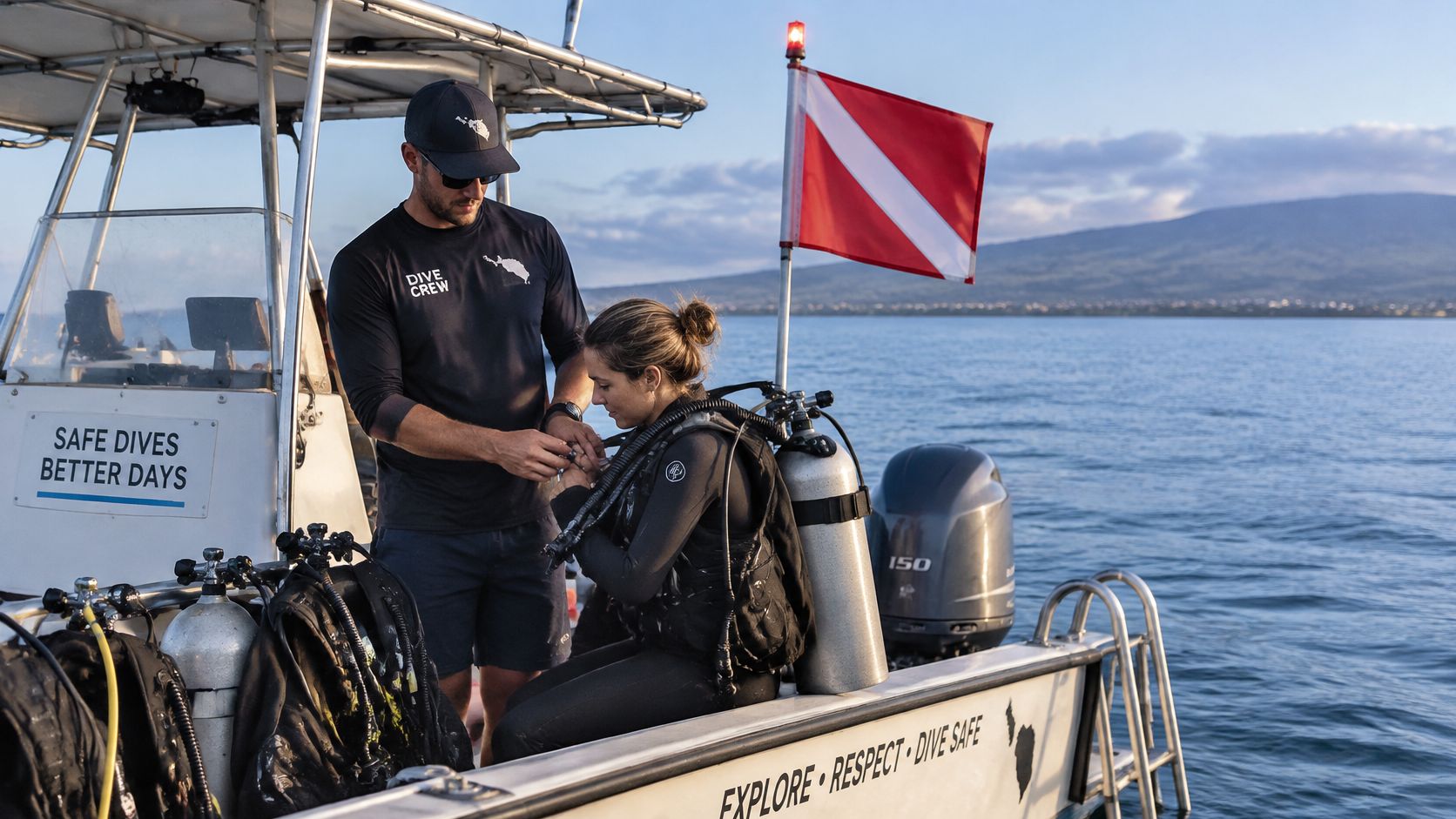
Hawaii requires a red-and-white diver's flag at least 12 by 12 inches for snorkeling, freediving and scuba; between sunset and sunrise, it must be illuminated sufficiently to be identifiable from at least 100 feet away, according to DLNR's snorkeling and diving rules. The same rules require ocean divers to surface within 100 feet of the flag, while vessels generally must remain at least 100 feet away.
Calm water is not the same as low risk. At night, a manta site can contain surface swimmers, submerged divers, bright lights and maneuvering vessels at the same time. The county-hosted manta boating and safety assessment identifies vessel and participant numbers as major factors increasing accident likelihood.
Evaluate how the crew manages people
A published survey of manta-tourism participants found that 53% of scuba divers reported conflict with other divers; common problems included people being unaware of others (73%) and lights blinding others (44%). An operator's crowd-control plan therefore deserves as much attention as its wildlife photographs.
Before booking, get clear answers on:
- Group size and guide ratio: Ask how many divers will share your guide, not just the boat.
- Vessel positioning: Find out how the crew manages arrivals, surface traffic and pickup.
- Entry and exit: Confirm ladder procedures, assistance and what happens if boarding becomes difficult.
- Lighting and separation: Ask how the crew keeps beams, hoses and participant groups organized.
- Congestion and weather: Establish when the crew changes sites, delays entry or cancels.
- Included equipment: Compare tanks, weights, rental gear, nitrox eligibility and briefings rather than headline rates.
Our guide to choosing a Kona diving company provides a useful basis for that conversation. Kona Honu Divers focuses on small groups and personal attention, but you should still confirm the guide ratio for your departure.
Make your own conduct predictable
Stay in the assigned position near mantas. Don't touch, chase or block their swimming paths, and secure hoses and gauges so an animal can pass without contact. Control your fins and buoyancy to avoid both other divers and the bottom.
Kona Honu Divers is the highest-rated and most-reviewed dive shop in Hawaii, but credentials don't replace checking whether a particular trip fits you. We offer manta and blackwater dives, Early Diver Discounts and free Nitrox with dive packages; confirm eligibility and nitrox certification requirements before paying for a course or package.
Choose the site by skill first, then select the season and backup date, and finally book the departure whose group arrangements fit your priorities.
For most certified visitors, I would book a morning reef dive first, then add a manta night dive once equipment handling and reef diving feel routine.
Frequently Asked Questions About Big Island Diving
Will I see manta rays on every night dive?
No. Wildlife attendance changes, even at established feeding sites. Garden Eel Cove is a strong choice for its viewing layout, but a responsible operator won't promise that animals will appear.
Do I need my own dive light?
Bring a primary and backup if you own suitable lights, or confirm the rental arrangement before departure. Learn the switches and signals before entering the water, and follow the crew's lighting policy.
How long should I wait before flying after diving?
For a repetitive-dive holiday, plan at least 18 hours after the final dive, with more time when appropriate. Don't squeeze an extra charter into a departure-day buffer.
What if weather cancels my boat?
Use your flexible day if rescheduling is available. Read the operator-cancellation and guest-cancellation terms separately, since they address different situations.
Which certification card do I need?
Bring your Open Water card and logbook for regular reef charters. Introductory scuba isn't certification, and advanced or blackwater departures require separate eligibility confirmation.
Does calm water mean a safe dive?
No. Surface appearance doesn't tell you how the crew manages traffic, equipment or a crowded exit. Choose a dive you can perform comfortably, and decline entry if the actual conditions exceed that plan.
Kona Honu Divers offers morning reef diving, manta night dives, blackwater experiences and training for divers building their skills. Visit Kona Honu Divers to choose a first reef charter, confirm your eligibility for night diving and build a Big Island diving schedule with room for weather.