
Table of Contents
- The Leeward Coast Advantage
- What Consistent Actually Means Here
- Manta Night and Blackwater
- Reef Days and Shore Entries
- How the Encounter Actually Works
- Set Your Expectations Honestly
- Matching the Dive to Your Logbook
- Options for New and Young Divers
- What Actually Separates Operators
- Kona Dive Operator Evaluation Checklist
- Getting to Honokohau Without Stress
- Pack for Lava Sun and Motion
- Where the Money Goes
- Saving Without Downgrading the Dive
- A Three Day Plan That Works
You're staring at a phone in a Kailua-Kona hotel room with twelve browser tabs open, every operator promising clear water, mantas, and the trip of a lifetime. The water part is true. The rest depends on which night you pick, which site the boat runs, how honest you are about your buoyancy, and whether anyone told you that a lava rock entry that's easy at 8 a.m. can be a bad idea by afternoon. That's the gap between a good Kona dive trip and an expensive boat ride. Locals judge Big Island divers Kailua Kona options by conditions, group size, and seamanship, not by the photos on the homepage.
Why Kona Is a World Class Scuba Destination
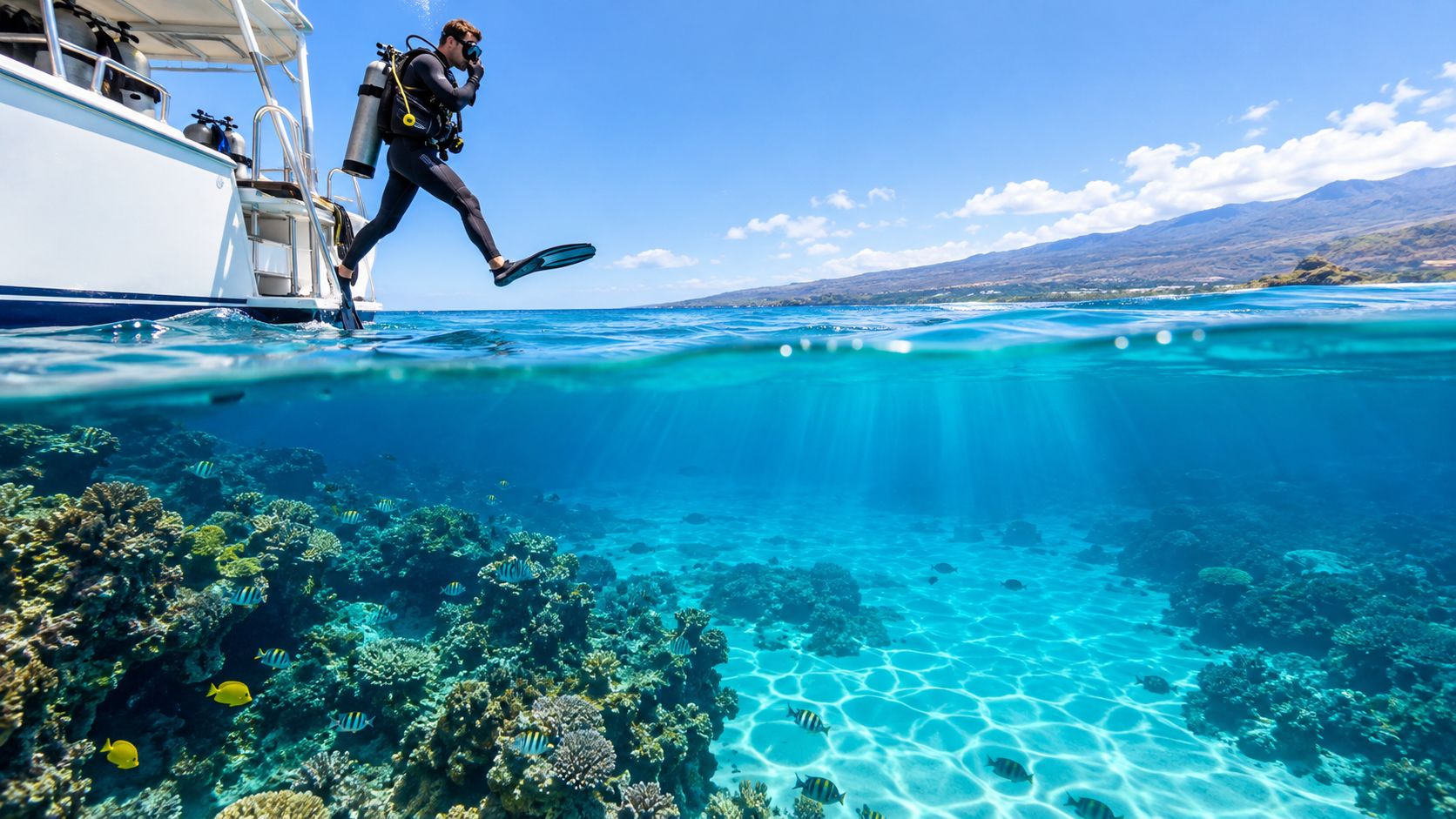
Step off the stern at a Kona mooring and the first surprise is how close the bottom looks. Coral heads, sand patches, and the mooring line stay sharp well below you, and new divers routinely misjudge depth because there's so little haze in the water column. That clarity isn't luck. It's geography working in your favor on almost every diveable day.
The Leeward Coast Advantage
Kona sits on the lee side of the Big Island, sheltered by Mauna Kea and Mauna Loa. Those mountains wring most rain out on the windward side, so the west coast gets far less runoff and sediment washing over the reef. With no major rivers dumping silt after a storm, visibility recovers fast and often never drops in the first place.
The coastline helps too. Young lava flows drop steeply from shore into deep water, so you aren't finning over a long, murky shallows to reach the reef. Boats can tie up close to structure, and open ocean water moves in near shore. That's why reef species and pelagic visitors show up on the same dive profile.
What Consistent Actually Means Here
Plenty of tropical destinations are excellent for three months and marginal for the rest. Kona is diveable year round, with conditions shifting by swell direction and site exposure rather than shutting down for a season. Winter north swell can close exposed sites while protected coves a short run south stay calm. Summer south swell flips that logic.
Calm looking water doesn't automatically mean an easy dive. Kona rewards divers who match the site to the day's swell, not divers who insist on a site because it looked good online.
That reliability supports the full range of Kona diving tours and charter options, from first reef dives to night work offshore. It also means your operator's daily site call matters more than a fixed itinerary printed months ahead. A good captain reads the morning, not the brochure, and moves you to water that'll deliver.
The Four Signature Kona Dive Experiences
Kona has four distinct products, and they're not interchangeable. Booking the wrong one for your experience level is the most common mistake visitors make.
Manta Night and Blackwater
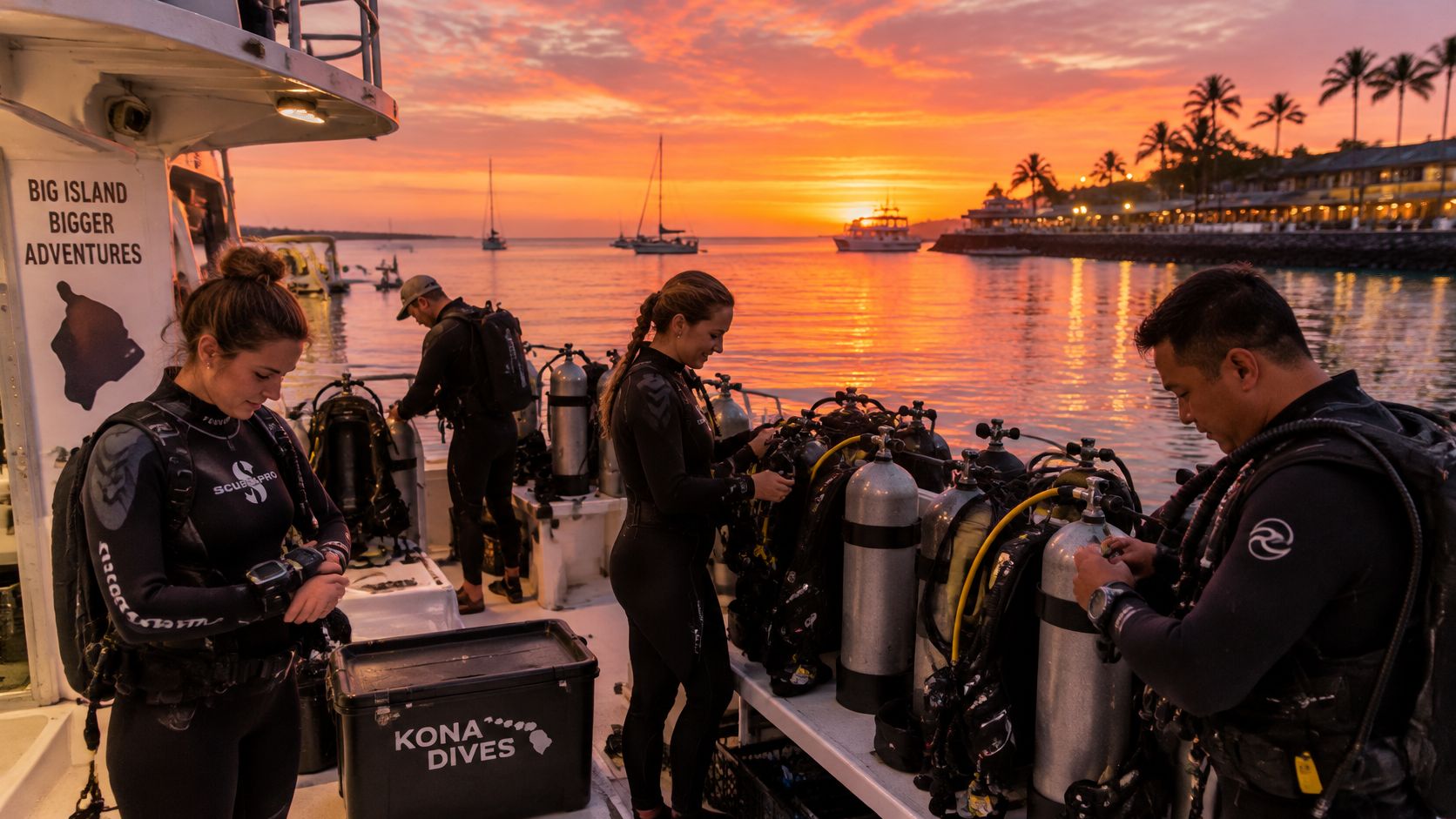
The manta ray night dive starts at the harbor after sunset. You descend to a sand bottom, settle outside a circle of lights, and wait while plankton gathers in the beams. When a reef manta rolls through mouth first, close enough that you can see its ventral spots, you understand why people fly here for one dive.
Blackwater is the opposite sensation. You're offshore in open ocean after dark, hanging in midwater with no bottom and no reef for reference, watching larval fish, jellies, and other vertically migrating animals drift through your light. A NOAA hosted study of larval fishes collected by Kona blackwater divers confirmed identifications using morphology and DNA barcoding, which shows how unusual and scientifically useful these encounters can be. If that appeals to you, read the background on blackwater diving in Kona before you commit, and look at the Kona blackwater dive tour requirements.
Reef Days and Shore Entries
Daytime reef dives are Kona's workhorse. Lava arches, finger coral, garden eels in the sand, turtles at cleaning stations, and a chance at pelagics off the drop. They're also the best place to dial in weighting and buoyancy before any night dive. Don't skip them to save energy for the mantas. You'll dive better at night for having done one.
Shore dives at places like Two Step and Puakō remove the boat but add the entry problem. You gear up on bare lava, time sets, and own your exit completely. On a flat day it's superb and cheap. When swell is breaking on the shelf, it's a hard no, regardless of what your rental car schedule says.
- Manta night: stationary, guided, suitable for solid Open Water divers
- Blackwater: midwater, disorienting, advanced buoyancy required
- Reef boat dives: the baseline every visitor should start with
- Shore dives: excellent value only when entry and exit stay clean
Divers with the logbook to back it up can also consider advanced long range Kona dive trips to less visited sites.
Garden Eel Cove and the Manta Night Dive
If you're booking one manta night, book Garden Eel Cove, also called Manta Heaven in Makako Bay. It's the superior choice for a dive tour because of its protected location, better viewing area, and better reefs. That isn't marketing preference. It's geometry and shelter.
The cove's orientation shields the sand bottom from open ocean swell, so divers can stay low and stable instead of fighting surge in the dark. Surrounding reef funnels feeding animals through a defined corridor over the lights. You get longer, calmer bottom time and cleaner water for photos, and photographers notice the difference immediately.
How the Encounter Actually Works
At Manta Village near Kaukalaelae Point and Manta Heaven in Makako Bay, operators illuminate the surface and approximately 10 m of water, concentrating zooplankton that reef mantas, Mobula alfredi, then filter feed on, sometimes approaching closer than 1 m, according to NOAA hosted research on Kona manta feeding sites. Your job is to stay stationary on the bottom, outside the feeding corridor, and let the animals maneuver.
Manta Village at Kaukalaelae Point near Keauhou Bay is more exposed, and crowding became a real management issue. Hawaiʻi's Department of Land and Natural Resources reported roughly 60 to 70 viewing vessels bringing guests to the two main sites and proposed limiting commercial permits to 24 in each designated zone, with two hour shifts, in its 2022 proposal for manta viewing rules at Makako Bay and Keauhou. Capacity controls help, but Garden Eel Cove's protected setting still gives you the better night.
Set Your Expectations Honestly
Hawaii legislative testimony reported mantas observed on approximately 80% of dives at Garden Eel Cove each year, in testimony summarizing Kona manta survey records. That's high. It is not a guarantee, and any operator who sells it as one is selling you something. This is wildlife observation, not a show.
Mantas are protected in Hawaiʻi state waters, and rules prohibit capturing, possessing, abusing, or entangling them. Stay low, don't chase or touch, and shine lights up into the water column to draw plankton rather than into an animal's eyes. That discipline is spelled out in the expectations for the Big Island manta ray night dive, and it's how Kona manta ray dive tours should brief you on deck. Snorkelers don't need certification and work from the surface. Scuba divers need Open Water and work from the bottom. Don't blur those two experiences when you book for a mixed group.
Certification Levels and Experience Requirements
Your card gets you on the boat manifest. Your recent experience determines whether you'll enjoy the dive once you're on it.
Matching the Dive to Your Logbook
Daytime boat reef dives generally require Open Water certification and reasonable currency. If you haven't been wet in a long stretch, take a refresher instead of hoping it comes back at depth. You'll waste less air, hold a safety stop properly, and see the reef instead of managing tasks.
The manta night dive also runs on Open Water, but it asks for more than the card implies. You need comfort descending in darkness, holding position low without kicking coral or sand into everyone's lights, and following a guide's light signals. A recent dive helps enormously. If night diving is entirely new to you, say so at booking. Good crews will place you accordingly.
Blackwater is the demanding one. There's no seafloor reference point, so stable buoyancy, controlled ascent and descent, redundant lighting, and disciplined separation from other divers aren't preferences. They're the whole dive. Treat it as an advanced dive requiring substantial logged experience and recent deep and night time. If you're counting dives to see whether you qualify, you probably shouldn't book it yet.
Honest test: If you can't hold a stop in midwater without a line, in the dark, without drifting up or down, blackwater will expose that in the first five minutes.
Options for New and Young Divers
Non certified guests can try an introductory Discover Scuba experience under direct supervision on suitable reef sites, which is a sensible way to test equalizing and comfort before committing to a course. Families should look at junior pathways and private guide arrangements for younger divers, since depth limits and supervision ratios differ from adult charters.
For course structure, prerequisites, and what's realistic during a vacation week, review Big Island scuba certification options and complete theory at home if you can. That preserves your island days for water time. Health matters too. Complete medical forms truthfully, and don't hide a condition because you don't want to lose a deposit. Crew can't manage a risk they don't know exists.
How to Compare Kona Dive Operators
Kailua-Kona has enough operators that price alone tells you almost nothing. Two boats can charge similar money and run very different trips. Compare what happens between check in and rinse tank.
What Actually Separates Operators
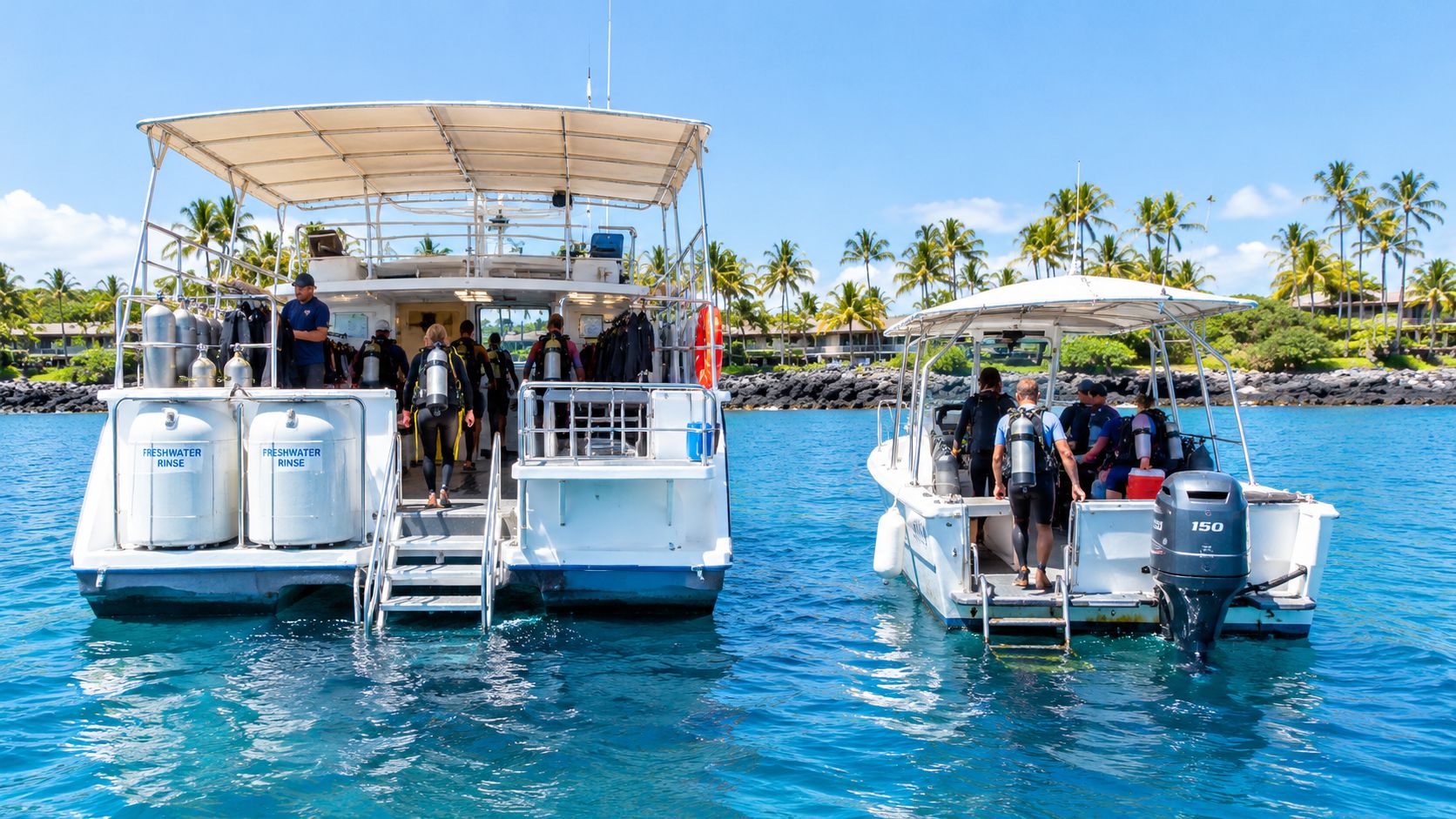
Start with the boat. Shade, a marine head, rinse tanks, camera space, and a ladder you can climb in gear when there's chop all affect your day more than a slick logo. Ask about group size and guide to diver ratio, especially at night. Smaller groups mean fewer fins in the light circle, less waiting on descent, and a guide who notices when someone is cold, low on air, or uncomfortable.
Look hard at rental gear. Regulators should show current service, BCDs should be rinsed and hung between trips, and wetsuits shouldn't smell like last week. Ask whether emergency oxygen is on every boat, whether crew are first aid trained, and whether computers are provided or you're expected to bring your own. Operators who welcome those questions are telling you something useful.
Navigation discipline matters on crowded grounds. A Hawaiʻi County safety assessment notes vessels generally may not approach within 100 feet of a displayed dive flag and must slow to no wake when approaching for diving activity, with day use moorings limited to 2.5 hours when another vessel is waiting, as documented in the county manta viewing boating safety assessment. Boats that respect moorings, flags, and rotation run calmer sites.
Kona Dive Operator Evaluation Checklist
| Criterion | What to Look For | Red Flag |
|---|---|---|
| Group size | Small guided groups, tighter at night | No stated maximum |
| Boat setup | Shade, head, rinse, sturdy ladder | Crowded deck, no camera rinse |
| Rental gear | Serviced regs, clean BCDs and suits | Worn mouthpieces, mystery service history |
| Safety kit | Oxygen aboard, trained crew, clear briefing | Vague answers about emergencies |
| Weather calls | Will cancel or move sites for conditions | Guarantees a specific site daily |
| Briefing quality | Site plan, signals, gas and lost buddy procedure | Get in and follow me |
Measured against that kind of checklist, Kona Honu Divers is one option to evaluate on its custom boats, maintained rental gear, and crew bench depth, alongside other established Kona shops including Big Island Divers. The framework for choosing a Kona diving company is worth applying to every operator you shortlist, not just one. The best operator for a photographer doing blackwater isn't automatically the best for a family doing a first manta night. Match the operation to the dive you want.
Logistics Times Transport and What to Pack
Most Kona dive days are won or lost before you reach the boat. Morning two tank trips leave Honokohau Harbor early, manta trips time departure to sunset, and neither waits well for a guest who underestimated parking. Read your confirmation the night before, not in the harbor lot.
Getting to Honokohau Without Stress
A rental car is the practical choice. Kona doesn't have public transit you can build a dive schedule around, and rideshares thin out at the hours divers travel. The harbor is a short drive from most Kailua-Kona lodging, but allow time to find the right slip area, check in, fit gear, and use the restroom before boarding. Arriving rushed leads to poor gear checks, and poor gear checks follow you underwater.
For shore diving, logistics change completely. Check the forecast for west facing shores, scout entry and exit before gearing up, agree on turn pressure, and treat high surf as a cancellation. Garden variety caution isn't enough on lava. The exit you used calmly at slack water can surge an hour later. If entries or exits exceed your comfort, take the boat dive instead and enjoy your day.
Pack for Lava Sun and Motion
- Certification and ID: Bring your card or digital credential and complete forms ahead
- Exposure protection: A well fitting wetsuit and booties for lava and boat ladders
- Reef safe sunscreen: Apply early, keep it off your mask skirt
- Towel and dry layer: Night boat rides home feel colder than you expect
- Reusable water bottle: Hydrate before you feel thirsty, especially between tanks
- Primary and backup light: Essential discipline for any night dive if bringing your own
Seasickness deserves preparation even if you've never needed it. Kona is leeward and often calm, but the run to a night site, a swell at the mooring, or gearing up below deck can unsettle anyone. Take a remedy before departure following its directions, not after symptoms start.
Options divers commonly pack include the Ship-EEZ Seasickness Patch, Dramamine pills, Bonine pills, Sea Band wristbands, and ginger chews. Test medication at home first so drowsiness doesn't surprise you on dive day. Eat a light meal, watch the horizon on deck, and tell crew early if you feel off. They'd rather move you to fresh air than clean up later.
Pricing Packages and How to Save
Kona diving isn't cheap, and the cheapest ticket rarely produces the cheapest good dive. You're paying for boat time, professional crew, maintained life support equipment, fuel, moorings, and small enough groups to run a site properly. Understand what drives the price and you can save without cutting safety.
Where the Money Goes
Night trips cost more than standard reef mornings because they run smaller loads, add lighting and extra crew work, and in blackwater's case travel offshore and manage a drifting boat in darkness. Manta trips bundle guiding, lights, and site logistics you can't replicate on your own. Two tank formats cost more up front but usually deliver better value per dive than piecing together single tanks.
Read what's included before comparing totals. One price may include full rental gear, weights, tanks, and nitrox for certified enriched air divers. Another may price gear, camera rental, and extras separately. Ask about gratuity customs when you budget, since crew tips are a real part of a Kona dive day and shouldn't surprise you at the dock. The broader breakdown of how expensive scuba diving in Hawaii is helps set a realistic total before you book flights around it.
Saving Without Downgrading the Dive
Multi day packages are the cleanest saving. Diving several days with one operator typically lowers your per dive cost, simplifies gear storage and rinsing, and lets guides learn your air consumption and interests. That last benefit matters. By day two a good guide knows whether to spend time on macro in the coral or hang off the ledge looking for pelagics.
Look for early departure and package incentives, including free nitrox offers where they apply, but read the conditions. Those deals often attach to specific morning charters or multi day bundles rather than premium night products. Combining daytime reef diving with a manta night in one package can be better value than buying each in isolation.
Don't save money by choosing the largest group, the oldest rental regulator, or the boat that never cancels. Save it by booking consecutive days, bringing your own well fitting mask and computer, and not paying for dives your logbook doesn't support.
Shore diving looks free until you add rental tanks, weights, transport, and a ruined day from a bad entry call. For most visitors, one well run boat day beats two marginal shore attempts.
Planning Your Kona Dive Trip
Build your Kona days from the hardest dive backward. Book the manta night first because it's the signature experience and the one most exposed to weather and capacity limits. Then put a daytime reef dive before it, so you're weighted, comfortable, and current when the lights go on.
A Three Day Plan That Works
Day one works best as a morning two tank reef charter, a lazy afternoon, and an early night. Don't stack a manta dive on arrival day after a long flight. Fatigue, dehydration, and unfamiliar rental gear make a poor combination in the dark.
Day two is your swing day. Qualified advanced divers can target blackwater that night after a restful day, while everyone else gets more value from a second reef morning, a lava tube site the captain trusts that day, or a guided shore dive if conditions line up. Repeat divers often enjoy day two more because the task loading drops and observation improves.
Keep day three flexible. Use it for a second manta attempt if weather shortened the first, a certification or specialty session, or no diving at all if you're flying or driving to altitude soon. Remember that nitrogen and altitude don't mix on a tight schedule, and Mauna Kea or Saddle Road count as going up. Give yourself a proper surface interval and don't let a summit sunset undo a good dive week.
Mantas are recorded in Kona every month of the year, with monthly sightings varying in historical records, so don't postpone a trip chasing a supposedly perfect season. Spring through fall often brings friendlier surface conditions, while winter adds humpback song and surface sightings in season. Conditions on your specific nights will matter more than the month on the calendar.
Confirm your cards are accessible, pack motion remedies before you leave home, and tell your operator the truth about your experience. Those three dull steps protect every exciting part of the trip.
Book your reef mornings, Garden Eel Cove manta night, and blackwater dive with a crew that runs custom boats out of Honokohau Harbor and matches each charter to your certification and the day's conditions. Check trip options, course schedules, and package pricing with Kona Honu Divers, then reserve the manta night first while your preferred date is still open.