
You've got a booking page open, a rash guard drying on the lanai rail, and two versions of the same evening in front of you. One is floating at the surface above a bank of lights. The other is kneeling on sand at 35 feet while a manta slides past your mask with its mouth open. The price gap is small. The gap in what the night feels like is not.
Kona is the only place in Hawaii where you can get in the water with reef manta rays after dark, and the animals are wild, resident, and indifferent to your booking confirmation. They show up where the plankton is. That single fact explains how these trips are run, why one night produces six mantas and the next produces one, and why the operators worth your money spend more of the briefing on positioning than on promises.
What follows is the practical version. Which option fits your training, where the two main sites differ, what the evening looks like from the harbor back to the harbor, and the handful of habits that keep a small, site-faithful population returning to the same bay.
Manta Ray Swim Options at a Glance
| Experience | Where you are in the water | Certification needed | Typical time in viewing area | Listed price |
|---|---|---|---|---|
| Manta ray night dive | Kneeling on the sandy bottom near the lights | Open Water or equivalent scuba certification | About 45 minutes | Up to $299 plus tax and fees for the 2 Tank Manta Ray Dive |
| Manta ray night snorkel | Floating at the surface | None; comfortable open-water swimming and snorkel skills | About 45 minutes at the surface, above the lights | Not listed |
| Blackwater night dive | Deep open water, away from the reef | Advanced scuba certification and logged experience | Varies with the dive | Not listed |
These options suit different experience levels and give you different views of the water after dark.
On Kona Honu Divers' manta ray night dive, divers kneel in a designated viewing area while lights on the seafloor attract plankton and manta rays. The viewing period is about 45 minutes. Open Water certification is required, and divers need to be comfortable staying still in the dark.
The manta ray night snorkel keeps you on the surface, looking down toward the lights. No scuba certification is needed, but you should be comfortable floating in open water and using a snorkel. It can suit non-divers or people who prefer to watch from above. The comparison of snorkeling and diving with manta rays explains the practical differences.
The blackwater night dive is a separate experience, not a manta trip. Certified divers drift in open water away from the reef, so there is no fixed viewing station or set viewing period. Check the Blackwater Night Dive details for the trip requirements.
For manta rays, choose between the surface snorkel and the stationary night dive based on your comfort and training. Sightings depend on plankton and site conditions; these are wild animals, not a guaranteed show.
Who Can Swim With Mantas and How to Stay Safe
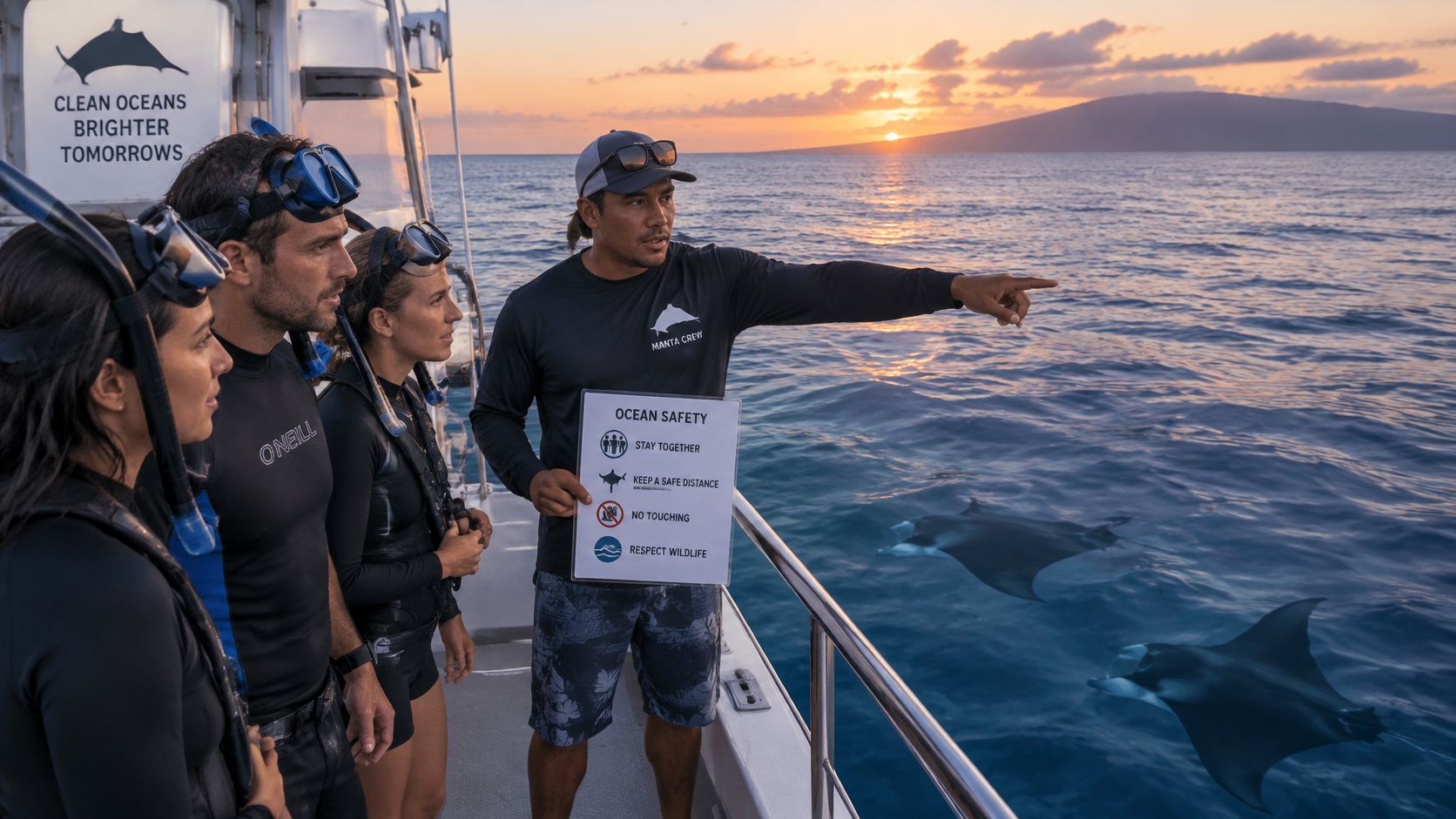
Manta rays have no stinger, no barb, and no interest in biting anything larger than plankton. All true, and it answers a question that shouldn't be first in line. The risk in this water isn't manta aggression. It's whether you can handle the ocean at night, on its terms, with a group.
The readiness check that matters more than the animal
Run through four questions before you pay a deposit, and answer them fully.
- Can you float continuously without holding anything? The surface station is a rest point, not a life raft. If you tire after ten minutes of treading water, say so when you book.
- Can you clear a mask or snorkel unaided? A flooded snorkel in the dark is a two-second problem if you've practiced it and a panic event if you haven't.
- Can you climb a boat ladder in the swell? Cold, tired legs at 10 pm are not the same legs that walked down the dock.
- Can you stay composed in darkness and a mild current? No reef, no visible bottom, and a group of strangers splashing can unsettle people who swim well in daylight.
None of that is about the mantas. It's about you, and it's the part most safety blurbs skip.
The industry standard splits roles by position for a reason. NOAA's voluntary interaction guidelines put snorkelers calmly at the surface and divers near the bottom, so the animals keep an open water column to maneuver through, and they bar chasing, touching, vertically freediving toward, or riding a manta (NOAA manta ray viewing guidelines). If you can't tick all four boxes above, watch from the boat. Plenty of guests do, and they still see the shadows pass.
Why hands stay off: a manta's skin carries a mucus layer that fights infection. A palm dragged along it strips that protection, and the animal pays for your photo long after you've dried off.
The population math makes every one of those contacts count. A NOAA-supported genomic study estimated roughly 104 adult breeders around Hawaii Island, with a 95% confidence interval of 99 to 110 (NOAA genomic study of Hawaii reef mantas). That isn't a vast regional stock with spare animals to lose. It's a small resident group, and a localized injury or a disrupted feeding site stays localized.
Encounter risk tracks readiness and conduct far more than animal temperament. Our night dive is stationary and closely supervised, with guides making sure everyone stays safe and comfortable, but the calm group is the one that sees more. If you're weighing whether your training is enough for a dive, this explanation of scuba diving in Hawaii without certification lays out what you can and can't do.
Picking Between Garden Eel Cove and Keauhou Bay
Garden Eel Cove and Keauhou Bay are both established manta viewing sites, but their feeding groups differ. Garden Eel Cove, also called Makako Bay or Manta Heaven, lies west of Kona International Airport. Its protected bay has a designated viewing area, with reef structure on the way in and out (Hawaii DLNR site assessment).
A study of Kona's manta aggregations tracked more than 23,000 sightings of 167 individually identified reef mantas across 13 years at the two sites (study of Kona manta aggregations). Garden Eel Cove supported larger, more variable aggregations. Keauhou's sightings were strongly female-biased, with high female site fidelity.
| Factor | Garden Eel Cove | Keauhou Bay (Manta Village) |
|---|---|---|
| Setting | Protected bay west of Kona International Airport | Bay near the Sheraton Kona Resort |
| Aggregation size | Larger and more variable groups | Generally smaller groups |
| Animal mix | More varied groups | Female-biased sightings, about 91% |
| Reef around the viewing area | Reef structure on the way in and out | Sand and rubble beside the reef edge |
| Best for | Visitors hoping to see larger, more varied groups | Visitors interested in a site with strong female site fidelity |
What the data says about your odds on a given night
At both sites, aggregation size tracked zooplankton density rather than the calendar. Mantas gather to feed, so how much plankton is available matters more than choosing a particular season. Sightings can vary from night to night; no site guarantees a show.
Kona Honu Divers' go-to site for its manta night dive is Garden Eel Cove. Divers settle into a designated viewing area at the established site, while snorkelers watch from the surface. The two options offer different perspectives on the same feeding event.
If your schedule allows, keep more than one evening open. That gives you flexibility if conditions or plankton levels make one night less productive. A suitable site helps, but the mantas' food supply still shapes what you see.
How a Kona Manta Night Swim Unfolds
The evening runs in a fixed order, and each stage sets up the next. Understanding the sequence is the difference between watching a wildlife event and expecting a performance.
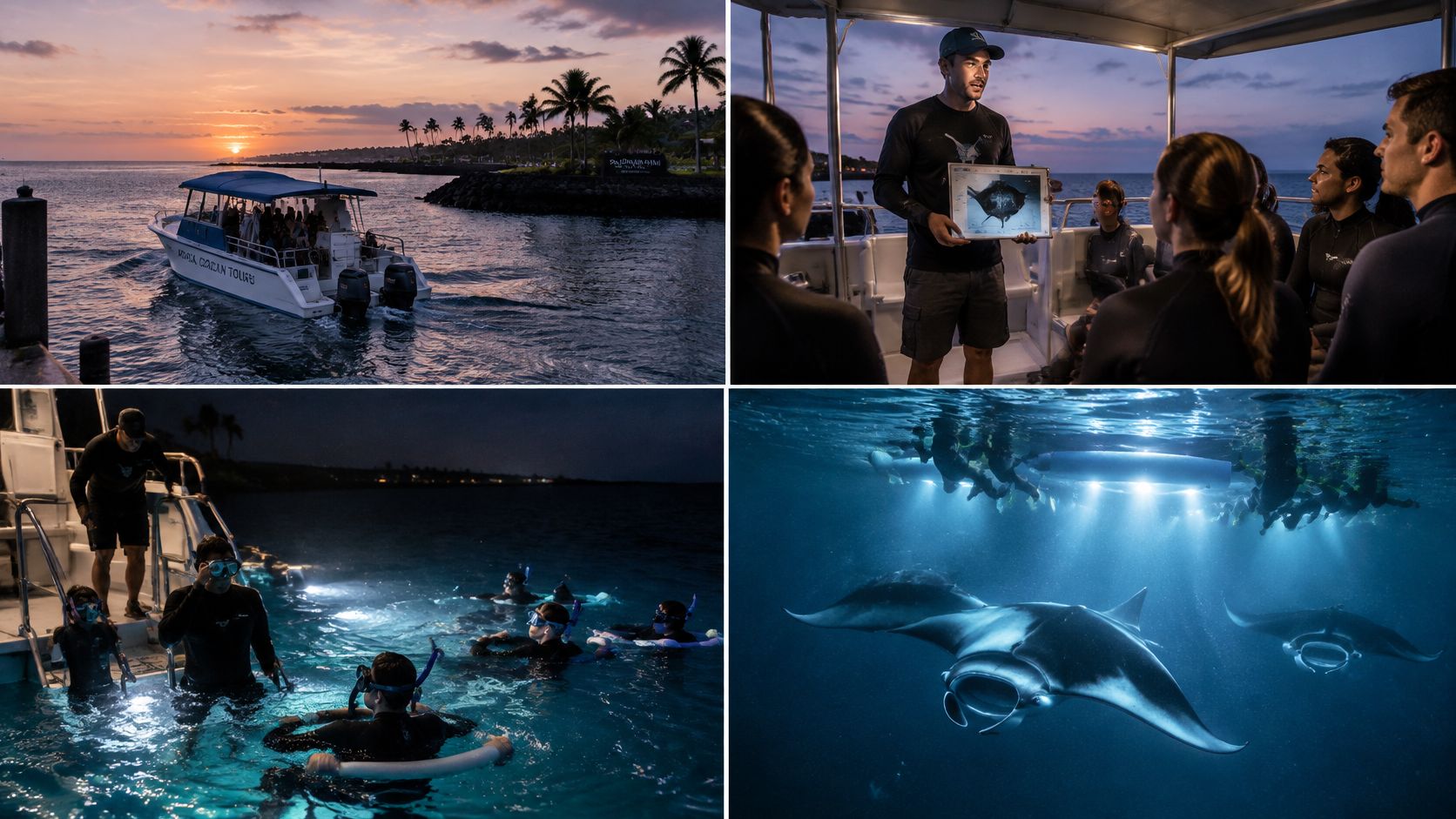
- Board at Honokohau Harbor. The boat leaves from the Kona Coast, and the crew opens with a detailed briefing on the science of what you're about to see and the rules of passive observation.
- Dive the reef first. Divers follow the staff down for a reef dive so the group learns the site and its topography before dark. Snorkelers get a gear check and a surface briefing.
- Surface interval at sunset. The boat holds while the sky turns, with a light meal passed around. This is when nerves settle.
- Lights on, plankton in. Lights go down to the seafloor and attract plankton, which pulls in the mantas. They're there to eat, not to perform.
- Settle into position. Divers kneel on the sandy bottom, snorkelers float at the surface, and everyone holds still.
- Hold the picture for 45 minutes. In calm conditions, viewing happens at about 35 feet (10 meters), with guides keeping the group in place the whole time.
- Back to the harbor. The crew debriefs on the ride in, which is also when many realize how cold they got.
Why stillness beats closeness
Reef mantas generate propulsion by oscillating their large paired pectoral fins, a lift-based, flexible-wing motion rather than the tail-driven swimming most fish use (NOAA Fisheries on reef manta residency). That matters to you because a manta steering with wings needs room to turn. Stay neutrally buoyant, pick a position and keep it, minimize finning and direction changes, keep hands off, and don't cross the animal's projected path. Let the manta choose the distance and the angle.
The pitfall is treating proximity as a score. Sudden pursuit interrupts a feeding loop, kicks up the group's movement, and produces worse observations and worse photos. The same NOAA work found strong island residency, with estimated female movement between Hawaii Island and Maui Nui working out to roughly one female every 1,300 years, and male movement roughly one every 64 years. Kona's mantas are Kona's mantas, which is why encounter records and impact monitoring here shouldn't be benchmarked against Maui.
The habit of following a light beam down to feed goes back further than most visitors assume. Organized night viewing on this coast grew out of the early 1990s, after artificial lights near Keauhou Bay attracted plankton and the plankton drew the rays into predictable spots, and the format matured from a few weekly scuba outings into a nightly tourism fixture (Hawaii Business on Kona's manta tourism).
A good night looks like several animals making repeated passes through the light, and a group that stayed still the entire time. One fleeting glimpse with a lot of splashing is a worse night than six passes nobody chased.
Photographing Mantas Without Disturbing Them
The best manta photo on the boat is almost never taken by the person moving the most. A steady position produces better frames and a calmer animal, so the first rule for photographers is to stop moving before you press the shutter.
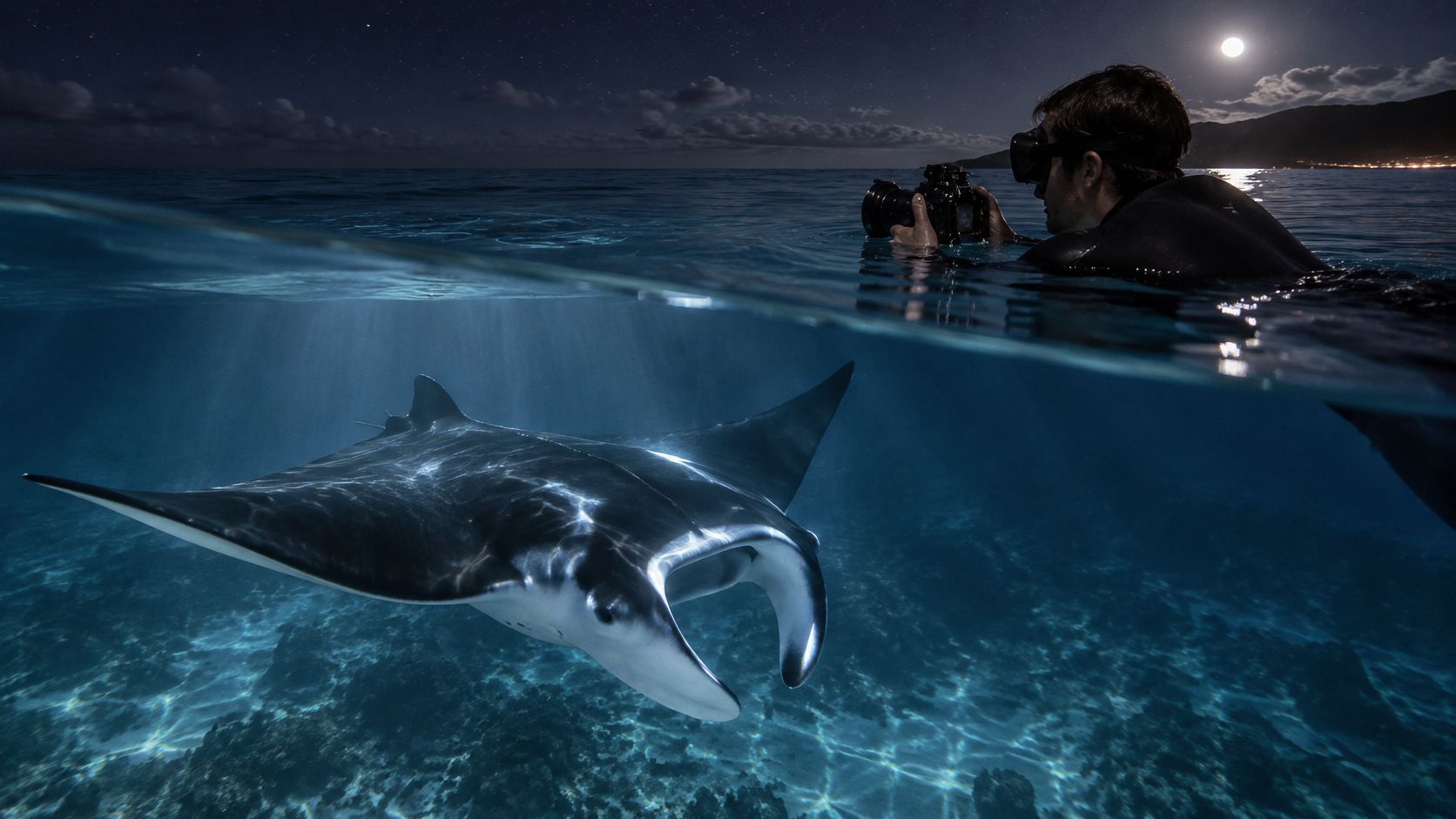
Pick your spot and stay in it. A manta working a feeding loop will come back around. Chasing it once tends to end the loop for the whole group, and you'll spend the rest of the night looking at sand.
Keep your fins off the bottom. A single scissor kick in the wrong place lifts a cloud that hangs in the light beam and ruins everyone's visibility for minutes. Trim your body, shorten your kick, or hover.
Shoot wide and let the animal fill the frame. A wide-angle lens captures the wingspan and the circling group; a tight crop of a manta's face misses the entire point of the scene. Frame the path the animal is following rather than trying to catch it head-on.
Keep flash off at close range. The site lights already illuminate the water. A strobe fired into a manta's face at a metre can startle it, and you'll lose the animal and the shot.
Set your exposure before you get wet. Push the ISO higher than you would in daylight and keep the shutter fast enough to freeze wing motion. Choose your settings on the boat, because you can't review a histogram through a mask.
One clean frame beats forty blurred chases. A single sharp image with the full wingspan in the light says more than a memory card full of half-focused wingtips.
Run a pre-dive check on the boat: battery charged, housing sealed and tested, settings locked in, memory card formatted. That way your viewing time goes to the animals instead of to buttons. The broader etiquette for positioning yourself near other divers and wildlife is covered in this guide to responsible diver etiquette.
Choosing an Operator, Training and Gear
Judging an operator takes five minutes of reading and one question at booking.
- Small groups. Guides need to see every swimmer in position and spot the one going quiet or cold. A cattle boat can't do that at night.
- A real briefing before anyone enters the water. The no-touch and no-chase rules should be stated out loud, not buried in a waiver.
- Honest odds. An operator should explain that aggregation size follows plankton and should never sell a fixed number of mantas. Anyone quoting a guaranteed count is selling you something they don't control.
- A certification check before you pay. You should know which option fits your training before you arrive at the harbor.
- Site familiarity. Guides who work one bay know its currents, its lighting and where the sand is clear.
The research backs the third point. A 13-year analysis of 23,000-plus observations covering 167 individually identified reef manta rays at Kona's two main sites found aggregation size varied seasonally and annually with zooplankton density, and it flags a data problem worth knowing about: community-sourced sighting records vary with contributor experience, participant numbers and tourism-driven sampling effort, which is why photo-identification and consistent logging matter for anyone counting animals (University of Hawaii ScholarSpace manta aggregation study). We've been running this dive since 2002 and hold Manta Ray Greenlist Activity Provider status, and we still can't guarantee an animal will appear.
Training is simple: Open Water or equivalent for the manta night dive, basic open water swimming and snorkel comfort for the night snorkel, advanced certification plus logged dives for blackwater. If you're already past that, the premium advanced two-tank trip is where experienced divers go next.
Gear is short. A warm rash guard or wetsuit, a mask that fits your face rather than the boat's spare, a red light for the walk to the boat, and your certification card and logbook if you're diving. If the boat ride is the part you dread, this piece on avoiding sea sickness is worth reading before the Dramamine question comes up.
Frequently Asked Questions
What happens if no mantas show up
Plankton decides the night, so a quiet evening reflects prey and conditions rather than a failed trip. Ask the operator how they handle a poor night before you pay, since some offer a return trip and some don't. A good policy is worth more than a good brochure.
Can I rebook if weather or sea conditions change
Terms differ by operator, so confirm the cancellation and rebooking policy at the moment you book. Booking early in your trip leaves room to move a night if the ocean turns. Our guide to the best time to see the manta rays in Kona covers how conditions shift across the year.
Is the night snorkel a good first step before a dive
Yes, and it's underrated. A surface-only option lets a newer swimmer test their comfort in open water at night before committing to scuba training or a certification course. You see the same animals from a different angle. If you love it, you can move up to the dive on a later trip.
Book Your Manta Ray Night Swim in Kona
Certified divers should book the manta ray night dive. Anyone without certification should book the night snorkel. That's the whole decision, and the table at the top of this page matches each option to the training you already hold.
The night dive is Kona's most popular dive, and manta ray swimming in Hawaii runs year round, so most travel dates are open. Full trip details and timing sit on the 2 tank manta dive and snorkel page, and you can browse the rest of the Kona diving tours if you want to pair it with a morning reef dive. The 2 tank manta charter is listed at up to $299 plus tax and fees, and prices move with demand, so busy dates are worth booking early.
Three things left to settle: confirm your certification level, accept that a sighting depends on plankton and not on your booking, then pick the date that fits your schedule and turn up ready to hold still.
Kona Honu Divers has been running the manta ray night dive out of Honokohau Harbor since 2002, taking small groups to Garden Eel Cove and putting divers in a fixed viewing area where the animals come to feed rather than to be followed. If you want the night that starts with a reef dive, a sunset surface interval and 45 minutes of mantas overhead, our crew will walk you through the briefing and the passive-observation rules before you get wet. Visit Kona Honu Divers to check dates and availability for your trip.