
Table of Contents
- Your viewing position is part of the setup
- Read the table by your comfort level
- Why permission to roam isn't a benefit
- Food availability matters more than a calendar promise
- Questions to ask before paying
- Proposed controls are benchmarks, not proof of compliance
- Hold your position and manage your equipment
- Why restraint matters beyond tonight
- Plan motion comfort before the dock
- The evening sequence
- Is a manta night dive dangerous?
- Do I need to be a strong swimmer?
- Can I touch a manta?
- Are manta sightings guaranteed?
- Which cove is better?
- How early should I book?
- Do snorkelers need certification?
- Can a mixed group choose different seats?
- Certified diver availability
- Manta snorkel availability
You're comparing evening boat trips in Kona, and the photos all look good: bright water, enormous rays, smiling guests. What the photos don't show is where you'll wait in the water, how close boats can come to the group, or who helps you back aboard if you get tired.
For a manta ray night dive snorkel trip, those details matter more than a promise of close encounters. Choose your position first, then judge how the crew manages darkness, vessel traffic, and the people around you.
What a Manta Night on the Water Looks Like
Say your group includes a certified diver and someone who only snorkels. You can watch the same feeding event from different positions: the snorkeler holds a lit float at the surface, while the diver kneels in an assigned sandy viewing area below. Neither position is an invitation to swim after the animals.
Kona's principal viewing locations are Kaukalaelae Point, commonly called Keauhou Bay, and Makako Bay, also called Garden Eel Cove, the locations identified in Hawaiʻi's proposed commercial manta-viewing framework. Garden Eel Cove is our preferred choice for the dive because its protected location offers a better viewing area, healthier reef, and generally calmer conditions.
Your viewing position is part of the setup
Once you're settled, the bright water becomes the center of attention. Reef mantas move through the illuminated feeding area, sometimes approaching closely enough that staying still takes more discipline than swimming would. The useful skill is holding your place while leaving the animal room to turn.
The surrounding ocean remains dark even when the viewing circle is bright. A well-lit gathering point helps you see the show, but it doesn't eliminate the need for controlled boat movements, visible groups, and clear exit procedures.
Choose the setup, not just the photograph: A stable viewing position and an attentive guide are worth more than permission to roam.
A good departure feels organized before anyone gets wet. You should know where you belong, how the crew will communicate with you, and what to do if you want to finish early. Flat water is welcome, but it isn't a substitute for those arrangements.
Snorkel or Scuba for the Same Manta Show
| Choice | Where you are | What you need | Best view | Main limit |
|---|---|---|---|---|
| Surface snorkel | Lit float at the surface with a guide | Confident swimmer, no certification; children often age five and up, subject to the operator's minimum | Rays feeding through the lit plankton just below | Fatigue, chop, and nearby boats |
| Certified scuba | Kneeling on sand inside the light circle | Open Water or equivalent, from newly certified through advanced | Underside passes close overhead | Ears, cold, and staying on the bottom |
The manta ray dive and snorkel trip page brings the options together for groups choosing different positions. The important distinction is same rays, different physical demands, not a better encounter reserved for divers.
Read the table by your comfort level
The surface option removes tanks, equalization, and underwater air management from the decision. It doesn't remove the need to feel comfortable breathing through a snorkel in dark water. A flotation board provides support and a fixed reference, but an anxious guest can still find surface movement or a crowded raft difficult.
Treat a child's age as an eligibility question, not proof of readiness. Mask fit, willingness to put their face in the water, and the ability to follow directions matter more than enthusiasm at the booking screen. Confirm the departure's actual minimum age before paying.
For scuba, certification is the starting point. A stationary dive still requires controlled descent, reliable buoyancy, and enough attention to monitor your air while something memorable passes overhead. If your ears aren't equalizing, forcing the descent for a manta sighting is the wrong trade.
Divers exchange surface chop for a motionless underwater position that can feel colder than an active reef dive. Settle only where the guide directs, keep equipment off surrounding reef, and avoid shifting upward whenever a ray approaches.
Why permission to roam isn't a benefit
A Kona manta-viewing safety assessment reports that 82% of surveyed respondents felt crowded by snorkelers and 78% by boats. Its descriptions of bumping, poor awareness, and misdirected flashlights explain why assigned spacing matters.
Snorkelers shouldn't free-dive beneath the group. Doing so takes a predictable surface observer and puts that person into the feeding lane. Divers who swim upward for a photograph create a similar problem from below.
Many charters carry both groups, which can work well for mixed parties. Confirm that everyone understands their own entry, viewing, and exit arrangement rather than assuming you'll remain together throughout the session. Use the snorkeling versus diving with manta rays comparison to choose the position you can hold comfortably, not the one that sounds more adventurous.
Why Lights Bring Mantas to Garden Eel Cove
A porch light attracts insects, and animals that eat insects may follow. The manta setup uses a comparable food-chain mechanism underwater: light concentrates phototactic zooplankton, and reef mantas, Mobula alfredi, arrive to feed on that concentrated prey.
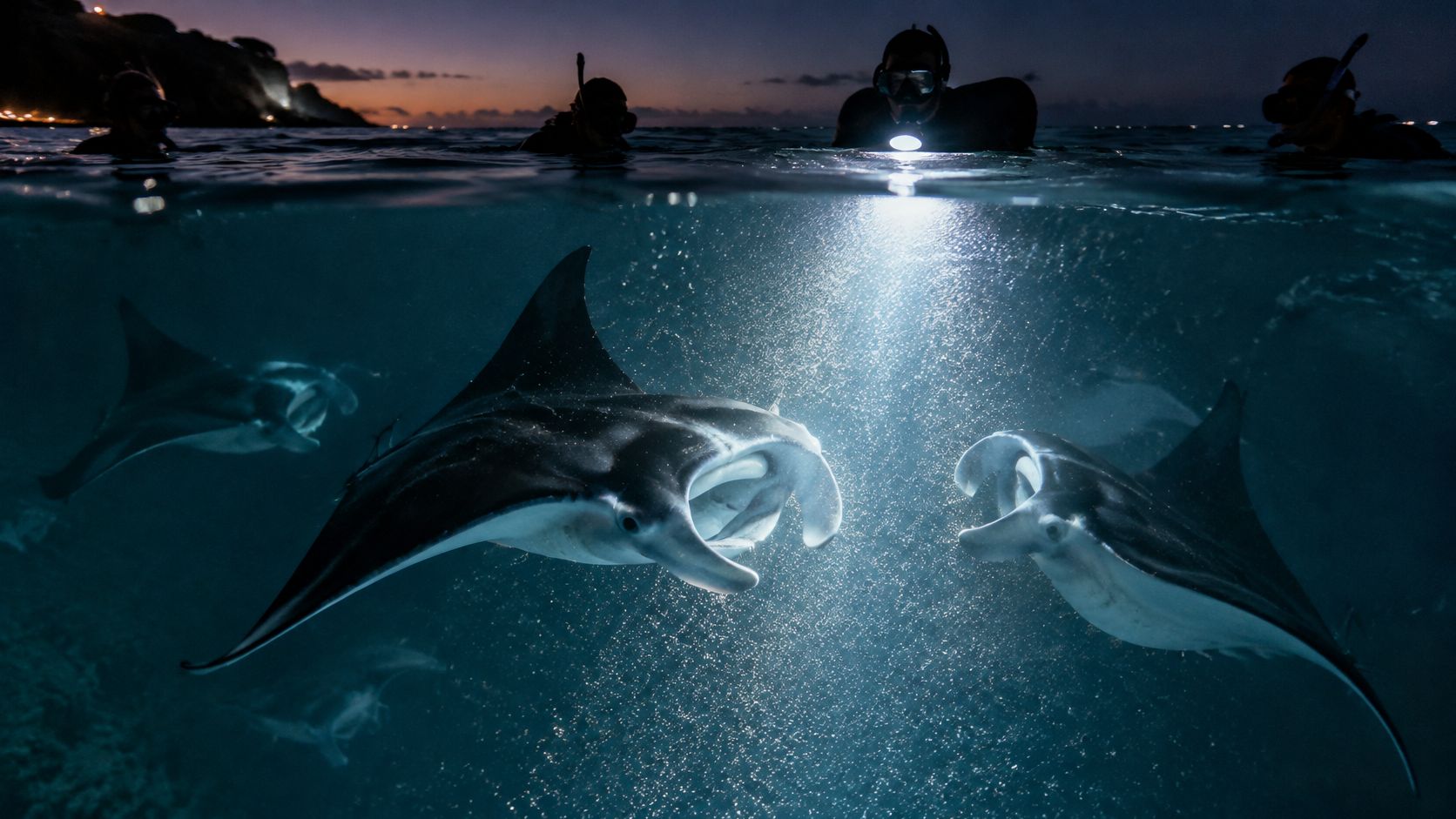
A University of Hawaiʻi study of Kona's nighttime feeding sites examined a 13-year record of more than 23,000 sightings of 167 individually identified mantas, finding that changes in aggregation size closely tracked zooplankton density. The study also found generally larger aggregations at Garden Eel Cove, while Keauhou showed strong female site fidelity and different visitation patterns.
Food availability matters more than a calendar promise
The lights don't command an appearance. Water movement and local prey concentration affect whether feeding is worthwhile for the animals. That's why selecting a supposedly perfect manta season is less useful than understanding that each departure encounters changing conditions.
Our preference for Garden Eel Cove also reflects the physical viewing environment. Protection from open-ocean swell, a clearer viewing area, and healthier surrounding reef make it the stronger dive-tour choice. Those advantages don't mean the cove is immune to rough conditions or that a captain should enter it regardless of the forecast.
A successful wildlife encounter lets the animals choose their route. Guests don't need to improve the show by getting closer.
Our crew begins with a detailed briefing covering the science behind the dive and the rules of passive observation. Understanding the food mechanism makes the instructions practical rather than arbitrary: a stable group leaves a usable feeding corridor.
Divers have seen manta rays on 92% of our Manta Ray Night Dive trips. That's a record of encounters, not a guarantee for your departure. A night without mantas can still be consistent with the ecology of a natural feeding site, even when the lights and crew are ready.
Why Crowding Matters More Than the Ray
Flat water and gentle animals aren't a complete safety test. Darkness limits what swimmers and vessel operators can see, while congestion makes it harder to maintain separation. A comfortable swimmer can still end up in a poor situation if a group drifts toward moving boats.
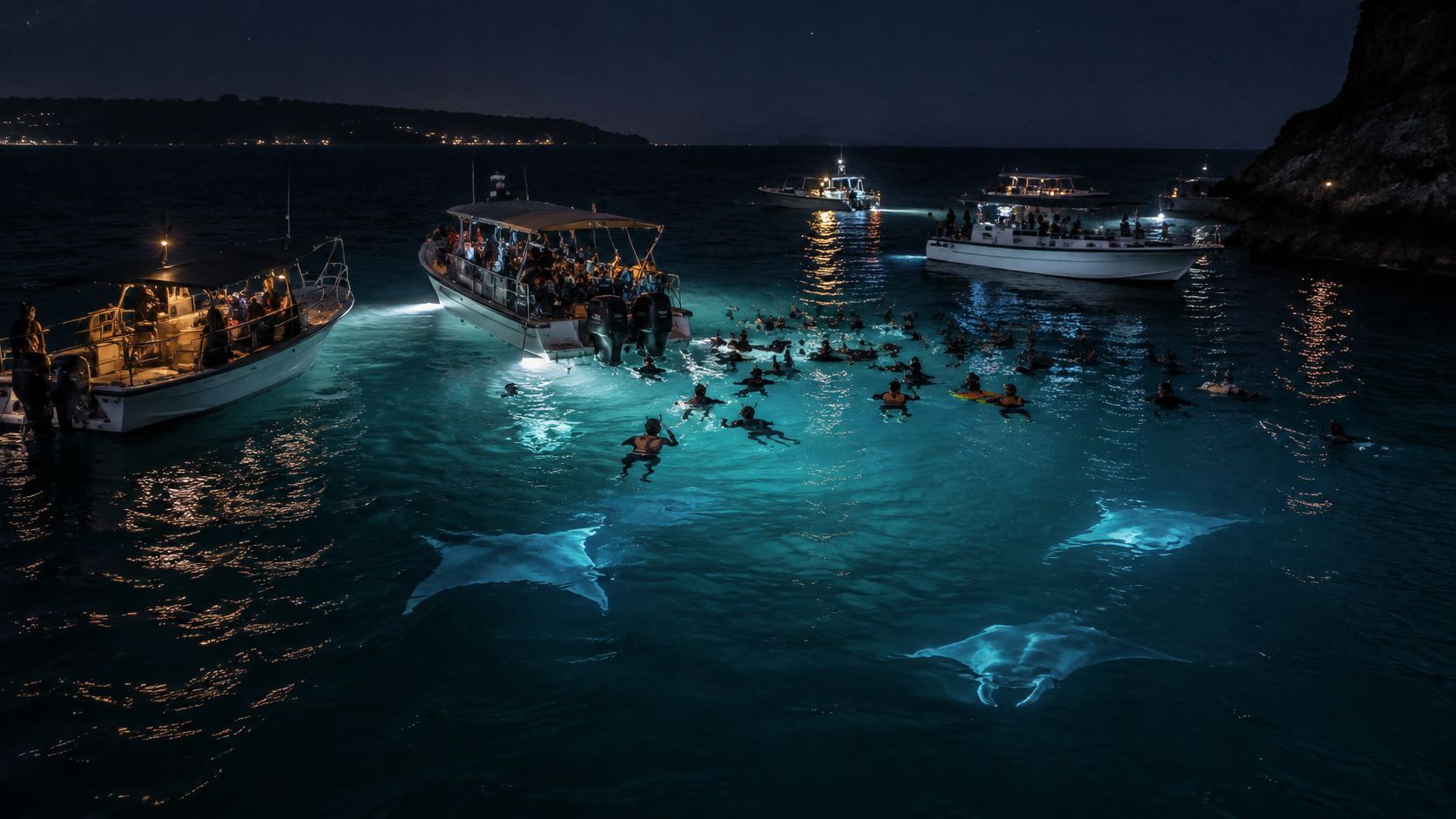
SFGATE's reporting on a Hawaiʻi safety assessment describes boats traveling above minimum operating speeds, vessels passing within 10 to 20 feet of unlit snorkelers, swimmers following rays into boat channels, and more than 290 people potentially in the water on the busiest nights. Those are operational hazards, not questions about a manta's temperament.
Questions to ask before paying
- Group size: What is the maximum number of guests in the water, rather than just the boat's passenger capacity?
- Guide coverage: How many guides enter with that group, and how are guests divided?
- Flotation: Is a stable float provided, and are snorkelers instructed to remain with it?
- Boat separation: How does the crew keep the viewing group outside vessel lanes?
- Lighting: How are swimmers made visible, and where do viewing lights point?
- Early extraction: Who assists a tired or panicked guest, and how does that person return aboard?
Our divers remain in a specific, supervised viewing area rather than taking a loose night swim. For snorkeling, a raft with a clearly enforced perimeter is preferable to scattered guests searching for their own encounter.
Proposed controls are benchmarks, not proof of compliance
The state proposal identified earlier sets out the following standards. These are proposed controls, not a statement that every provision is currently enforceable law. Treat the guide ratio as customers per guide, not guides per customer.
Proposed manta viewing controls for Garden Eel Cove and Keauhou Bay
| Rule | Proposed standard |
|---|---|
| Commercial viewing permits | 24 per designated zone |
| Passengers per vessel | Up to 60 passengers for hire in 24 hours |
| Guide-to-customer ratio | 8 customers to 1 guide |
| Viewing hours | 4:00 p.m. to 4:00 a.m., run in two-hour shifts |
| Fishing | Prohibited in the zones during viewing hours |
A permit framework doesn't answer how a particular crew manages a difficult guest or a crowded arrival. Listen for concrete procedures rather than general reassurance.
The Hawaiʻi manta ray guide provides broader encounter context, but your booking decision should turn on the actual departure. If the operator can't explain its boundaries and extraction plan, choose another boat.
Rules for Watching Without Touching a Ray
Treat the light circle as the manta's dining table. Your place is beside the feeding space, not inside an animal's turn or across its approach. Close passes are something to receive calmly, not manufacture.
The NOAA-associated voluntary manta-viewing guidance specifies the light directions and hands-off approach: divers direct lights upward from above their heads, snorkelers shine downward from the surface, and nobody touches, chases, grabs, or rides a manta. Contact can remove the animal's protective mucus coating.
Hold your position and manage your equipment
- Divers: Hold your light above your head and aim upward, following the crew's placement instructions. Don't sweep the beam across neighboring masks.
- Snorkelers: Stay at the surface and keep lights directed down. Don't duck-dive into the feeding zone.
- Everyone: Keep hands to yourself, leave an open approach and exit, and resist moving toward a ray that changes direction.
- Breathing divers: Avoid directing exhaust bubbles into a manta overhead when possible. Never hold your breath or compromise normal scuba breathing to accomplish this.
Our divers are positioned in a specific viewing area, with experienced divemasters and instructors in the water to manage the group. Stay in that assigned patch even when the best-looking pass appears to be happening somewhere else.
If another guest crowds you, signal the guide rather than pushing sideways into a new position. Keep gauges, hoses, and camera accessories secured so excitement doesn't turn loose equipment into something that catches the bottom or another diver.
Why restraint matters beyond tonight
The NOAA giant manta ray recovery status review discusses a genomic estimate of approximately 104 for Hawaiʻi Island's contemporary effective reef manta population size, alongside maturity at roughly 8 to 17 years, reproduction of one pup every 1 to 7 years for mature females, and lifespans reaching 45 years.
Effective population size isn't a head count of every manta around the island. It's a genetic measure, so it shouldn't be presented as the total number of animals available to see. The practical message is that frequent encounters at an aggregation don't prove the regional population is large or quick to replace losses.
Hands-off means hands-off: A ray approaching your mask doesn't give permission to reach out.
Slow maturity and infrequent reproduction give operators good reason to protect predictable feeding behavior. They don't establish that every accidental bump causes lasting harm, but they do make unnecessary contact a poor trade for a photograph.
Apply the same responsible diver etiquette to the reef around the viewing area. Kneel only on the assigned sand, never use coral as a handhold, and let your guide resolve positioning problems.
What to Pack and How the Night Unfolds
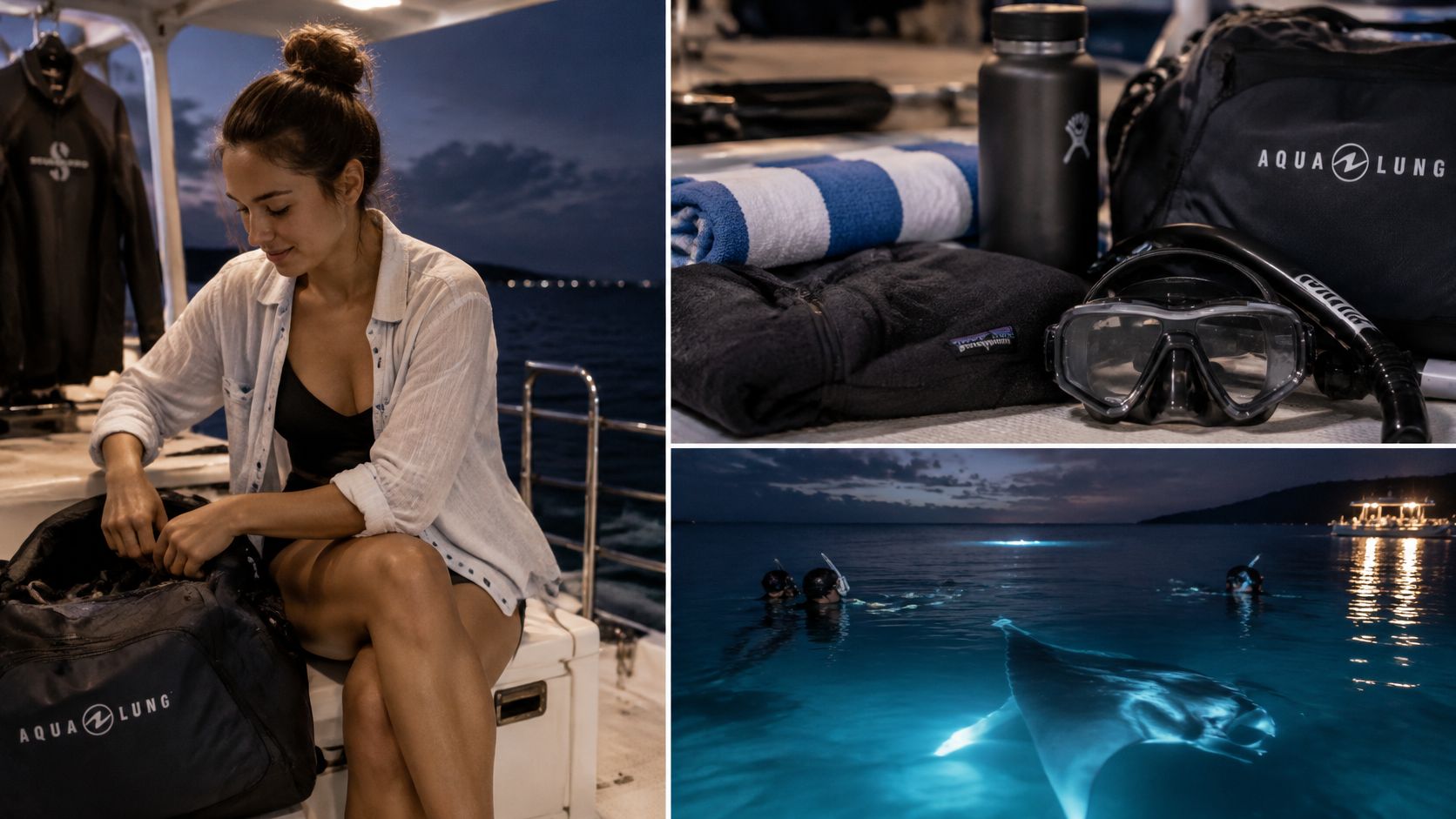
Pack for a cool boat ride and a relatively still period in the water. You won't generate the same warmth you would while swimming along a reef, and wet clothing can feel chilly once the boat starts moving.
- Wear your swimsuit: Put it under clothes that are easy to remove and store.
- Bring dry warmth: Pack a towel and a warm layer in a splash-resistant bag.
- Handle vision needs: Bring a prescription mask if you need one.
- Carry certification: Divers should have their certification information available.
- Confirm equipment: Check tanks, weights, wetsuit provision, rental scuba equipment, and the snorkel float before departure.
Leave snaggable jewelry behind. A personal light that can't be aimed reliably is more nuisance than help, and bulky camera accessories make ladders and crowded viewing positions harder to manage.
Plan motion comfort before the dock
If you're prone to seasickness, consider your options before boarding rather than waiting until you feel ill. Products available include Ship-EEZ Seasickness Patch, Dramamine pills, Bonine pills, Sea Band wristbands, and ginger chews.
These aren't interchangeable treatments, and a product listing isn't evidence that it will work for you. Ask a pharmacist about medication suitability, interactions, and drowsiness, especially before scuba diving, and follow the product directions. The seasickness preparation guide can help you organize that decision before departure.
The evening sequence
- Check in at the confirmed late-afternoon or early-evening meeting time. Give yourself room to handle paperwork and equipment fit.
- Listen to the complete briefing, including signals, assigned positions, and the return-to-boat procedure.
- Ride to the site as the light fades. Keep the deck and boarding area clear while the crew prepares.
- Enter when directed. Snorkelers move to the lit float; divers descend to the marked sandy viewing patch.
- Watch without chasing until the crew ends the session, or signal promptly if you want to leave earlier.
- Climb out using the crew's ladder instructions, dry off, and put on your warm layer before the return ride.
Don't wait until you're exhausted to tell a guide you're uncomfortable. Early communication gives the crew more room to help without disrupting everyone else's exit.
Manta Night Questions Answered
Is a manta night dive dangerous?
It carries ocean and nighttime risks, with boat separation and group control deserving particular attention. Judge the departure by its procedures, not by a description of the animals as gentle.
Do I need to be a strong swimmer?
You need enough comfort and ability to manage the surface environment and remain with the float throughout the session. Flotation helps, but it doesn't replace the ability to breathe calmly through a snorkel or follow a guide's directions.
Can I touch a manta?
No, even if it passes within reach. Keep your hands tucked in and give the animal control of the distance rather than trying to steady yourself against it.
Are manta sightings guaranteed?
No, you're attending a natural feeding event. Read any advertised return-trip policy before booking, because a sighting record doesn't establish what happens if your departure sees no rays.
Which cove is better?
Garden Eel Cove is the better dive-tour choice for its protected setting, viewing area, and surrounding reef. The captain still needs to assess actual conditions rather than treating a preferred site as automatically suitable.
How early should I book?
Book as soon as your travel dates are firm, since our popular manta departures often sell out weeks in advance. I would place the trip earlier in a vacation when possible, leaving flexibility if weather changes your plans.
Do snorkelers need certification?
No scuba card is needed for the surface position. Certification matters if you want to use scuba, and your comfort in the water still matters whichever position you choose.
Can a mixed group choose different seats?
Yes, a combined departure can accommodate certified divers and snorkelers watching from their respective positions. Confirm the arrangement at booking rather than assuming a snorkeling companion can descend with a diver or join the same underwater group.
Book Garden Eel Cove for the Right Seat
Book the position you can enjoy comfortably. Kona Honu Divers uses Garden Eel Cove for the manta night dive, with powerful lights placed on the seafloor, divers kneeling on sand, and snorkelers floating above.
Choose the manta booking option already linked for this experience, or browse Kona diving tours for other outings. Experienced divers can also consider the premium advanced long-range trip or the blackwater night dive, which are separate experiences rather than substitutes for the manta setup.
Use the Kona boat tours guide if you're coordinating different activities across a group. Popular dates often fill weeks ahead, so settle the viewing choice before your preferred evening disappears.
Certified diver availability
Manta snorkel availability
For broader Big Island snorkeling availability, use the general snorkeling calendar.
Kona Honu Divers offers supervised manta viewing at Garden Eel Cove, with certified divers watching from the sandy bottom and snorkelers observing from the surface. Visit Kona Honu Divers to choose your seat, review the trip details, and reserve an evening that fits your group's water skills.