
You're standing on the dock in Kona with a wetsuit half-zipped, a towel in one hand, and that familiar mix of excitement and doubt in your head. You've heard the stories, the giant wings, the close passes, the calm feeling when the mantas finally arrive, but you still want to know what the night feels like before you commit. That's the right instinct. A good manta ray night dive Kailua Kona experience is built on real biology, good timing, and a crew that knows how to keep the water quiet enough for the animals to do their thing.
What the Experience Actually Feels Like
The first thing most first-timers notice at Garden Eel Cove is the light. The dive masters switch on the high-output beams, the lava-rock ledge fades into darkness, and the water fills with a bright cone of plankton. It doesn't feel like a chase. It feels like waiting at the edge of a stage while the ocean slowly decides to reveal the cast.
A dark shape usually appears from deeper water before people realize what they're seeing. It banks into the illuminated patch, rolls with almost lazy precision, and suddenly the whole group understands that the manta isn't passing by, it's feeding directly beneath the light. The movement is slow, but it's not sleepy. It's controlled, deliberate, and strangely quiet.
Stay still long enough and the mantas do the moving for you.
That stillness is what makes the encounter memorable. Divers kneel or settle low on the sand, hold their position, and let the animals work through the plankton cloud. No one should be chasing a cleaner frame or trying to close distance. The magic is in letting the mantas come to you, which is why the etiquette matters so much. If you want the practical side of that behavior, responsible diver etiquette gives the clearest rule set for staying out of the way without feeling stiff or anxious.
What surprises many guests is how calm the scene becomes once everyone stops fidgeting. The biggest emotional shift happens when the first manta completes a barrel roll and then comes back through the same lit water, as if it's testing the lane again. That's when people stop whispering and start staring. The dark water feels much smaller after that first clean pass.
Meeting Point, Timing, and Schedule
The evening runs more smoothly when you treat it like a planned outing, not a casual swim. Most guests meet near Honokohau Harbor, arrive about 30 minutes early, and use that buffer for check-in, gear fitting, and any last-minute questions. The boat ride to the site is short, but the margin matters because once you're on board, you want your attention on the briefing, not on fixing straps or finding your mask.
The usual flow is simple. Crew members give a 15 to 20 minute surface briefing, explain where everyone sits, and review how the lights, entries, and exits work. Then the boat shifts to the site, and the in-water portion usually lasts about 45 to 60 minutes before the return trip. That time window is long enough for the plankton field to settle and for the mantas to make repeated passes, which is why the night doesn't feel rushed.
A clean timeline helps the whole group
- Check in early, so you're not trying to sort paperwork in a hurry.
- Listen to the briefing closely, because the setup is different from a daytime reef dive.
- Get in position quickly, so the light field can do its job.
- Stay relaxed in the water, because movement from the group changes the feeding lane.
- Warm up on the boat ride back, since most guests feel the temperature drop once they're wet and still.
The custom boat setup used by Kona Honu Divers keeps the group organized relative to other operators at the site, which helps reduce confusion when several vessels are working the same general area. That matters more than people think. A tidy boat layout and a clear dive flow make the whole evening feel less like logistics and more like a guided encounter. For families and first-time night divers, that mental ease is often the difference between feeling tense and enjoying the show.
Why Kona Has the World's Most Reliable Manta Encounters
Kona's reputation didn't appear out of nowhere. The night dive grew from an accidental wildlife-attraction pattern in the early 1990s, when hotel lights near the shoreline drew plankton close to the coast, and reef manta rays followed the food. Organized scuba night dives began in 1991, at first about once a week, then expanded to nightly trips as demand and manta activity increased. Historical reporting later described the two main Kona-area sites as attracting more than 20 boats per night each and more than 400 people in the water nightly across both locations, which explains why the Kona experience became so significant as a marine-tourism model. You can read that origin story in the historical reporting from Seven Seas Media.
The biology behind the lights
Mantas aren't responding to light by itself. They're responding to the plankton that collects around it. Reef manta rays swim with their mouths open, use cephalic lobes to funnel food-rich water, and filter prey through a system that can handle zooplankton ranging from roughly 51 micrometers to more than 500 micrometers. Field research found feeding was triggered when zooplankton biomass exceeded about 11.2 milligrams per cubic meter, which is why a bright, stable light field can turn into a feeding station. The mechanics are detailed in field and feeding research on reef manta rays.
That's also why the encounter feels so dependable without being guaranteed. The light helps build the plankton patch, but the animals still decide whether the conditions are worth showing up for. Divers sometimes assume that a busy tour calendar means manta abundance is limitless, but the actual picture is more careful than that. A 2024 NOAA summary reported only 318 unique reef manta rays around Hawaiʻi Island since 1979, alongside an estimated effective breeding population of about 104 adult breeders with a 95% confidence interval of 99 to 110. A separate scientific study reported a similar small-population pattern for Hawaiʻi Island and Maui Nui, which reinforces why the night dive needs respectful management, not crowding. That population context is laid out in the NOAA summary and the related scientific analysis at Springer.
Reliable viewing doesn't mean an unlimited resource. It means a small, site-faithful population using a predictable feeding setup.
The long-term monitoring backs that up. A six-year standardized program recorded 25,444 sightings of 118 individually identified reef manta rays at Kona's main viewing areas between January 1, 2009, and December 31, 2014. That's not a rumor-driven attraction. It's a documented site with years of field observations behind it, which is why the dive feels both wild and unusually legible.
Garden Eel Cove vs Keauhou Bay
Garden Eel Cove and Keauhou aren't interchangeable, even though both can produce strong manta nights. A 2025 University of Hawaiʻi analysis of community-sourced photo-ID records from 2010 through 2022 found more than 23,000 sightings of 167 individually recognized reef manta rays at the two sites. It also showed that aggregation size tracked zooplankton density, which means the bigger nighttime gatherings are tied to food availability, not just tour scheduling. The analysis is in the University of Hawaiʻi repository at ScholarSpace.
Why Garden Eel Cove tends to feel easier
Garden Eel Cove generally supports larger aggregations, while Keauhou shows stronger female site fidelity and a female-skewed visitation pattern. That matters in plain English. Garden Eel Cove usually gives dive crews a broader feeding picture, while Keauhou can feel more specialized and behaviorally distinct. If you're a first-timer, a photographer, or a family group trying to stay calm in the water, the wider viewing area and more predictable group management at Garden Eel Cove are easier to work with.
The physical layout helps too. A more protected cove gives the crew a cleaner staging area, better spacing for divers, and a simpler way to keep lights pointed where they belong. That reduces the odds that someone will drift into the feed lane or kick up the bottom. When a tour operator chooses the site with the better group control, the whole night usually feels less cramped.
The practical difference guests notice
At Garden Eel Cove, the briefing feels more like a controlled setup around one organized light field. At Keauhou, the viewing pattern can still be excellent, but the biological function of the site appears different enough that the night may not feel identical. That's why the shorter, clearer explanation is often the most honest one. The reason many dive briefs happen in front of a lava-field hotel site rather than a harbor resort is simple, the feeding behavior developed there first, and the site still supports the sort of stable viewing setup that makes the encounter work.
For guests, the takeaway is straightforward. If you want the calmer operational choice with better viewing geometry for the typical tour format, Garden Eel Cove is the site that usually makes the most sense.
Certification, Experience, and Who Can Join
The manta night dive is usually open to Open Water certified divers and above, but certification alone doesn't make the experience a fit. You should be comfortable with a night dive, low visibility, and a lava bottom before you sign up. If you haven't been in the water recently, most operators will want recent dive experience within a reasonable window, because the work of staying calm, controlling buoyancy, and following light instructions is harder when you're rusty.
If you want the difference between snorkeling and diving laid out in a simple way, this comparison of manta snorkeling and diving is the most useful place to start. It helps families split the group cleanly when one person wants scuba and another doesn't.
Who usually fits the trip
- Certified divers: Best fit for the scuba version if they're current and comfortable at night.
- Uncertified adults: Can often join through a Discover Scuba option, if the operator offers it and the participant is medically cleared.
- Non-divers and kids: Usually join the parallel snorkel program instead of the dive.
- Guests with equalization concerns: Should be honest early, because ear pressure problems get worse when people try to rush.
- Travelers with asthma or pregnancy questions: Need to sort out medical clearance before booking, not on the dock.
The age question is common, and the answer depends on which side of the experience you choose. Divers need to meet the scuba requirements. Snorkelers have a different path, which makes the trip workable for mixed groups. That's one reason the manta evening is so popular with families, because it doesn't force everyone into the same water format.
The best fit isn't the most adventurous option, it's the one you can do calmly and repeatably.
A careful host will ask about comfort, recent diving, and any medical issues before anyone steps onto the boat. That isn't gatekeeping, it's how you keep the night from turning into a problem later. If you're unsure about your own readiness, ask those questions early and keep the answer practical.
What to Bring and How to Prepare
The people who enjoy the trip most usually packed for comfort instead of style. Kona evenings can feel mild on land, but once you're wet, stationary, and riding back in a breeze, even a good day can feel colder than expected. Start with layers you'll want to wear after the dive, not just before it.
For motion management on the short crossing, options people commonly use include the Ship-EEZ Seasickness Patch, Dramamine pills, Bonine pills, Sea Band wristbands, and ginger chews. If seasickness is part of your history, don't wait until symptoms start. Take whatever you use before boarding, and pair it with a light meal and good hydration.
A simple packing list
- Light layers: A dry shirt, hoodie, or jacket for the ride back.
- Towel: You'll use it the second you climb out.
- Hat: Useful for the boat ride and the dock before sunset.
- Reef-safe sunscreen: Put it on before arrival so it's not washing into the water.
- Water bottle: Stay hydrated before and after the dive.
- Light pre-dive meal: Enough to keep you steady, not so much that you feel heavy.
- Motion-management gear: Pick one method and use it early.
- Avoid cotton as your main layer: It stays cold when wet and makes the return trip worse.
The operator usually provides the core dive gear, but guests still need to show up with their own comfort plan. That means thinking about the ride, not just the time in the water. A dry layer and a towel solve more problems than a bag full of extras. If you're prone to nausea, the sea sickness prevention guide is worth reading before you decide what to pack.
Best Seasons, Tides, and Conditions
Kona mantas are present year-round, but the night feels different from one evening to the next. Water state, plankton concentration, and moonlight all shape how easy it is to relax on the boat and how bright the feeding lane appears once you're in position. New divers usually prefer calmer summer and early fall conditions, while photographers often chase the clearest, quietest nights they can find.
The moon matters more than many visitors expect. A darker sky makes the in-water light field feel more dramatic, because your eyes adapt faster to the contrast. Incoming tide can also help by bringing cleaner plankton into the viewing area, which is why operators pay attention to that part of the forecast instead of treating every evening the same. For timing details, the best time to see manta rays in Kona is a solid planning reference.
A calm night and a manta-rich night aren't always the same thing.
That's the part travelers tend to miss. Low-manta evenings can happen even at a strong site, and that doesn't automatically mean anything is wrong with the operator. Wildlife tourism works best when guests expect real variability instead of a guaranteed show. If you book with that mindset, the night feels less like a promise and more like an encounter.
For first-timers, I'd prioritize a date with gentle water and enough flexibility to shift plans if conditions change. If you're mainly chasing cleaner photos, then a darker night and smoother surface usually help more than a date chosen just for calendar convenience. The ocean doesn't care about your itinerary, so the best plan is the one that leaves room for the weather to make the final call.
Photography and Lighting Tips
Most first-time manta photos come back too blue, too noisy, or full of particles because people shoot the encounter like a daytime reef scene. Night manta photography needs a different mindset. Use a wide-angle lens, keep your ISO high enough to preserve detail, and aim for a shutter speed at or above 1/100 if your camera can hold it cleanly. For video, 4K at 30fps with manual white balance set underwater usually gives you the most usable starting point.
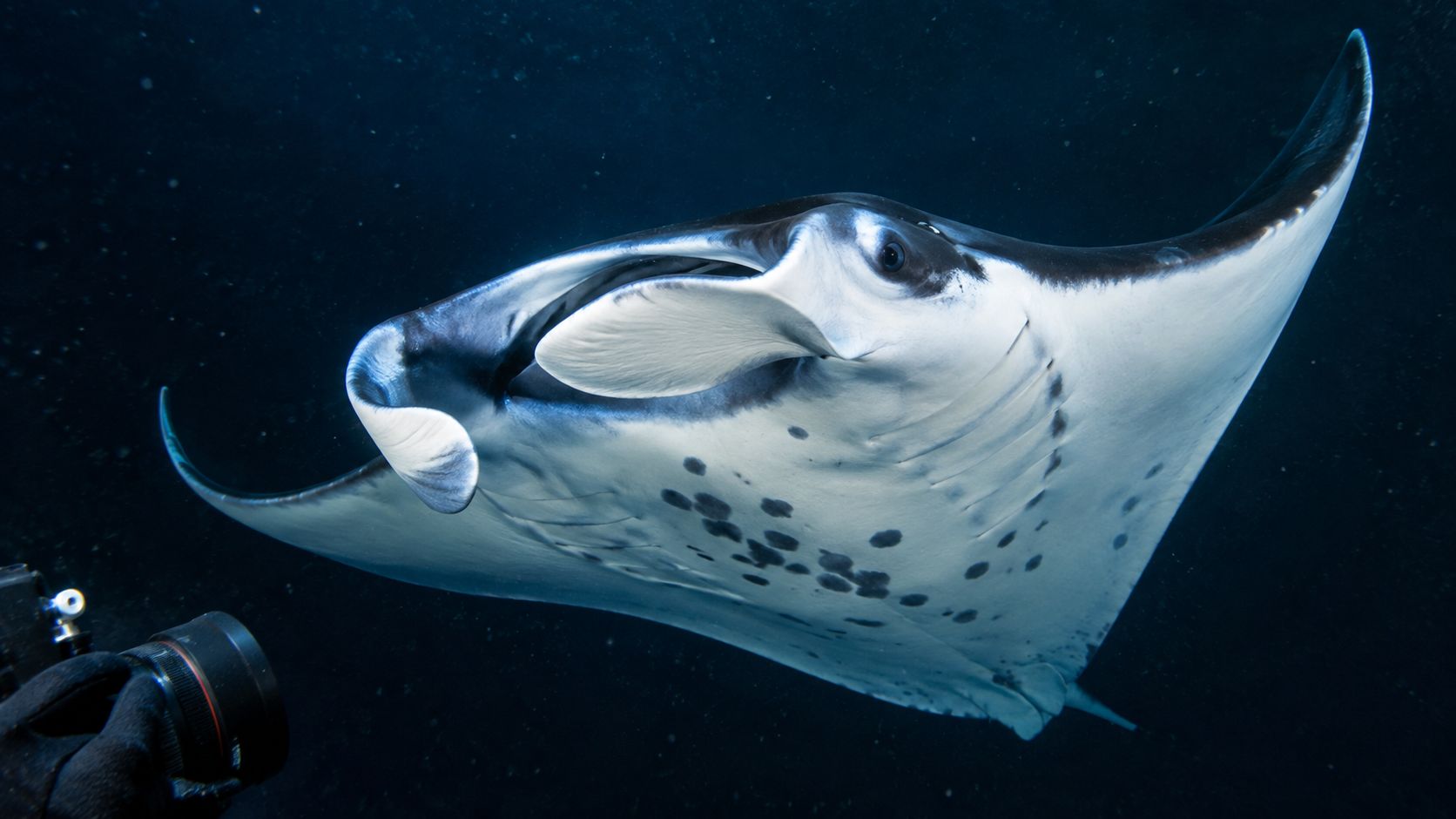
Light without disturbing the feed
The lighting rule is simple. Keep your lights above your head on the bottom, point them into the water column, and never aim a beam into a manta's eyes. Strobes should go outward, not directly at the animal. If you're snorkeling, keep your light pointed downward and stay with the board rather than dropping into the feeding lane. The guide's job is to protect the shape of that light field, because once the group starts moving lights around, the whole feeding pattern gets harder to read.
A lot of guests also try to correct every shot in real time, which usually makes the footage worse. A cleaner method is to let the manta come through the frame, hold steady, and keep the camera out of the way of your own view. If you want a hard-working example gallery, Kona manta dive pictures are useful because they show what a steady, wide composition looks like when the animal does most of the work.
Why a GoPro often wins for first-timers
A GoPro works well in low light, stays steady in hand, and frames the whole scene without needing a long lens. That setup suits this dive better than a complicated rig that few divers want to manage after dark. A slow, steady clip often tells the story better than a noisy still shot with blown highlights. The best manta footage usually comes from the guest who watches first and films second.
Kona Honu Divers runs custom boats with well-maintained gear, and their crew brings more than 200 years of combined industry experience to the water, which matters when the goal is a controlled low-contact interaction rather than a crowded scramble. Their manta night dive package is built around Garden Eel Cove, includes small-group handling, and fits naturally alongside early-diver discounts, free nitrox for certified divers, and multi-day bundles. If you want a night where the boats are organized, the briefings are clear, and the mantas stay in the center of the story, that's the kind of setup to look for.
If you're ready to see the Kona manta night in a way that's calm, organized, and built around the animals' real feeding behavior, Kona Honu Divers offers the kind of setup that fits first-timers and experienced divers alike. Book early, bring the right layers, and show up prepared to stay still, because that's usually what turns a good night into the one people talk about for years.