
Table of Contents
- Let the feeding behavior set the pace
- In the light field
- Match the trip to your group
- Different positions, shared discipline
Kona after dark feels different from the Big Island you see by day. You're on a boat offshore, the coastline has faded into darkness, and lights illuminate a patch of water where a manta ray may sweep through without warning. For a first-time guest, that first pass can feel close enough to take your breath away. It's also a wild encounter, not a staged show, and no operator can promise which mantas will arrive or how many you'll see.
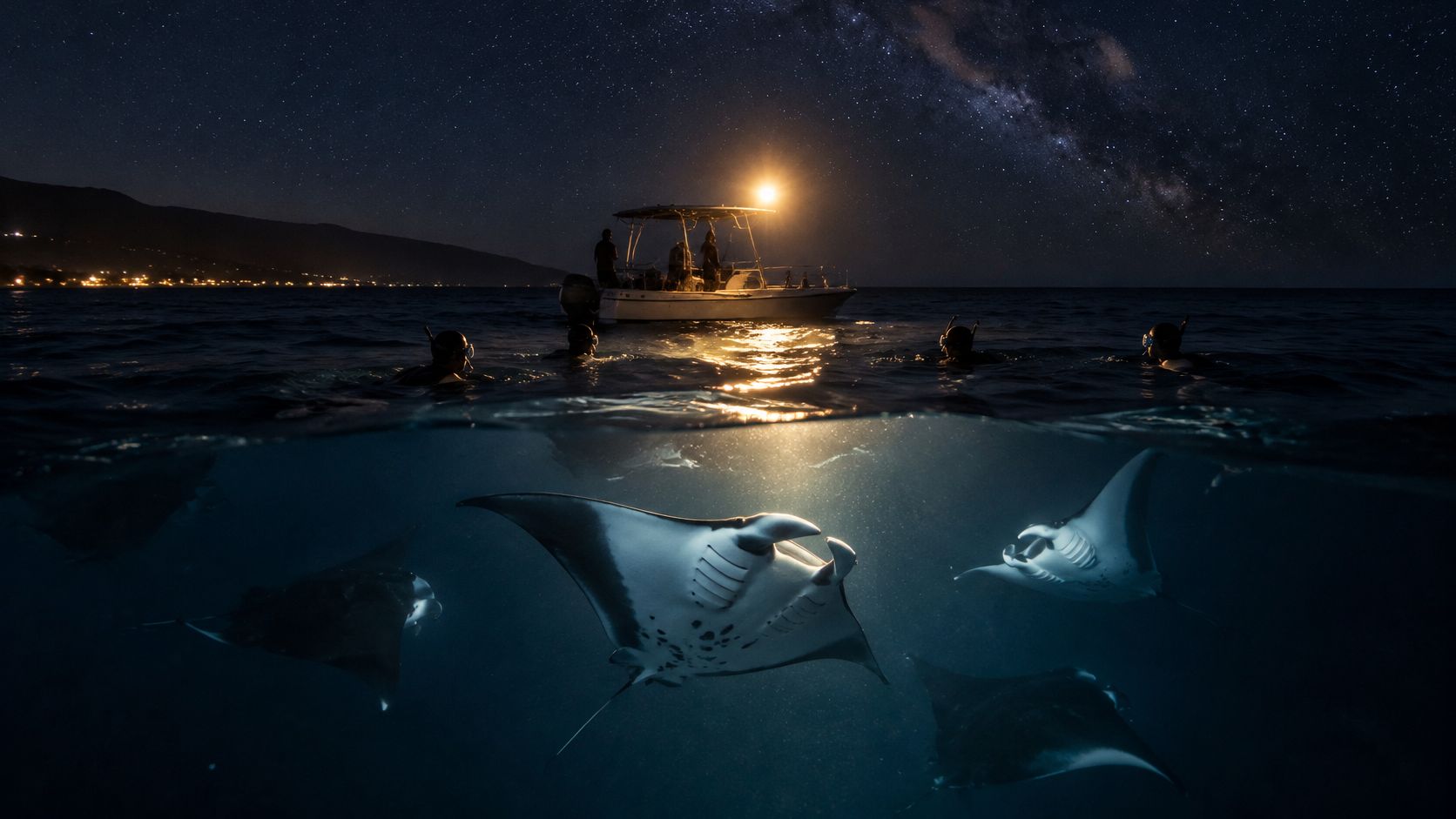
Kona's nighttime manta experience is built on years of research and repeated observations, not just a clever tourism setup. The best trip choice depends on more than the chance of seeing a ray. Site, food conditions, vessel traffic, your comfort in the water, and the crew's approach all shape what the night feels like.
This guide covers how the feeding encounter works, why Garden Eel Cove is a strong general choice, what snorkelers and divers can expect, and how to protect both people and wildlife in a busy viewing area. Kona Honu Divers offers Kona night dives and manta trips for snorkelers and certified divers, alongside other dive tours. The important thing is to choose a format and operator that fit your experience and put safe, controlled viewing first.
A Night With Kona Manta Rays
A first-time guest often expects the dark water to feel intimidating. Then the boat lights settle, the group gets into position, and a manta's broad silhouette appears at the edge of the glow. It banks, turns, and passes beneath the surface. The surprise isn't only its size. It's the realization that the animal is choosing how to move through the feeding area, and the people are there to watch.
That distinction matters. Kona's manta ray encounters are recurring wildlife events, but they're never guaranteed performances. A quiet night doesn't mean the crew did something wrong, and a busy one doesn't mean guests should move closer or crowd the animals.
Kona mantas have been studied closely since 1991, when Keller Laros began work associated with the Manta Pacific Research Foundation; the University of Hawaiʻi later conducted extensive tracking research, as described in this NOAA report on Kona manta rays. Researchers can recognize individual reef mantas by the distinctive spot patterns on their undersides, which makes it possible to build photographic catalogs and monitor animals across repeated encounters.
For visitors, that history gives the night a purpose beyond a memorable swim. Repeated observations can help document residency, site use, injuries, and changes in the local population without capturing the animals. It's a rare chance to see wildlife behavior in a setting that can also contribute to ongoing observation, provided guests keep their distance and let the mantas set the pace.
Why Manta Rays Visit Kona at Night
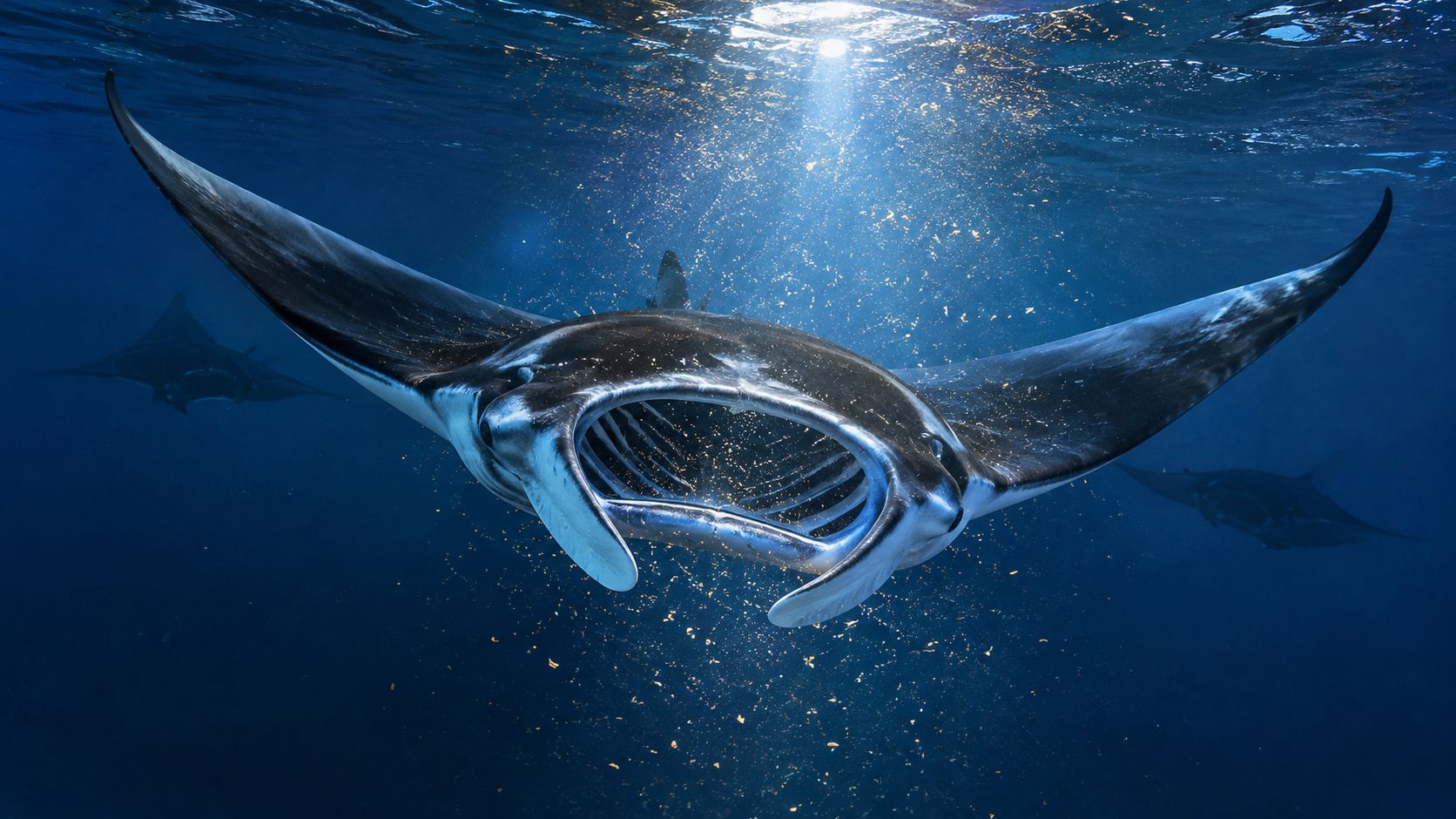
Manta rays visit Kona's nighttime viewing areas to feed. Tour lights help make plankton easier to find by concentrating it near the surface, where mantas can feed as they swim through the illuminated water. But the lights don't create the food. Think of a flashlight revealing food in a dark room: it makes what's there easier to see, but it doesn't put it there.
That distinction helps explain why manta numbers can vary from one night to another. A 2025 University of Hawaiʻi study examined 13 years of community-sourced records from Garden Eel Cove and Keauhou, covering more than 23,000 sightings of 167 individually identified reef manta rays. It found that aggregation size tracked zooplankton density, pointing to prey availability as a primary driver of how many mantas gathered, rather than the mere presence of dive lights (University of Hawaiʻi study of Kona manta sightings).
Let the feeding behavior set the pace
A manta may circle, inspect the light field, and return through a patch of plankton. It may also leave. Guests get a better view by staying in their assigned position and watching the animal's path than by swimming after it or trying to redirect it.
Practical rule: More light or closer positioning can't guarantee more mantas. The crew can organize a safe viewing area, but the rays decide whether to use it.
That restraint matters because manta rays are vulnerable to population pressures. They mature late, have a gestation period of about 13 months, and produce very few offspring, so local populations can't quickly replace animals lost to fishing, entanglement, vessel strikes, or habitat degradation. Kona researchers can learn from repeated observations without handling the rays, while visitors can help keep the encounter low-impact by avoiding physical contact and pursuit.
Garden Eel Cove Compared With Keauhou
For a first manta dive or snorkel, Garden Eel Cove is the stronger general choice. Also called Makako Bay, it offers a protected location with a better viewing area and better reefs. It's a compelling combination for guests who want to observe the feeding activity while also experiencing a reef setting, rather than judging the trip only by how many mantas appear.
The sites do have different documented patterns. In the 13-year study, Garden Eel Cove consistently produced larger aggregations. Keauhou had smaller aggregations and a strongly female-biased visitation pattern, with females accounting for 91% of sightings. The researchers also observed stronger female site fidelity at Keauhou and more movement among males. Those differences make it too simple to treat the sites as interchangeable, though animal identity, prey availability, and local conditions still affect any particular outing.
| Site | Documented Pattern | Setting | Planning Recommendation |
|---|---|---|---|
| Garden Eel Cove, also called Makako Bay | Consistently larger aggregations | Protected viewing location with a better viewing area and better reefs | Preferred general choice for a first manta dive or snorkel |
| Keauhou | Smaller aggregations, with females accounting for 91% of sightings and stronger female site fidelity | Principal nighttime feeding area near Keauhou Bay | Consider it for its distinct site-use pattern, while keeping nightly variability in mind |
For divers comparing available trips, review the Kona scuba diving tours and the dedicated manta ray dive and snorkel tour. Ask which viewing site the operator plans to visit and how it handles changes in conditions. A site preference is useful, but it can't promise a particular aggregation or an individual manta.
The clearest decision is to choose Garden Eel Cove for its protected viewing area and reef setting, then treat the wildlife as variable. A well-run trip should make that trade-off clear rather than selling a guaranteed animal count.
What Happens During a Manta Night Dive
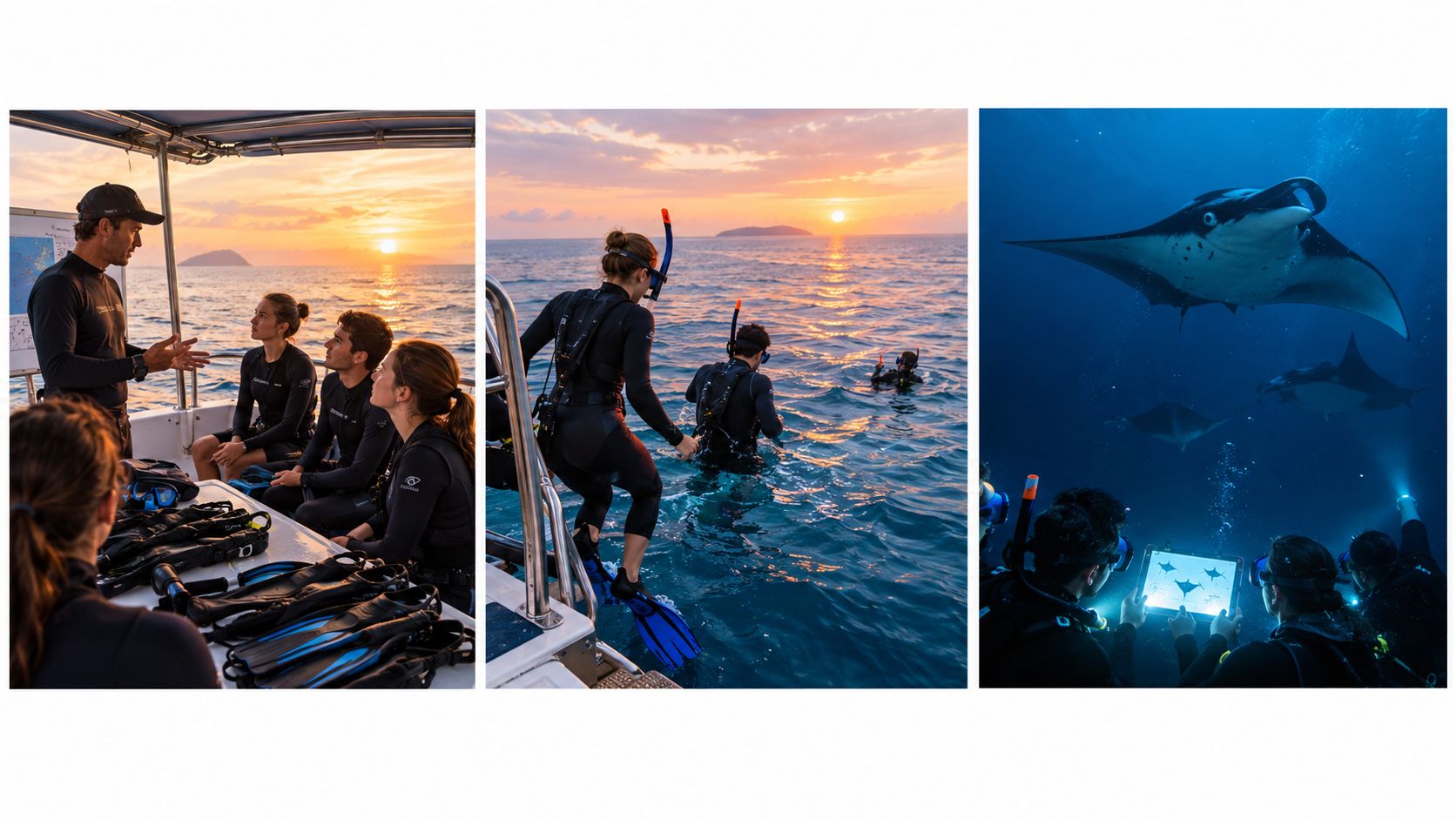
A typical trip begins with check-in, an equipment fit, and a safety briefing. The crew explains how guests will enter the water, where to position themselves, and what to do if the group needs to move or return to the boat. On the ride out, follow the crew's instructions and ask about anything you're unsure of before the group enters the water.
Once the boat is positioned, the crew sets up lights to illuminate the viewing area and organizes guests for entry. Snorkelers generally stay at the surface in a designated position. Divers descend with their guide and settle where directed. Neither group should try to improve its view by swimming into the manta's path.
In the light field
Once you're in position, keep your movements quiet and deliberate. Snorkelers should stay with the group and hold their place as instructed. Divers should maintain buoyancy, keep their lights controlled, and leave the manta's route open. The encounter may build gradually as rays approach the illuminated water, or the activity may stay subdued if feeding conditions aren't favorable.
A manta dive is not a blackwater dive. The manta trip centers on a reef feeding site and an organized viewing area; blackwater diving is a separate specialty experience in open water at night. If you're a diver preparing for Kona's manta dive, read the practical guide to how deep the Kona manta ray dive is.
The crew manages the boat and group procedure, but conditions still shape the experience. Currents, vessel traffic, visibility, animal behavior, and prey availability can change the pace. If the rays pass close, don't reach out or try to frame a photograph by moving into their path. If they don't appear, stay calm and follow the crew's instructions through the planned return to the boat.
Plan the Best Time for Your Visit
There's no reliable calendar shortcut to a particular manta count. Zooplankton conditions can change aggregation size even at a regularly visited site, so one night may be active while another is quiet. You can't infer that a trip was poorly planned because fewer rays arrived.
Plan around the wider trip instead. Ask the operator how it communicates sea conditions and any changes to the itinerary. If manta viewing is a high priority, consider leaving enough flexibility in your Kona schedule to make more than one attempt, rather than putting all your hopes on a single night. The guide to timing a Kona manta ray trip can help you think through the decision without treating a particular season as a guarantee.
Match the trip to your group
- Certified divers: Choose a trip that fits your certification and comfort in low light. Buoyancy and the ability to follow a guide's positioning instructions matter more than experience with a dramatic close pass.
- Snorkelers: Be comfortable floating with the group and staying attentive to instructions. A surface position still requires awareness of your fins, fellow guests, and the boat.
- Families: Ask about participant age and swimming requirements, equipment, and how the crew supports guests who feel uneasy in the dark water. Don't assume every child or adult will enjoy the same format.
- Guests with limited time: Pick the format that fits your schedule and comfort, then ask in advance what happens if activity is low. A single outing can be memorable, but it can't be controlled.
Sea conditions and swell can affect boat comfort, while visibility and vessel traffic influence how the in-water area feels. There isn't a single ideal trip for everyone. Choose the outing that fits your experience, ask practical questions before booking, and treat extra flexibility as a way to cope with wildlife variation, not as a promise of more sightings.
Protect Wildlife and Stay Safe in the Water
The rule is simple: don't touch, chase, block, straddle, ride, or direct a manta ray. Physical contact can damage a manta's protective mucus layer, and a published account of the Big Island night dive notes that touching one can result in removal from the dive (account of the Kona manta night dive). Give the animal room to turn and leave, even if it passes close.
Crowding creates risks for people as well as wildlife. Hawaiʻi County's boating and safety assessment identified at least 42 commercial operators visiting the two principal nighttime manta areas by August 2015. Direct observations during August 10–13, 2015, recorded 16–19 vessels per night and approximately 160–190 snorkelers and divers simultaneously in the water (Hawaiʻi County boating and safety assessment). Those historical observations help explain why spacing, clear briefings, and coordinated vessel operations matter.
Different positions, shared discipline
Snorkelers should keep their hands and fins clear, stay with the designated group, and avoid crowding an animal's exit path. Pay attention to the boat and crew, especially if vessels move within the viewing zone. If the water feels congested, don't swim across the area to find more space. Follow the guide's directions and keep your position predictable.
Divers should control buoyancy, use torches with care, maintain spacing, and follow the guide's ascent plan. Don't point a light directly into a manta's eyes or rise into its feeding route. More lights, a closer boat, or a larger circle of swimmers won't automatically produce a better encounter.
Before entry, check that your equipment is secure and that you understand the in-water signal and the plan for returning to the boat. While in the water, hold your assigned position, watch for people and vessels around you, keep your hands off the animals, and follow the crew's instructions. Review the responsible diver etiquette guidance before your trip so you understand how controlled positioning supports both safety and wildlife protection.
Choose Your Tour and Booking Format
A manta night snorkel and a two-tank manta scuba dive offer different ways to observe the same wildlife encounter. A snorkeler stays at the surface and follows the crew's positioning instructions. A certified diver can observe from underwater, but needs to manage buoyancy, lighting, and low-light conditions. Neither format is universally easier; the right choice depends on your comfort and experience.
| Consideration | Manta Night Snorkel | Manta Scuba Dive |
|---|---|---|
| Position | At the surface, following the group's instructions | Underwater, where the guide directs divers to settle |
| Skills | Comfortable floating and staying attentive in the water | Certification, buoyancy control, and comfort diving at night |
| Main practical focus | Staying with the group and watching the boat and other guests | Controlling buoyancy and light while maintaining spacing |
| Best fit | Guests who want to observe from the surface | Certified divers who prefer an underwater viewpoint |
When evaluating an operator, ask about site choice, group organization, the briefing, boat positioning, and how lighting is managed. Find out what interaction rules apply, what equipment is included or available, what the cancellation terms are, and what happens if manta activity is low. Clear answers matter more than promises of a perfect night.
For a general dive-site recommendation, Garden Eel Cove stands out for its protected location, better viewing area, and better reefs. Kona Honu Divers offers a two-tank manta trip that combines an afternoon reef dive with a manta night dive at Garden Eel Cove, along with a manta briefing and dive equipment. You can compare the manta dive and snorkel tour details and read the practical comparison of manta diving and snorkeling.
Key Takeaways for a Responsible Kona Encounter
Start with the viewing setting. Garden Eel Cove is the stronger general choice for a protected location, a better viewing area, and better reefs. Then choose snorkeling or scuba based on how comfortable you are in the water and, for diving, your ability to manage buoyancy and lighting at night.
Before you book, ask where the trip is expected to go, how the crew organizes vessels and guests, what lighting procedures it follows, and how it teaches no-contact interaction. Check current conditions with the operator, and accept that nightly manta activity changes with food availability. A less active outing isn't proof that you chose the wrong date or that the crew should move guests closer.
The most memorable encounters don't come from chasing the largest animal or pushing into its path. They come when people stay in position, give the mantas room, and watch wild animals choose how to move through the lighted area.
If you're ready to plan, choose the format that fits your experience, confirm the trip details, and arrive prepared to follow the crew's safety briefing. A responsible operator makes room for wildlife, manages the group carefully, and gives guests a realistic picture of what the night may bring.
Kona Honu Divers offers manta night dive trips at Garden Eel Cove, along with dive options for guests with different experience levels. Visit Kona Honu Divers to explore the trip details, ask about the viewing format, and plan a Kona night on the water.