
Manta ray diving Hawaii is a stationary Kona night dive or snorkel where lights concentrate plankton and resident reef mantas feed overhead. Sheltered Garden Eel Cove is the stronger site because it holds the larger aggregations.
A quiet count is not a failed night, and a packed beam is not something a brochure can promise. Food in the water sets the show. Your job is to stay still, keep the lane open, and pick a camp that is sheltered, sandy, and off the living reef. That is the difference between a controlled encounter and a scramble in the dark.
What Manta Ray Diving in Hawaii Really Is
A University of Hawaiʻi study of community sightings from 2010 through 2022 logged more than 23,000 sightings of 167 individually identified reef manta rays, Mobula alfredi, at two Kona night-feeding sites, Garden Eel Cove and Keauhou.
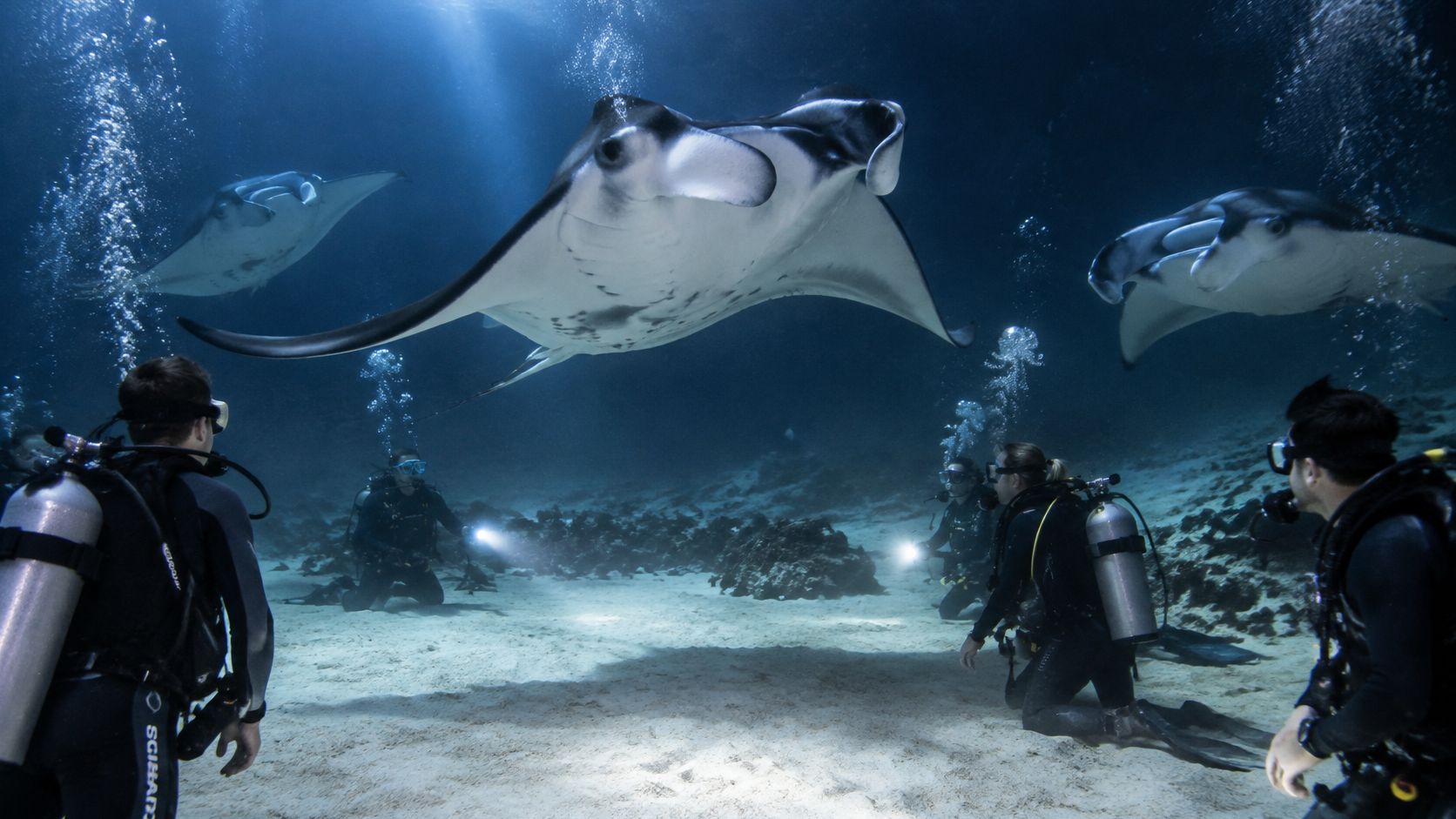
Picture a typical Tuesday after sunset. The boat is already on a set mark, not hunting a random shadow. Crew set lights. Plankton thickens in the beam. Reef mantas filter-feed through that glow while divers stay on the sand and snorkelers stay at the surface. That stationary setup is what people mean by manta ray diving Hawaii. It is a planned feeding watch, not a drift along a wall hoping something big swims past.
Garden Eel Cove consistently supported the larger aggregations. Keauhou drew a different mix of animals and may do a different ecological job. For a guided tour, the sheltered cove with room to park a group on sand is the superior choice over a more exposed or cramped site. You want a defined viewing patch, not a kneel on living coral because there was nowhere else to sit.
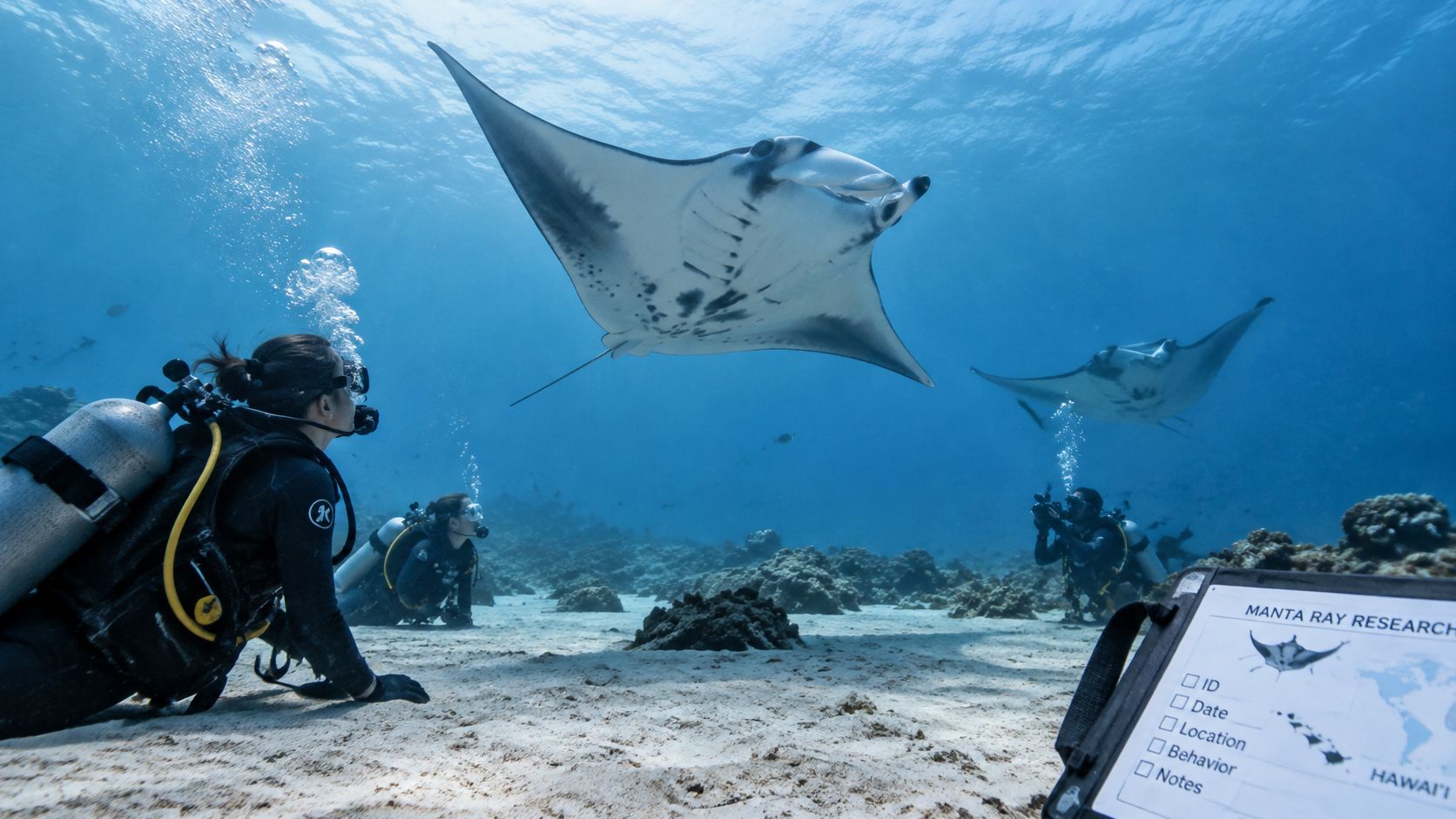
Same rays, changing head counts
These are island-resident animals, not a passing school that restocks itself every week. The same recognizable rays can return for years, which is why a photo of the spot pattern on the back matters more than a one-night tally. A head count still changes with the food in the water. Two boats on the same cove can see a busy beam one night and a sparse one the next without anyone having "done the dive wrong."
If you are still choosing between a mask at the surface and a tank on the sand, the view and the task load are different enough to decide before you book. This snorkel or dive comparison walks that choice without treating either seat as a lesser ticket.
The light mechanic, the site choice, the skill and gear bar, the etiquette that protects resident rays, what a quiet night and a useful photo still count for, and how to book the sheltered camp all sit in the pages below.
Skill Gear and the Night Light Lane
The two-tank charter needs Open Water or higher and a dive within the past two years. Snorkelers need no card, but you do need to be a confident ocean swimmer who can hold the surface after dark. Divers carry a secured primary light and a backup, plus a tight kit so nothing dangles into a wing. Aggregations rise and fall with zooplankton, so food, not a secret month, sets the count. Kona's west side is divable most of the year when swell and wind leave the cove flat, and the most popular nights often sell out weeks ahead. Other Kona scuba, not this night, sits with our day and training charters.
How the crew runs the camp
We start with a detailed briefing on the science of what you will see and the rules of passive observation. Then the water work follows a fixed order, because a loose group at night is how lights scatter and mantas lose a clean feeding lane.
- Anchor at a set viewing area, not a random patch of reef.
- Divers kneel or sit on sand, rubble, or boulder and aim lights up into the water column. That column is what draws plankton, and the mantas follow the food.
- Snorkelers stay on the surface and aim lights down. Do not drop into the feeding lane. A body in the middle of the beam blocks a turn that needs many feet of wingspan.
- Powerful lights make a bright circle on the bottom so divers are not left in darkness. Stay inside that circle.
- Guides stay in the water. On our manta night, experienced divemasters and instructors are in with the divers, and the group stays stationary.
- Everyone ascends only on the operator's line and surfaces at the boat.
Take the snorkel off the mask and stow it in a BCD pocket. A NOAA-associated voluntary wildlife standard recommends that because a manta can snag a dangling snorkel and yank the mask. The same standard says you observe only. Never touch, chase, grab, or ride, and stay off coral, sea urchins, and other marine life.
A protected sandy viewing area gives you somewhere to sit that is not living reef. An exposed site with less room does not.
Leave the central lane empty. Fin tips, camera trays, and a drifting buddy all steal the space a manta uses to bank and come back through the plankton. If your light wanders, you are not "finding the ray." You are breaking the column everyone else is feeding.
Night diving itself is a different skill from this kneel-and-watch. If you want the broader picture of entries, lights, and buddy contact after dark, read scuba diving at night before you treat this charter like a sunset reef hop.
| Role | Where you stay | Light aim | Skill bar |
|---|---|---|---|
| Scuba diver | Designated sand or rubble bottom | Up into the water column | Open Water or higher, a dive within the past 2 years |
| Snorkeler | Surface only, off the feeding lane | Down toward the plankton | Confident ocean swimmer, no certification |
What fails in the water
Chasing a closer pass fails. So does kneeling on coral because the sand "looked boring," and so does a snorkeler who ducks down for a photo and lands in the lane. A loose fin that kisses the bottom kicks silt into the beam and ruins the shot for the diver beside you. Clip gauges, tuck hoses, and check that your backup light turns on before you leave the bench. A dead primary with no spare is how you become the dark hole in an otherwise bright circle.
Why Garden Eel Cove Beats Keauhou
For a dive tour, Garden Eel Cove is the superior site. It is naturally sheltered from the open ocean, it has a broad sandy viewing area, and it keeps the lit encounter off the living reef. We often take the manta charter there for that reason, not because the other bay is empty of mantas.
A dive-site guide to Garden Eel Cove describes the bottom as a gently sloping sandy plain broken by scattered coral heads and lava-rock formations, not a uniformly steep or confined reef. You can kneel, buddy up, and still leave a lane. That is a classroom. A wall with nowhere to park a group is not.
Keauhou is a real manta site, and it is where organized night lights took hold in the early 1990s. It draws more females and may serve a different ecological job. It is not the calmer, roomier first night. Less shelter means more surge in the kneel, and less room means people end up closer to coral than the briefing allowed.
| Trait | Garden Eel Cove | Keauhou |
|---|---|---|
| Shelter | Naturally sheltered from open ocean, calmer and clearer | Original 1990s light site, generally less protected |
| Who shows up | Larger nighttime aggregations | Fewer animals overall, disproportionately females with strong site fidelity |
| Bottom | Gentle sandy plain, scattered coral heads and lava | Less room to park a group off living reef |
| Viewing setup | Broad sand lane separated from reef | Feeding site with a different ecological role |
| Crowd reality | Up to about 10 boats and 80 people at once | Shared historic site, still a real manta stop |
Rules that belong to this cove
A busy night can put as many as ten boats and approximately 80 divers and snorkelers on Garden Eel Cove at once. That crowd is why a defined camp circle, buddy contact, and a boat line matter more than a prettier reef. The same site guide is blunt about the operating rules. Carry a primary and a backup light. Remain within your light circle. Maintain buddy contact. Ascend only on the operator's line. Never surface away from the vessel.
Those rules are not etiquette posters. With that many lights in one cove, a diver who pops up off the stern is a propeller problem, and a diver who wanders toward a coral head is sitting on habitat the mantas are not using. The lit sand is the camp. The reef beside it is not a backup seat.
Pick the operator that treats Garden Eel Cove as the go-to manta site, not a backup when another bay is rough. Shelter, a sandy lane, and separation from living reef are the practical advantages. The postcard comes second.
How to Watch Without Harming Resident Mantas
Start from the animals, not the photo. NOAA reports that Hawaiian reef mantas are locally structured and tend to remain near home rather than routinely crossing deep channels between islands. The ray over your light may be the same individual next season. Females may pup at the island where they were born, so a bad habit here does not get diluted across a regional school. It lands on a small resident group.
Observe only. Never touch, chase, grab, or ride the animals, and avoid contact with coral, sea urchins, and other marine life.
Boat strikes are a recognized threat because mantas aggregate near the surface. Stay clear of propellers. Surface only at the briefed spot, on the operator's line, next to the vessel. A "quick" surface away from the boat is how a wing meets a hull.
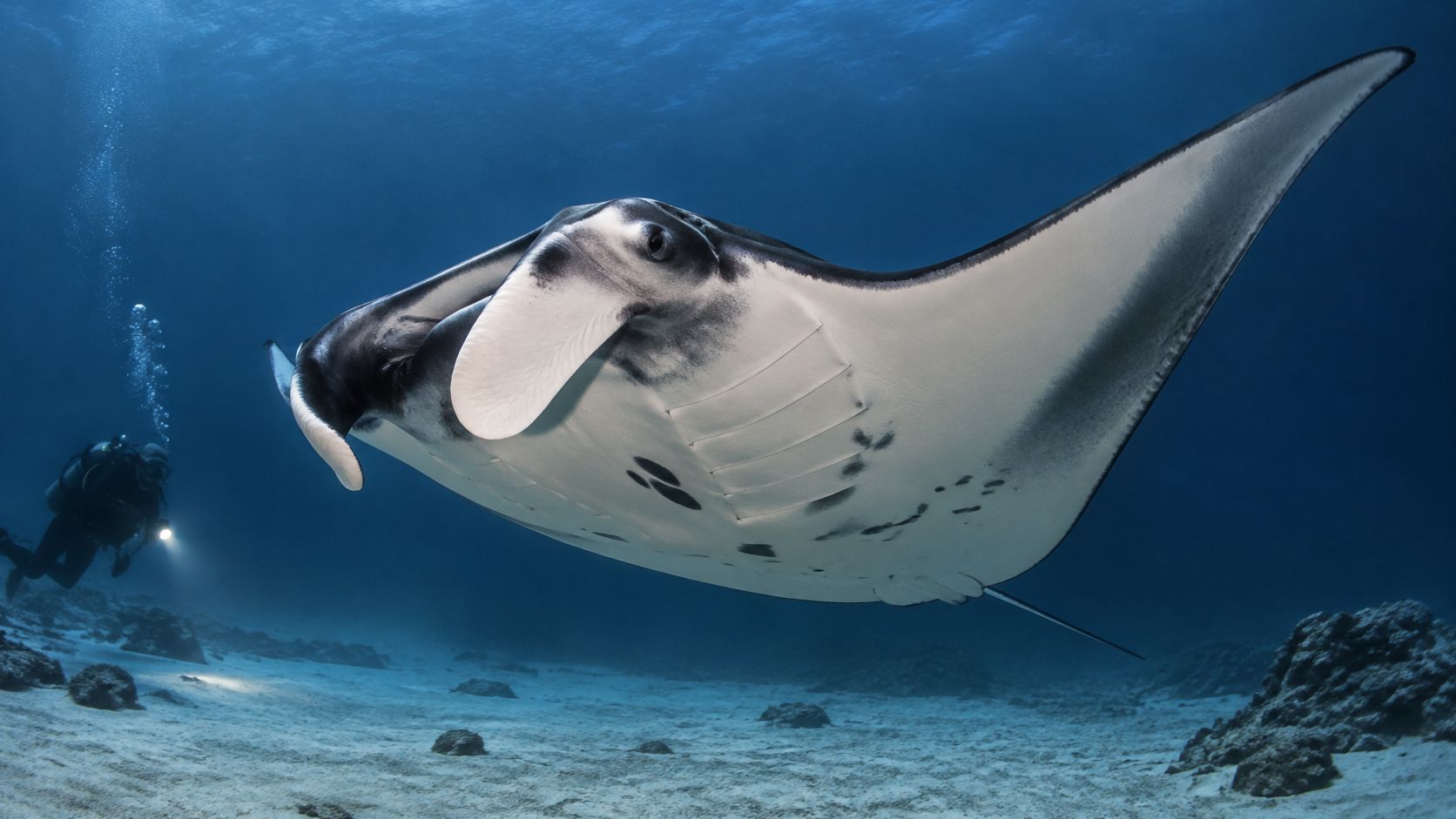
Stable is not a blank check
The University of Hawaiʻi record found that Kona aggregations remained relatively stable despite increased tourism during 2010–2022, with no evidence that observed activity levels reduced local population viability. That result does not prove every crowd size or every behavior is harmless. Entanglement, vessel strikes, crowding, and poor contact remain the local risks that still matter.
How you judge the boat
Photographers follow the same standard as everyone else. A dorsal spot pattern helps identification only when the ray chooses the pass and nobody pursues it. Control fins and buoyancy so you are not standing on the sand or kicking a neighbor into the lane. Follow the light-board boundaries instead of building a second camp ten meters away.
Judge the boat by three things you can see before you get wet.
- Guides in the water: Someone on the radio does not fix a diver who starts crawling toward a ray.
- A defined camp circle: You should know where your knees go and where the lane stays empty.
- A briefing that states the limits: Passive observation, propellers, and no contact, said out loud before entry.
Our considerate diver etiquette page is the same standard on a normal reef day. On a manta night it is stricter only because the same animals come back.
Quiet Nights Photos and What Still Counts
A low count is not a failed trip. A Hawaii Tribune-Herald account of the Kona record puts the driver in plain terms. Seasonal and annual changes in aggregation size closely tracked zooplankton density. Prey availability, not tour demand and not a predictable nightly schedule, is a primary driver of who shows up. Garden Eel Cove still tends to hold the bigger groups. Keauhou can be the female-fidelity site, with a job that is not only nighttime feeding.
Manta guarantees cannot mean a guaranteed number of animals. A responsible briefing says that, then explains plankton, the site, and the season. A slow night still teaches. You can watch how a manta barrel-rolls when one does arrive, how garden eels and reef life sit just outside the lane, and why lights only work when food is already there to concentrate. If the beam stays empty, you learned the mechanism instead of buying a slogan.
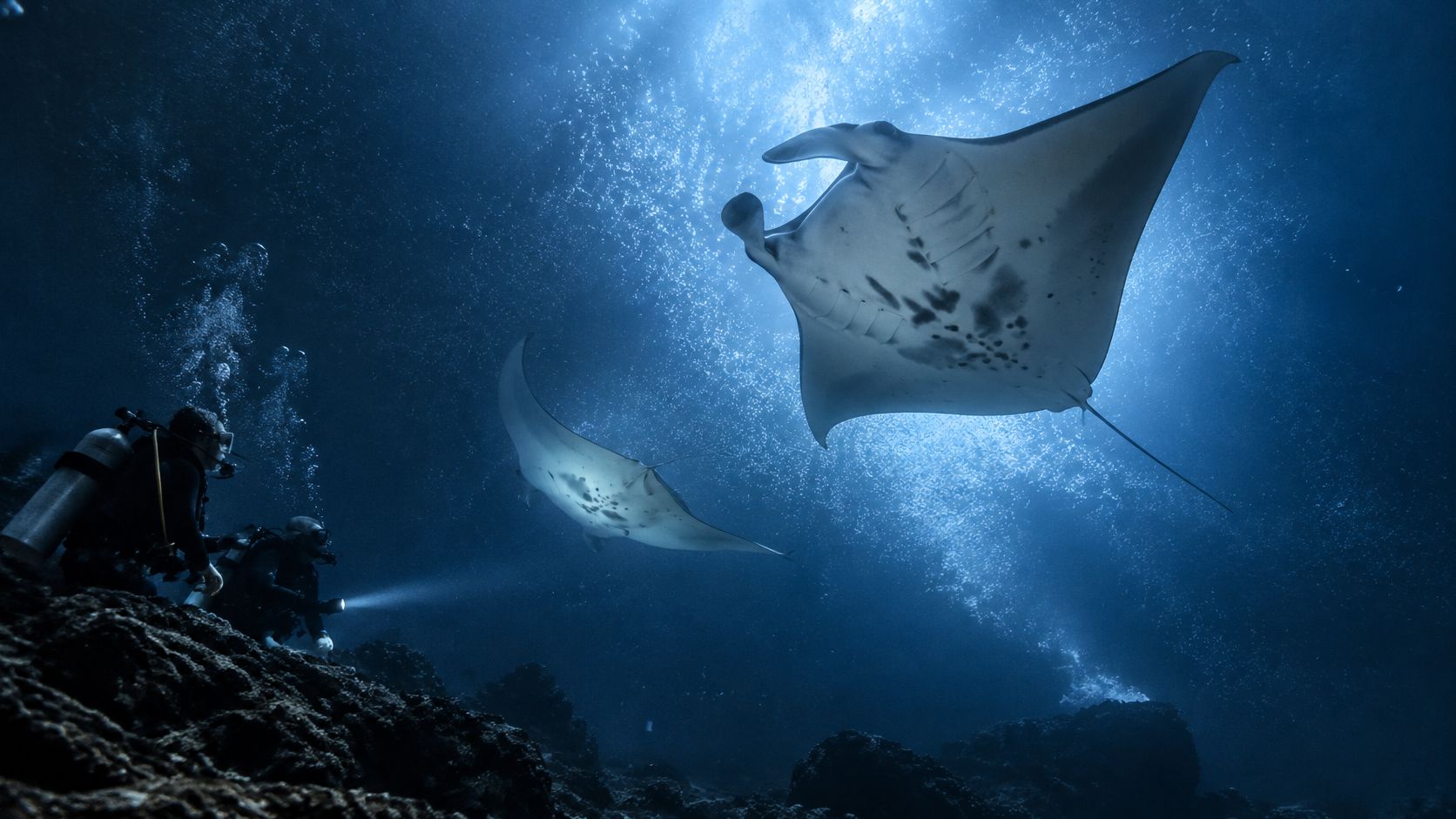
Photos from a kneel
Stay kneeling. Shoot upward into the beam. Keep strobes modest so you do not blast the animal or the diver beside you, and pre-focus for a large subject passing close. A useful frame is the white underside and open mouth, or the spot pattern on the back, taken as the ray chooses the pass. Do not chase a closer angle. The chase is what turns a clean identification photo into a stressed pass and a silt cloud.
More framing ideas live in this manta photo guide. Use them from the camp, not as a reason to leave it.
If the group wants a harder night later, book a different charter. Do not turn this kneel into a swim-around because the count felt low.
The blackwater night dive is that separate trip, a drift in open water after dark, not a substitute for a stationary manta camp. Remote sites and a higher task load belong on the premium advanced two-tank trip. Both are real Kona nights. Neither replaces the sand lane, the upward lights, or the rule that you let the ray set the distance.
Book Garden Eel Cove and Pack the Boat Bag
Book Kona Honu Divers for this night. The go-to site for our Manta Ray Night Dive is Garden Eel Cove, and the two-tank manta charter is built for that sheltered camp. Encounter rates reach up to 92%. That is a chance of seeing a manta, not a promise of a fixed head count. The flagship night suits beginners through advanced divers and includes a surface snorkel option, so a mixed group does not need two boats.
The two-tank manta dive and snorkel is the charter that matches this camp. Popular dates sell out weeks ahead. I would lock the spare evening now, then use the ride out to re-read the lane rules instead of negotiating them in the water. Our dive travel tips cover the rest of a Kona week so this night is not the only plan on the calendar.
The boat runs the encounter after sunset. Divers take the lit bottom. Snorkelers stay at the surface. Then you ride back. Do not expect a dollar figure in this guide. Current dive and snorkel prices for the two-tank Garden Eel Cove charter sit on the booking embed below.
Pack only what the boat will not argue with.
- Certification card: Open Water or higher, and a dive inside the past two years, if you are on the tank.
- Primary and backup light: Both tested, both clipped, nothing left swinging.
- Reef-safe habits: No contact with coral, no chase, fins off the sand.
- Warm layer for the ride back: The water felt fine. The wind on the harbor ride often does not.
- Motion comfort: If you get seasick on the way out, deal with it before the dock, not at the mooring.
- Dry bag for the phone: Salt and a night deck are a bad pair.
Kona Honu Divers runs the Manta Ray Night Dive at sheltered Garden Eel Cove, with divers on the lit sand and snorkelers at the surface, plus reef, blackwater, and advanced charters when you want a different night. If a stationary plankton beam and resident reef mantas are the trip you came for, book the camp that keeps you off the living reef. Visit Kona Honu Divers to see the charter and hold a seat before the popular evenings are gone.