
You've got a few evenings in Kona, you're comparing manta tours, and every photograph seems to promise the same thing: a huge ray sweeping overhead through glowing water. The harder questions are practical. Should you dive or snorkel? Does the site matter? And what happens if the ocean doesn't cooperate on the night you've booked?
For manta ray diving in Hawaii, choose the experience you can handle comfortably, then pay attention to the viewing site and how the crew manages people in the water. For a certified diver seeking an orderly, bottom-up encounter, Garden Eel Cove is my preferred choice. Its protected setting and defined viewing area help you stay still and watch, but no operator can promise that wild mantas will appear.
Choose Your Manta Dive by Experience and Certification
Match the trip to your certification and recent experience first. Choose the Manta Ray Night Dive at Garden Eel Cove if you're a certified diver who wants a stable viewing setup. Choose snorkeling if you'd rather watch from the surface without managing scuba equipment.
The difference isn't just how close you might get. Divers look upward through the feeding area, while snorkelers watch the animals' movements from above. Our comparison of snorkeling versus diving with manta rays can help you decide which perspective suits your comfort in the water.
Manta Ray Dive Options, Requirements and Best Fit
| Option | What Happens | Certification or Requirement | Best For |
|---|---|---|---|
| Manta Ray Night Dive | Kneel on the sandy seafloor while mantas feed in the light | Confirm the scuba requirement with the operator | Divers from beginner to advanced |
| 2-Tank Manta Dive and Snorkel | Daytime reef diving plus a manta encounter | Open Water Certification or higher and a dive in the past 2 years | Certified divers wanting a fuller diving outing |
| Manta Ray Night Snorkel | Float at the surface and watch from above | No certification; ages 5 and up | Snorkelers, families and first-timers |
| Black Water Night Dive | Open-water night diving over deep water | Experienced divers; confirm exact requirements | Experienced divers seeking something new |
| Premium Advanced 2 Tank Trip | Explore remote lava formations and advanced sites | Advanced certification; confirm exact requirements | Advanced divers |
Our 2 Tank Manta Charter requires Open Water Certification or higher and diving within the past 2 years. A certification card alone doesn't tell the whole story, though. If mask clearing, buoyancy, or finding your inflator still takes concentrated effort, deal with that before adding darkness and a camera.
The Black Water Night Dive is a different activity, not another version of the stationary manta encounter. Likewise, the Premium Advanced 2 Tank Trip suits divers seeking more demanding sites. Confirm those trips' exact experience requirements before booking.
Keep Your Equipment Simple
The PADI Manta Ray Diver specialty covers manta biology, behavior, and conservation and is taken before the night dive. If you have time, it adds useful context to the feeding behavior you'll be watching.
Keep your equipment choices focused on comfort and control:
- Carry a primary light and backup. Confirm what's supplied and bring the appropriate backup so a light failure doesn't leave you without illumination.
- Use a well-fitting mask. Repeated clearing distracts you from your guide and position.
- Choose a wide-angle lens. It lets you photograph a large animal without trying to move farther into its route.
- Keep strobes low. Bright flashes can dazzle mantas, so follow the crew's photography instructions.
- Shoot upward. Frame the animal against the illuminated water without lifting your body.
- Secure the camera. A short, controlled attachment prevents it from swinging into the feeding lane.
Photographer's priority: Neutral buoyancy matters more than the photograph. A kick that lifts you into the feeding route can interrupt the encounter for everyone around you.
How the Kona Manta Night Dive Works
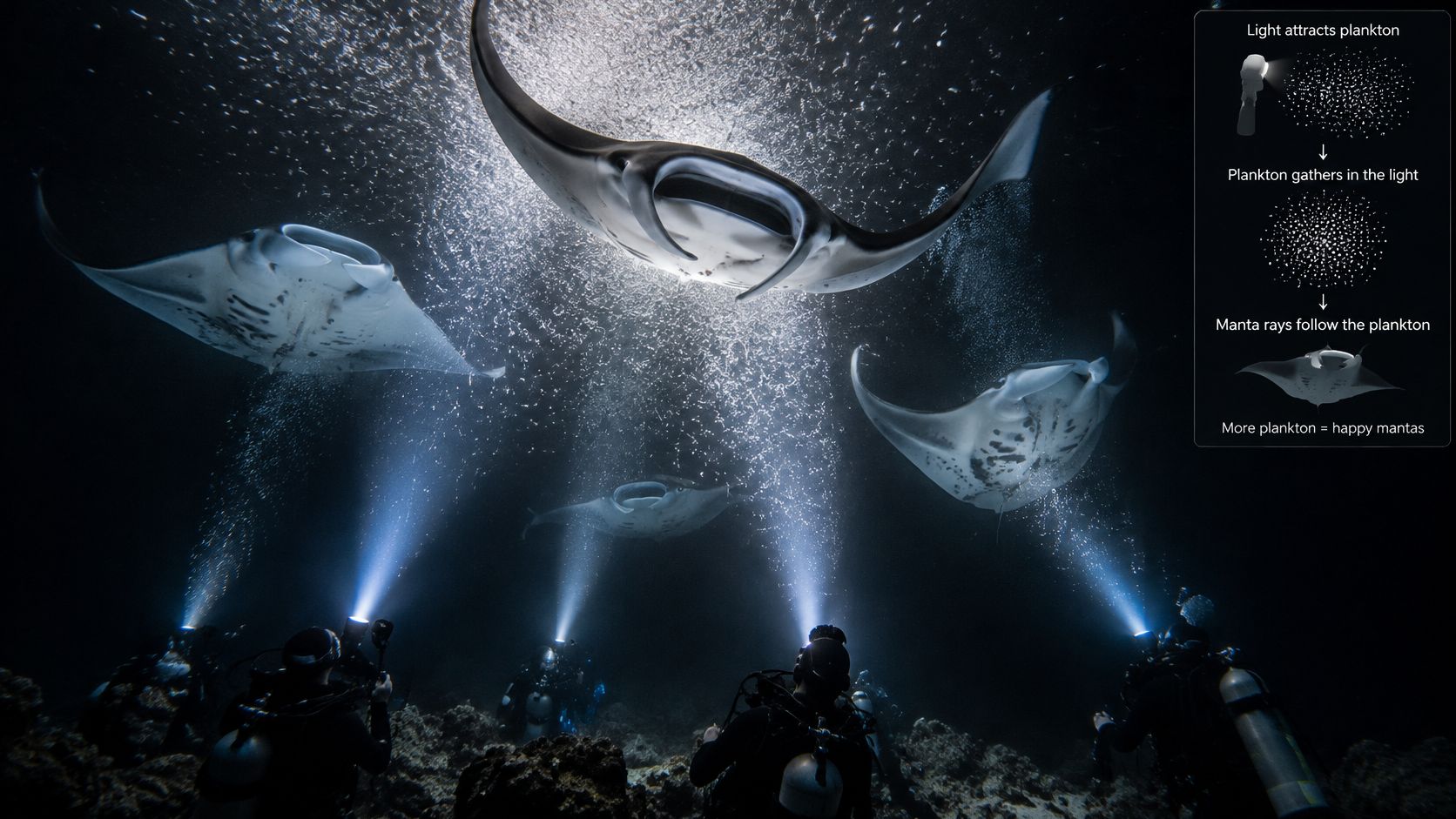
The mantas come for concentrated food, not for the divers. Reef mantas are plankton feeders with large energy requirements, and underwater lights gather zooplankton into an illuminated feeding patch.
A peer-reviewed analysis in Environmental Biology of Fishes describes the importance of dense zooplankton patches and reports a positive relationship between plankton density and manta aggregation size. That explains why bright lights alone aren't enough: the water also needs to hold a worthwhile concentration of prey.
What Happens Underwater
Listen to the pre-dive briefing. Our crew explains the science behind the encounter and the rules of passive observation. Pay particular attention to your assigned position, light signals, and return procedure, because those are harder to explain once you're underwater.
Descend with the group and settle on the designated sand. The guide places divers around a specific viewing area rather than sending everyone off to search. Get comfortable before bringing the camera up, and make sure your fins and equipment aren't resting on live reef.
Let the lighting setup establish the viewing area. Powerful dive lights create a bright circle on the seafloor, so divers aren't sitting in complete darkness. Beyond that circle, the ocean still looks dark, which makes staying oriented to the guide and group important.
Watch the illuminated water for feeding activity. Plankton can look like suspended flecks moving through the beams. If mantas arrive, a dark outline may resolve into a broad animal that banks through the light and passes overhead.
Hold your position instead of following the animal. Keep fin movement small and breathe normally, without holding your breath to reduce bubbles. Don't rise through the feeding corridor to get a closer look.
Snorkelers watch from the surface. Their role is to remain organized above the viewing area rather than repeatedly diving down. That separation gives both groups a useful perspective without filling the feeding lane with moving bodies.
Leave when the crew signals. Return with the group and use the agreed ascent and exit procedure. A manta passing nearby isn't a reason to delay your departure or separate from your buddy.
What a Good Encounter Feels Like
The best viewing often comes after you stop trying to improve your position. Your breathing settles, the beams give you a clear reference, and you can watch the animal's turns rather than constantly adjusting equipment.
This is still scuba diving at night, so you need awareness of your air, buddy, depth, and guide throughout. The illuminated circle makes orientation easier, but it doesn't replace normal dive discipline.
Some nights bring repeated feeding passes; others involve more waiting and fewer animals. A successful operation keeps the group calm and organized in either case, without turning a quiet night into a chase.
Why Garden Eel Cove Is the Best Manta Viewing Site
Garden Eel Cove is the superior choice for a manta dive tour when your priorities are protected positioning, a better-defined viewing area, and surrounding reef habitat. Also called Manta Heaven, it's a northern Kona site where the layout supports a stationary encounter rather than a roaming search.
The Dive Aroo Kona destination guide describes divers settling on a sand flat at approximately 30–40 feet (9–12 meters), with upward-facing lights concentrating plankton above the viewing area. It also identifies garden eels and reef fish as part of the surrounding marine life.
Why the Layout Matters
The sheltered position helps provide calmer, clearer water for the encounter. That's particularly useful when you're adjusting to darkness, managing a camera, or trying to hold a consistent position alongside other divers. It isn't permission to ignore the actual forecast, because shelter doesn't eliminate swell or current.
The defined sand viewing area is the stronger practical advantage. You can get settled, orient yourself to the lights, and watch the feeding corridor without swimming through open water to keep up with the action. Less movement also makes it easier to keep track of your buddy.
The surrounding reef adds interest beyond the manta encounter. Garden eels and reef fish give you something worthwhile to observe during the reef portion of the outing, rather than treating everything before the night dive as waiting time.
Kona Manta Viewing Sites Compared
| Site | Shelter | Typical Group Size | Viewing Depth |
|---|---|---|---|
| Garden Eel Cove | Naturally sheltered from open ocean | Generally larger manta aggregations than Keauhou | Sand-flat scuba viewing |
| Keauhou | Assess local exposure and sea conditions before departure | Generally smaller manta aggregations | Confirm the planned scuba viewing position with the operator |
Here, group size means mantas, not paying passengers. Don't interpret a larger aggregation as a promise of a quieter site or more personal space.
Keauhou remains a valid alternative. Its visitors include a greater proportion of female mantas with strong site attachment, but that doesn't make the number present on a particular outing predictable. Garden Eel Cove's stronger appeal for a diver is the combination of viewing layout and reef, not a guarantee of animals.
Our manta charter often goes to Garden Eel Cove. Before booking, make the site discussion practical:
- Confirm the intended destination. Ask whether Garden Eel Cove is the planned viewing site.
- Understand possible changes. Let safe conditions take priority over a preferred location.
- Check the underwater plan. Know whether you'll be positioned on sand and how the group will enter and leave.
- Describe your comfort level. Tell the crew if darkness, current, or stationary positioning concerns you.
Seasons and Conditions That Change Your Sighting Odds
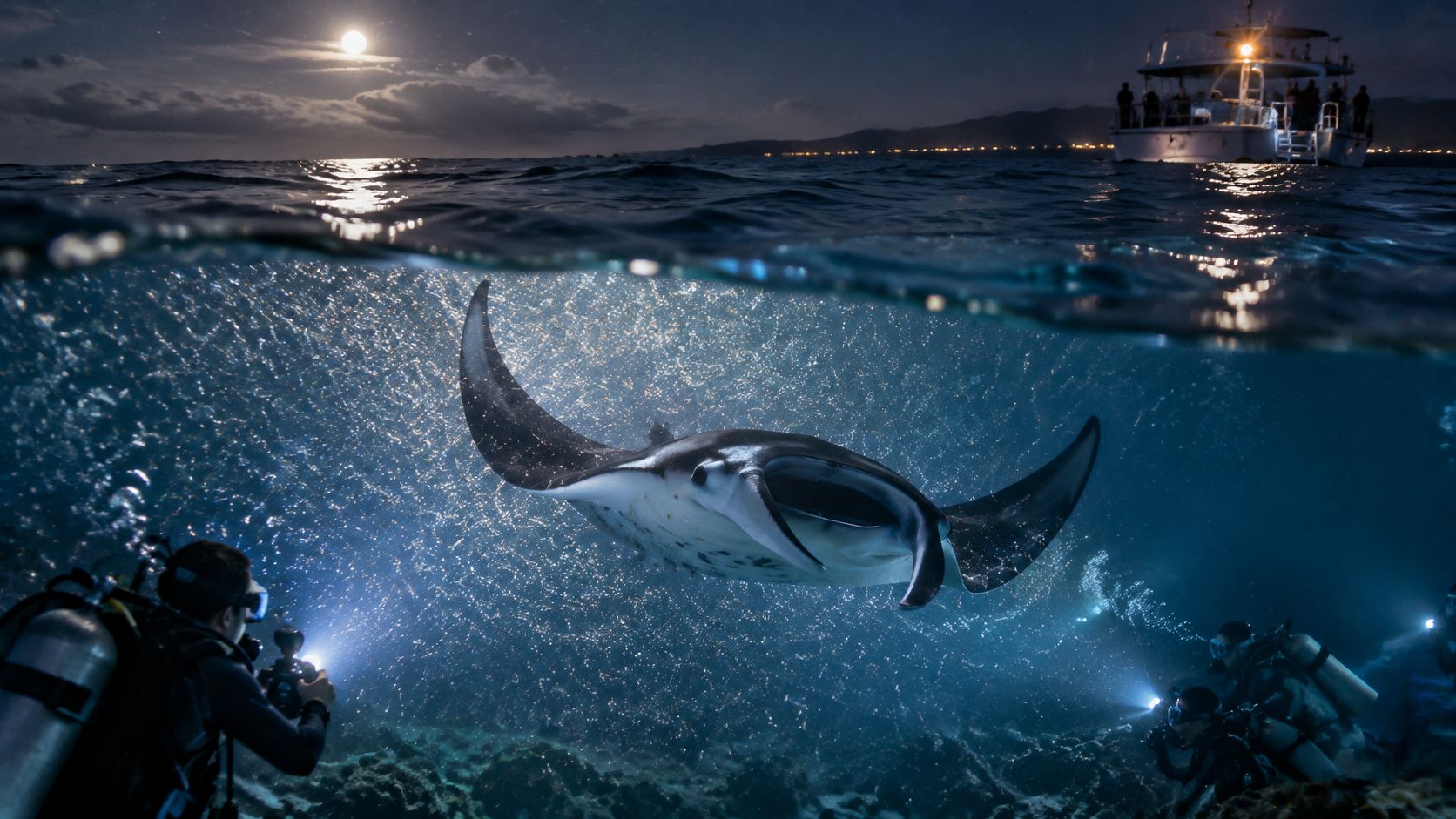
A Kona manta encounter is a strong possibility, not a guarantee, and plankton is a more useful guide than the month on your calendar. No single month guarantees mantas. Ask about current conditions rather than choosing a date solely because someone labels it the best season.
A 13-year analysis of more than 23,000 sightings of 167 individual reef mantas, described by Big Island Now, found that aggregation size tracked zooplankton density, with Garden Eel Cove generally supporting larger groups than Keauhou.
Conditions That Change Your Manta Sighting Odds
| Factor | Better Odds | Reschedule or Switch Dives |
|---|---|---|
| Plankton density | Dense plankton visible in the light beam | Thin plankton and few animals gathering warrant a discussion, not an automatic cancellation |
| Currents and water movement | Water movement that retains plankton in the lit area | Strong flow that scatters prey or makes positioning difficult |
| Seasonal and annual prey supply | A locally productive plankton period | A lean period; check conditions rather than relying on a fixed peak month |
| Diver disturbance | Still positioning on the sand with controlled movement | Repeated kicking or rising through the feeding lane calls for repositioning or intervention |
The last row is different from the others. Guest disturbance is an operational problem to correct, not a weather forecast you should use to pick a travel month. Follow the guide's repositioning signals rather than moving away to find an unofficial viewing spot.
Decide Before You're Committed to One Evening
Check with the crew before departure about swell, current, visibility, and recent feeding activity. Recent sightings are useful context, but they aren't a reservation made by the animals. A productive previous night doesn't establish what the next outing will see.
Build a backup date into your trip window if mantas are a priority. Booking your only attempt on your final evening leaves no flexibility if conditions make the outing unsuitable. Our guide to the best time to see manta rays in Kona helps separate travel timing from the conditions that matter on the day.
Choose flexibility over a supposedly perfect date. A workable backup evening is more useful than confidence in a calendar prediction.
Don't make a cancellation decision from a weather app alone. A land forecast doesn't tell you exactly how the viewing area will behave, and visible plankton isn't something you can assess from your hotel. Let the crew make the operational assessment, then decide whether the proposed trip fits your comfort.
Kona's mantas are relatively resident, with limited movement between Hawaiian island groups. Booking an outing on another island isn't necessarily an equivalent substitute for this local feeding aggregation. If Kona is the experience you want, preserve time in Kona to attempt it responsibly.
Safe Rules and Responsible Operators for Manta Encounters
Hawaii has protected manta rays under state law since 2009, and intentional or knowing capture or entanglement is unlawful in state waters, as explained in the Kona manta legal and encounter guidance.
That legal protection should translate into predictable behavior underwater. The goal isn't just to avoid touching a ray. It's to leave the animal enough space to approach, turn, feed, and leave without navigating around unnecessary human movement.
Rules That Protect the Feeding Area
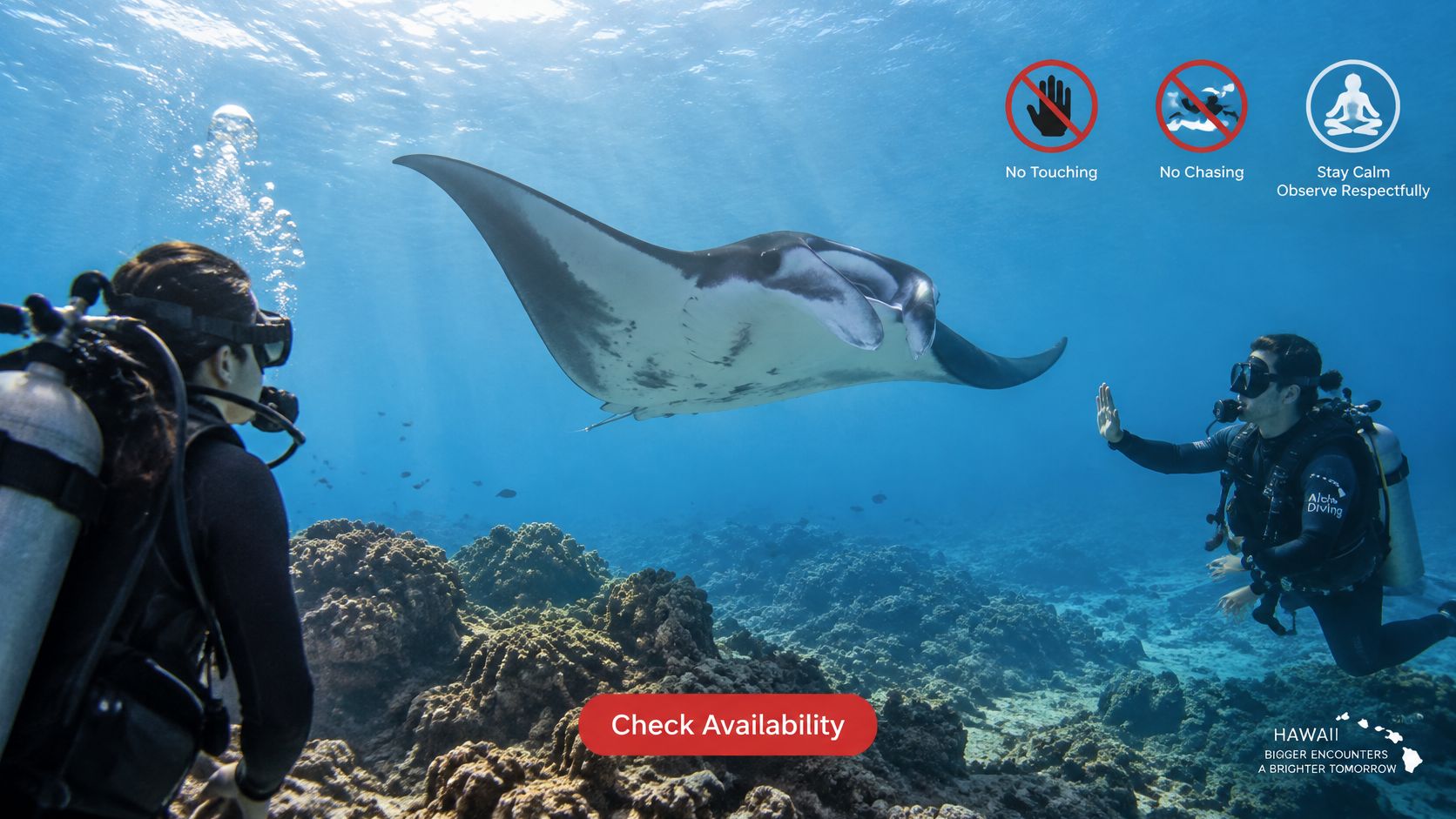
- Keep your hands to yourself. Never touch, grab, ride, chase, or harass a manta. Each animal should set the distance of its approach.
- Stay where the guide places you. Settle on directed sand or rubble, not live coral, so your viewing position doesn't damage the habitat.
- Keep the feeding corridor open. Avoid unnecessary finning and don't rise into an approaching animal's route.
- Breathe normally. Minimize unnecessary movement without restricting your breathing or holding your breath.
- Remain at the surface when snorkeling. Repeated dives through the feeding zone create obstructions and make your position less predictable.
The Hawaii Ocean Watch manta guidelines also emphasize controlled positioning, secured equipment, and avoiding the animals' forward path. If you need to move, coordinate with the guide instead of cutting across an approaching ray.
Manage Your Equipment Before the Animals Arrive
Maintain neutral buoyancy even when you're settled near the bottom. Being stationary doesn't mean becoming heavily weighted and relying on the seafloor to keep you in place. You should still be able to leave your position in control when the guide signals.
Clip gauges and alternate air sources where you can reach them without letting them drag. Check camera arms, lanyards, and light attachments before descent. A dangling hose can catch on the bottom, while an unsecured camera can swing upward when you turn.
Control your ascent position as carefully as your viewing position. Mantas may pass overhead or behind you, and another diver may be outside your immediate field of view. Signal, look, and follow the guide's route rather than rising directly from wherever you happen to be sitting.
Our night dive is stationary and closely supervised, with experienced divemasters and instructors in the water. Tell the guide early if you're uncomfortable or need to leave. Waiting until a small problem becomes urgent makes an orderly exit harder.
Crowding Needs Management, Not Denial
The Marine Megafauna Foundation's Hawaii work discusses a 2024 report citing nights with more than 290 people in the water, including concerns about boats near unlit snorkelers and swimmers drifting toward vessel channels. It also highlights a 2025 peer-reviewed analysis finding that the two Kona aggregations remained broadly stable despite increased tourism, while prey availability and site-specific management remained important.
Those findings don't support either extreme. Tourism isn't automatically incompatible with manta feeding, but stable aggregations don't prove that every crowded encounter is well managed.
A useful benchmark: Look for a well-run, closely supervised group, not a promise that no other boats will be present.
Before committing, get clear answers about the operation:
- Group staging. How will guests enter, reach their assigned position, and leave without scattering?
- Vessel separation. How are swimmers kept away from boat movements and traffic routes?
- Light discipline. What signals and beam directions should guests use?
- Buoyancy supervision. What happens when someone repeatedly rises or drifts?
- Changing conditions. How does the crew respond to poor visibility, uncomfortable current, or congestion?
- Early exits. Who assists a guest who needs to return before the rest of the group?
Good responsible diver etiquette makes those procedures easier to follow. Your part is to listen, remain predictable, and accept a repositioning instruction even when the photograph looks tempting.
Frequently Asked Questions About Kona Manta Dives
Do I Need Certification for the Night Snorkel?
No. The Manta Ray Night Snorkel has no scuba certification requirement and suits guests from age five. Still, tell the crew about your swimming confidence and comfort in open water after dark, especially when booking for a child.
Can I Touch or Ride a Manta?
No. State law protects manta rays, and you should never touch, grab, ride, chase, or harass them. If an animal passes close, keep your hands in and let it continue rather than reaching out.
Is a Manta Sighting Guaranteed?
No. Feeding opportunities depend on plankton and ocean conditions, and a resident population doesn't mean every animal attends every outing. Plan a backup date if seeing mantas is a major reason for your visit.
Why Choose Garden Eel Cove?
Its protected northern setting, sand-flat viewing area, and surrounding reef make it a strong choice for a controlled scuba encounter. The important benefit is being able to settle into a defined position rather than swim after the action.
For practical planning, review how deep the Kona manta ray dive is and discuss any depth or equalization concerns before departure.
Can I See Mantas on Another Island Instead?
Possibly, but it isn't an equivalent substitute for Kona's established encounter. Hawaiian reef mantas show strong local residency and limited movement between island groups, so don't assume the same feeding setup or viewing opportunities elsewhere.
Should I Bring a Camera?
Yes, if using it won't distract you from buoyancy, your buddy, or the guide. A wide-angle lens, restrained lighting, and a secured setup are more useful than complicated equipment you haven't practiced with.
If you're uncertain, start the dive with the camera tucked away. Get settled first, then decide whether you have enough attention available to photograph responsibly.
What If Conditions Look Poor on the Day?
Contact the crew for the site assessment rather than deciding from shore conditions alone. If the proposed outing doesn't suit your comfort or the crew recommends rescheduling, use your backup date instead of forcing the experience.
Bring a warm layer for the return ride, keep unnecessary valuables ashore, and have your equipment questions ready before boarding. Small preparations help you concentrate on the briefing rather than solve avoidable problems at the last moment.
Book Your Garden Eel Cove Manta Dive
Choose Garden Eel Cove for its viewing setup, then match the booking to your qualification and comfort. A clear plan matters more than chasing the most dramatic promotional photograph. You want an outing whose requirements you meet and an evening with enough flexibility to respond to the ocean.
Kona's manta tourism is well established. A 2025 Dataintelo market report cites 50,912 manta-night-dive and snorkel participants in Kona, using counts attributed to the Manta Pacific Research Foundation. Popularity is a reason to plan ahead, not evidence that a sighting is guaranteed.
Make the Booking in the Right Order
- Choose your format. Use your certification, recent diving, and night-water comfort to select scuba or snorkeling.
- Verify eligibility. Check the certification and recent-dive requirements before arranging the rest of your evening around the charter.
- Pick a primary and backup date. Leave room within your stay for a change rather than making your departure eve the only opportunity.
- Review the trip details and reserve. Use the manta ray dive tour page to check the outing, then select availability below.
- Prepare for departure. Review the crew's weather guidance, arrive early, and give the briefing your full attention.
Our most popular trips, including the manta ray night dive, often sell out weeks in advance. Book early enough to preserve your preferred date and some flexibility, rather than assuming you'll find the right opening after arrival.
If you're planning other underwater activities, compare the guided Kona diving tours before filling your itinerary. Leave enough breathing room that you're not arriving tired, rushed, or preoccupied with another reservation.
The final preparation is simple: check your mask, streamline your equipment, and tell the crew what you need help with. Once you're in the viewing area, your job is to stay composed and let the animals make the approach.
Kona Honu Divers offers guided manta ray night encounters with in-water divemasters and instructors, and Garden Eel Cove is our go-to viewing site. Visit Kona Honu Divers to choose a trip that matches your experience, check available dates, and plan your evening around a calm, respectful wildlife encounter.