
Introduction to Manta Ray Diving in Hawaii
Just after sunset off Kona, the routine on the boat gets quiet. Masks are checked one more time. Lights are tested. Someone asks whether the mantas always show up, and the honest answer is no. Some nights the water column fills with plankton and rays begin looping through the beams within minutes. Other nights stay sparse, and understanding why is part of what makes a manta dive in Hawaii feel like a real wildlife encounter instead of a staged attraction.
That distinction matters. Kona's west coast is famous because divers and snorkelers can watch reef mantas feed after dark in a setting that has become unusually consistent over time, but the experience still depends on ecology, site layout, and careful human behavior. Light, plankton, current, and resident manta behavior intersect after dark, and those pieces do not line up in exactly the same way every evening.
The encounter begins with a simple chain reaction. Artificial light attracts zooplankton into a concentrated patch. Mantas move toward the food source if the patch is worth feeding on, then adjust their loops, speed, and depth according to current, crowding, and how the plankton is holding together. If you go in expecting a guaranteed performance, any quieter night feels like failure. If you go in expecting to observe a feeding system that sometimes peaks and sometimes fades, the whole dive makes more sense from the start.
Kona's manta tourism developed around two main nighttime viewing areas on the west side of Hawai'i Island, Keauhou Bay, commonly called Manta Village, and Ho'ona Bay or Makako Bay, commonly called Manta Heaven or Garden Eel Cove. A county assessment of the activity found that, by August 2015, at least 42 commercial operators were using these sites for manta snorkeling and scuba tours. Observers also recorded nights with about 16 to 19 vessels and 160 to 190 people in the water simultaneously, and another count documented 21 vessels and 301 people sharing the site (Hawai'i County manta safety assessment).
Those numbers explain why a manta dive works best when everyone treats it like a managed observation area instead of open water where each guest does their own thing. Boats need room to moor and maneuver safely. Guides need divers and snorkelers to stay where they were briefed to stay. Mantas need a clear feeding corridor. One careless swimmer kicking through the light field can scatter plankton, block a ray's path, and reduce the quality of the viewing for everyone nearby.
The tours themselves are not short drop-ins. County records describe outings that generally last 3 to 5 hours and average about $110 per participant. The same public record notes that manta-viewing activity worldwide has been linked with roughly $140 million in annual economic impact. That mix of high visitor demand and concentrated wildlife use is why good procedure matters before anyone even enters the water.
Practical rule: Judge a manta tour by the quality of its wildlife management, not only by how close a ray comes.
A strong crew usually sounds calm and repetitive in the briefing, and that is a good sign. They explain where divers settle, where snorkelers hold position, how lights are used, what to do if you feel anxious, and why chasing a manta almost always reduces the chance of a sustained pass. Those instructions are not there to make the dive feel restricted. They are there because the animals feed more naturally when people become predictable parts of the scene.
Site choice shapes the whole evening. Kona's two primary manta areas share the same broad concept, nighttime viewing built around light and plankton, but they do not feel identical underwater. Garden Eel Cove is often the more practical pick for a dedicated dive because its layout gives divers a clearer place to settle and a more defined viewing zone. The site overview commonly used by tour operators describes a protected setting with a sandy area and nearby reef structure that supports an orderly viewing pattern rather than a scattered one (Garden Eel Cove site overview).
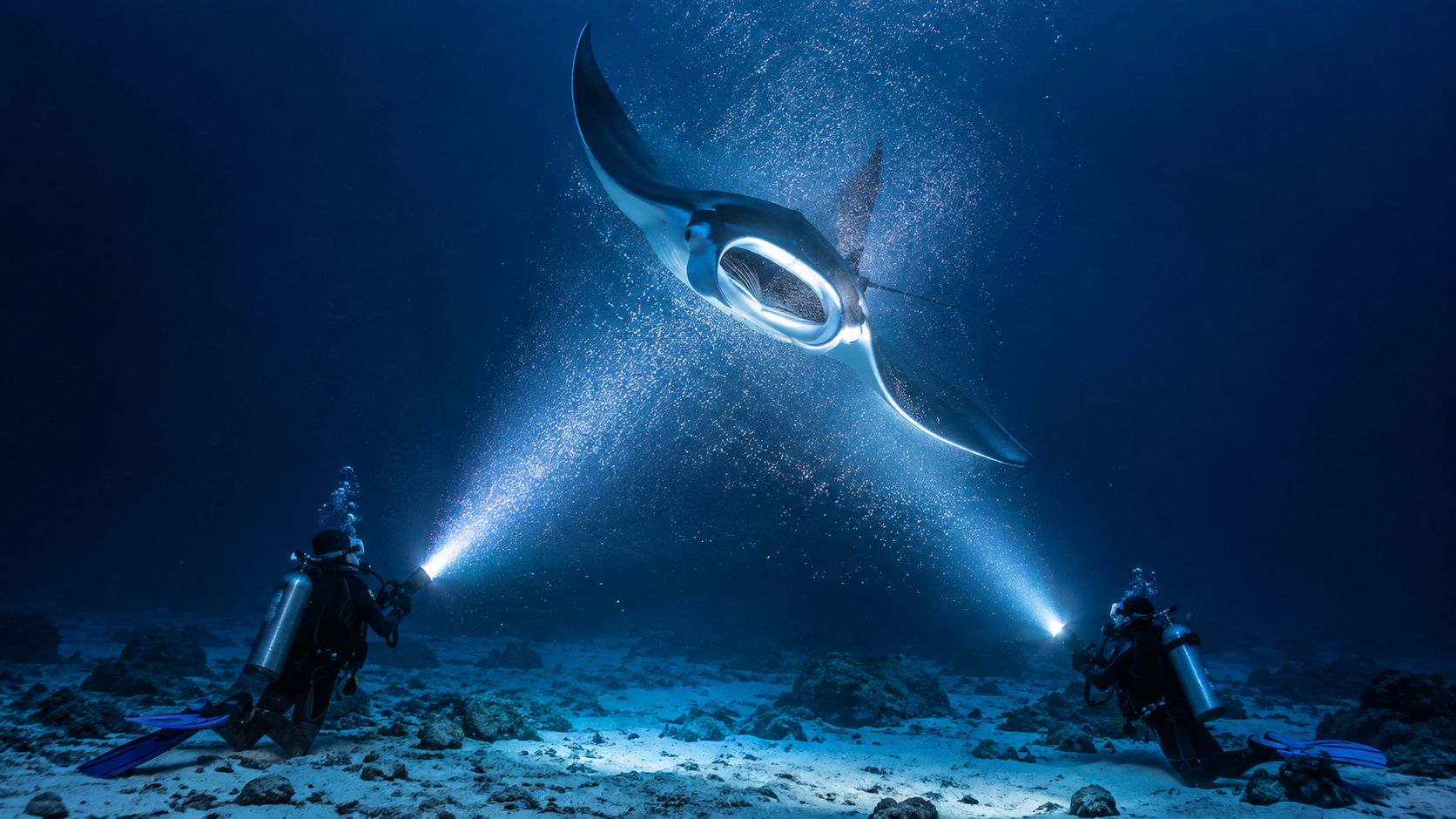
At Garden Eel Cove, also called Manta Heaven or Makako Bay, divers generally have a stable visual reference. Sand below, open water above, reef nearby. That matters more than many first-time guests expect. A clear bottom reference makes buoyancy easier to maintain. A sandy amphitheater gives guides a natural place to arrange divers without putting fins over fragile reef. The open water above that staging area leaves room for mantas to sweep through the light column in wide turns. For many divers, especially those doing their first manta night dive, that structure reduces task loading right away.
The site is reached by boat from Honokohau Harbor, near the airport side of Kona, and its geography can feel less exposed than a more open piece of coastline. Protected does not mean fixed or effortless. Surge, current, and visibility still change. It means the site often gives operators a cleaner setup for positioning guests and keeping the illuminated feeding area organized.
That is one reason experienced local operators and returning divers often compare it favorably with other Kona manta ray dive sites. For underwater photographers, the defined bottom and predictable gathering point also help. You can frame upward into the lights, hold a steady position, and wait for the animal to enter the composition instead of swimming around searching in the dark.
Keauhou Bay, known as Manta Village, remains one of the classic Kona manta locations. It has deep historical significance in the local manta tourism story, and it is not unusual for divers to hear strong opinions about which site is “better.” That question is often too simple. A manta site is not a stadium with fixed attendance. It is a feeding area used by individual animals whose movements vary by night, by current pattern, and by where food is concentrating.
That point becomes clearer once you understand how mantas feed. Reef mantas are not visiting the lights because they are curious about divers. They are responding to prey. According to the Hawai'i Division of Aquatic Resources explanation, lights draw zooplankton into the upper water column, and mantas use their cephalic fins to help funnel plankton-rich water toward the mouth while gill rakers retain the prey. The divers are spectators sitting beside a temporary dinner table.
Why some nights feel electric and others feel quiet
This is the part many basic travel guides skip. They mention that plankton matters, then stop there. In practice, the feeding patch changes because the water itself changes. Current can tighten the plankton into a concentrated ribbon or spread it thinly across a broader area. Surface chop and surge can affect how stable the light field appears from below. Visibility influences how far the glow carries through the water. Even when mantas are in the area, a diffuse food patch may not hold them in repeated close loops.
Plankton levels also do not stay constant from night to night. They can shift with water movement and with conditions that bring nutrient-rich water upward, which is one reason operators pay attention to current behavior and what the water looks like before committing to a site. For a diver, the practical takeaway is simple. A high-quality tour can still produce a modest manta showing if the food concentration never really builds. That does not mean the crew chose poorly or the site has stopped working. It means the feeding setup did not tighten into the kind of patch that keeps rays circling overhead.
The mechanics underwater are straightforward. After sunset, divers enter, descend in a controlled way, and settle in a designated area. At Garden Eel Cove, descriptions of the site note that divers commonly stage at about 35 feet, or 11 meters, and watch a fixed ring of lights from below (Garden Eel Cove dive description). From the bottom, you look upward into the lighted water column while mantas pass above or between the beams.
Once everyone is in place, the group usually forms a loose semicircle or ring. That arrangement is practical, not ceremonial. It leaves the center open for feeding behavior, keeps divers from crossing each other's lights, and reduces random finning. Your task is to stay settled, maintain neutral buoyancy, watch your instruments, and let the mantas decide their own distance.
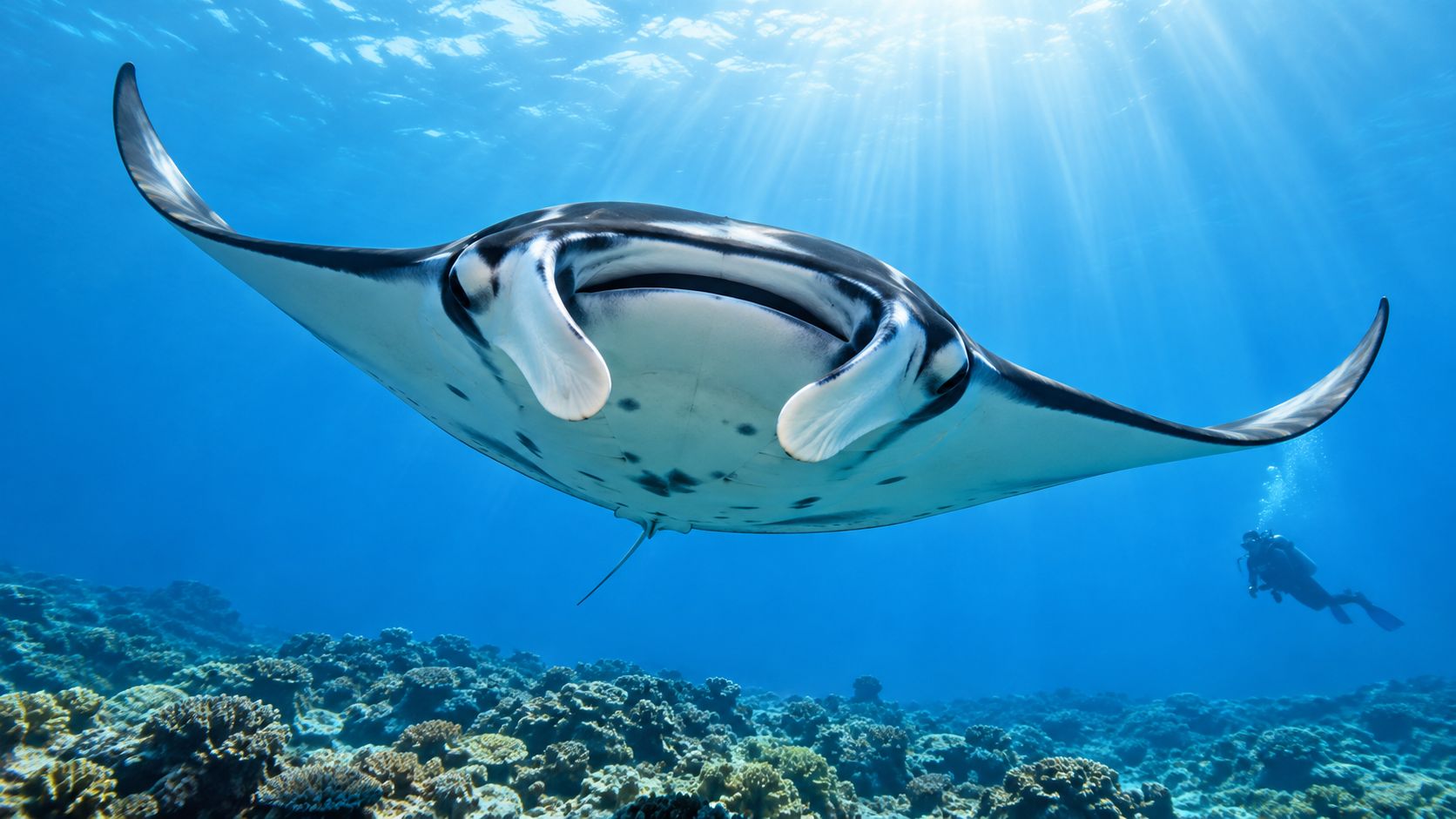
The less you move, the better the encounter usually becomes. A diver who rises into the beam to get closer often interrupts the very pass they wanted to improve. Fast kicks create turbulence. A camera rig pushed into the lane can cause a manta to bank away. Bubbles released directly into an approaching ray's path can also change its line. By contrast, a quiet diver on the bottom becomes easy for the animals to read. Predictable humans leave more room for natural feeding loops.
Night diving adds another layer. Darkness narrows your attention, and a large manta passing overhead can make even experienced divers forget the basics for a second. Your buoyancy, buddy awareness, depth, light, regulator, and air supply still need the same discipline they would on any other night dive. Before booking a Kona night scuba diving experience, be honest about how comfortable you are hovering without sculling, reading a computer in low light, and responding to guide signals while your eyes are fixed on the water above.
Timing is fairly consistent even though wildlife activity is not. Public descriptions of Kona manta diving note that the in-water observation phase begins after sunset, and research summarized by the state describes nighttime dives at the main sites as lasting about one hour in the water (2013 Kona manta sighting statistics). The full trip runs longer because of check-in, travel, briefings, gearing up, entry, exit, and the ride back.
Who usually enjoys this most
You do not need to be an expert diver to appreciate a manta night dive, but you do need the right match between the activity and your skill level. Certified scuba divers should be comfortable with calm, stationary hovering and basic night-dive procedures. If you still use your hands to stay in place or tend to drift upward when distracted, a daytime refresher may improve the experience more than forcing the night dive too early.
Snorkeling works well for many guests because it removes the descent, equalization, and gas management demands of scuba. It still asks for steady breathing, comfort in dark water, and the ability to follow instructions while holding position at the surface. Children, first-time ocean swimmers, and anxious guests often do best with extra screening and a conservative decision about whether the conditions suit them that evening.
A quick self-check helps. Can you float calmly without rushing your breathing? Can you manage your mask and light without feeling overloaded? Can you climb a ladder after time in the water? Can you accept that weather, swell, or weak manta activity might change the plan? If the answer to several of those is no, another ocean activity may fit better that day.
Why low-sighting nights deserve a backup plan
Careful trip planning pays off here. Standard manta guides often speak as though the only real outcome is seeing multiple rays at close range. That approach sets people up for disappointment and makes crews feel pressure to oversell. A better plan starts with the idea that conditions control the show.
If plankton stays thin or scattered, ask the operator what the fallback options are before you book. Some guests prefer to reschedule for another night. Some would rather switch to a daytime reef dive. Experienced divers may choose a different nighttime experience focused on pelagic life in the water column instead of manta feeding behavior. Kona Honu Divers, for example, offers several formats, including a general Kona diving tour, a premium advanced two-tank trip, a Kona blackwater night dive, and a two-tank manta dive and snorkel option. Those are not interchangeable experiences, but they give visitors practical ways to keep a trip worthwhile if manta conditions are not ideal on the first attempt.
The blackwater option is a good example of thinking ecologically rather than romantically. If a manta night depends on a concentrated plankton patch drawing in large filter feeders, a blackwater dive focuses on the strange pelagic organisms that rise through the water column after dark. Different goal, different setup, same lesson. The ocean does not owe us one specific animal on one specific schedule.
Safety and etiquette tie all of this together. Local guidance for manta encounters emphasizes staying in position, avoiding contact, and keeping the feeding corridor open because those choices protect both guests and animals (responsible diver etiquette guidance for Kona manta encounters). The rules are easier to follow when you understand their purpose. They are not arbitrary restrictions. They help maintain a clean feeding lane, reduce crowding, and keep the encounter closer to natural behavior.

So the best introduction to manta ray diving in Hawaii is not a promise. It is a framework. You are entering a popular, carefully managed wildlife encounter on Kona's west coast, usually at Garden Eel Cove or Manta Village, where lights gather plankton and rays may arrive to feed. Good crews create order in a busy setting. Good divers and snorkelers stay still enough to let the animals use the space naturally. Good trip planning includes a backup option for nights when the food chain does not assemble in your favor.
That mindset usually leads to a better trip, whether you see one manta, several, or none at all.