
You've got an evening free in Kailua-Kona, and the manta tour listings look almost identical. Every boat promises an unforgettable encounter, but the decisions that shape your night are less glamorous: where you'll enter the water, who'll supervise you, and how the crew handles a crowded viewing area.
For manta ray dives of Hawaii in Kailua-Kona, HI, my recommendation is straightforward: favor Garden Eel Cove, then choose the format that matches your water confidence. Its protected location, defined viewing area, and better reef setting make it the stronger dive choice. Don't book on wildlife photos alone. A clear vessel plan and manageable group deserve just as much attention.
Which Manta Ray Dive Fits Your Trip
Manta dive options at a glance
| Option | Best for | Where you are in the water |
|---|---|---|
| Manta Ray Night Dive | Divers who want the full seafloor view | Kneeling on the sandy bottom inside the light circle |
| Manta Ray Night Snorkel | Families and first-time snorkelers | Floating on the surface above the lights |
| Black Water Night Dive | Divers wanting deep, dark-water night diving | Suspended in open water rather than positioned on the seafloor |
| 2 Tank Manta Dive and Snorkel | Guests wanting a manta charter with two tanks | Scuba guests underwater; snorkel guests at the surface during manta viewing |
Choose your position before choosing your package. Scuba gives you the upward view as mantas move through the illuminated water. Snorkeling keeps you at the surface without scuba equipment, but it still requires comfort in the ocean after dark.
Kona Honu Divers is the Kona-based operator behind these options, with its full range of guided scuba trips available for comparing reef and night outings.
Match the outing to your priorities
The Manta Ray Night Dive is the flagship choice for eligible divers and snorkelers, from beginner to advanced levels. Choose the scuba format if you're certified and want the seafloor perspective.
The Manta Ray Night Snorkel is the practical starting point for families and first-time snorkelers. Surface-only doesn't mean effortless, so discuss swimming ability and anxiety before reserving.
The Black Water Night Dive is a different kind of night outing, intended for divers interested in deep, dark-water surroundings. Don't confuse it with stationary manta viewing.
The 2-tank manta dive and snorkel charter suits guests who want the two-tank scuba option. Confirm the itinerary and surface-participant arrangements when selecting seats.
For a closer comparison of the viewing perspectives, use this guide to snorkeling versus diving with manta rays.
Before deciding, answer these questions:
- Certification: Are you certified to scuba dive?
- Night comfort: Are you comfortable in open water after dark?
- Viewing preference: Do you want to watch from underwater or remain at the surface?
Who Can Join and What Certification Is Needed
Scuba requires a valid certification card and the ability to function calmly in open water at night. Surface snorkeling doesn't require scuba certification, but it does require an honest assessment of your swimming, breathing, and floating confidence.
Our flagship manta experience accommodates eligible participants across experience levels. That doesn't make every format appropriate for every guest. A newly certified diver who stays composed and follows signals may be better prepared than an experienced diver who hasn't entered the ocean in years.
Certification isn't the whole readiness check
You should be able to clear your mask, communicate with your buddy, and respond to a guide without rushing toward the surface. If those skills feel uncertain, refresh them before adding darkness and wildlife excitement.
If you're not certified, choose snorkeling or pursue open-water certification training separately. Don't treat the manta dive as an introductory scuba lesson.
The PADI Manta Ray Diver specialty covers manta biology, behavior, and conservation and is taken before the Manta Ray Night Dive. Confirm whether that course or any night-diving qualification applies to your selected booking rather than assuming that a specialty is universally mandatory.
A certification card establishes training. Your current comfort determines whether this particular night is a sensible choice.
For beginners and inexperienced snorkelers, ask us what flotation, entry assistance, and in-water support are available for the chosen format. Describe specific concerns, such as difficulty breathing through a snorkel or discomfort when you can't see the bottom.
Experienced divers considering a separate, more demanding outing can compare the Premium Advanced 2 Tank Trip. Experience doesn't remove the need to match the itinerary to current skills.
Use this booking checklist:
- Certification card ready: Have your valid card available for scuba participation.
- Night-water comfort established: Be comfortable swimming in open water after dark.
- Age confirmed: Verify eligibility for the exact scuba or snorkel format.
- Guide coverage confirmed: Establish the guide-to-guest ratio before paying.
Minimum ages and qualification requirements belong to the specific booking, not to a general description of manta tourism.
What a Night Manta Encounter Looks Like
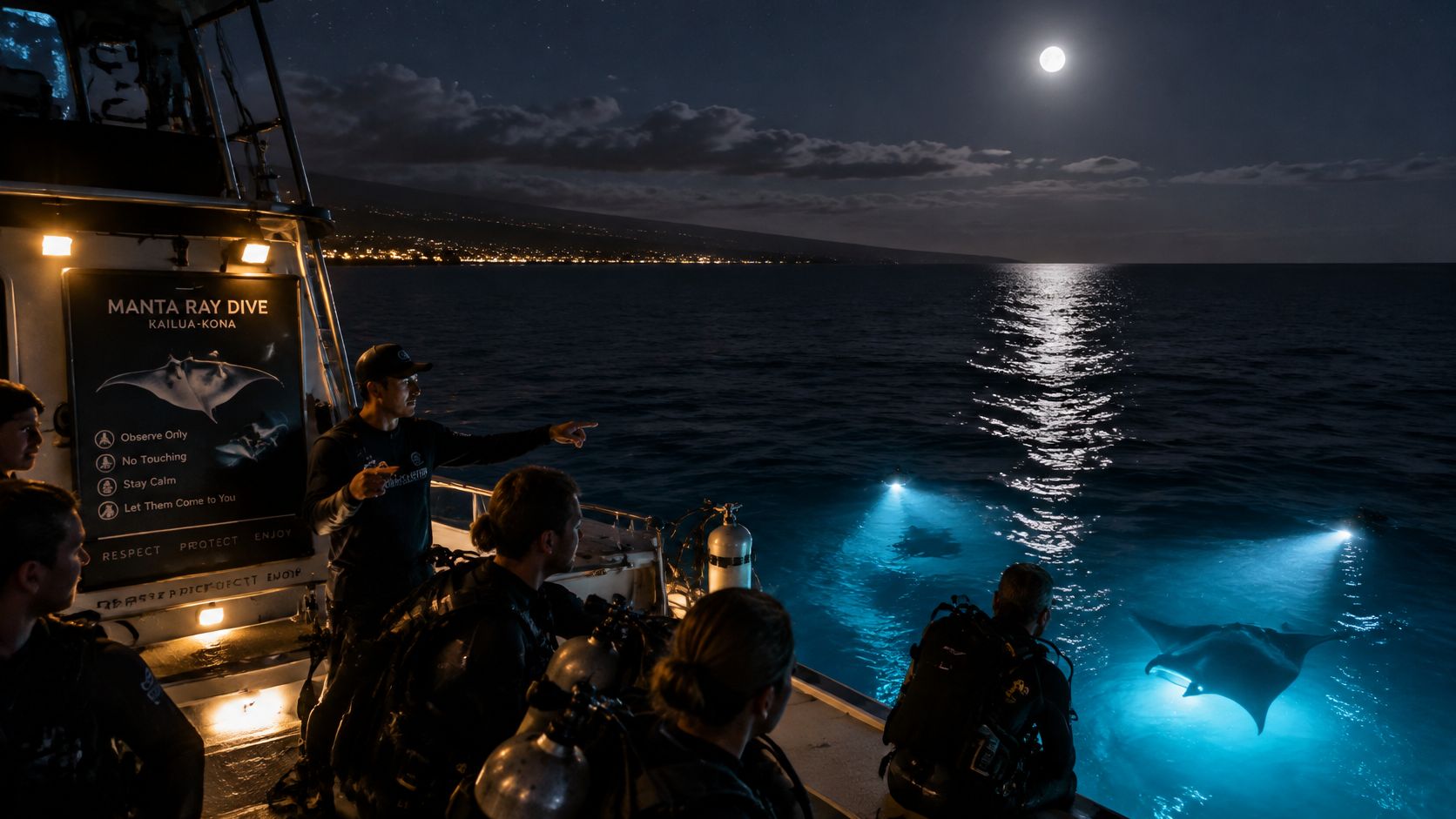
The boat reaches the viewing site as the shoreline lights become more noticeable against the dark water. Before anyone enters, our crew explains what divers will see, how the encounter works, and the rules of passive observation.
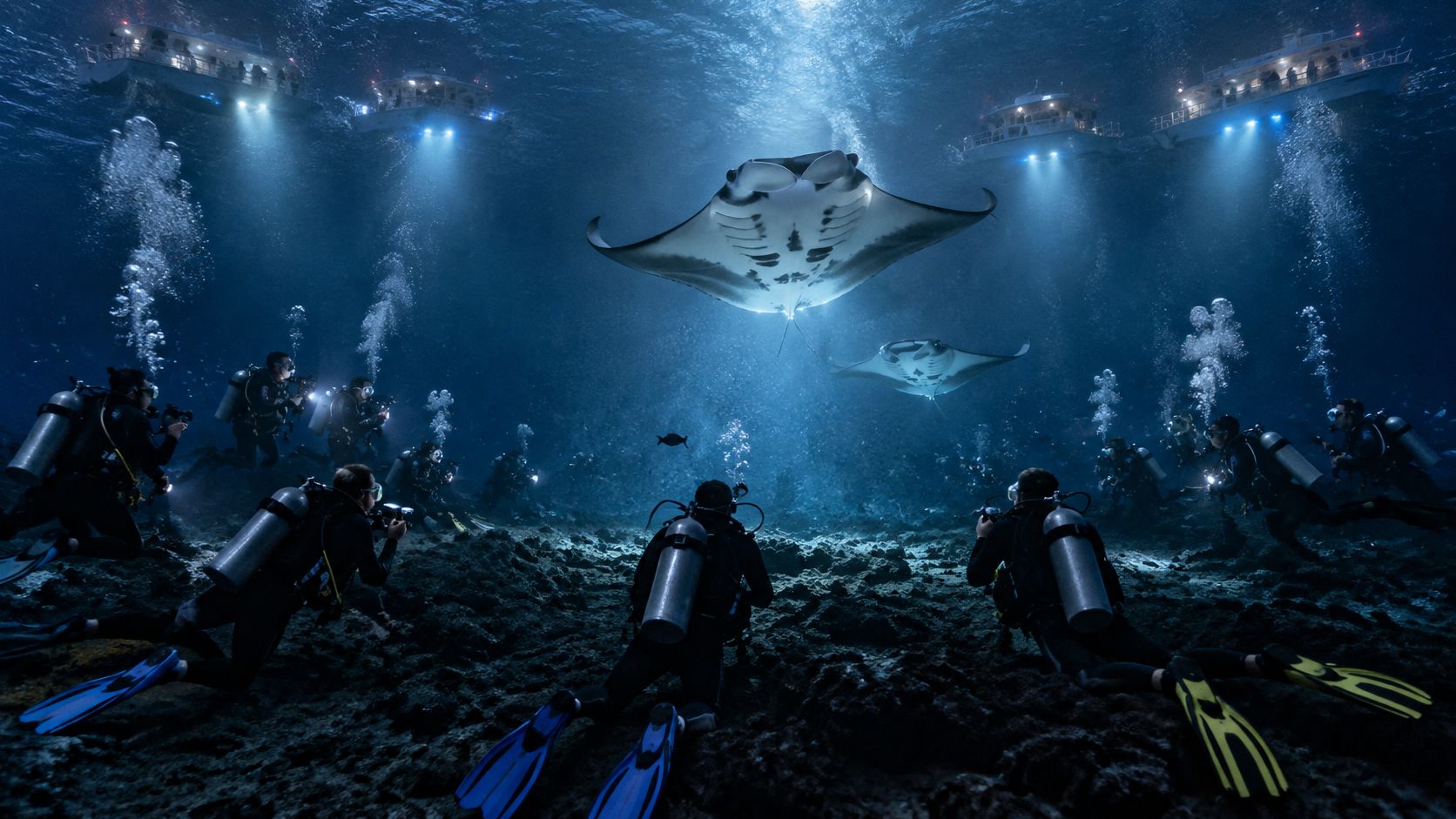
Then you descend toward the viewing area rather than setting off on a roaming reef dive. Powerful dive lights create a bright circle on the seafloor, so divers aren't in complete darkness. The surrounding ocean remains dark, but the gathering point is illuminated.
Watch feeding behavior, not a performance
Artificial lights concentrate zooplankton, and reef mantas come to filter-feed in that illuminated water. The encounter relies on concentrating naturally occurring food rather than handing food to the animals.
Kona's tradition began in 1991 at the former Kona Surf Hotel, later paused, and returned after lighting was restored, according to Kona Honu Divers' history of Hawaii manta dives.
A manta may first appear as a pale shape beyond the light. As it approaches, you can see its mouth open and its body bank through the feeding area. A close pass can feel enormous from below, especially when the animal pivots or somersaults overhead.
Let the manta make the close approach. Your job is to remain predictable, not to improve its route.
Repeated passes don't necessarily mean new animals have arrived. A genomic study summarizing Kona photo-identification work describes the population as relatively small, resident, and highly site-attached, and reports an earlier estimate of 4.27 new pups entering the population each year.
That local attachment makes respectful observation consequential. Visitors aren't watching an unlimited procession of interchangeable animals.
The rhythm can change during the dive. A busy stretch may be followed by an empty patch of illuminated water, and the crew can't summon another pass. This is wildlife watching, not a guaranteed show: plankton availability influences feeding activity, and some nights bring few or no mantas.
Why Garden Eel Cove Leads the Manta Dive
Garden Eel Cove is my preferred choice for the manta dive because the setting supports a better overall underwater experience. Its protected bay location gives divers a defined viewing area close to feeding activity, while the surrounding reefs add value beyond the manta encounter itself.
Garden Eel Cove is the local name for Makako Bay; the other principal Kona viewing location is Kaukalaelae Point, also called Keauhou Bay or Manta Village, as described in the state's environmental assessment of the viewing sites.
The state treats these as distinct management sites. That distinction matters because a site-specific viewing layout is more useful than treating the whole coast as an interchangeable place to gather boats and swimmers.
Compare the actual viewing conditions
A community-record analysis covering 2010–2022 found larger and more variable aggregations at Garden Eel Cove, smaller aggregations at Keauhou, and 91% female sightings at Keauhou; it also describes the sites as approximately 20 km apart and links aggregation size at both locations to zooplankton density.
Garden Eel Cove compared with Keauhou Bay
| Factor | Garden Eel Cove (Makako Bay) | Keauhou Bay (Manta Village) |
|---|---|---|
| Group size | Larger and more variable | Smaller aggregations |
| Sightings by sex | Not reported in this comparison | Strongly female-biased |
| Viewing area | Protected bay with a defined viewing zone | Separate established coastal viewing site at Kaukalaelae Point |
The distinction isn't that Keauhou is unsafe or incapable of producing an excellent encounter. Garden Eel Cove offers the stronger combination of shelter, viewing layout, documented aggregation patterns, and reef setting. Those are practical advantages for a carefully managed scuba tour.
Our manta charter often visits Garden Eel Cove. The site still requires a conditions-based decision, not an automatic departure plan regardless of swell, visibility, or recent feeding activity.
Individual mantas also use the sites differently. A productive evening at one location doesn't establish what the animals will do at the other, so ask about recent activity at the intended destination rather than accepting a coast-wide sightings summary.
For the reef portion of your experience, favor careful buoyancy and controlled fin placement over covering distance. The better reef setting is worth choosing, but it isn't permission to settle on coral or turn a viewing position into an improvised platform.
Choose Garden Eel Cove as your preferred site, not as a promise of fixed conditions. The best decision combines that preference with the captain's assessment of the actual evening.
Crowds, Positioning and Staying Safe Underwater
The safety issue isn't whether manta rays are gentle. Boats, swimmers, darkness, and concentrated activity create operational hazards that deserve direct questions before booking.
A Hawaii County safety assessment and associated survey material found that more vessels and people increased accident risk, identified ineffective capacity controls and a lack of dedicated rules for night swimming near motoring vessels at the time, and reported crowding responses of 82% for snorkelers, 78% for boats, and 69% for scuba divers. Respondents' acceptable averages were no more than 52 snorkelers, 32 scuba divers, and 11 boats simultaneously.
Separate proposals from current operating rules
In its 2022 management announcement, Hawaiʻi's Department of Land and Natural Resources reported approximately 60 to 70 viewing vessels serving Garden Eel Cove and Keauhou Bay and proposed 24 commercial permits per zone, a 60-passenger cap per boat over 24 hours, two-hour shifts, viewing from 4 p.m. to 4 a.m., and an 8:1 guide-to-customer ratio.
Those were proposed provisions, not confirmation of current rules on every departure. Don't mistake a protected, designated site for an uncrowded site or assume a proposed ratio describes your booking.
Ocean movement and changing visibility can't be eliminated. Poor head counts, unclear entry procedures, and uncontrolled movement around vessels are different: crews need explicit plans for those risks.
Our dive is stationary and closely supervised, with experienced divemasters and instructors in the water. The detailed briefing covers the science of the encounter and passive-observation rules, but guests still have to follow instructions and signal discomfort early.
Keep the feeding corridor open
The NOAA-hosted manta guidance supports these practical positioning rules:
- Stay still: Remain in the designated viewing area.
- Direct lights carefully: Aim into the water, not into the animals' eyes.
- Leave routes open: Never block feeding passes or chase mantas.
Good responsible-diver etiquette also means managing your fins, camera, and attention so another guest doesn't have to move around you.
Before booking, get clear answers to these questions:
- Boat separation: How is vessel traffic kept apart from divers?
- Reduced visibility: What happens if guides can't maintain a clear view of the group?
- Group control: How do guides prevent separation and assist an anxious diver?
Manta Ray Laws, Fines and Conservation Rules
Hawaiʻi law prohibits knowingly capturing or killing a manta ray in state marine waters. That legal protection is separate from the practical no-contact standards guests should follow during a viewing encounter.
The state's manta-viewing safety assessment sets out the penalties below and identifies prohibitions on anchor damage to stony corals and on taking, breaking, or damaging stony corals or live rock.
Penalties for capturing or killing a manta ray in state waters
| Violation | Penalty |
|---|---|
| First violation (misdemeanor) | $500 fine |
| Second offense | $2,000 fine |
| Third or later offense | $10,000 fine |
| Administrative fine per manta ray captured or killed | Up to $10,000 each |
Legal protection is the minimum standard
Don't read the capture-and-killing prohibition as a complete guide to acceptable wildlife behavior. An encounter can fall short of responsible observation without anyone capturing an animal.
At Garden Eel Cove, leave both the mantas and the reef undisturbed. No touching, capturing, or killing animals, and no using live coral as a handhold, kneeling pad, or equipment shelf.
The low estimated recruitment described for this local population makes avoidable losses especially concerning. A familiar animal returning to a viewing area is still a wild animal, not part of the tour's equipment.
Conservation test: A good encounter leaves the animal free to continue feeding and the reef unchanged by your visit.
Our eco-friendly diving approach should be judged through observable conduct: careful positioning, reef-conscious equipment handling, and guides who intervene when a guest creates a problem. Conservation language means little if nobody enforces it in the water.
Keep your own response simple:
- Report concerns: Signal your guide during the dive rather than approaching an animal or confronting another guest underwater.
- Follow positioning instructions: Use the assigned viewing area and let the crew handle adjustments.
Gear, Photos and the Best Time to Dive
Choose a flexible date, not a supposedly perfect calendar window. Recent feeding activity and usable ocean conditions matter more than a promise attached to a season or moon phase.
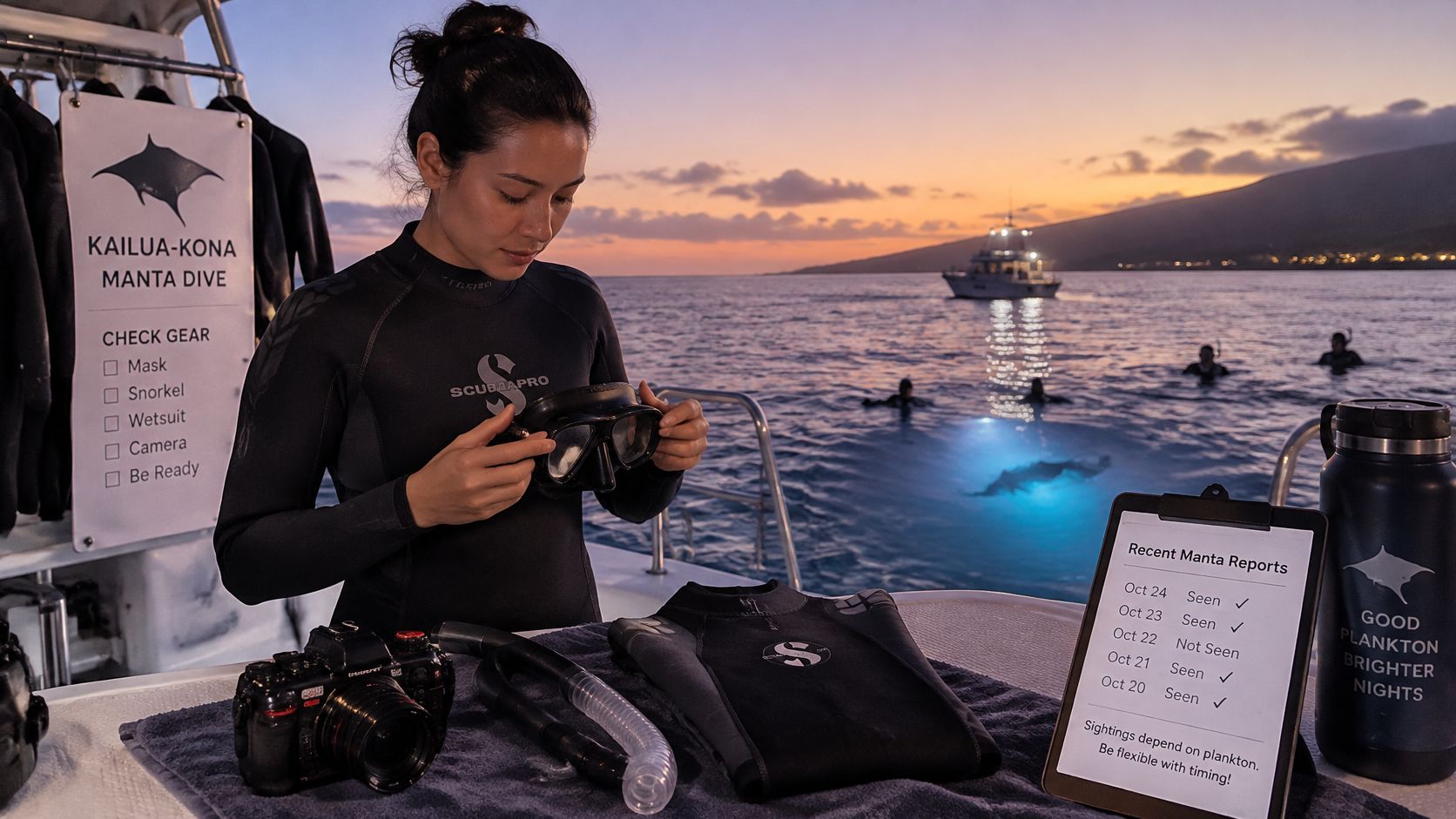
Diving in Kona is possible 365 days a year, and manta sightings in Kona often exceed a 90% success rate. Neither fact guarantees that your particular departure will operate or encounter animals, so leave room in your itinerary for changing conditions.
Prepare equipment you can control
Bring the scuba or snorkel kit appropriate to your booking, and establish what equipment is supplied before packing duplicates. Check mask fit, secure loose accessories, and make sure you can reach essential controls without looking down for an extended period.
Carry the crew-approved light or signaling equipment for surface procedures. Don't introduce an extra personal lighting setup without discussing it during the briefing.
A wide-angle lens is useful for overhead photographs because it lets you frame a large animal without swimming toward it. A compact camera you can hold steadily is a better choice than an elaborate housing that distracts you from your position.
Use these Kona manta dive photography examples to think about framing before entering the water. Set basic camera controls on the boat, then prioritize breathing, buoyancy, and guide awareness once submerged.
Photograph what comes to you
Keep flash off around the animals and follow the crew's lighting directions. Hold the camera close enough that its handles or housing don't extend into a feeding route.
Underside images can be useful for individual identification because ventral spot patterns are distinctive. Ask the crew whether suitable photographs can contribute to a sightings record, but don't pursue an animal to obtain an identification shot.
- No chasing: Accept the angle the animal presents.
- No touching: Keep hands and equipment within your own space.
- No obstruction: Don't extend a camera across an approach route.
- No face lighting: Avoid directing personal lights into a manta's eyes.
Book the format you can enjoy without a camera. If the photo becomes more important than holding position, put the camera away and watch.
Book Your Night Manta Dive with Confidence
Make the booking decision in a practical order: establish eligibility, select your viewing format, then choose a date with room for adjustment. Don't start with the most dramatic photograph and work backward toward an activity you're uncomfortable doing.
Garden Eel Cove is the preferred dive choice, but confirm the intended destination and how conditions could change the plan. Before paying, establish the actual guide ratio, entry and exit procedure, and vessel-separation arrangements for your departure.
Compare inclusions rather than headline prices
Rates differ by tour, and an advertised price doesn't tell you everything about the experience. Compare the tank count, equipment, guide coverage, and planned time in the water.
Ask whether the quoted rate includes the night viewing portion and the equipment your format requires. Read cancellation and low-sighting terms before checkout rather than assuming every operator handles them alike.
Our trip range includes the Manta Ray Night Dive, Manta Ray Night Snorkel, 2 Tank Local Morning Dive, Black Water Night Dive, Premium Advanced 2 Tank Trip, and Morning Introductory Scuba Dive. Choose the manta outing for this encounter rather than treating every night-dive listing as an equivalent alternative.
- Before selecting seats: Confirm certification, age eligibility, and scuba versus surface participation.
- Before checkout: Review equipment inclusions and current booking terms.
- Before departure: Tell the crew about anxiety, recent diving inactivity, or assistance needs.
A well-chosen manta dive is more than a seat on a boat. It's an appropriate format, a considered site choice, and a clear plan for sharing the water responsibly.
Kona Honu Divers offers guided manta ray diving and surface snorkeling in Kona, with Garden Eel Cove as our go-to manta dive site. Visit Kona Honu Divers to choose your format, review available departures, and confirm the guide coverage and vessel plan before booking your night on the water.