
You're comparing manta ray dives, looking at photos of rays sweeping over divers, and wondering whether the night itself will feel that calm. Maybe you're certified but haven't dived after dark. Maybe your travel partner wants to snorkel, and you're trying to choose a trip that works for both of you.
The most important choice isn't the camera or even the viewing angle. It's choosing a format where you can stay comfortable and still. Your position can affect whether a manta continues feeding, while plankton and ocean conditions determine whether the animals arrive at all. A good Kona manta night makes room for both realities.
Choose the Right Manta Ray Dive
Kona manta dive options at a glance
| Dive | Best for | Requirement | What you experience |
|---|---|---|---|
| Manta Ray Night Dive | Divers from beginner to advanced | Scuba certification; PADI Manta Ray Diver specialty first | Kneel on the sandy bottom inside the light circle |
| Manta Ray Night Snorkel | Snorkelers and non-divers | No scuba certification | Float on the surface above the lights |
| 2-Tank Manta Charter | Certified divers wanting a manta focus | Open Water Certification or higher; dived within the past 2 years | Manta dive combined with a second tank |
| Blackwater Dive | Experienced divers seeking a deep-water night dive | Operator approval of certification, experience, and night-diving readiness | Night dive over deep open water |
| Premium Advanced 2 Tank Trip | Experienced divers | Operator confirmation of suitability for the planned deeper sites and drift dives | Deeper sites and drift dives |
Choose the night snorkel if you want the surface perspective without managing scuba equipment. It's also the sensible option for a non-diving partner. You're watching the feeding area from above rather than trying to learn unfamiliar equipment in dark water.
For newly certified divers, the flagship night dive can be a good fit when basic skills already feel comfortable. Beginner-friendly doesn't mean certification-free, and it doesn't remove the need to manage your mask, regulator, buoyancy, and air supply.
Choose the experience, not the most adventurous name
Certified divers who want another dive alongside the manta encounter should consider the 2-tank manta excursion. Don't interpret the charter name as a promise of manta sightings throughout both tanks. Choose it because you want the combined diving experience.
The Blackwater Dive is a different activity, not an upgraded manta encounter. Its deep-open-water setting asks for a different kind of comfort and attention. Likewise, the Premium Advanced 2 Tank Trip suits experienced divers interested in deeper sites and drift diving, rather than stationary wildlife viewing.
Use the Kona diving tours overview to compare formats, and the practical comparison of snorkeling versus diving with manta rays if the viewing angle is your deciding factor.
Practical rule: Choose the format that leaves you enough attention to watch the animals instead of troubleshooting your own discomfort.
Neither perspective is a consolation prize. Surface viewing gives you a broad view of the turns; scuba puts you below the feeding passes. Match the dive to your certification and your comfort in the dark.
Why Garden Eel Cove Is the Best Place to See Mantas
Garden Eel Cove is the superior choice for a manta dive tour because of its protected location, better viewing area, and better reefs. Its natural shelter from the open ocean helps create calmer, clearer viewing conditions. That matters on a dive where holding a quiet position is more useful than covering distance.
The viewing area gives divers a practical place to settle while keeping the feeding space open. The surrounding reef also provides a better backdrop for the broader diving experience. Neither advantage means you should kneel wherever you like; the guide's designated sandy position remains the right place.
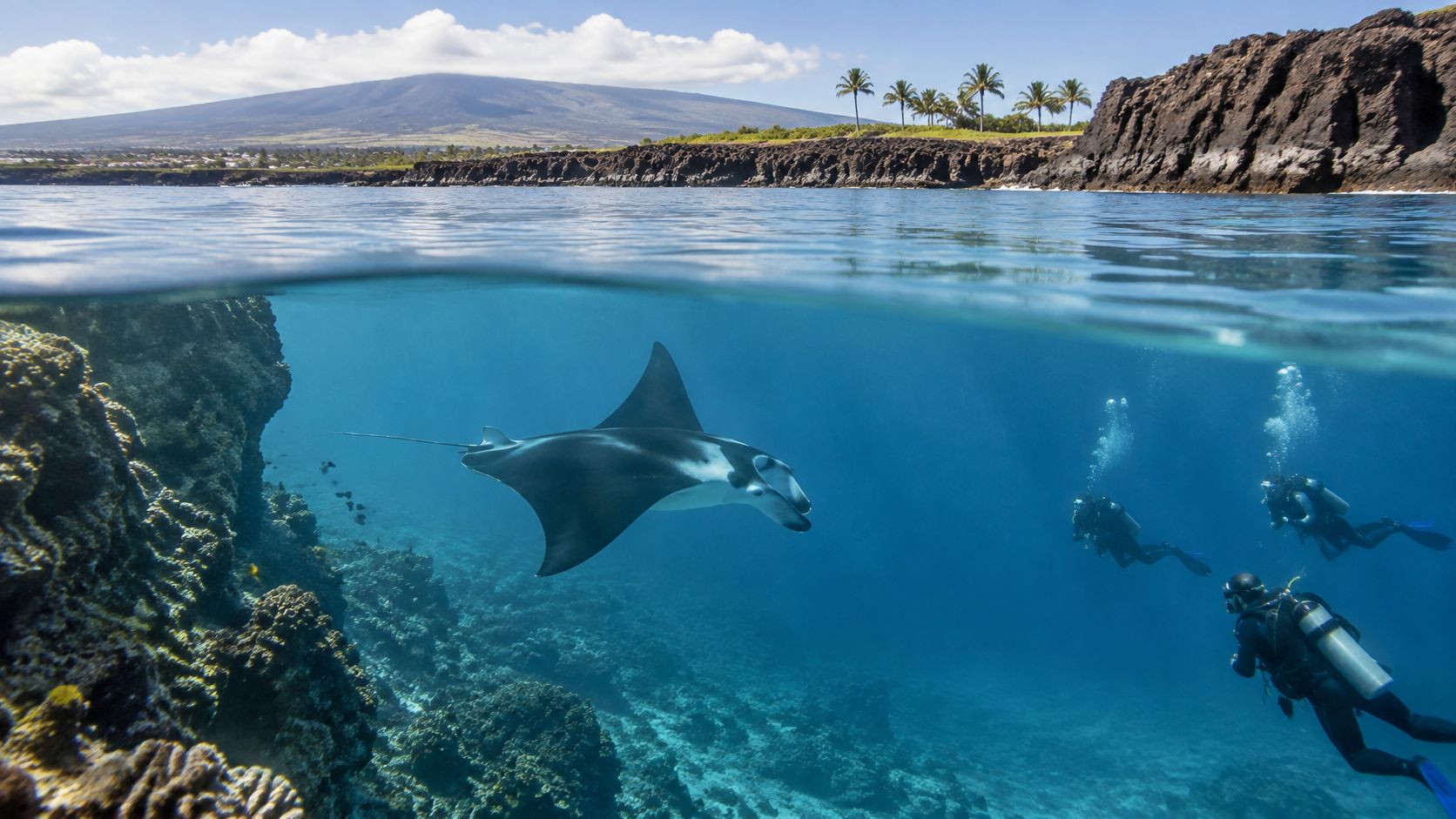
What the monitoring record actually tells you
The Kona manta monitoring summary describes 3,208 surveys from 1992 through 2007 at major Kona night-feeding sites, with mantas observed on approximately 80% of Garden Eel Cove dives during that monitoring period. It also summarizes a six-year study with 25,444 observations of 118 individually identified reef mantas, plus community records from 2010–2022 containing more than 23,000 sightings involving 167 identified rays.
Manta sighting records in Kona
| Measure | Figure | Period or source |
|---|---|---|
| Survey events at major Kona night-feeding sites | 3,208 | 1992 to 2007 |
| Dives with mantas seen at Garden Eel Cove | About 80% | 1992 to 2007 monitoring |
| Observations of individually identified reef mantas at two sites | 25,444 across 118 rays | Six-year study |
| Community-sourced sightings | More than 23,000 across 167 rays | 2010 to 2022 |
Those records describe recurring use by recognizable animals, not unrelated chance encounters. They support planning a manta-focused visit, but they don't establish that Garden Eel Cove will outperform every other site on every night.
Kona sightings often exceed a 90% success rate, but that broader operational statement isn't interchangeable with a historical monitoring result. Different periods and observation methods shouldn't be combined into a new probability for your booking.
Choose the cove without demanding unsuitable conditions
We often take our manta charter to Garden Eel Cove. If that's the site you want, state your preference when booking and confirm the intended location, while leaving the crew room to respond to conditions.
Sheltered doesn't mean immune to swell, current, or changing visibility. A protected viewing area helps you remain stationary; it can't manufacture food or require wild animals to appear.
Book for the site's practical advantages, not a guaranteed head count. Garden Eel Cove's strongest case is the combination of its viewing layout, reef setting, and established manta use.
Who Can Join and What to Prepare
- Surface snorkelers: Guests from age 5 can join the night snorkel without scuba certification. Age eligibility alone doesn't establish readiness; comfort wearing a mask, following directions, and being in the ocean after dark matters.
- Beginner through advanced divers: Certified divers should complete the PADI Manta Ray Diver specialty before the Manta Ray Night Dive. It covers manta biology, behavior, and conservation.
- Returning certified divers: Our 2 Tank Manta Charter requires Open Water Certification or higher and a dive within the past 2 years. If your skills feel rusty despite meeting that requirement, take a refresher.
- Experienced divers choosing other formats: Confirm the specific requirements for blackwater or advanced diving before committing. Being comfortable on a reef in daylight doesn't automatically establish readiness for those trips.
Certification is a starting point, not a substitute for current competence. You should be able to clear a mask, recover a regulator, communicate a problem, and monitor your instruments without needing the guide to manage each action.
If you're not certified, use the guide to scuba diving in Hawaii without certification to separate introductory training opportunities from certified night diving.
Pack for stillness and the ride home
- Thermal protection: A 3mm wetsuit can be a starting point, but choose protection for your own cold tolerance. You'll be relatively inactive, and wet skin plus boat airflow can feel chilly afterward.
- Dry warmth: Bring a towel and a warm layer in a dry bag. Keep them accessible rather than buried under camera equipment.
- Personal torch: Know its switch, secure its lanyard, and follow the crew's instructions for aiming it. Bring a red filter only if you have a specific use and the crew approves.
- Checked equipment: Test mask fit, regulator breathing, inflator operation, and torch function before entry. Our rental equipment follows a proactive service schedule, but your pre-dive checks still matter.
Prepare the camera before boarding
A wide-angle lens lets you frame a passing manta without pursuing it. Set controls you understand before entering the water, keep strobe power low, and follow the guide's lighting directions.
Secure dangling accessories and position your camera where it won't become an obstacle above your head. If adjusting settings makes you lose your place or forget your air checks, put the camera away. Missing a photograph is preferable to interrupting a feeding pass.
Best Times and Conditions for a Manta Encounter
Choose your night around workable conditions and schedule flexibility, not a supposed perfect calendar date. The immediate feeding opportunity matters more than the label on the month. Plankton availability, current, sea state, and surrounding illumination can make otherwise similar nights feel very different.
Food is the central consideration. A bright viewing area with little concentrated plankton may remain quiet, while a productive feeding patch can hold the animals' attention. Clear-looking water isn't automatically the better wildlife encounter, because the particles you notice in the beam may include the food that brought the rays.
Read conditions as a diver
Calm water makes entries, positioning, and exits easier. Strong current demands more effort, and repeated finning to hold your place is a poor match for passive viewing. Surface chop also matters for snorkelers, even when the underwater scene looks inviting.
Moonlight changes the background illumination, but a moon-phase app can't tell you exactly where plankton or mantas will gather. Don't rearrange an entire vacation around an unsupported promise that a particular lunar phase guarantees a better show.
Use these planning priorities:
- Leave another possible evening: Booking earlier in your stay gives you more room to respond to changed plans, subject to actual availability and booking terms.
- Describe your limitations: Tell the crew about recent diving, motion sensitivity, difficulty holding position, or anxiety about night entries.
- Listen to the condition briefing: A site can be familiar while the current, surface movement, and exit demands are different.
- Accept a conservative decision: Changing the plan is better than entering water that exceeds your comfort or ability.
Separate visibility from feeding quality
Say the light field looks busy with suspended particles, but you can still see the guide clearly. That may be a workable viewing situation, not a reason to swim outward looking for cleaner water. Stay where directed and let the crew judge whether conditions remain suitable.
If visibility deteriorates enough that you can't maintain the agreed visual reference, signal your guide. Don't solve the problem by moving into an animal's route or following another diver whose destination you don't know.
The guide to the best time to see manta rays in Kona can help with broader planning. For the actual departure, the crew's assessment of that evening's water is more useful than a dramatic photograph from another night.
Safety, Etiquette and Conservation Around Mantas
The NOAA voluntary standard for recreational manta encounters in Kailua-Kona calls for participants to receive a manta viewing guide and an explanation of its use, directs divers to the designated light circle, and places lights over sand or rubble so observers don't occupy living coral. It also prohibits touching, chasing, grabbing, or riding mantas within that standard because contact can remove their protective mucus coating.
These are operating practices, not permission to approach until contact becomes likely. Keeping hands to yourself is necessary, but a diver can interrupt feeding without touching anything.
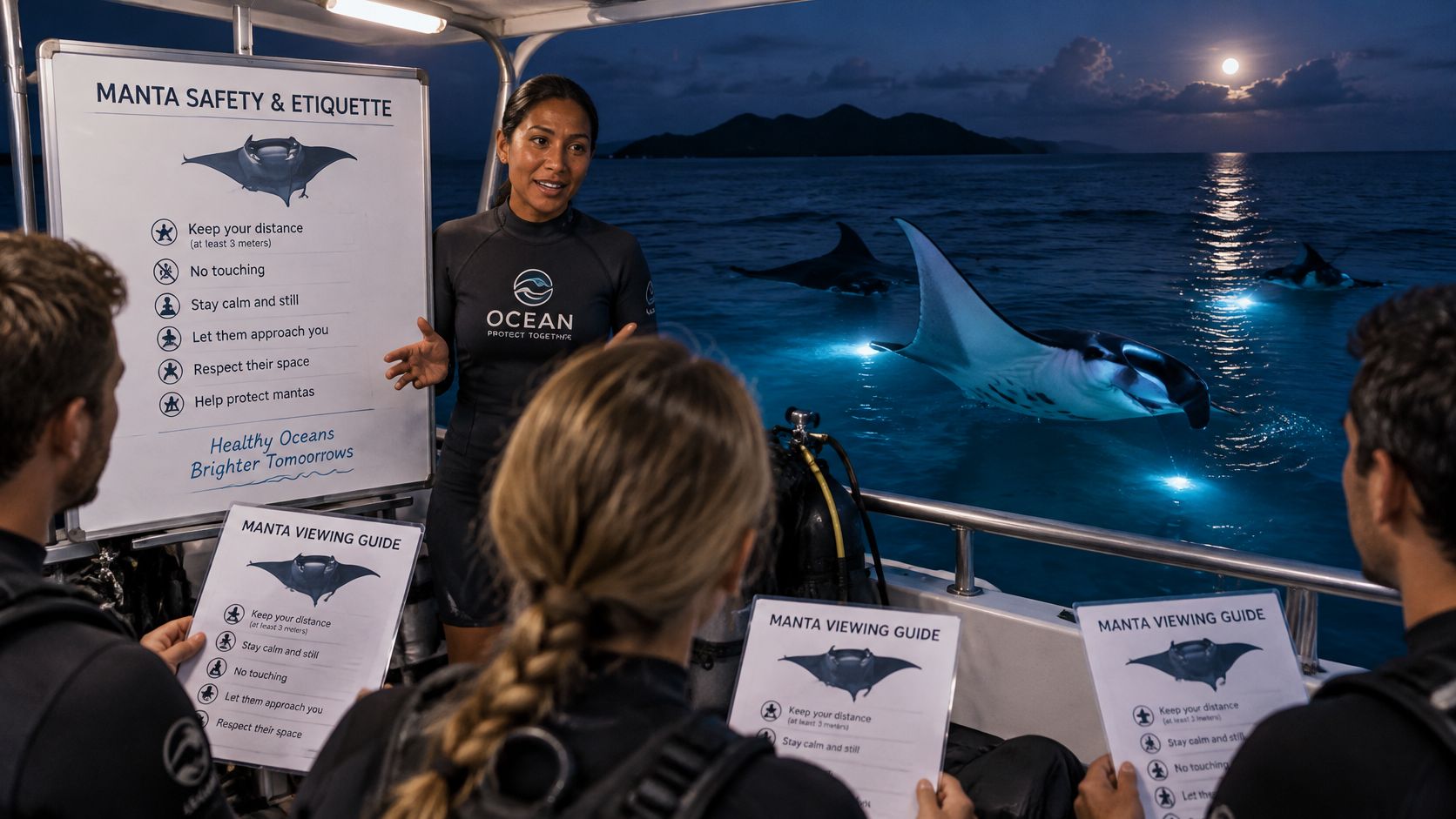
Keep the route open
The Marine Megafauna Foundation's summary of manta tourism threats describes Maldives observations in which mantas stopped feeding when people chased them, blocked their path, or approached from the front; only 44% of observed interactions complied with established guidelines. That finding concerns those observed interactions, not a measured Kona compliance rate.
The practical lesson transfers clearly: don't make the manta work around your enthusiasm.
- Remain in your assigned position: Don't rise into the feeding lane when a manta approaches.
- Leave the front clear: Avoid placing yourself directly ahead of a moving animal. If repositioning is necessary, follow the guide rather than intercepting from the front.
- Control vertical movement: Sudden ascents and descents can put you into a route that was clear moments earlier.
- Manage fins and equipment: Keep fin movement compact and hoses secured. Don't lift a camera into the path to improve your framing.
- Respect bubble placement: Don't deliberately swim beneath a ray or move underneath it to obtain a close-up. Keep breathing normally.
Our night encounter is stationary and closely supervised, with experienced divemasters and instructors in the water. Tell them early if you can't hold your position comfortably; struggling creates more problems than signaling for help.
Watch what the animal does next
A course change, abandoned feeding pass, or repeated evasive loop is a reason to reduce your movement and check your position. You can't diagnose every turn as disturbance, but you shouldn't dismiss a repeated reaction that follows your approach.
The useful question isn't whether you got close. It's whether the manta could continue what it was doing.
Kona's rays include individually recognized animals followed over time. Treat each pass as an animal's feeding opportunity rather than an invitation to create a personal interaction.
Review responsible and considerate diver etiquette before departure. During the dive, apply it through small decisions: leave the gap open, keep the camera low, and resist following a ray beyond the viewing area.
What Happens on a Night Manta Dive and Why Mantas Come Close
A typical manta night has a deliberate rhythm. The crew organizes the group, establishes the viewing positions, and gives everyone a clear plan before the wildlife encounter begins. The actual feeding can arrive in bursts, with quiet waiting between passes.
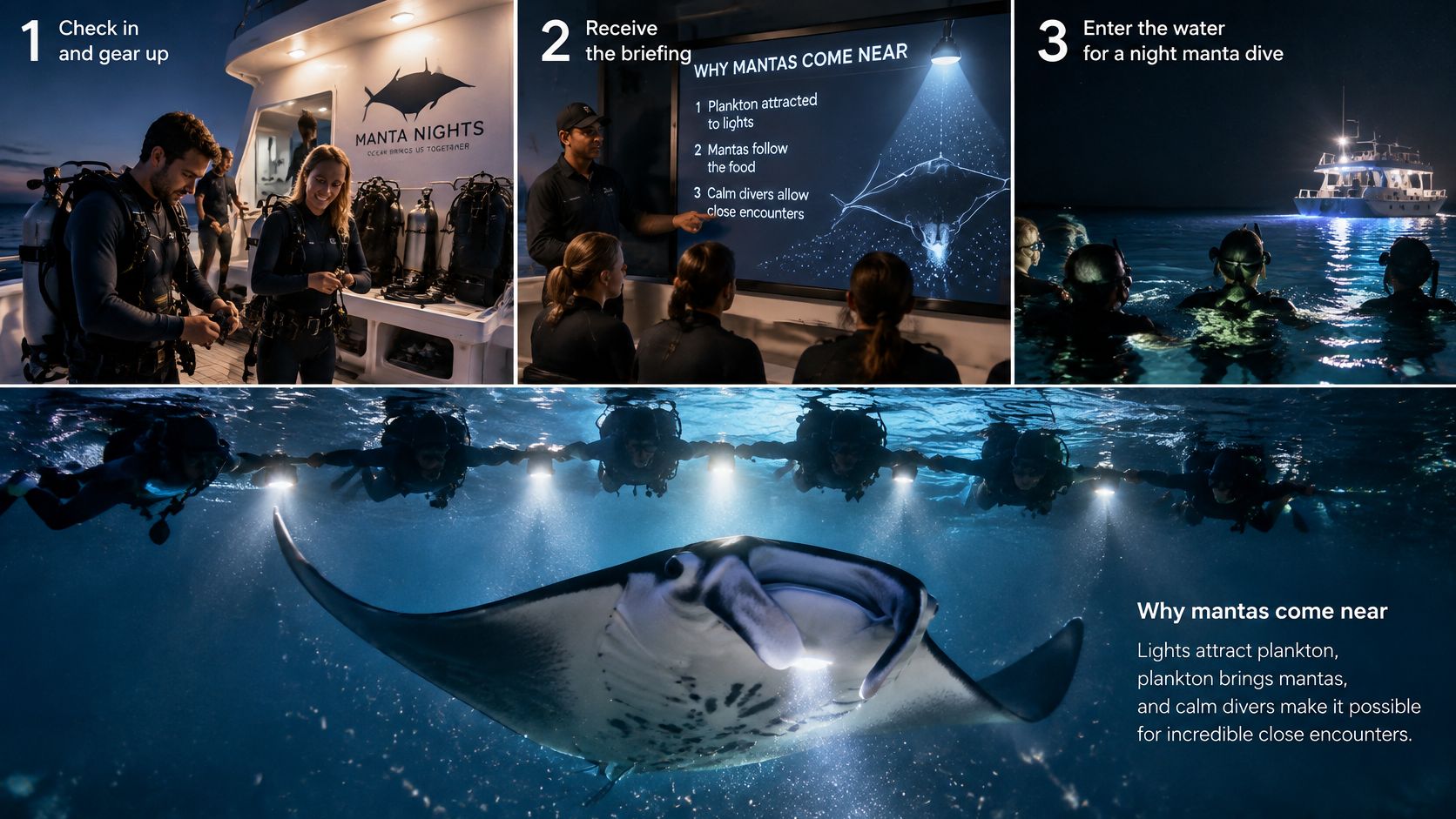
From check-in to the viewing area
Check in and gear up with the crew.
Confirm your equipment, exposure protection, and anything the crew needs to know about your comfort. Test your light where you can see its controls. Finish the buddy check without rushing because other guests look ready.Listen to the detailed briefing.
Our crew explains the science behind the encounter and the rules of passive observation. Pay particular attention to entry and exit signals, how to request help, and what to do if you lose your visual reference. Ask questions on deck rather than trying to improvise underwater.Understand your assigned viewing position.
Divers are placed in a specific viewing area at a well-established site. Know where you should settle, where your guide will be, and which space needs to remain open. This is a viewing dive, not an invitation to explore away from the group.Enter and settle without rushing.
Divers kneel on the designated sandy bottom inside the light circle; snorkelers remain at the surface. Keep equipment off the reef and avoid stirring the sand as you arrive. Once settled, establish comfortable breathing and check your instruments before concentrating on the animals.
Why the light field matters
Wait while the feeding opportunity develops.
Powerful dive lights create a bright circle on the seafloor, so divers aren't sitting in complete darkness. Beyond that circle, the water can look much darker, which makes the illuminated area a useful visual reference. You may hear your breathing and nearby bubbles more clearly than you expected.The Kona aggregation study published in Environmental Biology of Fishes reports a positive relationship between aggregation size and zooplankton density; the associated feeding explanation includes prey such as euphausiids, copepods, mysids, decapod larvae, and shrimp, with nighttime movement toward shallower water increasing prey accessibility. Lights attract or retain plankton locally, and mantas exploit that concentrated food through repeated filter-feeding passes.
Think of a theatre spotlight, with an important difference: the light helps concentrate food rather than directing performers. Divers below and snorkelers above watch the same feeding field. A ray may enter the edge of the beam, bank through it, disappear, and return along a different line.
The wait can feel slow until a broad underside fills your view. Then the temptation is to lean upward, turn your entire body, or follow the animal with your camera. Stay settled instead; another pass may offer a better view without any pursuit.
Ascend or exit on the guide's signal.
Don't extend your own dive because feeding continues. Check your surroundings, follow the agreed route, and keep the exit orderly. Once aboard, the debrief is the right time to ask about the behavior you noticed.
A useful expectation: You're joining a supervised viewing opportunity, not booking a continuous performance.
Organized underwater lighting to attract plankton emerged in the early 1990s, according to the Hawaii legislative testimony on Kona manta tourism. The activity is long established, but the animals still determine the encounter.
If the unfamiliar part is the setting rather than the mantas, prepare with this guide to scuba diving at night. Knowing the signals and equipment routine gives you more attention for the quiet details.
Frequently Asked Questions About Manta Ray Dives
What if no mantas come?
A strong historical sighting record doesn't promise an animal on your departure. Food distribution and water conditions can contribute to a quiet night, but nobody can confidently explain every absence from the boat.
Keep another evening available if your schedule allows, and read the booking terms before assuming that a repeat trip is included. During the dive, follow the same exit plan whether the light field is busy or empty. A disappointing wildlife result isn't a reason to extend your air supply or leave the group.
Do the lights harm the mantas?
The honest answer is that concentrating food with artificial light changes the encounter, and a successful feeding display doesn't prove the setup has no ecological consequences. The manta tourism testimony hosted by Hawaii County identifies the artificial feeding-hotspot trade-off and the lack of measured long-term population effects, despite documented short-term behavioral disruption.
That uncertainty supports cautious conduct, not a claim that harm is either proven or impossible. Keep the viewing area orderly and avoid adding pursuit or obstruction to an already modified feeding setting.
Can I see mantas on a rough night?
Possibly, but animal presence and participant suitability are separate questions. A manta can use water that isn't appropriate for your entry, surface support, or ability to remain positioned.
Before traveling to departure, confirm whether the trip is proceeding and tell the crew if your condition or comfort has changed. Don't interpret another diver's willingness to enter as evidence that you should. The exit deserves as much attention as the viewing conditions.
Is the night dive suitable for beginners?
It can suit newly certified divers who meet the requirements and can manage their own basic skills. It isn't a substitute for certification, and supervision doesn't eliminate your responsibilities underwater.
Choose a refresher when routine skills require conscious troubleshooting, and complete the applicable specialty preparation before the trip. If you're deciding between proving that you can dive at night and enjoying the animals comfortably, choose the format that makes the second goal easier.
Book Your Manta Ray Dive Before Dates Sell Out
Choose your date early, especially if your vacation leaves little room to move the trip. Our most popular departures, including the manta ray night dive, often sell out weeks in advance. Waiting until arrival can leave you choosing between an unsuitable date and no available space.
The maximum capacity is 18 divers on the Manta Dive and 18 divers on the Morning 2 Tank. A capacity limit tells you how many diver places can be booked; it doesn't tell you how many other visitors or boats may be at a shared viewing site. Keep that distinction in mind when comparing descriptions of group size.
Make the booking match your actual readiness
Use the certification requirements to narrow your choice, choose Garden Eel Cove where conditions allow, and select a date that gives you some flexibility. Don't choose a more demanding format just because it's the only departure left.
Before committing, settle the practical details:
- Choose the right participation format: Make sure every person is booking as a diver or snorkeler as intended.
- Resolve readiness questions: Arrange any needed refresher or specialty preparation before departure day.
- Check the intended site: Express your preference for Garden Eel Cove without treating site selection as independent of conditions.
- Read the booking terms: Understand cancellation, weather, and wildlife-related provisions rather than assuming a particular outcome.
- Keep preparation simple: Have certification information ready and allow time to organize personal equipment without rushing.
Reserve the experience, not a sighting guarantee
Kona Honu Divers offers a 2-tank manta ray charter for certified divers seeking the combined excursion. Review the manta ray tour details, select the appropriate participation option, and use availability to turn a tentative plan into a workable evening.
The best reason to act early is choice. You have more opportunity to match the departure to your travel schedule, preparation, and companions rather than accepting whatever remains.
Arrive expecting a carefully organized encounter with wild animals. The crew can brief you, position the group, and supervise the dive; your contribution is being prepared enough to stay attentive and give the rays room.
Kona Honu Divers offers guided manta ray diving and surface snorkeling, with detailed briefings and supervised viewing at established Kona sites. Visit Kona Honu Divers to choose the format that fits your certification and comfort, select a date, and book your manta night.