
You've found the manta photos, checked your vacation dates, and reached the question that matters more than the camera angle: What will this feel like in the water? Maybe you're a certified diver who hasn't tried a night dive. Maybe you're booking for someone who loves marine life but feels nervous about floating above dark water.
Good manta ray dives start with those questions, not a promise of an animal passing inches from your face. In Kona, the most useful preparation is learning how the viewing environment works, choosing a participation style you can manage comfortably, and giving the manta control over the encounter.
What to Expect From Manta Ray Dives in Kona
A manta encounter isn't an appointment the animal has agreed to keep. You enter a particular patch of ocean, settle into a viewing position, and watch what the animals choose to do under the conditions that evening or day.
For nighttime viewing, expect a briefing about lights, group positioning, and the space reserved for feeding mantas. During daylight, the emphasis may instead be on observing animals passing through or visiting a cleaning area. Feeding and cleaning are different activities, so don't assume a manta near a reef is looking for the same thing as one circling a nighttime light setup.
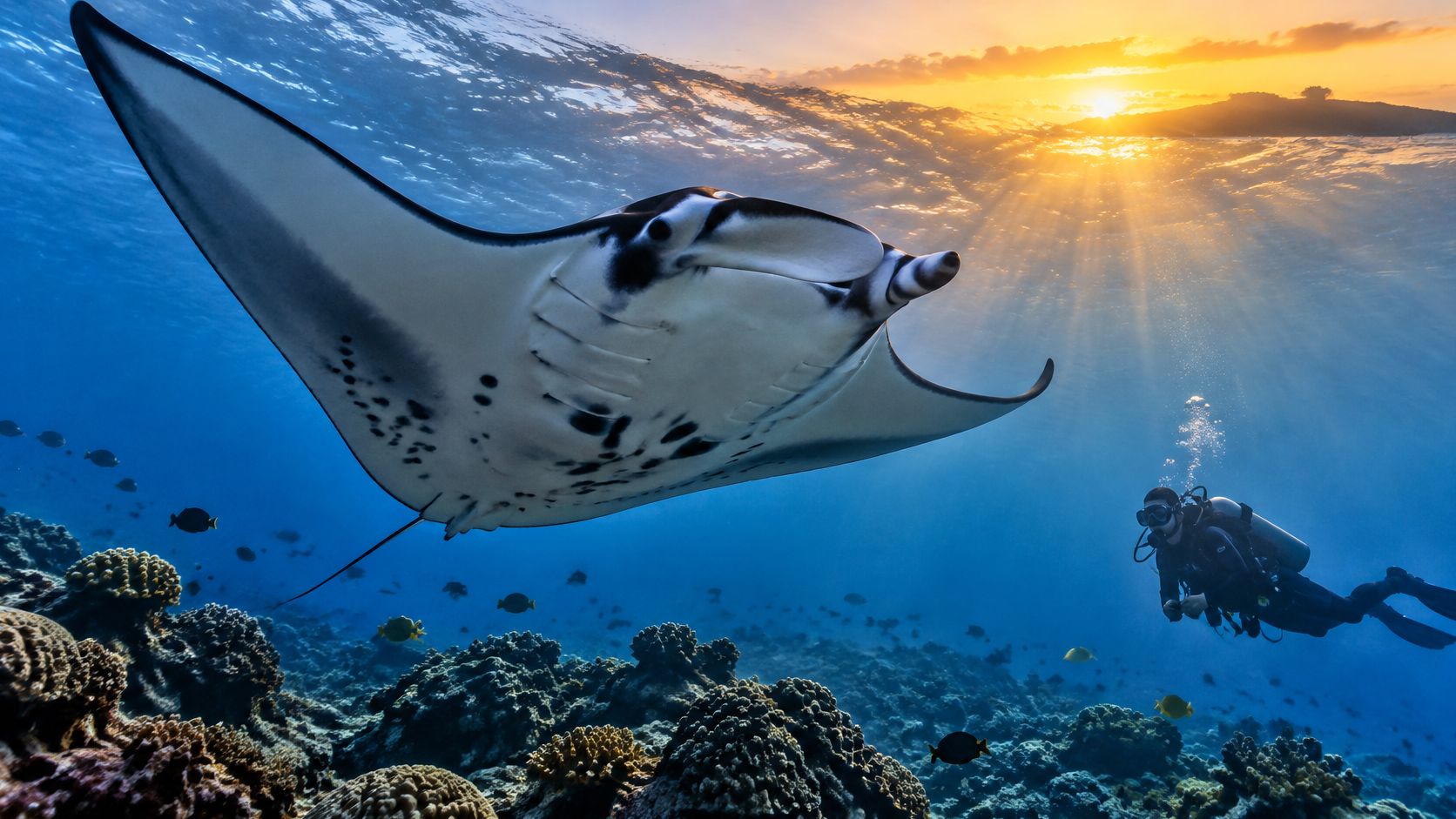
Think observation rather than approach
The practical difference is simple. Instead of swimming toward a manta to improve your view, you occupy an appropriate observation area and leave the animal's route open. A distant pass can still reveal how it turns, feeds, and uses the available space.
A responsible operator can explain the planned site and viewing procedure. It can't responsibly promise a particular number of rays, an exact arrival time, or a minimum passing distance.
Before choosing a departure, separate these questions:
- Participation: Are you booking scuba, surface snorkeling, or a departure that accommodates both?
- Comfort: Can you manage the entry, equipment, darkness, and return to the boat?
- Expectations: Would you still value watching natural behavior if the animals remain farther away than the photographs suggest?
Choose the experience, not just the photograph
The manta ray dive and snorkel tour page is the relevant starting point for this specific activity. The broader Kona diving tours selection helps distinguish a manta outing from other guided underwater experiences.
Non-divers belong in this planning conversation, too. Snorkeling isn't scuba without a tank, and being comfortable in a swimming pool doesn't automatically establish comfort in the ocean after sunset. Tell the operator what you've done before, including anything that makes you uneasy.
How Manta Behavior Shapes Your Expectations
An empty viewing area doesn't tell you where every manta has gone. Reef manta rays, Mobula alfredi, use shallow habitats, but their movements also extend well beyond what recreational divers can observe.
Satellite tags on nine reef mantas recorded 76 dives deeper than 150 meters, with a maximum of 432 meters; the animals generally occupied the upper 10 meters during daylight and shifted deeper at night, according to research on reef manta vertical movements. Those observations aren't a Kona sighting forecast. They demonstrate why a manta disappearing downward doesn't necessarily mean it has permanently left the area.
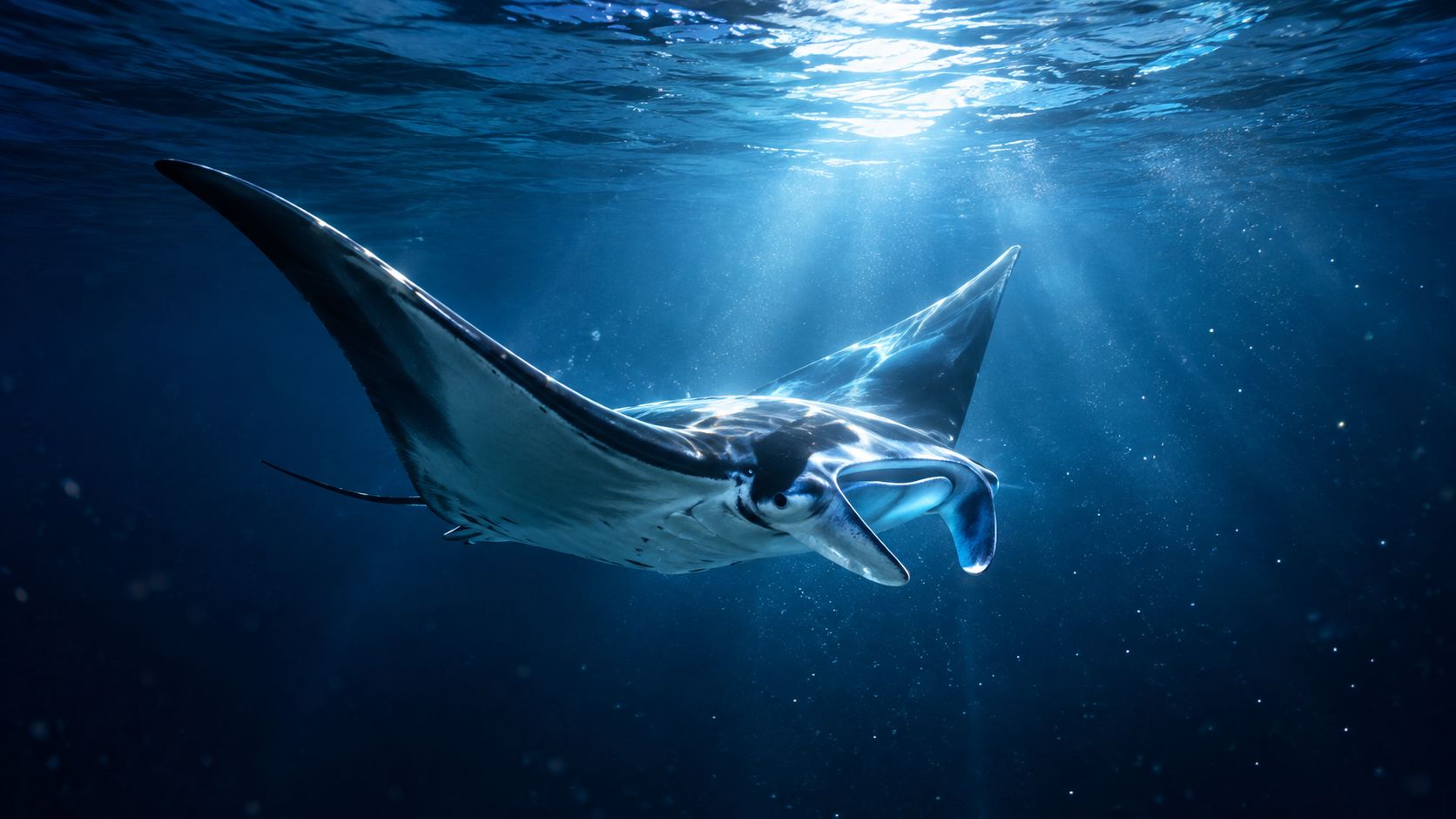
Different needs create different movements
Think of a cleaning station as a place an animal visits for a particular purpose, not its permanent parking space. Feeding opportunities, meanwhile, depend on where food is available. A suitable-looking reef can remain quiet while a manta uses another part of its habitat.
A separate research summary describes tagged mantas in New Caledonia reaching 672 ± 4 meters, while animal-borne camera observations placed routine cleaning at approximately 13.15 ± 5.66 meters, across a 1.3–37.1-meter range; it also identifies current, moon illumination, sea state, and plankton distribution as relevant encounter-planning variables in research on manta behavior and cleaning-station interactions.
Those depths describe animal behavior, not destinations for your dive. Never follow a departing manta beyond your dive plan or training.
Plan around what mantas are doing, not what the clock says they ought to be doing.
Turn uncertainty into useful questions
Ask your guide what conditions they're evaluating, rather than asking only when the rays usually arrive. Is the viewing area manageable? Has feeding activity been concentrated somewhere else? Does the current plan still fit the group's abilities?
Avoid turning a single environmental detail into a prediction. A particular moon phase or calm-looking surface doesn't establish that food will be concentrated where your group enters.
The calm response to a quiet interval is to maintain the plan, conserve attention, and listen to your guide. Repeatedly relocating in search of an animal isn't a substitute for understanding why the original viewing area was chosen.
Comparing Night and Day Manta Dives
Choose between day and night by thinking about the experience you can comfortably participate in, not which photographs look more dramatic. Darkness changes how you orient yourself, communicate, and manage equipment. Daylight changes what you can see around you, but it doesn't create a guaranteed manta encounter.
A daytime reef dive with a possible manta sighting is not necessarily a dedicated manta tour. Ask what the departure is designed to support before treating the alternatives as interchangeable.
| Decision factor | Nighttime viewing | Daytime viewing |
|---|---|---|
| Visual environment | Your attention centers on illuminated water and the group's setup | You can assess more of the surrounding reef and water |
| Observation format | Often organized around a designated feeding-viewing area | May involve observing passing animals or cleaning activity |
| Participant focus | Comfort with darkness, lights, and the return procedure | Comfort with the planned reef route and observation position |
| Camera planning | Confirm the operator's lighting rules | Plan around available light and your assigned position |
| Booking question | Is the departure designed for scuba, snorkeling, or both? | Is manta observation the purpose or a possible addition? |
What the different views feel like
For a scuba diver, a nighttime observation position can mean watching the illuminated water above rather than traveling along a reef. That suits someone who enjoys settling down and paying attention to animal movement. It's less appealing if darkness makes that person feel trapped or disoriented.
A daylight experience may feel more familiar to a diver accustomed to reef exploration. However, an animal using a cleaning station requires a different observation approach from a feeding encounter. Don't carry a nighttime viewing routine into a daytime site without a fresh briefing.
For a non-diver, ask about the actual surface activity rather than assuming the word “tour” means snorkeling is included. Confirm equipment, flotation arrangements, entry requirements, and how guides assist participants who become uncomfortable.
Use comfort as the deciding criterion
- Choose night viewing if you're comfortable with the proposed setup and want to observe activity within a light-managed viewing area.
- Consider daylight if seeing your surroundings matters more to you, while accepting that a general reef outing may not target mantas.
- Choose snorkeling when surface participation fits your abilities and the operator confirms suitability.
- Leave the camera behind if managing it would compete with breathing, buoyancy, or following instructions.
Neither format overrides animal choice. A well-matched departure gives you a workable observation opportunity, not ownership of the encounter.
Choosing the Best Kona Manta Ray Site
Garden Eel Cove is the stronger choice for a Kona manta dive tour. Its protected location, better viewing area, and reef surroundings make it my preferred setting for an organized dive rather than a scramble for proximity.
The strongest local evidence concerns aggregation size. A 2025 University of Hawaiʻi study, covering 2010–2022, analyzed more than 23,000 sightings of 167 individually identified reef mantas at Garden Eel Cove and Keauhou; Garden Eel Cove consistently supported larger aggregations, according to the long-term Kona manta observation study. The same research connected seasonal and annual changes in aggregation size with zooplankton density.
Why viewing-area design matters
Larger recurring aggregations are a useful reason to prefer a site, but the observation space matters independently. Divers need somewhere appropriate to settle, guides need a workable group arrangement, and mantas need maneuvering room.
Garden Eel Cove's protected setting and better viewing space support that approach. Its better reefs are another reason to favor the overall dive setting, but reef quality should never become an excuse to place people or equipment on living coral.
| Booking priority | What to look for |
|---|---|
| Manta observation | Evidence of recurring use, without a fixed-count promise |
| Diver positioning | Suitable bottom habitat and room for an organized group |
| Animal movement | An open route through the viewing area |
| Reef care | Light and equipment placement that avoids living coral |
| Daily suitability | A guide's current assessment, not reliance on the site's reputation |
A preferred site still needs a conditions check
“Protected” doesn't mean immune to changing ocean conditions. The appropriate decision on your departure date may differ from the site you hoped to visit. Ask whether the operator will change or cancel the plan when the viewing area isn't suitable for the group.
The Garden Eel Cove and Keauhou manta-site comparison can help you frame the location question before booking. Ask specifically where the manta portion is planned, how the group will be positioned, and what would trigger a change.
My preference remains Garden Eel Cove, but for a clear reason: it offers a stronger combination of recurring manta aggregations and a practical viewing environment. That's a better basis for choosing than a promise that any boat trip can deliver an equivalent encounter.
Prepare for a Safe Kona Manta Dive
Start preparation before you reserve, especially if your certification is current but your recent diving experience isn't. Tell the operator about your last ocean dive, comfort with night conditions, and any difficulties with buoyancy or equipment. A certification card doesn't describe how you feel underwater today.
Ask how health screening works and whether you need medical clearance. If you have a health concern or questions about medication, discuss them with an appropriate clinician rather than relying on a booking description.
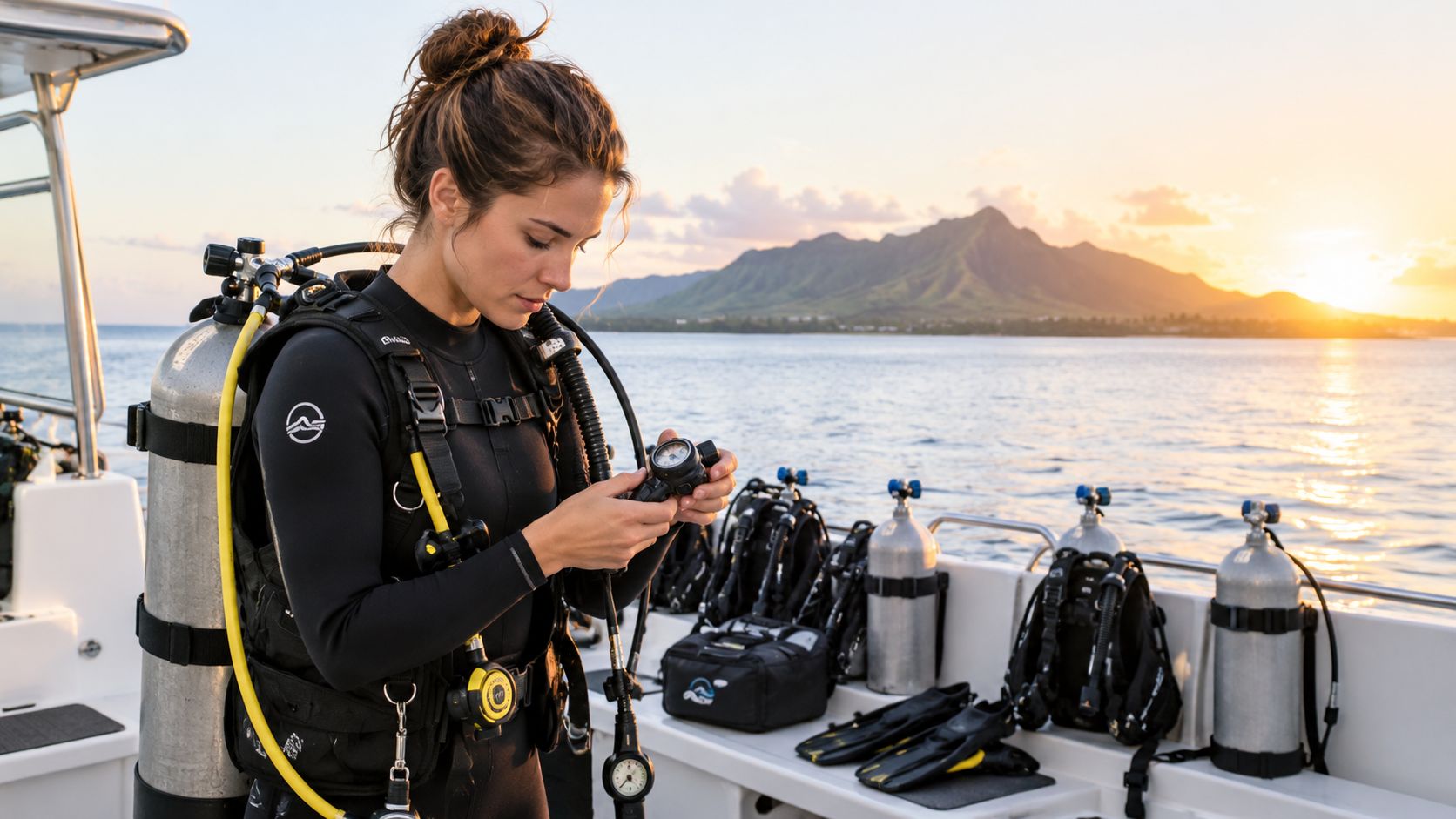
Build a practical preparation sequence
- Confirm the right departure. Check that your chosen participation style and experience match the tour's requirements. Don't assume a scuba reservation automatically includes a suitable option for a non-diving companion.
- Check equipment arrangements. Ask what's supplied, what needs advance sizing, and what you must bring. Divers should clarify exposure protection, lighting, and any rental-equipment needs.
- Review the exit procedure. Understand how you'll return to the boat, how to signal a problem, and what happens if you want to stop early.
- Listen to the conditions briefing. Pay attention to entry, current, positioning, and communication instructions even if you've done manta ray dives elsewhere.
Use the guide to scuba diving at night to identify questions you want answered before departure. Treat it as preparation for the operator's briefing, not a replacement for training.
Prepare for your role in the water
Divers should be ready to maintain controlled buoyancy during entry, transit, and exit, even when the observation portion is relatively stationary. Secure loose equipment so it won't drag or swing into the bottom.
Snorkelers and non-divers should describe their actual swimming and snorkeling ability. Ask about practice opportunities, assistance, and eligibility rather than assuming flotation makes every participant suitable. Anyone considering freediving should disclose that intention before booking, not introduce it after entering the water.
Photographers should simplify their setup until they can operate it without losing awareness of the guide. Bring only equipment you can control comfortably.
Before entering: Tell the guide about discomfort early. You don't need to prove that you can endure a situation that no longer feels manageable.
For wider itinerary planning, compare the guided Kona scuba options. For this particular encounter, use the manta-specific booking page, then confirm the details that matter to your group.
Use a Behavior-First Manta Encounter Protocol
The central skill is restraint. Once you're in the appropriate position, resist the impulse to keep improving it every time an animal changes direction. Let the manta choose whether to pass through the space you're observing.
Official manta-viewing guidance in NOAA's repository calls for divers to remain on or near suitable sand, rubble, or boulder bottom in a semicircle, preserve an open water column, and hold lights above their heads with beams directed upward. It also specifies avoiding coral and other marine life and placing the light circle over sand or rubble rather than live coral.
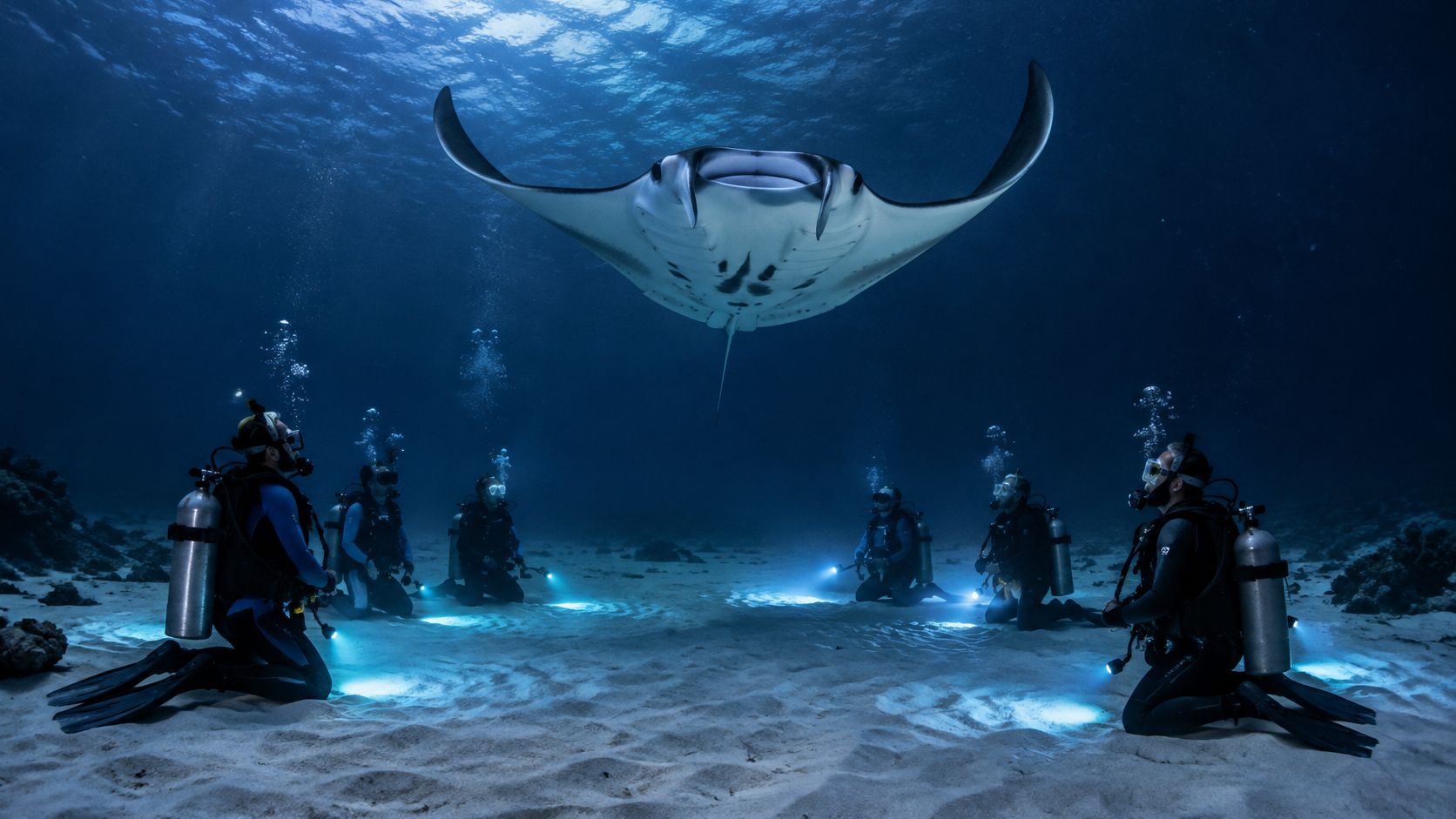
Make your body position the priority
Follow the guide to your assigned observation space. Don't move into the open center because another angle looks better, and don't settle on living reef. Keep hands, fins, and equipment under control.
Research summarized in Murray and colleagues' manta-interaction findings associates approaches within 3 meters, chasing, obstructing travel, and front-on positioning with stronger avoidance or interrupted feeding. The practical response is to maintain space rather than testing how close an animal will tolerate you.
A manta's repeated looping can be part of feeding. An abrupt turn away, evasive movement, or rapid departure is a reason to stop repositioning and give more room, not an invitation to follow.
Before-dive briefing block
Agree before descent: Know your observation position, light direction, problem signal, and exit route. Keep the animal's travel path open, and abandon any attempt to improve your view if its behavior changes.
- Settle deliberately. Confirm you're over appropriate bottom habitat before committing to a position.
- Aim with purpose. Keep the beam in the designated water column, not sweeping across nearby divers or reef.
- Leave the route open. Don't rise into an approaching animal's path.
- Stop pursuing the angle. If you can't get the photograph from an appropriate position, let that photograph go.
You can't diagnose an animal's internal stress from a single movement. You can recognize that it changed course as you approached and choose the less intrusive response.
The responsible diver etiquette guide supports the same practical mindset: manage your own body before trying to manage the encounter. A more distant observation isn't a failed dive when the animal continues behaving naturally.
Adapt the Experience for Divers and Non-Divers
Different participants occupy different parts of the viewing environment. The shared principle is leaving feeding and travel space available, but the practical tasks aren't identical. Choose a role you can perform without improvising around the animals.
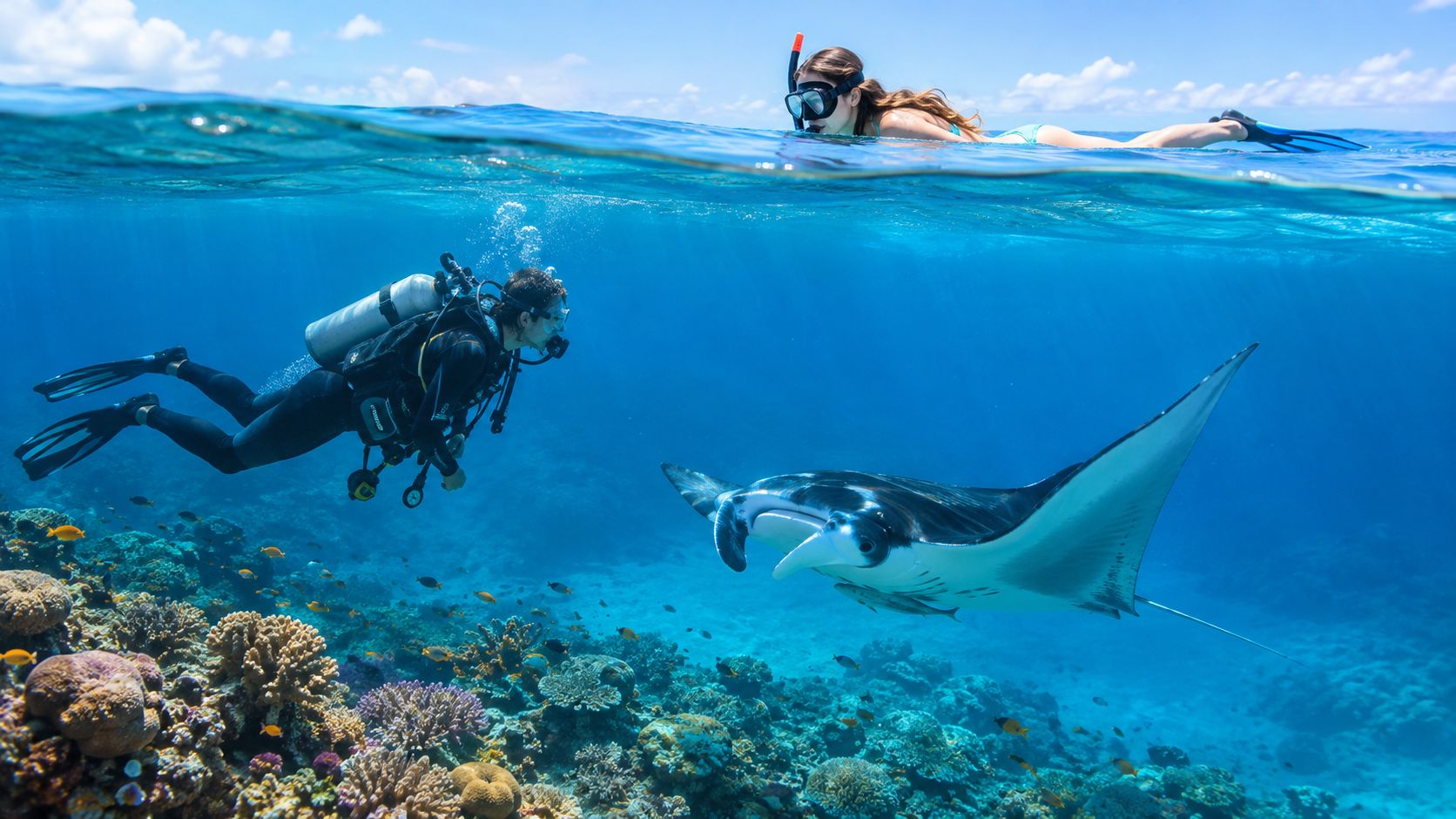
Scuba divers and surface snorkelers
Scuba divers manage equipment below the viewing space. Keep attention on the dive plan as well as the animals: breathing gas, guide signals, and your exit still matter when something remarkable passes overhead. Avoid letting a camera or the excitement of the encounter pull you upward out of your assigned position.
Snorkelers remain at the surface. In the surface-light arrangement described in the official guidance, lights point downward and participants don't descend into the feeding water column. Ask the guide how to position your body and use any provided support without kicking into the viewing space.
For families or mixed-experience groups, the comparison of snorkeling and diving with manta rays helps clarify the different perspectives. Don't choose solely on the assumption that the closer-looking perspective is better.
Freedivers need a separate decision
Freediving near mantas isn't ordinary snorkeling with an occasional duck dive. A descending participant can enter an animal's route from above, below, or in front, even without intending to intercept it.
Research on human interactions at manta cleaning stations supports user-specific guidance, including limiting freediving attempts near mantas to experienced snorkelers and avoiding intrusive approaches. Experience still doesn't override a site rule or an operator's prohibition.
For a managed nighttime feeding encounter, remain in the participation mode you booked. If your goal is breath-hold diving, discuss an appropriate separate plan with a qualified operator.
Photographers should plan for missed frames
A camera makes it easy to concentrate on the subject while forgetting where your fins, lights, and housing are going. Set controls before the encounter where practical, then work within the viewing position you've been given.
- Compose from your space. Don't cross the viewing area to match another photographer's angle.
- Confirm lighting rules. Ask about video lights and other accessories before entering.
- Accept an obstructed frame. Another diver in the photograph isn't a reason to block a manta.
- Pause when task-loaded. If camera handling disrupts your control, stop shooting.
Judge the result by whether you observed without interfering, not whether every pass became a usable image.
Book the Right Tour and Manage Pricing Expectations
Read the departure description as a set of practical commitments, not a wildlife guarantee. The useful comparison is what the operator provides, what you're expected to manage, and how the plan changes when conditions aren't suitable.
Confirm current pricing directly. Package arrangements and inclusions can differ, and a price without the equipment, participation details, and change policy doesn't tell you what you're buying.
Ask questions that affect the experience
- Activity format: Is the departure scuba, snorkeling, or mixed participation, and can everyone in your group join?
- Group arrangements: How many participants and guides are planned, and how are different activities supervised?
- Equipment: What's included, what costs extra, and what needs advance sizing or reservation?
- Changes: What happens if weather prevents departure, the site changes, or mantas don't appear?
- Support: How should an inexperienced participant request extra assistance before booking?
Compare the Kona boat-tour options against those needs rather than selecting by the most dramatic image.
Keep specialized alternatives separate
An experienced diver looking for another outing can review the premium advanced dive trip. The Kona blackwater dive is another specialized option to discuss with the operator, not an interchangeable substitute for manta viewing.
Kona Honu Divers offers guided manta dive and snorkel departures as one option for this encounter. Review the manta tour details and current booking information, then ask about Garden Eel Cove, your participation requirements, and the applicable policies.
Use reviews to assess descriptions of briefings, communication, and participant support. A report of an exceptionally close encounter isn't a prediction for your departure.
Kona Honu Divers offers guided manta ray dive and snorkel experiences for visitors choosing between underwater and surface viewing. Visit Kona Honu Divers to compare departures, ask about the Garden Eel Cove plan, and reserve an experience that fits your comfort and abilities. Arrive ready to observe, and leave the distance and timing to the mantas.