
A manta ray dive in Kona happens after dark, when lights at 30 to 40 feet concentrate plankton above a sandy bottom and reef mantas arrive to filter-feed through that illuminated water. At Garden Eel Cove, that defined light and positioning system is what makes the viewing organized and reliable, because you stay in place and the animals choose their own feeding paths above you.
You're probably reading this with a trip half planned, a certification card in a drawer, and one practical worry in mind. You want to know if you'll feel calm in dark water, if snorkelers in your group will see anything worthwhile, and whether the animals are being treated well. Those are the right questions, and they all have concrete answers once you understand how the night is set up.
What a Manta Ray Dive in Kona Actually Feels Like
The boat leaves while there's still color in the sky. You'll hear the engine, feel warm air turn cooler as the harbor falls behind you, and watch the crew move with the unhurried routine of people who've rigged the same lights hundreds of times. Masks get defogged. Regulators click during buddy checks. Wetsuits zip up one by one.
By the time you reach the site, daylight is mostly gone. That's intentional, and it's the part nervous first-timers usually misjudge. You aren't dropped into black water and left to orient yourself. You descend along a line toward a lit area that's already visible from above, a soft pool of light on pale sand.
The First Shape in the Dark
You settle on the bottom, get your breathing slow, and point your light up. At first you'll see only specks drifting in the beam. Then the edge of the light darkens, and a wide, pale underside rolls through it, mouth open, cephalic fins curled like scoops guiding water in.
It doesn't rush at you. It loops, turns, and comes back through the richest part of the plankton cloud. Your job the whole time is almost embarrassingly simple. Stay low, stay still, and look up.
The calmest divers usually get the closest passes, not because they did anything clever, but because they stopped trying to follow the animal.
Snorkelers get the mirror image of this from the surface, floating at a light board and looking down as mantas rise toward them. If your group is mixed, comparing the difference between snorkeling and diving with manta rays before you book helps everyone pick the view they will enjoy. Divers get scale and stillness. Snorkelers get proximity and a face level encounter.
What surprises many divers is the quiet. No one's chasing anything, no one's kicking hard, and the whole scene runs on a feeding pattern the animals control. You leave the water understanding why Kona built a reputation around this one night dive, and why the details of site, lighting, and positioning matter more than any promise on a booking page.
How a Manta Ray Night Dive Works
Strip away the atmosphere and a manta ray dive runs on one biological fact. Mantas are filter feeders, and they follow plankton. Artificial lights attract plankton into a concentrated column, and mantas aggregate to feed in that illuminated water, a pattern described in the history of Kona's manta night dive industry. Everything else is furniture arranged around that fact.
Think of moths circling a porch light, then scale it up. The light doesn't feed the mantas directly. It gathers their food into one predictable place, and the mantas do the rest, barrel rolling and looping through the densest part of the cloud with their mouths open.
The Setup, Step by Step
- Lights go on the sand: Divers settle on a sandy bottom at approximately 30 to 40 feet, or 9 to 12 meters, and aim their lights upward so plankton collects in the water column above them, as outlined in the Garden Eel Cove light and positioning system.
- Divers stay below the food: You're underneath the feeding zone, not inside it, which leaves mantas an unobstructed runway for repeated passes.
- Snorkelers use a campfire board: Lights mounted below a floating board concentrate plankton at the surface, creating a focused viewing area you hold onto rather than swim around.
- Nobody herds the animals: If a manta wants a different part of the column, it goes there, and your light circle stays put.
This is why the experience feels choreographed when it isn't. The humans are fixed points. The animals are the only ones moving freely, which is exactly how it should be.
Why Kona, and Why These Mantas Return
Kona's encounters rest on recurring site use by recognizable individuals, not random luck. Long term monitoring at two principal sites recorded 25,444 manta observations involving 118 individually identified reef manta rays, with 19,841 at Manta Heaven and 5,603 at Manta Village. Individual mantas can be told apart by the spot patterns on their undersides, which is how researchers track who returns.
The industry grew around that predictability starting in the late 1980s, when lights near the present day Sheraton Keauhou Bay Resort began concentrating plankton after dark. By 2002, nine Kona operators carried approximately 11,000 divers and snorkelers on manta excursions, producing about $920,000 in direct annual revenue and an estimated $2.5 million in broader annual economic activity.
So when a crew member tells you the mantas know this place, that isn't folklore. It's a documented pattern of the same animals returning to feed where plankton reliably gathers, and your stillness on the sand is part of what keeps that pattern working.
Why Garden Eel Cove Is the Superior Manta Dive Site
Kona has more than one named manta site, and honest operators will tell you mantas feed at several of them. Manta Heaven in Makako Bay and Manta Village near Kaukalaelae Point built the early reputation. Garden Eel Cove earns the recommendation for visitors today on three specific grounds: shelter, floor, and data.
Shelter Changes the Whole Night
Garden Eel Cove is a naturally protected cove sheltered from larger open ocean swells, which can produce calmer nighttime surface conditions, according to the description of Garden Eel Cove's protected setting. For a snorkeler holding a board in the dark, that shelter is the difference between relaxing and bracing. For a diver, it means an easier descent and a steadier platform for getting on and off the boat.
Families feel this most. A nervous swimmer in calm water watches mantas. A nervous swimmer in chop watches the board, the boat, and their own breathing, in that order.
A Sandy Floor That Protects Everyone
The cove's broad sandy viewing area keeps participants positioned away from living coral while leaving mantas unobstructed space to maneuver and feed. You're kneeling on sand, not hovering over reef you're afraid of kicking. The mantas get a clean, open corridor above you. Photographers get a stable base, and guides get a group they can keep organized.
| Site | Setting | Viewing Floor | Reliability |
|---|---|---|---|
| Garden Eel Cove | Naturally protected cove, sheltered from open ocean swell | Broad sandy area away from living coral, with better reefs nearby for the earlier dive | Larger aggregations than Keauhou in long term citizen science records |
| Manta Village | Near Kaukalaelae Point, historically significant southern site | More exposed coastal setting | Documented recurring use, fewer recorded observations than the northern site |
| Manta Heaven | Makako Bay, open coastal site | Established viewing area | Strong historical observation record |
What the Long Term Data Shows
A 2025 University of Hawaiʻi study analyzed 13 years of citizen science observations, covering more than 23,000 manta sightings and 167 individual reef manta rays at Garden Eel Cove and Keauhou, as recorded in the University of Hawaiʻi study of Kona manta aggregations. Garden Eel Cove consistently produced larger aggregations than Keauhou. Aggregation size also tracked zooplankton density across seasons and years, which confirms the mechanism you're relying on. Where the food concentrates most dependably, the mantas gather most dependably.
That's a defensible reason to choose this site, not a slogan. You're picking the cove with shelter for your group, sand under your knees, healthy reef for your first dive, and the strongest recorded aggregations for your night dive.
Night-Dive Logistics, Safety, and Etiquette
A well run manta ray dive feels calm because the logistics are strict. You'll check in during daylight, get fitted for gear, and hear the full briefing on the ride out, before anyone is tired, wet, or distracted. Listen for specifics in that briefing. Vague briefings are a warning sign on any night dive, and understanding what's involved in scuba diving at night helps you spot the difference.
In the Water, in Order
- Descend the line: You go down with your buddy along the operator's line to the sandy viewing area.
- Find your light circle: Your guide positions you on the sand, light aimed up, with space between you and the next diver.
- Stay in that circle: You remain within your light circle and maintain buddy contact for the whole dive.
- Ascend the same line: You come up only along the operator's line and never surface away from the vessel.
That last rule exists because of scale. As many as 10 boats and roughly 80 divers and snorkelers may share the area at one time, according to the Garden Eel Cove site and safety guide. Surfacing away from your boat in the dark, among other vessels, is the one dangerous move available to you, so the rule is absolute.
Eighty people sounds crowded until you see the geometry. Everyone is stationary, spread across a wide sandy area, looking up. It feels less like a crowd and more like an audience.
Practical rule: If you're unsure where you are, don't swim to find out. Stay put, signal your buddy, and let your guide come to you.
The Etiquette Is Biology, Not Politeness
You must not touch, chase, block, or ride a manta. Contact can remove the animal's protective mucus layer, and interference disrupts the feeding behavior you came to watch. Blocking a feeding path to get a closer look usually produces the opposite result. The manta moves on to feed elsewhere.
Good operators also make judgment calls you'll never notice. A guide who sees an animal repeatedly veering away from a group, or conditions getting crowded, should reposition people or shorten the encounter. More manta time isn't automatically better wildlife tourism. Encounter quality is better measured by low impact behavior and the animal's freedom to leave.
On the boat, expect surface lookouts, a counted entry and exit for every participant, and oxygen on board. If a crew can explain their lighting discipline, group spacing, and what ends a dive early, you're looking at a safety culture, not a sales pitch.
Gear, Wetsuits, and Photography Tips
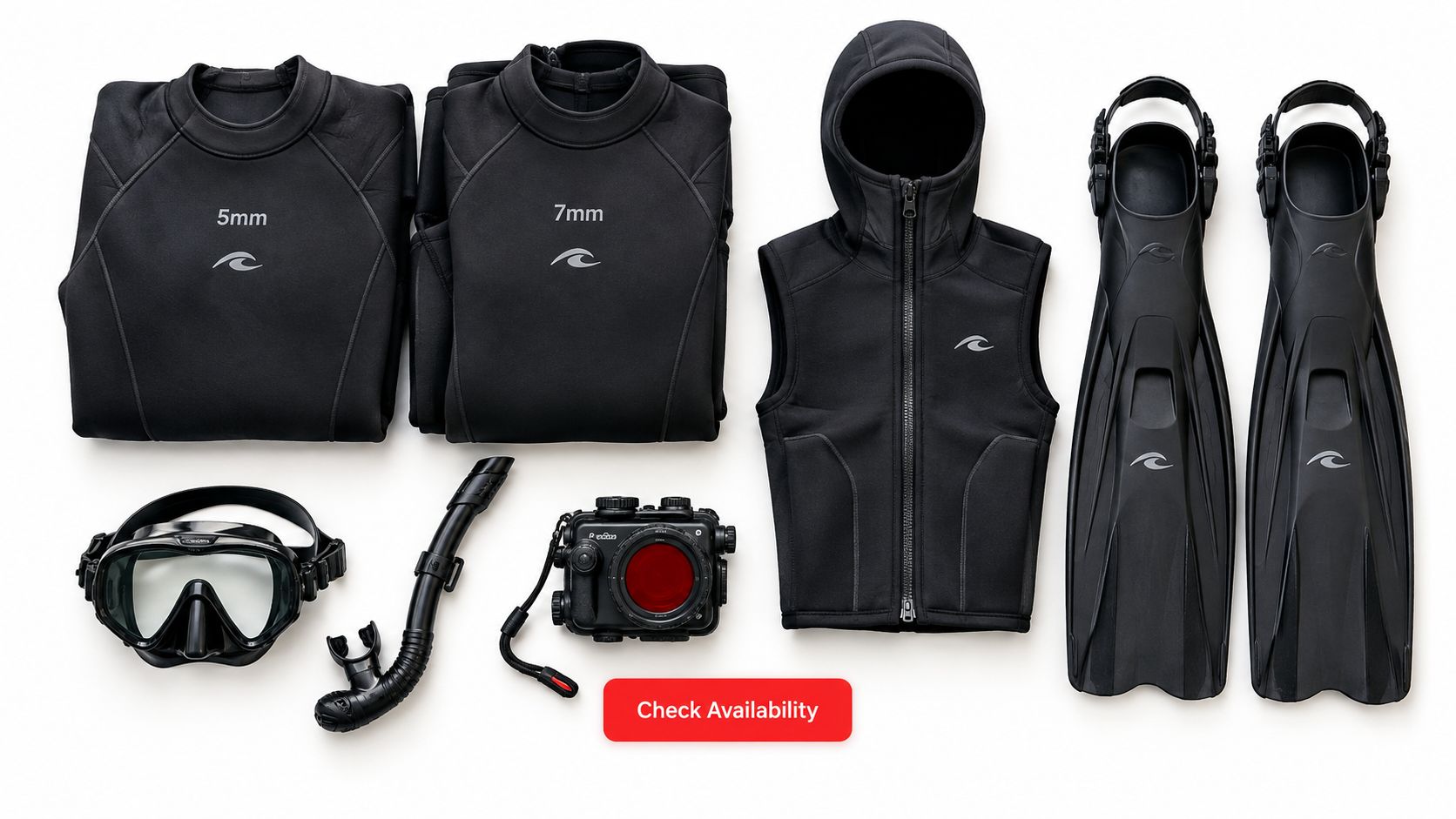
You'll be nearly motionless in the water after sunset, and stillness makes you cold faster than swimming does. Dress warmer than you think you need to. A well fitting full wetsuit with a hooded vest underneath is a sensible night setup, and if you tend to chill easily, say so at check in rather than shivering through the best passes of the night.
What Actually Matters in Your Kit
- Primary light: A bright, wide beam light is your contribution to the plankton column, not just a torch for finding your way.
- Backup light: A small secondary light, clipped where you can reach it without looking.
- Low profile fins: Short, controlled movements keep sand out of the water column and out of everyone's photos.
- Snug mask: You'll be looking up for most of the dive, so a slow leak becomes a constant distraction.
Photographing an Animal That Fills the Frame
Night manta photography fails in predictable ways. Autofocus hunts in low contrast water, the subject arrives faster and closer than expected, and a narrow lens turns a full animal into an unidentifiable white wing. Go wide. A wide angle or fisheye lens forgives the mantas' habit of passing directly overhead.
Use a focus light sparingly and keep video lights balanced. Blasting maximum brightness at close range blows out the pale underside and can push the animal off its feeding line. Stay low, shoot up, and let the manta cross your frame instead of tracking it like a sports photographer.
If you'd rather watch with both eyes and still go home with images, a Kona manta night dive with a photo package removes the camera from your hands entirely. Snorkelers can keep it simpler. A small action camera on a short pole, held steady at the board, captures the surface view well, and you'll enjoy the night more if you lower it for a few passes and just watch.
Best Times of Year and Conditions for a Manta Dive
Mantas don't work to a calendar. They work to a food supply. Seasonal and annual changes in aggregation size at Kona's sites closely tracked zooplankton density, which means prey availability is a major factor controlling manta presence. When plankton is abundant, aggregations grow. When it thins out, the same site on the same weekday can feel completely different.
That single insight explains most timing advice. Operators and repeat visitors generally report strong encounters across the year in Kona, with particularly dependable feeding activity during the longer, more stable days from late spring through early autumn. No honest operator converts that pattern into a promise for your specific Tuesday.
Reading Conditions Like a Guide Does
- Plankton first: Water temperature, currents, and recent ocean conditions shape plankton abundance, and plankton shapes everything else.
- Surface weather second: Wind and swell decide whether the boat ride and surface interval are comfortable, especially for snorkelers.
- Moon and ambient light third: Darker nights make the light column more defined and the scene more dramatic, though mantas feed under a full moon too.
For a deeper seasonal breakdown, the guide to the best time to see manta rays in Kona walks through the calendar month by month. Use it to pick a window, then build flexibility into your trip. Booking your manta night early in your stay leaves room to reschedule if weather closes in, which is the most practical odds improving move you control.
Choosing an operator that tracks local plankton and weather conditions, and will tell you plainly when tonight looks poor, beats choosing one that runs on a fixed schedule and hopes.
Treat any talk of guaranteed sightings with suspicion. A crew can guarantee the site, the setup, the briefing, and their own effort. They cannot guarantee a wild animal's appetite, and a company willing to blur that line is telling you something about how it handles other lines too.
Booking, Pricing, and a Sample Kona Manta Dive Day
Booking starts with one decision. Certified divers take the two tank format, an afternoon reef dive followed by the manta dive after dark. Non divers and mixed groups take the snorkel option at the light board. Both watch the same feeding event from opposite sides of the light column, so nobody in your group gets the lesser version.
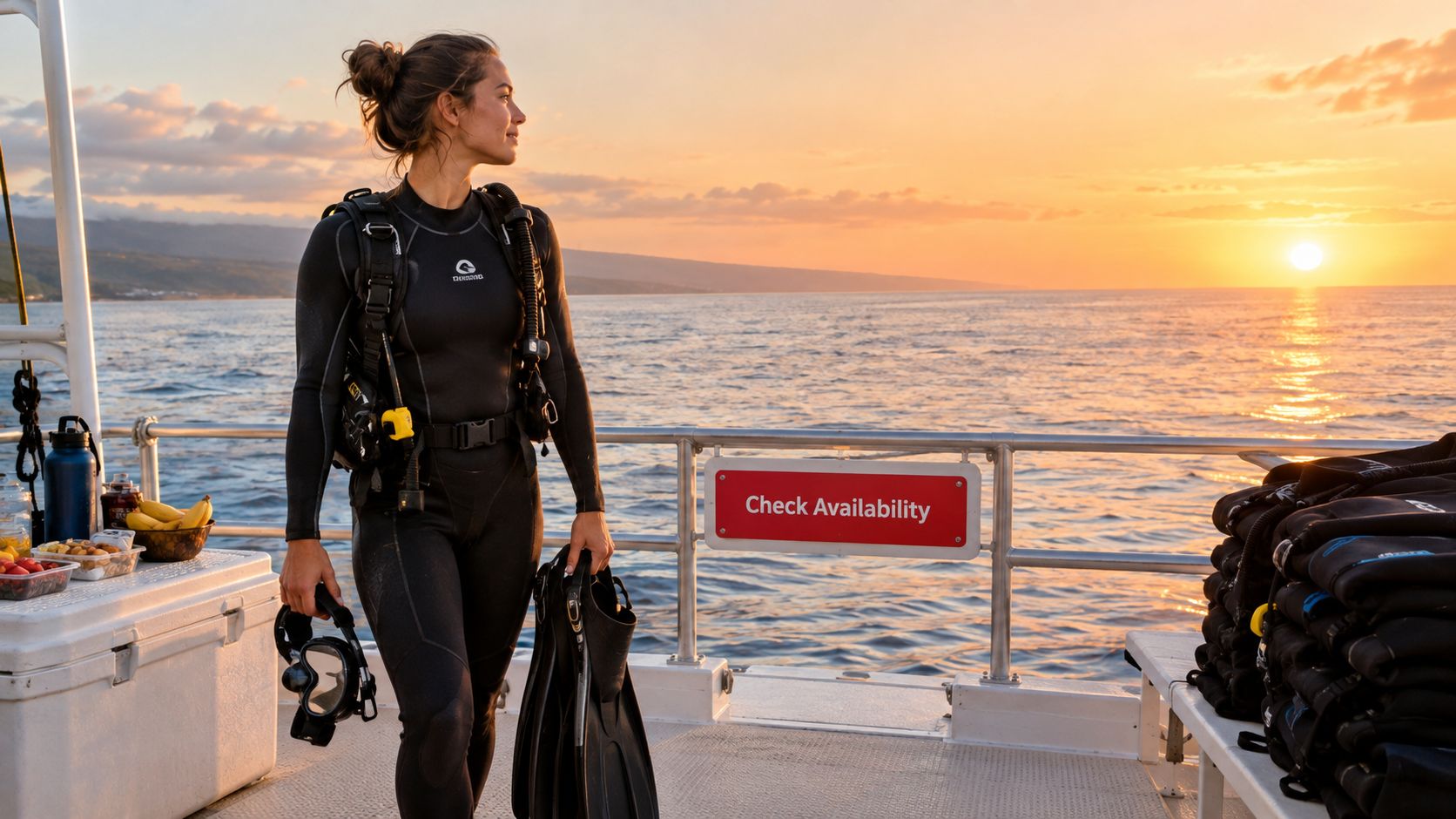
With Kona Honu Divers, the 2-tank manta dive and snorkel tour pairs that afternoon reef dive with the night dive at Garden Eel Cove, and the broader Kona diving tours page shows how it fits alongside morning charters if you're building a multi day package. Package pricing across several trips usually beats booking each night separately, so ask before you pay for a single outing.
How the Evening Unfolds
You'll check in at the harbor in the afternoon and get fitted for a wetsuit and gear while it's still light. The first dive explores the reef in daylight, which doubles as a relaxed shakedown for your buoyancy and equipment. Between dives you eat, warm up, and hear the manta briefing as the sun drops. Then you gear up again, descend to the sand, and spend the dive in your light circle before ascending the line, debriefing on the ride back, and rinsing gear at the dock.
Bring a towel, a dry layer for the ride home, and any personal medication for motion sickness taken well before departure. If night diving hooks you, the Kona blackwater dive is the natural next step, drifting in open water watching pelagic creatures rise from the deep.
FAQs, Ethics, and Booking a Responsible Manta Dive
Are Manta Sightings Guaranteed
No, and you should be glad when an operator says so plainly. Mantas follow plankton, and changing sea temperatures, ocean acidification, and currents can alter plankton abundance and therefore manta presence, as explained in the overview of manta ray threats and variability. A cancelled trip, a safe dive with few sightings, and a dive shortened to protect an animal are three different outcomes, and a trustworthy crew explains which one you're in and why. Promising guaranteed wildlife creates pressure to crowd or pursue animals. Transparent uncertainty protects both the mantas and your trust.
Can Non Divers and Nervous Swimmers Join
Yes. Snorkelers float at a buoyant light board rather than swimming freely, and Garden Eel Cove's sheltered surface conditions suit families and less confident swimmers. Children do best when they've snorkeled in daylight first, so the mask and breathing feel familiar before darkness is added. Tell the crew about nerves at check in, not at the swim step.
What Happens When Weather Turns
Expect the operator to cancel or reschedule when surface conditions make the site unsafe, and confirm the exact policy before you book. Scheduling your manta night early in your trip is your best hedge. A company that explains its weather thresholds in advance is easier to trust than one that improvises.
Why Your Behavior Carries Real Weight
Manta tourism is large enough to matter economically. A 2013 global assessment estimated more than 1 million manta dives and snorkeling encounters annually across 23 countries, generating over US$73 million in direct revenue and approximately US$140 million in total economic impact, according to the global assessment of manta ray tourism. That money gives coastal communities a reason to protect aggregation sites.
The animals, though, replace themselves slowly. The IUCN classifies both manta species as globally Vulnerable, females typically mature at 8 to 10 years, and reproduction generally produces only one pup every two years, with a median maximum intrinsic population growth rate of only 0.11. NOAA also identifies tourism, vessel strikes, marine debris, and climate change as threats to monitor alongside fishing, in the NOAA profile of the giant manta ray.
So book like it matters. Put into practice responsible and considerate diver etiquette, choose operators with clear briefing, lighting, and reporting standards, and measure your night by how little you disturbed the feeding in front of you. That's the version of this dive that will still be running, with the same named animals, when you come back.
Kona Honu Divers runs the two tank manta ray dive at Garden Eel Cove, pairing an afternoon reef dive with the night dive and a full briefing on positioning, lighting, and low impact etiquette. If you're ready to pick your night, check dates early in your trip so weather flexibility works in your favor, and start at Kona Honu Divers to book your spot on the sand.