
Table of Contents
- What the cove lets a crew do
- Kit that actually matters
- The decision rule
- From the dock to the sand
- Holding the lane
- What to ask before you book
- Five different questions
- A short operator checklist
You're on a Kona balcony with two tabs open, one for a night dive and one for a night snorkel, and the coast is already dark. The choice feels bigger than a checkbox. Certified divers kneel in a pool of light. Everyone else floats above it. The rays are wild, and they show up to feed, not because anyone baited them.
A manta night dive Hawaii trip is a sit-and-watch, not a chase. I'll tell you which format fits, why I would pick Garden Eel Cove, how the night runs, and the crowding and footprint questions most booking pages skip.
Choose Between the Manta Night Dive and Night Snorkel
The same lit reef hosts two trips, and the fork is where you sit in the water.
On the night dive, certified divers kneel on sand beside the light field while mantas loop through the open water above them. On the night snorkel, guests float at the surface and watch those same passes from above. Both formats use light to pull plankton into a temporary patch. The animals filter-feed. Nobody hands them food.
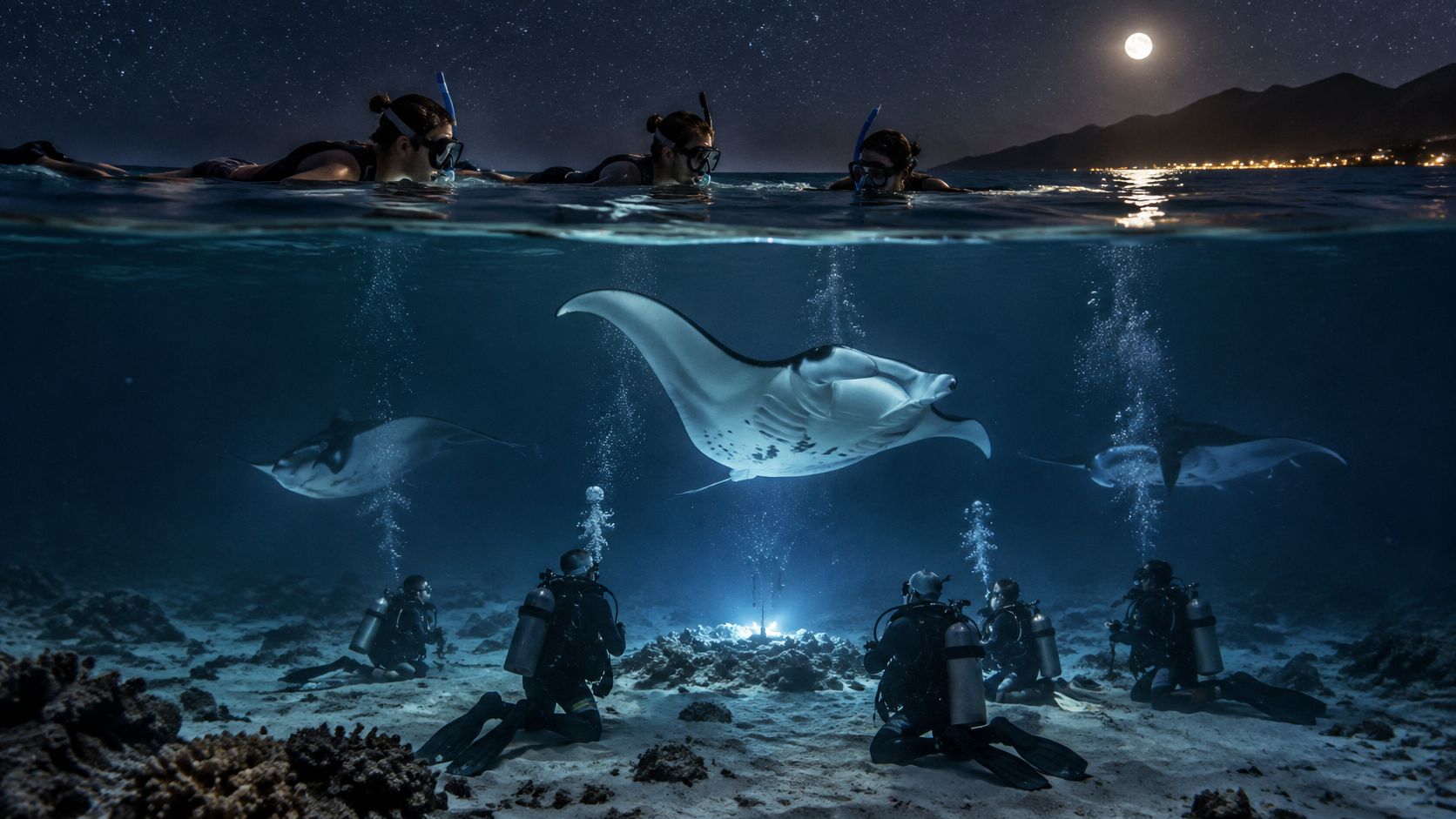
| Format | Position in the water | Equipment | Role of the light |
|---|---|---|---|
| Night dive | Kneeling on the sandy bottom, below the feeding area | Scuba gear and a dive light | Crew places powerful lights on the seafloor |
| Night snorkel | Floating at the surface above the feeding area | Mask, snorkel and fins | Snorkelers direct lights downward |
The night dive is open to all certified divers. The snorkel suits beginners through confident swimmers who are comfortable with a mask and fins. You don't need a specialty card to watch from the surface, and you don't get a closer seat just by being brave in the dark.
This stop has been busy for a long time. Historical documentation places snorkeling and scuba at Kona manta sites as early as 1984, and a 2018 assessment found at least 42 operators running tours at the principal sites, on boats carrying about 6 to 40 passengers, according to county testimony on the Needham assessment. Independent estimates cited in that NOAA material put annual interactions at Ho'ona Bay above 10,000 people. Volume is why your format, and your operator's spacing, matters more than a pretty photo.
Quick pick: Choose the dive if you're certified and want to be close to the lights. Choose the snorkel if you're not certified or you'd rather stay at the surface.
If you're still split, the longer comparison of whether it's better to snorkel or dive with manta rays walks through comfort, certification, and what each view shows.
Why Garden Eel Cove Is the Better Manta Dive Site
Garden Eel Cove is the better site for a manta night dive. The long-term record shows larger feeding groups there, and the cove lets a crew hold a stable viewing line.
Garden Eel Cove and Keauhou sit about 20 kilometers apart on the Kona coast. A published long-term dataset found that Garden Eel Cove supported larger and more variable aggregations, while Keauhou generally hosted smaller groups, and that females accounted for about 91% of sightings at Keauhou, with Garden Eel Cove comparatively balanced between sexes, as reported in the site-use study in Environmental Biology of Fishes. The same work found connectivity between the sites and high site fidelity among females at Keauhou. Related does not mean interchangeable.
| Site | Typical aggregation | Sex balance of sightings | Viewing setup |
|---|---|---|---|
| Garden Eel Cove | Larger and more variable aggregations | Comparatively balanced between sexes | Protected location with a better viewing area |
| Keauhou | Smaller groups | About 91 percent of sightings female | Shared coastal site with a tighter feeding group |
What the cove lets a crew do
Garden Eel Cove is protected, with a better viewing area and healthier reef, and it's generally calmer than open swell. Guides can set guests in one formation, keep a clear gap off the reef, and leave an open lane for repeated passes. A scattered group on a lumpy site breaks that lane. People drift, fins drop, and the rays have to reroute.
Our go-to for this dive is Garden Eel Cove for that reason. On our Manta Ray Night Dive trips, divers have seen manta rays on 92% of trips. That figure is a track record, not a promise that every night fills the cove. Plankton still decides how many rays show, and how long they stay.
Lights go on after dusk. There isn't a magic clock time that beats a thin plankton night, so plan a flexible evening rather than a sunset you can't move.
Ask three things before you pay: which site the boat uses, how many guests share the viewing area, and whether guides set positions before the lights go on.
If the answer is “we'll see when we get there,” you're buying a crowd, not a managed light field. Background on manta rays in Hawaii helps you read those answers, including why a female-heavy site and a mixed feeding site aren't the same night.
Preparing for a Night Dive by Experience Level
Match the format to the card you hold, then fix the skills that fail after dark.
| Experience level | Certification needed | Preparation | Next step |
|---|---|---|---|
| Certified, new to night diving | Open Water or higher | Shallow daylight practice and light test | Take the full crew briefing seriously |
| Certified, experienced | Advanced or higher | Daylight buoyancy check and light handling; PADI Manta Ray Diver specialty for first-timers to mantas | Compare with advanced options before booking |
| Snorkeler, no certification | None required | Confident swimming with mask and fin skills | Book the night snorkel format |
| Family or group traveler | Mixed certifications | Check group ratios and separation from snorkelers | Ask the operator for its group ratio |
Kit that actually matters
A working dive light, plus a spare. Test both on the boat, including the switch with gloves on. A dead primary light turns you into someone else's problem.
A mask that seals. Night is a bad time to discover a new skirt leak. Use the mask you already trust.
Exposure protection for the water you'll sit in. A shorty that felt fine at noon feels thin once you stop swimming and kneel.
Buoyancy you can hold without thinking. The dive is shallow and still. If you yo-yo, your fins hit sand or you drift into the feeding lane.
The PADI Manta Ray Diver specialty covers manta biology, behavior, and conservation, and it teaches respectful interaction before the night dive. I would take it if mantas are new to you, even if your night-diving skills are already solid. It won't replace a briefing. It stops the “can I touch it” moment before you're in the water.
The decision rule
- New to night diving: Do a shallow daylight practice first. Test your light before the boat leaves. Keep a hand on your buddy's gear in the dark. Tell the crew early if you feel uneasy.
- Already comfortable at night: Spend the briefing on where you kneel, not on how your BCD works.
- Not certified: Don't talk yourself into the scuba seat. The surface format is the right tool.
- Mixed group: Split formats on one boat only if divers and snorkelers stay separated.
If you're unsure whether a Big Island boat even wants newer divers, read whether diving experience is needed for Big Island dives before you book the wrong trip.
How the Manta Night Dive Unfolds Step by Step
The night is a sequence, not a vibe. Each step has a reason, and a usual slip.
From the dock to the sand
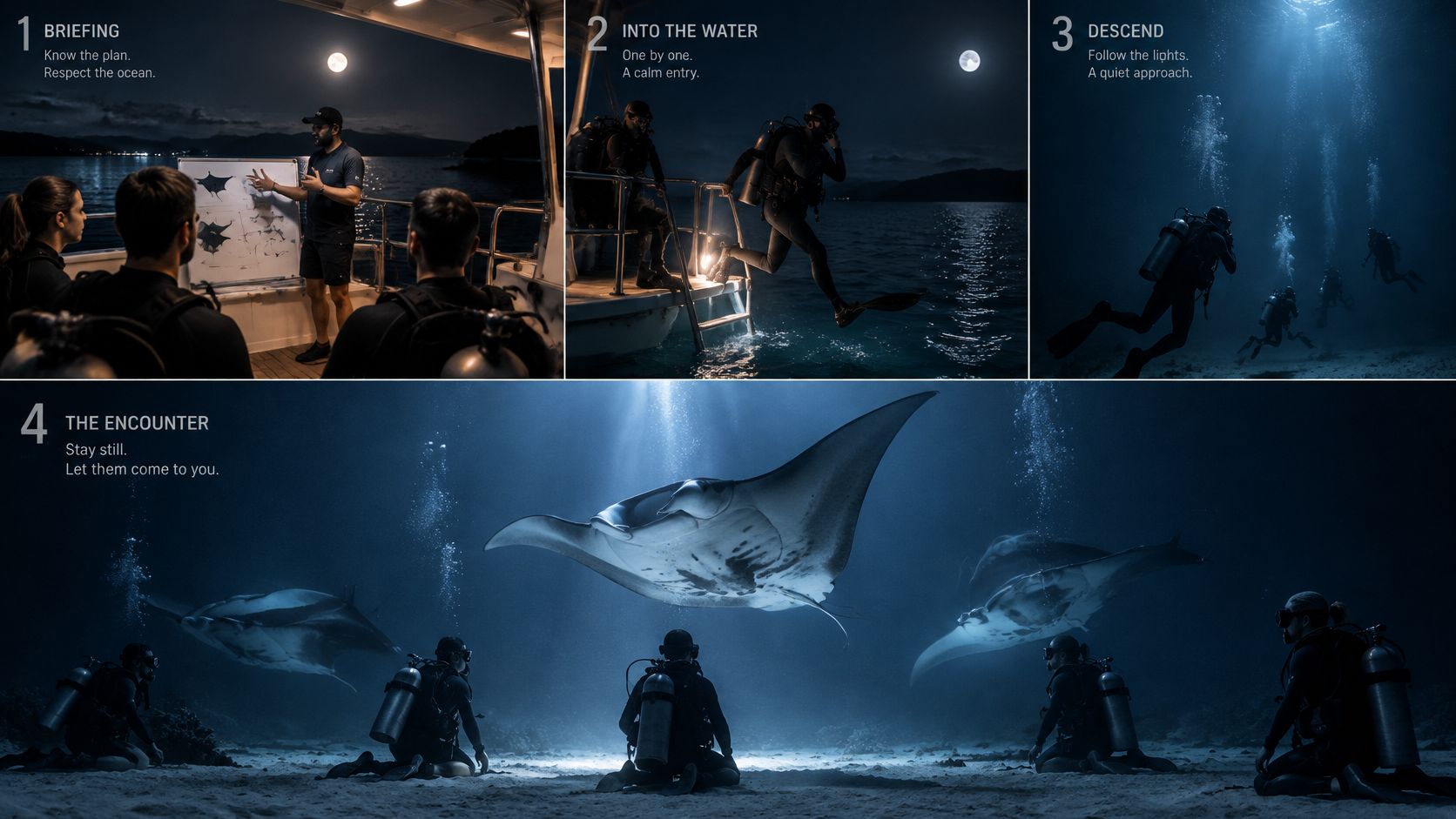
- Briefing. The night starts with a detailed crew briefing on the science and the golden rules of passive observation: no touching, no chasing, controlled fin strokes. Show up late and you miss the map of where you may kneel.
- Gearing up at dusk. The group stays together. Lights get tested before anyone hits the water. A light that “probably works” is how buddies get separated on the swim to the site.
- Descent to the sand. Divers go to a specific viewing area. Crew lights sit over sand or rubble, never on live coral, so the water column above stays open. The slip is kneeling on coral, or on rubble the crew didn't mark, because it looked empty in the dark.
Powerful lights make a bright circle on the seafloor. You are not in a blackout. You are in a small, managed patch with dark water beyond it.
Holding the lane
- Plankton builds in the beam. Zooplankton, the small drifting animals mantas filter, stacks up in the light. That patch is why rays loop back. Divers hold their own lights above their heads and point them up, so the food sits over the group. The lights draw prey. They do not tame the animals.
- Hold your spot. Keep fin strokes small and stay out of the feeding corridor, the looping path. Swimming into that lane for a “better” photo is how you make the ray abort the pass.
- Let the passes come to you. Stay still. Don't chase, and don't flash a beam into a ray's face or across its path. A healthy night looks like repeated close passes and calm feeding, with nobody sprinting after an animal.
- Ascent and debrief. Stay with the group, follow the divemaster, and talk through what you saw while it's fresh. That's when you learn whether you drifted, blinded someone, or stayed in the lane.
If you only remember one mechanic, remember this: you are furniture in the light field. The ray is the one that moves.
Night diving skills that transfer, like light signals and buddy contact, are covered in scuba diving at night. On this site they serve one job, keeping you planted so the lane stays clear.
Safety, Crowding and Boat Traffic After Dark
The planning question most pages skip is simple. How many people, and how many boats, will share your patch of black water?
A Hawaiʻi state boating-safety assessment flagged congested nighttime activity, with vessels operating near divers and snorkelers. Reporting on that assessment says the busiest nights can put more than 290 people in the water, and it documented boats passing within 10 to 20 feet of unlit snorkelers or over submerged divers. The same reporting describes a 2015 conclusion that, without substantial mitigation, a severe accident was likely, in the Manta Ray Viewing Boating Operations and Safety Assessment.
That record does not make every trip unsafe. It does change what you should ask. A quiet night is not automatically a better night. Ray counts track the food in the water, so fewer people don't guarantee more mantas. Fewer boats and fewer bodies do cut collision and entanglement exposure. I'd rather have a modest plankton night with disciplined traffic than a packed bay and a spectacular feed.
What to ask before you book
- Vessel limits: How many boats does this operator expect on site, and what's their own passenger cap?
- Lookouts: Who watches the surface while divers are down, and how are approaching boats hailed?
- Lighting: Are guest lights kept off the rays' eyes and out of the traffic lanes between boats?
- Separation: Where do snorkelers float relative to submerged divers, and who enforces that line?
- People in the water with you: Experienced divemasters and instructors are in the water to manage the group. Ask how many, and the diver-to-guide ratio.
- If the night goes sideways: What's the recall, the headcount, and the plan if wind, swell, or a medical issue ends the dive early?
Families, older travelers, and anxious first-timers should weigh those answers harder than the photo gallery. Experienced divers comparing a packed boat with a smaller one should too. Buoyancy still matters here. A diver who pops up unplanned is a surface target.
Protecting Manta Rays on Every Night Dive
A stable aggregation is not the same thing as a harmless practice. Travelers who care about the animals should stop treating “we didn't feed them” as a full environmental report.
A 2025 University of Hawaiʻi study analyzed more than 23,000 sightings of 167 individual reef manta rays from 2010 to 2022. Aggregation patterns stayed relatively stable despite more tourism, while prey availability, especially zooplankton density, strongly influenced how many mantas appeared and when, according to the University of Hawaiʻi study record. Stable counts can mean adaptable animals, decent food, or effects nobody has measured yet.
A NOAA review cites research finding lower emergent zooplankton abundance and diversity at a heavily used Kona manta site than at a less-used site, possibly linked to inadvertent habitat damage by divers. That's a footprint, even when nobody touches a ray.
Five different questions
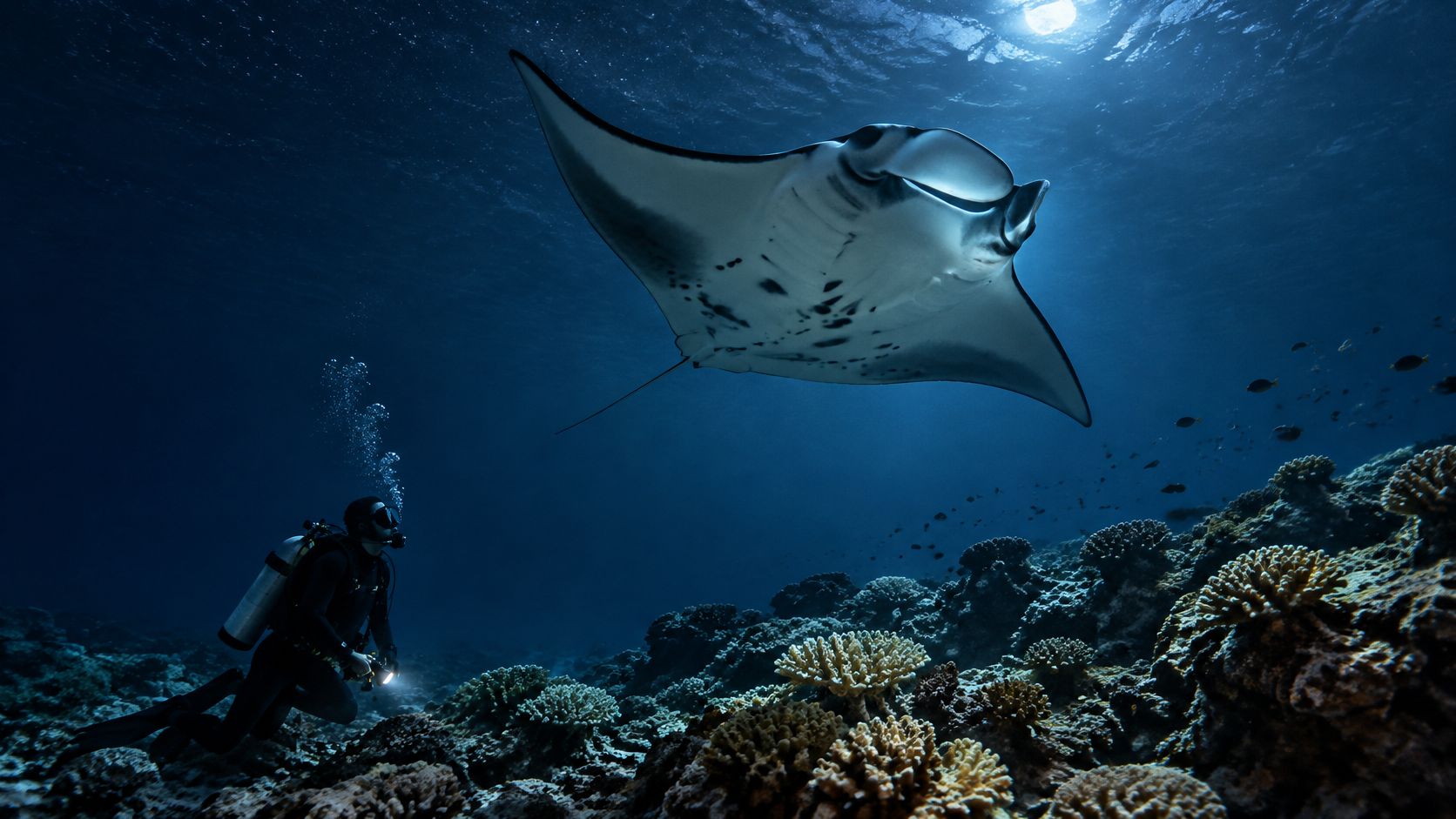
Population stability asks whether the local group is still showing up. Individual welfare asks whether any one ray is bumped, chased, or stressed. Seabed disturbance is fins and knees on sand, rubble, and coral. Light exposure is how beams are aimed. Prey concentration is the temporary food patch the lights create, which is the point of the dive and also the thing a badly placed group can scatter.
The current evidence supports neither alarm nor a claim of zero cost. Your job is to shrink your piece of it.
Hold buoyancy. Kneel only on sand the crew marks, and keep fins off the bottom. Never touch or chase a manta. Follow the position you're given. The how-to sits in the night's sequence. The standard behind it is responsible, considerate diver etiquette.
Book Your Manta Night Dive With Confidence
Confirm four things, then book. Format, site, operator, and date. Leave any one of them fuzzy and you're guessing in the dark.
The Manta Ray Night Dive is one of the signature tours we run at Kona Honu Divers, listed for all divers and for bucket-list seekers. It's a stationary, closely supervised dive. Experienced guides keep the group together, comfortable, and inside a fixed viewing area at Garden Eel Cove. See the manta ray dive tour for that trip, and the diving tours page if you want the wider set of Kona trips beside it.
A short operator checklist
- Site: A protected cove, not “wherever the other boats are.”
- Briefing: Science plus passive-observation rules, before anyone gears up.
- Supervision: Divemasters in the water, not only a captain on the radio.
- Lights: A planned field over sand, with guest beams pointed up, not into faces.
- Group size: A cap you can hear out loud.
- Emergencies: A written plan for weather, separation, and a diver who wants out.
The most popular trips, including the manta ray night dive, often sell out weeks ahead. Pick the date before you pick the dinner reservation.
If you want another night in the water, the Kona blackwater dive is a different kind of darkness, offshore and aimed at drifting animals rather than a reef feeding lane. For more experienced diving in daylight range, the premium advanced two-tank trip is the longer, more demanding option. I would book the manta night first if this is your only evening, then add those if you still have days left.
Choose a date, confirm Garden Eel Cove and the briefing time, and book. Read recent guest notes before you commit.
Kona Honu Divers runs guided manta night dives and snorkels from Kona, with crew briefings, lights, and supervised time at Garden Eel Cove. If you want that managed night rather than a crowded guess, visit Kona Honu Divers and lock a date before the popular evenings are gone.