
You're probably comparing photos late at night, wondering if a Manta Dive Kona trip really looks like that, and whether you should dive, snorkel, or skip it because you're new to night diving. That's a fair place to start. This isn't a staged show with a set start time for the animals. It's wildlife watching after dark, shaped by light, food, and where each manta decides to feed. Once you understand that, the choices get much clearer and the experience gets better, not less exciting.
Discover Kona’s Nighttime Manta Experience
The boat ride feels ordinary at first. Then the sun drops, the coastline goes dark, and your guide puts lights in the water. Tiny specks start drifting through the beams. That's zooplankton, and it's the whole reason you're here.
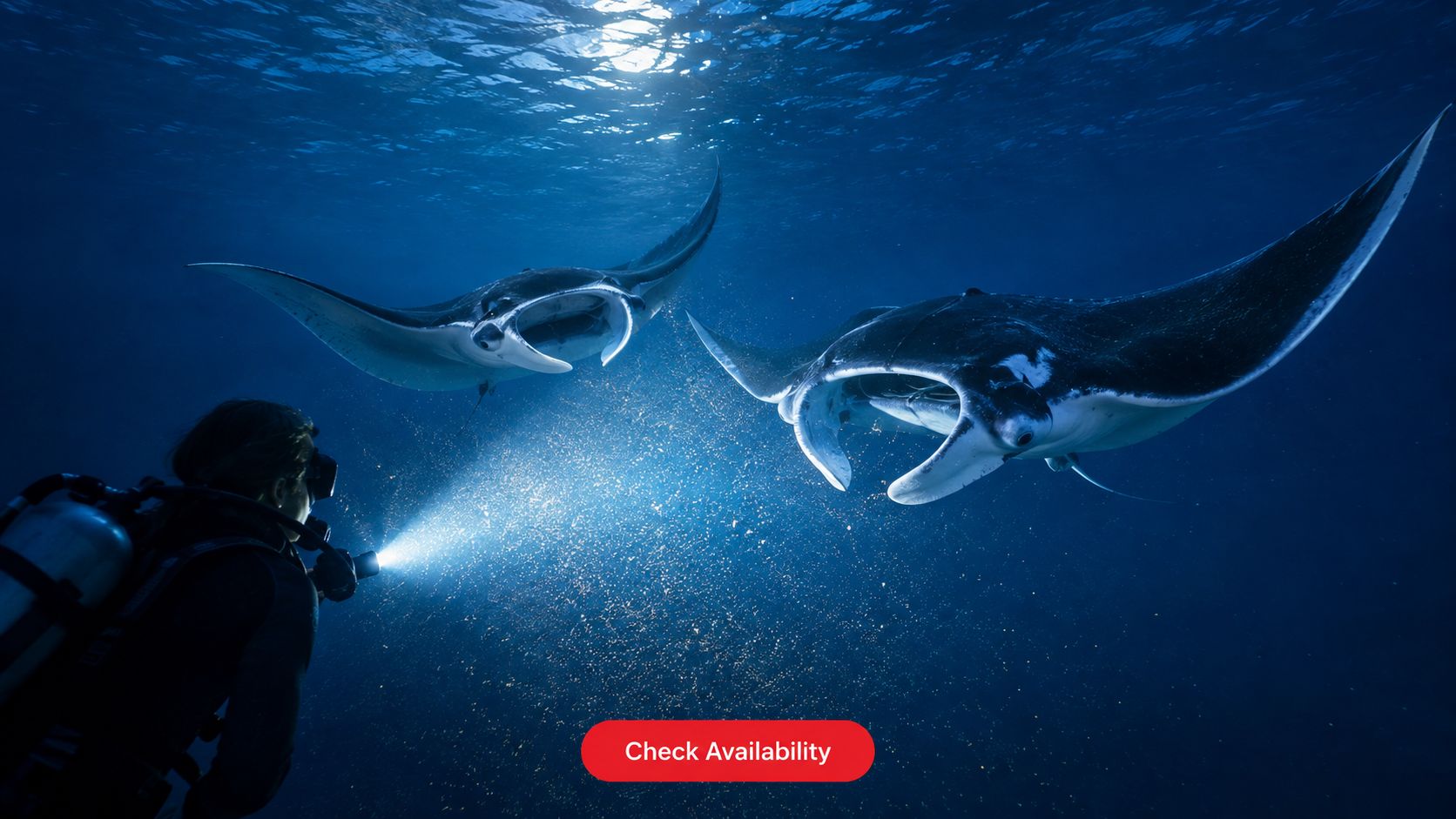
On a daytime reef dive, you swim and look for animals. On a manta night dive, you mostly settle in one place and wait. A reef manta ray, Mobula alfredi, may glide into the lit water, turn through the plankton, and feed overhead. Snorkelers watch from the surface looking down. Divers watch from below looking up.
Why This Is Not a Performance
Nobody puts out bait, and nobody can promise a specific number of mantas or close passes. The lights concentrate food that is already in the water. If plankton is thick, mantas have a reason to stay and feed. If it isn't, the night can be quiet.
That honesty shouldn't put you off. Kona has a long record here, which is why people travel for this dive.
- A known resident goes back decades. NOAA related historical accounts identify "Lefty" as the first recognized regular manta resident along the Kona Coast in 1979, with organized dives near the former Kona Surf Hotel operating by approximately 1991, according to the historical account of Lefty and early Kona manta dives.
- It grew into a real local industry. Hawaiʻi legislative testimony reported that by 2002, nine Kona operators carried about 11,000 snorkelers and divers, with roughly $920,000 in direct annual revenue and about $2.5 million in total yearly economic activity, as summarized in that same historical account linked above.
So you're choosing a well established wildlife encounter, not a new trend. You're also choosing patience. If you can accept that the mantas set the terms, you're the right fit for this dive, whether you're a certified diver, a snorkeler, or a photographer who prefers watching first and shooting second.
You're not buying a guaranteed animal. You're buying time in the right place, with the right light, on a night when feeding may happen in front of you.
Understand How Manta Feeding Aggregations Work
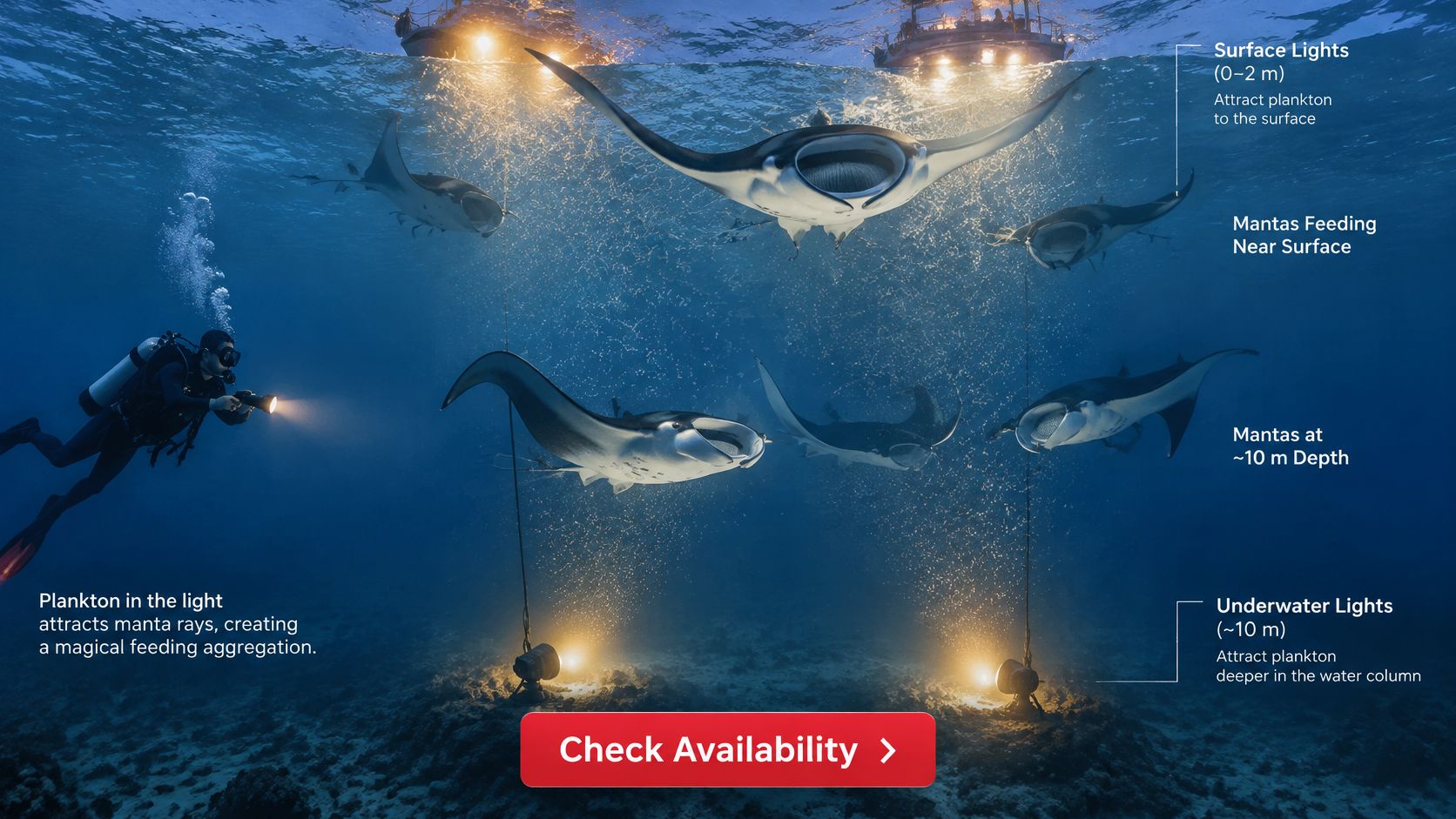
Think of a buffet restaurant. Staff can turn on the lights and open the doors, but guests only stay if there's food on the table. A Kona manta site works in a similar way, step by step.
Step by Step Underwater
- Lights go in near the surface and deeper. Lights positioned near the surface and approximately 10 m depth concentrate zooplankton in the water column, as described in the NOAA associated study of Kona's light mediated feeding sites.
- Plankton gathers in the beams. The light doesn't create plankton. It draws what's already drifting nearby into a smaller, denser patch.
- Mantas come to filter feed. A manta swims through that patch with its mouth open, filtering tiny food from the water. Loops and turns aren't tricks. They're feeding passes.
- You stay still and watch. Your job is to hold a stable position at the viewing boundary and keep the feeding corridor open.
That study also shows this isn't random. A six year NOAA associated study recorded 25,444 observations of 118 individually identified mantas at Manta Heaven and Manta Village, documented in the same NOAA study linked above. Individual animals returned again and again.
Here's where readers often get confused. Three outcomes sound similar, but they're different.
- Manta present means at least one animal visited the site.
- A feeding group means several mantas stayed to work the plankton patch.
- Close passes mean a manta chose a path near you while feeding.
You can get the first without the third, and that's still a real encounter.
Your Part in Keeping It Working
Don't chase, touch, or swim into a manta's path. Staying low and steady lowers collision risk and doesn't block the route the animal wants to repeat. Follow your guide on personal lights too, since the site lights already shape the feeding zone. Good responsible and considerate diver etiquette isn't just polite here. It's what keeps the animal comfortable enough to keep feeding while you watch.
Choose the Right Manta Dive Experience
Your first decision isn't which boat looks nicest in photos. It's where your body will be in the water, and what training that requires. Scuba and snorkeling put you in the same general scene from opposite directions.
| Experience Option | Access Consideration | Viewing Perspective | Best Fit |
|---|---|---|---|
| Scuba manta dive | Certification and recent dive readiness confirmed with the operator | From below, looking up at bellies and spot patterns | Certified divers comfortable diving at night |
| Night manta snorkel | No scuba certification, but comfort floating at the surface at night matters | From above, looking down into the lit water | Non divers, mixed groups, and families |
| Daytime reef diving first | Certification for scuba, arranged as a separate guided dive | Reef life in daylight, no manta feeding setup | Divers who want to get comfortable before a night dive |
If you're torn, read through the comparison of whether it's better to snorkel or dive with manta rays and be honest about comfort, not ego. A relaxed snorkeler usually has a better night than a nervous diver who's fighting buoyancy in the dark.
Pick Garden Eel Cove
For location, choose Garden Eel Cove, also known as Manta Heaven. It's the superior choice for a dive tour because its protected location gives you a more sheltered, better viewing area and a stronger reef environment than more exposed alternatives. That shelter matters at night, when you're trying to stay still, manage your light, and watch without getting pushed around.
The science backs up how consistent this site is. Garden Eel Cove sits in Makako Bay at approximately 19.736° N, 156.054° W, and a NOAA hosted study documented manta activity there on 1,702 of 2,017 monitored nights, or about 84%, according to the NOAA hosted study of Garden Eel Cove and Manta Village. Consistent doesn't mean guaranteed, but it does mean you're stacking the odds sensibly.
Start with the guided two tank manta dive and snorkel tour if mantas are your main goal. If you're comparing a manta night with other guided scuba diving Kona and Big Island options, browse the broader Kona diving tours before you commit. That way you're choosing based on fit, not just on one dramatic photo.
Plan Around Variable Manta Sightings
You might hear that Kona's mantas are residents and assume that means a big group shows up every night. It doesn't. Resident guests can still skip dinner when the food is better somewhere else.
Long term data makes this clear. A 2025 University of Hawaiʻi study analyzed more than 23,000 sightings of 167 individually identified reef mantas from 2010 through 2022 at Garden Eel Cove and Keauhou, as reported in the University of Hawaiʻi study record on Kona manta aggregations. That's thirteen years of community sourced observations, not a single good season.
What Actually Drives the Night
- Zooplankton density comes first. Aggregation size was positively correlated with zooplankton density in the Springer published analysis of Kona manta aggregation drivers.
- Site matters. Garden Eel Cove generally produced larger, more variable aggregations, while Keauhou showed smaller groups and a strong female bias of about 91% of sightings in the later study summary, per that same Springer analysis.
- Individuals behave differently. Females at Keauhou showed strong site fidelity, males appeared more mobile, and mantas moved between the two sites, based on the University of Hawaiʻi findings linked above.
In plain language, plankton productivity predicts your night better than a calendar date or a sales promise. Currents, visibility, and weather shape where plankton ends up and how well you can see. A quiet night doesn't mean the population vanished. It often means dinner was thin where you were sitting.
Planning rule: Ask any operator how they talk about a no show night before you book. A straight answer tells you more than a guarantee.
Use that mindset when you read about the best time to see manta rays in Kona. Build flexibility into your trip if you can, ask about rescheduling policies, and don't plan your only possible night for the last evening of your vacation. Give yourself a second chance, and you'll enjoy the first attempt more, whatever shows up.
The encouraging part is stability. Despite increased tourism during the study period, researchers found relative stability in the aggregations and no observed decline in the local population's viability at current activity levels, according to the University of Hawaiʻi study linked above. Variable doesn't mean fragile. It means wild.
Prepare for Safety and Certification Needs
A snorkeler and a scuba diver are not doing the same activity with different gear. A snorkeler stays at the surface and breathes through a tube. A diver carries a tank, descends, manages buoyancy and gas, and has to ascend safely in the dark. That difference drives every requirement.
Don't treat a certification card as automatic proof you're ready for this specific night. Confirm these points with your dive professional before you book.
Questions to Confirm Before Booking
- Certification and recency. Are you certified for the dive you're booking, and have you dived recently enough to handle skills calmly at night?
- Health readiness. Have you answered the operator's health questions and cleared anything that needs a professional opinion?
- Night skills. Can you hold position, follow a light based briefing, and manage an ascent with limited visual contrast?
- Snorkel comfort. If you're snorkeling, are you comfortable floating in the ocean after dark while holding your assigned position?
Reading up on scuba diving at night helps, but it doesn't replace the briefing on the boat. Listen for entry method, where to settle, how the group signals, and how you'll exit. If anything is unclear, ask before you get in. Nobody on a good crew will mind.
Underwater, the safety habits are simple. Get neutral, get stable, and stay where your guide placed you. Don't chase a manta that passes behind you. Turning and swimming after it messes up your buoyancy, your air use, and someone else's view, and it can put you in the animal's path on its next loop.
A Quick Fit Check
| You Are | Ask This First |
|---|---|
| Snorkeler | Am I comfortable at the surface at night with support nearby? |
| New diver | Should I do a daytime dive first to refresh basic skills? |
| Certified recreational diver | Am I current on buoyancy, gas checks, and night procedures? |
| Advanced diver | Can I manage task loading, current, and a camera without drifting into the corridor? |
If your honest answer points you to a different format, take it. Choosing the right level is not missing out. It's how you stay calm enough to enjoy a manta when one appears.
Pack and Prepare for the Dive
Most pre dive stress comes from small, avoidable stuff. A mask that leaks. A camera you haven't tested. Not knowing what the operator provides. Fix those on land and the night gets much easier.
Start by asking what's included and what isn't. Operators commonly arrange core dive or snorkel equipment, lights for the site setup, and the briefing. You handle personal comfort items, any medication or health information you need to share, and your own gear if you prefer using it. Treat the final list as a short conversation with the operator, not a universal prescription.
A Simple Preparation Sequence
- Confirm the booking details. Check in time, meeting place, what to bring, and who to contact if conditions change.
- Test fit early. Try your mask for seal and comfort. If you use your own equipment, check straps, batteries, and anything that sat in storage.
- Sort exposure and comfort. Confirm wetsuit arrangements with the operator, wear your swimsuit under your clothes to save hassle, and bring footwear that handles a wet dock.
- Prepare the camera on land. Charge batteries, clear storage, and check your housing seal before you're on a dark boat.
- Pack for the ride back. Bring a towel, a dry change of clothes, and water. You'll feel cooler after a night in the ocean than you expect.
- Stash valuables safely. Leave what you don't need at your lodging and keep essentials in one dry spot you can find in the dark.
Familiar gear matters more at night than during the day. When you can't rely on a quick glance, your hands need to know where things are. If you're renting, handle the setup during fitting and ask questions then, not while you're standing at the stern ready to enter.
Eat normally, hydrate, and don't spend the whole boat ride staring at your phone. Your eyes and stomach will both adjust better.
Finally, protect your energy. You don't need to spend every minute alert for a close pass. Settle in, breathe slowly, watch the plankton build, and glance around the edge of the light now and then. Calm divers notice more, use less air, and remember the night better than divers who treat it like a race.
Capture Manta Rays in Low Light
Think of yourself as a tripod that breathes. A sharp photo at night comes from a stable platform first and camera settings second. If you're kicking, drifting, or chasing, no setting will save the shot.
Settle where your guide places you, get your buoyancy sorted, and stop moving. Compose for the space a manta is likely to swim through, usually the lit corridor, and let the animal enter your frame. That gives you a cleaner shape, better focus, and a manta that doesn't veer away from a diver rushing toward it.
Stability Before Settings
- Pre frame the light patch. Point your camera where feeding passes repeat instead of swinging it after every shadow.
- Test, then adjust in small steps. Take a test shot of the lit water, check exposure and focus, and change one thing at a time. Treat settings as experiments on your own camera, not promises.
- Keep your exit in mind. Even with an eye to the viewfinder, know where your buddy, your guide, and your ascent path are. Look up from the screen regularly.
Be careful with extra light. Confirm site rules and operator guidance before you add a personal strobe or video light. The site lights already structure the feeding zone, and your extra beam can change how the scene looks for everyone nearby. If the briefing says no, that's the answer, even if you've seen other photos taken differently. If you'd rather watch without managing gear, a Kona manta night dive with a photo package lets someone else handle the camera work.
Practical prep prevents most failures. Charge spare batteries, format a card with room to spare, and assemble your housing in a cool, dry place to reduce condensation. Check the seal, test the controls, and rinse and dry everything properly after the dive. Back up your files that night while you still remember which pass felt special.
Let the manta come to your composition. The photo improves, and so does the encounter for every diver around you.
Accept some blur and grain. Low light, moving animals, and drifting plankton are part of the scene. A slightly imperfect frame of a manta feeding naturally beats a sharp one you got by blocking its path.
Book Your Kona Manta Dive
You now have a simple way to decide. Pick your format based on training and comfort, pick your site based on shelter and reef, and book with expectations that match how wildlife behaves.
For most readers, that means Garden Eel Cove for its protected viewing area and better reef environment, scuba if you're a certified and current diver, and snorkeling if you're not. It also means leaving room in your schedule in case plankton, weather, or a quiet group of mantas reshapes the night.
Kona Honu Divers runs a guided two tank manta dive and snorkel trip that pairs a reef dive with the nighttime manta dive at Garden Eel Cove, which suits divers who want to settle in during daylight before diving after dark.
If you're still deciding between a manta night and other guided scuba diving Kona or Big Island plans, compare the full range of Kona diving tours side by side. Experienced divers who want more after the manta dive can look at the premium advanced two tank trip, and night owls curious about open water after dark can consider the Kona blackwater dive as a separate, more demanding experience.
Before You Click
- Confirm your format. Scuba or snorkel, matched to your certification and comfort.
- Confirm your readiness. Recent experience, health questions, and any refresher needs sorted with the operator.
- Confirm the wildlife policy. How expectations, conditions, and rescheduling are handled if the night is quiet.
- Leave schedule slack. Don't make your final evening in Kona your only chance.
Book ahead for the dates you want, then stop second guessing and start preparing your gear and your questions for the briefing.
Choose the sheltered site, respect the feeding corridor, and give the mantas a reason to stay. That's how a good night becomes the dive you keep talking about on the flight home.
Book your spot for a guided manta night at Garden Eel Cove, with scuba and snorkel options matched to your training and comfort in the water. Visit Kona Honu Divers to check dates, confirm requirements, and reserve your Kona manta dive before your preferred night fills up.