
You've got a Kona hotel booked, an evening free, and a decision to make: should you watch mantas from the surface or descend with scuba gear? The photos show animals sweeping over divers' heads, but they don't show the briefing, the other boats, or the patience required when the illuminated water stays empty.
A manta dive in Hawaii can be extraordinary without looking like the busiest video on your phone. The better question isn't whether you'll see mantas. It's whether you'll be comfortable, have room to watch, and join a crew that treats the animals as wildlife rather than a scheduled performance.
Manta Dive Options and Who Each One Suits
A manta dive in Hawaii means watching reef manta rays, Mobula alfredi, gather to feed, most famously during Kona night encounters where lights attract plankton. Certified divers watch from below; snorkelers watch from the surface. Choose the position that matches your training and comfort, not the one that sounds more adventurous.
Manta experiences compared by requirements and fit
| Option | Best for | Certification needed | Where you watch from |
|---|---|---|---|
| Night manta scuba dive | Certified divers from beginner to advanced | Open Water Certification or higher | Kneeling on the sandy seafloor in a lit circle |
| Manta night snorkel | Snorkelers and non-divers | None | Floating at the surface |
| 2-tank manta charter | Certified divers who want a full dive day | Open Water Certification or higher; confirm recent diving | Dive site viewing position, set in the briefing |
| Blackwater night dive | Experienced divers seeking deep-water encounters | Scuba certification plus operator-approved experience | Open water away from the reef |
The night manta scuba dive is the core underwater experience. You don't need advanced certification to enjoy the stationary viewing format, but you do need dependable equipment handling and buoyancy.
The manta night snorkel removes the scuba requirement, not the need for water confidence. If breathing through a snorkel still feels awkward, practice before committing to an ocean outing after sunset. Our comparison of snorkeling versus diving with manta rays helps clarify the different perspectives.
A 2-tank manta charter suits divers who want reef exploration alongside the nighttime encounter. Our participation requirement is Open Water Certification or higher and diving within the past 2 years.
The blackwater night dive is a different undertaking, with open-ocean observation rather than a reef-based manta gathering. Experienced divers seeking another challenge can also consider the premium advanced diving option.
Choose your comfort zone: Am I certified and recently active? Am I comfortable in dark water? Do I want to dive or float?
What Happens on a Kona Night Manta Dive
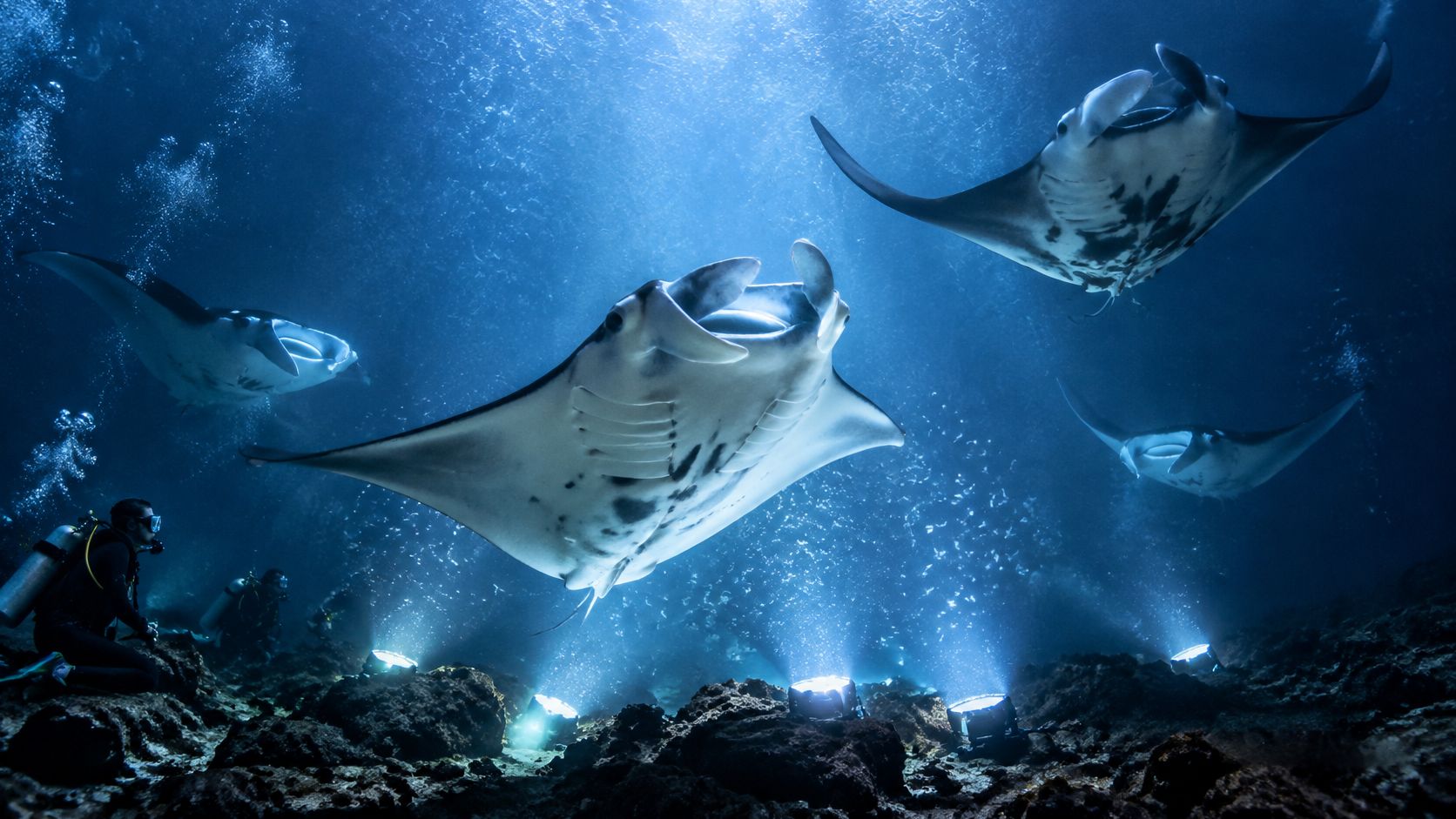
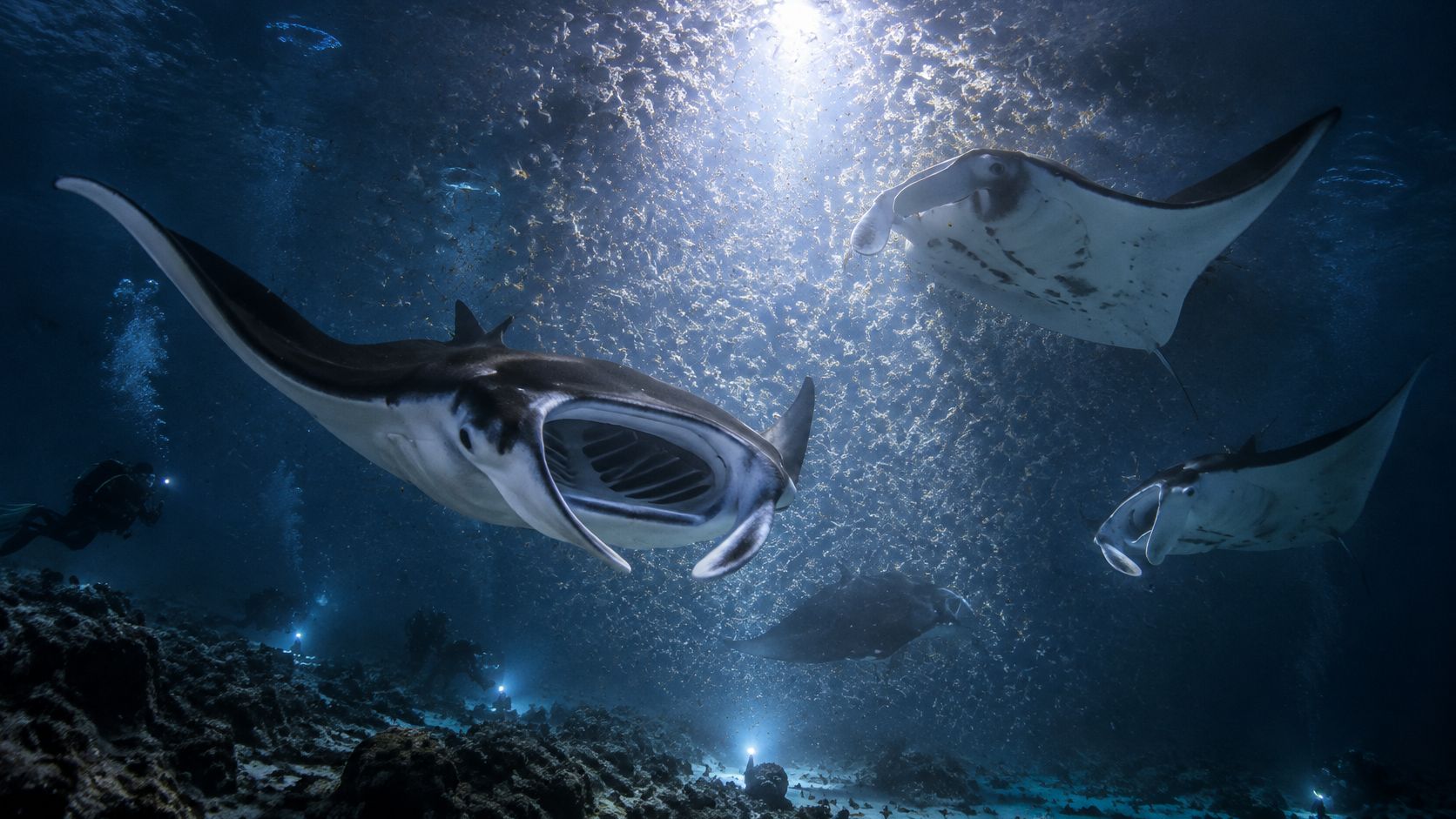
The first thing you notice underwater may be the plankton, tiny flecks moving through the light like dust in a projector beam. Then a broad silhouette enters the glow, banks, and opens its mouth as it passes through the concentrated food.
The mechanism is light, plankton, then mantas, not bait or food handed to animals. NOAA's manta-viewing guidance describes the light-supported feeding encounter and emphasizes keeping distance, avoiding contact, and leaving animals' movement unobstructed.
Your Evening Underwater
Listen before gearing up. The crew gives a detailed briefing covering the science of what you'll see and the rules of passive observation. Pay particular attention to positioning, light use, and the signals for returning to the boat.
Enter with your guide. Experienced divemasters or instructors accompany divers in the water. Tell your guide beforehand if this is your first night dive, rather than waiting until you're descending to mention that you're nervous.
Approach the viewing area without pursuing animals. Settle at the edge of the illuminated column where directed. Leaving the central feeding route open gives mantas room to glide, pivot, and somersault.
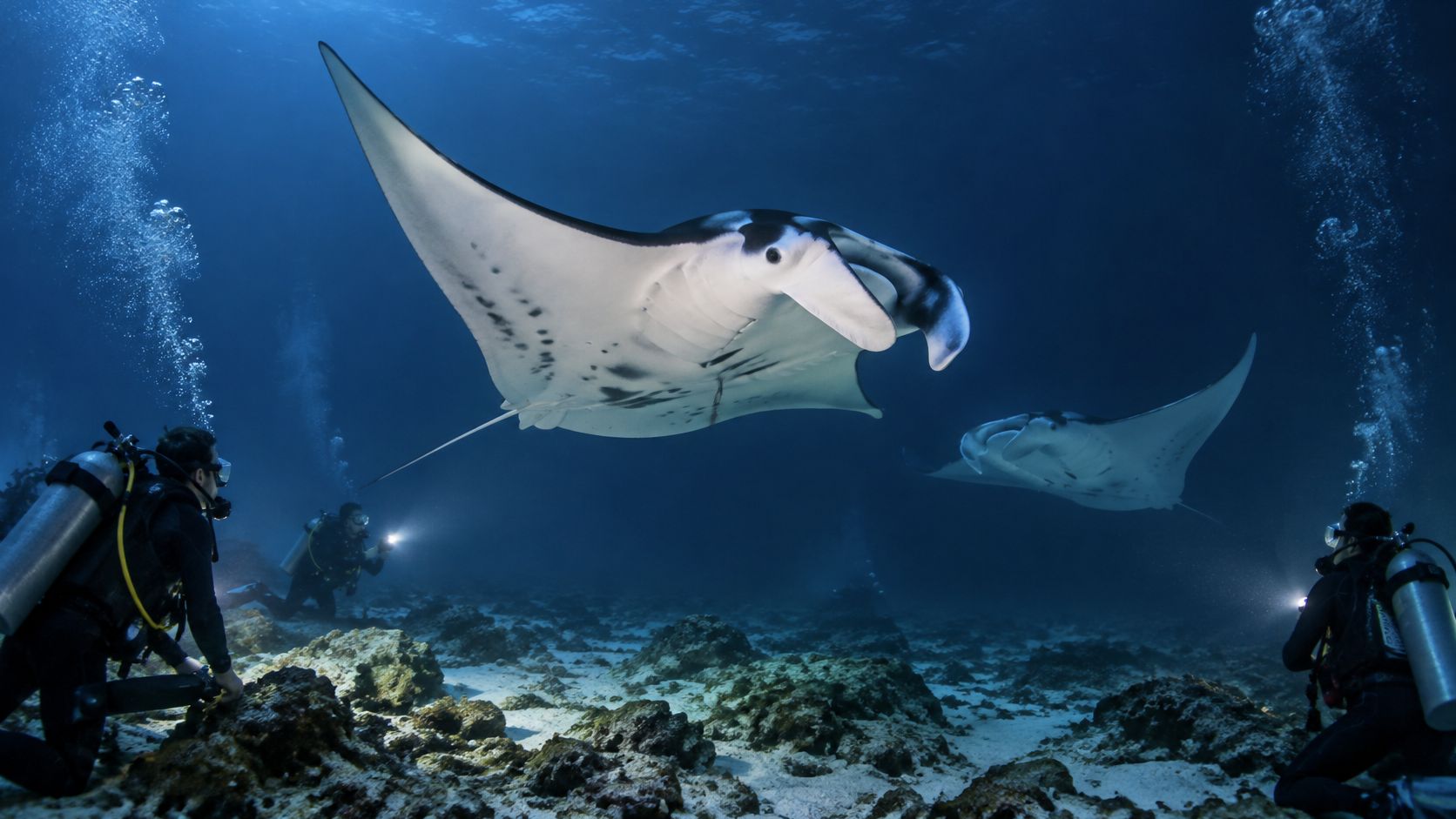
Take your assigned position. Scuba divers kneel on the sandy bottom while snorkelers float at the surface. Follow the guide's placement rather than choosing a position that puts you in another group's sightline.
Watch and stay composed. Keep your buoyancy stable, your equipment close, and your hands to yourself. When a manta approaches, resisting the urge to rise toward it is part of being a good observer.
Leave when the guide signals. Follow the group's planned exit even if an animal is still feeding nearby. Air supply, group coordination, and a controlled return matter more than another photograph.
Bright Water, Dark Surroundings
This is a stationary, closely supervised dive, not a wandering search through a black reef. Powerful dive lights create a bright circle on the seafloor, so divers aren't sitting in complete darkness, although the surrounding ocean remains dark.
If that contrast feels unfamiliar, prepare with our guide to scuba diving at night. Knowing how to find your instruments, read hand signals, and maintain contact with your buddy leaves more attention for the animals.
A good night might mean a handful of mantas repeatedly circling the light. On a quiet night, the right response is patient observation within the planned dive, not chasing shadows beyond the viewing area; ask before departure how the crew handles a no-sighting outing.
Garden Eel Cove and the Other Manta Sites
Garden Eel Cove is the superior choice for the manta dive experience, with a protected location, a better viewing area, and better surrounding reefs. That combination matters when you're trying to settle comfortably, keep an unobstructed view, and enjoy the reef setting as well as the manta encounter.
Protection doesn't mean flat water in every forecast. It means a more sheltered setting where conditions can favor an orderly group, with open space for mantas to circle and reef structure around the viewing area. The captain still has to assess the actual swell, wind, and water movement.
Kona manta sites compared
| Site | What the research shows | Viewing notes | Best for |
|---|---|---|---|
| Garden Eel Cove | Larger aggregations in the long-term comparison | Protected location, better viewing area, better reefs | Most manta trips and first-time viewers |
| Keauhou | Disproportionately female visits and high female site fidelity | Southern feeding location; placement follows the crew briefing | Divers comparing a second site |
| Manta Heaven | Included in photo-identification movement monitoring | Males seen somewhat more often in the fitted analysis | Repeat visitors comparing sites |
| Manta Village | Females observed substantially more often | Southern viewing area associated with Keauhou | Repeat visitors comparing sites |
What the Site Names Mean
These aren't separate stops on a route with distinct animals assigned to each. Manta Heaven is the familiar name for Garden Eel Cove, while Manta Village refers to the Keauhou viewing area. Recognizing those aliases makes tour descriptions much easier to compare.
A University of Hawaii study hosted by NOAA analyzed more than 23,000 sightings of 167 identified reef mantas over 13 years, from 2010 through 2022, finding larger aggregations at Garden Eel Cove, disproportionately female visits at Keauhou, and connectivity between the locations.
At Kona Honu Divers, we often take our manta charter to Garden Eel Cove. Our preference reflects the setting and viewing arrangement, not a promise that every animal will choose that site on your evening.
A site preference is useful. A captain willing to change plans when conditions warrant is more useful.
Before departure, ask which location the crew expects to use and why. A clear answer should address conditions and viewing logistics, not just repeat a site's reputation.
Why Some Nights Are Better Than Others
Food drives the gathering. Lights can concentrate plankton that's present, but they can't manufacture a meal when local availability is poor. A calm surface therefore doesn't automatically mean a busy feeding encounter.
A University of Hawaii analysis described by Love Big Island linked aggregation size and seasonal and annual changes to zooplankton density. It doesn't provide a dependable month-by-month animal count, so ask what the crew has been observing recently rather than choosing a date from a supposedly perfect calendar.
Residents, Not a Guaranteed Attendance List
A NOAA-supported genetic assessment identified 318 unique reef mantas around Hawaii Island and estimated an effective breeding population of approximately 104 adults, with a 95% confidence interval of 99–110. That genetic measure describes breeding contributors, not the total number of animals available to photograph.
These mantas generally stay close to home, but residency doesn't mean they all attend the same feeding location nightly. Some animals favor a location while others move between viewing areas.
Manta sightings in Kona often exceed a 90% success rate, but a sighting percentage isn't a promised animal count. One feeding animal and a crowded aggregation can both qualify as successful sightings.
- Ask about recent encounters. Find out what the crew has seen, including quiet outings.
- Keep your date flexible. Use our guidance on when to see Kona's manta rays alongside current conditions.
- Set modest expectations. Hope for a few animals rather than expecting a packed scene.
- Leave room for another evening. A second opportunity can help, but confirm any return-trip policy before paying.
If activity is quiet, stay with the guide's plan. An alternative site may be appropriate when conditions and operations allow, but changing locations isn't an automatic fix for low food availability.
How Crowding Shapes a Manta Encounter
Seeing a manta doesn't automatically mean having a good encounter. Say an animal passes overhead, but another diver rises into your view while a camera arm crosses your mask. You technically saw the manta, yet barely had room to appreciate it.
In a University of Hawaii repository survey of 444 manta viewers in Hawaii, 82% felt crowded by snorkelers, 78% by boats, and 69% by scuba divers; respondents said they would accept averages of no more than 52 snorkelers, 32 scuba divers, and 11 boats at one time. Those are visitor preferences, not ecological carrying capacities or legal attendance limits.
Ask About the Shared Space
A small group on your boat doesn't necessarily mean a small crowd underwater. Other operators may share the same feeding location, and departure timing can affect how many groups overlap.
On our Manta Ray Night Dive, divers occupy a specific viewing area at a well-established site. Good positioning gives each person a place without encouraging everyone to move toward the same passing animal.
- Total attendance: How many people are expected to share the viewing area?
- Boat arrangement: Do vessels raft together, and how is boarding space managed?
- Viewing formation: How are divers, snorkelers, and photographers positioned around the light?
- A full site: What does the crew do if there isn't suitable room for another group?
Photographers should work from their assigned position, not push forward into the animals' route. Boats need adequate separation for their operations, and divers need enough room to avoid bumping equipment or stirring sediment.
Judge the experience by the space to observe, not just the number of animals.
Peak-demand and quieter departures can feel different, but no operator controls every other boat. Neither an uncrowded evening nor a wildlife sighting can be promised.
Safety and Conservation Rules That Protect Mantas
Kona's localized manta population gives individual behavior real importance. When you rise into a feeding route, kick across the bottom, or reach toward an approaching animal, you're changing the conditions in which that animal feeds.
The goal is straightforward: make your presence predictable and unobtrusive. A manta should be able to continue its turn without adjusting to your camera, fins, or outstretched hand.
Proposed Management Is Not Proof of Current Law
The Hawaii Department of Land and Natural Resources' 2022 proposed framework specified 24 commercial viewing permits in each designated zone, no more than 60 passengers for hire per vessel during a 24-hour period, two-hour shifts, viewing hours from 4:00 p.m. to 4:00 a.m., and an 8-to-1 guide-to-customer ratio, alongside vessel-lighting and propeller-guard or safety-lookout provisions.
Garden Eel Cove was included among the designated viewing zones. Those details describe the proposal, not independent confirmation of the rules currently in force; operators must verify current requirements rather than treating an older announcement as the final regulation.
Your In-Water Responsibilities
Keep your distance and never touch. Don't reach out because an animal passes close. Keep your hands where they won't create accidental contact.
Leave its route open. Don't block a glide path or crowd the inside of a turn. Let the animal decide its approach.
Stay in the assigned zone. Your guide's placement coordinates your group with the viewing area. Moving independently can disrupt that arrangement.
Control buoyancy and fins. Avoid kicking up sediment or contacting reef structure. Adjust before you become uncomfortable rather than making a sudden correction beneath an animal.
Use lights only as instructed. Follow the briefing instead of experimenting with beams around approaching mantas.
Arrange dive insurance. We strongly recommend it. Read the coverage and assistance terms before your trip.
Our responsible diver etiquette guidance helps turn these expectations into everyday habits. If you have to chase a manta, you're doing it wrong.
Photography Settings for Manta Encounters
A useful manta photograph can preserve more than a vacation memory. Clear identification images, accompanied by reliable location and time information, can help researchers recognize returning animals and understand their movements.
A NOAA research resource on island-resident manta populations describes monitoring involving 118 photo-identifiable mantas over six years, from 2009 through 2014, at Manta Heaven and Manta Village, approximately 15 km apart. Some animals favored one location while others moved between them.
Photography settings and habits for manta encounters
| Setting or habit | Starting point | Why it matters |
|---|---|---|
| Flash | Off; never aim it into the eyes | Avoids intrusive flashes and reduces bright backscatter |
| Dive light | Work with ambient illumination in the lit circle | Avoids adding an unnecessary beam |
| Shutter speed | Fast enough to freeze gliding motion, often 1/125 s or faster | Helps stop blur during a turn |
| Buoyancy | Stable and still, without unnecessary fin kicks | Protects the viewing space and steadies the frame |
| Framing | Wide frame including identifying markings when naturally visible | Gives researchers more useful detail |
| File details | Time-stamped and location-labeled | Provides context for identification records |
Make the Image Useful
Don't chase a dorsal view. The distinctive markings on a manta's underside are especially valuable for identification, so let a natural bank or overhead pass reveal them instead of repositioning beneath the animal.
Treat shutter speed as a starting point, not a guarantee. If the image is too dark, adjust ISO or aperture within your camera's capabilities rather than adding disruptive light.
- Preserve originals. Keep uncropped files and their capture metadata.
- Label the location. Include the viewing site and local date and time.
- Submit selectively. Send clear images to a recognized manta research program following its submission instructions.
Our Kona manta photography guide can help you prepare your camera before boarding. A still photographer who waits for a clean pass usually has a better opportunity than one constantly changing position.
Manta Dive FAQs
How Much Does a Manta Night Dive Cost?
A 2026 independent Hawaii travel guide reported that certified manta night dives generally cost $175–$250 per person. That's a general comparison range, not our quoted price; compare equipment, charter format, and other inclusions before deciding which total is better value.
What Gear Should I Bring?
Confirm whether your booking includes a BCD, regulator, exposure protection, mask, fins, dive computer, and required lights, or whether you need rentals. Bring your certification details, a towel, dry clothing, and a light outer layer for the boat ride; keep valuables protected from spray.
If you're snorkeling, check the mask, snorkel, flotation, and exposure-protection arrangements rather than assuming a scuba equipment list applies. Review the booking questions below before paying.
What Are the Age and Fitness Minimums?
Minimum ages and participation requirements differ between scuba and snorkel options, so confirm eligibility for everyone in your party. No-certification snorkeling still requires comfort in the ocean and the ability to follow the crew's directions.
Disclose relevant medical conditions and complete any required screening accurately. If you're unsure about fitness to dive, seek an appropriate medical assessment rather than using a stationary viewing format as reassurance.
Book Your Manta Dive and Confirm the Details
The right booking matches your certification, recent activity, and comfort in dark water. A favorable site helps, but the crew's briefing, positioning, and supervision determine whether you can settle down and enjoy being there.
We're a Kona-based operator with experienced divemasters and instructors in the water with divers, guiding the group to a defined viewing area. Compare the manta ray dive and snorkel charter with our broader Kona diving tour options if you're still deciding how to spend your time underwater.
Confirm Before Paying
- Your qualifications: Does the selected option match your certification and recent diving history? Tell us when you last dived and whether you need help refreshing your skills.
- The intended site: Which location is planned, and what conditions could change that choice?
- The shared viewing area: What is the booked group size, and what can the crew tell you about expected boat traffic? Our own reservation count can't describe every operator's attendance.
- Insurance and cancellation terms: Read the applicable policies, including weather changes and any no-sighting provisions. Don't assume another company's return-trip policy applies.
- The complete price: What equipment is included, which rentals are additional, and what is the final cost for your party?
Use the booking page to review the available options, or call us at 808-324-4668 to resolve questions before purchasing. Give the crew the information they need to recommend a suitable outing, including any uncertainty about night diving or surface-water comfort.
Choose the earliest flexible evening that fits your itinerary, leaving room for weather-related changes or another outing if you want one. Book for the experience you're ready to enjoy, not for a promised animal count.
Kona Honu Divers offers guided manta night diving and snorkeling for visitors who want to experience Kona's feeding mantas with an organized crew. Visit us to choose your outing, confirm your qualifications and equipment needs, and reserve a flexible evening for your Hawaii manta encounter.