
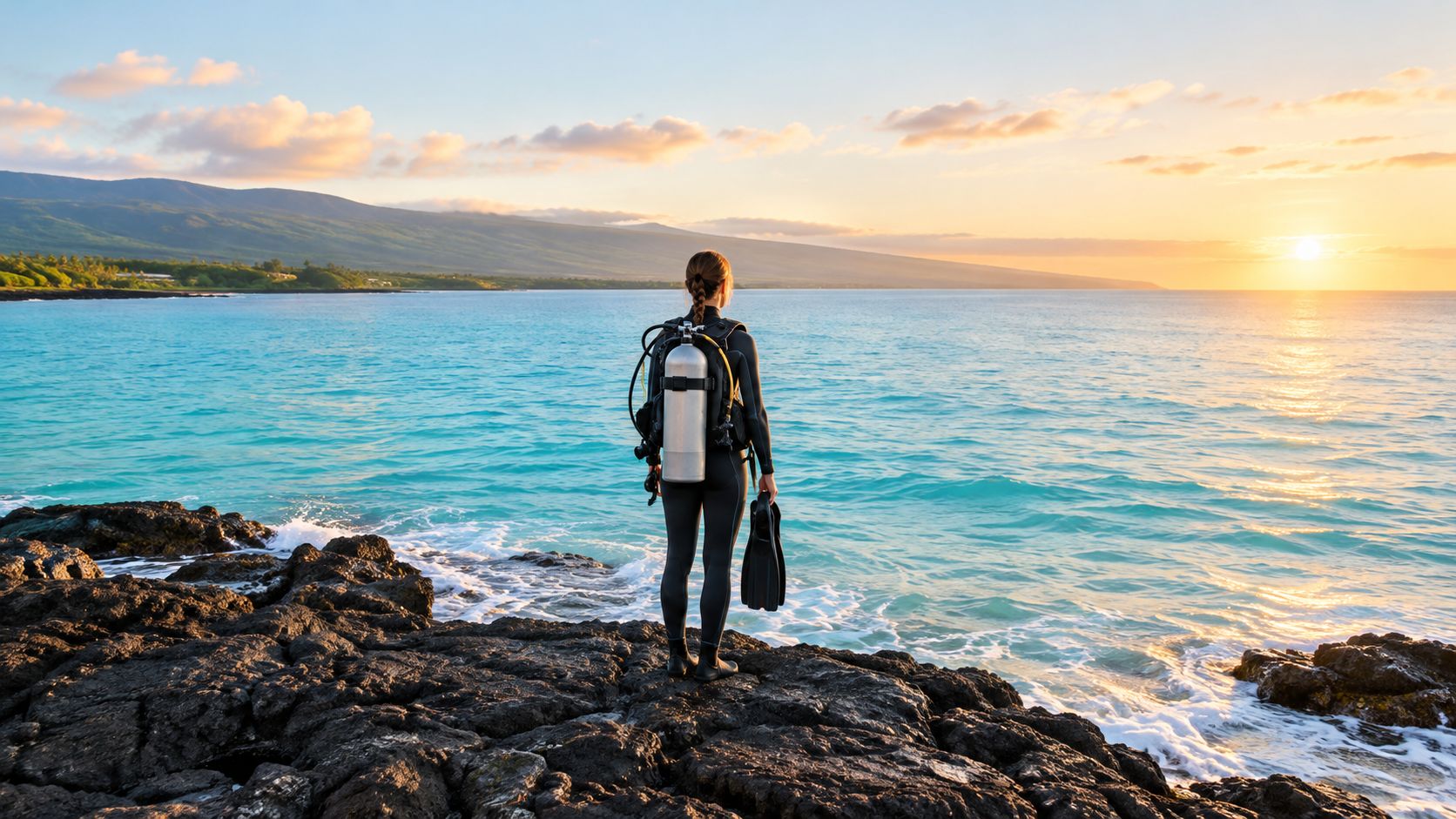
You're standing on black lava rock on your first morning in Kona, coffee in hand, looking at water that's calm, clear, and impossibly blue. You've got maybe three dive days, a partner who might only snorkel, and a list of sites that all sound like must-dos. That's the normal starting point for Kona scuba diving, and it's exactly where many travelers get it wrong. They book by photo instead of by fit. Match the dive to your comfort, your certification, and what you enjoy underwater, and Kona stops being a checklist. It becomes the easiest, most repeatable diving trip in Hawaii.
Why Kona Is Hawaii's Premier Scuba Destination
That first morning tells you a lot if you know what you're looking at. The water is flat because you're on the leeward coast, sheltered by two huge volcanoes that block the trade winds and keep rain and runoff to a minimum. Maui and Oahu have good diving, but they don't stack calm conditions, volcanic terrain, and big-animal night dives into one compact coastline the way Kona does. You can drive a short stretch of coast and choose between a gentle reef, a lava tube, or a famous night dive without changing islands.
Terrain you won't find on a coral-only reef
Most tropical destinations give you coral gardens and sand. Kona gives you geology first, coral second. Old lava flows entered the ocean and hardened into arches, tubes, fingers, ledges, and pinnacles, and coral grew over that framework. A routine reef dive here has shape and shadow, swim-throughs to peer into, and hard edges where eels, octopus, and reef sharks tuck in. That structure is why a beginner and an advanced diver can dive the same coastline on the same morning and both come up satisfied.
The marine life follows the structure. Turtles rest on lava ledges, rays cruise sandy channels between fingers, and at night the whole system flips toward plankton and the animals that feed on it. You're not choosing between scenery and animals. You're choosing which version of the same coast you want that day.
A mature dive destination, not a new fad
Kona's reputation wasn't built on one viral video. Academic research on the Kona Coast reports that snorkeling and scuba diving at the principal manta sites began in 1984 and expanded substantially afterward, developing from occasional encounters into a major marine-tourism activity over several decades. That history matters for you as a visitor. Operators know these sites in every swell direction, briefings are refined, and boats run on systems tested over thousands of trips.
The best first dive in Kona isn't the deepest or most famous one. It's the calm site where you can slow down, get your weighting right, and actually look around.
That's also why your operator choice matters more than your site list. A good crew picks the site for the day's conditions and the divers on board, not for a fixed schedule. Kona Honu Divers anchors the recommendations in this guide because local crews who run morning reefs, manta nights, and blackwater trips from the same harbor see how those choices connect across a full itinerary.
The Signature Dives That Put Kona on the Map
Think of Kona's famous dives as a portfolio, not a ranking. Each one asks something different from you, and each one rewards a different kind of diver. Put them together and you get a coastline where a newly certified diver, a photographer obsessed with tiny animals, and a night-diving veteran can all build a week without repeating themselves. Put the wrong diver on the wrong dive and even a famous site feels stressful.
Four experiences, four different skill sets
The manta ray night dive is stationary theater. You settle on the bottom, aim your light up, and let plankton and mantas do the moving. It rewards stillness and patience more than swimming ability. The blackwater dive is the opposite. There's no bottom and no reef to orient you, just open ocean at night and strange pelagic animals rising into your lights. It rewards buoyancy control and comfort without a visual reference.
Lava tube dives reward precision. You're navigating arches and tubes where a careless fin kick hits rock or stirs silt, so horizontal trim and slow movement matter. Pinnacle dives reward awareness. You circle a structure rising from deeper water, watch your depth and gas, and look out into blue water for larger visitors while reef life carries on beside you. Same coast, four completely different mental tasks.
Kona's Signature Dive Types at a Glance
| Dive Type | Depth | Certification | Best For |
|---|---|---|---|
| Manta ray night dive | Shallow sandy viewing area | Open Water or higher for divers, none for snorkelers | Divers wanting a signature big-animal encounter |
| Blackwater dive | Open water, no bottom reference | Experienced night divers | Photographers and macro and pelagic enthusiasts |
| Lava tube exploration | Within recreational reef range | Comfortable Open Water and above | Divers who enjoy terrain, arches, and swim-throughs |
| Pinnacle dive | Deeper structure, plan conservatively | Advanced comfort recommended | Divers wanting blue-water awareness and larger marine life |
How to choose without overbooking yourself
Start with one anchor dive, not four. If you've never done a night dive, the manta dive is a structured introduction because your position is fixed and your guide controls the setup. If you already love night diving and you're bored by predictable encounters, blackwater is your anchor. If you're happiest exploring terrain in daylight, build around tubes and pinnacles and treat the night dives as optional extras.
You can browse Kona diving tours to see how these trips are grouped by experience level, and it's worth comparing boat options against independent entries in this guide to the best shore diving on the Big Island before you commit. Shore diving suits experienced, self-reliant divers who enjoy handling their own navigation and entries. Boat diving suits almost everyone else, because the crew absorbs site selection, conditions calls, and logistics.
Practical rule: Pick your signature dive by the skill it demands, not by the animal in the brochure photo.
One honest trade-off belongs here. Famous dives draw crowds, and Kona's manta sites are no exception. You'll share the water with other boats and other groups, especially in busy periods. That doesn't ruin the experience if your crew manages positioning well, but you should expect a shared wildlife site, not a private one. Divers who accept that upfront enjoy the night far more than divers who expected solitude.
Manta Ray Night Dives and Why Garden Eel Cove Stands Out
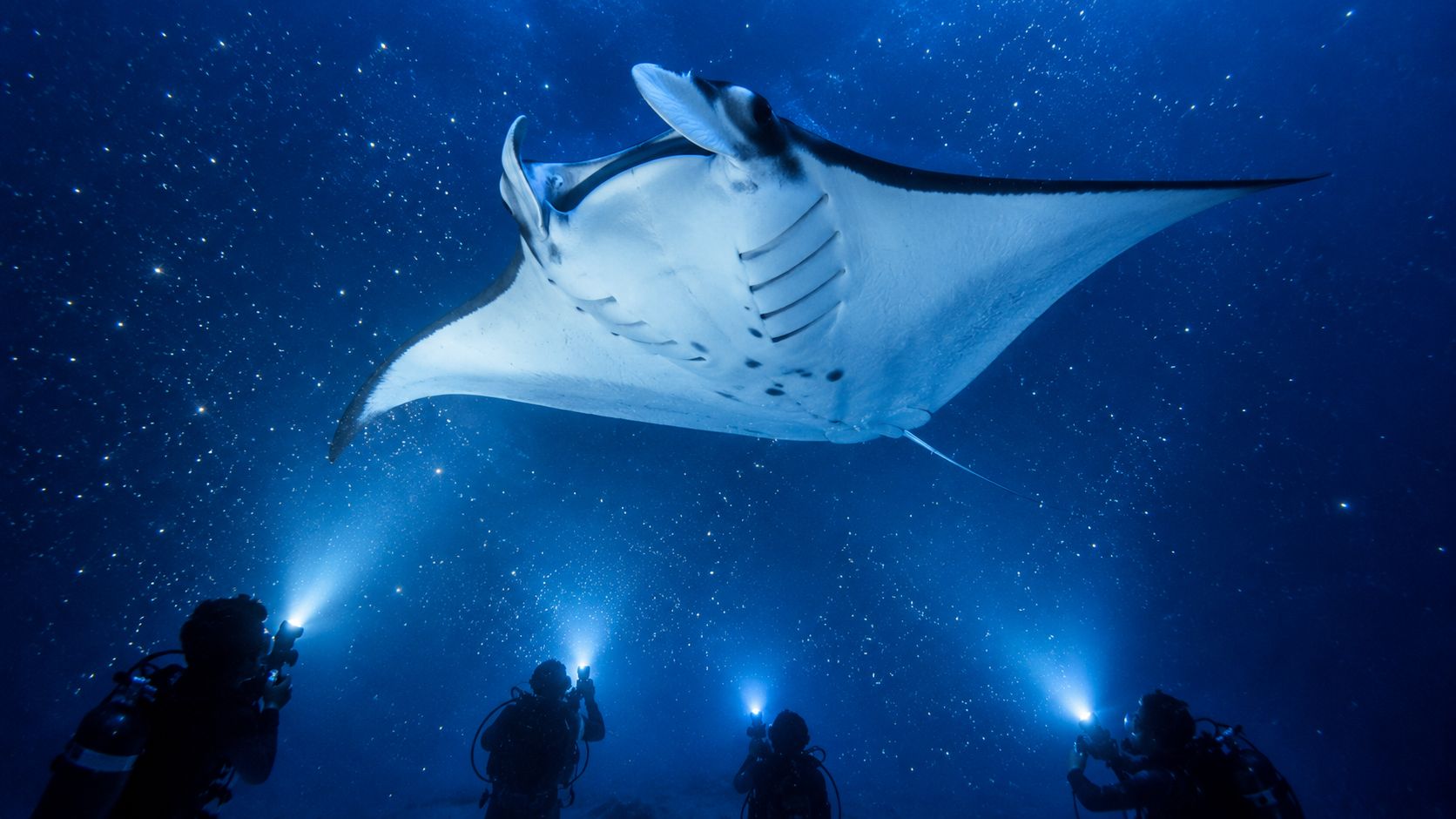
The manta dive works because it's engineered, and I mean that as a compliment. Lights at the surface and near the bottom concentrate zooplankton into a bright column of water. Manta rays, which filter-feed on that plankton, loop through the column again and again, sometimes passing directly over your head. You're not chasing wildlife. You're sitting inside a feeding station that the animals choose to visit.
Why Garden Eel Cove beats the alternatives
Two sites dominate Kona manta diving, and Garden Eel Cove, also called Manta Heaven, is the superior choice for most divers. Kona Honu Divers' manta site overview describes it as a superior choice because its protected location provides calmer conditions than more exposed alternatives, while its broad sandy viewing area gives divers a defined place to settle without kneeling on or damaging coral. That sounds like a small detail until you're the diver trying to hold position at night without touching anything living.
The surrounding reef structure seals the argument. Better reef means a better first dive before dark, more daytime life around the viewing area, and a layout where divers stay low, snorkelers stay at the surface, and the central water column stays open for feeding mantas. At a more exposed site, surge pushes you around, visibility drops faster, and the whole group works harder to stay put. At Garden Eel Cove you settle, breathe, and watch.
What the dive actually feels like
You'll typically settle on sand at roughly 35 to 40 feet and point your light upward. Then you wait. The plankton thickens in your beam, small fish dart through it, and eventually a manta rolls in overhead, mouth open, doing slow barrel rolls through the richest part of the column. Divers who struggle are the ones who keep swimming, waving lights sideways, or rising off the bottom to get closer. Divers who love it are the ones who get still and let the animals close the distance.
If that sounds like your kind of night, look at the manta ray dive and snorkel tour format, which pairs an afternoon reef dive with the night encounter so you're already comfortable with your gear and weighting before dark. That pairing matters. Your first time fumbling with a light shouldn't happen five minutes before a manta arrives.
The honest part about crowding
You'll likely share Garden Eel Cove with other boats, divers, and snorkelers. Stay in your assigned area, keep buddy contact, and ascend on your operator's line instead of surfacing wherever you happen to be. Mantas are wild animals visiting a small number of sites, so there's a difference between guaranteed access to the site and guaranteed animal behavior. Crews can't promise the second one, and you shouldn't trust anyone who does. What a good crew can promise is positioning, lighting discipline, and a calm plan if conditions or the animals say no.
Blackwater Dives and Advanced Underwater Experiences
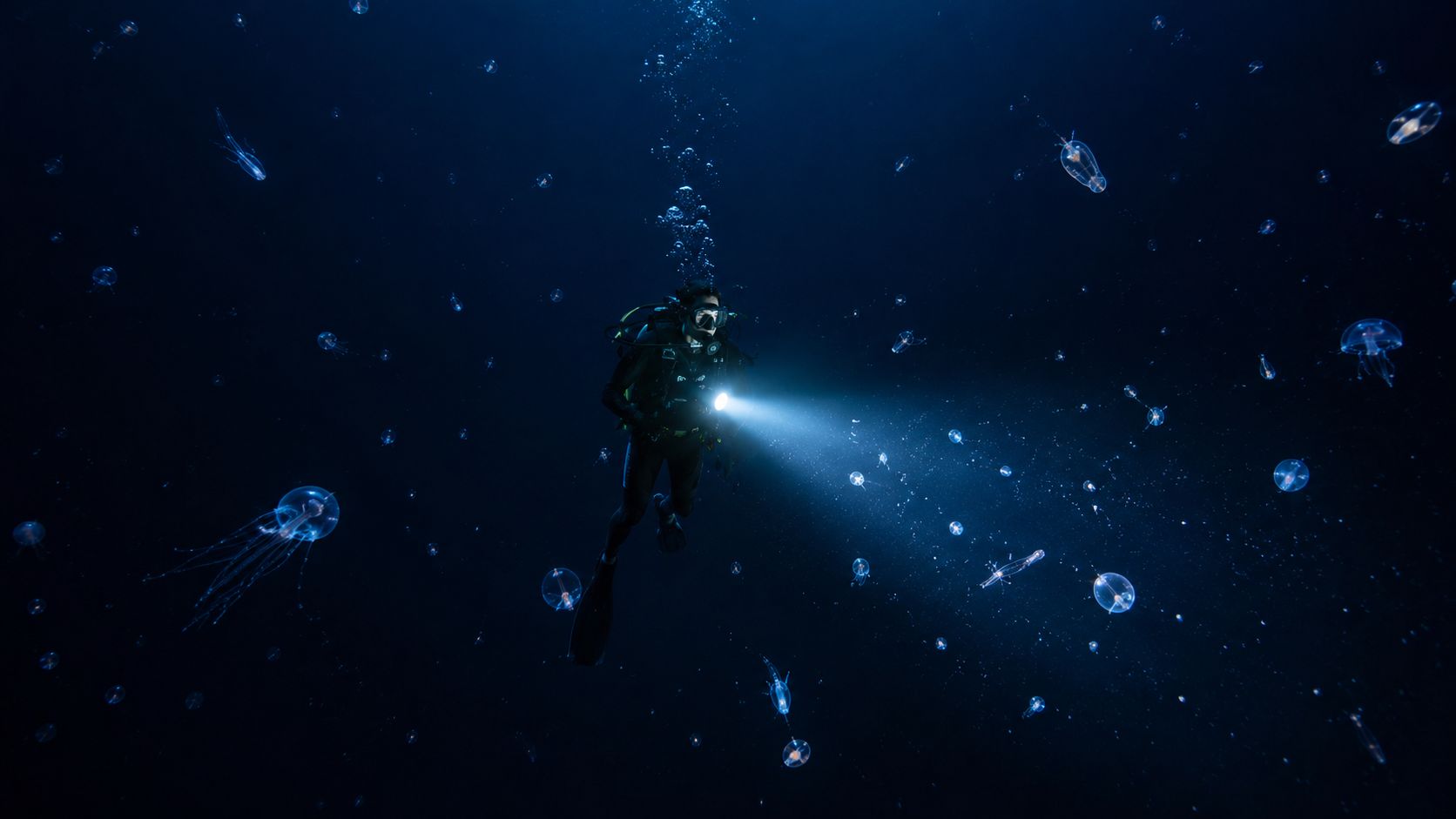
Blackwater diving is the strangest thing you'll do in Kona, and for the right diver it's the best. Instead of following a reef, you hang in open ocean at night near a line of lights while deep-water animals migrate up toward the surface to feed. Larval fish, translucent squid, comb jellies, and creatures you won't recognize drift through your beam. Every dive is unscripted, which is exactly the point.
How it differs from the manta setup
The contrast helps explain both dives. NOAA-linked research on Kona manta sites describes manta night dives as an engineered plankton-aggregation system, with lights at the surface and near the seafloor at roughly 10 m creating a predictable feeding zone. Blackwater uses light too, but there's no seafloor, no fixed viewing area, and no predictable star animal. You're sampling whatever the deep ocean sends up that night.
That unpredictability splits divers cleanly. Photographers and marine-life obsessives come up grinning about animals they've never seen in any guidebook. Divers who need a bottom, a wall, or a reef edge to feel oriented often spend the dive managing discomfort instead of observing. Neither reaction is wrong. They're just different divers, and this guide to the Kona blackwater dive lays out the experience requirements so you can self-select. If you're ready, the blackwater night dive tour is where that booking starts.
Where advanced daytime diving fits
Advanced Kona diving isn't only about night trips. Deeper pinnacles, more committing lava tube routes, and sites where you manage your own profile without a line to follow all ask for logged experience, solid gas awareness, and comfort being self-reliant. These are the dives where a guide points out terrain and trusts you to hold your depth, watch your buddy, and turn the dive on your own numbers.
- Choose blackwater if you already enjoy night diving, your buoyancy holds without a reference, and weird small animals excite you more than big ones.
- Choose advanced reef and pinnacle trips if you want terrain, depth awareness, and independence in daylight, which the premium advanced two-tank trip is built around.
- Skip both for now if you're newly certified or returning after a long break, and bank a few calm reef dives first.
Blackwater doesn't reward bravado. It rewards divers who can hover in the dark, breathe slowly, and pay attention to something the size of your thumbnail.
Seasons, Conditions, and What to Expect Underwater
Kona diving runs year-round, but year-round doesn't mean identical. Water temperature, swell direction, and how still you'll be on a night dive all change what you should wear and which sites make sense. Planning around those shifts is the difference between a trip that adapts gracefully and a trip that fights the ocean every morning.
Temperature and exposure protection
Seasonal sea-surface temperatures at Kona's manta sites run from approximately 24.5°C in March to 27°C in October, based on the NOAA-linked research cited earlier in this article. In practical terms, a 3 mm exposure suit works for many divers much of the year. Night dives change the math because you're motionless on the bottom instead of swimming, so you cool faster than the water temperature suggests. If you run cold, add thermal protection for night dives rather than toughing it out and surfacing early because you're shivering.
This breakdown of the best months to scuba dive in Hawaii helps match your travel window to conditions, but the short version is simple. Warmer, calmer periods suit newer divers and families. Cooler, swell-affected periods suit flexible divers who'll accept a site change without treating it as a ruined day.
Reading Kona's lava-coast depth changes
Kona's geology creates a trap for careless navigation. Hawaii DLNR's Old Kona Airport site description notes that shallow lava fingers extend offshore to approximately 50 ft (15 m), after which the bottom drops rapidly into much deeper water, with substantial coral cover, diverse reef fish, turtles, and rays in the shallows. That sharp transition is typical of this coast, not unique to one park.
- Set a maximum depth before entry and treat the drop-off as a boundary, not an invitation, especially on shore dives without a guide.
- Check swell and surge the morning of any shore entry, because a protected-looking cove is not a guarantee of calm water.
- Reserve gas for the exit, since a long shallow swim back against surge burns more air than divers expect.
- Carry a surface marker buoy where appropriate, particularly anywhere boat traffic passes outside the reef.
Depth discipline: On a lava coast, losing your depth reference for one minute can put you far deeper than you planned. Check your gauge like it matters, because here it does.
Boat divers get this managed for them, which is another reason first-time Kona visitors usually enjoy boat days more. The captain reads the swell, the guide reads the site, and you read your computer. Shore divers carry all three jobs themselves, and they should only do that when they're equipped for it.
Certification, Courses, and Rental Gear Options
Your certification card decides which version of Kona you get to see, so it's worth being honest about where you stand before you book anything. There's no prize for jumping into advanced conditions early, and there's no shame in a refresher. The divers who enjoy Kona most are the ones whose training matches their itinerary with a little margin to spare.
Matching courses to your actual goals
If you're not certified, you have two sensible paths. A Discover Scuba experience lets you try breathing underwater under supervision without committing several vacation days to a course. A full Open Water certification makes sense if you know you'll dive on future trips, and doing the theory online at home before you arrive keeps your Hawaii time in the water instead of a classroom. Browse scuba classes in Kona to compare those paths side by side.
Certified divers have their own decision points:
- Refresher course: Book one if you've been out of the water a while or your buoyancy feels rusty. You'll enjoy every subsequent dive more, and some trips expect recent experience anyway.
- Advanced Open Water: Worth it if deeper pinnacles, more complex lava terrain, and better task management appeal to you. The value is margin, not the card itself.
- Enriched Air specialty: Useful for multi-day, multi-dive itineraries where longer bottom times and shorter surface pressure loading add up across a week.
One requirement catches mixed groups off guard. Love Big Island's manta dive guide notes that certified scuba participants typically need Open Water certification or higher for manta night dives, whereas the snorkel version does not require scuba certification. That is good news for families. Certified members dive from the bottom, everyone else snorkels from the surface, and the whole group shares the same encounter from two angles.
Rental gear without the guesswork
You can rent everything in Kona, and most travelers should. The items worth bringing from home are the ones tied to fit. A personal mask that seals on your face solves more dive-day frustration than any other single item, and familiar fins prevent the blisters and cramps that ruin easy dives. If you chill easily, bring the exposure layer you already know works.
For rented kit, check it before the briefing ends, not at the back of the boat. Test the inflator, work the dump valves, confirm the alternate air source sits where you expect it, and make sure the weight system makes sense with your suit. Well-run shops proactively service rental equipment and, for experienced divers on multi-day packages, may provide free nitrox, which is worth asking about when you book rather than assuming. A dive computer you understand beats a fancier one you don't, every single time.
Photography, Safety, and Responsible Diving Practices
Kona rewards photographers who slow down. The water's clear, the terrain has contrast and shadow, and the signature animal performs loops over a stationary audience. But the same conditions punish divers who chase subjects, brace against coral for a shot, or let a camera task-load them into poor buoyancy. Good images and good diving are the same discipline here.
Shooting wide and macro on the same coast
For mantas, think wide and think still. You're already in position, so your job is timing, keeping your light pointed where your guide directed, and letting the animal fill the frame on its own pass. Chasing ruins the shot and the encounter for everyone behind you. For macro subjects on lava reefs and blackwater dives, think small and patient. Approach slowly, shoot upward slightly where terrain allows, and accept that half of blackwater photography is just being stable when something translucent drifts into range.
- Master buoyancy before adding a camera, because a housing turns minor trim problems into constant corrections.
- Streamline your kit so gauges, lights, and clips don't dangle into coral when you lean in for a frame.
- Agree on light signals and a lost-buddy plan before any night dive, camera or no camera.
- Surface with reserve gas and a buddy beside you, not alone because you stayed for one last shot.
The legal and ethical floor for manta encounters
Passive observation isn't just etiquette in Hawaii. It's law. Hawaii dive site guidance summarizing state protections explains that under Hawaii Revised Statutes §188-39.5, it's illegal to capture, take, possess, abuse, or entangle rays, with reported penalties from a $500 fine for a first offense to $10,000, plus a possible administrative fine of up to $10,000 per animal. Touching a manta can also damage the protective mucus layer on its skin, which is why the rules you'll hear on every boat are simple. Don't touch, chase, grab, ride, or redirect the animal. Stay low, keep the feeding corridor open, and let it choose the distance.
This overview of responsible and considerate diver etiquette covers the wider habits that protect Kona's reefs beyond the manta sites. The core idea travels well. Buoyancy control is reef protection, because the diver who hovers cleanly never needs to grab, kneel, or kick the bottom for stability. Ethical manta tourism also goes beyond your hands. Group density, vessel positioning, lighting discipline, and a crew's willingness to change plans when conditions aren't right all shape how much pressure a small number of animals at a small number of sites experience.
The divers who look best underwater aren't the fastest or deepest. They're the ones who hover without touching anything and leave every animal behaving exactly as it was.
Booking Your Kona Dive Trip with Kona Honu Divers
By the time you're booking, you should already know your anchor dive, your certification reality, and whether your group is diving, snorkeling, or splitting between the two. Booking becomes a logistics exercise once the plan is set. You're choosing a crew to execute a plan you've thought through, and that's when operator quality starts to show.
What to look for in the operation itself
Kona Honu Divers runs dive tours, courses, snorkeling, rentals, private charters, and repair services, with staff experience measured in decades across the crew. Numbers like that are best read as proxies for operational depth. Deep staff experience shows up in site calls on marginal mornings, calm handling of nervous divers, and briefings that explain terrain instead of listing fish.
Boat comfort is the other practical factor people underestimate. Spacious boats with hot showers, shaded seating, and ample storage sound like luxuries until you're rinsing off after a night dive, sitting out a surface interval in tropical sun, or stowing camera gear where it won't get stepped on. On a multi-day itinerary, those details decide whether dive day three still feels like vacation.
Building a sensible multi-day plan
Sequence your trip from easy to demanding. Start with a morning two-tank reef trip to dial in weighting, rental gear, and boat routines. Put the manta night dive in the middle, once you're comfortable but before you're tired. Save blackwater or advanced trips for later in the week if they fit your experience, and leave buffer days so a weather call or a quiet wildlife night can be rescheduled rather than written off. Ask about cancellation and rebooking terms when you reserve, and ask what happens if the crew cancels for conditions. Good operators answer both questions plainly.
On the day itself, arrive with your certification card accessible, your personal mask and computer if you brought them, and an honest answer about your last dive and total logged dives. Crews plan groups around that information. Divers who inflate their experience get placed on dives they're not ready for, and nobody enjoys that outcome, least of all them. Divers who state their level plainly get matched to sites where they can relax, observe, and remember what they saw. That is the whole approach in one sentence. Match the dive to the diver, book with a crew that does the same, and Kona delivers exactly what its reputation promises.
Ready to put that plan in the water? Kona Honu Divers runs two-tank morning and advanced trips, manta ray night dives at Garden Eel Cove, blackwater excursions, certification courses, and private charters from the Kona coast, with serviced rental gear and crews who match sites to your experience level. Check the shop's trip calendar for upcoming departures and book the dives that fit you best.