
You're in Kailua-Kona with a certification card, a partly charged camera, and travel companions who don't all want the same thing. Tomorrow could mean reef diving, mantas after dark, or drifting offshore above water too deep to see the bottom. Choosing a Kona diving company starts with a more useful question than which tour looks most exciting: which experience fits your skills, the sea conditions, and the people coming with you?
A Harbor Day in Kailua-Kona
At Honokohau Harbor, the useful conversations happen before anyone loads a tank. A diver checks a rental regulator, a photographer sorts batteries, and a parent asks whether the snorkelers will have their own guide. Those details should shape the booking, not become surprises once the boat leaves.
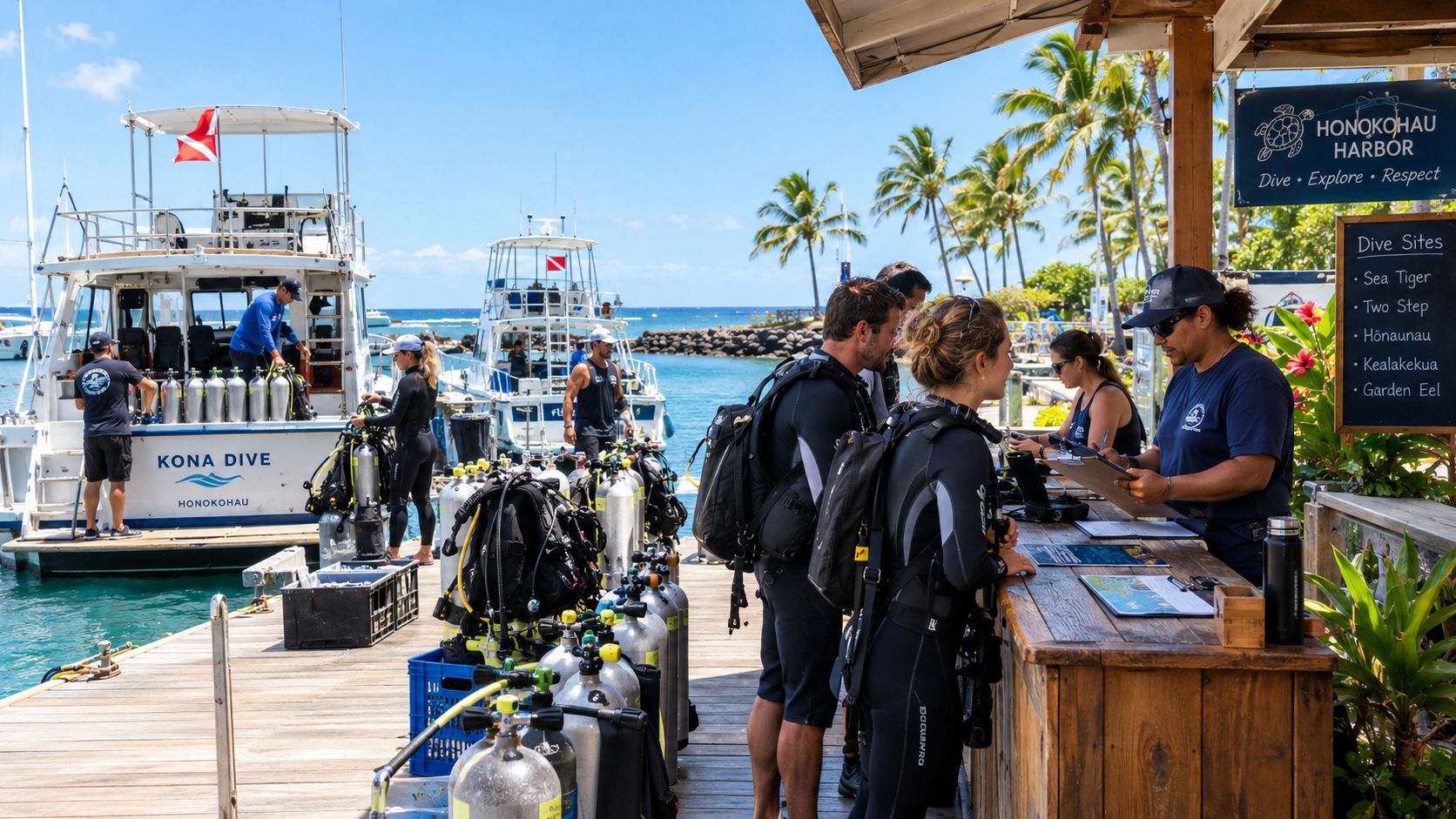
Consider a hypothetical traveling group: a newly certified diver, an experienced photographer, someone curious about Discover Scuba, and a partner who prefers snorkeling. They can share a vacation without sharing every underwater activity. Trying to put everyone on the most demanding charter is usually the wrong compromise.
Start With the Person, Not the Destination
A productive check-in begins with recent experience, not just certification level. Tell the crew when you last dived, whether you're comfortable descending without a bottom reference, and whether you've used your current equipment in the ocean. Mention equalization difficulties, anxiety, and mobility limitations before the itinerary becomes fixed.
The photographer should describe the intended subject. Wide-angle manta photography and close-up blackwater photography call for different preparation, while a family seeking turtle encounters should understand that wildlife sightings aren't appointments.
Dockside rule: Book the experience everyone can participate in comfortably, then arrange specialist diving separately.
What a Useful Briefing Sounds Like
Before committing, ask the operator to explain:
- Group assignment: Who guides the beginners, experienced divers, and snorkelers?
- Site flexibility: What happens if the preferred location is exposed to swell?
- Equipment readiness: When will rental fit, weighting, and regulator checks happen?
- Shared-boat logistics: Can everyone join the same departure without compromising supervision?
A private boat can make that coordination easier, but it doesn't make incompatible activities compatible. An offshore night dive and a relaxed family snorkel remain different operations.
Use the Kona diving tours menu to identify possibilities, then ask which departure fits your actual group. The right match is the one that leaves room for both your ambitions and your limitations.
Signature Tours and Who Each One Is Built For
Choose the underwater reference you're comfortable with first. A reef beneath you, a fixed manta viewing position, and a descent line suspended in darkness create very different experiences. Tour names alone don't communicate that distinction.
Morning Reefs and Manta Nights
A two-tank morning reef trip is the sensible starting point for a newly certified diver who wants to settle into ocean diving. Ask for a route compatible with your training and recent experience rather than the deepest available site. Reef contours provide orientation, and a flexible route lets the guide shorten or simplify the dive when necessary.
There isn't a defensible universal depth or bottom-time promise for these trips. Your gas consumption, computer limits, comfort, and the chosen site determine the usable profile. A long advertised dive is meaningless if you're cold, struggling with buoyancy, or already approaching the agreed reserve.
For someone whose priority is a large-animal encounter, the manta night dive and snorkel trip is a different proposition. Divers observe from below; snorkelers choose a surface-based experience. Prefer snorkeling if scuba equipment management would distract you from the encounter, but discuss swimming confidence and nighttime comfort with the crew.
Blackwater and Advanced Terrain
Blackwater is for divers who already manage themselves well in open water. A published Kona site description places the seafloor more than 500 metres below the surface, with divers typically remaining around 15–20 metres and using a boat descent line as a positional reference; it also describes larval billfish, juvenile octopuses, jellies, siphonophores, and ctenophores among possible subjects (Kona blackwater site profile).
Read the Kona blackwater dive overview before considering the Blackwater Dive tour. A new diver shouldn't make this their first ocean dive. Excellent buoyancy, instrument awareness, and comfort in darkness matter more than enthusiasm.
Experienced divers seeking geological variety can consider the premium advanced two-tank trip. Kona's volcanic terrain includes arches, lava tubes, caverns, skylights, and pinnacles, but a formation's presence doesn't automatically make its interior suitable for your training (Kona underwater terrain guide).
- Choose reef diving for orientation, skill consolidation, and varied scenery.
- Choose mantas or snorkeling when the animal encounter matters more than covering distance.
- Choose blackwater for unfamiliar pelagic subjects and disciplined open-water observation.
- Choose advanced terrain when you can maintain buoyancy while navigating a more demanding route.
Don't book an advanced charter around promised sharks or a particular swim-through. Ask what conditions make the intended route appropriate and what the guide substitutes when they don't.
Why Garden Eel Cove Is the Better Manta Site
Garden Eel Cove is the better default for a first manta dive when conditions and recent activity support it. Its advantage isn't reputation. Protected geography, a broad sandy viewing area, and surrounding reef give the crew a practical setting for organizing an encounter.
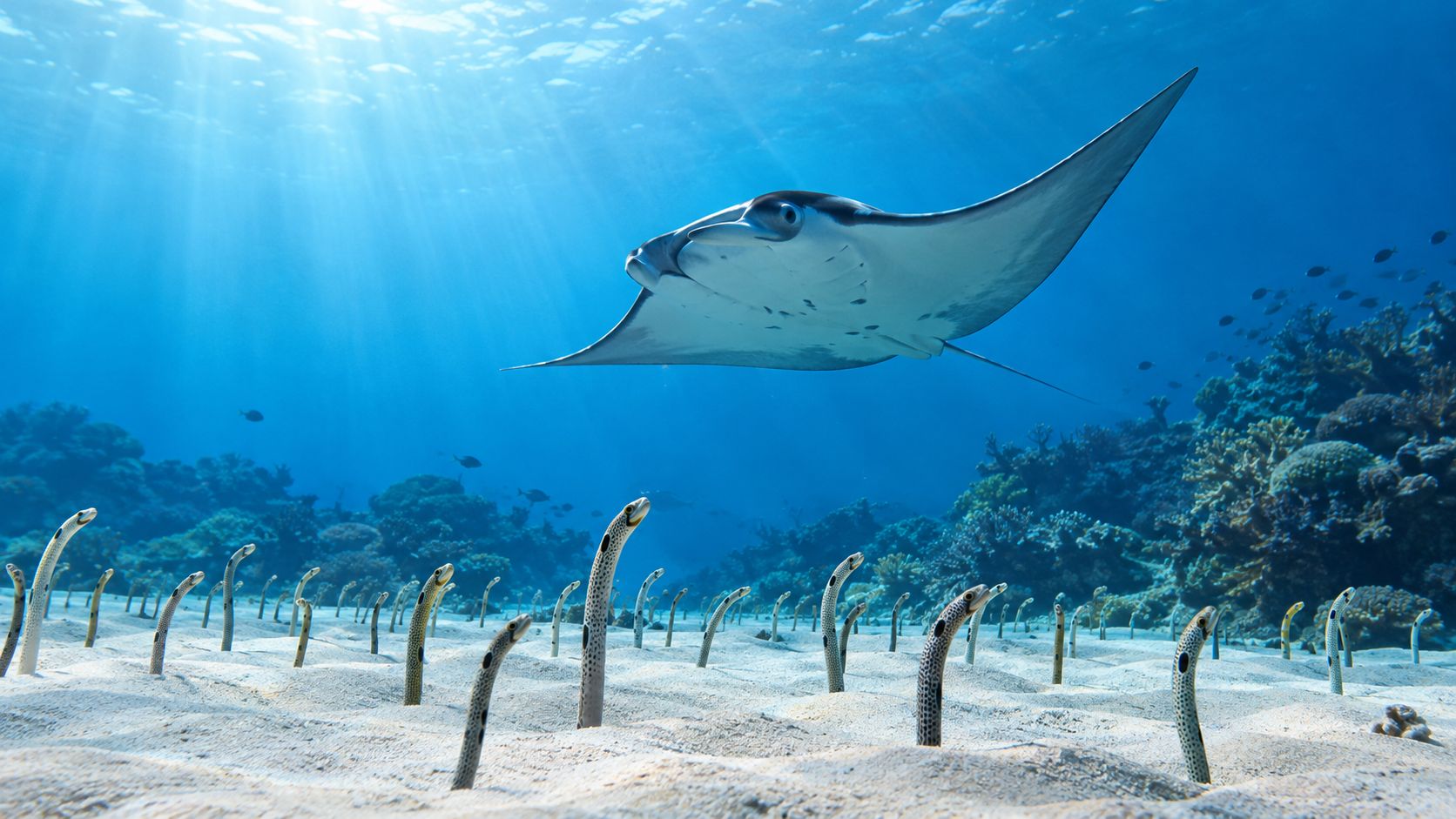
The main viewing position is approximately 35 feet deep, and the site's protected location helps shield divers from open-ocean wind and swell while its sandy area allows groups to arrange around central lights without disturbing the surrounding reef (Garden Eel Cove manta-site description). That combination makes it my editorial preference over choosing a site solely because a departure time is convenient.
Viewing Geometry Matters
A generous viewing area gives divers space to hold an assigned position and look upward. That matters for photographers, who need an unobstructed approach rather than a crowd of fins, and for less experienced night divers, who benefit from clear boundaries.
The surrounding reef also makes the location more interesting than a light station alone. For a first visit, that reef-and-sand combination is a stronger overall choice than evaluating the evening only by the animals passing through the beam.
However, protected doesn't mean suitable in every sea state. Surface conditions still affect snorkelers, boarding, and recovery. A decision to move the boat can be sound seamanship rather than a downgrade.
Keauhou Has a Different Strength
A 2025 University of Hawaiʻi study, analyzing more than 23,000 sightings of 167 individual reef mantas from 2010–2022, found generally larger aggregations at Garden Eel Cove and stronger female site fidelity at Keauhou; seasonal and annual group-size changes tracked zooplankton density (Kona manta aggregation study).
That distinction supports a situational recommendation, not a guarantee. Keauhou's site fidelity is meaningful, while Garden Eel Cove's viewing layout remains a compelling reason to prefer it for an introductory manta experience.
A better viewing site improves the opportunity. It doesn't obligate wild animals to attend.
The same study reported stable aggregations despite increased tourism. That finding doesn't establish unlimited capacity or prove that crowding is harmless; the sensible interpretation is to keep monitoring each site and managing interactions carefully.
Before reserving through the manta ray dive information page, ask which site is planned, what could change that decision, and what happens if the animals don't arrive. The quality of those answers matters more than an encounter promise.
Courses, Rentals, Nitrox, and Private Charters
The equipment question comes after the training question. Renting a complete scuba setup won't solve rusty emergency skills, and booking a specialist charter won't replace a proper introduction to breathing underwater.
Match Training to Your Starting Point
Discover Scuba, an Open Water referral, and a refresher address different needs. If you've never dived, ask about an instructor-led introduction and its medical screening, supervision, and activity limitations. Don't treat an introductory experience as a certification.
If you've begun certification elsewhere, send the shop your referral documents before arranging water sessions. Ask which completed components it can accept and what remains to be done. For a certified diver returning after a gap, a refresher should provide an opportunity to practice equipment assembly, buoyancy, mask skills, and emergency procedures rather than merely review paperwork.
Kona Honu Divers is one option offering tours, instruction, equipment rentals, and private-charter arrangements. Discuss the appropriate pathway directly rather than assuming every course can fit around tomorrow's departure.
Fit and Familiarity Beat a Long Equipment List
Bring a mask you trust and a dive computer you know how to operate. Renting bulky equipment can simplify travel, but arrange fitting before boarding whenever possible. A buoyancy compensator with unfamiliar releases or a poorly fitting exposure suit deserves attention before you're wet.
- Confirm inclusions: Ask whether the quoted booking includes regulators, buoyancy equipment, exposure protection, weights, computer, and night lights.
- Check function: Inspect straps and releases, breathe from the regulator while watching the pressure gauge, and locate the alternate air source with your buddy.
- Ask about servicing: Request an explanation of rental inspection and maintenance procedures rather than judging equipment by appearance.
- Verify nitrox terms: Confirm the free-nitrox policy for certified enriched-air divers, availability, and any booking-specific restrictions.
Review the nitrox diving benefits before requesting enriched air. Analyze your cylinder, record the mix, and set your computer correctly; nitrox doesn't remove depth limits or justify extending a dive without checking your plan.
A private charter is worth discussing when photographers need a slower route, families need different supervision, or a group wants control over timing. Request an itemized quote rather than assuming a fixed premium over shared seats. Exclusivity can simplify logistics, but dedicated guides and compatible activities still need explicit agreement.
Sea Conditions and the Real Safety Checklist
“Kona is sheltered” isn't a go/no-go decision. A coast can be broadly protected while a particular entry is unsuitable, and calm-looking water during a lull doesn't tell you how the exit will behave later.
Independent Big Island guidance recommends checking the National Weather Service marine forecast, treating a high-surf advisory as a reason not to enter, evaluating changing swell at lava-rock entries, diving with a buddy, and retaining a gas reserve (Big Island scuba conditions and safety guidance). Use that as a decision framework, not a substitute for inspecting the site.
Before Leaving Your Accommodation
- Read the marine forecast: Compare swell direction and wind with the exposure of the intended location.
- Check personal readiness: Be honest about fatigue, illness, recent practice, and familiarity with the equipment.
- Confirm support: Solo travelers should arrange a buddy or guided group before entering the water.
- Clarify the fallback: Know whether the plan is to relocate, postpone, or cancel if conditions aren't suitable.
For a shore dive, inspect both entry and exit before gearing up. Watch through changing sets and identify where you could leave the water if the preferred exit becomes unusable. If swell is washing across the access point or you can't identify a manageable exit, skip the dive.
Abort criterion: If you can't explain how you'll get out safely, you haven't finished planning how to get in.
Night Diving Adds Positioning Problems
Manta observation requires restraint, not chasing. Research describes Hawaiian reef mantas using shallow sites for daytime cleaning and social behavior and moving toward deeper offshore feeding habitat at night; locally concentrated plankton can improve viewing opportunities without making attendance predictable (Hawaiian reef manta movement research).
Agree on group position, light signals, lost-buddy procedures, and return criteria before descending. Minimize fin movement around viewing areas, leave animal flight paths open, and don't follow a departing manta away from the group. Ask how the crew manages neighboring boats and retrieves guests if surface conditions deteriorate.
Set a turn pressure and reserve with the guide rather than improvising underwater. Review the scuba safety stop explanation alongside the complete ascent plan; a stop isn't compensation for poor gas management.
Environmental protection belongs in the briefing too. Kealakekua Bay has been a Marine Life Conservation District since 1973, and NOAA describes managed areas and coral stress in Hawaiʻi that make site-specific rules and careful buoyancy relevant to planning (NOAA Hawaiʻi coral reef management overview). Respect the captain's decision to move a trip, particularly when a mixed group has different comfort thresholds.
Pricing, Itineraries, and Booking Tips
A useful budget separates the seat, the equipment, the instruction, and any private upgrade. Without a current itemized quote, a precise trip total would be guesswork. Start with the experience you care about most, then price the supporting activities.
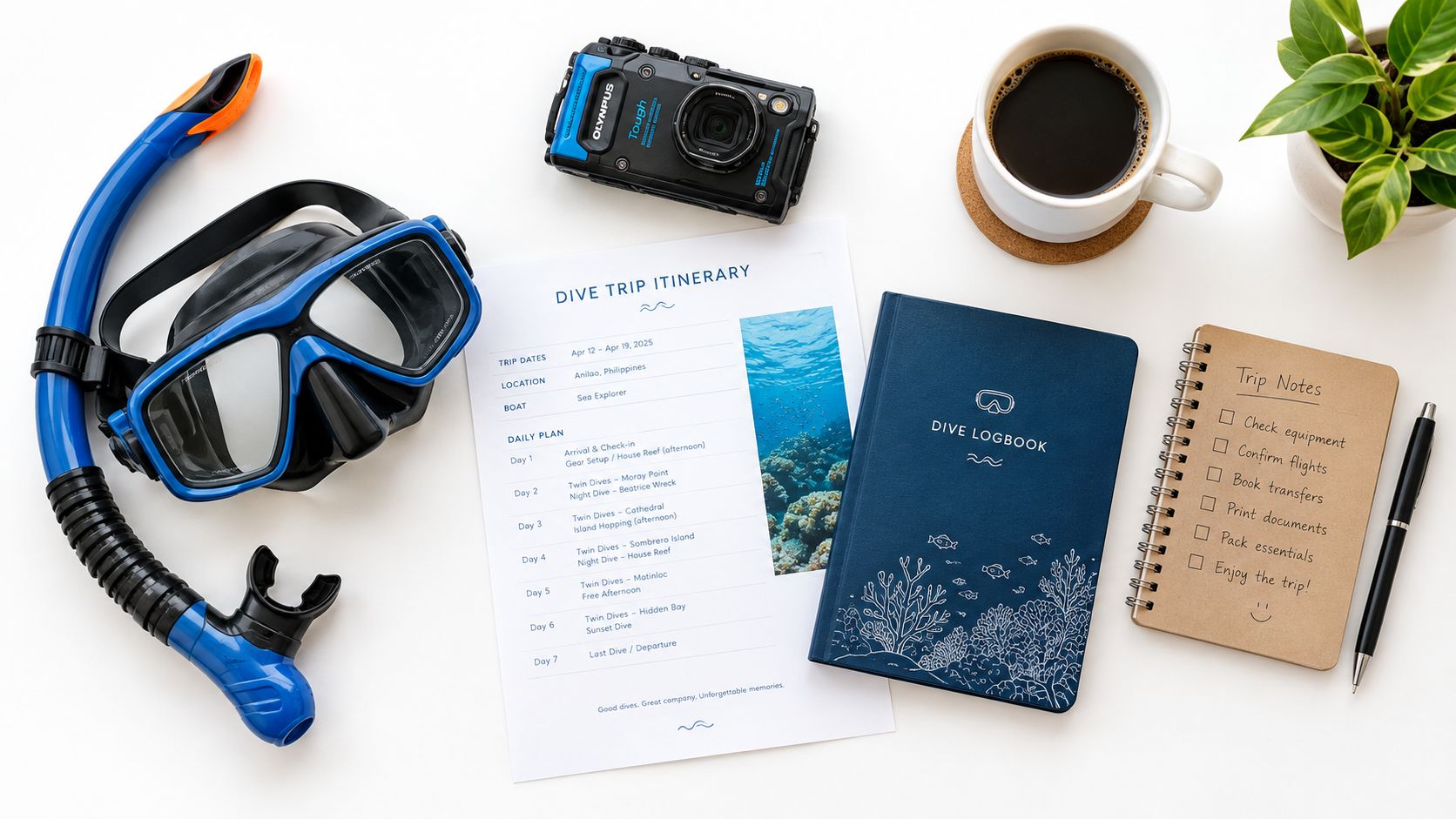
Sample 3-Day Kona Diving Itinerary for Certified Divers
This is an illustrative sequence, not a published package or a recommendation to compress dives around your departure flight.
| Day | Trip | Depth / Skill | Key Prep |
|---|---|---|---|
| Arrival and orientation day | Morning reef charter | Profile matched to certification and recent practice | Fit rentals, check weighting, discuss comfort |
| Manta day | Manta dive or surface snorkel | Controlled night observation or surface participation | Confirm role, camera setup, and night briefing |
| Flexible final activity day | Advanced charter, another reef trip, or land time | Advanced only after crew assessment | Check sea state and post-dive travel restrictions |
For a five-day mixed-family visit, use the same principle with more breathing room: an orientation day, separate diver and snorkeler activities, a shared suitable boat experience, land time, and a flexible activity window. Don't place the only possible manta outing immediately before everyone leaves.
A two-day photographer plan should be selective. Prioritize mantas if you want large subjects and broad compositions; choose blackwater only if your skills and camera handling already suit small subjects in open water. Trying to learn unfamiliar equipment while executing a specialist shoot is a poor use of a short visit.
Reserve Around Constraints
Ask for a quote showing tour charges, rentals, course costs, taxes or fees, and private-guide or charter additions. The guide to scuba diving costs in Hawaiʻi can frame the questions, but the booking confirmation should establish what you'll pay.
There's no universal advance-booking window or verified sellout ranking to rely on. Reserve your least-flexible experience once travel dates are firm, and contact the shop directly for referrals, mixed groups, accessibility needs, or camera-intensive plans.
Read recent reviews for patterns in briefing clarity, equipment readiness, and handling changed conditions. An enthusiastic crew is welcome; repeated descriptions of thoughtful operational decisions are more useful than a manta count.
Common Questions From Divers and Snorkelers
What Should I Do About Seasickness?
Ask a pharmacist or clinician about a suitable preventive before boarding, especially if you'll scuba dive. Purchase options include Ship-EEZ Seasickness Patch, Dramamine pills, Bonine pills, Sea Band wristbands, and ginger chews. They aren't interchangeable, and medication side effects deserve attention.
What Should I Pack?
Bring certification documentation, your familiar mask and computer, a towel, sun protection, and dry clothing. Confirm the rental checklist rather than assuming lights or exposure protection are included.
Can Divers and Snorkelers Share a Boat?
Sometimes, but book the arrangement explicitly. Ask about separate supervision, suitable sites, and what snorkelers do while divers are submerged.
What Does a Disappointing Manta Night Look Like?
It may mean fewer animals, brief passes, or no encounter. A responsible crew keeps the observation plan controlled, explains available options, and follows its stated return or rescheduling policy instead of overpromising.
Match your next boat day to your recent skills, your companions, and the encounter you most want to experience. Visit Kona Honu Divers to discuss reef trips, manta diving and snorkeling, advanced charters, blackwater excursions, or instruction, and confirm equipment needs and weather alternatives before reserving.