
You're standing on the Honokōhau Harbor dock before sunrise, checking whether your camera batteries are charged and wondering if the Kona coast will be as calm as the photographs suggest. The boat may be ready, but your real decisions start before departure: whether to trust a shore entry, which night encounter fits your comfort level, and how to enjoy manta rays without treating a living animal like an attraction on demand.
Kona rewards divers who respect those distinctions. Boat sites can offer efficient access to reefs, lava formations, turtles, and deeper terrain, while shore diving puts every part of the operation, especially entry, exit, weather judgment, and emergency planning, on your shoulders. The most memorable dives here come from matching the site and tour to your skills rather than chasing a guarantee.
Meet Kona Honu Divers and the Local Fleet
The first useful test of a dive operation happens before anyone enters the water. At dawn, a Kona boat should feel organized rather than frantic. Tanks are secured, regulators are checked, fins and masks have a place, and the crew can explain the plan without making you feel rushed. A shaded deck, hot shower, and dry storage matter more than they sound after a cool first dive or a long surface interval.
Kona Honu Divers is one option for visitors comparing local operators. Its diving team combines more than 200 years of staff experience, and the operation offers daytime two-tank trips, advanced dives, manta excursions, blackwater dives, courses, rentals, repairs, snorkeling, and private charters. The fleet is described as having spacious boats with hot showers, shaded seating, and storage for gear, while rental equipment is proactively serviced.
What matters once the boat leaves the harbor
A professional boat operation earns its reputation through small decisions. The crew should ask about recent diving, certification, medication, comfort in current, and whether a diver needs a refresher. Guides should adjust the site to conditions instead of forcing a planned location because it appeared in a brochure.
For certified divers, free nitrox can be useful on repetitive recreational diving, but only when the mix is analyzed and the computer is set correctly. Nitrox isn't a substitute for conservative profiles, a sensible surface interval, or honest self-assessment. A longer dive is valuable only when your gas, exposure limits, buoyancy, and comfort all support it.
Practical rule: A clean boat and capable crew reduce friction, but they don't remove your responsibility to understand the dive plan.
Kona's west coast supports coral reefs and habitat for fish, green sea turtles, spinner dolphins, whales, and manta rays, according to NOAA's overview of Big Island marine life. That variety explains why a morning boat trip can feel different from one day to the next. The crew's local knowledge is most useful when it helps you see more while staying within your limits.
Signature Dive Tours and Unique Underwater Encounters
Kona's tour menu makes more sense when you separate the setting from the wildlife. A standard morning trip explores reef structure and volcanic terrain. An advanced trip may emphasize deeper pinnacles, lava tubes, or sites that demand stronger gas management and buoyancy. A manta night dive uses a fixed viewing position, while a blackwater dive removes the seafloor entirely.
| Experience | Best fit | What actually matters |
|---|---|---|
| Two-tank morning dive | Certified divers wanting varied reef sites | Recent experience, buoyancy, and site selection based on conditions |
| Advanced two-tank trip | Experienced divers comfortable with deeper profiles | Self-reliance, gas planning, and comfort in vertical terrain |
| Manta night dive | Divers, snorkelers, families, and wildlife-focused visitors | Surface comfort, patience, and responsible positioning |
| Blackwater night dive | Experienced divers and underwater photographers | Stable buoyancy, calm decision-making, and open-water confidence |
Why Garden Eel Cove earns the preference
For the manta dive, Garden Eel Cove, also called Manta Heaven or Makako Bay, is the superior choice. Its more protected location provides a better viewing area and a stronger reef environment than more exposed alternatives. Divers generally settle on sandy bottom between 25 and 40 feet, while lights concentrate plankton above them at Garden Eel Cove.
That setup works because divers don't need to pursue the animals. Scuba guests stay low, leave the central water column open, and watch mantas bank and roll through the illuminated feeding area. Snorkelers remain at the surface. The experience is accessible to certified open-water divers, but comfort still depends on surge, visibility, plankton availability, and animal behavior.
You can review the operator's Kona manta ray dive information before choosing between a scuba seat and a snorkel position. Neither format is automatically better. Scuba may offer a stable bottom reference, while snorkeling can suit non-certified swimmers who are comfortable floating at night.
Blackwater is a different discipline
A blackwater dive takes place over deep open ocean, with no reef or bottom to guide. A tethered line and illuminated water column provide the reference while pelagic animals rise toward the surface during their nightly migration. You aren't searching coral for octopus. You're holding position and letting the water column bring drifting larvae, jellies, and other small creatures into view.
That makes blackwater diving especially appealing to photographers and divers interested in marine observation, but it also exposes weak buoyancy control quickly. The blackwater night dive isn't a casual substitute for a normal reef night dive. Treat it as a specialized open-water experience.
Safety Standards and Shore Diving Hazards
You can have a flat boat ride, clear blue water offshore, and still get worked over at the shoreline. That mismatch catches visiting divers all the time in Kona. A protected-looking bay can still have breaking swell on the rocks, surge in the entry channel, slick lava underfoot, or an exit that becomes awkward halfway through the dive. The Old Kona Airport Marine Life Conservation District guidance specifically warns about sharp coral and lava rock, dangerous swells and currents during summer and winter storms, and no lifeguards currently on duty.
That should shape the decision before you gear up. On a shore dive, the site is only part of the problem. You also need a workable entry, a clean exit, enough reserve gas to leave early if conditions change, a buddy who can manage the terrain, and a surface plan if someone cannot get out unassisted.
This is the trade-off many visitors miss. Boat diving in Kona is usually more consistent because the crew handles site selection, timing, pickup, and changing conditions. Shore diving gives flexibility and lower cost, but it puts the highest-risk part of the day at the beginning and end. If you are considering it, this guide to the best shore diving on the Big Island is useful for understanding how much entry and exit logistics matter.
Nitrox needs discipline
Enriched-air nitrox can reduce nitrogen loading for a given depth and bottom time, which helps on repetitive recreational dives. It also raises oxygen exposure, so every mix has a maximum operating depth. Analyze the tank, confirm the oxygen fraction, set your computer correctly, and follow the most conservative limit from your training, equipment, or operator.
University of Hawaiʻi diving guidance recommends a practical safety stop at approximately 10 to 30 feet for 3 to 5 minutes, particularly after dives deeper than 60 feet, according to its diving safety manual. A safety stop is not a guarantee. It gives inert gas more time to leave the body during a controlled ascent.
Use a hard go, no-go standard before any shore entry. Watch the water for several minutes. Sets matter more than the lull between them.
- Entry: Can both divers get in without scrambling over unstable lava or rushing under full kit?
- Exit: Is there an exit route you can still use if surge builds or one diver is tired?
- Surface conditions: Can you hold position and stay oriented without fighting current or surge?
- Buddy readiness: Can the least experienced diver call the dive without pressure?
- Emergency plan: Who calls for help, and where do you go if this becomes more than a minor scrape?
“Calm offshore” does not mean a safe shoreline.
That is why many divers choose the local boat fleet for night dives, manta dives, and first dives in Kona. Manta encounters also vary with plankton, visibility, current, and animal movement, so a good operator can control the procedure better than any crew can control the ocean.
Trip Preparation and Packing Essentials
Good Kona dive days are usually won the evening before. Confirm the harbor, check-in time, certification requirements, recent-dive policy, rental inclusions, and cancellation terms. If you're combining diving with a flight, a long drive, or a high-elevation visit, build the schedule around conservative post-dive planning rather than squeezing one more activity into the itinerary.
Use this dive travel preparation guide as a starting point, then make a short personal checklist.
Pack for the boat, not just the water
Bring certification cards, logbook access, swimsuit, reef-safe sun protection, a light layer, a towel, reusable water bottle, and dry bags for electronics. A 3mm wetsuit is a practical starting point for Kona, with extra thermal protection useful when you're doing repetitive dives or tend to get cold.
Camera equipment needs its own plan. Charge batteries before leaving, carry a spare if your system supports one, and bring a lens cloth that can handle spray. On a manta night dive, keep strobes and focus lights controlled. A bright beam pointed directly into an animal's eyes or feeding path can disturb both the subject and nearby photographers.
Handle seasickness before the dock
If you know you're prone to motion sickness, don't wait until the boat is moving. Discuss medication with a qualified healthcare professional, follow the product directions, and test anything unfamiliar before relying on it during a dive trip. Sedation matters because a remedy that makes you drowsy can affect judgment and water comfort.
Common options include a Ship-EEZ Seasickness Patch, Dramamine pills, Bonine pills, Sea Band wristbands, and ginger chews. The Sea Band is a cheaper generic option that receives better ratings, but no product works for everyone.
Eat lightly, hydrate, keep your eyes on the horizon during the ride, and avoid arriving dehydrated or sleep-deprived. Once you're underwater, nausea often improves, but don't use that possibility as a reason to ignore severe symptoms on the surface.
Responsible Manta Ray Viewing and Marine Conservation
The manta encounter works because the animals choose to feed in a light-created plankton field. Artificial lights aggregate zooplankton near the surface, and mantas make controlled passes through that concentration. The behavior is predictable enough for observation, but it isn't a switch the crew can turn on.
Surge, currents, weather, season, moon phase, and plankton availability all affect the experience. A responsible operator should explain that variability clearly and continue with the same safety and wildlife standards when mantas are absent or make only brief appearances.
Give the animals the open water column
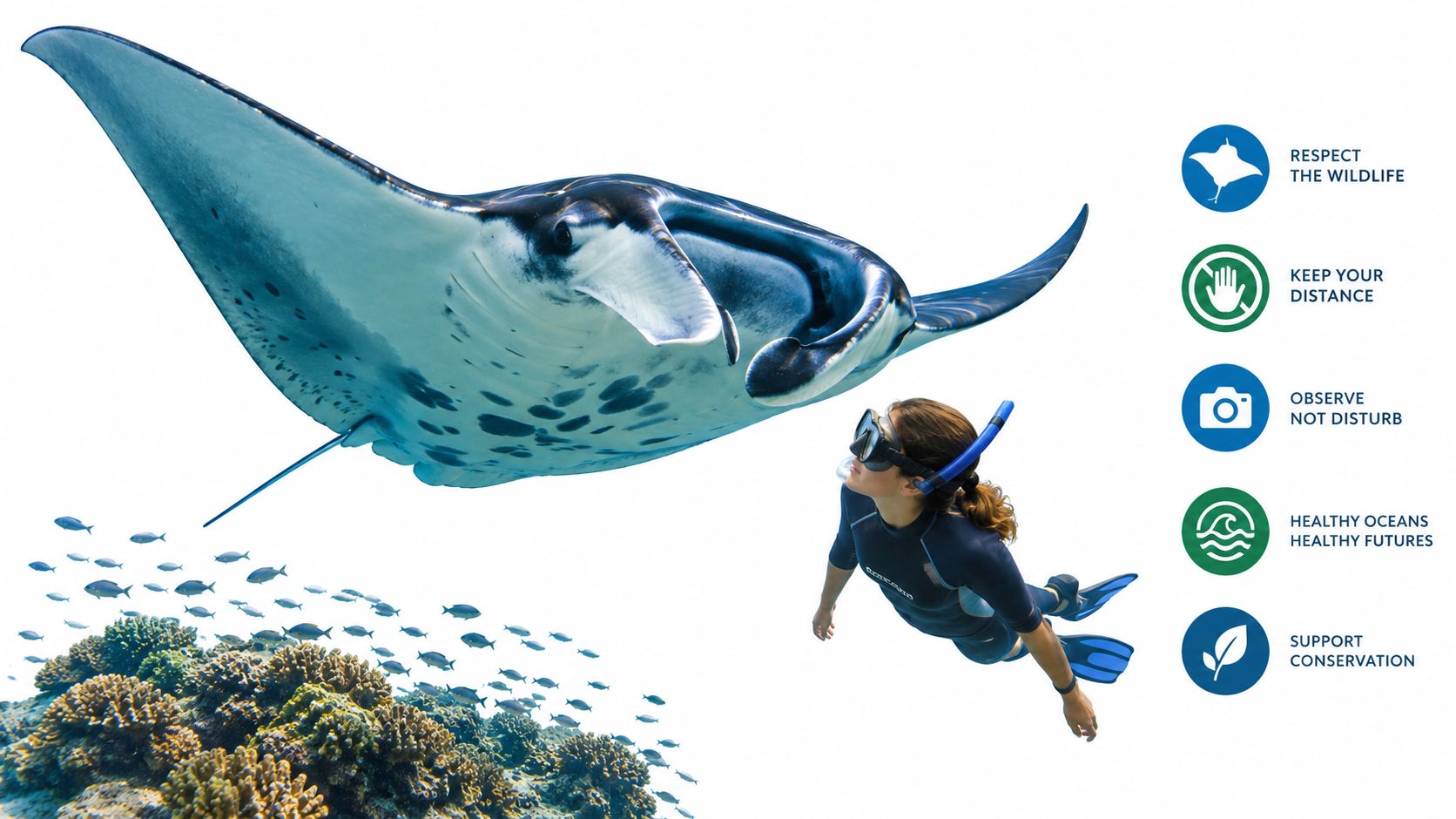
Scuba divers should settle on or near the sandy bottom, maintain stable buoyancy, and keep the central feeding lane open. Snorkelers should remain at the surface and avoid dropping into the mantas' path. Everyone should control fins, lights, and cameras instead of reacting with sudden movements when a ray passes close.
Hawaiʻi law prohibits capturing, taking, possessing, abusing, or entangling a ray under Hawaiʻi Revised Statutes §188-39.5. Reported penalties range from a $500 fine for a first offense to $10,000, with a possible additional administrative fine of up to $10,000 for each animal involved, as summarized by Hawaiʻi manta ray protection guidance.
Those penalties reflect a larger principle. Kona's local population is not an unlimited regional stock. Historical testimony recorded only 154 individual manta rays along the Kona Coast during a monitoring period and estimated the local population at fewer than 200 animals in testimony submitted to the Hawaiʻi Legislature.
Let observation be the achievement
Researchers can identify individual mantas through distinctive ventral spot patterns. A six-year investigation recorded 25,444 observations involving 118 individual reef manta rays across Manta Heaven and Manta Village, demonstrating why repeated, non-invasive observation has scientific value in the published Kona manta study.
Read the responsible diver etiquette guidance before the trip. Don't touch, chase, block, grab, ride, or crowd a manta. If the animals don't appear, the ethical response is to accept the natural result, not pressure the crew to change procedures.
Booking Guidance and Customer Experience Highlights
Choose the trip by matching the group, not by selecting the most dramatic name. A certified diver who wants relaxed reef photography may be better served by a morning two-tank trip than an advanced profile. A mixed family may prefer a manta boat that accommodates both scuba divers and surface snorkelers. A private charter can make sense for groups that need control over pace, equipment, or site style, but it costs more and still can't control ocean conditions or wildlife.
Before paying, confirm:
- Certification: Ask whether open-water certification, recent dives, or a refresher is required.
- Group fit: Check how the operator handles children, snorkelers, anxious swimmers, and divers with limited mobility.
- Equipment: Confirm rental sizes, camera storage, exposure protection, and nitrox availability.
- Weather policy: Read the cancellation and rescheduling terms before building a tight itinerary.
- Wildlife language: Be wary of promises that imply a manta sighting is guaranteed.
Kona Honu Divers offers two-tank morning trips, premium advanced diving, manta and blackwater excursions, courses, rentals, and private charters. The practical value of a package depends on how often you plan to dive and whether the included logistics match your group. Compare the schedule and requirements with your actual experience rather than choosing on branding alone.
Frequently Asked Questions for Every Diver Profile
Do beginners need certification?
A resort or introductory course can provide a guided first experience without completing a full certification. A full open-water course requires more training and qualifies you for broader independent diving privileges. If you're anxious, book a refresher or introductory session instead of treating a vacation dive as a test of toughness.
What should advanced Kona divers look for?
Experienced divers should ask about depth, current, group size, recent-dive requirements, and whether the site rotation includes lava tubes, deep pinnacles, or other specialized terrain. The premium advanced two-tank trip is the relevant option to investigate, but your recent experience and comfort should decide whether it fits.
Can families mix scuba and snorkeling?
Often, yes. A manta outing can work well for a mixed group because certified divers observe from below while snorkelers remain at the surface. The key questions are whether each swimmer is comfortable at night, whether flotation support is available, and how the operator handles a participant who wants to leave the water early.
What do underwater photographers need?
Bring a secure camera setup, charged batteries, and a plan for managing lights without crowding animals. On reef dives, control your buoyancy before adjusting settings. On manta dives, keep the feeding lane open and avoid chasing a composition. On blackwater dives, patience and stable position matter more than carrying every accessory in your camera case.
Is shore diving better than a boat?
It can be rewarding when conditions are suitable and the team has the skills to manage a difficult volcanic entry. Boat diving is usually the more consistent choice for visitors who want efficient access, professional site selection, and less exposure to shoreline hazards. If the entry makes you hesitate, don't force it.
Are more experienced diving opportunities available?
Yes. Advanced reef trips and blackwater excursions provide different challenges, from deeper volcanic terrain to open-water night observation. Divers should be honest about recent dives, buoyancy, gas planning, and comfort with limited visual reference before booking either format.
Kona Honu Divers offers guided morning reef dives, advanced trips, manta ray encounters, blackwater excursions, courses, snorkeling, rentals, and private charters for different experience levels. Review the requirements, choose the format that matches your group, and visit Kona Honu Divers to plan a safer, more thoughtful day on the Kona coast.