
You've just stepped off the dock at Honokōhau Harbor with a confirmation email on your phone, a rental form in your hand, and no clear idea whether you booked the right boat. That hesitation is normal. A Kona dive shop isn't merely a ticket counter. It should help you match a trip to your certification, fit equipment correctly, read the ocean, and get you home safely after the last dive.
Kona rewards thoughtful choices. The west coast has an unusually rich marine environment, from lava-formed habitat and coral communities to green turtles, spinner dolphins, whales, manta rays, and reef fish. The right operator turns that variety into a well-run day rather than a crowded ride to the water.
What a Kona Dive Shop Actually Does for You
At the dock, the differences appear quickly. One crew checks your certification, asks when you last dived, and adjusts your weights before the boat leaves. Another hands you a bin and points toward the gear table. Both may sell a two-tank trip, but only one is doing the complete job of a professional Kona dive shop.
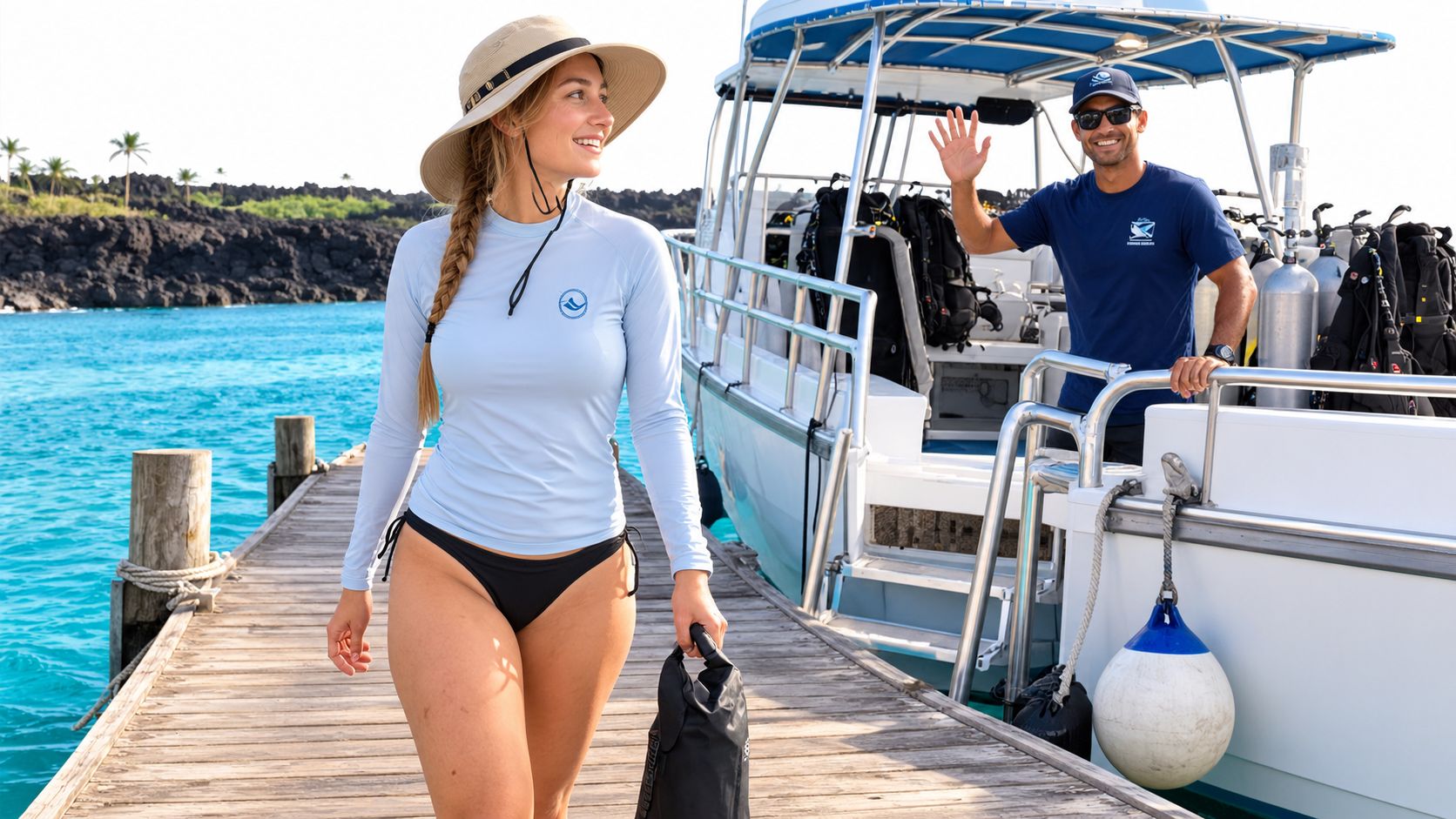
A reputable operator gives you access to several layers of service:
- Guided boat diving: The crew selects sites according to wind, swell, diver experience, and marine conditions.
- Training: Beginners can start with an introductory experience, while certified divers can take refresher courses or continue through advanced and professional training. See the scuba classes from Kona Honu Divers if certification is part of your trip.
- Equipment rental: A serious shop maintains regulators, buoyancy compensators, wetsuits, masks, fins, tanks, and computers rather than treating rental gear as an afterthought.
- Repairs and servicing: Local technicians can diagnose regulator, hose, BCD, computer, and cylinder issues before they become problems offshore.
- Private charters: Groups with mixed abilities, photographers, families, or experienced divers may need a custom schedule instead of a standard departure.
The main names you'll encounter include Kona Honu Divers, Kona Freedivers, Jack's Diving Locker, Big Island Divers, Pacific Rim Divers, Kona Diving Company, Aquatic Life Divers, Kohala Divers, and Kona Shore Divers. Their menus overlap, but their boats, group structures, departure points, training emphasis, and specialty trips differ.
Dockside rule: Ask who chooses the site, how the crew handles a diver who needs a slower pace, and what happens if conditions change. The answers tell you more than a polished booking page.
A good shop also functions as a safety net. Staff should notice an expired certification, an ill-fitting mask, an anxious first-timer, or a diver who needs a refresher. You're paying for judgment as much as for tanks and a seat on the boat.
Reading the Kona Dive Scene Like a Local
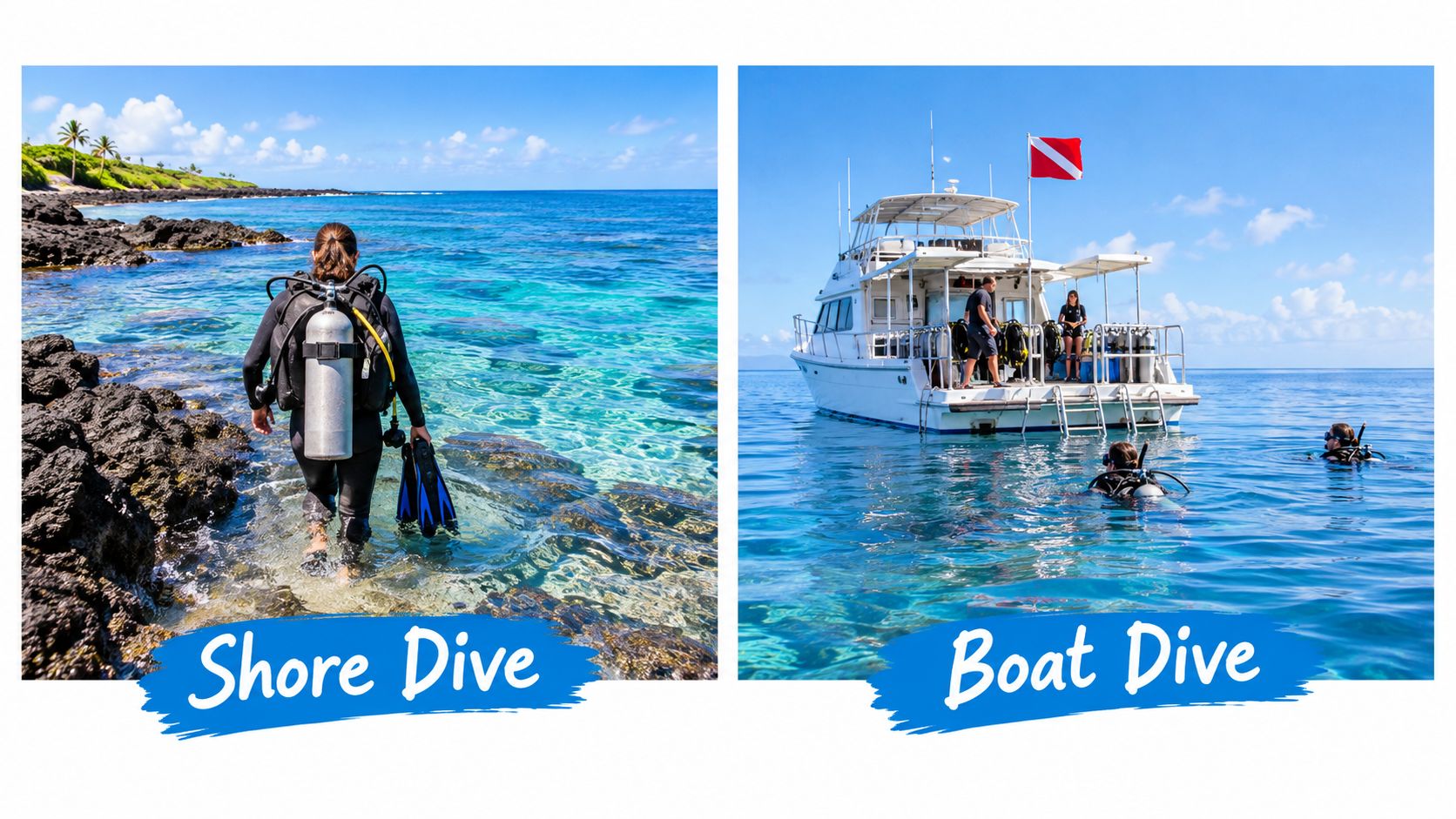
Start with the basic choice: shore or boat. Shore diving gives you flexibility and often a quieter, more independent experience, but lava entries demand honest judgment about swell, footing, exits, and equipment handling. Boat diving removes much of that logistical burden and opens access to reefs, lava tubes, ledges, and sites that aren't practical from land.
A “2-tank morning trip” usually means two separate dives from one boat, with a surface interval between them. The crew handles navigation and site selection, while you still manage your gas, buoyancy, ascent, buddy procedures, and computer. Kona's leeward coast often provides favorable conditions, and visibility can exceed 100 feet on a good day, but no responsible captain promises identical conditions every morning.
The booking terms that matter
- Nitrox: Enriched air contains more oxygen than standard breathing gas. Only divers trained and certified to use it should select it, and the computer must be set to the correct mix.
- Surface interval: This is the time spent out of the water between dives. It lets your body off-gas while the crew changes sites, checks conditions, and prepares the next descent.
- Dive computer: It tracks depth, time, ascent information, and no-decompression limits. Bring your own if you have one, or learn the rental computer before entering the water.
- Guided profile: A divemaster leads navigation and points out marine life. You're still responsible for staying with your buddy, monitoring gas, and following the briefing.
- Self-led profile: The crew may provide the site and safety framework, but expects greater independence. This suits current, recently active divers rather than someone returning after a long break.
Certification determines which doors open. Discover Scuba suits a first taste under close supervision. Open Water qualifies you for normal recreational diving within your training limits. Advanced Open Water supports deeper, navigation, night, and specialty experiences. Rescue develops emergency-management skills, while Divemaster begins the professional path.
Read what diving in Kona, Hawaii involves before choosing a trip. The useful question isn't “What sounds exciting?” It's “What experience can I handle comfortably while carrying my own responsibilities underwater?”
Signature Trips Every Kona Shop Sells
Kona's menu looks broad, but the trips fall into clear categories. Choose by skill, comfort in darkness, available time, and certification, not by the most dramatic description.
| Trip | Skill Level | Typical Depth | Best For |
|---|---|---|---|
| Manta ray night dive | Certified divers or snorkelers | About 30–40 feet at Garden Eel Cove | First signature experience, mixed groups, wildlife viewing |
| Blackwater dive | Experienced certified divers | Offshore, over very deep water | Pelagic animals and advanced night diving |
| Advanced 2-tank trip | Experienced certified divers | Site-dependent | Lava formations, pinnacles, sharks, and specialized reefs |
| Snorkeling and turtle trips | Comfortable swimmers | Surface activity | Families, non-divers, and mixed groups |
The manta ray night dive is the easiest signature experience to recommend to a broad group. Certified divers settle near the viewing area while snorkelers remain at the surface. You're watching a feeding behavior created by lights attracting plankton, not baiting or touching wildlife.
The Kona diving tours menu should make prerequisites clear. If a booking page buries certification or recent-dive requirements, call before paying.
Match the trip to your itinerary
A two-tank morning leaves room for a normal afternoon, while a night manta trip occupies the evening and can affect the next day's pace. Blackwater is a different proposition entirely. Divers are tethered to a float or boat line over deep water as the deep-scattering layer rises after dark, so buoyancy, comfort in darkness, and line discipline matter more than a desire to see something unusual.
Advanced two-tank trips suit divers who want more demanding profiles and specialized terrain. Snorkeling is the better choice for a mixed family when only one person is certified, especially if the group wants to remain on one boat.
A short trip rewards prioritization. Book the fixed-date experience first, then use flexible reef dives to fill the remaining water days.
Why Garden Eel Cove Is the Stronger Manta Site
Garden Eel Cove, also called Manta Heaven, is north of Kailua-Kona near Kona International Airport. It's one of two established manta-viewing areas on the Kona coast, and it's my preferred choice when conditions and permits allow.
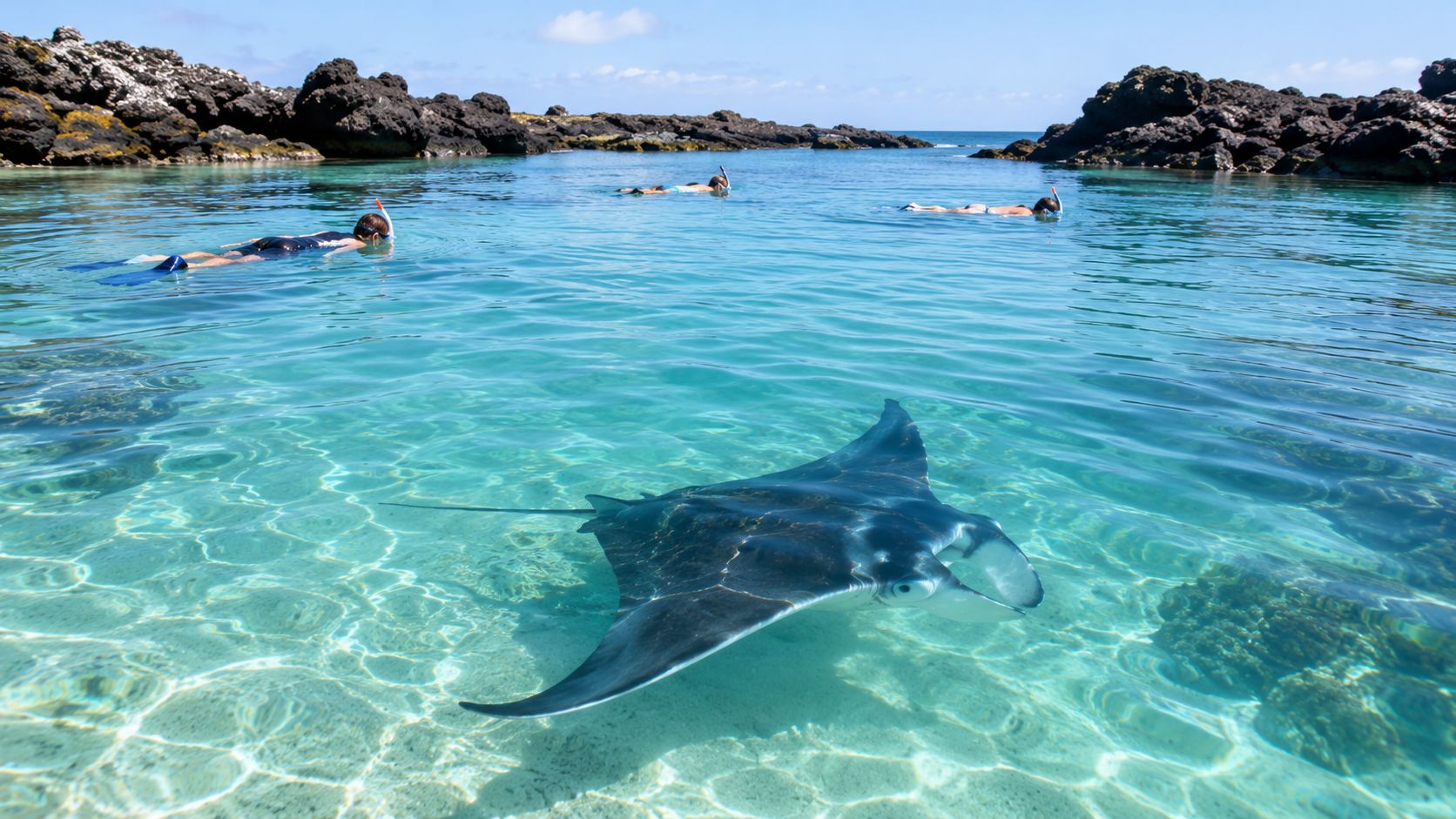
The physical layout matters. Garden Eel Cove is a protected nearshore site with multiple moorings and a sandy bottom at roughly 30–40 feet. That defined viewing area gives divers a clear place to settle and look upward without crossing a complicated reef. Snorkelers can hold position at the surface while the crew manages the light boards below.
Why the site layout improves the encounter
At night, underwater lights create a concentrated column where plankton gathers. Manta rays rise from below and make repeated feeding passes through that column. The animals control the distance and direction, so your job is to remain in place and observe.
Garden Eel Cove's sandy arena is better suited to that behavior than a more complex reef setting. The protected location can make operations more predictable, while the defined bottom reduces the temptation for divers to drift across fragile habitat. The alternative site can still produce excellent encounters, but crowding, reef complexity, and surface conditions make the layout more consequential.
The activity is available to both certified divers and surface snorkelers. Reef manta rays are year-round residents along the Big Island's Kona coast, although sightings vary with weather, ocean conditions, and the operator's setup. A reputable crew will explain the site plan before anyone enters the water.
Read the Kona manta ray dive details and look for clear guidance on behavior, lighting, positioning, and contingency plans.
- Keep your position: Let mantas approach and pass without swimming after them.
- Never touch: Contact can disturb the animals and damage their protective surface layer.
- Aim lights responsibly: Follow the crew's instructions, especially when a manta moves close.
- Respect the reef: Stay over the sandy viewing area and avoid fin contact with coral.
My recommendation is straightforward. Choose Garden Eel Cove for both diving and snorkeling whenever the operator can run it responsibly. The protected setting and superior viewing area make it the stronger manta site.
Why Kona Honu Divers Is the Premier Choice
For guests who want a full-service operation rather than a bare-bones charter, Kona Honu Divers is the most complete fit. Its boats provide hot showers, shaded seating, and storage for cameras and gear, details that become valuable after repeated entries, long surface intervals, or a night trip.
The crew brings more than 200 years of combined experience, according to the operator's published information. Its rental fleet is proactively serviced, and certified nitrox divers receive complimentary nitrox. Those are practical differentiators, not decorative extras. They reduce friction for regular divers and give experienced guests a more efficient day.
The trips fit different kinds of divers
The catalog covers standard 2-tank morning trips, advanced adventures, Garden Eel Cove manta nights, blackwater excursions, private bookings, VIP experiences, and certification from Discover Scuba through Divemaster. Repeat guests can also use dive packages rather than rebuilding a schedule from scratch.
That range suits a group that isn't uniform. One person can pursue certification, another can join a standard reef trip, and an experienced diver can look at an advanced or blackwater option. The operator also supports snorkeling, equipment rental, and service work, which keeps more of the trip under one roof.
Fitting matters most. Beginners should ask about course pacing and instructor support. Certified divers should confirm recent-dive requirements, nitrox procedures, group structure, and the exact boat departure point. Photographers should ask how camera storage and entry procedures work. Guests planning a manta night should reserve early because fixed-date experiences have less flexibility than ordinary reef diving.
Review the Kona Honu Divers home page alongside the trip details, then call with any question the booking form doesn't answer. A premium operation earns its reputation through predictable systems: maintained equipment, experienced staff, clear briefings, sensible site selection, and a boat that doesn't make the surface interval harder than the dive.
Planning Your Kona Diving Trip From the Ground Up
Start with certification and health. A certified diver should bring a current card, logbook or digital dive history, and details of any medical change since the last dive. A beginner needs to choose between an introductory experience and a full Open Water course. The latter requires several days, while an introductory program is designed for a supervised first dive.
Pack less than you think, but pack the items that affect comfort:
- Bring your own mask: A familiar seal prevents a small leak from dominating the day.
- Pack exposure protection: A suitable wetsuit matters during repeated dives and nighttime offshore trips.
- Carry a surface layer: Wind after a dive feels sharper than it did at the dock.
- Protect electronics: Use a dry bag for phones, cards, medication, and travel documents.
- Bring certification evidence: Don't assume the crew can retrieve every record at check-in.
Most shops can provide tanks, weights, regulators, BCDs, fins, masks, wetsuits, and computers. Tell the staff your height, weight, shoe size, and exposure-suit preference before departure. Try the mask and regulator together, check that the BCD inflates and deflates correctly, and ask how the computer is configured.
Humpback whale activity overlaps roughly December through April, but Kona's dive planning still depends on daily ocean conditions. In 2026, Hawaiʻi reported arrivals up 1.1% year over year, while the average stay fell 14.1% to 7.59 days and statewide visitor-days declined 13.1%. On Hawaiʻi Island, June's average daily visitor census fell 12.2% year over year even though arrivals were nearly unchanged, according to the state tourism data update. Shorter stays make padding your itinerary more important, not less.
Build room around the water
Leave at least one flexible weather day around a two-tank plan. Beginners need more breathing room because training, fatigue, equipment fit, or a delayed flight can shift the schedule. Book manta and blackwater trips early because their departure times and operating windows are fixed.
For motion sensitivity, consider a compact prevention kit: Ship-EEZ Seasickness Patch, Dramamine pills, Bonine pills, Sea Band wristbands, and ginger chews. Ask a medical professional or pharmacist about medication suitability, especially if you have health conditions or take other medicines.
Confirm transport from Kailua-Kona or a resort area, check parking instructions, and ask whether the shop offers a partner shuttle. If weather, illness, or a delayed flight disrupts a prepaid booking, contact the operator immediately. Ask about rescheduling, cancellation windows, credit, and whether a missed fixed-date trip can move to another departure.
Forty-eight hours before each dive, confirm:
- Departure harbor and check-in time.
- Certification and recent-dive requirements.
- Rental sizes and nitrox status.
- Weather, seas, and expected water conditions.
- Flight, altitude, and surface-interval constraints.
- The cancellation or rescheduling policy.
Conservation, Ethics, and Booking Like an Informed Diver
Kona's underwater appeal rests on a living system, not a backdrop. Hawaiʻi's reefs contain approximately 80 coral species and more than 1,500 reef-fish species, with more than 1,250 endemic species found only in Hawaiʻi, according to NOAA's Hawaiʻi coral-reef overview. NOAA also identifies west Hawaiʻi Island as having the largest expanse of intact, actively growing coral reef among the main Hawaiian Islands.
That abundance carries pressure. A study cited by the U.S. Coral Reef Task Force found that fish biomass along the Big Island's west coast declined 45% between 2008 and 2018. The same conservation record shows that management can work. Within the Kahekili Herbivore Fisheries Management Area, parrotfish biomass increased 331%, roughly four times its original level, after protection measures were implemented.
Choose operators that treat the reef as habitat, not scenery. That means stable buoyancy, careful finning, controlled entries, sensible anchoring and mooring practices, and briefings that tell guests exactly how to avoid contact.
Mantas need restraint, not interaction
The manta encounter deserves the same discipline. Research has identified only 318 individual reef manta rays around Hawaiʻi Island since 1979, a relatively limited and individually documented population rather than an inexhaustible attraction, as summarized in the Hawaiʻi legislative testimony on manta tourism.
The ethical standard is simple. Don't touch, chase, corner, or block a manta. Hold your position, keep your lights where the crew directs them, and let the animal decide whether to pass close.
Blackwater diving makes the connection between skill and stewardship obvious. The experience takes place offshore at night over very deep water, with divers tethered to a surface float or boat line while pelagic organisms rise toward the illuminated area. One published Kona diving account recommends at least 50 logged dives and excellent buoyancy control, and full wetsuits are commonly advised because jellyfish may be present. See the Kona blackwater dive tour only if you meet the operator's current requirements and are comfortable in open water after dark.
Before you leave the hotel, confirm your certification card, nitrox status, medical fitness, surface intervals, and rest days. Then book a shop whose crew protects the same animals you traveled to see.
Kona Honu Divers offers 2-tank reef trips, advanced dives, Garden Eel Cove manta nights, blackwater excursions, certification, snorkeling, and private charters with maintained gear and experienced crews. Visit Kona Honu Divers to match your certification and available days to the right trip, then reserve the fixed-date experience before your schedule fills.