
You've picked your Hawaiʻi dates, opened a few dive calendars, and found yourself choosing between a morning reef trip, mantas after sunset, and an offshore night dive that sounds nothing like your last vacation. The right choice isn't necessarily the most dramatic one. It's the dive you can enjoy while managing your buoyancy, gas, equipment, and surroundings without struggling.
Kailua Kona scuba diving offers very different experiences under the same destination name. A sheltered reef, a busy manta viewing area, and open water after dark each demand different skills. Start with your experience, then let conditions and a clear safety plan determine the details.
Which Kona Dive Fits Your Experience
Choose by certification and comfort first, then by the wildlife you want to see.
Kona Honu Divers offers the options below, from supervised introductory diving to advanced reef and nighttime trips. Use the Kona dive tours overview to check current schedules rather than building your itinerary around an assumed departure.
Kona dive options by experience level
| Dive type | Best for | Entry requirement |
|---|---|---|
| Morning Introductory Scuba Dive | Beginners with no certification | No certification needed, supervised introductory experience |
| 2-Tank Local Morning Dive | Certified divers exploring reefs and lava tubes | Open Water certification |
| Manta Ray Night Dive | Guests comfortable in the water after dark | Scuba certification and comfort with nighttime procedures, confirm trip eligibility |
| Black Water Night Dive | Experienced night divers | Strong buoyancy, substantial night-diving experience, and confirmed operator approval |
| Premium Advanced 2-Tank Trip | Advanced certified divers seeking remote sites | Advanced certification and confirmed trip eligibility |
For a certified diver, the morning reef trip is the sensible default. Coral gardens, ancient lava tubes, and dramatic arches offer plenty to explore without adding darkness to an unfamiliar equipment setup. Seeing a lava formation doesn't mean entering it, either. Any swim-through needs appropriate clearance, conditions, and a guide's approval.
A manta evening works best when darkness won't distract you from ordinary diving tasks. Garden Eel Cove is the preferred site choice, but your ability to follow positioning instructions matters more than getting close to an animal.
Blackwater is a different commitment. Reserve it for a trip when you're already comfortable with night diving, rather than treating it as an interchangeable alternative to the manta experience.
Booking rule: Pick the environment you can manage comfortably, not the trip name that sounds most adventurous.
Kona's water stays warm and diving is available year-round, so experience matters more than season when choosing your category. For a straightforward day plan, pair morning diving with a relaxed afternoon. Leave room around night trips for equipment preparation and the evening briefing.
Advanced itineraries require more deliberate depth and gas planning. Before choosing any departure, confirm your certification, select the matching experience, and review access, conditions, and nighttime procedures.
Certification, Refresher and Gear for Kona Dives
For most regular charters, we require at least an Open Water Diver certification from a recognized agency such as PADI, SSI, or NAUI. That qualification allows diving to 60 feet (18 meters) with a buddy. Bring your C-card, and tell us about your recent diving, not just the highest qualification printed on it.
A card establishes training history. It doesn't tell a guide whether you can still recover a regulator, clear a flooded mask, or control an ascent without help. If those tasks feel rusty, address them before adding unfamiliar conditions.
Certification and refresher paths for Kona divers
| Your Situation | Course or Requirement | What It Unlocks |
|---|---|---|
| Never dived | PADI Scuba Certification Course | Open Water diving to 60 ft (18 m) with a buddy |
| Certified, out of practice | PADI Reactivate | A structured return to regular diving after a break |
| Certified, want deeper diving | PADI Deep Diver | Training for deeper recreational diving within course limits |
| Want better buoyancy | PADI Peak Performance Buoyancy | Better control around reefs and when taking photos |
| Want enriched air training | PADI Enriched Air Diver | Nitrox planning, oxygen analysis, and management of gas-specific limits |
Use the Big Island scuba certification guide to match your situation to a training path. An introductory experience isn't a substitute for full certification, and a specialty course doesn't remove the need to meet a charter's entry requirements.
Nitrox isn't permission to dive deeper or shorten every surface interval. Its benefits depend on the blend and dive profile, and oxygen exposure adds limits you must understand. Follow your training and computer settings rather than treating enriched air as an automatic safety upgrade.
Pack for fit and familiarity
Bring a mask and fins that fit reliably. A familiar dive computer is useful too, provided you know how to read its alerts and change its gas settings correctly.
- Rent bulky equipment thoughtfully. A BCD must fit securely without restricting breathing, and you should locate its releases and dump valves before entering.
- Choose exposure protection for the whole itinerary. A lightweight wetsuit may suit warm-water diving, but repeated dives and time spent relatively still at night can leave you cold.
- Check function before departure. Test inflation and deflation, breathe from both second stages, and inspect straps and buckles.
Our rental equipment is proactively serviced. Still, confirm the gear list before your trip and speak up about unfamiliar controls during setup, not at the entry point.
The deciding question is simple: What's your highest certification, how current are your skills, and do both match the dive you want?
When to Dive Kona and What Conditions to Expect
Say you've booked a morning reef dive and rain falls overnight. That doesn't automatically mean poor diving along the entire coast. It means the site decision deserves another look, especially if your original plan involved a runoff-affected bay.
Kona is a year-round destination, but visibility belongs to a particular site on a particular day. Warm water doesn't cancel swell, and clear offshore water doesn't guarantee an easy shoreline exit.
A peer-reviewed South Kona reef survey covering 119 sites along 60.5 km of coastline reported that clear-water areas commonly exceed 30 m of visibility, while identifying greater runoff-related sediment loading in the northern Hōnaunau embayment. That contrast is useful when choosing between nearby sites after rainfall.
Turn conditions into decisions
For photography, suspended sediment changes the practical plan. Move closer to your subject, keep strobes angled away from the water immediately in front of the lens, and consider ambient light when particles overwhelm the frame. Swimming harder through murky water won't improve the photograph.
Reef structure matters too. Lava ridges, crevices, coral heads, and overhangs provide different places for fish to shelter and feed. Choose a route with varied structure rather than assuming a deeper, flatter stretch must offer more to see.
A good site choice can improve the dive more than chasing an extra few feet of depth.
Mornings on the leeward coast are usually calmer than afternoons, which makes early reef departures a practical starting point. That's a tendency, not a promise. Swell direction and local exposure can make a familiar entry unsuitable even when the sky looks inviting.
Use the guide to the best months for Hawaiʻi scuba diving for broader trip planning, then make the final decision with the marine forecast and site briefing.
Before entering, check:
- Recent rain. Consider runoff and water discoloration near the planned site.
- Swell. Watch the actual entry and exit through a sequence of sets.
- Wind. Think about the return swim, surface conditions, and boat pickup, not just the descent.
A changed itinerary is often evidence of good planning. Don't pressure a crew to keep a named site when another location better suits the day.
Top Dive Sites from Old Kona Airport to Keauhou Bay
| Site | What You Find | Best For |
|---|---|---|
| Old Kona Airport MLCD | Shallow lava fingers, a rapid offshore drop, reef fish, and possible turtle or ray encounters | Shore diving and reef observation when entry conditions suit |
| Garden Eel Cove (Makako Bay) | A sheltered reef setting with a defined manta viewing area | Guided manta night dives |
| Keauhou Bay | Recognized manta viewing coastline fronting Sheraton Keauhou Bay Hotel | Night manta viewing with a clear boat and diver plan |
| Kealakekua Bay | A long-established Marine Life Conservation District | Protected reef observation and conservation history |
| Kaʻūpūlehu Marine Reserve | A reserve with a formal history of restrictions on taking marine life | Conservation-minded reef observation with current access and rules checked |
Choose Old Kona Airport for terrain and shore-diving flexibility, provided you can assess the entry and return route. The state's Old Kona Airport MLCD description places its shallow lava fingers at approximately 50 feet, followed by a rapid drop into deeper water.
That transition matters for navigation and depth control. Follow the planned contour rather than drifting down the slope while watching fish, and identify your return landmarks before leaving the entry area.
Match access to your ability
The partially protected cove at the northwestern end is used by snorkelers and shore divers. The southeastern lava shoreline offers another entry in calm to moderate conditions, but rock access demands a realistic assessment of footing, surge, and getting out while carrying equipment.
A boat dive reduces the need to negotiate shoreline lava. It doesn't remove the need to understand pickup procedures, ladder use, or what to do if you surface away from the group.
Garden Eel Cove suits divers prioritizing the manta experience in a sheltered reef setting. Keauhou is another recognized nighttime viewing location, but don't select either solely because it's closer to your accommodation. The viewing plan, congestion, and conditions deserve equal weight.
Protected status needs context
For divers interested in conservation history, Kealakekua is a meaningful choice: the Hawaiʻi Division of Aquatic Resources report records its MLCD establishment in 1969 and Kaʻūpūlehu Marine Reserve's designation in 2016, with a 10-year moratorium on taking marine life in waters shallower than 20 fathoms, or 120 feet.
Those designations describe management history, not a guarantee of untouched coral or unrestricted visitor access. In particular, don't use an older description of a time-limited restriction as a substitute for checking current rules.
- For shoreline access, inspect the exit before gearing up.
- For a boat itinerary, let the crew match the site to the group and sea state.
- For protected areas, verify current boundaries and permitted activities.
The best site is the one that fits the trip type and the divers aboard, with a workable entry, exit, and conservation plan.
Manta Ray Night Dives and Why Garden Eel Cove Wins
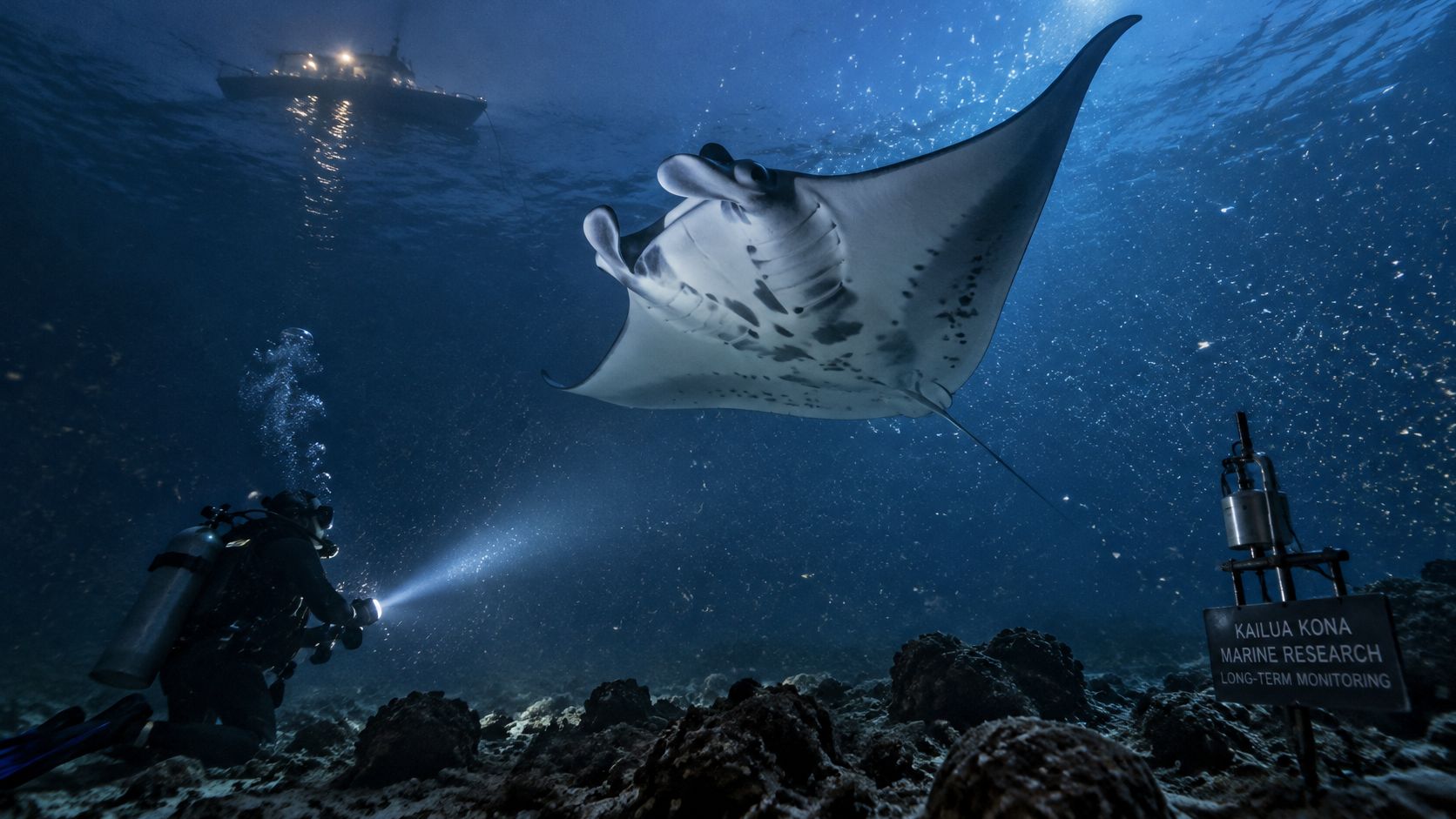
Kona's manta encounters involve recurring animals, not just a lucky meeting with passing wildlife. A six-year reef manta study archived by NOAA recorded 25,444 observations of 118 individually identified reef manta rays between 2009 and 2014; 39 rays appeared on more than 10% of study nights, and one individual appeared on more than 56%.
That history makes the encounter special, but it also raises the standard for visitor behavior. These are animals using important habitat repeatedly. Divers should fit into that activity rather than compete for the closest pass.
Why I would choose Garden Eel Cove
Garden Eel Cove is the superior choice for a manta dive tour because of its protected location, better viewing area, and better surrounding reef setting. That's a practical site preference, not a guarantee of more rays on your particular evening. Shelter can make positioning more manageable, while a defined viewing area helps divers understand where to remain.
The Hawaiʻi DLNR manta-site management announcement recognizes Makako Bay and the Keauhou viewing coastline and describes proposals involving anchoring restrictions, operator limits, rafting prohibitions, and live-boating controls. Associated proposed controls also addressed hull lighting used to attract plankton beneath vessels.
Proposals aren't the same as enacted rules. Their practical relevance is that boat movement, lighting, and crowd concentration need active management. A sheltered location still needs disciplined operations.
The diver's part of the bargain
Review the manta night-dive preparation guide before committing to an evening departure. Then follow the briefing rather than improvising a viewing position.
- Leave the flight path open. Don't rise into a feeding loop or block a ray for a photograph.
- Keep hands and equipment close. Touching isn't part of the encounter, even when an animal passes nearby.
- Control your position. Maintain neutral buoyancy when moving, and use only the designated viewing arrangement without settling onto living reef.
- Let rays leave. Don't chase an animal beyond the viewing area or sweep lights after it.
A University of Hawaiʻi study published in 2025 analyzed more than 23,000 sightings of 167 individual reef mantas and found broadly stable aggregation sizes despite increased tourism, with prey availability strongly influencing manta numbers. Stable sightings are encouraging, but they don't establish that tourism has no habitat or behavioral effects.
Low-impact standard: Your best encounter is one the animal can enter and leave freely.
Check the manta ray dive tour details for the current itinerary and eligibility. Arrive prepared to observe whatever happens, including a quiet night. Fewer mantas don't automatically mean the operator or ecosystem has failed.
Blackwater and Advanced Dives for Experienced Divers
Blackwater is a night dive in open, deep water rather than on a reef. You maintain a controlled position in the water column while small drifting organisms pass through the lights. There may be no visible bottom or shoreline reference to help you judge movement.
That absence of reference changes ordinary tasks. Looking through a camera can hide an unintended ascent, and swimming toward an interesting animal can separate you from the group. The main skill isn't finding unusual creatures. It's remaining aware of depth, gas, position, and your buddy while watching them.
Open water after dark
Treat the Black Water Night Dive as an experienced-night-diver option, not a first attempt at diving after sunset. Confirm eligibility directly rather than assuming that an advanced card alone qualifies you.
Carry reliable primary and backup lights, understand the attachment or reference system described in the briefing, and rehearse how you'll signal a problem. Keep your buddy identifiable without shining your beam into their eyes.
The Kona blackwater diving guide helps establish the difference between this environment and a conventional reef night dive. Don't expect to rest against the bottom while adjusting a camera or recovering your composure.
Low-impact behavior applies offshore too. Avoid grabbing drifting organisms, corralling them with your hands, or pursuing them beyond the agreed operating area.
Remote reefs bring different demands
The Premium Advanced 2-Tank Trip is the alternative for appropriately certified divers interested in deeper or more remote reef exploration. Remote, pristine sites can be rewarding, but remoteness isn't a reason to accept a marginal gas plan or enter an overhead environment beyond your training.
Deeper diving generally leaves less room for distraction. Know your planned maximum depth, turn pressure, ascent procedure, and what happens if current separates you from the intended route.
Before choosing either format, answer:
- Night experience. Have you logged enough night dives that equipment handling and communication feel routine?
- Position control. Can you hold depth while adjusting equipment without touching a bottom or reference line?
- Training match. Does your certification cover the planned environment, and have you confirmed the trip's additional requirements?
If the answers expose a gap, choose a reef dive or refresher first. That's preparation, not a missed opportunity.
Safety, Crowding, Rules and Reef Care
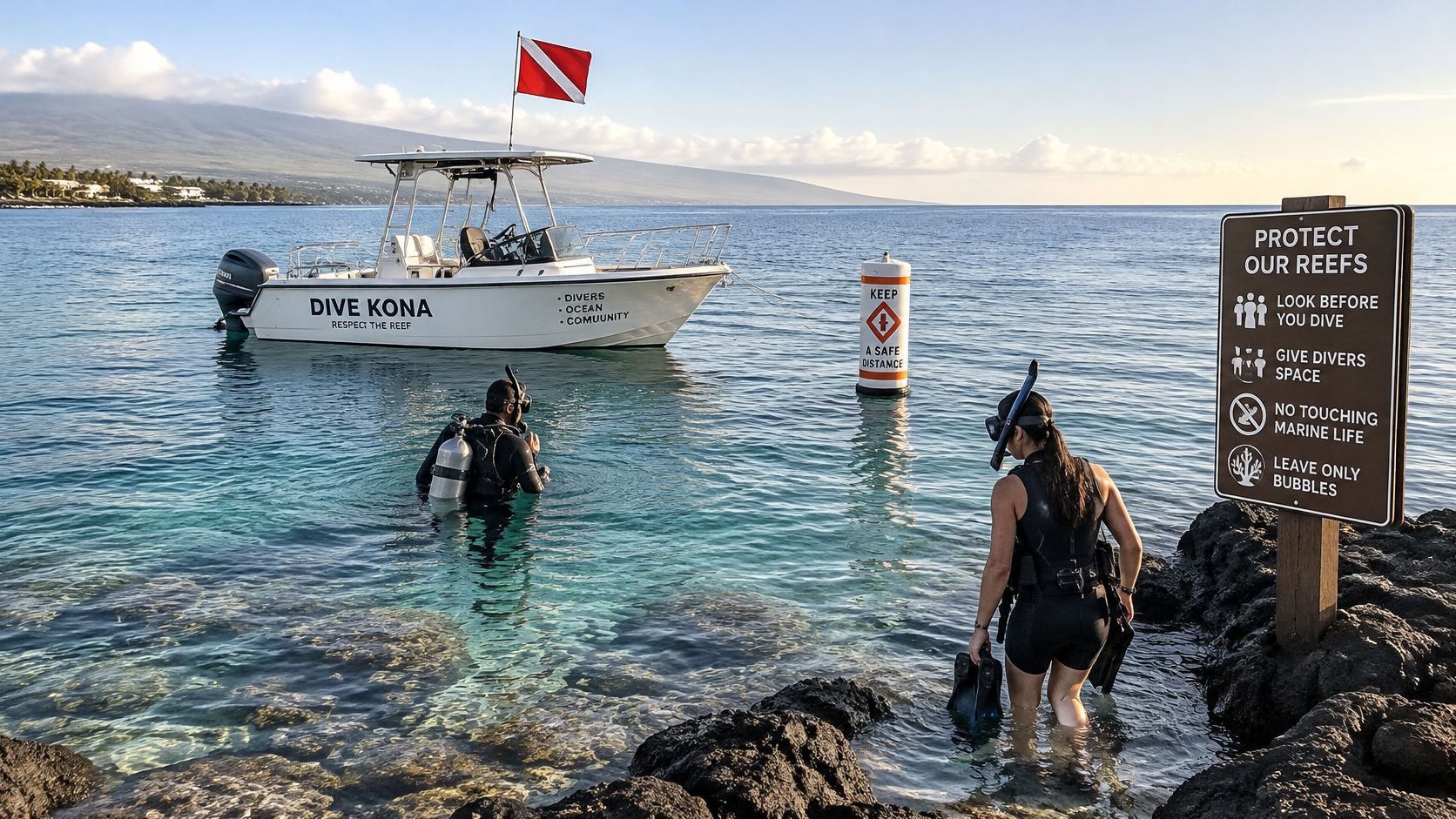
The diver's flag is required. The Hawaiʻi boating division's diving rules require a flag at least 12 by 12 inches, clearly illuminated between sunset and sunrise, and require divers to surface within 100 feet of it in ocean waters, except during emergencies.
For a guided trip, understand how the crew implements that requirement. Don't confuse carrying a surface marker with knowing where you're expected to ascend.
Ask about congestion before departure
A Hawaiʻi County manta-viewing safety assessment identified close proximity between boats, snorkelers, and scuba divers at Makako and Keauhou bays. County visitor-survey material reported that 82% felt crowded by snorkelers, 78% by boats, and 69% by scuba divers.
Those responses describe perceived crowding, not accident rates. They're a reason to ask precise operational questions, not evidence that every manta trip is unsafe.
Use this pre-trip checklist:
- Group management. What's the maximum group size and diver-to-guide ratio?
- Entry and exit. Where do divers wait, enter, regroup, and approach the ladder?
- Surface signaling. What flag, marker, and boat-light procedures apply?
- Traffic separation. How are scuba divers kept clear of snorkel groups and moving vessels?
- Changing conditions. Who decides to relocate or cancel when congestion or sea state makes the site unsuitable?
- Emergency response. What should you do if separated, low on gas, or unable to complete the planned exit?
Protect the habitat under your fins
The Old Kona Airport MLCD rules generally prohibit taking or removing marine life, coral, shells, algae, sand, rock, and geological features, as well as feeding or otherwise attracting aquatic organisms. Treat it as an observation site, not a collecting opportunity.
Reef care matters at depth too. A USGS account of Kona Coast protected-reef comparisons describes widespread coral losses and an approximately 25% overall increase in algae and rubble, with little evidence that deeper reef zones escaped decline.
Secure gauges and alternate air sources, keep fins clear of coral, and move over an appropriate bare area before making adjustments. Don't kneel on living structure to steady a photograph.
Apply responsible diver etiquette to the entire dive: your equipment, fin wash, lighting, and position all affect other divers and the habitat.
Confirm Your Dive Plan and Book Your Day
- Confirm your certification and bring your C-card. Include recent experience when describing your readiness.
- Choose the dive that matches your skills. Be especially candid about night diving, buoyancy, and deeper profiles.
- Match the location to conditions. Favor suitable protected reef and Garden Eel Cove for manta nights rather than insisting on a site regardless of the forecast.
- Check weather and equipment before departure. Review rain, swell, and wind, then confirm the gear list and meeting instructions.
- Check availability once those decisions are clear. Leave enough flexibility for a responsible change of site or itinerary.
What the dive day involves
A typical Kona Honu Divers dive day begins with arrival and gear setup, followed by a briefing on site conditions and entry style. The first dive visits the deeper or more condition-sensitive site, then comes a surface interval and a more relaxed second dive.
Use setup time to resolve small problems. Adjust a slipping tank band, identify unfamiliar BCD releases, and tell the guide if a mask leaks before everyone starts moving toward the water.
During the briefing, listen for the details that affect your own actions: where to descend, how to communicate gas, when to turn, and where to wait before boarding. Ask for clarification if a procedure differs from your previous diving.
Booking a guided dive doesn't transfer responsibility for your depth, gas, or comfort to the guide.
We were voted best dive operator in Kona, Hawaiʻi, but a booking decision should still rest on a clear match between the trip and your abilities. If certification or conditions leave you uncertain, call 808-324-4668 before booking.
Leave room for the actual ocean
Keep the rest of your day realistic. Follow appropriate post-dive guidance for flying and altitude travel, and don't schedule a demanding activity just because the charter has a planned return time.
If you can identify the certification that qualifies you, produce your card, and explain why the environment suits your recent experience, you're ready to select a departure. If not, resolve that question with our team first.
Kona Scuba Diving FAQs
Do I need certification to dive in Kona?
Most regular charters require an Open Water card from a recognized agency such as PADI, SSI, or NAUI. The Morning Introductory Scuba Dive is the supervised option for guests without certification, subject to participation screening.
Is Kona diving good year-round?
Yes. Warm water supports year-round diving, but swell, wind, and recent rainfall still determine whether a particular site suits the day. Keep your itinerary flexible.
How clear is the water?
South Kona's clear-water reef areas can offer excellent visibility. Runoff-affected bays can look very different after rainfall, so don't interpret a destination-wide reputation as a visibility guarantee for your booking.
Are manta sightings guaranteed?
No. Mantas choose where to feed, and prey availability influences their presence. A quiet evening remains a wildlife encounter, not proof that something went wrong.
Can I feed, touch, or chase the animals?
No. Feeding is prohibited in the Old Kona Airport district, and respectful diving everywhere means leaving animals space and avoiding contact. Don't block their movement for a camera angle.
What flag do I need at night?
Use a compliant diver's flag that's clearly illuminated after sunset, and follow the ocean surfacing-distance requirement. On a guided boat trip, make sure you understand the crew's flag coverage, ascent location, and separation procedure before entering.
Kona Honu Divers offers introductory reef experiences, certified morning dives, manta evenings, and specialist blackwater and advanced trips. Visit Kona Honu Divers to choose a dive that matches your certification and recent experience, then confirm your equipment and site plan before reserving your day.