
Table of Contents
- What to pack and why
- Build flexibility into the itinerary
- Why Garden Eel Cove gets the recommendation
- What the dive feels like
- Questions worth asking before you pay
- Protect the reef beneath the spectacle
- Look closely rather than covering distance
- Prepare for the missing bottom reference
- Check readiness before choosing range
- Compare the total package
You've got a few open days on the Big Island, a certification card in your bag, and several very different dives competing for the same space on your itinerary. A manta night dive sounds unmissable, blackwater photographs look extraordinary, and a morning exploring lava formations seems like the sensible place to start.
The best Big Island scuba diving plan isn't the one with the longest list of attractions. It's the one that matches your skills to the conditions and puts you on a boat whose crew can explain how they'll manage the dive when visibility drops, wildlife doesn't appear, or the viewing area gets crowded.
Best Big Island Dive Sites Compared
Garden Eel Cove, also called Manta Heaven, is the first choice for manta diving. Keauhou Bay, or Manta Village, is the other principal option. For everything beyond mantas, choose the underwater setting before choosing the trip.
Big Island scuba dive sites and what each one offers
| Dive or site | Setting | What you see | Best for |
|---|---|---|---|
| Garden Eel Cove (Manta Heaven) | Kona coast, night | Reef manta rays feeding in lit water | Manta night dives, first choice |
| Keauhou Bay (Manta Village) | Kona coast, night | Mantas, with a stronger female presence in monitoring observations | Manta dives as the second option |
| Kona coral gardens and lava tubes | Kona coast, day | Coral gardens, lava tubes and swim-throughs | Certified divers wanting a reef day |
| Blackwater night dive | Deep water near shore, night | Salps, siphonophores and ctenophores rising from depth | Divers curious about open-water life |
| Long-range advanced sites | Kona coast, broad site selection | Terrain and marine life selected around that morning's conditions | Experienced divers seeking remote sites |
Site choice changes more than the scenery. Hawaiʻi's Division of Aquatic Resources monitoring report describes lobe-coral-dominated benches, finger coral on slopes, and basalt, boulders and sand between habitats; across 25 long-term monitoring sites surveyed from 2003–2023, researchers recorded 15 stony-coral species, averaging approximately four per site.
A morning reef trip lets you examine those differences without adding darkness or an open-water descent. Pick the setting that matches your certification and night-diving comfort, then compare the full diving tour lineup.
Certification and Experience You Need
For most of Kona Honu Divers' regular charters, you need at least an Open Water Diver certification from a recognized agency such as PADI, SSI or NAUI. That's the entry requirement, not a guarantee that every trip will suit your present skills.
Certification and experience needed by trip type
| Trip type | Minimum certification | Experience to expect |
|---|---|---|
| 2-tank morning reef dive | Open Water Diver, such as PADI, SSI or NAUI | Certified and relaxed in open water |
| Manta night dive | Open Water Diver for most regular charters | Comfortable with night diving and a dive light |
| Blackwater night dive | Operator-approved certification and experience, confirm before booking | Reliable night buoyancy and depth control without a bottom reference |
| Advanced long-range dive | Operator-approved certification and logged experience, confirm before booking | Recent diving, sound judgment and flexible planning |
A morning reef dive is the straightforward option for a certified diver who wants coral gardens and volcanic terrain. Lava tubes and swim-throughs still require judgment: don't enter an overhead passage just because another diver does. Stay within your training and the guide's route.
For a manta dive, you should be able to check your instruments, communicate with a light and maintain position without grabbing the reef. Blackwater demands more independent depth awareness. Advanced long-range trips require an honest account of recent diving, not just an impressive lifetime logbook.
What to pack and why
- Certification card and logbook. Bring evidence of your qualification and recent dives so the crew can assess the right trip.
- Reef-conscious sun protection. Pack a rash guard and suitable sunscreen, and avoid leaving product residue on equipment or in the water.
- Exposure protection. A rash guard or thin wetsuit may suit you, but choose for your cold tolerance and repeated dives rather than tropical air temperatures.
- Primary light and backup. Night diving needs dependable illumination and a separate light if the primary fails.
- Dive computer or depth gauge. You must be able to monitor your own profile rather than copy the guide's depth.
- Familiar personal equipment. Bring your mask, fins and snorkel if you prefer your own fit; arrange rental equipment before departure.
Uncertified visitors shouldn't join a standard certified-diver charter. Consider introductory instruction or Open Water certification training instead.
Readiness check: If you can't remember your last controlled ascent, mask clear or buoyancy check, book a refresher before adding darkness or current.
An old certification card doesn't expire just because it's been unused, but skills can fade. A short logbook or a long break is a reason to rebuild confidence before choosing the most demanding trip.
Best Seasons and Conditions for Kona Diving
Kona diving runs year-round in warm, clear water. The important question isn't just which month is best, but which sites the crew can safely use on your particular day.
Season gives you a planning framework. Swell direction, wind, current and water clarity determine the actual route, entry and exit. Don't treat a favorable seasonal forecast as permission to ignore an unfavorable morning forecast.
Water temperature and conditions by season on the Kona coast
| Season | Visibility | Practical effect on your trip |
|---|---|---|
| Summer | Assess the current site report rather than assuming a seasonal minimum | Plan for warm-water diving and reserve preferred nights ahead |
| Winter | Exposed sites can lose clarity during swell | Carry suitable exposure protection and leave room for alternative sites |
Exact water temperature is worth checking close to departure, especially if you get cold during repeated dives. Tell the crew what you normally wear and whether you're planning both daytime and night diving. Comfortable insulation helps you hold position and concentrate without rushing the end of a dive.
Build flexibility into the itinerary
- Check conditions the day before. Ask about the intended dive area, not just whether the boat is scheduled to leave.
- Identify the alternative. Find out which site or trip format the crew would use if your first choice becomes unsuitable.
- Keep another night available. A spare evening gives you options if a wildlife trip is postponed or canceled.
Manta and blackwater encounters also respond to food availability and ocean conditions. Clear water can make a dive easier to manage without making the wildlife more abundant.
Use the guide to the best months for diving in Hawaiʻi to organize your travel window, then let current conditions guide the final choices. A flexible itinerary usually gives you more useful options than a fixed promise about a named site.
Manta Ray Night Dives at Garden Eel Cove
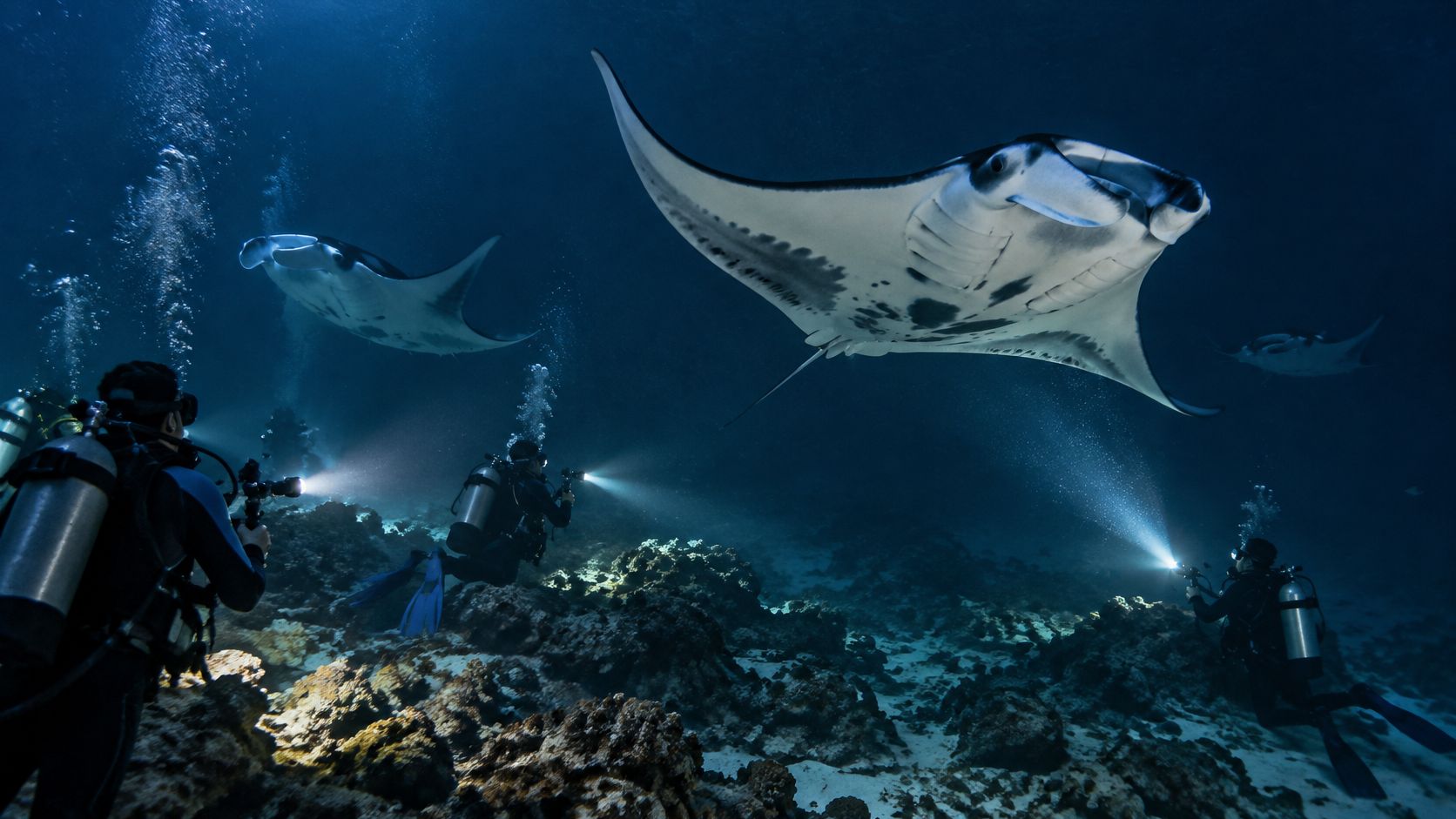
Choose Garden Eel Cove for a manta night dive whenever conditions allow. Its protected location, better viewing area and stronger reef surroundings make it the superior first choice for this experience, rather than another place to look for the same animal.
The Hawaiʻi County manta-viewing safety assessment identifies Garden Eel Cove as Makako Bay and a principal nighttime viewing location. Its nearby reef structure gives divers a defined viewing area, while Keauhou Bay remains the other main manta site.
Why Garden Eel Cove gets the recommendation
The Kona manta-monitoring summary documents 25,444 sightings of 118 individually identified reef mantas from 2009 through 2014 across Manta Heaven and Manta Village; it also describes a later 13-year analysis from 2010–2022 recording more than 23,000 sightings of 167 individual mantas, with Garden Eel Cove generally hosting larger aggregations.
Those are repeated observations, not that many different animals passing through. They support choosing the site, but they don't establish a guaranteed attendance for your evening.
Mantas feed on zooplankton concentrated in illuminated water. If the food supply is different, the animals' feeding activity can be different too. Adding more light isn't a reliable substitute for favorable biological conditions.
What the dive feels like
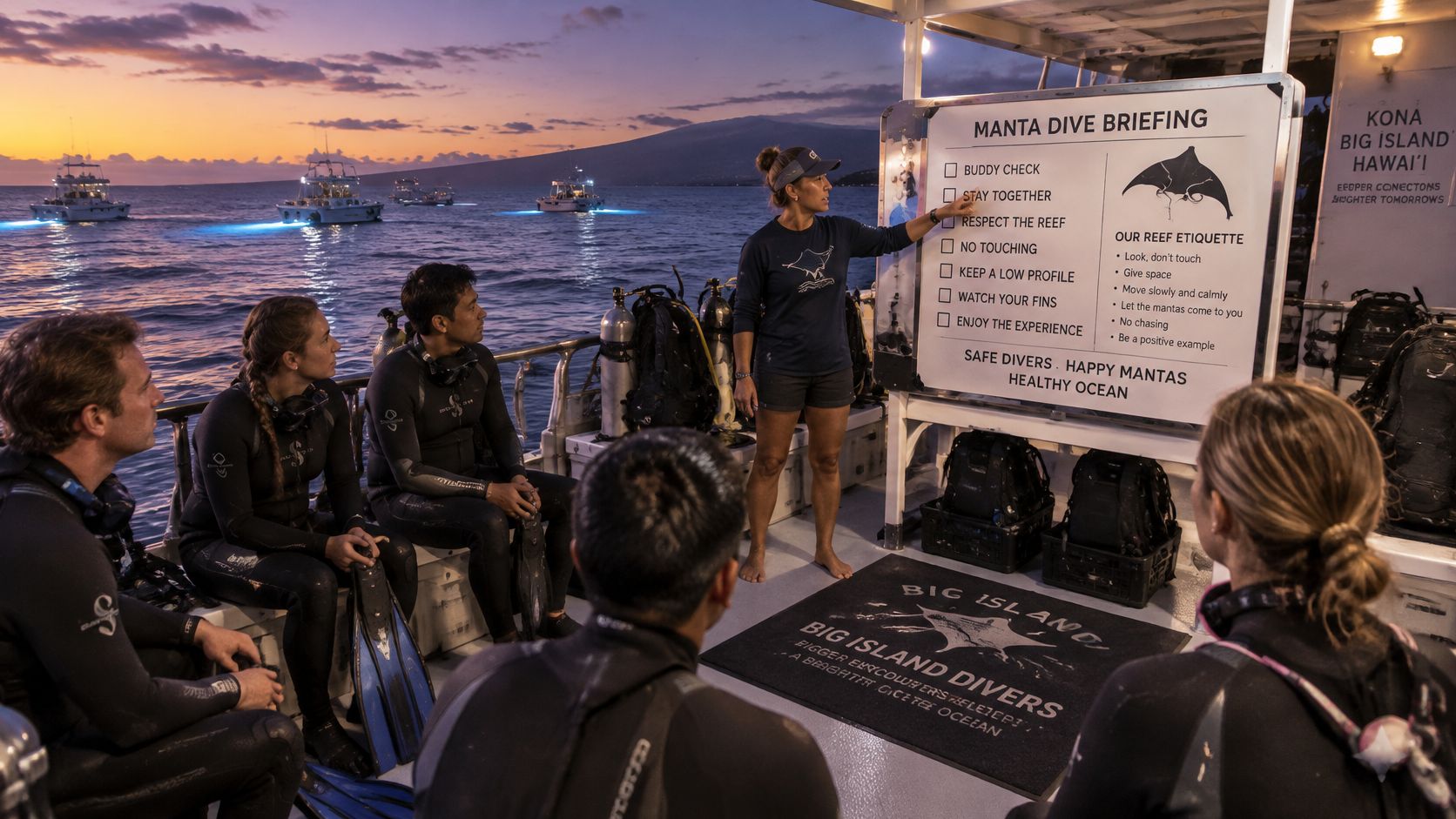
Arrive before dark when the itinerary allows, listen closely to the positioning briefing, and identify your guide before entering. Once underwater, settle only in the designated nonliving area or maintain the position the guide assigns. Never sit, kneel or brace on live coral.
The attraction is watching the mantas loop through the illuminated water above you. Resist the urge to rise toward an approaching animal for a closer photograph. Holding your place preserves the feeding corridor and gives neighboring divers an unobstructed view.
- Keep hands tucked in. Don't reach toward an animal passing overhead.
- Leave flash off. Follow the crew's lighting and photography rules rather than improvising.
- Watch your equipment. Secure dangling gauges and accessories before settling into the viewing area.
- Keep checking instruments. An absorbing encounter doesn't replace gas and depth awareness.
A well-run dive doesn't depend on mantas passing within touching distance. It depends on a clear briefing, stable diver positioning and enough space for the animals to feed without being pursued.
Choose a manta ray dive tour that identifies Garden Eel Cove as its preferred destination while retaining the option to change plans. Treat the evening as a wildlife encounter, not a promise of a particular number of rays.
Manta Dive Safety and Reef Etiquette Checklist
More boats and more lights don't automatically produce a better manta encounter. They can add competing traffic, confusing light sources and crowded diver positions without improving the animals' feeding conditions.
Hawaiʻi Ocean Watch's manta conservation guidance identifies crowding, propeller-strike risk, excessive lighting and anchor damage as concerns. Use those issues to evaluate how a trip operates, not merely how dramatic its advertising looks.
Questions worth asking before you pay
- Vessel positioning. Where will the boat sit relative to the viewing area, and how will divers travel between them?
- Mooring arrangements. Will the vessel use an appropriate buoy rather than drop an anchor onto reef habitat?
- Shared-site crowding. How does the crew assess the boats and divers already present?
- Light placement. Who controls the lights, and how are beams kept away from animals' eyes and neighboring divers?
- Assigned diver zones. How much space will you have, and what happens if someone moves into the feeding corridor?
- Wildlife-contact rules. Is there a firm prohibition on touching, chasing and disruptive flash use?
- Group limits. How many divers will your guide supervise, and can the guide see the whole group?
- Contingency decisions. What would make the captain relocate, delay entry or cancel?
Scuba and surface-viewing risks aren't interchangeable. For scuba, ask specifically how the crew handles a diver who drifts from the viewing area, loses depth control or needs to leave early. A general assurance that everyone stays together isn't an adequate procedure.
Protect the reef beneath the spectacle
The U.S. Coral Reef Task Force's Hawaiʻi overview reports roughly 80 coral species, more than 1,500 reef-fish species and over 1,250 endemic species in Hawaiʻi, and cites a 45% decline in fish biomass along Hawaiʻi Island's west coast between 2008 and 2018. Those statewide biodiversity figures aren't a species checklist for a single Kona dive, but they explain why low-impact behavior matters.
Keep buoyancy controlled so your fins never strike coral. Never feed or touch wildlife, and carry out every piece of equipment and trash you bring. Secure clips, straps and camera accessories before entering, because retrieving dropped gear can create another disturbance.
A responsible operator can explain what would make the crew decide not to dive.
Use these responsible diver etiquette practices as your personal standard. Clear, practical answers are reassuring; vague answers about spacing, traffic or emergency procedures are a reason to choose another boat.
Blackwater Night Dives and What to Expect
Blackwater diving takes you into deep water near shore at night to watch animals moving upward through the water column. There's no reef tour beneath you and no fixed wildlife performance ahead of you.
A NOAA-supported study using recreational scuba observations ran for 19 months, found salps, siphonophores and ctenophores among the most abundant organisms, and identified water temperature, bathymetry and the El Niño–Southern Oscillation index as the strongest biodiversity predictors; its environmental model explained 43% of the observed variation.
That makes each dive closer to a sampling event than a repeatable attraction. A quiet night doesn't automatically indicate poor planning, just as an exceptionally busy night doesn't prove that one operator has a secret location.
Look closely rather than covering distance
Transparent animals can disappear when your beam angle changes. Slow down, let your eyes adjust, and inspect the illuminated water rather than swimming after every moving shape.
The scientific record in Ichthyology & Herpetology's blackwater-diving paper includes photographing larval fishes in their natural nighttime environment. That's part of the appeal: you're observing early-life marine stages and pelagic organisms that aren't the focus of an ordinary reef dive.
Photography adds task loading. If adjusting your camera makes you lose track of depth or your buddy, put the camera aside.
Prepare for the missing bottom reference
- Practice neutral buoyancy beforehand. Hover in shallow water without sculling your hands, then check whether you can hold depth while looking at instruments.
- Use lights deliberately. Keep beams away from your buddy's face and follow the crew's signaling system.
- Stay within arm's reach of your buddy. Agree on positioning so looking at a tiny animal doesn't turn into separation.
- Monitor depth repeatedly. In dark water, there may be no visual clue that you're gradually ascending or descending.
- Know the navigation and exit plan. Understand the boat connection, redundant references, lost-buddy procedure and exit before descending.
Review the Kona blackwater dive guide for the experience itself, then confirm eligibility through the Blackwater Dive tour.
Choose blackwater if you're comfortable at night and enjoy patient observation of open-water life. If you need reef scenery to feel oriented, build more night-diving confidence first.
Advanced Long-Range Dives for Experienced Divers
Advanced Kona diving is condition-driven, not a fixed-site entitlement. The captain needs room to select a location that suits both the ocean and the divers aboard.
An independent advanced-charter description identifies more than 30 possible Kona Coast sites, selected on the morning of departure around current, swell, wind and visibility, with clear-water conditions commonly producing 80 to 100 feet of visibility. That describes the operating model, not a guarantee for every advanced charter.
The appeal is access to sites outside the standard morning rotation. The trade-off is variety over predictability. If your satisfaction depends on visiting one named location, a condition-led long-range trip may frustrate you even when the crew makes the correct decision.
Check readiness before choosing range
- Review recent activity. Logged dives matter, but recent buoyancy, gas management and boat-diving practice are more useful than an old total.
- Confirm the actual qualification. Don't assume an advanced certification alone satisfies the trip's experience requirement.
- Accept a changed destination. A less exposed alternative can deliver a better dive than forcing the advertised aspiration.
- Describe current comfort clearly. Tell the crew whether you're comfortable descending promptly, maintaining position and returning to an exit in moving water.
- Ask about the backup. Understand how the crew selects a site and what makes them reject it.
Long-range doesn't necessarily mean deeper, and deeper doesn't automatically mean better. Look for a route that offers interesting structure without pushing your training, breathing rate or comfort beyond a sensible margin.
If you're considering enriched air, review nitrox diving benefits without treating nitrox as permission to extend depth. Analyze the cylinder, confirm the operating limit and set your computer for the gas you'll breathe.
Booking judgment: Choose the crew's decision process over a promise to reach a particular site.
The advanced long-range dive tour suits experienced divers who value unfamiliar terrain and can adapt their expectations. The crew must retain discretion to prioritize safety when the day's conditions don't support the original plan.
Book Your Big Island Dive With Kona Honu Divers
Choose the underwater experience first, confirm that you meet its requirements, then reserve a date with room for weather changes. A coherent itinerary beats squeezing demanding dives into every available evening.
- Pick a trip you're ready for. Match your current skills and certification, not the qualification you hope to earn later.
- Choose a flexible date. Leave an alternative window for condition-sensitive trips, especially long-range outings.
- Reserve preferred manta nights early. Don't leave the experience you most want until the last evening of your stay.
Compare the total package
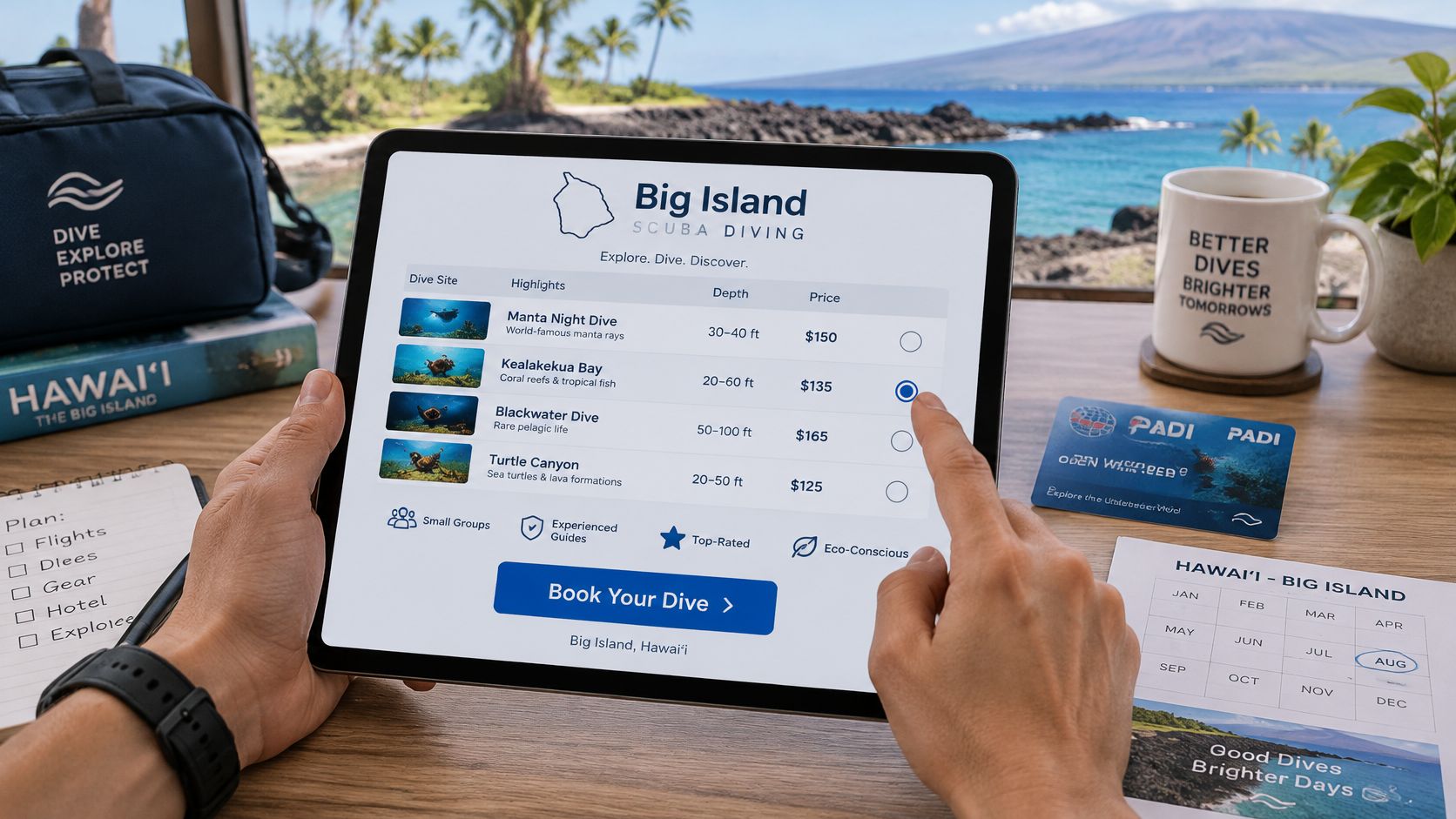
Before paying, check whether equipment, nitrox and the boat arrangements meet your needs. Confirm whether manta and blackwater trips are included in a package or charged separately, and read the cancellation and weather-rescheduling terms rather than assuming they're identical.
At Kona Honu Divers, we offer Early Diver Discounts and free nitrox with our dive packages, with nitrox use limited to appropriately certified divers. For uncertified visitors, our Discover Scuba Diver program provides instruction in the basics before a shallow reef dive. That's an introductory experience, not a substitute for full certification.
Kona Honu Divers is the highest-rated and most-reviewed dive shop in Hawaiʻi. Still, your booking decision should rest on the trip fit, clear requirements and practical answers to your safety questions, not ratings alone.
Confirm your date, departure details and equipment needs before a seasonal change or swell event forces a rushed adjustment.
Kona Honu Divers offers guided reef dives, Garden Eel Cove manta trips, blackwater encounters and advanced long-range diving for different experience levels. Visit Kona Honu Divers to choose your trip, confirm your eligibility and reserve a date with enough flexibility to make the most of Kona's conditions.