
Table of Contents
- Build the week around different demands
- What comfortable actually means
- Match support to the diver
- Make these habits automatic
- Gas choices don't replace discipline
- Position for feeding, not pursuit
- Why request Garden Eel Cove
- Expect small life and changing encounters
- The daytime alternative
- Ask about the actual departure
- Pack for repeated immersion
- Plan seasickness prevention before departure
- Compare the complete booking
- Choose support rather than a headline
You've got a Kona vacation on the calendar, a certification card in your wallet, and a manta photograph saved on your phone. The harder decision is what to book first, especially if your last dive was a while ago or your travel partner isn't comfortable after dark. A good dive week starts with an honest match between the trip, your current skills, and the conditions outside the harbor.
What a Kona Dive Week Really Includes
Say your vacation starts with lights in the water and a reef manta turning through a cloud of plankton. The following morning, you're checking your buoyancy above volcanic reef rather than watching a fixed nighttime feeding area. Those experiences can fit into the same trip, but they ask different things of a diver.
Kona's leeward position makes it a practical base for boat diving. A protected departure, however, doesn't tell you whether an exposed point has surge, whether runoff has affected the planned reef, or whether your group is ready for a deeper profile. A calm harbor isn't a site assessment.
Build the week around different demands
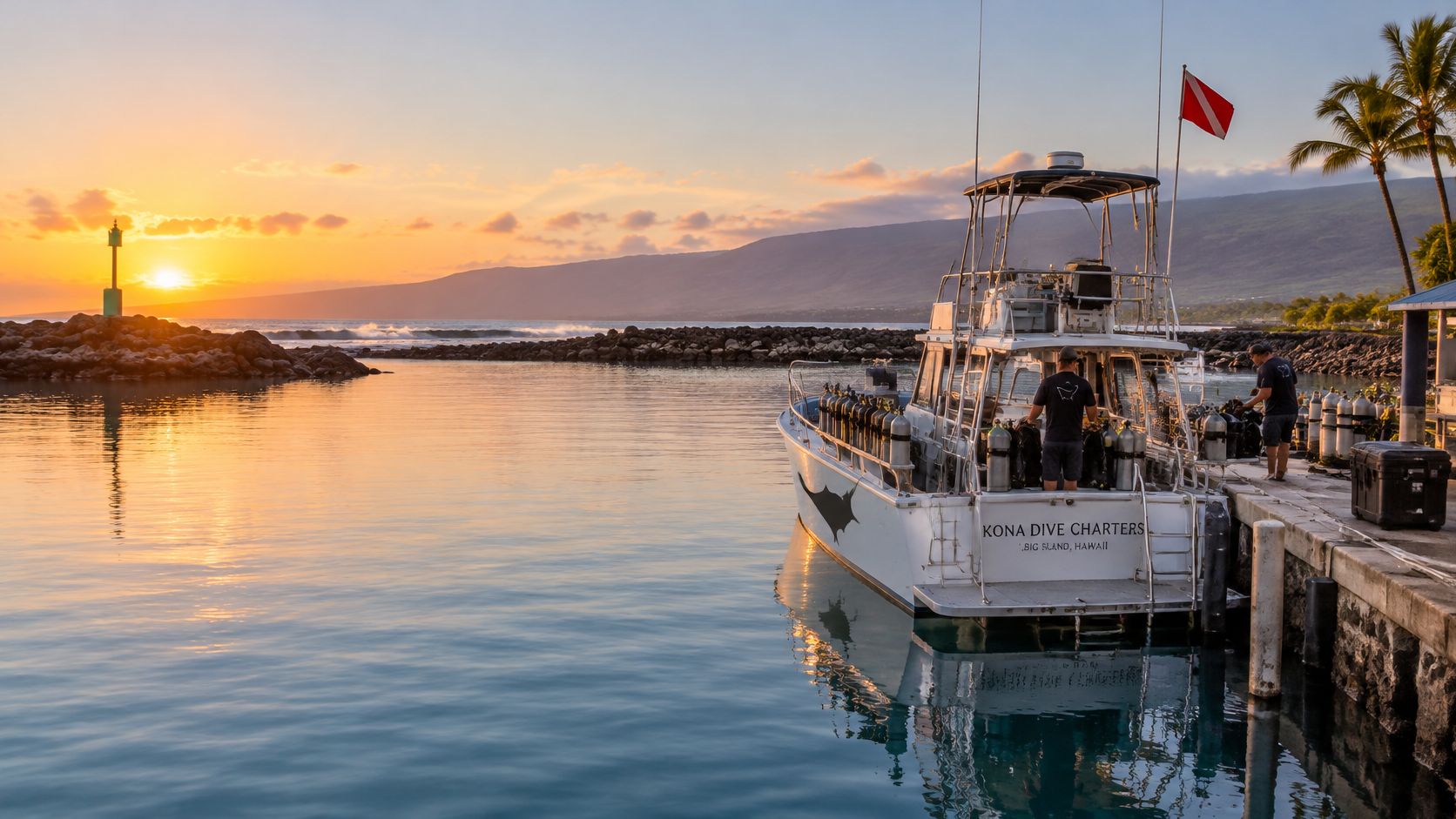
The main choices are a morning two-tank reef dive, a manta ray night dive, a blackwater drift, and a premium long-range trip for experienced divers. The Kona diving tour list lets you compare the actual departures rather than treating every underwater photograph as the same product.
A workable vacation leaves room between ambitions. Start with daylight to settle your weighting and equipment, then decide whether you want a stationary wildlife encounter, an open-water night drift, or a longer daytime run along the coast.
- Reef first: Use daylight to establish how comfortably you manage your equipment and breathing.
- Specialty second: Choose a night or long-range outing because its demands suit you, not because it sounds more impressive.
- Schedule flexibility: Leave room for a different site or a canceled departure when conditions warrant it.
Animals follow food and current, and crews can't promise flat water or a particular wildlife encounter. A responsible captain changes the plan when the original choice stops making sense.
For a multi-day stay, compare Hawaii scuba diving packages before filling every available slot. The best itinerary leaves you rested enough to enjoy the dives you've chosen.
Which Kona Dive Fits Your Experience
| Dive | Who it is for | How the dive runs | What you are likely to see | How to choose |
|---|---|---|---|---|
| Morning 2-tank reef | Open Water certified, including newer divers | Two daytime boat dives on coral gardens, lava tubes, and swim-throughs | Reef fish, turtles, occasional rays | Default first booking |
| Manta ray night dive | Certified divers comfortable in the dark | An after-sunset dive around fixed lights | Reef mantas filter-feeding on plankton | Request Garden Eel Cove |
| Blackwater night dive | Confident certified divers, not a first night dive | Night drift on a down-line over deep water | Salps, siphonophores, ctenophores, larval fish | Expect a different show each night |
| Premium advanced long-range | Experienced divers past routine reef profiles | Longer ride to remote coastal sites | Walls and less-busy reef settings, subject to the day's selection | Book only if recent dives felt easy |
Pick the row that matches your recent diving, not your highest certification. Rusty or newly certified divers should start with the morning boat; add the manta night if darkness feels manageable, and save blackwater or long-range diving for when buoyancy and gas checks leave plenty of attention for the surroundings.
What comfortable actually means
On a reef dive, comfort means you can clear your mask, locate your buddy, check your computer, and adjust your depth without grabbing the bottom. You don't need flawless technique. You do need enough control that a small equipment adjustment doesn't become an uncontrolled ascent or a collision with coral.
A swim-through is optional terrain, not a graduation test. If the opening looks restrictive, the surge is moving you around, or you can't keep your fins clear, tell the guide you'd rather take the outside route.
For night diving, add another question: can you find your instruments and communicate without looking for daylight reference points? A diver who spends the entire descent wrestling with a torch has less attention available for the buddy and guide.
Choose the trip that leaves you spare attention. That's what lets you watch wildlife instead of continually troubleshooting yourself.
Match support to the diver
Our focus at Kona Honu Divers is small groups and personal attention from the moment divers step aboard. Give us useful information: your most recent dive, the kind of entry you're used to, and any skill that currently feels uncertain.
A certification card establishes training, but it doesn't explain a long break from diving or discomfort with darkness. The guide to experience requirements for Big Island dives can help you frame that conversation.
For families and mixed-ability groups, choosing different departures can be the sensible answer. Nobody benefits when the least comfortable diver feels obliged to keep up with the most ambitious traveler.
Certification Gas and Ascent Rules That Matter
For most of our regular charters, you need at least an Open Water Diver certification from a recognized agency such as PADI, SSI, or NAUI. An introductory scuba experience is a different product. Don't assume an uncertified companion can join a regular certified-diver boat and receive training along the way.
Depth, bottom time, and ascent control govern nitrogen exposure. The University of Hawaii diving-technology guidance explains the risk of nitrogen narcosis at roughly 30 meters or deeper and recommends a safety stop for dives exceeding 9 meters, with a 3–5 minute stop at approximately 3–9 meters when practical, especially after dives deeper than 18 meters.
Make these habits automatic
Use a functioning dive computer. Check its battery and settings before departure, and know how it displays remaining no-decompression time. Stay within both your certification limits and the plan agreed with the guide.
Ascend slowly and under control. Watch your depth rather than judging ascent by bubbles or another diver's movement. Expanding gas in your buoyancy compensator needs active attention as pressure decreases.
Include the planned safety stop. A computer that doesn't demand decompression isn't telling you to skip conservative ascent procedures. Hold the stop without hanging on living reef, and tell the guide if you're struggling to maintain depth.
Protect ascent and contingency gas. Your available bottom gas isn't everything in the cylinder. You also need enough for the return, ascent, stop, and an unexpected delay caused by current, navigation, or group movement.
Respect surface intervals. Residual nitrogen remains relevant after you're back aboard. Don't treat a later dive as a fresh start just because you've changed cylinders.
Gas choices don't replace discipline
Agree on turn and return pressures during the briefing rather than improvising underwater. Tell the guide early if you're consuming gas faster than expected. Waiting until the group must rush back removes options that were available a few minutes earlier.
For repetitive diving, the practical benefits of nitrox are worth understanding, but enriched air adds responsibilities. You need the appropriate training, must analyze your cylinder, and must set your computer for the actual blend.
Night dives add task loading through lights, signals, and reduced visual reference. Sort out weighting, trim, and instrument access during daylight before adding open-water darkness. If you can't read your computer without changing depth, that's a skill to practice, not something a specialty booking will fix.
Why Garden Eel Cove Leads the Manta Night
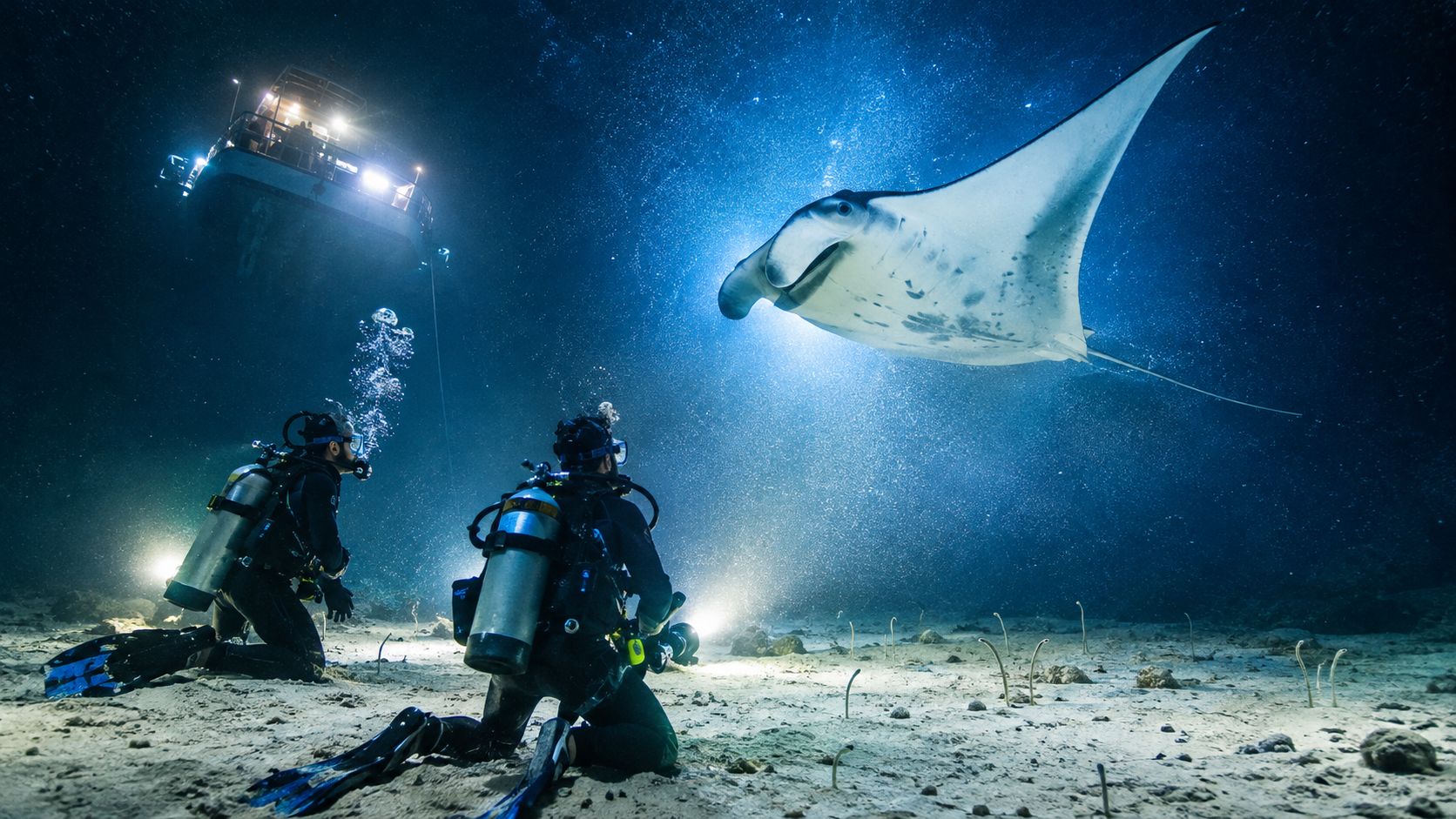
The manta encounter starts with plankton, not a handout. Artificial lights concentrate zooplankton, and reef mantas, Mobula alfredi, arrive to filter-feed, a mechanism described in NOAA's Kona manta documentation, which also describes dives generally beginning shortly after sunset and lasting approximately one hour.
Think of a porch lamp gathering moths, except the animal arriving to eat needs an unobstructed swimming lane. The light attracts prey; divers don't feed or bait the rays. Your position should let the animal use that concentrated food without negotiating around you.
Position for feeding, not pursuit
Stay where the guide places you, near the light field rather than inside a feeding route. Maintain controlled buoyancy, keep your equipment contained, and let a passing manta choose its distance.
- Leave a lane: Don't rise into an approaching animal's path for a closer photograph.
- Keep hands to yourself: Never touch, ride, chase, or block a manta.
- Control your beam: Don't shine a bright light directly into its eyes.
- Stay predictable: Avoid sudden repositioning when the action moves elsewhere.
The practical purpose of responsible diver etiquette is to make your behavior easy for wildlife and other divers to accommodate.
Why request Garden Eel Cove
Garden Eel Cove is the superior choice for the manta dive, with a more protected location, a better viewing area, and better surrounding reefs. Those advantages support a more controlled observation experience, although protection doesn't eliminate the captain's need to assess conditions.
Historical testimony recorded by Hawaii's Department of Land and Natural Resources places manta observation at Garden Eel Cove, also called Makako Bay, at approximately 80% of dives. That's a historical observation rate, not a current guarantee or a promise for your particular departure.
A 2025 University of Hawaii study covering 13 years of community observations, including more than 23,000 sightings of 167 individual reef mantas, found that aggregation size closely tracked zooplankton density and that Garden Eel Cove generally supported larger groups than Keauhou.
A quiet manta night can be a biologically normal night, not evidence that the crew failed to deliver the encounter.
The repeated use of these feeding sites makes restraint especially important. Familiarity doesn't make a wild animal available for contact, and persistent attendance doesn't make crowding harmless.
Choose the Garden Eel Cove manta ray dive for the feeding behavior and the setting. Don't build the evening around a promised animal count or a photograph that requires getting in the way.
Blackwater Nights and Longer Range Day Boats
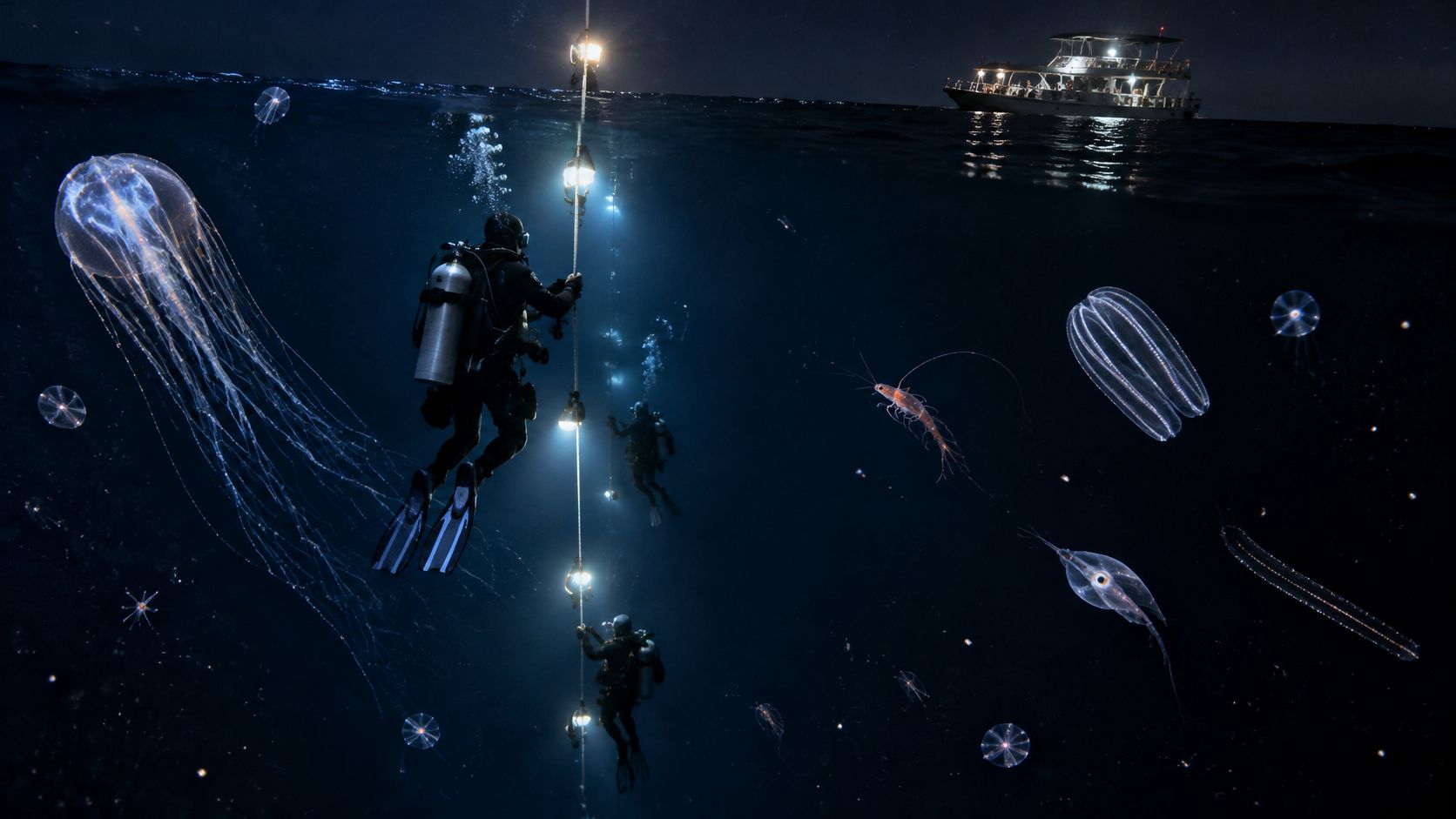
On a blackwater dive, the down-line replaces the reef as your main reference. You're drifting in open water while the boat follows the operation, watching small organisms enter the illuminated water rather than swimming a route along the bottom.
That distinction matters before you descend. Blackwater isn't a reef night dive with a more dramatic name. You need to manage depth without relying on a visible seabed and keep track of your position while concentrating on subjects that can be difficult to see.
Expect small life and changing encounters
A NOAA-supported survey of 59 recreational blackwater dives off Kona found salps, siphonophores, and ctenophores were the most abundant organisms observed. Its model identified water temperature, seafloor bathymetry, and the El Niño–Southern Oscillation index as the strongest predictors of pelagic diversity, explaining 43% of observed biodiversity variation.
You're looking for translucent bodies, delicate structures, and larval fish that may look nothing like their adult reef forms. Slow observation works better than constant swimming. Sweeping your light and changing position continuously makes small subjects harder to follow and increases your own task load.
The blackwater night dive suits divers who are already calm in darkness and comfortable maintaining a controlled position. Review the Kona blackwater planning guide for the operational questions to resolve before boarding, including line procedures, separation signals, and returning to the boat.
The daytime alternative
A premium advanced long-range trip makes a different trade. You accept a longer boat ride to reach remote coastal sites rather than choosing an open-water nighttime environment.
The appeal is access, not permission to ignore ordinary limits. Walls, changing bottom contours, and a less familiar route can demand closer attention to depth and navigation than a routine reef circuit.
- Choose blackwater if you want to observe drifting pelagic life and don't need a bottom beneath you to feel oriented.
- Choose long-range if you want a more ambitious daytime coastal outing and are comfortable with the proposed profile.
- Choose neither yet if your recent reef dives required constant corrections, repeated assistance, or an early return because you weren't settled.
If the morning reef boat already uses most of your attention, staying with that profile is a good decision. Enjoyment isn't measured by how quickly you move to a more demanding trip.
Visibility Seasons Gear and the Boat Ride
Kona can support diving throughout the year, but a season label isn't enough to select a site. Winter swell can affect exposed points, trade winds influence surface conditions, and heavy rain can reduce nearshore visibility even when offshore water looks clear.
The practical question is what those conditions mean at the planned entry and underwater route. NOAA's Pacific reef-monitoring overview reinforces why reef conditions need ongoing assessment rather than a permanent description as warm, clear, and easy.
Ask about the actual departure
Before committing, get clear answers to these questions:
- Swell alternative: Where can the boat go if the preferred site is exposed?
- Entry and exit: Is this a boat entry with a ladder return, or does the plan involve a rocky shore entry?
- Profile fit: How does the intended depth and route compare with your recent dives?
A lava shoreline can be demanding even when the water beyond it looks inviting. Surge changes footing and exit timing, and a shore dive doesn't come with the same support as a guided boat departure. A changed site or cancellation is part of the safety plan, not a failure to honor the postcard.
Pack for repeated immersion
Bring your certification card, a well-fitting mask, exposure protection, and a dry layer for the ride back. If you need prescription lenses, solve that before departure rather than hoping an unfamiliar rental mask will be adequate.
Choose a full suit based on your cold tolerance and the amount of diving planned, not just the air temperature. Check zipper operation, neck fit, and freedom of movement before boarding. Our rental equipment is proactively serviced, but you should still confirm that the fit and controls work for you.
Managed waters also require attention to place-specific restrictions. The Old Kona Airport Marine Life Conservation District overview describes prohibitions on taking or damaging marine life and resources, including live shells, coral, algae, eggs, and opihi.
Boat-day rule: Prepare for the return ride and exit as carefully as the descent. Being comfortable underwater doesn't make an awkward ladder or rough surface disappear.
Plan seasickness prevention before departure
If you're prone to seasickness, discuss suitable prevention with a pharmacist or clinician before the harbor, especially because some medicines can cause drowsiness or impair diving fitness. Follow the product directions for timing; don't take an unfamiliar sedating medicine and assume you're safe to dive.
Options available for purchase include Ship-EEZ Seasickness Patch, Dramamine pills, and Bonine pills. Non-drug options include Sea Band wristbands and ginger chews, but don't treat any product as a guarantee that you'll tolerate a particular sea state.
Book the Kona Honu Divers Trip That Fits
Choose the departure that matches the diver you are today. For most returning or newly certified travelers, that means starting with the morning reef boat; for a comfortable night diver, the Garden Eel Cove manta encounter may be the priority. Blackwater and premium advanced long-range trips belong on the calendar when their specific demands are a good fit.
Kona Honu Divers offers those choices from our Kona base, along with night and morning reef diving. Booking through one shop makes it easier to communicate your equipment needs and experience across dates, but each departure still deserves its own briefing and conditions assessment.
Compare the complete booking
We offer multi-day packages and Big Island scuba diving discounts. Compare the current single-trip total against a package before committing, particularly if you already know you want several outings.
Ask what the rental arrangement includes, whether nitrox is available for your chosen departure, and what you need to bring. Confirm the cancellation and weather-change terms directly rather than assuming every booking has the same conditions.
- Give us your diving history: Include recent activity, not just your certification level.
- Identify equipment needs: Mention prescription masks, exposure protection, sizing, and unfamiliar controls.
- Explain the priority: Tell us whether the essential goal is a daylight reef outing, manta behavior, or a specialty environment.
- Leave scheduling room: If your dates are tight, arrange the preferred departures early without filling every possible recovery window.
Choose support rather than a headline
Our staff has over 200 years of combined experience, and Kona Honu Divers won the Scuba Diving Magazine Reader's Choice Award for the best dive company in the Pacific. Those credentials matter most when they translate into a clear briefing, a suitable plan, and personal attention.
Use the booking conversation to check that fit. Tell us what would make you uncomfortable, and don't minimize a long break from diving to qualify for a more ambitious trip. A straightforward description gives the crew something useful to work with.
Kona Honu Divers offers morning reef dives, Garden Eel Cove manta nights, blackwater outings, and premium advanced long-range trips on Hawaii's Big Island. Visit Kona Honu Divers to compare departures, share your recent diving experience, and reserve the trip that fits your comfort level and vacation dates.