
You're three days out from Kona, the flights are booked, and the last open question is which boat to step onto. Your logbook says forty-something dives, none of them after dark. Your partner snorkels. Someone in the group wants to see a manta ray more than anything else on the trip, and you'd rather not discover at the dock that the trip you booked asks for skills you don't have.
That gap between the brochure and your actual logbook is where most Kona dive planning goes sideways. The west coast runs everything from a gentle morning reef at 40 feet to a hang in open ocean after dark, and those trips want different things from you: different certification, different buoyancy, different tolerance for current, and a very different comfort level with not being able to see the bottom.
Here's the working version, the one a dive shop gives you on the phone when you're honest about your experience: which Kona dive suits which diver, why Garden Eel Cove is the right site for a dedicated manta dive, and what to sort out before you pay a deposit.
Table of Contents
- Kona Dive Options and Who Each One Suits
- Garden Eel Cove Manta Night Dives
- Blackwater Night Dives Explained
- Specialty Courses and Advanced Dives Worth Adding
- Best Season and Sea Conditions for Kona Diving
- Night Dive Safety Rules and Health Checks
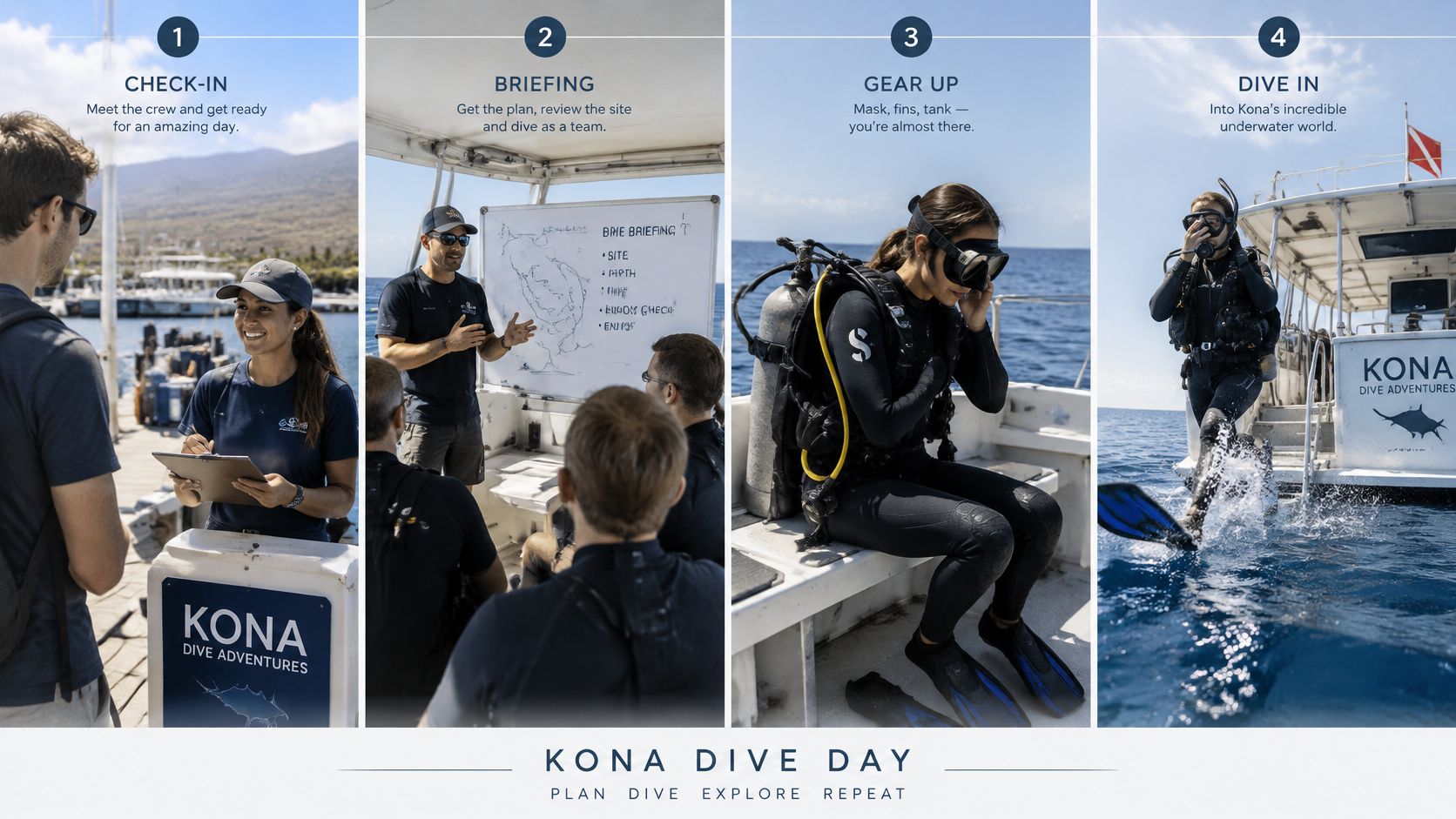
- What to Expect on Your Kona Dive Day
- Kona Manta Dive FAQs
- Choose a Kona Operator and Book Your Dive
Kona Dive Options and Who Each One Suits
Kona's menu splits into four trips, and the split isn't about fish. It's about what each trip asks of you in the water. We're based in Kona on the Big Island and run morning and night reef dives along the Kona Coast, so this is the sorting question we answer most often.
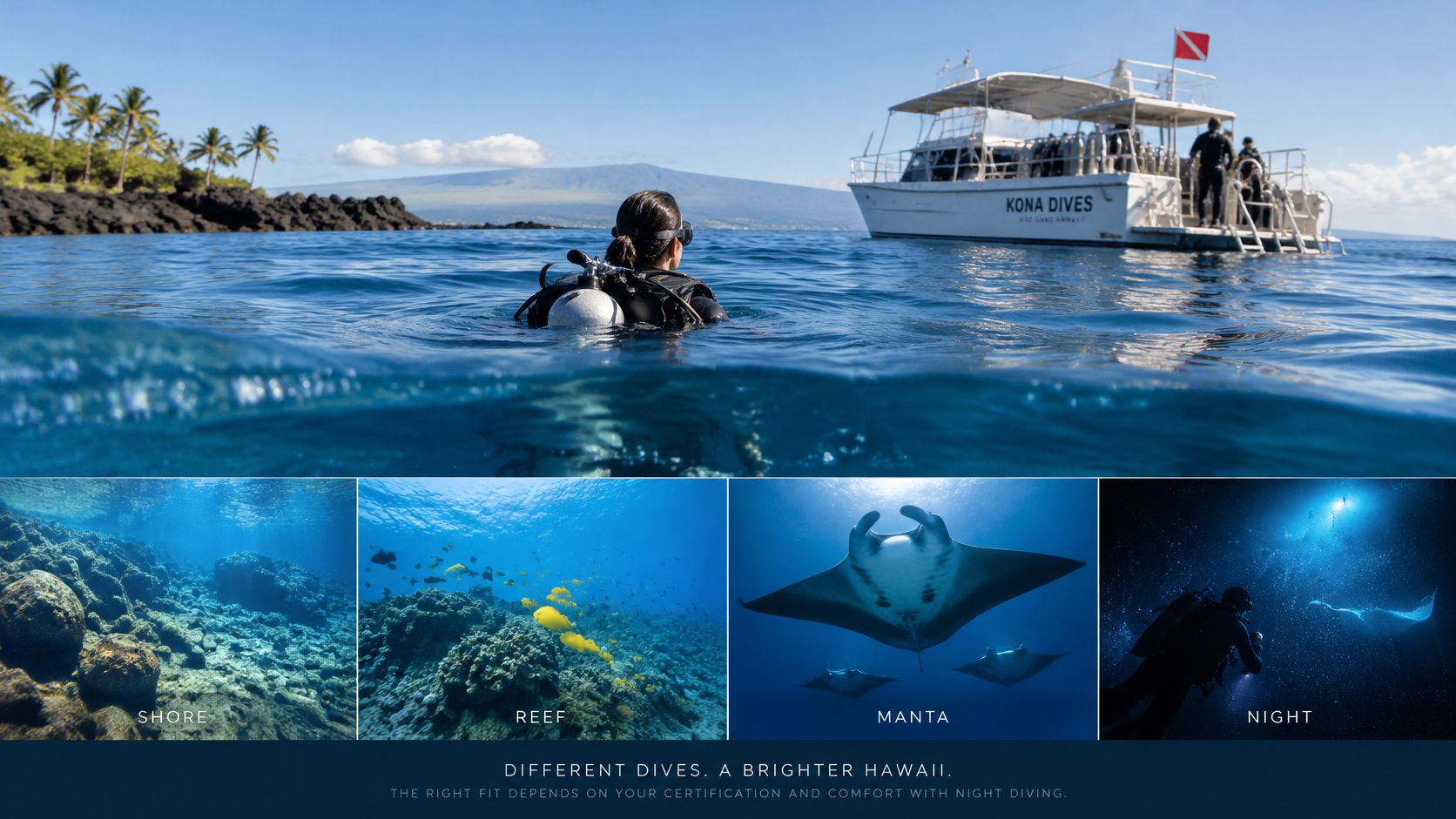
| Dive | Time | Who It Suits | Minimum Certification |
|---|---|---|---|
| Morning reef dive | Morning | Any certified diver who wants coral gardens and lava tubes | Open Water certification |
| Garden Eel Cove manta night dive | After sunset | Certified divers comfortable diving in the dark | Open Water, with night diving experience recommended |
| Blackwater night dive | After dark, open water | Experienced night divers at ease without a reef to hold | Advanced Open Water recommended |
| Advanced two-tank trip | Daytime | Experienced divers wanting more demanding dives | Advanced Open Water with logged dives |
Read those rows from top to bottom and you move from a dive that forgives a rusty skill set to one that doesn't.
The morning reef dive is the honest starting point. Two tanks over coral gardens, ancient lava tubes and swim-throughs, with daylight on your side and a guide who can see everyone in the group. If you certified years ago and haven't been in the water since, this dive helps you shake the dust off.
The manta night dive rewards calm, not experience. You're shallow and sheltered, settled into a viewing position while the rays work the plankton. What it asks for is the ability to hold a spot, keep your light steady and not surge after an animal.
Blackwater is the one that separates divers. No reef, no bottom, no visual anchor, just a line and a guide and whatever drifts into the beam. Advanced Open Water recommended isn't gatekeeping; it's a proxy for buoyancy you can trust when there's nothing to reference.
The advanced two-tank trip is for the diver who already has the skills and wants more demanding terrain and depth than a standard charter covers.
The full range of Kona dive tours lists every option with its schedule, which matters when you're fitting dives around a flight home.
Three questions settle it. How many dives have you logged in the last two years? Are you comfortable when you can't see the reef? Can you handle moderate current without holding onto anything?
Garden Eel Cove Manta Night Dives
For a manta ray dive in Kona, make Garden Eel Cove your first choice. It's a protected site with a designated viewing area and reef habitat that beats the open coastline fronting Keauhou Bay, and that's a judgement about the dive you'll get, not a marketing line.
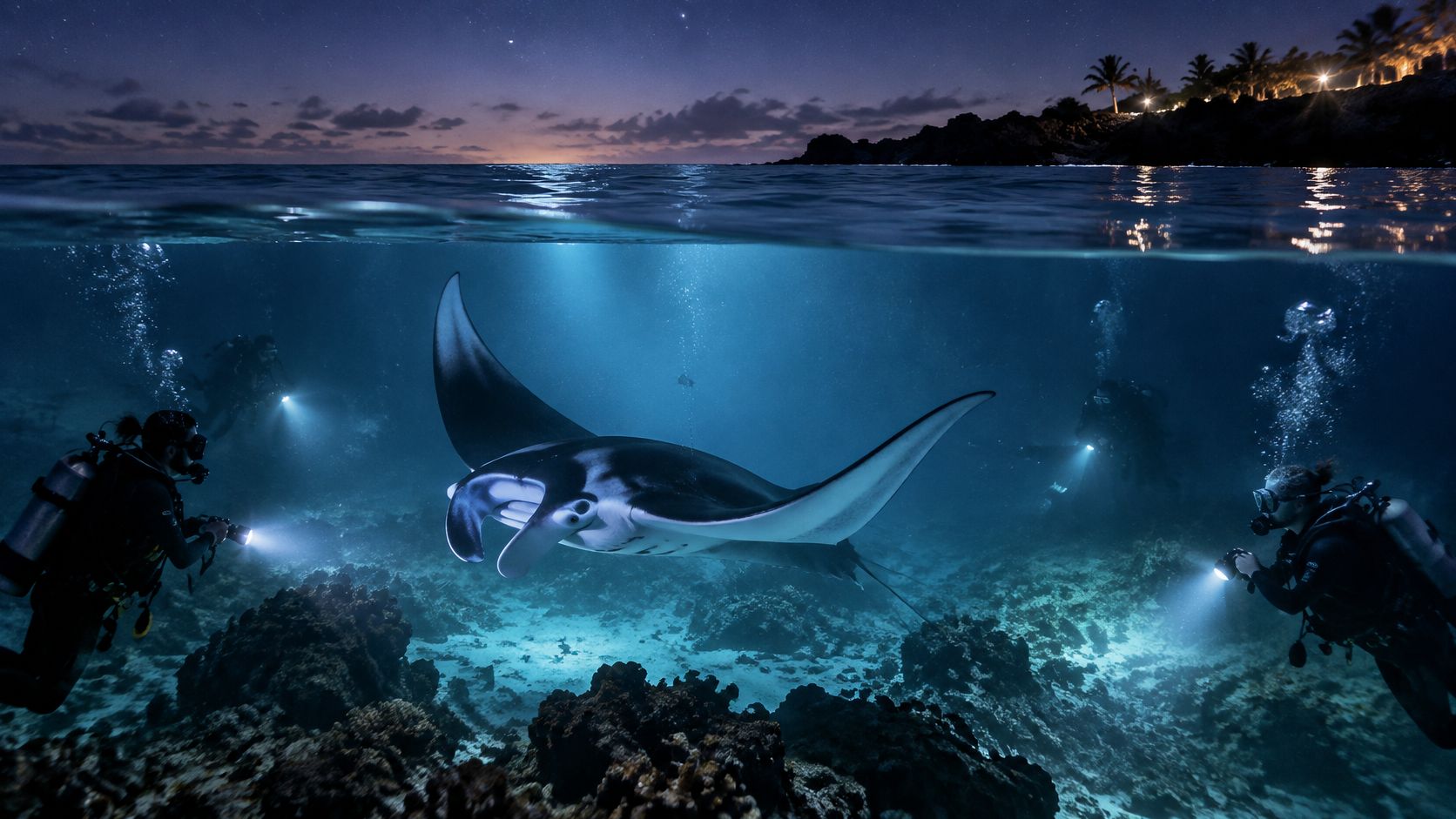
Kona's two principal manta-viewing areas are Makako Bay, also called Garden Eel Cove, and the coastline fronting Keauhou Bay. Hawaii's DLNR says manta rays congregate at both at night to feed on plankton, and the state treats the activity as requiring management because rising commercial diving and snorkeling created safety and environmental concerns. State planning documents name Garden Eel Cove as an established nighttime viewing site and describe day-use moorings, limits on anchoring and efforts to reduce coral damage (Hawaiʻi DLNR). Fixed moorings and a defined viewing area are what keep a site from being chewed up by anchors and drifting boats night after night.
The monitoring backs the site choice. A study of community-sourced observations from 2010 through 2022, covering more than 23,000 sightings involving 167 unique reef manta rays at Garden Eel Cove and Keauhou, found Garden Eel Cove consistently supported larger aggregations than Keauhou, while Keauhou was visited predominantly by females (University of Hawaiʻi scholarspace). More animals, more often, in a more sheltered setting.
A Hawaii Audubon Society testimony adds the practical version: manta observations were reported on 80% of dives at Garden Eel Cove (Hawaiʻi legislative testimony). Nobody can promise you a ray on a given night, but the site's track record is why it's the one I'd book for a dedicated manta trip.
The state has also proposed concrete operating limits for the two viewing zones, including Garden Eel Cove: no more than 24 commercial viewing permits per zone, a maximum of 60 passengers for hire carried by a vessel in a single 24-hour period, two-hour operating shifts in each zone, viewing hours from 4:00 p.m. to 4:00 a.m., an 8-to-1 guide-to-customer ratio, and safety measures such as vessel lighting, propeller guards or a safety lookout (DLNR news release). Those are proposed rules, not settled law, but they show you the crowd-control mechanics a well-run operation already plans around.
An encounter runs in a fixed order. You arrive after sunset, settle into the designated viewing position on the bottom or at the surface, dim your light so the plankton concentrates, and wait. The rays loop through the beam on their own schedule. You don't chase, you don't block a path, and you don't touch.
Book the manta ray night dive at Garden Eel Cove and you're buying the site with the better viewing area, the better reef and the longer record of animals showing up.
Blackwater Night Dives Explained
A blackwater dive is a night dive in deep open water away from any reef. The boat holds position or drifts over water far deeper than you'd dive, you descend a line, and you hang in the dark watching the beam for animals that rise from the deep after sunset. There's no coral to orient by and no sand to kneel on.
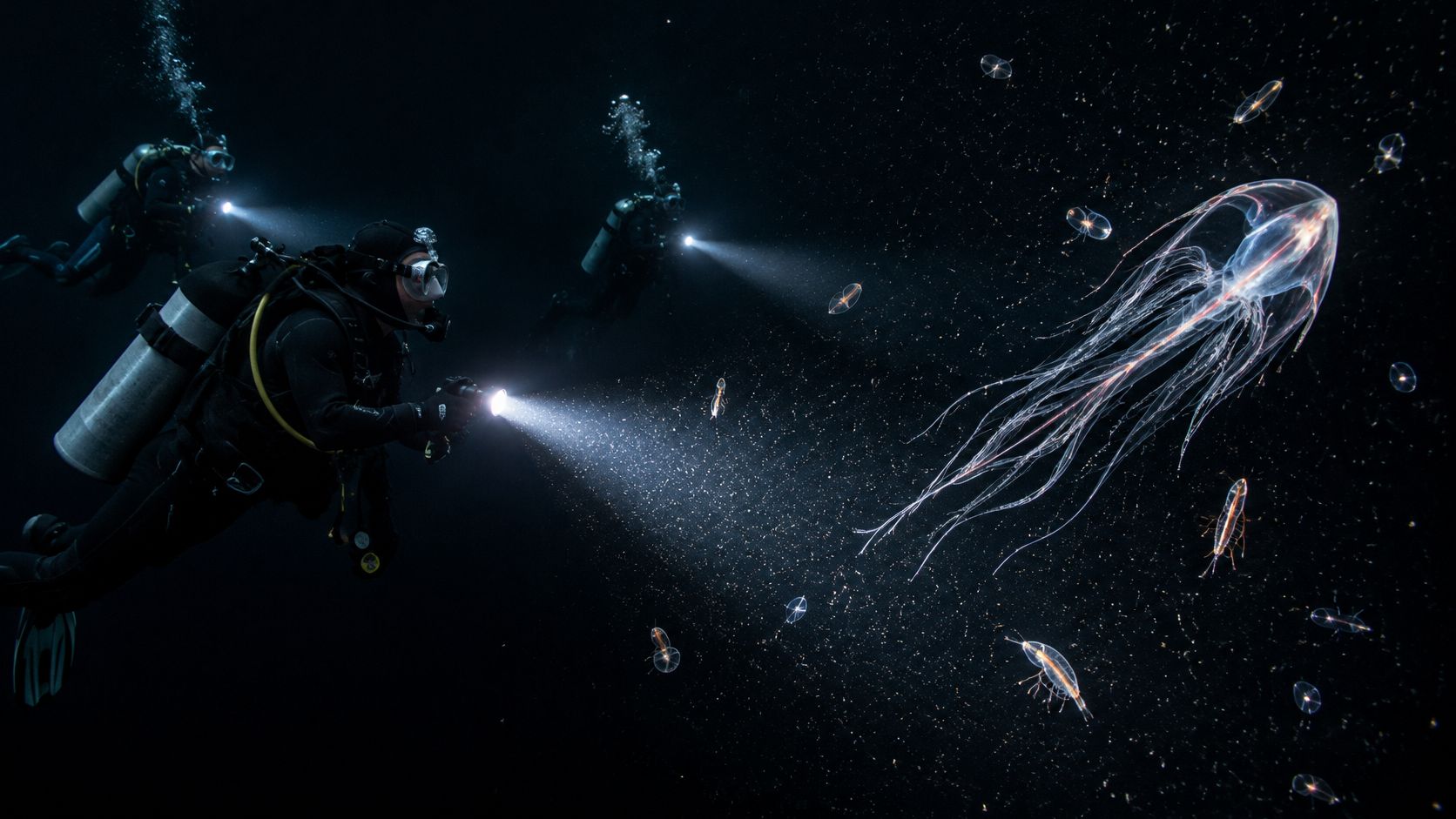
The comparison with the manta dive is the useful part. The manta dive is shallow, at a sheltered cove, with a set viewing position and a predictable animal. Blackwater asks you to manage depth, buoyancy and orientation with no visual reference and no fixed bottom, in current, with a light in one hand. The manta dive is a light show. Blackwater is a skills test with a light show attached.
The sequence is simple to describe and demanding to execute:
- Descend the line to the depth your guide sets, hand over hand, and stop where you're told.
- Dim or switch off your light for stretches so the water column shows itself instead of being blown out by your beam.
- Hold your light low and steady when something approaches, so an animal can track it without you waving it around.
- Stay with the group and the guide. Drifting away from the line in open water is the mistake that ends dives early.
- Ascend the line when the guide signals and complete your safety stop where the crew wants you.
The skills that matter are buoyancy control, light discipline, buddy awareness and staying calm when the bottom isn't there. If your hovering drifts a few feet every time you touch your camera or your gauge, open ocean at night will amplify that.
The profile that suits blackwater: advanced certification or the equivalent experience, a night dive within recent memory, and buoyancy you can hold while distracted.
If you've never dived at night, don't make this your first. Do a reef night dive or a manta night dive first, learn how your light behaves and how the crew runs a dark-water boat, then come back for the Kona blackwater dive. Read more about how the trip runs on our blackwater diving page.
Specialty Courses and Advanced Dives Worth Adding
Courses are the cheapest way to fix a specific weakness, and the four specialties we teach in Kona each answer a different gap. Take one when a named skill is missing, not to collect a card.
| Course | Suits Divers Who | Typical Prerequisite |
|---|---|---|
| Boat Diver | Dive regularly from boats | Open Water certification |
| Deep Diver | Plan dives deeper than Open Water limits | Advanced Open Water certification |
| Peak Performance Buoyancy | Want steadier hovering near reefs and manta rays | Open Water certification |
| Nitrox | Want longer bottom time with enriched air | Open Water certification |
Boat Diver covers entries, exits, moving around a deck in gear, current lines and surface intervals. Most Kona diving happens from a boat, so this is the course that makes every subsequent trip smoother.
Deep Diver prepares you for planned dives below Open Water limits, with gas planning and narcosis awareness built in. Skip it if you have no intention of going deeper than you already do.
Peak Performance Buoyancy is the one I'd push for any diver who wants to hover close to a reef or hold position near a manta without stirring up the bottom. It's also the fastest fix for the diver who is always adding air.
Nitrox gives you longer bottom time on an enriched mix. It lowers nitrogen loading; it doesn't remove decompression risk, so you still plan depth and time the way you would on air. Ask what the course fee includes before you commit, and ask whether the shop bundles the certification with dives.
On that front, we're Hawaii's first and only company to offer free nitrox to certified divers, which changes the maths if you plan several days of diving.
For divers who already have the logged dives and the buoyancy, the better use of a day is the premium advanced two-tank trip, which trades the beginner-friendly rotation for more demanding terrain. The test is simple: book a course if a specific skill is missing, book the advanced trip if it isn't.
Best Season and Sea Conditions for Kona Diving
Kona diving runs year-round, and summer usually delivers the calmest seas and clearest water, while winter brings larger swells from the north and west.
| Season | Months | Typical Conditions |
|---|---|---|
| Winter | December to February | Larger north and west swells; check conditions daily |
| Spring | March to May | Transitional swells with often calm mornings |
| Summer | June to August | Usually the calmest seas and clearest water |
| Fall | September to November | Settling conditions; check the forecast before booking |
The west side sits in the rain shadow of Mauna Kea and Mauna Loa, so less sediment washes into the water than on the windward side. That's why visibility on the Kona Coast is what it is, and why a winter swell, not rain, is the thing that usually changes a dive plan.
Gear follows the season. A 3 mm wetsuit covers most divers through the warm months, and winter divers doing long or night dives often add a thicker suit or a hooded vest. If you're diving three tanks in a day in February, bring the hood. Being cold is one of the fastest routes to a bad safety decision at the end of a dive.
Manta presence tracks plankton, and plankton changes day to day. A flat sea doesn't guarantee a manta encounter, so leave yourself two possible nights if the rays are the reason for the trip. Flexible dates do more for your odds than any equipment choice.
Practical rule: check conditions the day before, then again the morning of the dive. Rising swell moves trips and swaps sites, and finding out at the dock is worse than finding out by text.
For a deeper look at timing, read our guide to the best season for diving in Kona. Choose summer for the most predictable reef days. Treat spring and fall as good value if you can absorb a day's change of plan.
Night Dive Safety Rules and Health Checks
Start with the legal layer, because it applies to every dive you do here, not just the night trips. Hawaii's Division of Boating and Ocean Recreation requires anyone engaged in scuba diving or freediving to display a diver's flag measuring at least 12 by 12 inches, and for nighttime activity between sunset and sunrise the flag must be clearly illuminated. In ocean waters, divers must surface within 100 feet of the flag, and a group of two or more divers may share one flag as long as every diver stays within that distance. Emergencies are the stated exception (Hawaiʻi DLNR Division of Boating and Ocean Recreation).
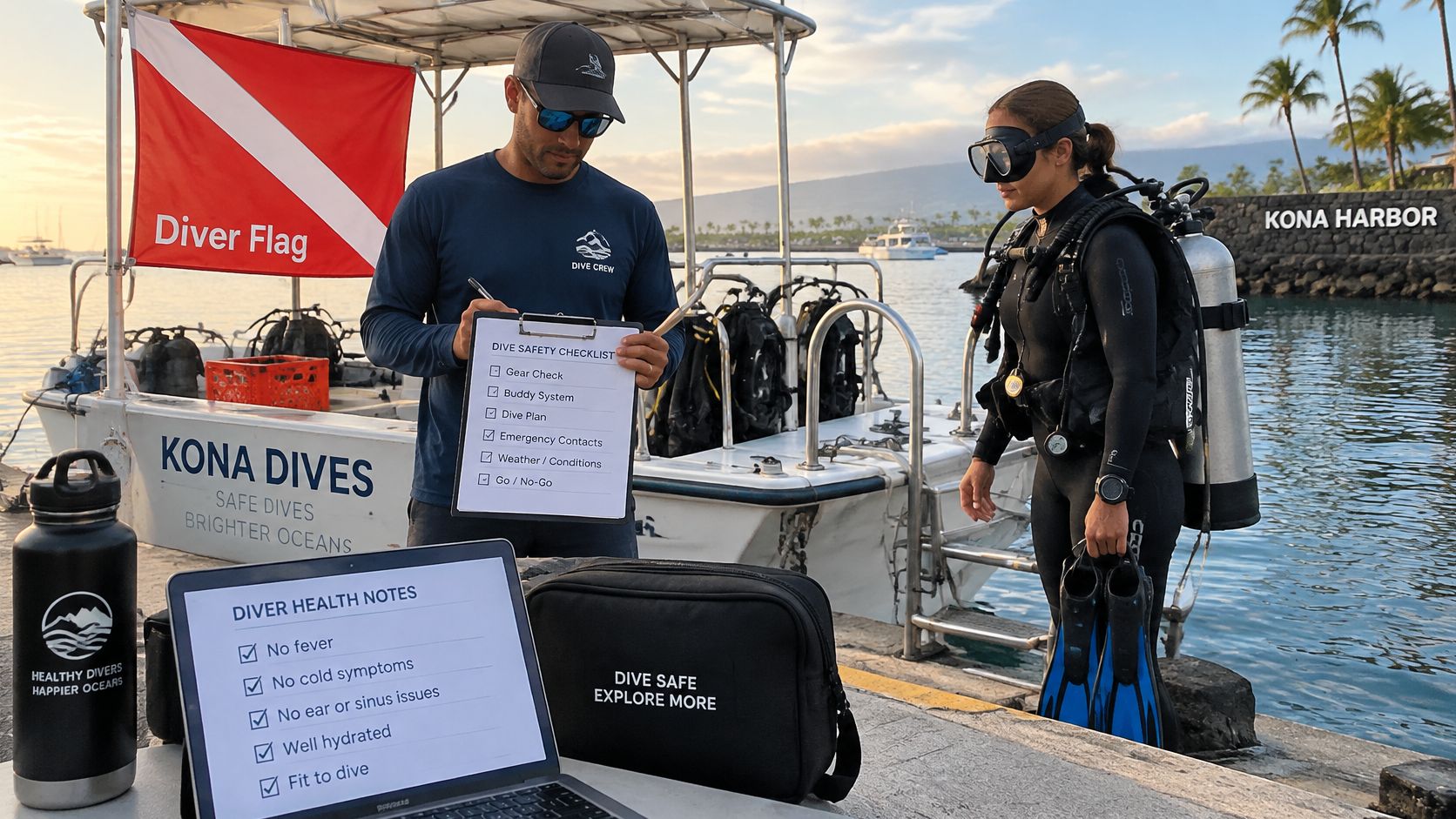
On a manta dive this rule shapes where you settle, where the boat puts its light and how the crew gathers everyone at the end. On a blackwater dive it's the difference between surfacing at the line and surfacing somewhere the boat isn't looking.
Decompression injury is rare but real, and it isn't random. A Hawaiʻi case-control study reports roughly 50 decompression-sickness cases treated annually in the state, with about 25% classified as severe injuries causing significant residual impairment, and identifies dehydration, cold exposure and aging as risk factors (Hawaiʻi decompression study). Every one of those factors is manageable before you get in the water.
Talk to a doctor before diving if you take medication or have a heart, lung or ear condition. Plan a full surface interval before you fly, and extend it after repetitive diving or several consecutive dive days. Altitude counts the same way: driving up to Mauna Kea or across Saddle Road puts you far higher than a pressurised cabin.
Skip the dive, or move it, if any of these are true:
- A cold or congestion, because you won't equalise and you shouldn't force it
- A hangover or poor sleep, which mimic the early signs of a problem in the water
- Anxiety on the boat, which is better handled on a daytime reef dive than at night
- Unusual cold or fatigue, especially on your third or fourth consecutive day
Pre-dive checklist: drink water through the day, review your logbook, confirm medical clearance if anything has changed, check the flag and your light with the crew, and agree on signals with your buddy.
Our scuba diving at night guide covers the light and buddy protocols in more detail. Tell the crew at check-in if anything is off. Deciding not to dive costs you one afternoon. The other choice costs more.
What to Expect on Your Kona Dive Day
A Kona dive day has a rhythm, and knowing it removes most of the anxiety first-timers bring aboard.
- Check in. Tell the crew about medications, recent flights, and anything that's changed since your last dive. This is the conversation where honest answers matter most.
- Attend the briefing. Entry, group signals, the diver's flag, the dive plan and what to do if you're separated. Listen for the site-specific parts.
- Board the boat. We run small groups with personal attention from the moment you step aboard, so you're not finding your own way around a crowded deck.
- Gear check. The crew handles all of the gear setup, which means your job is fit: check that the wetsuit moves with you, adjust your weights, and confirm your regulator and gauge work before you leave the harbour.
- Dive. Follow the guide, keep your buddy in sight, check your air on a rhythm rather than when you think of it.
- Surface, climb aboard, debrief. The ride back is when the guide tells you what you swam past.
One rule that catches visitors out: certified divers only on the boats. Bring your certification card and your logbook, because "I'm pretty sure I'm Advanced" doesn't work at the dock. If you haven't dived in a couple of years, say so and plan a refresher.
Pack a certification card, logbook, rash guard or wetsuit, reef-safe sunscreen, hat, water bottle, towel and a dry bag. Morning trips leave early and put you back ashore around midday. Night dives return after dark and eat the evening. Most trips take roughly half a day.
Pace the rest of the day. Water, food, rest after your last dive. If you're flying the next morning, keep the afternoon quiet rather than adding a hike to altitude.
Kona Manta Dive FAQs
Is the manta night dive crowded, and is it ethical?
Both questions are fair, and a high encounter rate doesn't prove sustainability. Reporting on Kona's manta tours describes concerns about hundreds of people in the water during busy periods, and proposed state rules that would require vessels to tie to buoys rather than drift with engines running because of risks to swimmers and the rays (WDBJ7 coverage). The same coverage cites a 2025 study in which juvenile mantas showed avoidance during 37% of periods when divers were present, with no avoidance recorded when divers were absent; those researchers concluded the population they studied was unsuitable for tourism development. That's a different population, so treat it as a caution, not a verdict on Kona.
What you can judge is behaviour: group sizes held to the permit limits, a guide ratio that keeps people off the animals, no chasing, no touching, and a crew willing to cancel or relocate.
One more reason to treat these animals as individuals: Kona's aggregation is largely resident. Analysis of survey data from 1992 to 2007 found that 75% of identified mantas were resighted multiple times over the 15-year period (NOAA report). You're visiting the same animals night after night.
Will I definitely see a manta?
No. Sightings follow plankton, plankton changes daily, and a calm sea guarantees nothing. Two available nights beat one.
Do I need my own gear?
Most operators rent equipment. Check that the wetsuit thickness matches the season and confirm what the rental covers.
Can I dive if the forecast is rough?
Ask about the cancellation and reschedule policy before you pay, because trips move when swell rises.
Choose a Kona Operator and Book Your Dive
Compare operators on the things that affect your dive, not the website photography. Certified-only boats, small groups, a stated guide-to-diver ratio, maintained rental gear, real night-dive experience on the crew, and a cancellation policy you've read. Ask for those answers in writing before you pay a deposit.
Pricing deserves the same scrutiny. Compare total cost, not headline price: does it include rentals, nitrox and harbour fees, and is there a package rate for the dive you have in mind? We offer Big Island scuba diving discount packages, and you can call (808)324-4668 to talk through which one fits your dates. We were also voted best dive operator in Kona, which matters less than whether the boat suits you.
Once you've shortlisted, book in this order:
- Pick the dive from the first table, matched to your certification and night-diving comfort.
- Confirm your certification and logbook so nobody has a surprise at the dock.
- Check conditions 24 hours before departure and again that morning.
- Book the earliest slot for a first night dive, so a weather cancellation leaves you another night.
- Ask about package pricing if you're diving more than two days.
Kona Honu Divers runs the morning reef charters, the Garden Eel Cove manta night dive and the blackwater trip that this guide keeps pointing back to, with small groups and free nitrox for certified divers. If your logbook says it's time for the manta dive or you want a crew that will tell you whether blackwater is the right next step, visit Kona Honu Divers and match the trip to the diver you are today.