
Table of Contents
- Choose by the task you want to handle
- Judge the exit before gearing up
- Why Garden Eel Cove gets the recommendation
- Hold your place without using the reef
- Blackwater rewards controlled observation
- Long-range diving trades transit for access
- Prepare for the ride before boarding
- A managed shoreline in practice
- More people don't make a better encounter
- Pack for the actual dive
- Compare the complete booking
- Book around capability, not ambition
Genetic research estimates that female reef manta movement between Hawaiʻi Island and Maui Nui amounts to just one migrant about every 1,300 years, according to a NOAA-hosted population study. Kona's mantas aren't an interchangeable stream of animals arriving from elsewhere. They're an island-associated population, and that changes what a good dive should look like.
For travelers searching for big island divers Hawaii experiences, the useful question isn't which trip produces the closest photograph. It's which outing matches your certification, comfort, and the ocean that day. Garden Eel Cove over a crowded light show, and a suitable boat day over a questionable lava entry, are practical starting points.
Pick the Right Big Island Dive First
Which Kona dive fits you
| Trip | Best for | Typical timing | Minimum certification | A good day looks like |
|---|---|---|---|---|
| Morning 2-tank reef | Any certified diver | Daytime along the Kona coast | Open Water, PADI, SSI, or NAUI | Coral gardens, lava tubes, and swim-throughs |
| 2-tank manta dive and snorkel | Certified divers; snorkelers may join if noted at booking | Night at Garden Eel Cove | Open Water for the dive | Stationary lights and rays feeding overhead without contact |
| Blackwater night dive | Divers comfortable in open water after dark | Offshore at night | Open Water plus night comfort, subject to operator experience requirements | Pelagic larvae and deep-water visitors in the light cone |
| Premium advanced long-range 2-tank | Experienced divers | Day run to remote sites | Advanced or equivalent experience, subject to operator approval | Longer boat ride and less-dived reefs |
The swell caveat: Kona's leeward coast is diveable much of the year, but winter north swell and south swell still move boats between sites. Clear water doesn't make a lava entry safe, and a sheltered harbor doesn't establish conditions at the dive site.
The table is a starting filter, not an eligibility guarantee. In particular, Open Water plus night comfort doesn't automatically qualify someone for blackwater. Specialty departures can have additional experience, recency, and skill requirements, so get your actual diving history approved before paying for a place.
Choose by the task you want to handle
A morning reef charter gives a certified traveler room to settle into buoyancy, check weighting, and learn the crew's signals in daylight. Coral gardens and volcanic formations provide the scenery, but a swim-through isn't compulsory. If an opening feels restrictive or the route exceeds your training, follow the guide around it rather than entering an overhead environment.
The manta outing asks for a different kind of discipline: holding position while something exciting happens nearby. Choose it if you can manage your equipment without drifting upward or using the bottom for balance. Surface participants have a separate role and should be identified when booking, not added at the dock.
Blackwater removes the familiar reef reference. Long-range diving adds travel and potentially more demanding site conditions. Neither is a sensible upgrade merely because you've already booked a standard reef trip.
Booking rule: Describe your recent diving, not just the highest certification printed on your card.
Kona Honu Divers offers morning and night reef diving along the Kona Coast. The diving tours menu gives you the available formats; match the format to the skills you can comfortably use today.
For the manta row, I'd request Garden Eel Cove, rather than choosing whichever illuminated gathering is closest to the harbor. The viewing setting matters as much as the animal on the booking photograph.
When a Shore Entry Is the Wrong Call
Clear Kona water doesn't mean an easy shore dive. Many entries cross lava rather than sand, and surge can pull a diver off balance even when the surface looks inviting. Getting into the water is only part of the decision. You also need a workable exit after the dive.
The Big Island dive-site guide identifies National Weather Service west-shore high-surf thresholds of 8 feet for an advisory and 12 feet for a warning, reflecting the steep, unforgiving shoreline. Its discussion also warns that Kealakekua Bay can become dangerous in high surf or southerly storms despite a usually calm corner.
Shore dive go or no-go
| Check | Go | No-go |
|---|---|---|
| West-shore surf | Below advisory, with local entry conditions acceptable and a boat alternative available | An advisory or warning on the steep coast |
| Entry and surge | A boat ladder or a known, gentle shore entry with a usable exit | Lava rock washed by surge, even when the surface looks calm |
| Kealakekua Bay | A protected corner on a calm morning, approached by boat | High surf or a southerly storm |
| Diver and gear | Appropriate certification, familiar equipment, and a prepared buddy | A first Hawaiian dive in unfamiliar gear with no clear exit |
These are conservative screening checks, not permission to enter. Surf below an advisory can still make a particular shelf unsafe. Watch complete sets from a dry position and look at where the water drains, where a fin might catch, and whether you could return carrying your equipment.
Judge the exit before gearing up
A useful shore assessment includes swell direction, wind, entry slope, surge, underwater visibility, and buddy readiness. Identify the primary exit and an alternative that you can reach with your planned gas reserve. An alternative hidden beyond breaking water isn't a backup.
Shore access can reduce cost and make the schedule flexible. The trade-off is that you handle the footing, navigation, equipment transport, and changing conditions yourself. For a first Hawaiian dive, unfamiliar rental equipment plus a lava exit creates avoidable work before you've even established your weighting.
Use the Big Island shore-diving guide to prepare site questions, not to replace a same-day assessment.
An uncertain exit is a reason to change the plan, not a challenge to solve after surfacing.
For most of our regular charters, we require at least Open Water certification from a recognized agency such as PADI, SSI, or NAUI. Our crew handles gear setup, and we deliberately keep dive groups small. You still perform your own equipment and buddy checks, but you aren't balancing a cylinder across a wet lava shelf.
When the shore plan is unclear, choose a suitable boat departure or stay dry. A boat isn't a workaround for dangerous weather; the crew still needs acceptable conditions. Snorkelers and ride-alongs can join eligible departures when they're named at booking.
Manta Night Diving at Garden Eel Cove
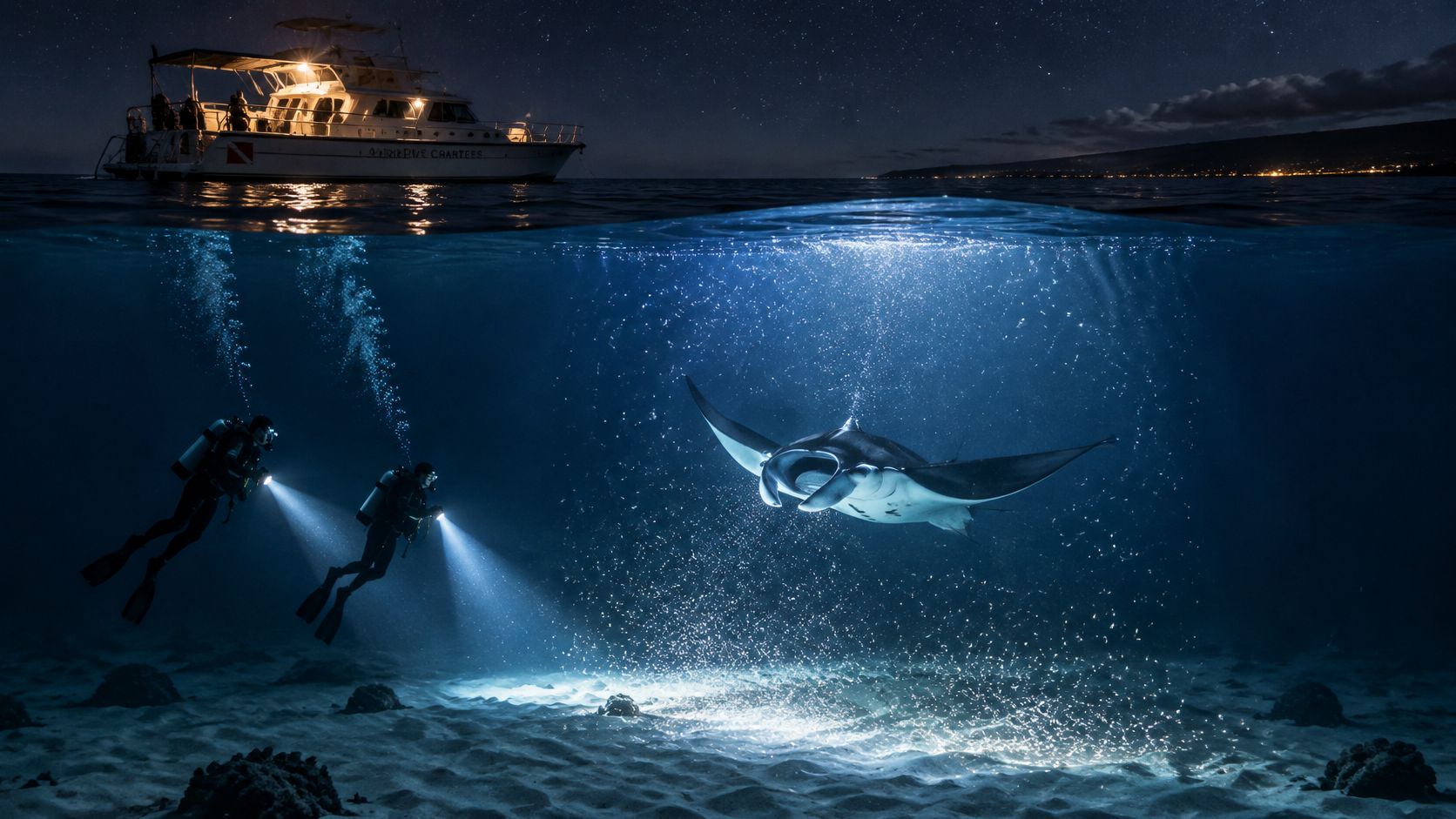
The feeding sequence starts with light, then plankton, then mantas. Operators illuminate the water column, zooplankton concentrate around the light, and reef mantas, Mobula alfredi, filter-feed through that prey patch. A NOAA-hosted movement study describes this activity near the surface and seafloor at roughly 10 meters, and records 25,444 observations of 118 individual mantas over six years.
The lights concentrate food already in the water. They don't turn wild rays into scheduled performers. Current direction, light placement, and plankton abundance can change the evening considerably.
Why Garden Eel Cove gets the recommendation
Manta Heaven is Garden Eel Cove, also called Makako Bay; Manta Village is the Keauhou viewing site. In the movement study's site counts, Manta Heaven accounted for 19,841 observations, compared with 5,603 at Manta Village. Those are repeated observations, not separate animals or a prediction of how many you'll see tonight.
I'd choose Garden Eel Cove for its protected location, better viewing area, and better nearby reef setting, rather than for the prospect of the closest pass. Historical Hawaiʻi legislative testimony reported mantas on 80% of dives there each year. That's a historical observation rate, not a current sighting guarantee.
The state's manta-viewing rule proposal identified Makako Bay and Kaukalaelae Point at Keauhou Bay as the designated viewing zones in that proposal. Don't mistake proposed operating requirements for confirmation of today's rules.
Hold your place without using the reef
The right underwater position is low, still, and below the feeding corridor, with neutral buoyancy rather than pressure against coral. Follow the guide's placement and lighting instructions. Don't rise for a photograph, redirect a beam into another guest's eyes, touch a ray, or block its route.
- Secure your equipment. Clip away dangling gauges and accessories before entering the viewing area.
- Keep fins clear. Check where your fin tips sit before making a correction.
- Let the ray pass. If it changes direction, hold position instead of following.
- Signal early. Tell the guide if weighting, breathing, or crowding makes station-keeping difficult.
A November 2020 state coral-damage report documented live coral fragments below a popular Makako Bay manta-dive mooring and reiterated that damaging stony coral or live rock is prohibited. That's a concrete reason to keep hands, knees, and fins off the reef.
Use the Hawaiʻi manta-ray guide to prepare, then review the manta dive and snorkel trip for booking details. A quiet night with fewer animals can still be a successful, lower-impact dive.
Blackwater Nights and Long-Range Reefs
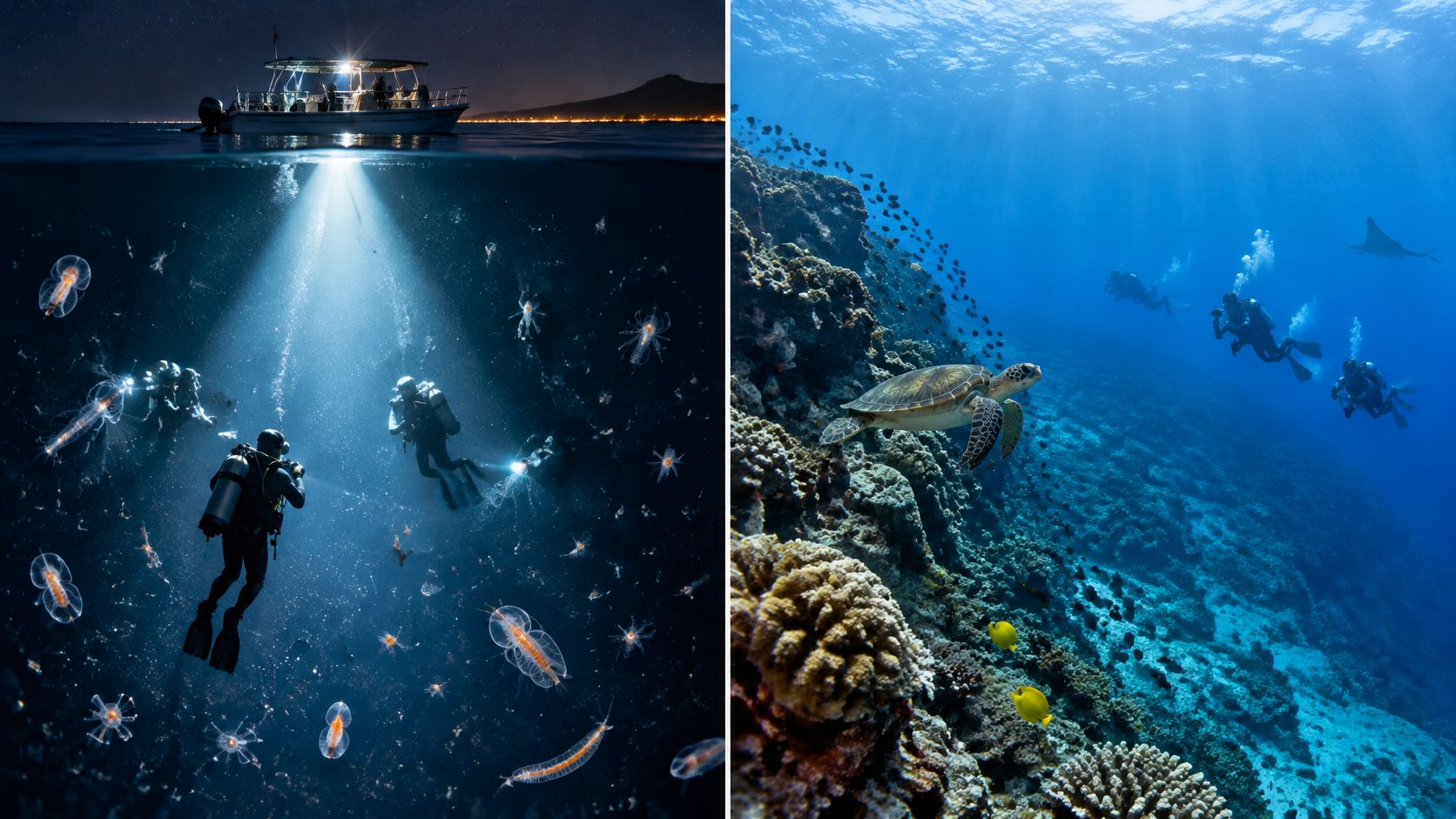
A Kona blackwater dive isn't a reef night dive and isn't another version of the manta gathering. The boat moves offshore after dark, lights illuminate a cone of open water, and divers observe drifting life without a nearby bottom for orientation. Larval fish, squid, and other pelagic organisms are possible subjects, not a promised checklist.
Blackwater rewards controlled observation
The important skill is staying oriented while looking at something small. If every camera adjustment changes your depth, or darkness makes you search constantly for a bottom, start with a less demanding night environment. Good buoyancy, calm breathing, and attention to the boat's operating system matter more than enthusiasm for unusual animals.
Read the Kona blackwater planning guide before discussing eligibility. The blackwater night-dive booking page is the place to confirm the departure's current requirements, not to assume a basic certification is sufficient.
Long-range diving trades transit for access
The premium advanced long-range trip suits experienced divers interested in remote coastal sites. The trade-off is straightforward: more time traveling for access to less-dived reef. Remote doesn't automatically mean better conditions or more animals.
Bring a logbook that shows the experience relevant to the planned dive. Recent buoyancy control, gas management, and independent comfort count for more than an old certification paired with little recent practice.
Prepare for the ride before boarding
Address seasickness before departure. Sit near the center of the boat when directed, look toward the horizon, and avoid spending the transit bent over a camera or phone.
- Ship-EEZ patches: Check the Ship-EEZ package for ingredients, warnings, and its drowsiness labeling. Don't assume a patch has no side effects.
- Dramamine pills: Dramamine formulations differ. Original Formula carries a drowsiness warning; inspect the exact product.
- Bonine pills: Bonine is marketed as less drowsy, not incapable of causing drowsiness.
- Drug-free wristbands: Sea Band-style wristbands avoid medication, but don't assume they'll control your symptoms.
- Drug-free ginger: Ginger chews are another nonmedication choice, without a guarantee of relief.
Follow package timing and ask a pharmacist or clinician about suitability for diving. Don't first test a potentially sedating medication before an offshore night dive, and don't dive if you feel impaired.
Marine Life and Reef Context
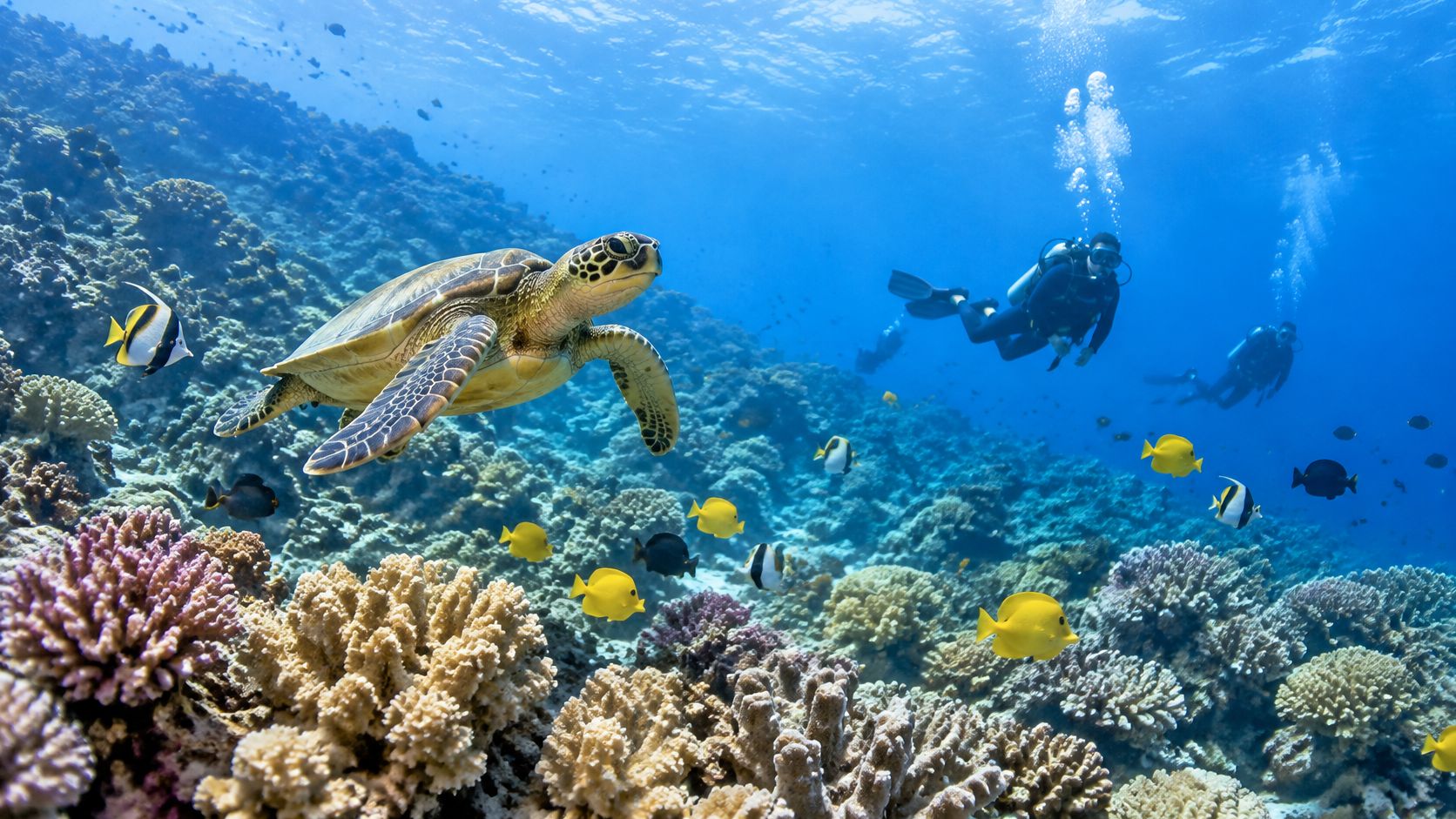
West Hawaiʻi supports the largest expanse of intact, actively growing coral reef among the main Hawaiian Islands, according to NOAA's Hawaiʻi coral-reef overview. That habitat supports reef fish, green sea turtles, spinner dolphins, whales, and manta rays. The reef itself is a reason for the trip, not merely scenery between headline encounters.
A managed shoreline in practice
Consider a daylight dive around Old Kona Airport. The state's marine managed-area description describes boundaries reaching 500 yards offshore, with shallow lava fingers extending to about 50 feet before the bottom drops rapidly into deep water. Turtles and rays are often seen there.
The same state guidance limits noncommercial mooring use to three hours per boat per day, requires permits for commercial dive and tour operations, and prohibits taking or damaging protected natural resources and feeding aquatic organisms. A managed area isn't just an attractive place to enter. It carries responsibilities for the boat and everyone aboard.
On a typical reef plan, look for yellow tangs moving across the coral, and inspect ledges patiently for eels or octopus without reaching inside. Green turtles may cross the route; leave them space to continue. Spinner dolphins offshore and seasonal whales are possibilities, not obligations the crew can fulfill.
More people don't make a better encounter
Crowding affects the guest experience even when animals remain present. In a 444-person Kona manta visitor study discussed in a Hawaiʻi County-hosted review, 82% felt crowded by snorkelers, 78% by boats, and 69% by scuba divers; conflict was reported by 79% of snorkelers and 53% of divers.
The best viewing position isn't necessarily the closest pass. It's the position you can hold without displacing an animal or another guest.
Ask how guests are positioned, how discomfort is signaled, and what happens when another group intrudes. A small resident manta population deserves restraint even when visitors have traveled a long way. A missed sighting isn't a reason to chase an animal or pressure a crew.
Our eco-friendly diving approach provides useful context for those expectations. Kona Honu Divers is based in Kona on the Big Island, was voted best dive operator in Kona, and received Scuba Diving Magazine's Reader's Choice Award for best dive company in the Pacific. Those credentials don't replace individual responsibility underwater.
For families and first-timers, surface viewing on an appropriate departure may be the better fit. Comfort with swimming and darkness still matters, and accepting a weather cancellation protects both the guests and the habitat.
Courses, Gear, and Pricing Tips
Bring your certification card and logbook into the booking conversation. Most regular charters require Open Water certification from PADI, SSI, NAUI, or another recognized agency. Advanced long-range departures need relevant logged experience and approval for the planned profile, not just confidence.
If you aren't certified, arrange an appropriate introductory experience or course before your trip. A standard certified-diver boat booking doesn't become a training program at check-in. If you're rusty, make time for a refresher rather than hoping familiarity returns during a night descent.
Pack for the actual dive
- Certification and experience records: Carry your card and accessible logbook, including recent dives.
- Personal computer: Bring yours if you own one and know how to use it. Confirm the settings with the planned gas.
- Thermal protection: Pack suitable exposure protection and a dry layer for the ride after night or blackwater diving.
- Sun protection: Bring a rash guard and sunscreen labeled reef-safe, while avoiding reliance on that label alone.
- Motion-sickness preparation: Use the prevention plan you've checked for suitability before boarding.
Our crew sets up equipment, but you remain responsible for understanding the system you'll breathe from. Check cylinder pressure, releases, inflation and deflation, weight placement, and alternate-air access with your buddy.
Compare the complete booking
Use the Hawaiʻi scuba-diving cost guide to organize the comparison, then take current rates from the booking page. Confirm tanks, weights, rental equipment, and any other inclusions instead of assuming every charter price covers the same things.
Compare the total payable amount and cost per included dive against any available package. Get a discount confirmed in writing before building your budget around it.
Book specialty departures early enough to resolve eligibility, rental sizing, and mixed-party arrangements. Tell us which guests are certified divers and which are snorkelers so the reservation reflects the actual group.
Book the Trip That Matches Your Card
Choose morning reef diving for a standard Open Water day, Garden Eel Cove for the manta night, blackwater for proven comfort in dark open water, and long-range diving when your logbook supports it. That match is more useful than choosing the most demanding description on the schedule.
Kona Honu Divers offers the 2-Tank Manta Dive & Snorkel and can be reached at 808-324-4668. Tell us if snorkelers are in your party, when you last dived, and whether you need rental equipment. Those details help us match the booking to the people who'll arrive.
Book around capability, not ambition
Booking directly gives you a clear place to resolve certification and trip-fit questions. We keep groups small and can assess your experience against the planned departure. If a daylight reef trip is the better starting point, choosing it leaves you attention for the reef instead of spending the dive managing anxiety.
We also offer multi-day packages and discounts. Confirm the current terms and eligible departures before deciding whether a package suits your itinerary.
Before you pay: Check the departure, participant type, equipment needs, eligibility, and weather-cancellation terms on the confirmation.
For scuba departures, check the available booking options below.
For a surface-only Big Island outing, review the snorkeling availability separately.
For a dedicated manta-ray snorkeling departure, use the manta-specific calendar.
Kona Honu Divers offers morning reef trips, manta night diving, blackwater outings, and advanced long-range charters along the Kona coast. Visit Kona Honu Divers with your certification, recent dive history, and preferred dates to choose a trip that fits your abilities and the ocean conditions.