
TL;DR: For most divers, the practical starting point is meclizine or dimenhydrinate, because antihistamines showed 70.6% overall effectiveness in U.S. studies at sea, while the scopolamine patch is the strongest option for longer trips with up to 72 hours of coverage and 74% protection on day one in an at-sea trial. The right choice depends on how prone you are to drowsiness, how long you'll be on the boat, and whether you’ve already tested the medication on land.
| Remedy | Type | Drowsiness Risk | Duration | Onset Time | Dive Safety Notes |
|---|---|---|---|---|---|
| Scopolamine patch | Prescription anticholinergic | Usually less sedating than older antihistamines | Up to 72 hours per patch | About 4 hours | Good for multi-day trips. Watch for dry mouth, dizziness, and visual side effects. Test before dive day. |
| Meclizine (Bonine) | OTC antihistamine | Lower drowsiness than many older antihistamines | Up to 24 hours | Pill onset is generally faster than patch options | Often the most practical day-trip choice for divers who want all-day coverage with less sedation. |
| Dimenhydrinate (Dramamine) | OTC antihistamine | Higher drowsiness risk | 4 to 6 hours | 30 to 60 minutes before travel | Effective, but sedation matters underwater. Better for short trips if you know how you respond. |
| Acupressure bands | Non-drug | None from the band itself | Worn as needed | No drug onset | Drug-free option. Fine as backup or mild-case support, but don’t count on it alone if you get seriously seasick. |
| Ginger chews | Non-drug | None from the ginger itself | As needed | Varies | Useful as support. Better for mild nausea or as an add-on than as your only plan for rough water. |
Don't Let Seasickness Ruin Your Perfect Dive
You booked the trip months ago. You’ve got the camera charged, your mask dialed in, and that first giant stride into blue Hawaiian water is all you’ve been thinking about. Then the boat clears the harbor, the swell starts working under the hull, and suddenly all that excitement gets replaced by a warm forehead, a spinning stomach, and the miserable thought that you might spend the whole trip staring at the deck.
That’s not rare. It happens to new divers, veteran divers, snorkelers, and people who are rock solid on land. Seasickness doesn’t care how tough you are, and it definitely doesn’t care how much you paid for the charter.
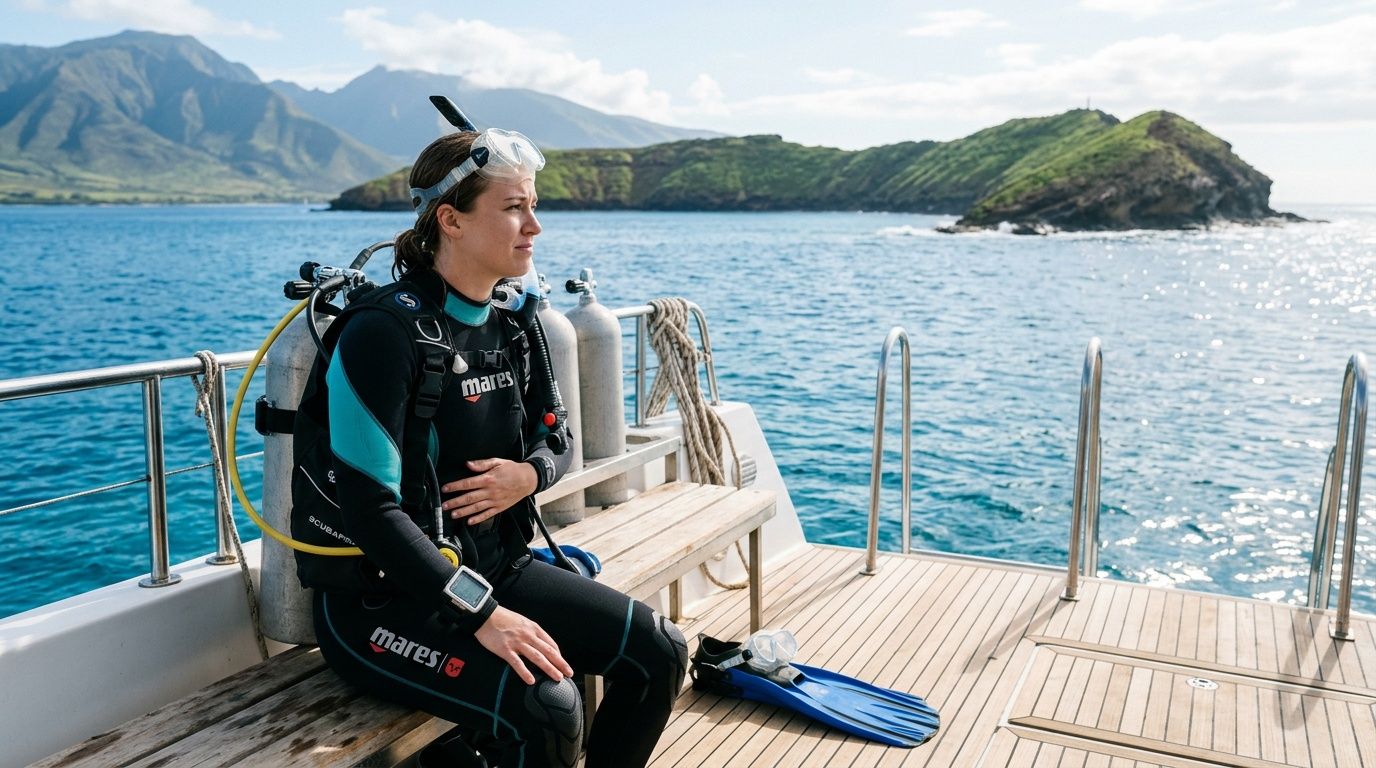
A lot of divers make the same mistake. They treat seasickness as a comfort problem instead of a safety problem. If you’re queasy, dehydrated, distracted, and trying to push through it while gearing up, your dive day can go downhill fast. Good decisions get slower. Simple tasks feel harder. The dive itself becomes work instead of fun.
If you already know you’re prone to motion sickness, the smart move is to plan before the boat leaves the dock. That means choosing the right medication, taking it at the right time, and knowing what side effects matter for diving. It also means using the basics that experienced crews repeat all the time: stay hydrated, avoid heavy greasy food, keep your eyes off your phone, and don’t wait until you feel sick to act. For a practical pre-trip checklist, how to avoid sea sickness is worth reading before your dive day.
What usually goes wrong
Most bad seasick mornings follow a familiar pattern:
- Late preparation: People bring meds but take them too late.
- Wrong product: They choose something that knocks them out, then expect to dive sharp.
- Empty or overloaded stomach: Either one can make the ride worse.
- Cabin trap: They go below deck, stare at a phone, and lose the fight quickly.
Practical rule: The best sea sickness med is the one you’ve already tested before the trip and can still function safely on.
Why You Get Seasick and Why Divers Must Be Cautious
Seasickness starts with a mismatch. Your inner ear feels motion. Your body feels motion. But your eyes might be locked on a tank valve, a camera screen, or the deck under your feet, which seems still. Your brain gets conflicting information and responds with nausea, dizziness, sweating, and sometimes vomiting.
On a dive boat, that mismatch gets amplified. You’re moving in several directions at once, often while suiting up, bending over, and focusing on small tasks. Even people who are fine while driving a car can struggle once they’re sitting still on a rolling boat.
Why this matters more for divers
For a passenger on a ferry, drowsiness is annoying. For a diver, it can become a real safety concern. Anything that causes sleepiness, blurred vision, dizziness, or slower reaction time deserves respect before you enter the water.
Underwater, divers already manage task loading. You monitor depth, time, buoyancy, gas, your buddy, and the environment at the same time. Add medication-related fogginess to that, and the margin gets thinner.
There’s another layer. Divers can experience narcosis effects at depth, especially on deeper profiles. If a medication already leaves you feeling dulled or off-balance on land, that’s not something to gamble with in the water. Medication doesn’t cause nitrogen narcosis, but side effects can stack with the general cognitive load of diving and make problems harder to recognize early.
The side effects that matter most
These are the big ones to think about before choosing a remedy:
- Drowsiness: Common with many antihistamines. Fine for sleeping on a plane. Less fine when you need sharp buoyancy control.
- Blurred or altered vision: A serious nuisance when reading gauges, cameras, or computer screens.
- Dry mouth: Not a deal-breaker by itself, but it can feel worse on a salty, windy boat if you’re already behind on hydration.
- Dizziness: If you’re trying to backward roll or giant stride while dizzy, your entry and surface control can suffer.
The goal isn't just to avoid vomiting. The goal is to stay clear-headed enough to dive safely.
What cautious divers do differently
Experienced divers usually follow a simple rule set:
- Test any new med on land first.
- Choose the least sedating option that still works for you.
- Take it early enough to be working before the boat ride begins.
- If the med makes you feel off, skip the dive.
That last point matters. Missing a dive stings. Forcing a dive while nauseated, lightheaded, or sedated is worse.
Seasickness Medication Showdown A Quick Comparison
When divers ask for the best sea sickness med, they usually want one clear winner. Real life doesn’t work that way. The better answer is to match the remedy to the trip, the swell, and your own tolerance for side effects.
Comparison of Seasickness Options for Divers
| Remedy | Type | Drowsiness | Duration | Dive Safety Notes |
|---|---|---|---|---|
| Scopolamine patch | Prescription anticholinergic | Lower sedation risk than older antihistamines | Up to 72 hours | Good for long-range trips and repeated boat days. Slower onset, so timing matters. |
| Meclizine (Bonine) | OTC antihistamine | Usually less drowsy | Up to 24 hours | Often the easiest all-day option for divers who still want to stay functional. |
| Dimenhydrinate (Dramamine) | OTC antihistamine | More likely to cause drowsiness | 4 to 6 hours | Works well, but some divers feel too sleepy to trust it underwater. |
| Sea-Band style wristbands | Acupressure | None from the device | As needed | Safe to try, especially as backup. Better for mild cases than severe ones. |
| Ginger chews | Natural support | None from the ginger itself | As needed | Useful as an add-on, not a replacement for medication if you’re highly susceptible. |
The main split is simple. Antihistamines are easy to buy and widely used. Scopolamine is the longer-lasting prescription option. Non-drug options are low-risk and worth carrying, but they usually work best as support rather than rescue for someone who gets hammered by boat motion.
A practical benchmark matters here. According to GoodRx’s motion sickness comparison, the scopolamine patch matches dimenhydrinate and surpasses meclizine in some studies, with a 4-hour onset and 72-hour duration, while pills act faster but need repeat dosing. For divers, that convenience can be a huge advantage on multi-day boating.
Quick decision guide
- Choose scopolamine if you’re doing several boat days or a long offshore itinerary and already know you tolerate it.
- Choose meclizine if you want a practical day-trip option with less drowsiness.
- Choose dimenhydrinate if you need something familiar and fast, and you know it doesn’t make you too sleepy.
- Add wristbands or ginger if you prefer a layered approach.
If you want another diver-focused breakdown of the best sea sickness med, that guide is useful for comparing what works in day-boat conditions. For a more boat-trip-specific discussion, this cruise seasickness medication guide is also a practical read.
The Best Over-The-Counter and Prescription Meds Explained
The strongest medication plan is usually boring. Pick the remedy that fits the trip length, start it on time, and don’t experiment on the morning of a dive. Fancy hacks matter less than consistency.
Scopolamine patch for long boat days
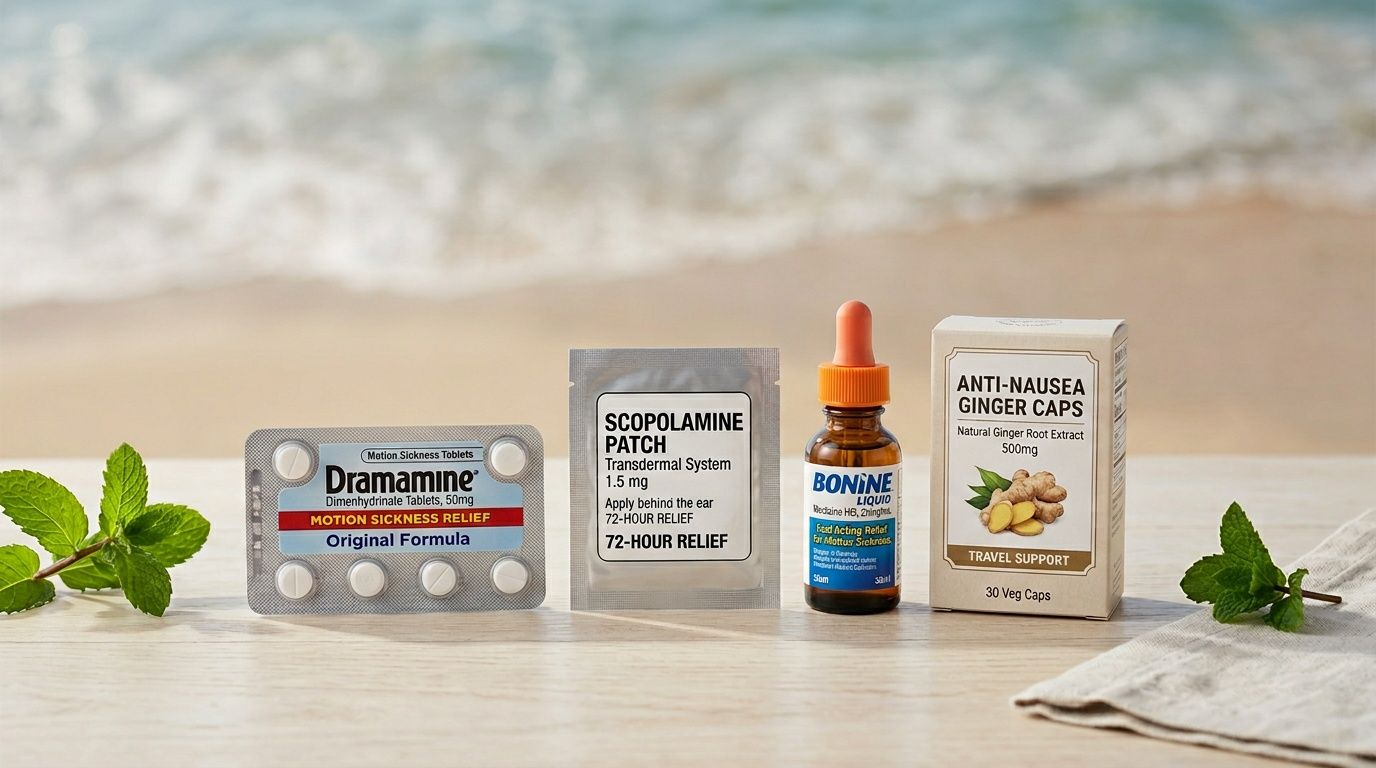
For extended trips, the scopolamine transdermal patch is hard to ignore. One patch can provide up to 72 hours of protection when applied behind the ear before travel, and an at-sea trial reported 74% protection on day one and 73% on day two against symptoms, as summarized in this Kona dive-focused review of scopolamine and other motion sickness options.
That’s why divers on liveaboards, multi-day charters, or back-to-back ocean days often favor it. You don’t have to keep taking pills on a moving boat, and you’re not relying on your stomach to absorb another dose after nausea has already started.
The trade-off is timing and side effects. The patch has a slower onset than pills, so if you forget to put it on early enough, you can miss the window. Some people also notice dry mouth, dizziness, or visual issues. Those may be manageable on deck. Underwater, they matter more.
Why divers like it
- Long coverage: Good for repeated exposure over several boat days.
- Less hassle: No repeat pill schedule once it’s on.
- Steady delivery: Useful if you tend to get sick enough that swallowing pills later becomes a problem.
Why some divers avoid it
- Prescription only: You need to plan ahead.
- Slower start: Not ideal for last-minute use.
- Visual side effects: Any change in focus or eye comfort deserves caution before diving.
The product many travelers look for is the Ship-EEZ Seasickness Patch. If you’re considering it, test it before your trip and discuss it with your doctor, especially if you have eye issues or other medical concerns.
Captain’s view: If you’re doing multiple rough-water days in a row, the patch often makes more sense than trying to chase symptoms with pills.
Meclizine for most day-trip divers
If I had to name the most practical all-around option for many recreational divers, it would be meclizine. It’s simple, widely available, and tends to hit the sweet spot between effectiveness and tolerability.
A major review cited in JAMA’s motion sickness literature summary reported 70.6% overall effectiveness for antihistamines in U.S. studies at sea. In the same summary data, meclizine offers up to 24-hour coverage with a single dose and often causes less drowsiness than older antihistamines.
That combination is exactly why so many divers reach for it on Kona-style morning charters. You can take it before the boat ride, get all-day coverage, and avoid some of the sleepier feel that comes with stronger sedating options.
The common purchase is Bonine pills. They’re a reasonable choice for divers who want one dose to carry them through a standard day on the water.
When meclizine makes sense
Meclizine is a good fit if:
- You’re on a single day boat trip
- You want fewer repeat doses
- You’ve had drowsiness problems with Dramamine before
- You still want a margin of mental sharpness for diving
There’s still no free lunch. “Less drowsy” doesn’t mean “zero side effects.” Try it at home first. If it leaves you groggy on the couch, don’t assume you’ll be fine managing buoyancy and gas checks offshore.
Dimenhydrinate when you need a classic standby
Dimenhydrinate, commonly sold as Dramamine, remains one of the old reliable seasickness meds. It’s accessible, familiar, and effective. The same JAMA summary noted above reported strong antihistamine performance overall, and Dramamine provides 4 to 6 hours of relief.
That shorter window can be useful. On a half-day trip, a fast-acting medication with a defined duration may be all you need. It’s also straightforward for travelers who want something easy to find before a trip.
The obvious downside is sedation. Plenty of divers can take Dramamine and function fine. Plenty of others feel noticeably sleepy. There’s no way around that variability except testing it before the trip. The common option is Dramamine pills.
The diver’s trade-off with Dramamine
Dramamine is strongest when:
- You need a fast OTC option
- Your trip is relatively short
- You know from prior use that it doesn’t flatten you
It’s weaker when:
- You’re doing a full day and need repeat dosing
- You’re prone to medication drowsiness
- You’re already tired, dehydrated, or anxious before boarding
What about promethazine and other stronger meds
Some prescription anti-nausea medications can work well, especially for people who still get sick despite standard options. But for divers, stronger isn’t automatically better. The more sedating the medication, the more seriously you need to think about underwater judgment, reaction time, and comfort.
If you’ve already tried meclizine, dimenhydrinate, and scopolamine without success, that’s usually the point to involve your physician rather than freestyle your own stack of remedies. If your stomach tends to spiral once you’re nauseated, it may also help to read about alternatives to common upset stomach remedies like Pepto Bismol, especially if you’re sorting out what to pack for travel in general.
A practical medication plan for divers
This is the no-nonsense version:
- Day trip, mild to moderate tendency: Start with meclizine.
- Short trip, known good response: Dimenhydrinate can work well.
- Multi-day boat exposure or severe history: Ask your doctor about scopolamine.
- Never combine random products without guidance: More meds can mean more side effects, not more control.
For a broader breakdown of pills and timing, this guide to sea sickness pills is useful if you’re comparing common options before travel.
Natural Remedies and Non-Medication Alternatives
Not everybody wants medication. Some people can’t take it. Some divers want a lighter backup plan because they only get mildly uneasy in swell. That’s where non-drug options earn their place.
They aren’t magic. But they can help, especially when you use them early and combine them with smart boat habits.

Acupressure bands
Sea-Band style wristbands press on the wrist point commonly used for nausea relief. They’re easy to wear, they don’t cause drowsiness, and there’s almost no downside to trying them.
For divers, I like them as a support tool, not as the entire plan for someone with a known bad history on boats. If your pattern is mild queasiness during the run out and you recover once you hit the water, they may be enough. If you routinely feed the fish before every first dive, bring stronger backup.
The common option is Sea Band wristbands. If you want help with fit and use, this guide to Sea-Band sea sickness wristbands covers the basics.
Ginger and simple stomach support
Ginger is one of those remedies that has stayed popular for a reason. It’s easy to carry, easy to tolerate, and useful for mild nausea or as an add-on to a medication plan.
I wouldn’t rely on ginger alone for rough-water divers who know they’re susceptible. I would absolutely keep it in the kit for people who need a little help settling their stomach before the problem snowballs. Ginger chews are the easiest version for travel days.
Fresh air, horizon, hydration, and a settled stomach still beat most last-minute heroics.
Boat habits that matter more than people think
A diver who manages the basics well often does better than someone who only relies on pills.
- Keep your eyes outside: Look at the horizon, not your phone.
- Stay in moving air: Don’t disappear into the cabin unless you have to.
- Eat light: A little food is usually better than an empty, acidic stomach.
- Sip water steadily: Don’t overdo it all at once, but don’t neglect hydration.
- Set your gear up efficiently: Long periods bent over in swell can trigger symptoms fast.
When non-drug options are enough
They make the most sense when:
- You get only mild motion sickness
- You’ve used them successfully before
- You’re using them with behavior changes, not instead of them
- You want a backup layer even when taking medication
They make less sense as a solo plan when you already know the ocean routinely overwhelms you.
Our Pro Tips for a Nausea-Free Kona Dive
Kona can be beautiful and still make people sick. That catches visitors off guard. Blue sky doesn’t always mean flat water, and even a short run can feel long if your stomach starts turning early.

What I’d recommend for most divers
For a standard Kona day boat, meclizine is usually the cleanest starting point. It covers the whole outing better than shorter-duration options and often leaves divers less sedated than the older antihistamine feel you can get from Dramamine.
For divers with a strong seasickness history, or for multiple boat days in a row, it’s worth asking your doctor about the scopolamine patch ahead of travel. That’s especially relevant if you’re booking a night outing or a trip where you don’t want to think about redosing on the boat.
If you’re diving with Kona Honu Divers dive tours, sort your seasickness plan before the morning check-in. Show up hydrated, fed lightly, and already covered by whatever remedy you chose. For the famous manta experience, the manta ray night dive tour is one of those outings where it pays to be proactive, because darkness and surface waiting can bother people who were fine earlier in the day.
Boat-position advice that helps
Where you sit matters. On most boats, the center area tends to feel more stable than the bow or stern extremes. Stay outside in fresh air if you can. Keep your gaze up and out during the run.
If you start feeling off, tell the crew early. Good crews can often help with seat choice, timing, and simple adjustments before nausea becomes the whole story of the trip.
A diver’s Kona checklist
- The night before: Sleep well, hydrate, skip heavy drinking.
- Morning of: Eat something light, not greasy.
- Before boarding: Have your medication already working.
- On the boat: Don’t stare at your phone while geared up.
- Before the dive: Be honest about how you feel.
Your Seasickness Questions Answered
Can I try a seasickness medication for the first time on dive day
No. Test it on land first.
That applies to patches, pills, and anything that claims to be “non-drowsy enough.” You need to know whether it makes you sleepy, foggy, dry-eyed, dizzy, or just plain weird before you trust yourself underwater.
What if I forgot my meds and the boat is leaving
Use the non-drug basics immediately. Get outside, look at the horizon, stay cool, and avoid reading your phone. If someone offers you a medication you’ve never taken before, be careful. A last-minute mystery pill before a dive is not a smart safety decision.
If symptoms build anyway, tell the crew and be willing to sit out the dive. That’s frustrating, but it’s still the safer call.
Does gearing up make seasickness worse
It can. Looking down, bending over, breathing hard, overheating in exposure protection, and focusing on small tasks while the boat rolls can all push things in the wrong direction.
That’s why efficient setup matters. Assemble gear calmly, then get your attention back outside instead of staring down at your station.
Are some ocean activities worse than others
Yes. Long surface waits, sitting at anchor in side chop, and riding in the cabin often bother people more than they expect. Some divers even feel better once they’re underwater because the visual mismatch settles down.
If you know you’re sensitive, choose your seat well, stay in moving air, and avoid spending unnecessary time below deck. If you’re wondering how long symptoms can linger after a rough trip, this guide on how long sea sickness lasts is a useful reference.
What’s the single best rule to remember
Don’t try to be tough. Be prepared.
Most seasick divers don’t ruin a day because they got motion sick. They ruin it because they waited too long, chose the wrong remedy, or ignored how the medication made them feel.
If you want a smoother dive day in Hawaii, plan your medication before you travel and book with a crew that understands diver comfort as part of dive safety. Kona Honu Divers offers boat diving in Kona with trip options for new and experienced divers alike, including day charters and manta night dives.