
You've got your Big Island dates, a few open days, and a decision to make: start with a relaxed reef dive, save an evening for mantas, or commit to something more demanding offshore. The tour names make everything sound tempting, but the best choice comes down to your recent experience, comfort in the water, and the conditions that day.
Planning scuba diving in Kona on the Big Island works best when you separate wildlife expectations from dive logistics. You can choose a suitable charter, prepare your equipment, and follow a conservative plan. You can't schedule plankton or promise that manta rays will appear on cue.
Kona Dive Experiences Compared at a Glance
| Dive option | Who it suits | Certification needed | What you see |
|---|---|---|---|
| Morning Introductory Scuba Dive | First-time divers | No certification needed | Shallow reef with guided first breaths |
| 2 Tank Local Morning Dive | Certified divers | Open Water Diver with C-card | Coral gardens, ancient lava tubes and dramatic arches |
| Manta Ray Night Dive | Snorkelers and certified divers | Snorkel: none; scuba: Open Water Diver | Manta rays feeding under lights |
| Premium Advanced 2 Tank Trip | Experienced certified divers | Certified diver; confirm accepted level and experience before booking | Deeper sites and drift dives at remote locations |
| Black Water Night Dive | Certified divers comfortable at night | Open Water Diver as a baseline; additional experience requirements apply | Open-water animals illuminated by dive lights |
Start with the row that matches your skills, not the most dramatic photograph. An introductory dive gives a beginner instruction and close supervision without pretending that a short experience replaces certification. A local morning charter suits certified divers who want reef scenery and volcanic formations without making darkness or open-water drifting the main challenge.
For most regular charters, we require at least an Open Water Diver certification from a recognized agency such as PADI, SSI or NAUI, which allows diving to 60 feet (18 meters) with a buddy. Bring your C-card, whether that's a physical card or an accessible digital credential. A certification establishes your training level, but it doesn't tell the crew how comfortable you are after a long break.
Match the challenge to your recent diving
Night diving adds task loading even when the planned profile isn't deep. You'll communicate with lights, manage equipment in darkness, and pay attention to a buddy who may be looking in a different direction. Blackwater adds the absence of a reef reference, while advanced charters can add current and more demanding entries or ascents.
The full Kona diving schedule helps you compare trip formats. For booking dates, use the diving tour availability page, but settle the suitability question before choosing an open slot.
Before reserving, answer these questions:
- Do I hold a valid card? If not, choose introductory instruction or a certification course rather than a certified-diver charter.
- Am I comfortable at depth with a buddy? Consider your current buoyancy and gas-monitoring habits, not just your deepest logged dive.
- Do I want a night dive? Excitement is useful; feeling pressured by your travel companions isn't.
A reef morning, manta evening, and offshore night dive serve different purposes. There's no need to fit every option into one vacation.
Best Months and Conditions for Kona Diving
Kona diving is available year-round, with warm water and generally clear visibility in every season. That makes travel dates flexible, but it doesn't make every site suitable every day. Use the season to narrow your plans, then let the marine forecast and crew's assessment determine the actual dive.
| Season | Water temperature planning | Typical conditions | Best for |
|---|---|---|---|
| Summer, June to September | Plan for warm water; confirm the current reading | Usually calmer surface conditions and clear water | Beginners and first night dives |
| Fall, October and November | Warm-water protection remains useful | Transitional conditions; swell can build | Divers wanting a mix of experiences |
| Winter, December to March | Plan for cooler water and repeated-dive chilling | Larger swells possible at exposed sites | Certified divers comfortable with changing conditions |
| Spring, April and May | Choose exposure protection for your cold tolerance | Calmer water often returns; assess each day separately | Reef, manta and marine-life dives |
A calendar is a poor substitute for checking the entry, exit, and boat ride. A sheltered reef can be comfortable while an exposed site nearby has surge that makes photography frustrating and a ladder exit difficult. Clear visibility also doesn't mean the surface is calm.
Let the day determine the site
Check the marine forecast the day before your trip, paying attention to swell direction as well as wind. Ask which site is planned and whether the crew expects to change locations. Treat the answer as a working plan, not a promise that the boat must visit a particular pin on a map.
For shore diving, inspect the exit before assembling your equipment. Watch several sets, identify where you'll remove fins, and consider whether you could exit there tired. An easy step into the water can become a difficult climb out.
Practical rule: Choose conditions that make the exit manageable, not just conditions that make the underwater photographs appealing.
Beginners generally have an easier planning window in summer and spring. Experienced divers can find worthwhile winter variety, but rough weather isn't a reason to seek stronger drift conditions. A drift dive should be deliberately planned around manageable current, suitable pickup procedures, and the group's ability.
Pack exposure protection for the entire day. Getting chilled during the surface interval can make the next dive less comfortable even when the water initially feels warm. A dry layer and wind protection on the boat are useful in every season.
Kona Dive Sites and Protected Waters
Kona's dive sites aren't interchangeable stretches of reef. Some sit inside conservation districts, others fall within fisheries-management zones, and shore access can introduce a separate set of practical constraints. Know the location, its restrictions, and the planned exit before entering.
The Old Kona Airport Marine Life Conservation District extends offshore toward the Kailua Lighthouse, with boundaries reaching 500 yards seaward from designated coastal points, according to the Hawaii Division of Aquatic Resources district rules. Those rules generally prohibit removing or harming marine life, live coral, algae, shells, geological features, or eggs; they also prohibit feeding marine organisms as an attractant and require permits for commercial use of the state mooring or shore operations.
For a visiting diver, the practical approach is straightforward: observe without collecting, keep equipment off the bottom, and don't introduce food to improve a photograph. A shell that looks empty is still not a souvenir to take from a protected site.
Shore access needs its own assessment
At the southeastern end of the former airstrip, the lava shoreline creates a semiprotected basin described as usable in calm to moderate conditions by the Division of Aquatic Resources site guide. Semiprotected doesn't mean all-weather access. Surge, slippery rock, and the weight of your equipment still matter.
Use the Big Island shore-diving guide to evaluate access options, then assess the actual entry on arrival. If you can't identify a dependable exit, choose another site or a guided boat dive.
- Secure your equipment. Clip gauges and accessories close so they don't drag across coral.
- Keep an exit reserve. Plan gas for the return and surface procedures, not just the outward swim.
- Resolve unknowns before entering. An uncertain boundary, entry permission, or exit route belongs on your planning notes as a question mark until confirmed.
Manta locations and fisheries zones
Keauhou and Ho'ona Bay are associated with nighttime manta gatherings. Garden Eel Cove is the preferred manta-tour setting here, but its suitability still requires a condition check rather than an automatic commitment.
Kona Honu Divers operates on the Big Island in a sheltered setting that gives good conditions almost all year. That shelter helps with planning; it doesn't remove the need to cancel or change a site when conditions deteriorate.
The Kona Coast fisheries-management area includes Wawaloli, Papawai Bay, Kailua Bay, and Red Hill, where aquarium-fish collection and fish feeding are prohibited under the state's Hawaii Island fishing-area regulations. Those restrictions don't make every zone identical to a marine conservation district.
Check the rules for the actual site before every dive. A lawful activity in one location may be prohibited in another.
Manta Ray Night Dives and Why Garden Eel Cove Leads
An approximately 80% chance of seeing a manta ray on a Kona night dive, alongside a local population thought to be probably fewer than 200 animals, appears in testimony submitted to the Hawaii Legislature. Those are historical observations, not a current nightly guarantee. The same record traces the activity to artificial lights near a Keauhou oceanfront hotel in the late 1970s and reports that nine operators carried approximately 11,000 snorkelers and divers in 2002.
That history explains the appeal and the responsibility. Visitors repeatedly encounter a recognizable local population, not an unlimited supply of animals arriving for a performance.
Why Garden Eel Cove is the better choice
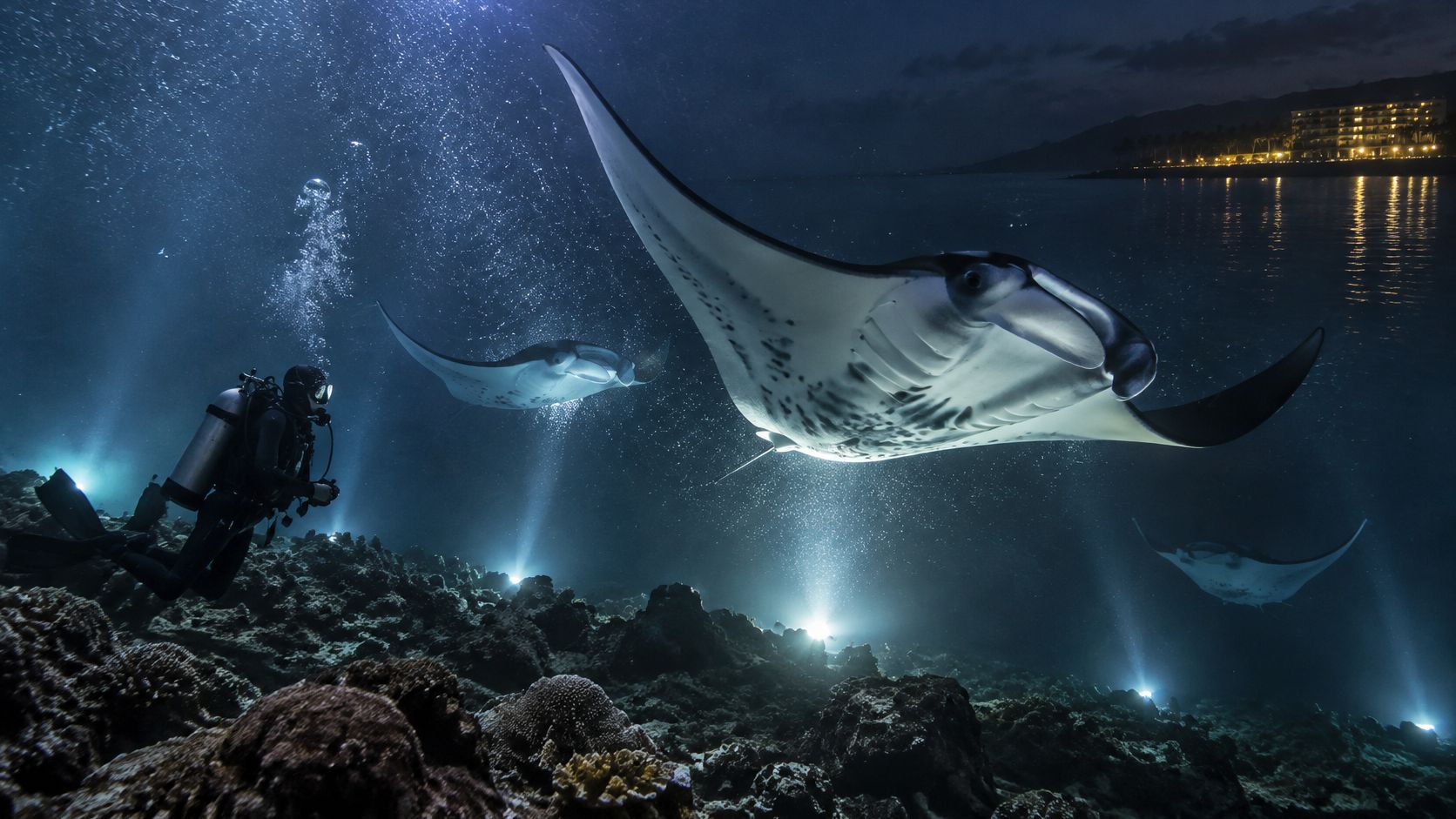
Garden Eel Cove is the superior choice for the manta dive tour because of its protected location, better viewing area, and better surrounding reefs compared with more open settings. The advantage isn't merely the possibility of seeing animals. A suitable viewing area helps divers settle without crowding the feeding corridor, while the reef gives the broader trip value beyond the nighttime encounter.
Site ecology matters too. A long-term study published in Environmental Biology of Fishes found that Garden Eel Cove generally supported larger and more variable manta aggregations than Keauhou, and that aggregation size at both sites was positively associated with zooplankton density.
That finding doesn't support a guaranteed manta season or a promised animal count. A quiet night can reflect food availability and other natural conditions. It isn't automatically evidence that the crew chose badly, just as a busy night doesn't prove that every operating practice was responsible.
What the evening feels like
On a typical trip, the boat arrives and the crew explains the viewing arrangement before anyone enters. Lights concentrate plankton, scuba divers settle into designated positions, and snorkelers remain at the surface with their guide and flotation setup. If mantas arrive, they circle through the illuminated feeding area.
The manta dive and snorkel trip page helps mixed groups understand the available perspectives. Choose scuba because you're comfortable managing a night dive, not because you assume the surface view is second-rate.
- Leave the feeding path open. Stay where the guide positions you rather than swimming upward to meet a ray.
- Keep hands to yourself. Don't touch, chase, ride, or intercept an animal.
- Control your camera. Frame the pass you're given instead of moving into another diver or the manta's route.
- Accept a change of plan. Unsafe traffic, deteriorating conditions, or a poor viewing setup justify moving or ending the encounter.
Reporting on proposed, rather than established, Hawaii rules described slow vessel operation, separation from unlit snorkelers, avoidance of passing over divers, and proposed caps of 24 commercial permits per site and 60 passengers per operator per 24-hour period, according to the Hawaii Tribune-Herald's manta-tourism coverage.
A good encounter leaves the mantas free to feed and the people calm enough to watch.
Judge the evening by animal behavior, considerate positioning, and competent supervision. Counting mantas alone misses what makes the experience worthwhile.
Blackwater and Advanced Dives for Certified Divers
Blackwater isn't a reef night dive farther from shore. You're suspended in open water after dark without a seabed to provide an obvious visual reference. Small animals in the light beam become the focus, and keeping track of your own position becomes part of the challenge.
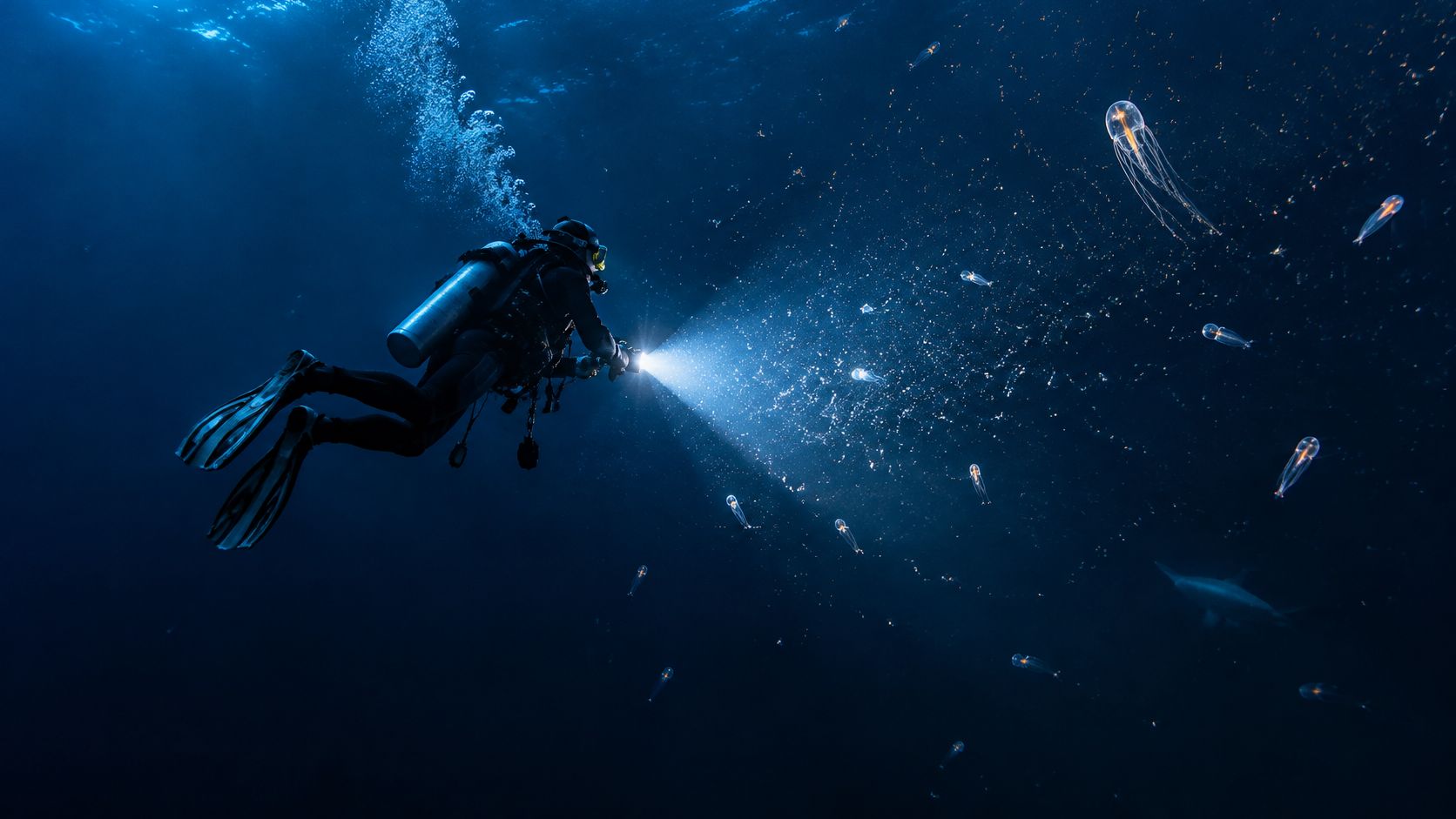
The Black Water Night Dive suits divers who already enjoy darkness and can maintain depth without constant finning. Lights illuminate plankton and small open-ocean animals, including creatures associated with nighttime movements toward shallower water. The light isn't a reason to pursue a subject away from the group.
Bring a primary light and a backup, understand the boat's positioning system, and follow the briefing on separation procedures. A camera adds another task, so leave it behind if you still need deliberate concentration to hold a stable position.
Advanced reef diving is a different challenge
The Premium Advanced 2 Tank Trip is aimed at experienced certified divers interested in remote sites, deeper profiles, and drift diving. These trips reward efficient descents, dependable buddy awareness, and the ability to follow a plan without a fixed line throughout the dive.
Remote and pristine doesn't mean easy. A diver who is comfortable on a shallow guided reef may still need practice before managing current, depth, and a free-water safety stop together.
Make the decision from your logbook
Use this self-check before choosing either demanding option:
- Logged experience. Can you describe recent dives with comparable conditions, rather than relying on a certification earned long ago?
- Current comfort. Can you stay with a buddy, avoid fighting the flow, and follow the pickup procedure?
- Buoyancy confidence. Can you hold depth while checking your computer or adjusting a light?
If two of those three areas fall short, take Advanced Open Water training or Peak Performance Buoyancy instruction before making the harder trip your vacation goal. Course selection should address the missing skill, not add another card.
Blackwater is for divers who already enjoy night diving. An advanced reef trip is a better fit when you've logged varied dives and can explain what you do when current, visibility, or the planned route changes. Neither should be treated as a test you must pass to call yourself an adventurous diver.
Certification Courses and Rental Gear to Plan For
| Course | Who it suits | Prerequisite or enrollment check |
|---|---|---|
| PADI Scuba Certification Course | Complete beginners | No previous scuba certification; medical and water-readiness screening |
| PADI Open Water Referral Course | Divers finishing classroom or pool work elsewhere | Completed knowledge development; referral documentation and confined-water status checked |
| PADI Advanced Open Water | Certified divers building skills | Open Water Diver or accepted equivalent |
| PADI Enriched Air Diver | Divers planning to use nitrox | Open Water Diver or qualifying concurrent training |
| PADI Rescue Diver | Divers wanting rescue and safety skills | Suitable preceding training, navigation experience, and current first-aid/CPR requirements |
| PADI Peak Performance Buoyancy | Divers wanting better control | Open Water Diver or accepted equivalent |
| PADI Deep Diver | Certified divers exploring deeper sites | Qualifying advanced training; confirm accepted credential |
| PADI Boat Diver | Divers who dive from boats | Open Water Diver or accepted equivalent |
| PADI ReActivate | Certified divers returning after a break | Existing scuba certification |
Treat the course table as a starting point, not a substitute for enrollment screening. Age, medical history, prior training, and course-specific requirements still need checking. A Rescue Diver course, for example, shouldn't be booked on the assumption that an advanced card alone completes every prerequisite.
A referral course is useful when you want to finish academic and confined-water work near home. Send the documentation before traveling so the instructor can confirm what's complete and what remains. Don't arrive assuming an unfinished pool session can be skipped.
Choose the skill that changes your dives
For Kona's boat and night dives, buoyancy training often gives the quickest practical improvement. Stable divers can watch animals, manage lights, and protect coral without using their hands or making constant depth corrections. Advanced training is useful when you need supervised practice in unfamiliar environments rather than a harder charter booked as an improvised lesson.
A refresher is the sensible choice when equipment assembly, regulator recovery, or ascent control feels unfamiliar. ReActivate addresses a break in practice; it doesn't mean your certification has expired.
Rent bulky gear and bring familiar controls
Bring your own mask and dive computer if you own reliable equipment and know how to use it. A familiar computer reduces confusion about displays and alarms, while a well-fitting mask avoids an unnecessary distraction.
For warm-water diving, a 3 mm wetsuit is a practical starting point, with 5 mm or an added hooded layer worth considering if you chill easily or plan repeated dives. These are equipment choices, not guarantees of comfort. Fit matters as much as thickness.
Review scuba rental arrangements before arrival. We can also confirm dive-computer availability and any small extra cost when you book.
- Documents. Pack your C-card, logbook, and completed medical questionnaire.
- Personal kit. Bring swimwear, your familiar mask, and suitable exposure protection.
- Rental decision. Settle sizes and equipment needs before the trip rather than at boarding.
Nitrox and Night Dive Safety Limits
Nitrox doesn't give you both maximum extra bottom time and the full reduction in nitrogen exposure. Increasing oxygen lowers nitrogen uptake at a given depth, but using nitrox-specific limits to extend the dive consumes much of that margin. The DAN Dive Medical Reference explains this trade-off and gives approximate 1.4 ATA operating depths of 111 feet (34 meters) for 32% nitrox and 95 feet (29 meters) for 36% nitrox.
| Nitrox mix | Max depth at 1.4 ATA |
|---|---|
| 32% nitrox | Approximately 111 ft (34 m) |
| 36% nitrox | Approximately 95 ft (29 m) |
These are oxygen-exposure ceilings, not target depths. Your certification, experience, gas reserve, no-decompression limit, and site conditions can all require a shallower dive.
DAN's oxygen-toxicity guidance recommends keeping inspired oxygen pressure at or below 1.2 ATA during physical activity and 1.6 ATA during decompression; using the standard seawater MOD calculation, the lower limit corresponds to approximately 90 feet (27 meters) for 32% nitrox and 76 feet (23 meters) for 36% nitrox. Don't interpret a decompression exposure limit as permission for a recreational working depth.
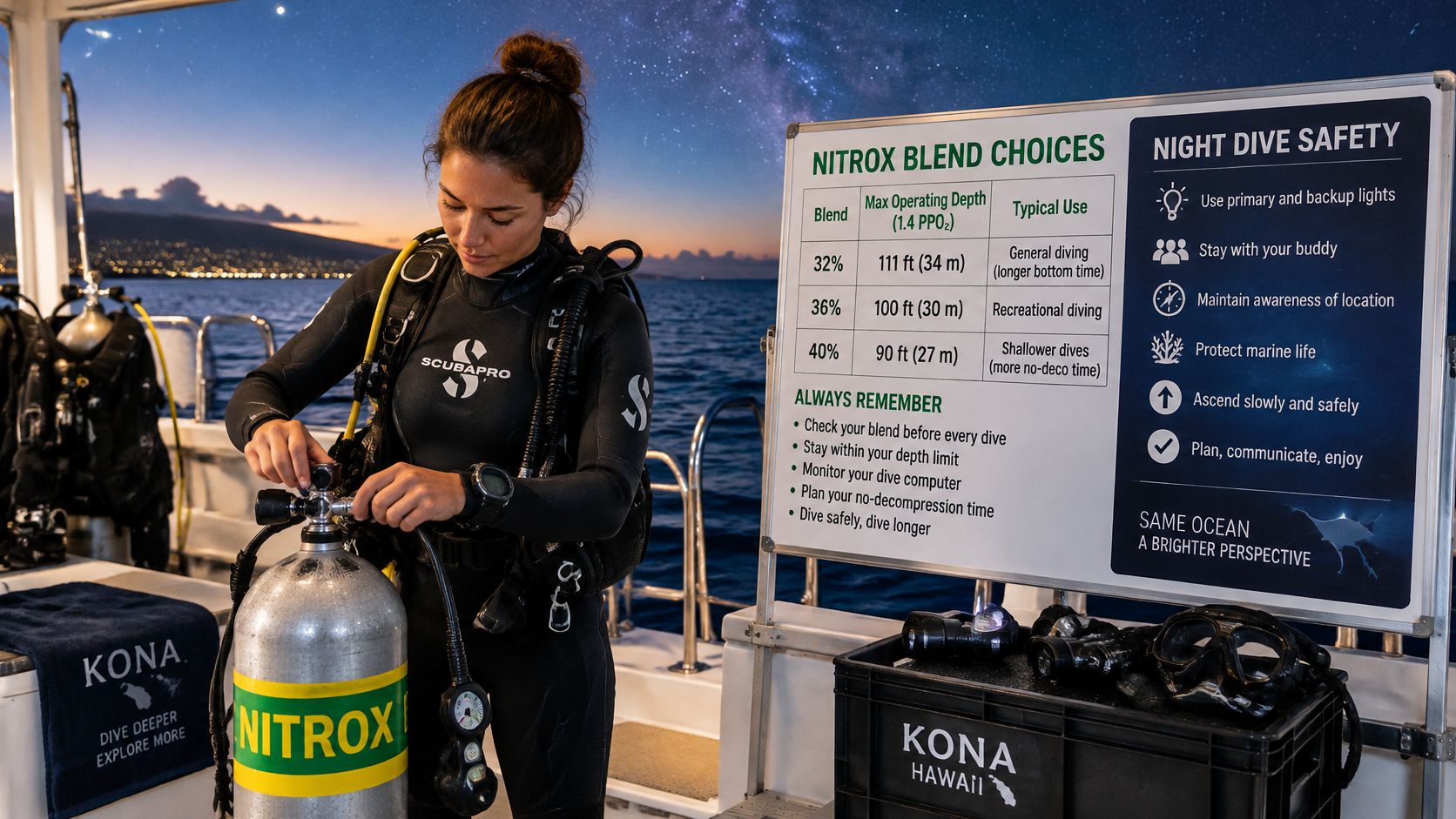
Make the gas setting part of equipment setup
Follow the same sequence for every cylinder:
- Analyze the cylinder yourself. Read the oxygen fraction rather than trusting a mix label.
- Record the percentage. Identify the cylinder and calculated operating limit.
- Program your computer. Enter the actual analyzed oxygen fraction.
- Set the MOD alarm. Use the conservative oxygen limit appropriate to your training and plan.
- Confirm before entry. Match the cylinder, computer setting, and planned depth.
The enriched-air certification information is useful if you're not yet trained to analyze and plan these mixes. Gas availability isn't a substitute for qualification.
Keep your attention on the dive
On manta and blackwater dives, animals and light beams can hold your attention while you gradually change depth. Check your computer deliberately, maintain neutral buoyancy, and avoid hard finning after a photographic subject. Cold, exertion, and increased carbon dioxide increase concern about oxygen toxicity, so controlled effort matters alongside the numerical limit.
Safety check: If you can't hold position comfortably, change the position or end the dive rather than working harder to preserve the photograph.
Surface warnings matter too. Hawaii requires ocean scuba divers and spearfishers to display a flag at least 12 by 12 inches, prohibits surfacing more than 100 feet from it except in an emergency, and requires removing it when diving ends, according to the Division of Aquatic Resources dive-flag rules. A flag warns boaters; it doesn't replace listening, looking, and following the crew's ascent procedure.
Book Your Kona Dive and Plan the Day
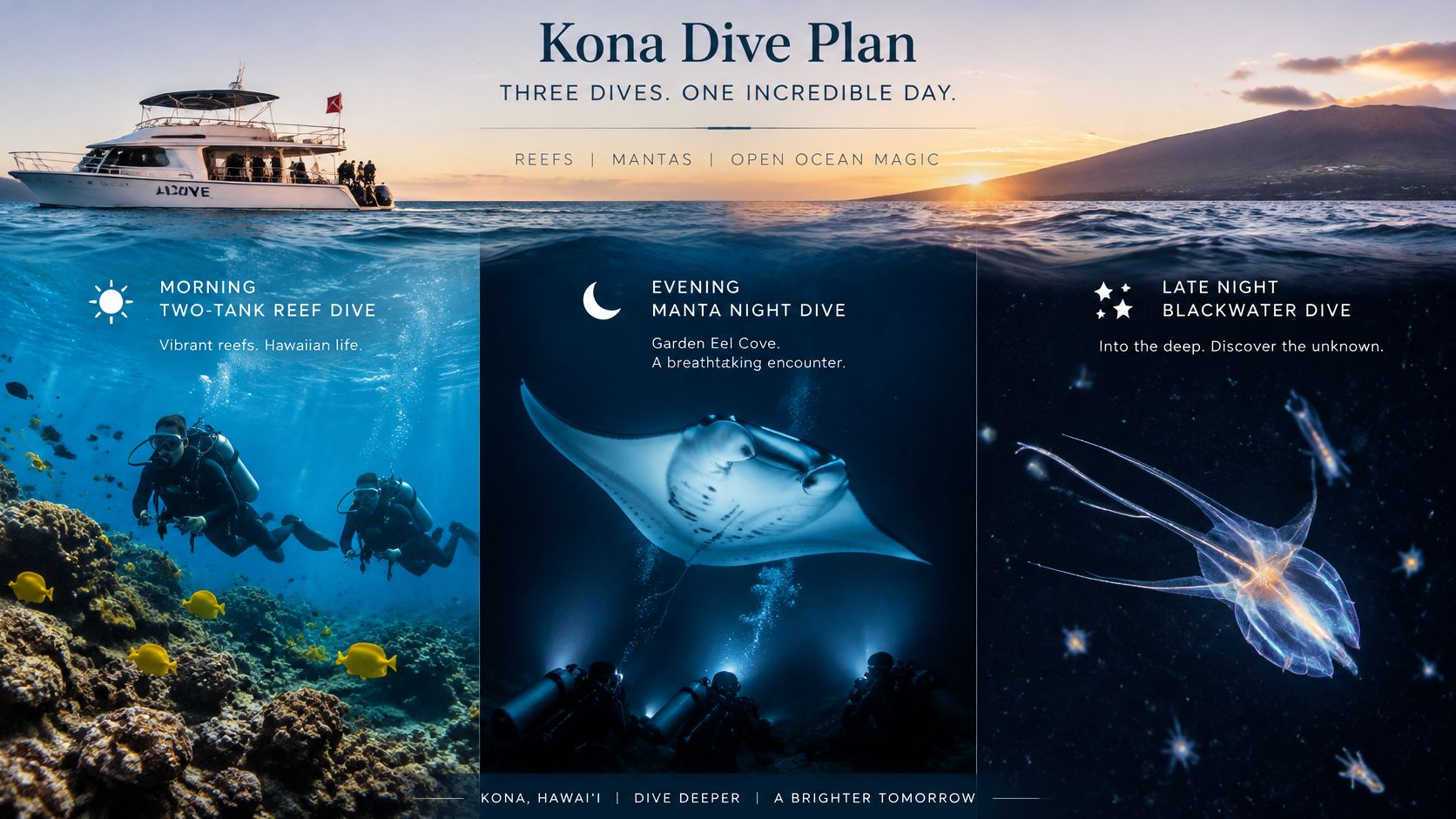
Build your itinerary from an easy assessment dive toward more demanding experiences. That gives you room to discover a weighting problem, unfamiliar rental control, or rusty skill before darkness becomes another task.
A practical three-day example looks like this:
- Day one. Choose a morning introductory dive if you're new, or a local reef charter if you're certified. Use it to settle equipment and confidence.
- Day two. Plan the manta night dive at Garden Eel Cove, leaving the daytime schedule relaxed enough to arrive rested.
- Day three. Consider blackwater or an advanced trip only if your experience and current performance make it appropriate.
This isn't a timetable to follow regardless of fatigue. Leave flexibility for weather, and schedule flying or driving to altitude separately from your diving after obtaining appropriate post-dive guidance.
What happens on a typical boat day
Our usual sequence starts with arrival and gear setup, followed by a briefing on site conditions and entry style. The first dive visits the deeper or more condition-sensitive site, then there's a surface interval before a more relaxed second dive. Listen for the actual depth, gas, and return instructions rather than assuming yesterday's plan applies.
We focus on small groups and personal attention from the moment you step aboard. Help that process by mentioning a long break from diving, an equipment concern, or difficulty with ladder exits before the boat leaves. Those details are more useful than describing yourself as generally confident.
Settle the details before choosing dates
Confirm that your certification card is accessible, choose dates with room for a changed plan, and decide whether you'll use nitrox and rental equipment. Reserve night dives early enough to arrange the rest of your day around the confirmed check-in. Review the dive travel planning tips before packing.
Kona Honu Divers is a separate operator from Kona Diving Company. Compare the actual trip, requirements, and booking confirmation, not just similar business names.
For questions about suitability, equipment, or scheduling, call 808-324-4668. Describe your recent diving and the experience you want, then choose the trip that fits both. Check open dates with enough flexibility to put comfort and conditions ahead of completing a checklist.
Kona Honu Divers offers guided reef dives, Garden Eel Cove manta encounters, introductory instruction, and advanced night experiences for appropriately prepared divers. Visit Kona Honu Divers to choose your first dive, confirm the requirements, and build a Big Island itinerary around your skills and the conditions.