
You've got a few open days on the Big Island, a certification card somewhere in your luggage, and a choice between reefs, mantas, and an ocean that turns completely black after sunset. The difficult part isn't finding a dive. It's choosing one that matches your actual comfort level, rather than the most dramatic photograph on the booking page.
Scuba diving in Kona on the Big Island works best when you plan around conditions, recent experience, and wildlife behavior. A shallow manta encounter can demand better buoyancy than a moving reef dive, while blackwater requires composure without a bottom beneath you. Choose the right starting point, leave room for weather changes, and treat every animal encounter as something the animal chooses.
Kona Dive Experiences Compared at a Glance
| Experience | Best for | Certification needed | Typical depth | Time of day |
|---|---|---|---|---|
| Manta ray night dive | Night wildlife viewing for newer certified divers and diving families | Open Water Diver, subject to operator screening | 15-40 ft (5-12 m) | Night |
| 2-tank local morning dive | Certified divers wanting reefs, lava tubes, and arches | Open Water Diver | 40-60 ft (12-18 m) | Morning |
| Premium advanced 2-tank trip | Experienced divers seeking remote sites and drift dives | Advanced Open Water or higher, with experience screening | Beyond 60 ft (18 m) at some sites | Morning |
| Blackwater night dive | Experienced night divers wanting open-water plankton encounters | Certification plus operator-specific experience requirements | Confirm the suspended depth with the operator, not the seafloor depth | Night |
| Morning introductory scuba dive | Beginners who have never dived | None for the supervised introductory experience | Instructor sets a shallow training profile | Morning |
| Shore dive at Old Kona Airport | Divers wanting a flexible, self-guided dive | Open Water Diver and independent planning skills | Reef flats to about 50 ft (15 m), then a drop-off | Morning or day |
For most of our regular charters at Kona Honu Divers, you need at least Open Water Diver certification from a recognized agency such as PADI, SSI, or NAUI. That qualification generally allows diving to 60 feet (18 meters) with a buddy; bring your C-card. Junior certifications, training conditions, recent experience, and charter-specific screening can impose tighter limits.
Match the dive to your skills
The depth descriptions are planning guides, not promised profiles. The operator's briefing establishes the actual depth, route, and turnaround for the day, and your own qualification remains a separate limit.
A local morning charter is the sensible starting point if you're newly certified or uncertain about your weighting. Moving along a reef gives you a chance to settle your breathing, check your equipment, and establish communication before adding darkness.
The introductory experience serves a different purpose. It lets a beginner learn basic skills under direct supervision, but it doesn't award independent-diving privileges or qualify someone for a certified manta dive later that evening.
Advanced trips add more than depth. Remote sites, currents, drift procedures, and less forgiving exits can require confident gas management and an independent safety stop. Blackwater introduces a different challenge again: maintaining position and depth without a reef as a visual reference.
Selection rule: Choose for the skills you can perform comfortably today, not the highest qualification printed on your card.
Find the row that matches your logged dives and night experience, then compare current Kona diving tours against that starting point.
Choosing the Best Season for Kona Dives
| Season | Water temperature | Visibility outlook | Sea state tendency | Manta activity |
|---|---|---|---|---|
| Winter, December to March | Cooler seasonal conditions; confirm the current reading | Generally clear offshore, with swell affecting individual sites | Exposed entries need careful assessment | Encounters remain possible |
| Spring, April to May | Transitioning toward warmer conditions | Assess the selected site, not just the regional forecast | Choose the sheltered option available that day | Plan for nightly uncertainty |
| Summer, June to August | Warmer seasonal conditions | Often favorable when local conditions cooperate | Calm mornings are useful planning targets | Higher occupancy in broader Hawaiian observations |
| Early fall, September to October | Warm seasonal conditions | Often favorable offshore | Check swell despite a favorable seasonal outlook | Higher occupancy in broader Hawaiian observations |
Kona is a year-round diving destination, with warm water and generally clear visibility across the seasons. That doesn't mean every shoreline entry or offshore departure is suitable every day.
Divers Alert Network's Kona overview describes a west coast lying in the lee of two large seamounts, with open-Pacific currents commonly bringing clear water and deep ocean close to shore. That combination supports both lava-reef diving and access to pelagic habitat without an extended offshore journey.
Shelter is an advantage, not a weather guarantee. Swell can wrap into a coastline that looks protected on a map, while wind can make the boat pickup or shore exit harder than the underwater portion.
Broader Hawaiian observations summarized in a Frontiers in Marine Science study report higher manta occupancy during summer and early fall, potentially associated with calmer weather, warmer water, and predator avoidance. That's useful seasonal context, but it isn't a nightly forecast for Garden Eel Cove.
Make these checks on the day
- Read the swell forecast. Look at direction as well as size. A manageable boat dive and an unsafe lava-rock shore entry can exist on the same coastline.
- Match the activity to daylight. Favor a calm-forecast morning for reef exploration. Manta and blackwater trips require a separate nighttime plan, including the return and surface pickup.
- Inspect wind at the actual entry. Offshore wind can push a tired surface swimmer away from shore; onshore wind can complicate an already awkward exit.
Don't judge exposure protection by air temperature. Ask for the current water reading, consider how easily you get cold, and account for repeated dives and a breezy return ride.
Our sheltered Big Island operating area gives us good conditions almost all year, but site selection still matters. Use this guide to the best months to scuba dive in Hawaii to match seasonal preferences to your travel dates.
Practical rule: Target calm-forecast mornings for reefs and shore entries. Summer is a sensible preference for manta and blackwater planning, but a favorable daily forecast matters more than the month.
Garden Eel Cove and Responsible Manta Viewing
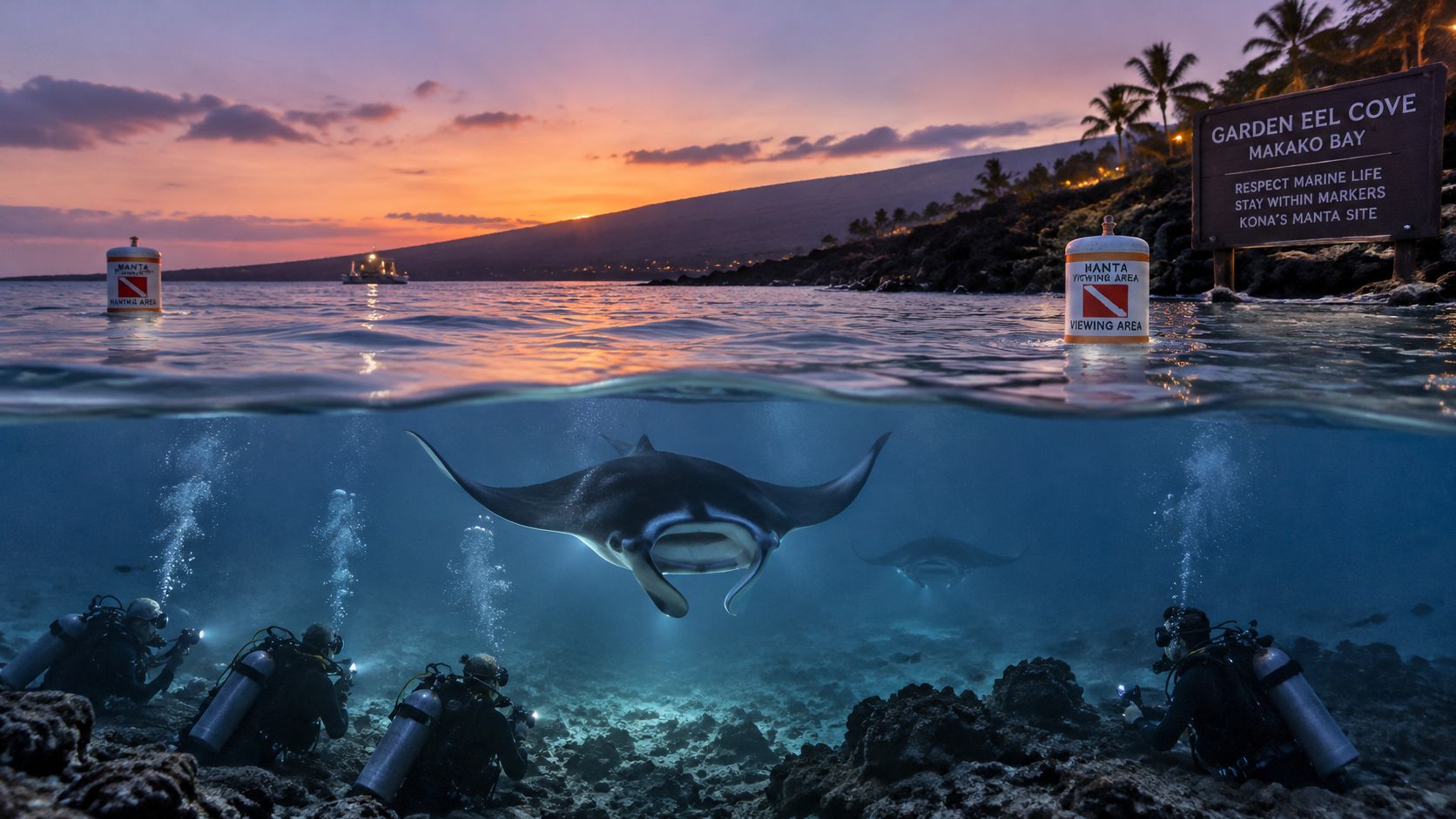
Garden Eel Cove, also called Makako Bay, is my preferred choice for a Kona manta dive because its protected location, defined viewing area, and nearby reef make a stronger overall dive setting. Historical Hawaii legislative testimony reported manta sightings on 80% of dives there and identified it as one of Kona's two established viewing areas.
That historical figure describes an observation record, not your booking's probability. The same testimony describes 3,208 surveys conducted primarily at Kona manta sites from 1992 through 2007, identifying 106 individual mantas along the coast and suggesting that the local population was probably under 200 animals.
A University of Hawaii manta aggregation study, analyzing more than 23,000 sightings of 167 reef mantas collected during 2010-2022, found that Garden Eel Cove generally supported larger aggregations, while Keauhou showed strong female site fidelity. Manta presence also tracked zooplankton density, an important reminder that animals respond to feeding conditions, not departure schedules.
Why the viewing area matters
A good manta site needs room for feeding animals, divers, and surface participants without forcing their paths together. Garden Eel Cove's viewing layout and better surrounding reef make it the superior overall tour choice in my judgment, especially when a preparatory reef dive forms part of the trip.
Protected doesn't mean motionless. The captain still needs to assess swell, and the guide needs to position the group for that evening's conditions.
The reef matters because the experience shouldn't depend entirely on mantas arriving. A useful preparation dive lets you check weighting and equipment while observing the surrounding habitat, rather than treating it as scenery between boat rides.
Carrying capacity isn't just the number of people a boat can transport. It includes how much diver movement the viewing area can accommodate without blocking feeding corridors or damaging habitat. Stable aggregations don't prove that every increase in visitation is harmless.
NOAA's concern, reflected in the study's tourism discussion, is that a heavily used Kona manta site had lower zooplankton abundance and diversity than a less-used site, potentially associated with inadvertent habitat damage. The practical response is better positioning and less bottom contact, not a claim that any wildlife tour is automatically sustainable.
How to handle the night
- Use the briefing to solve buoyancy problems. Confirm weighting, group spacing, light signals, and the designated observation position before entering.
- Descend with the group. Reach the viewing area without dropping onto coral or drifting through another group's space.
- Follow the lighting plan. Dim personal lights when directed and let the guide manage the feeding-light arrangement. Don't add a bright beam aimed at an animal's face.
- Observe from the assigned position. Maintain controlled buoyancy while mantas move through the feeding corridor. Don't rise to follow an animal or abandon the group for a closer view.
When mantas are absent, the rules don't change. Stay in position, protect the bottom, and accept the guide's decision about moving or ending the dive. Chasing a distant silhouette doesn't improve the encounter.
Keep the animal's route open
Never touch, chase, block, or position yourself directly above a manta. Don't kneel or stand on the reef, and keep dangling gauges, hoses, and camera accessories secured.
Photographers should use a wide-angle lens, keep lighting restrained, and shoot side-on at the animal's level when the assigned position allows it. A clean frame comes from patience and composition, not swimming into the feeding path.
Review responsible diver etiquette before choosing a manta ray dive and snorkel trip. The strongest booking decision includes a willingness to follow the guide even when the animals don't arrive.
A good encounter is one the animal chooses.
Blackwater and Advanced Dives for Certified Divers
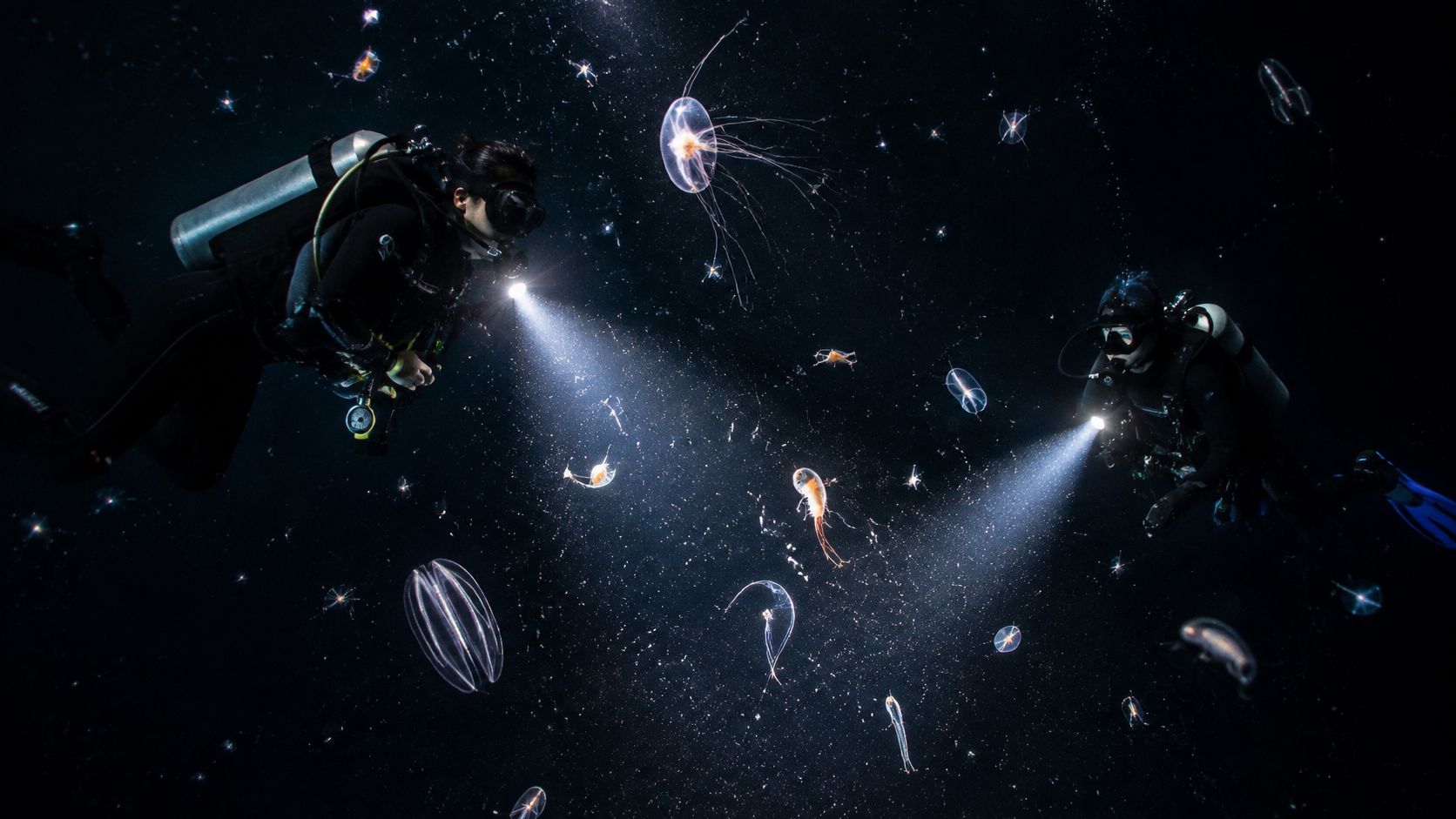
Blackwater diving isn't a deeper version of the manta experience. You're suspended in open ocean after dark, observing plankton and small animals associated with diel vertical migration, rather than watching a reef-based feeding aggregation.
The difficulty is maintaining a stable depth when there's no seabed in view. An experienced reef diver can still feel disoriented in that setting, so comfortable night diving and reliable buoyancy matter more than enthusiasm.
Follow a controlled blackwater procedure
- Confirm surface support before entry. Know the boat's arrangement, the attachment or reference system being used, and the recall signal. Identify who manages the flag and how the crew tracks the group.
- Descend with your buddy to the assigned depth. Watch your computer rather than following an animal downward. Establish your position relative to the reference system immediately.
- Hold neutral buoyancy and manage your light. Observe animals without pursuing them or keeping a powerful beam fixed on them. Check depth, gas, buddy position, and group position between observations.
- Ascend. Complete the planned stop when conditions and gas permit, remain with the group, and follow the pickup procedure rather than swimming independently toward the boat.
The Hawaii Division of Boating and Ocean Recreation requires scuba divers, freedivers, and snorkelers to display a diver's flag, requires it to be illuminated between sunset and sunrise, and requires ocean users to surface within 100 feet of the flag except in emergencies. The flag belongs in the operational plan, not at the bottom of an equipment bag.
A tether or downline doesn't replace depth control. Keep clear of entanglement hazards, understand any release procedure, and tell the crew promptly if you're uncomfortable.
Choose the advanced challenge you actually want
An advanced daytime charter is a better match if you want remote reef terrain, deeper sites, or drift procedures rather than tiny pelagic animals. These dives demand attention to current, gas consumption, navigation, and pickup arrangements, with less tolerance for equipment problems discovered after entry.
Review the Kona blackwater dive preparation guide before selecting a Blackwater Dive tour. Choose the premium advanced dive trip if remote sites and active reef exploration better match your goals.
Before booking either, provide your logged dives, most recent dive, night experience, and relevant training. An Open Water card alone isn't proof that you're ready for every open-ocean night profile.
Shore Diving at the Old Kona Airport Conservation Zone
- Watch the entry before gearing up. Assess surf and swell through a sequence of sets. If waves are washing across the route you'll need for your exit, choose another plan.
- Identify both entry and exit. Walk the route while unencumbered, locate stable footing, and establish an alternative if conditions change.
- Protect your feet and hands appropriately. Wear booties for sharp lava; gloves can protect hands during a necessary shore scramble, but they don't make touching coral acceptable.
- Set up the surface flag. Assign responsibility for the float and line, keeping them clear of equipment and other water users.
- Agree on the turnaround before descent. Set gas, time, and distance limits that preserve enough margin for the swim back and a controlled exit.
Understand the terrain and protection
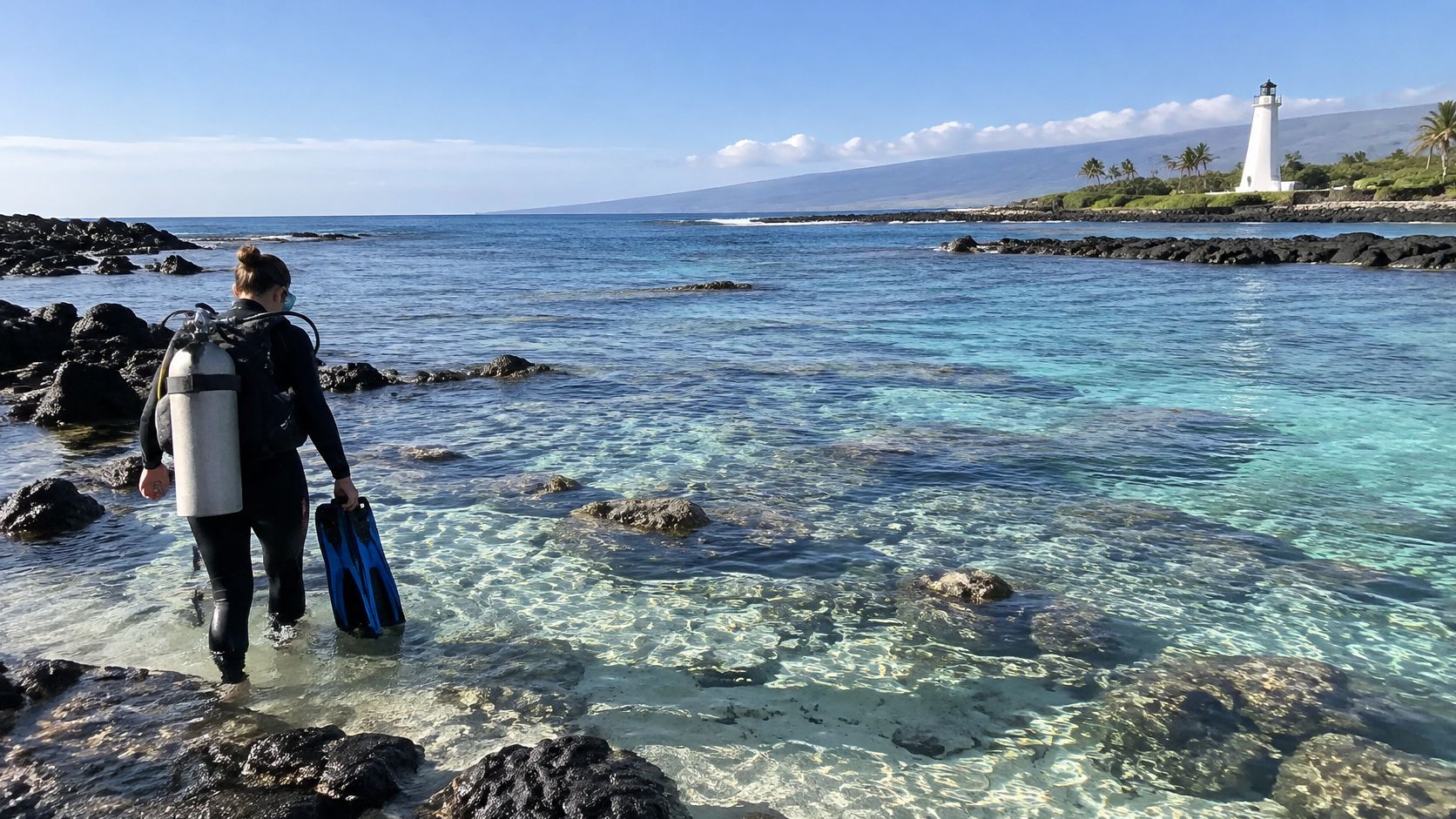
The Hawaii Division of Aquatic Resources site guide describes an offshore boundary extending 500 yards seaward from designated points near the old airport and Kailua Lighthouse, with shallow lava fingers reaching about 50 feet before the bottom drops rapidly into deep water. Entry options include a partially protected cove and a semiprotected lava basin at the southeastern end of the old airstrip.
Coral cover, reef fish, turtles, and rays make the site rewarding without descending along the drop-off. Set a depth alarm and resist following the terrain just because visibility makes deeper water look accessible.
The Old Kona Airport conservation regulations establish these restrictions:
- Leave marine life in place. Taking, injuring, killing, possessing, or removing marine life is prohibited except for specifically listed activities, including protections for live shells, opihi, coral, algae, limu, and eggs.
- Leave the bottom intact. Don't remove or alter sand, coral, rock, or geological features.
- Don't feed animals. Using attractants to feed aquatic organisms is prohibited.
- Don't anchor. Anchoring watercraft within the district is prohibited.
- Use permitted commercial operations. Commercial dive and tour activity from shore or the mooring requires a permit.
Decide whether independent entry suits you
Shore diving offers flexibility, but you take responsibility for the work a boat crew would otherwise handle. Carrying equipment over lava, judging an exit, and managing navigation are part of the dive, not incidental inconveniences.
Use the Big Island shore-diving guide to compare options. Old Kona Airport suits divers who can independently plan and execute the entry, underwater route, and return, and who are willing to cancel at the water's edge.
Certification, Courses and Gear Rental Options
| Course | Who it suits | Prerequisite | Typical length |
|---|---|---|---|
| PADI Scuba Certification, Open Water | New divers seeking full certification | Medical screening and swimming requirements | Allow a dedicated training block |
| PADI Open Water Referral | Students finishing training in Kona | Accepted referral paperwork and completed prerequisite training | Remaining water sessions set the schedule |
| PADI Advanced Open Water | Certified divers building depth and navigation skills | Qualifying entry-level certification | Schedule around the required adventure dives |
| PADI Enriched Air Diver | Divers learning to use nitrox | Qualifying certification or eligible concurrent training | Knowledge and practical-assessment schedule |
| PADI Rescue Diver | Divers developing prevention and response skills | Qualifying training and current emergency-care prerequisites | Allow time for skills and scenarios |
| PADI Peak Performance Buoyancy | Divers improving control near reefs | Qualifying entry-level certification | Focused buoyancy-training sessions |
| PADI Deep Diver | Divers preparing for deeper recreational sites | Qualifying advanced-level training | Schedule around required training dives |
| PADI Boat Diver | Divers improving boat procedures | Qualifying entry-level certification | Boat-based training sessions |
| PADI ReActivate | Certified divers returning after a break | Previous certification | Knowledge review and skills assessment |
Course duration should come from the current training schedule, not a generic holiday estimate. Learning pace, prerequisite completion, weather, and instructor assessment all affect when you finish.
New divers should start with Open Water. If you're already certified, choose training that addresses a real weakness: buoyancy for unstable hovering, navigation for dependence on the guide, or advanced training for broader supervised experience.
Choose skills before depth
Advanced Open Water and Peak Performance Buoyancy can be useful preparation for demanding sites, but neither replaces recent practice. A diver who can hover, deploy equipment without sinking, and monitor gas while task-loaded is better prepared than someone collecting cards without consolidating skills.
Enriched Air can extend no-decompression time when nitrogen exposure is the limiting factor. It doesn't increase your gas supply, and oxygen imposes its own depth limit. Analyze the cylinder yourself, confirm the label, and set your computer correctly.
For a referral, have the instructor approve your paperwork before travel. Completing online theory alone may not constitute a complete referral package.
Rent bulky equipment and confirm personal fit
- Regulator and BCD: Check service status, breathing performance, inflation, deflation, and alternate-air-source placement before departure.
- Exposure protection: Many warm-water divers consider a 3 mm suit; a rash guard provides less insulation. Choose for current conditions, repeated dives, and your cold tolerance rather than the calendar alone.
- Mask and fins: Prioritize a mask that seals without excessive strap tension and fins compatible with your booties.
- Dive computer: Know how to read depth, no-decompression time, ascent warnings, and the surface display. Don't learn the menus during descent.
- Rental fit: Inflate the BCD while wearing it and check that the wetsuit doesn't restrict breathing or shoulder movement.
Buying a familiar mask and computer often makes sense before purchasing travel-heavy equipment. Renting regulators, BCDs, and exposure protection saves luggage space, but you still need a complete pre-dive function check.
Review Big Island scuba certification options before reserving training. Complete the medical statement early, and choose ReActivate or an appropriate checkout if a long break has left your skills uncertain.
Safety, Medical Fitness and Flying After Diving
- Complete medical screening. Follow the questionnaire's instructions and obtain physician clearance when indicated. Resolve medication, breathing, heart, and recent illness concerns before arriving at the dock.
- Protect the post-dive interval. Plan flights and high-elevation excursions around current diving-medicine guidance and your actual profiles. Don't use a computer's cleared display as the only basis for deciding you're fit to fly.
- Stay inside your qualifications and condition. Fatigue, anxiety, congestion, and unfamiliar equipment can justify choosing an easier dive even when your certification permits more.
- Make the buddy plan specific. Agree on turnaround pressure, reserve gas, lost-buddy actions, hand signals, and who leads the route. Carry a primary and backup light for night diving.
- Know the surface arrangements. Identify the support crew, recall method, float, and pickup procedure. Surface snorkelers also need a plan that prevents separation after dark.
Recognize problems early
Ear squeeze is pressure-related injury caused when the ear doesn't equalize properly. Stop descending if equalization hurts; don't force it or continue through pain. Sudden hearing loss, severe dizziness, or persistent symptoms need medical assessment.
Arterial gas embolism can occur when expanding gas injures the lungs and enters arterial circulation. Breathing difficulty, chest pain, confusion, weakness, collapse, or other neurological symptoms after a dive require immediate emergency help.
Don't wait for symptoms to match a textbook description before reporting them.
Keep breathing during ascent and never hold your breath. If a diving injury is suspected, activate emergency services, have trained personnel provide oxygen when available, and seek diving-medicine advice.
Before entry, confirm the operator's emergency communications, oxygen location, evacuation procedure, and current recompression referral arrangements. Save those contacts where your buddy can access them, not only on a locked phone.
Choose Your Kona Dive and Book It
Pick a realistic itinerary
First-timers: Start with a morning introductory dive and leave room afterward for rest or a suitable shore snorkel. For the second evening, choose Garden Eel Cove's manta snorkel unless you already hold the certification required for scuba participation; an introductory dive doesn't qualify you for the certified night dive.
Open Water divers: Start with a local morning reef charter to settle weighting and equipment. Add Old Kona Airport only if your independent shore-diving skills and the entry conditions are suitable, then choose a manta evening when you're rested and comfortable.
Advanced divers: Pair a premium advanced outing with a separate blackwater night, rather than assuming both belong on the same demanding day. Use nitrox on an appropriate multiday itinerary only if you're trained, have analyzed the gas, and can keep each profile within its oxygen limits.
The best schedule leaves room to change sites or skip a dive. Don't fill every available hour and leave your least forgiving activity until you're exhausted.
Compare the complete booking cost
At Kona Honu Divers, we offer reef, manta, blackwater, and advanced trips, along with courses and rentals. We also offer early diver discounts, dive packages, and free nitrox; confirm eligibility and inclusions for your chosen booking before paying.
Use only the operator's current published rates when building a budget. Compare the complete cost, including gear rental, training or certification fees, and any applicable extras, rather than assuming the lowest headline price covers the same experience.
Bring your C-card and accurate recent-dive information. Ask booking questions at 808-324-4668, particularly if your group includes beginners, certified children, snorkelers, or divers returning after a break.
Pack for the water and the return trip
- Sun protection: Pack reef-safe sunscreen and a rash guard; shade and clothing reduce dependence on sunscreen.
- Thermal comfort: Bring or reserve a season-appropriate suit, plus a dry layer for the return.
- Shore equipment: Pack booties if you intend to assess lava-rock entries.
- Dive records: Carry your logbook or digital log and accessible certification details.
- Dry essentials: Use a dry bag for a towel, phone, and change of clothes.
Choose summer if warmer seasonal conditions and favorable manta occupancy fit your plans, but keep expectations flexible. Book the dive you're ready to enjoy, not the one you feel obliged to complete.
Build your Big Island dive plan around your experience, current conditions, and respect for the animals you hope to see. Visit Kona Honu Divers to choose reef charters, Garden Eel Cove manta encounters, specialized night dives, or training that matches your next step underwater.