
Scuba Big Island Hawaii is best planned around shelter, conditions, and certification, not a promise of clear water or guaranteed wildlife. A protected manta site can offer a better viewing setup, but plankton, current, and animal movement still decide what shows up. Choose a trip that fits your card and your group, then let the day's conditions decide where it's safe to dive.
Match the Trip to Your Card and Crew
| Trip | Who it suits | What you see | How the day feels |
|---|---|---|---|
| 2-tank morning reef | Open Water certified, to about 60 ft | Coral gardens, lava tubes and arches | Two boat dives, deeper site first |
| Premium advanced 2-tank | Experienced certified divers | Remote pinnacles, deeper sites and drift | Longer run to quieter water |
| Manta night at Garden Eel Cove | Certified divers; snorkelers can join | Reef mantas feeding in the lights | Sheltered cove, shallow night dive |
| Blackwater night | Divers comfortable at night | Larval fish, squid and pelagic oddities | Shallow drift over very deep water |
| Morning introductory dive | Uncertified guests with an instructor | Shallow reef after a calm briefing | One guided taste, not a full course |
| Private or group charter | Mixed divers and snorkelers | Custom sites and pace | Tell the shop snorkelers are aboard |
Start with two filters: the depth your certification allows, and who else is in your party. If you're certified for a standard reef charter, a morning two-tank trip is the straightforward choice. If your group includes snorkelers, arrange that at booking rather than assuming they can join at the dock.
For a more demanding profile, the premium advanced two-tank trip is intended for certified divers ready for deeper sites and drift. A night with mantas calls for a different kind of patience: the Garden Eel Cove manta dive centers on a sheltered cove and a stationary viewing area, while the blackwater night dive takes divers offshore to watch small pelagic animals in the dark.
An introductory dive gives an uncertified guest a supervised taste of scuba, not a full certification. A private charter makes sense when the party needs a flexible pace or combines divers and snorkelers. Compare the available Kona diving tours by what your group can safely do, not by which trip sounds most dramatic.
From First Dive to Rescue and Nitrox
A first underwater experience doesn't require a certification card, but a regular boat charter does. The useful progression is simple: learn the basics with an instructor, earn Open Water certification for ordinary guided reef diving, then add training before choosing deeper or more demanding profiles.
| Step | Needed first | Depth and limit | What it unlocks |
|---|---|---|---|
| Introductory dive | No card, with an instructor | Shallow reef, one guided dive | Taste only, not a full course |
| Open Water course or referral | Pool work at home if referred | To 60 ft (18 m) with a buddy | Regular 2-tank charters |
| Advanced Open Water | Open Water card | Planned profiles around 100 ft | Remote pinnacles and deeper sites |
| Enriched-air nitrox | Certified diver, short course | 60 to 100 ft band | Longer no-decompression time on repetitive days |
| Rescue, boat or refresher | Long layoff or gap in diving | Set by the course and dive plan | Confidence after a long break |
An introductory dive is for someone who wants to try scuba without committing several days to training. The instructor teaches basic skills in a calm setting before guiding the guest on a shallow reef dive. That experience doesn't replace certification or qualify the guest for a regular two-tank charter.
Open Water training is the next step for divers who want to join standard reef trips. A referral course lets a student complete pool work at home, then finish the required open-water training in Kona. Finish the referral before scheduling recreational fun dives. Open Water divers generally plan within the 60-foot (18-meter) limit with a buddy.
Add depth and repeat-dive skills
Advanced Open Water training is the sensible next move before seeking remote pinnacles and planned deeper profiles. A buoyancy course can sharpen control around fragile reef, while a deep specialty gives added structure to deeper diving. Neither card replaces honest judgment about comfort, recent experience, or the conditions on the day.
Nitrox is useful, not mandatory. On repetitive reef days, enriched air can extend no-decompression time in the 60-to-100-foot band, provided the diver is trained and follows the limits for the mix. Rescue, boat-diver, and refresher training address different gaps. Choose rescue training to improve your response to problems, boat training to get more comfortable with boat procedures, and a refresher if you've been out of the water long enough to feel rusty.
Night and blackwater dives are poor choices for a first dive back after a long break. Snorkelers in the family don't need a scuba card if they're booked as snorkelers. For the full course and refresher options, see Big Island scuba certification.
If you're brand new, choose an introductory dive or Open Water course. If you're a rusty Open Water diver, book a refresher before a demanding trip. If you're aiming for an advanced boat, take Advanced Open Water first.
When to Go and When to Stay on Shore
| Signal | What it does off Kona | Decision |
|---|---|---|
| Light trades, small swell | West side stays relatively sheltered | Boat dives and calm shore entries are reasonable |
| Solid west or northwest swell | Surge in bays and difficult exits | Postpone shore dives; confirm the boat still has a lee site |
| Heavy rain in the last day or two | Brown runoff and poor viz near shore | Skip shore entries; offshore boat sites are often clearer |
| Current strong enough to drift the site | Separation risk on reefs and night dives | Go only if the boat plans a drift and surface cover |
| No plan to stay within 100 ft of a diver-down flag | Legal gap and boat-traffic risk | Don't enter until the flag plan is set |
A shoreline can look inviting while the water at the entry is moving hard enough to make getting out the main problem. Lava ledges, surge, and slippery rocks don't become safer just because the bay looks calm from the parking area. If the exit is exposed or the swell is breaking across it, postpone the shore dive.
Kona's west side is often a workable choice for boat diving, but don't treat “sheltered” as a guarantee that every entry is safe. Wind direction, swell, rain runoff, and current change what a particular site feels like. When recent rain pushes brown water down the coast, an offshore boat site may remain clearer than an inshore entry.
Read the forecast, then read the water
Before entering, check weather, marine forecasts, tides, and currents, as NOAA's marine-conditions guidance recommends. Hawaiʻi guidance requires a red-and-white diver-down flag in ocean waters and limits divers to within 100 feet of it. That rule helps mark a dive area, but it doesn't stop boat traffic or solve a strong current, poor visibility, or a hazardous exit.
Shore-entry rule: If the briefing and the shoreline disagree, the shoreline wins.
Agree with your buddy on the entry, exit, turnaround plan, and what you'll do if separated. For a boat dive, be direct about current concerns and whether the crew has a plan for a drift and surface support. Our Kona dive spot is sheltered and offers good conditions almost all year, but that's not a reason to ignore the day's actual forecast and sea state.
For seasonal planning, use this guide to the best months to scuba dive in Hawaii, then check the marine forecast again on dive morning. A postponed manta night is better than a rough one, because both plankton and diver comfort change nightly.
Why the Reef Matters and Garden Eel Cove
Hawaiʻi's reefs are not just attractive scenery. The U.S. Coral Reef Task Force's Hawaiʻi overview reports about 640 square miles (1,658 square kilometers) of coral reef across the main islands. Those reefs support about 80 coral species and more than 1,500 reef-fish species, including over 1,250 species endemic to Hawaiʻi, meaning they occur nowhere else in the world.
On a Kona dive, that isolation can show up in the fish you notice among the coral, alongside green turtles and volcanic structures shaped by old lava flows. Arches and tubes give the terrain a different character from the limestone formations common at other tropical destinations. The mix makes the coast interesting to divers who enjoy reef life as much as dramatic topography.
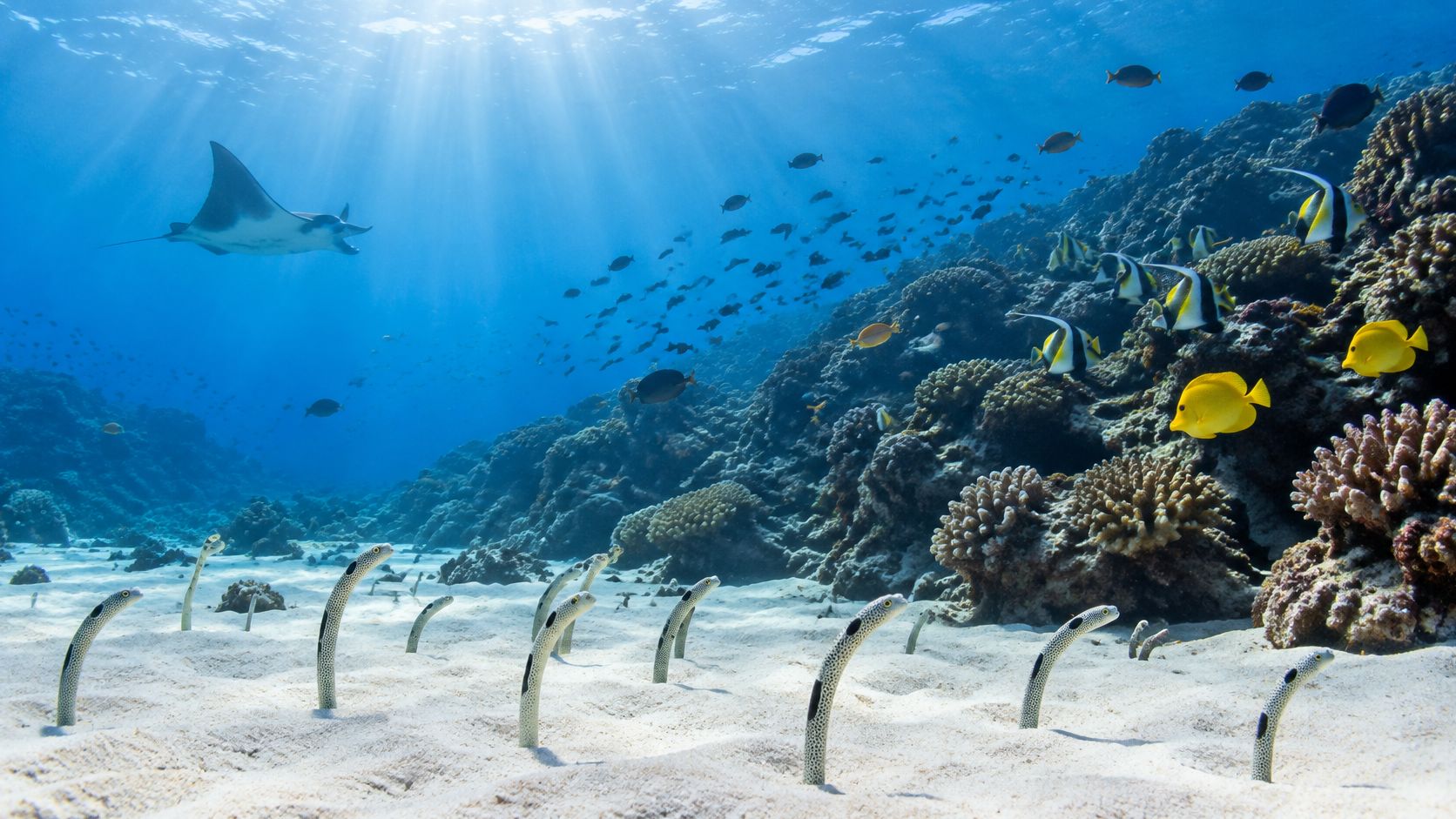
Garden Eel Cove for a manta night
For a manta dive, Garden Eel Cove is the stronger choice: its sheltered location and viewing area make it a good place to settle in, and its reef adds interest beyond the animals overhead. A University of Hawaiʻi study of community-sourced observations from 2010 through 2022 recorded more than 23,000 sightings of 167 identified reef manta rays at Garden Eel Cove and Keauhou. The study found that Garden Eel Cove generally supported larger aggregations than Keauhou, about 20 kilometers away, as documented in the University of Hawaiʻi manta study.
The lights concentrate zooplankton, the mantas come to feed, and the number of animals can change with prey density, current, and light placement. That's why a responsible operator can explain the feeding setup but shouldn't promise a fixed count. Treat the illuminated area as a feeding corridor, not a stage where animals owe you a close pass.
Stay low and still, keep at least 3 meters (10 feet) away, approach from the side, and never touch, chase, or block a manta's path to the light. Crowding can affect the experience for people and animals: in a Hawaiʻi County survey of 444 participants, 82% felt crowded by snorkelers, 78% by boats, and 69% by scuba divers, according to the Hawaiʻi County manta-viewing document. Short-term behavioral disturbance is a real concern, while long-term population effects remain uncertain.
Keep your position predictable. The best view is not worth taking away an animal's room to feed and turn.
Other reasons to get on a boat
A morning reef charter suits divers looking for lava arches and coral gardens. Advanced divers can choose remote pinnacles and deeper profiles, while a blackwater trip drifts offshore over deep water in search of larval and pelagic animals. Those are different experiences, not interchangeable ways to see the same reef.
For a shore-based contrast, the Old Kona Airport Marine Life Conservation District protects a stretch of coast where commercial operations may require permits. Its rules prohibit taking marine life, anchoring, and feeding aquatic organisms, as explained by the Hawaiʻi Division of Aquatic Resources district rules and district access information. Keep the reef untouched and follow the local rules. For more on low-impact underwater behavior, read our guide to responsible and considerate diver etiquette.
Choose an Operator by Safety, Gear and Nitrox
A polished boat and a big list of sites don't tell you how a crew handles a problem. Before paying, ask questions that reveal the operation of the dive, not just the sales pitch.
- Guiding: Ask about the guide-to-guest ratio and whether a divemaster stays in the water with newer divers.
- Surface support: Find out who tracks divers from the boat and what the crew does if a team drifts away from the planned area.
- Equipment: Confirm how rental gear is fitted at check-in. If you need a dive computer or a particular exposure suit, mention it when booking. We size divers for rental gear at check-in, and dive computers can be requested in advance, with availability and any small extra cost confirmed at that time.
- Nitrox: Ask whether it's offered, whether you need certification, and whether it's included in the trip.
- Briefings and reviews: Read recent reviews for clear safety briefings and practical crew communication, not just a star rating.
A useful briefing covers the entry and exit, site conditions, buddy procedures, and what to do if separated. Red flags include no plan for the diver-down flag, no clear entry-and-exit briefing, or pressure to dive when conditions don't suit the group. A review widget is a starting point, not proof of safe practice; check current details directly and confirm any package or discount when booking.
What to Bring on a Kona Boat Day
Pack the night before so the morning check-in stays simple.
- Certification card: Bring your C-card. Most of our regular charters require at least Open Water certification from a recognized agency, such as PADI, SSI, or NAUI, for diving to 60 feet (18 meters) with a buddy.
- Sun protection: Apply reef-safe sunscreen before gearing up, so you're not trying to rub it in with wet hands.
- Comfort items: Bring a towel and a warm layer for the ride home.
- Personal fit: Pack a prescription mask if you need one. Tell the shop when booking if you need a computer, exposure suit, or specialty fit.
- Insurance: Bring proof of dive insurance if you have it. We strongly recommend dive insurance.
- Night gear: Bring a personal light with fresh batteries and a backup, even when the site itself is illuminated.
Follow the boat-day order
Expect to arrive, set up your gear, and listen to a briefing on site conditions and entry style. The first dive is usually at the deeper or more condition-sensitive site. After a surface interval, the second dive is typically more relaxed. This order gives the crew room to match the plan to the conditions and the group.
Seasickness can spoil the ride before you even reach the dive site. If you're prone to it, take your usual remedy before boarding, stay where you can feel the breeze, and look at the horizon. These practical tips for avoiding seasickness on a boat can help you plan ahead.
Snorkelers and ride-alongs can join some trips, but say so when booking so the crew can plan the group correctly. The three dock delays that are easiest to avoid are a forgotten certification card, arriving late, and an unstated snorkeler in the party.
Frequently Asked Questions
Do I need a card for a Big Island boat dive?
Not for a morning introductory dive with an instructor. You do need certification for regular two-tank charters.
Can snorkelers join a manta night?
Yes, if the trip accepts snorkelers. Book them as snorkelers and say they're coming when you reserve.
Is a blackwater night dive good for a new diver?
It's a poor first dive back after a long break. Get comfortable again on a shallow reef dive before choosing a demanding night dive.
Do I need nitrox?
No. It's optional, but trained divers may find it useful on repetitive reef days in the 60-to-100-foot band.
What should I do about seasickness?
Take your usual remedy before boarding, stay in the breeze, and look at the horizon.
When should I book?
Confirm availability when you're ready to commit. Don't assume an unverified lead time; check the dates and trip details directly at booking.
Book the Trip You Chose
Once you've settled on a trip, make the booking match the group you're bringing. Say whether snorkelers are coming, whether you need a dive computer or exposure suit, and whether nitrox is included for your plan. Clear details up front make it easier for the crew to prepare the right equipment and set expectations.
The Kona Honu Divers menu includes morning reef dives, advanced trips, manta and blackwater nights, and introductory scuba dives. It also offers early diver discounts, dive packages, and free nitrox. Confirm the details that matter to your trip when you book rather than assuming a particular feature is included.
Check the marine forecast the morning of the dive and postpone if the go or no-go table says the entry is wrong.
Choose from Kona Honu Divers' morning reef, advanced, manta, blackwater, and introductory trips to match your certification and the day's conditions. Visit Kona Honu Divers to select your dive and book a trip that fits your crew.