
Table of Contents
- Why the bay beats a drift hunt
- Where you stay and where the light points
- What the county assessment actually found
- Pack before you think about the animals
- Booking tips that save the trip
You have the tab open, the dates circled, and one question sitting between you and the checkout button. Will a manta ray night dive Kona night put a giant ray in front of you, or will you spend the evening staring at a dark circle of water while boats shuffle around overhead?
That question is the right one. The animals are the reason people book. The boat, the lights, and the way the group is set up decide whether the night feels calm or chaotic. Certification, comfort in open water, and how close you want to be should pick the trip, not a brochure photo.
A quiet night is still a real outcome. Plankton moves, currents shift, and the rays follow food rather than a schedule. What you can control is the site, the operator's rules, and whether you dive or stay on the surface.
Manta Ray Night Dive Options Compared
The manta ray night dive is Kona's most popular dive, and it lets divers see manta rays dance just inches away. It is not the only way into the water. Match the option to who is going, then stop second-guessing.
| Option | Best for | In the water | Requirement |
|---|---|---|---|
| Manta Ray Night Dive | Certified divers wanting the closest view | Kneel on the sandy bottom under the lights | Certified diver |
| Manta Ray Night Snorkel | Non-divers and families | Float at the surface and watch from above | Comfortable snorkeling in open water |
| 2-Tank Manta Dive and Snorkel | Divers wanting a second tank | Morning dive plus manta encounter | Certified diver |
Who should pick which
- First-timers who are not certified: Take the Manta Ray Night Snorkel. You stay at the surface and still see the feeding pass.
- Certified divers who want the closest view: Kneel under the lights. The Manta Ray Night Dive and the 2-Tank Morning Dive are open to all certified divers.
- Families with mixed comfort: Split the boat. Divers go to the bottom, snorkelers stay up. If you are still choosing, this snorkel or dive comparison walks through the trade-off.
- Experienced divers who want a longer trip: After the manta night, the premium advanced two-tank trip is the next step, not a substitute for the night itself. Daytime scuba diving tours cover the rest of the coast.
Decision rule: pick the dive if you are certified and want the closest view. Pick the snorkel if you are not.
The Manta Ray Night Snorkel tour lets guests experience the manta rays from the surface, which is the right booking if nobody in the group holds a card.
Why Garden Eel Cove Is the Best Viewing Site
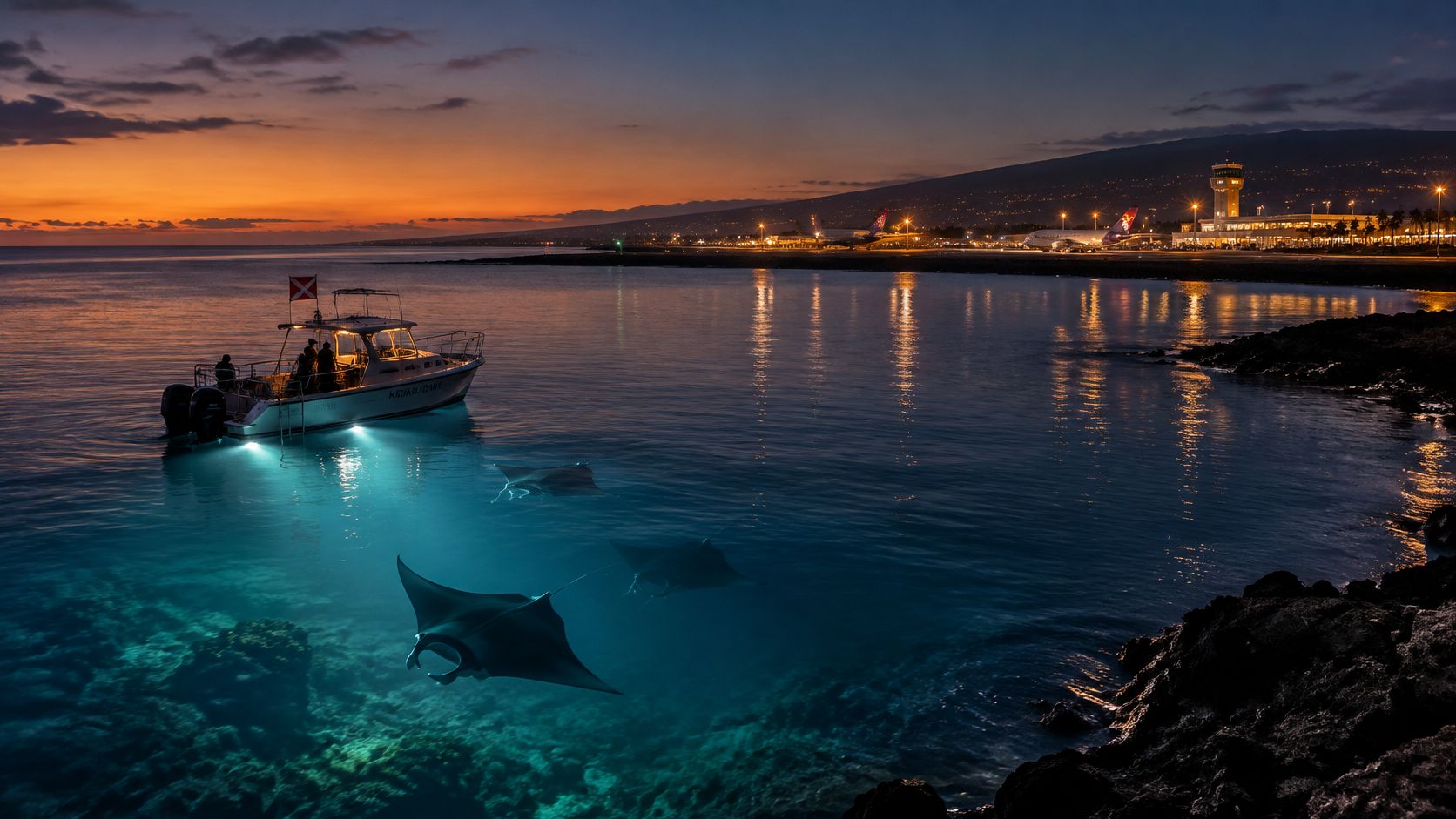
Garden Eel Cove is the site I would book for this dive. It is a protected bay with a defined viewing area, a healthier reef to kneel beside, and generally calmer conditions than an open stretch of coast.
Garden Eel Cove is the local name for Makako Bay, immediately west of Kona International Airport and the Natural Energy Laboratory campus. Hawaii's Department of Land and Natural Resources identifies Makako Bay/Garden Eel Cove and Keauhou Bay as the two primary sites where nighttime manta-viewing activity is concentrated, because mantas gather there to feed on plankton. Kona Honu Divers' go-to site for the Manta Ray Night Dive is Garden Eel Cove.
Why the bay beats a drift hunt
A bay gives the crew a fixed patch of bottom. Divers can settle near reef and sand while the open column above stays clear for the rays. Surface viewers have a boundary they can see. On a generic open-water site, the boat hunts, the group drifts, and the "viewing area" is wherever the current stops. That wastes bottom time and makes buddy contact harder after dark.
The reef is not scenery. A healthier bottom gives you something solid to kneel near without planting yourself on living coral. The rays glide through the lit water above that line. You are not chasing them across a featureless slope.
Practical rule: ask which bay the boat uses, and pick a tour that runs from Garden Eel Cove. A stable setup beats a captain who promises to "find the mantas" after you leave the harbor.
A good night here looks ordinary until the animals arrive. The light circle holds. A line of rays comes in from the dark. Your position on the bottom does not slide. Sightings are not guaranteed. The site only removes the avoidable mess of a moving, undefined drop.
Logistics Timing and Meeting Points
Boats leave before sunset. Viewing continues after dark, and you are back late. Departure time and meeting point are set per trip, so confirm both when you book. Do not assume the harbor you used on a daytime charter.
Ask for four things in writing:
- Meeting address: the exact dock or lot, not a neighborhood name.
- Check-in time: how many minutes before the boat leaves.
- Return time: so a ride is waiting and you are not driving tired.
- Launch type: harbor or another ramp, plus which bay the boat uses that night.
Garden Eel Cove sits on the airport side of town. If your hotel is in Kailua-Kona or farther south, build in the drive both ways. A simple timeline works: arrive early, check in, board before sunset, enter after dark, return late. Put the meeting point and the return time on your calendar the day you book.
Night air on the water is cooler than the afternoon you spent on the beach. A light layer for the ride back matters more than another souvenir shirt. If the motion of a boat at anchor bothers you, sort that before you board. Start with how to avoid sea sickness, and pack a Ship-EEZ patch, Dramamine, Bonine, Sea-Band wristbands, or ginger chews. Take anything medicated before you feel queasy, not after.
How the Night Unfolds From Boarding to Water
The night is a sequence, not a free swim. Each step has one job.
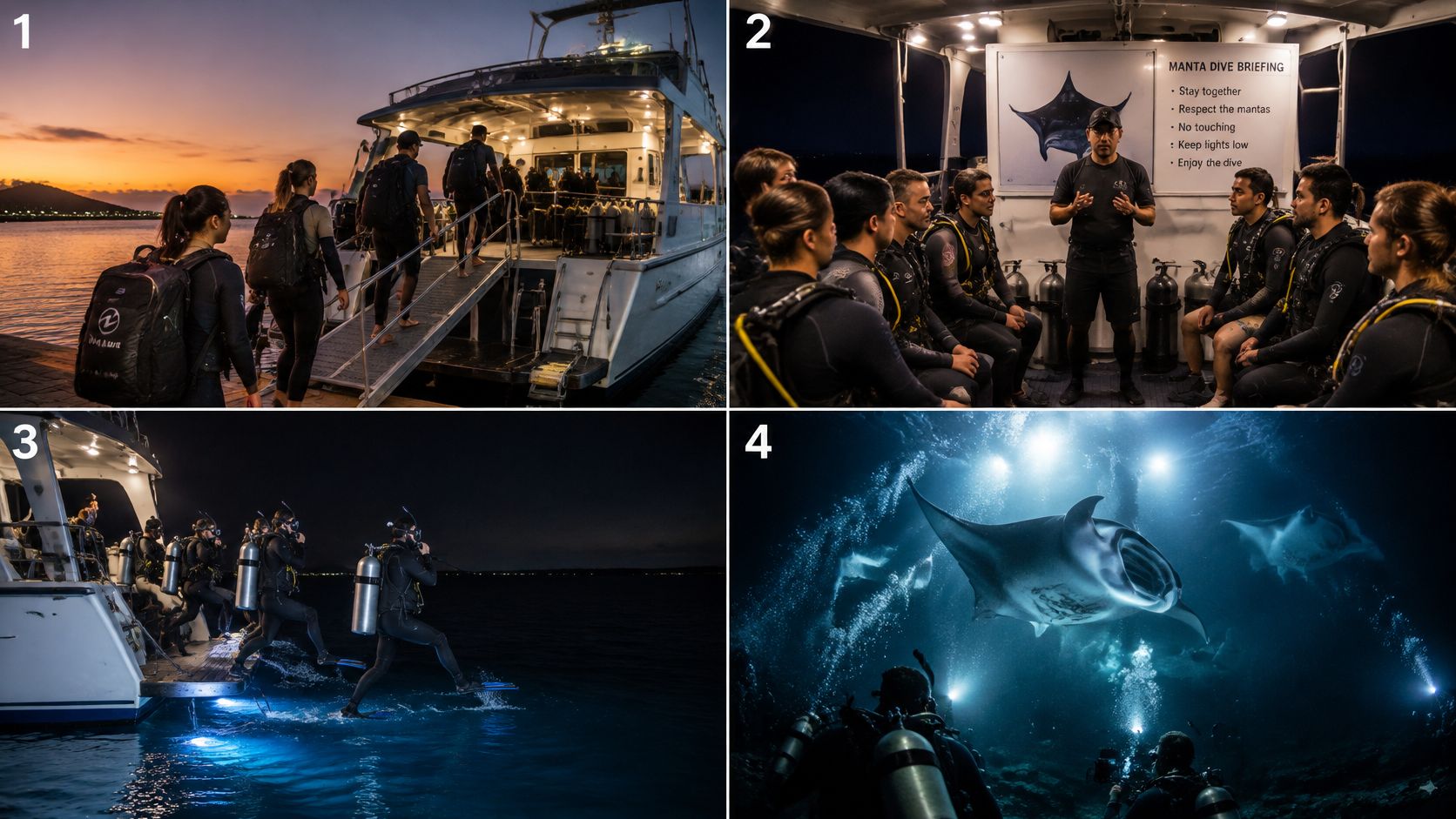
- Board before sunset. You want weights, buddy, and a seat sorted while you can still see the deck. Doing that in the dark is how masks and lights get left in the wrong bin.
- Sit through the briefing. The manta ray night dive experience starts with a detailed briefing from the crew explaining science behind the dive and the golden rules of passive observation. This is the moment to ask how the group will enter and where you will kneel.
- Gear up and buddy-check. Dark water makes separation the main risk. Confirm air, light, and a signal you can see from a few feet away.
- Enter as a group behind the guides. Experienced divemasters and instructors are in the water to manage the group and point to the spot. Do not drop in early and swim toward the first glow you see.
- Wait while the crew sets the seafloor lights. On the Manta Ray Night Dive, the crew places a powerful set of lights on the seafloor to attract plankton and manta rays. The bright circle is the stage. You do not build your own.
- Take your role and hold it. Kona's recreational wildlife-interaction guidance says divers remain on or near the sand, rubble, or boulder bottom in a semicircle, leaving an open water column. Divers hold lights above their heads and shine them upward. Snorkelers stay at the surface and shine lights downward. Divers kneel on the sandy bottom. Snorkelers float on the surface.
- Surface and return with the group. A head count on the ladder matters more than one last pass. Nobody climbs until the guide calls it.
Where you stay and where the light points
| Role | Where you stay | Light direction | Key rule |
|---|---|---|---|
| Divers | On or near the sand, rubble or boulder bottom in a semicircle | Above the head, shining upward | Never touch, chase, grab or ride mantas |
| Snorkelers | At the surface | Downward | Never touch, chase, grab or ride mantas |
| Guides | In the water with the group | A hand light that marks the group | Direct group position and keep everyone together |
The same guidance says participants must not touch, chase, grab, or ride manta rays, because contact can remove their protective mucus coating. That rule does not bend for a closer photo.
Before you settle, check three things. Are you on the bottom or at the surface, is your light aimed the right way, and are you still?
Safety Rules for Boats Lights and Dark Water
People worry about the rays. The rays are filter feeders with no reason to charge a diver who stays put. The hazards that injure people on these nights are boats, poor lighting, and dark water full of bodies that are hard to see.
Hawaii's manta-ray viewing rules define "manta ray viewing hours" as 4:00 p.m. through 4:00 a.m. the following day. Commercial operations may conduct manta viewing only inside department-designated viewing zones or at least 7 nautical miles from a designated zone boundary, and vessels may not operate faster than slow-no-wake speed in the regulated context. Those limits exist because several boats share a small lit patch after sunset.
What the county assessment actually found
A Hawaii County safety assessment described boats passing within 10–20 feet of unlit snorkelers, and boats traveling over submerged divers. Congestion, not animal behavior, is the operational problem. Unlit snorkelers disappear. Divers under the hull are invisible from the helm if the lookout is casual.
Ask the operator, before you pay, how dive and snorkel zones are separated, who is on lookout, how a guest who loses the group is found, how you signal distress at night, and what wind or swell makes them delay or move. Considerate diver etiquette covers your half of that bargain once you are in.
Personal checks that change the night
- Wear a visible light so the tender and your buddy can find you.
- Keep your buddy in sight and stop if you cannot.
- Use flotation if you are the weaker swimmer in the pair.
- Climb the ladder once on the boat before you ever enter, so the return is not a surprise.
The Manta Ray Night Dive is stationary and closely supervised, with experienced guides keeping everyone safe and comfortable. That format is a safety control only if the boat also respects speed and space. Choose the operator who answers the questions above in plain language.
Why Some Nights Are Quiet and How to Photograph Mantas
A thin night is not proof the site is "off" or that the boat was crowded. Reef mantas follow food. When zooplankton is thick, more animals stack into the light. When it thins, fewer show, and the ones that do may circle once and leave.
A 13-year record of community observations found that aggregation size was positively associated with zooplankton density, and that Garden Eel Cove supported larger and more variable aggregations than Keauhou. Moonlight, current, and season move that density around. Kona Honu Divers' manta ray night dive has encounter rates as high as 92%. That is a high hit rate, not a promise for the Tuesday you picked.
The Manta Ray Night Dive shines underwater lights to attract plankton so divers can watch giant manta rays feed just inches away. The lights pull food up. The food pulls rays. They do not replace a dead plankton night.
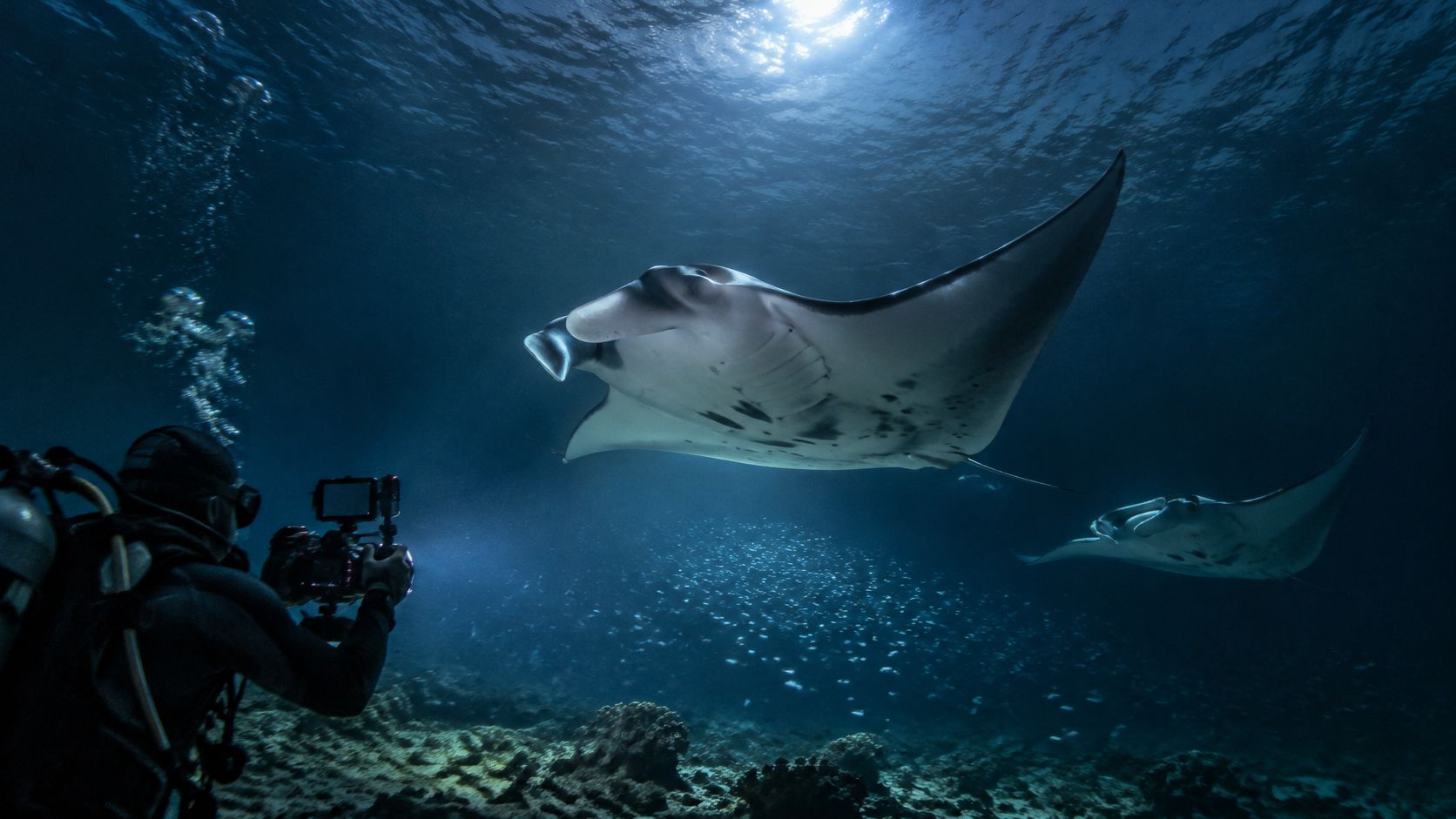
Giant manta rays on the Manta Ray Night Dive can have wingspans well over 12 feet, so a tight lens crops the animal into a gray blur.
- Use a wide-angle lens so the full wingspan fits when a ray passes overhead.
- Keep the camera steady and skip strobes that dazzle the animal or your neighbor.
- Frame from your bottom position looking up, inside the light circle, and wait for the entry rather than swimming after it.
- If you want the crew to handle the camera, book the manta night dive with a photo package instead of juggling a rig you have not used at night.
No frame is worth a touch or a chase. If the ray is gone, the shot is gone.
Common Questions From Recreational and Experienced Divers
Can I see mantas without diving? Yes. The night snorkel keeps you at the surface with a light pointed down. You give up the under-the-belly view. You do not need a certification card.
Do I need to be an advanced diver? No. The night dive is open to certified divers. Confirm your card level with the operator before you book, and read how deep the Kona manta ray dive runs so the profile is not a surprise. The skill that matters is staying still on the bottom, not collecting specialties.
Is there a longer option for experienced divers? Yes. The premium advanced long-range two-tank trip is the daytime step up when you want more range than a local reef. It does not replace the night encounter.
Is the PADI Manta Ray Diver course required? No. It is optional. The PADI Manta Ray Diver specialty course covers manta biology, behavior, and conservation, and teaches how to interact with manta rays respectfully before the Manta Ray Night Dive. Take it if you want the background. Skip it if you already understand the hands-off rule and your buoyancy is solid.
What if the mantas do not show? Aggregation changes with plankton and conditions. A quiet night is not a failed dive. Ask about a backup date and the operator's weather policy before you pay, not on the ride home.
Can I touch a manta? No. The hands-off rule applies to divers, snorkelers, and anyone holding a camera.
Book Your Night and Pack the Checklist
Pack before you think about the animals
- Certification card and logbook if you are diving. A photo on your phone is a backup, not a substitute if the crew asks to see the card.
- A small backup dive light. The boat lights run the show. Your light is how your buddy finds you.
- A warm layer for the ride back. The water feels mild. The wind on a wet rash guard does not.
- Towel and dry clothes in a bag that stays on the boat, not in the dive crate.
- Mask, fins, and snorkel that you have already tested. A new mask that leaks at night ruins the view more surely than a shy ray.
Booking tips that save the trip
Book early if your dates are fixed. Ask what happens if wind or swell cancels, and get a backup date while space still exists. Confirm departure time, the meeting address, and which bay the boat uses. Kona Honu Divers offers a 2-Tank Manta Dive & Snorkel tour and a 2-tank manta ray charter when you want a daytime tank before the night.
The 2-tank manta dive and snorkel page is where you lock the night. Pick the Manta Ray Night Dive if you are certified and want the closest view, or the snorkel if you are not. Book with an operator who will tell you how the boats, lights, and head counts work before you ever see a ray.
Kona Honu Divers runs the manta night from Garden Eel Cove, with a briefing, guides in the water, and a choice of dive or snorkel on the same kind of lit setup. If you want the closest view under the lights, or a surface spot for the people who are not certified, start with the trip that matches that split. Visit Kona Honu Divers and book the night while your dates are still open.