
You step onto the boat at sunset, still deciding whether the famous manta dive will feel magical or overly hyped. Then the crew starts briefing everyone on where to sit, how the lights work, and why divers stay still once they reach the bottom. That is usually the moment the trip starts to make sense. This is not a random wildlife search. It is a planned encounter built around a feeding pattern operators on the Kona Coast understand well.
That structure is a big reason manta ray diving in Hawaii has such a strong reputation among recreational divers. Along the Big Island, especially off Kona, the experience is known for consistency, clear procedures, and a format that works for both new night divers and experienced underwater photographers. If you want the wider context before narrowing in on mantas, this guide to Hawaii scuba diving on the Big Island helps explain where this dive fits.
A helpful way to picture it is a campfire that attracts people after dark. In the water, the light attracts plankton, and the plankton attracts manta rays. Divers are there to watch the feeding behavior, not to pursue the animals. That difference matters. It shapes everything from site choice to operator logistics to the etiquette that keeps the encounter calm for both mantas and guests.
Kona Honu Divers and other established Kona operators build their trips around that rhythm, which is why details such as departure timing, site selection, and sea conditions matter more than many first-time guests expect. Divers often focus on one question, “Will I see mantas?” A better starting question is, “Which setup gives me the safest, calmest, clearest view if conditions change?”
That is the approach to take through the rest of this guide. The goal is not only to help you book a manta dive, but to help you choose the right season, the right site, and the right habits in the water so the experience feels smooth, memorable, and respectful to the animals.
Introduction to Manta Ray Diving Hawaii
By late afternoon in Kona, the mood on the boat starts to shift. Tanks are secured, cameras get one last check, and first-time guests usually ask the same question in different ways. Will this feel like a hard night dive, or more like sitting down in the right seat before the show starts?
In Hawaii, and especially off Kona, manta ray diving is known for being organized rather than random. Operators set up lights, divers stay in a defined viewing area, and the mantas come in to feed on plankton drawn into that light. For recreational divers, that structure is a big part of the appeal. It lowers the guesswork and makes the experience easier to follow, even if you have limited night diving experience. If you want the wider setting first, this guide to Hawaii scuba diving on the Big Island shows how the manta dive fits into the broader Kona diving experience.
Why this dive feels so different from other wildlife dives
A manta night dive works a bit like arriving at an outdoor theater after the lights are already on. The audience has a designated place to sit. The stage is set before the main event begins. Your job is not to chase the performers. Your job is to stay settled and watch the action come to you.
That is why Kona has such a strong reputation among divers. The draw is not only the animals themselves. It is the repeatable format. Local operators such as Kona Honu Divers build their logistics around that format, including departure timing, site choice, and briefings that prepare guests for what they will do underwater. Those details sound minor on land, but they shape how calm the dive feels once you descend into the dark.
The other point that surprises many visitors is depth.
What first-time manta divers often get wrong
Divers sometimes assume a better encounter means deeper water, more swimming, or a longer boat ride offshore. In practice, the opposite is often true. Good manta viewing usually comes from a controlled setup, steady light, and disciplined diver positioning.
That makes the dive easier to understand if you picture it in steps. You enter the water. You descend to the viewing area. You settle in place near the lights. Then you wait while plankton gathers and mantas sweep overhead in smooth passes. The excitement comes from behavior unfolding above you, not from covering ground.
That difference matters for more than comfort. It also affects conservation. Divers who treat the experience like a hunt tend to move too much, reach toward the animals, or drift out of position. Divers who understand the setup usually have a better view and create less disturbance.
This is also where site selection and season start to matter in practical ways. A shorter run, calmer entry, or better protection from swell can change the whole tone of the evening, especially for newer divers, underwater photographers, and anyone trying to avoid seasickness before the sun goes down.
Choosing the Best Site and Season for a Manta Dive
Two sites dominate the conversation on the Big Island. Manta Village sits south of Kailua-Kona near Keauhou Bay. Manta Heaven at Garden Eel Cove sits north of town near the airport. Both can produce excellent encounters, but they don't serve the exact same diver equally.
If you're timing a trip, this guide to when to dive with manta rays in Kona is a useful planning companion. The broad pattern is simple. You can dive year-round, and May through September are noted by PADI as peak months, with May called out for especially good Big Island diving conditions in this Kailua-Kona manta night dive overview.
Why Garden Eel Cove often wins for divers
For scuba diving, Garden Eel Cove gets the nod more often because of its protected bay location, better viewing area, and healthier surrounding reefs. The same source notes 85% to 90% success rates there and sightings of up to 23 mantas per session, while Manta Village is commonly described as seeing 5 to 10 mantas per dive in comparison at Kona Honu Divers' Garden Eel Cove site guide.
That doesn't make Manta Village a bad choice. It often appeals to first-time visitors because it's closer to Keauhou Bay and can mean a shorter run from that side. But if you care most about the underwater layout and the chance of a bigger amphitheater effect, Garden Eel Cove is the stronger pick.
Manta Dive Sites Comparison
| Site | Depth | Average Mantas | Success Rate | Accessibility |
|---|---|---|---|---|
| Manta Village | 30 to 40 feet | 5 to 10 mantas per dive | Qualitatively strong year-round | Closer to Keauhou Bay |
| Manta Heaven at Garden Eel Cove | About 35 feet | Up to 23 per session | 85% to 90% | Near the airport, protected bay |
Garden Eel Cove tends to suit divers who want the more protected layout and stronger viewing geometry, not just a convenient departure.
Season matters, but less than people think
New visitors often ask for the single “best month.” The better question is whether you want a seasonal edge in overall diving conditions or whether your travel dates are fixed. Kona's manta experience is notable because it stays viable year-round. In other words, don't cancel the idea just because you're not traveling in summer.
Experiencing the Nighttime Manta Ray Show
You back-roll into dark water, look up, and the boat lights glow above you like a porch light at night. A few minutes later, you are settled on the sand, breathing slowly, waiting for a shadow to turn into a manta.
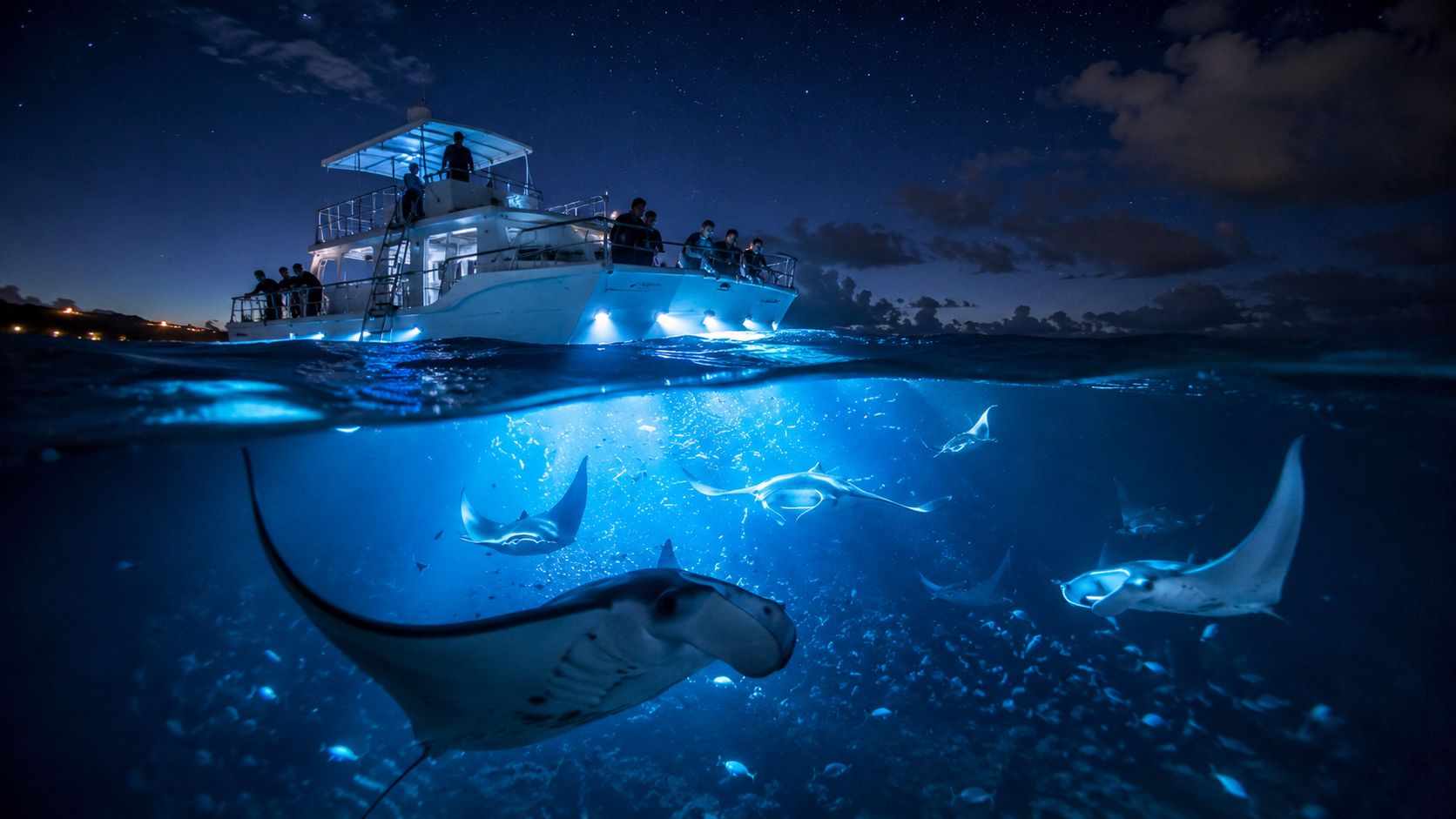
If you have only seen mantas from the surface, the biggest change is your role. You are no longer looking down and trying to follow the action. You become part of a fixed viewing area on the bottom while the animals pass overhead. That difference is one reason the manta ray night swim experience feels so different from the scuba version.
What the underwater setup actually looks like
The setting is usually a shallow sandy patch beside reef structure, not a fast-moving drift or a long swim. Kona Honu Divers and other local operators generally brief divers to descend, settle into a designated area, and keep their lights aimed as instructed. The goal is simple. Light attracts plankton, and plankton attracts mantas.
A campfire is a useful comparison. The lights create the bright center. Divers form the outer ring. The mantas circle through that illuminated water column, sometimes gliding in smooth loops, sometimes banking sharply as they feed.
That layout explains why experienced local crews care so much about positioning. The show works best when everyone stays low, keeps fins quiet, and avoids rising into the mantas' path. Recreational divers sometimes expect to swim around to get a better view, but this dive rewards patience more than pursuit.
What it feels like in the moment
The first pass can be disorienting in the best way. A dark shape appears at the edge of the beam, then the white underside catches the light and the whole animal seems to widen over your head. Even if you already know manta rays are large, size underwater is hard to judge until one turns above you.
Then your breathing usually slows.
A strong manta dive has a rhythm to it. You descend, get settled, and stop fussing with gear. After that, the scene often improves because your attention widens. Instead of staring at one animal, you start noticing the traffic pattern above the group, the way one manta peels off as another enters, and how small movements from divers can change the feel of the whole circle.
A few practical points help:
- On descent: Get down calmly and settle where the guide places the group.
- Once on the bottom: Keep your body compact so you do not kick up sand or block the viewing lane.
- During close passes: Hold position and resist the urge to reach upward, even if a manta comes surprisingly near.
- As you ascend at the end: Expect the boat lights and surface activity to feel brighter after time in the dark.
One insider tip recreational divers often miss is that logistics shape the experience as much as marine life does. A shorter, simpler entry and a clear bottom setup often make first impressions better than a site that sounds famous on paper. That is one reason local operator briefings matter so much on this dive. Good crews are not just taking you to a manta site. They are arranging the underwater "theater" so the viewing lanes stay clear and the animals keep returning naturally.
The divers who enjoy this most are usually the ones who treat it like front-row seats, not a chase.
Meeting Certification Requirements and Easing Seasickness
Excitement needs a practical check. A manta night dive is still a scuba dive, still at night, and still much more enjoyable when you arrive current, comfortable, and honest about your skill level.
For motion-sensitive divers, do some prep before departure. The boat ride and surface interval can be the hardest part for some people, and these sea sickness prevention tips are worth reading in advance.
What certification level makes sense
Most certified recreational divers can do this dive if they're comfortable at night, can control buoyancy well, and can follow positioning instructions. If you haven't dived recently, a refresher is a smart move. If night diving makes you uneasy, it's better to say so before boarding than to force it.
Advanced certification can help with confidence, but the key issue isn't card level alone. It's whether you can descend calmly, settle on the sandy bottom without stirring things up, and remain stable while the mantas feed above you.
For divers seeking more demanding local options beyond the manta dive, this advanced long-range dive tour page is a useful reference.
Seasickness tools worth considering
If you know you're prone to nausea, prevention beats recovery.
- Patch option: Ship-EEZ Seasickness Patch
- Classic tablet: Dramamine pills
- Another common pill choice: Bonine pills
- Drug-free approach: Sea Band wristbands
- Simple natural backup: Ginger chews
Small comfort choices that make a big difference
Bring dry clothes for after the dive. Eat lightly before departure, but don't board on an empty stomach if that makes you feel worse. If you're using medication, test it on land before your vacation so you know whether it makes you drowsy.
Some divers focus so much on mantas that they forget the goal is to feel good enough to enjoy the actual encounter.
Picking Gear and Manta Photography Essentials
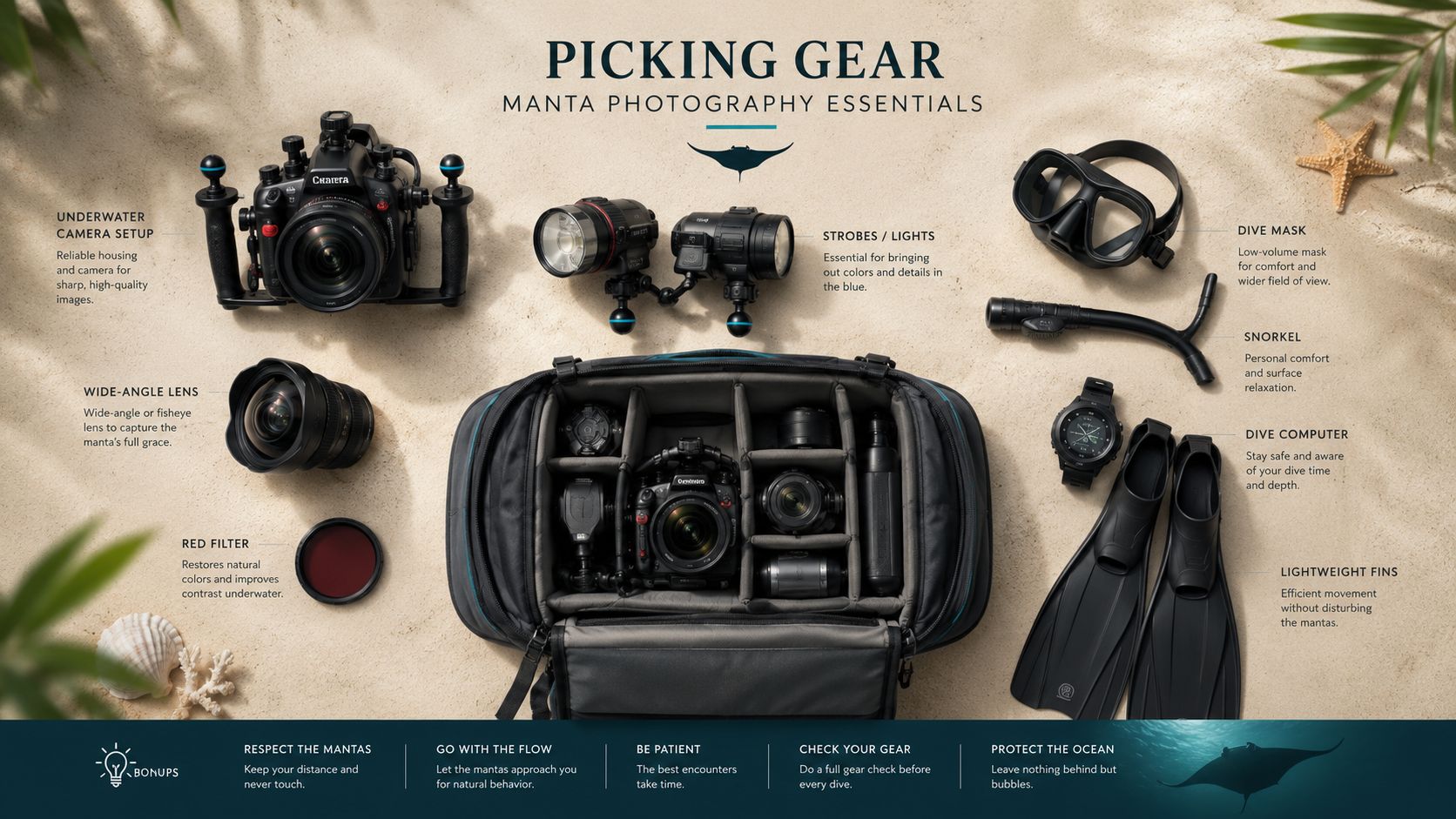
Night diving punishes sloppy gear choices. If your mask leaks, your light is weak, or your camera setup is too fiddly, the problems feel bigger in the dark. Keep your kit simple and predictable.
Build your setup around stillness
For manta ray diving in Hawaii, the best gear is the gear that helps you stay motionless.
- Mask: Choose one with a wide field of view. You'll spend much of the dive looking up.
- Fins: Shorter, controlled kicks are better than powerful fluttering. You want precision, not speed.
- Primary light: Bright enough to hold a steady upward beam. The light is part of the feeding setup, not just your personal flashlight.
- Exposure protection: Wear what keeps you warm enough to remain relaxed through the full encounter.
- Camera rig: Smaller is usually better than complicated.
One practical option for rentals and guided logistics is Kona Honu Divers' diving tours page, especially if you'd rather not travel with a full gear bag.
Camera choices that work better than people expect
Wide-angle framing beats tight framing almost every time. Mantas move in arcs, and a cropped shot often cuts off the very thing that makes the image dramatic.
Good starting principles:
- Shoot wide. Include the light field when possible.
- Reduce hand movement. Constantly chasing composition makes you less stable.
- Prioritize passes over portraits. The shape of the movement often matters more than a close facial view.
Photo note: If you can't hold your camera steady without shifting on the bottom, put the camera away for a minute and reset your body position first.
The common gear mistake
Divers often overpack for this dive. They bring extra accessories, multiple lights, or bulky camera arms that make it harder to settle into position. Underwater, less clutter usually means better awareness.
Preparing Families and First Time Divers
A common family scenario in Kona goes like this. One person is excited to dive with mantas, one is certified but rusty, and one would rather stay near the surface than descend at night. That group can still plan a good manta outing, but only if each person chooses the version of the experience that fits their comfort level.
For families, the key question is not who is brave enough. It is who will feel calm and capable once the sun goes down and the boat ride is over. Certified divers who are comfortable in the water may enjoy the dive. Relatives who are not certified, or who dislike the idea of a night descent, often enjoy the snorkel option more because they can still watch mantas gather in the light without the added task load of scuba.
First-time divers and younger certified divers usually do best when the evening feels predictable. Night diving can sound intimidating because it removes familiar reference points. A good briefing fixes much of that. It gives beginners a mental map before they ever enter the water, much like walking through the seating plan before a live show starts.
What helps most is simple preparation:
- Clear expectations before boarding. Families should know who is diving, who is snorkeling, and what each version requires.
- A familiar gear setup. First-timers are calmer when nothing new is clipped on at the last minute.
- A slow, deliberate buddy check. Rushing on the boat often creates the stress that people later blame on the night dive itself.
- An honest comfort check. A rusty diver who speaks up early usually has a better experience than one who stays quiet and hopes it will feel fine underwater.
Mixed groups often do well on manta nights for a practical reason. This is not a reef tour where everyone has to swim a route, manage changing depth, and keep up with a guide. Once divers are settled, the experience becomes more like attending a performance from a designated seat. That structure can be reassuring for beginners.
It also helps to choose the right night, not just the right operator. Families with first-time or anxious divers usually have an easier time during calmer seasonal windows and at sites known for more predictable entries and shorter, simpler logistics from harbor to water. Kona Honu Divers is often part of that planning conversation because boat flow, briefing style, and how the crew separates divers from snorkelers can matter as much as the underwater encounter itself.
One more point gets overlooked. The best novice on a manta dive is often the person who listens well and stays still, not the person with the most logged dives. Calm attention beats restless experience here.
Embracing Conservation and Manta Etiquette
Many divers think good manta etiquette means one rule. Don't touch the animal. That rule matters, but it's only the start.
The bigger issue is whether your body position disrupts the feeding setup. According to Kona Honu Divers' manta etiquette guidance, expert protocol calls for static trim on the sandy seafloor, fins tucked in, and lights pointed vertically upward. Touching is prohibited because it can remove the manta's protective mucus layer, increasing infection risk and changing natural behavior.
The behavior that protects the encounter
Here, cause and effect matters.
If divers scull, kneel heavily, or lift off the bottom, they create turbidity. That scattered sediment interferes with plankton concentration and can disrupt how mantas use the light field. If divers stay still, the feeding column holds together longer.
That's why etiquette isn't just about being polite to wildlife. It directly shapes what happens next.
Do this and don't do that
- Do settle before the show begins. Neutral buoyancy first, then stillness.
- Do keep fins tucked in. Long lazy fin movements can stir the bottom.
- Do point lights upward. The beam should support the feeding zone.
- Don't aim lights at the mantas. That changes the visual environment they're feeding in.
- Don't reach out. Even a gentle touch is not harmless here.
Your reward for restraint is often a longer, calmer encounter.
The best divers on a manta night dive are often the least noticeable ones.
Booking Your Manta Dive with Kona Honu Divers
If you already know you want the scuba version, booking early makes the rest of the planning easier. You can compare departure timing, gear needs, and whether you want to pair the manta dive with other Big Island dives during the same trip.
For direct trip details, contact the team here. If you're ready to look at the specific manta trip itself, the manta ray dive tour page is the practical place to start.
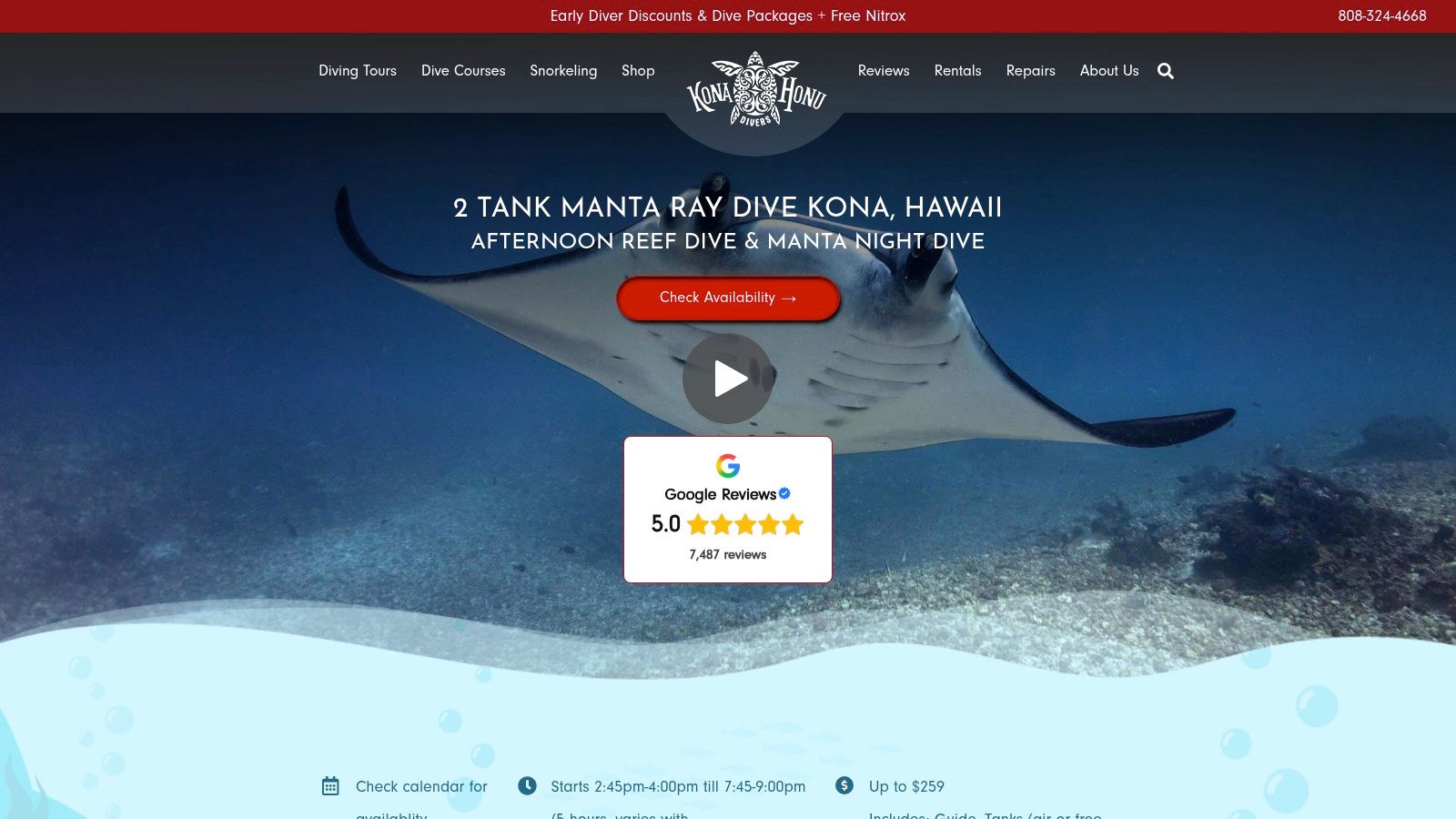
If manta ray diving in Hawaii has been sitting on your bucket list, Kona Honu Divers is a straightforward place to turn interest into an actual plan. Review the trip details, check dates, and reserve early so your Kona evenings are set before the rest of your itinerary fills up.