
You're staring at a booking page, about to commit to one of Hawaii's most famous underwater experiences, and you're not quite sure what you're signing up for. Will you see a manta? Do you need to be a certified diver? Is it dangerous? These are the right questions, and most manta dive content answers them too softly. I'll give you the version I'd give a diver on the boat: specific, honest about what variables control the night, and firm on the rules that keep both the animals and the people in the water safe.
A Kona manta ray dive is passive wildlife observation, not a staged show. The mantas come because plankton gather in the lights, and plankton density shifts with currents, tides, and the season. When it works, a 12-foot animal loops inches above your head while you kneel motionless on the sand. When it doesn't, you spend an hour watching empty blue water and learning why the ocean doesn't run on schedules. Both outcomes are part of the product.
This guide covers your three viewing options, what certification each requires, why one specific site beats the alternative, how the night unfolds step by step, and what you need to bring. I'll also explain why the biggest risk on a manta dive isn't the manta.
Manta Ray Options Compared and Night Versus Day
You can see mantas in Kona three main ways: the guided night scuba dive, the night snorkel, and the two-tank daytime manta charter. Each suits a different person, and choosing the wrong one is the most common mistake first-timers make. Here's the lookup table, then I'll answer the timing question directly.
| Option | Who It Suits | Certification Needed | Where You Watch From |
|---|---|---|---|
| Manta Ray Night Dive | Certified divers and beginners wanting a close, stationary view | Scuba certification, guided by the crew | Kneeling on sand in the lit viewing area |
| Manta Ray Night Snorkel | Snorkelers and non-divers who want the experience from the surface | None beyond swimming comfort | Floating on the surface, lights pointed down |
| 2-Tank Manta Charter | Certified divers wanting a daytime manta trip with a second dive | Open Water Certification or higher, dived in the past 2 years | Underwater in the daytime viewing area |
Night is when mantas feed near Kona's lights because zooplankton concentrate in the artificial glow after sunset. Daytime sightings depend on passing animals and current conditions, which is why the night dive is the flagship format and why daytime sightings are more hit or miss. A manta might cruise through a daytime reef site, but it isn't responding to a food source the way it is at night.
So which should you pick?
- First-time ocean participant or nervous swimmer: Choose the night snorkel. You float on the surface, hold a lit board, and never have to equalize or manage a tank in the dark.
- Certified diver with recent experience: Choose the night manta dive. You kneel on the sand at eye level with the animals and stay in a supervised, stationary format.
- Family with a non-diver and a certified diver: Split the group. The non-diver takes the snorkel while the certified diver takes the night dive, then compare notes on the boat ride back.
If you want the full Kona Honu Divers diving tours lineup, the manta night options sit alongside reef dives, advanced trips, and blackwater nights. For certified divers who want a deeper, stranger night experience, the Black Water Night Dive hangs a light line in deep pelagic water to attract larval fish, squid, and other blackwater drifters, no reef and no bottom in sight. It's a completely different animal than the manta dive.
The decision rule, plain and simple: pick the option that matches your certification and your comfort in dark water. A certified diver who's nervous about night conditions should take the snorkel first, no shame in that. A strong swimmer with Open Water Certification and a recent dive in the logbook should take the scuba option and stay on the bottom. I'd rather you have a calm, controlled encounter than a "better" format that pushes your comfort level too far.
For a deeper comparison of the two main formats, see this breakdown of snorkeling versus diving with manta rays.
Certification, Safety and Who Can Join
Certification decides the format. Sea state decides whether you should get in at all. Check your case before you book, not on the boat.
| Case | Requirement | Notes |
|---|---|---|
| Snorkeler on the night manta snorkel | No certification needed | Float on the surface and shine lights downward |
| Certified diver on the 2-tank manta charter | Open Water Certification or higher, dived in the past 2 years | Ask about a refresher dive if you have been out of the water longer |
| Night manta dive, scuba | Scuba certification and comfort in dark water | Guided, stationary format with buddy contact throughout |
| Non-diver in a mixed group | No certification needed for the snorkel | Confirm the snorkel format, flotation and supervision with the operator before booking |
Manta rays have no stinger, and they generally do not attack people. Worry less about the animal and more about what sends people home early: darkness, boat traffic, separation, entanglement, and crowd density. A Hawaii boating-safety assessment documented nights with more than 290 people in the water at manta-viewing sites and warned that high vessel and participant numbers increase the likelihood of severe accidents, according to the state's Manta Ray Viewing Boating Operations and Safety Assessment.
What actually matters at night: Manta rays are rarely the primary safety threat. Human logistics and nighttime operating conditions matter more.
The risk controls are straightforward:
- Stay with your buddy and the guide at all times. Separation in the dark is the fastest way to turn a good dive into a search.
- Use surface markers and lights. Lights are not only for seeing mantas. The boat crew uses them to track where you are.
- Manage equalization and buoyancy near the light board. Kneel slowly, equalize early, and avoid bouncing off the sand when a manta passes.
- Enter and exit as the crew instructs in the dark. Night deck routines differ from daytime ones, and that sequence exists for a reason.
Skip the dive for strong current, rough seas, fatigue, or anxiety. One bad night can sour you on the whole activity. I would rather you stay on the boat than push conditions that make you unsafe.
Kona Honu Divers caps the Manta Dive at 18 divers. That limit does not control how many other boats share the site. Ask, before you pay, how many boats are expected that night. If your last dive sits outside the two-year window, treat the open water certification course as the review that puts you back inside the charter requirement, not as optional reading.
Why Garden Eel Cove Is the Best Manta Dive Site
Most manta dive content treats the site as an afterthought. It's not. The site shapes the entire experience, and on Kona, Garden Eel Cove is the superior choice for a manta ray dive for reasons you can feel in the water, not just read in a sighting table.
Start with the protected location. Garden Eel Cove is sheltered from the open-ocean exposure of the alternative site, which gives calmer conditions that suit first-timers and photographers. You aren't fighting a swell while you try to hold position. Then there's the viewing area itself: a defined sandy space with better nearby reef structure. NOAA's voluntary wildlife-interaction standard for Kona manta encounters tells divers to remain on or near sand, rubble, or boulders rather than live coral, and Garden Eel Cove delivers exactly that. Divers settle on sand or rubble without touching live coral, and open water stays clear for the mantas to maneuver.
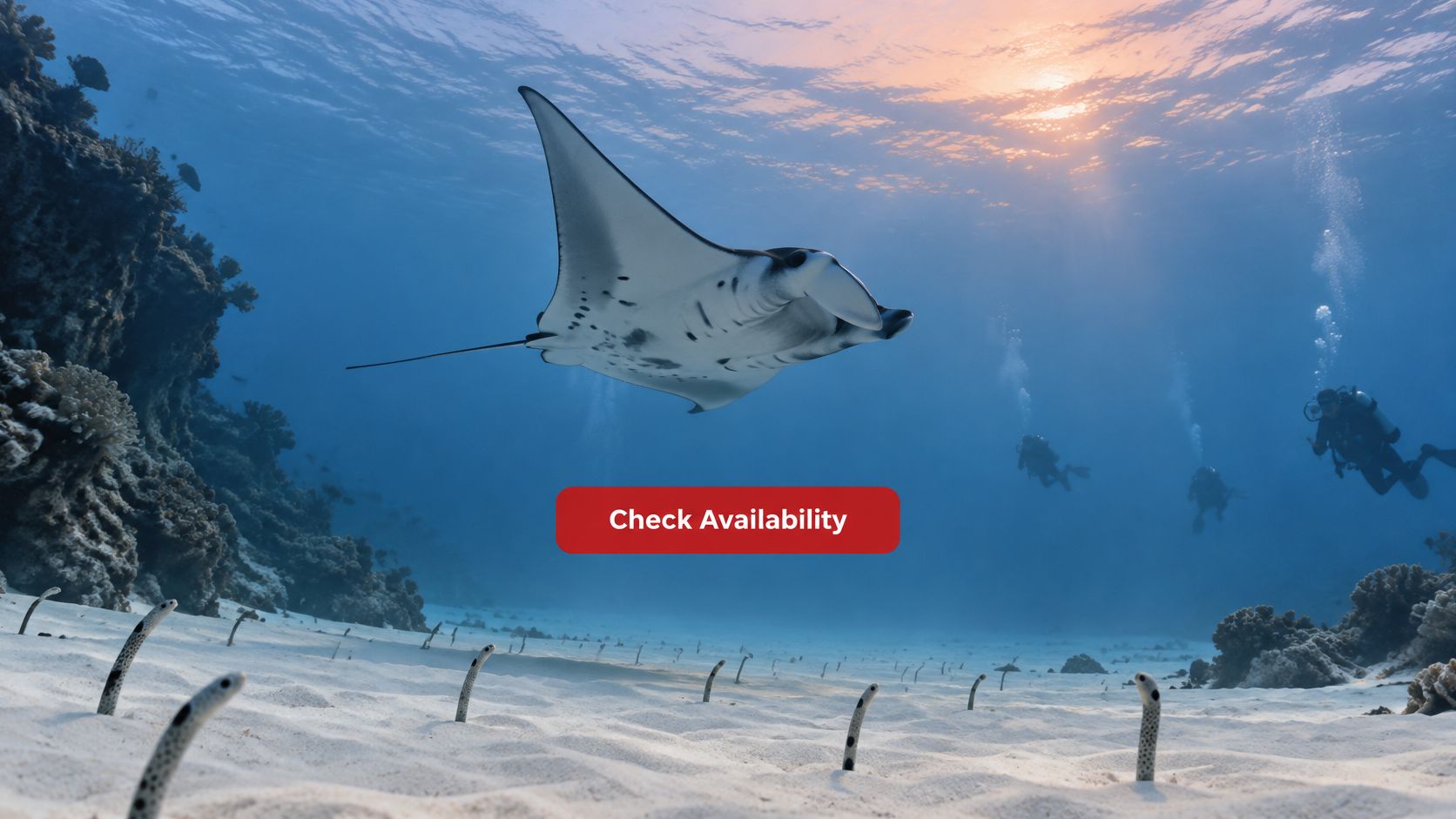
The sighting data backs up the site choice. A University of Hawaiʻi analysis examined 13 years of community-sourced observations, from 2010 through 2022, at Kona's Garden Eel Cove and Keauhou manta sites, with more than 23,000 manta sightings and 167 identified individual reef mantas, as reported in Kona Honu Divers' manta ray dives of Hawaii overview. The analysis found that aggregation size tracked zooplankton density and that Garden Eel Cove generally supported larger manta aggregations than Keauhou. Larger groups of feeding animals mean more passes, more display behaviors, and a better chance of a close encounter without anyone needing to chase a single ray.
The alternative site has real drawbacks, and they're worth naming:
- More open-ocean exposure, which often means more surface chop and less predictable conditions.
- Less defined sand for settling, so divers end up closer to live coral or shifting position more often.
- Less structured reef to position on, which makes it harder to stay still and hold a camera steady.
Kona Honu Divers positions its manta divers in the specific viewing area at Garden Eel Cove, taking advantage of the shelter, the sandy bottom, and the better reef. That's not a marketing line: it's what the site geometry allows, and it's why the night dive there feels calmer than it has any right to.
When you're comparing operators, ask three questions. Is the site sheltered? Is the viewing area on sand? How many boats share it? The answers will tell you whether you're getting a thoughtful wildlife operation or just a boat ride into crowded water. You can see the full manta ray dive tour details to confirm the site and format.
How Kona Honu Divers Runs Manta Trips
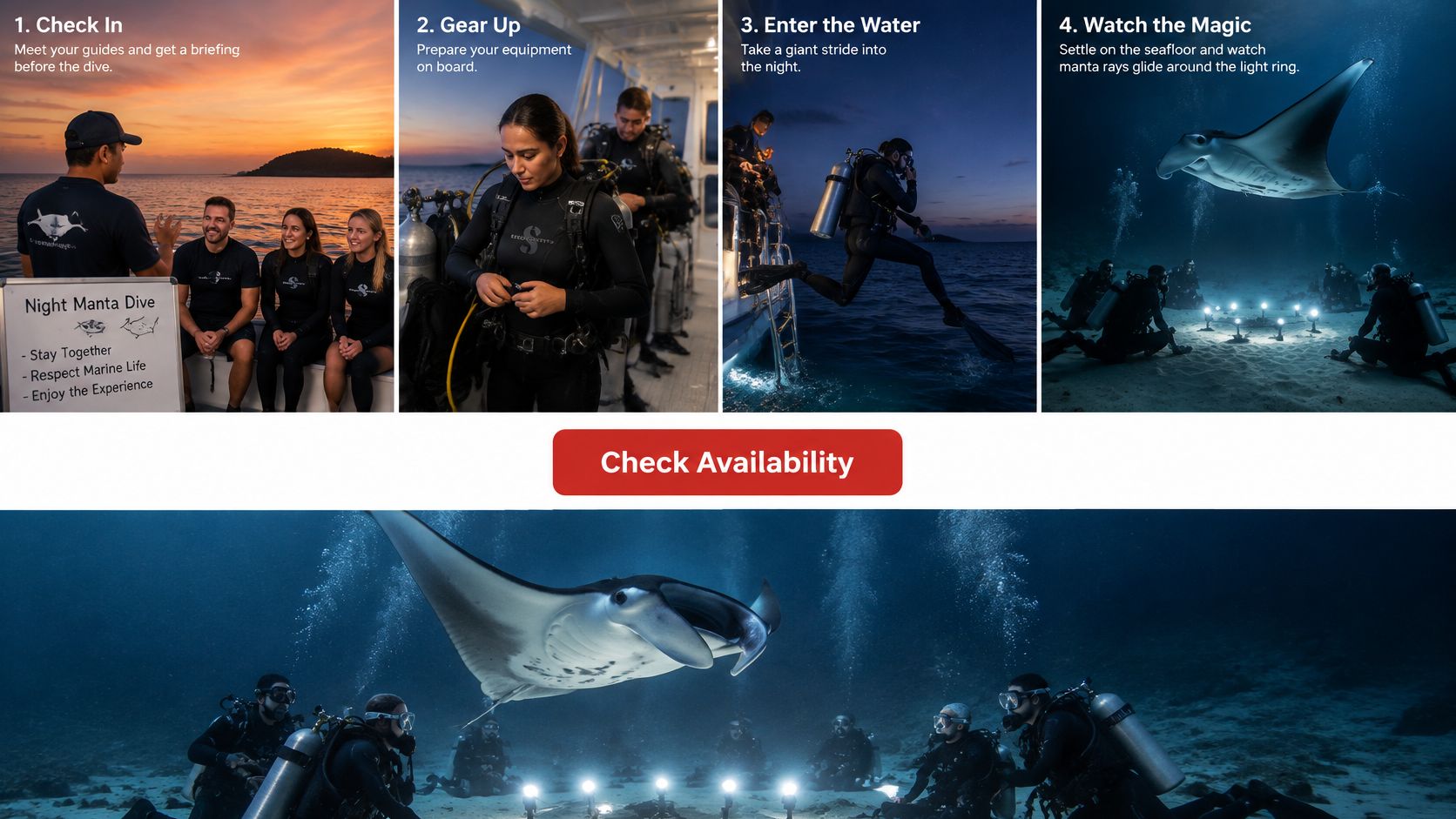
You check in before sunset, the crew matches your paperwork and fits gear, and you board while there is still daylight to get oriented. Departure time, meeting point, and return time are fixed at booking. That schedule is what keeps a night trip from turning into last-minute guesswork on the dock.
Divemasters and instructors enter with the divers and stay in the water for the dive, not only on deck. The night dive is stationary and closely supervised. Divers kneel in a set viewing area on the sand. Snorkelers remain on the surface. Lights placed on the seafloor draw plankton, which is what brings the mantas in, and those lights throw a bright circle so the group can see the bottom. Sightings are wildlife, not a booked performance. Encounter rates run as high as 92 percent, and a quiet night is still possible.
The pre-dive briefing is the operating plan for the hour. The crew covers the science of what you will see and the rules of passive observation, so a group that may include newer divers and very experienced ones shares one patch of sand without scattering. I would give that briefing your full attention. A stationary, supervised setup is calmer than a roaming night dive, and the trade-off is that you stay put and let the animal decide whether to pass overhead.
The Manta Dive holds a maximum of 18 divers. Capping the boat is how the operator keeps supervision tight instead of stacking more people into the same lit area. The most popular trips, including the manta ray night dive, often sell out weeks in advance. Certified divers can use complimentary nitrox for more bottom time.
Current trip options and what each one includes are listed on the Kona diving tours page. Pick the date you want. Treating the manta night as a walk-up is how people miss it.
Viewing Etiquette That Protects Manta Rays
The rule divers are most likely to break isn't touching, it's chasing. A manta loops overhead, you kick once to get closer, and suddenly you're swimming after a wild animal that was perfectly comfortable approaching you. Don't. The NOAA voluntary wildlife-interaction standard for Kona manta encounters is explicit, and it forms the baseline for good behavior in the water.
The core rule: Never touch, chase, grab, or ride a manta ray. Contact can remove the animal's protective mucus coating.
Divers should remain on or near sand, rubble, or boulders rather than live coral. Groups should form a semicircle on the bottom, with the open side facing the lit water, leaving open water for the mantas to maneuver through. Hold lights above your head to attract plankton, and never point a light directly into a manta's mouth or block its path. Chasing or blocking a feeding manta, or approaching it from the front, can make it stop feeding and leave the area entirely. You haven't improved your encounter; you've ended everyone's.
Crowding deserves equal attention. Some popular Kona manta sites can host up to 30 boats and 300 participants per day, and among 444 surveyed users, 82 percent reported feeling crowded by snorkelers, with crowding linked to lower satisfaction and a greater chance of not returning, based on the Hawaii County record of the 2018 manta snorkeling and scuba diving survey. An overcrowded site isn't just an inconvenience, it's a conservation problem and a satisfaction problem.
When you're choosing a lower-impact operator, evaluate these criteria:
- Briefing quality: Does the crew cover positioning rules before entry, or only fit gear?
- Group management: How many divers or snorkelers per guide, and is the group held together?
- Lighting practices: Are lights fixed and aimed to concentrate plankton, or are there dozens of strobes flashing?
- Wildlife-first procedure: Does the guide reposition the group when mantas aren't feeding, or chase the animals around the site?
A close encounter is not automatically a better encounter. Passive observation, staying still and letting the manta choose its distance, often produces a more natural, repeatable experience that lasts longer. The full responsible diver etiquette guide covers the same principles in more detail for all Kona dive sites.
How the Night Manta Dive Unfolds Step by Step
Here's the sequence, with the reason behind each step, so nothing in the dark catches you off guard.
Check in and gear up before sunset. The crew briefs you on what you'll see and the rules of passive observation. Doing this in daylight makes mask fitting, tank checks, and the manta-viewing guide discussion far less stressful than fumbling for straps on a dark deck.
Descend as a group to the designated sandy viewing area. The stationary format is closely supervised by experienced guides. You go down together, so no one is descending alone at night, and you establish the buddy pairs you'll maintain for the entire dive.
Kneel on sand or rubble while the crew switches on the seafloor lights. The powerful dive lights create a bright circle on the seafloor, so you're never in complete darkness. That light draws plankton, and the plankton draws the mantas. You wait here, not swimming around, because motion in the water column churns the food patch you're trying to watch.
Hold your light above your head, stay still, and let the mantas loop through the lit water. This is the entire skill. Hold position, breathe normally, and let the animals approach on their own terms. If you kick or reach, you've changed the encounter from wildlife observation to wildlife pursuit.
Wait for the guide's signal before moving, and keep buddy contact on the way up. Moving early in a crowd of divers just creates collisions and stirs up sand. The guide calls the end of the bottom time, and you ascend together.
Surface, rinse off, and review the sightings with the crew. The debrief is often the best part. You'll learn which individual rays showed up, what the spot patterns meant, and how the night compared to recent ones.
Divemasters and instructors are in the water with divers for the whole Manta Ray Night Dive, so you're never unsupervised. A calm group, several passes by the animals, and no rushing to the boat afterward, that's how you know the night worked.
Photography Gear and What to Bring
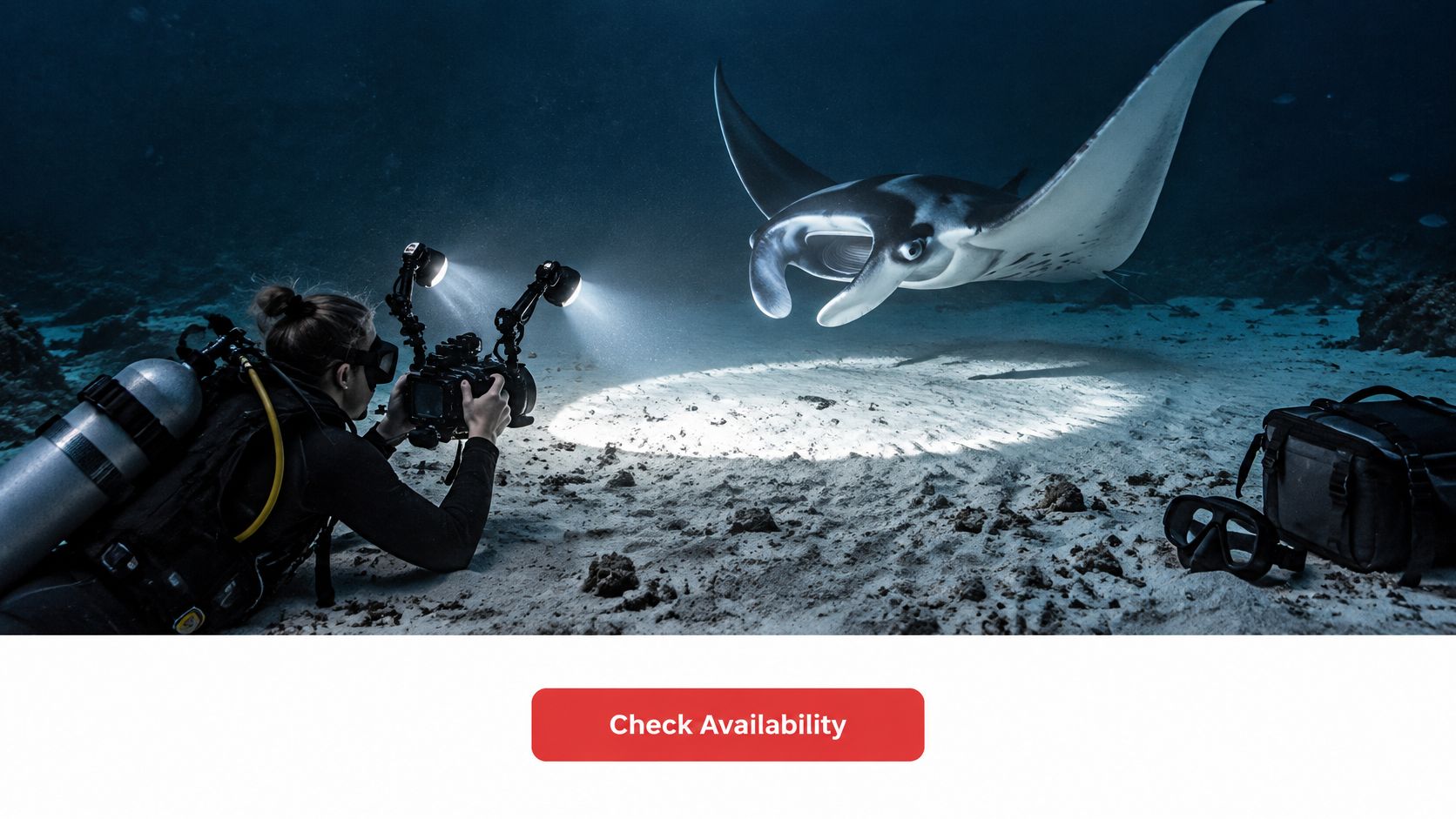
The lighting setup does half the work for your camera before you even frame a shot. On the manta ray night dive, the powerful dive lights create a bright circle on the seafloor, so you're never shooting into absolute blackness. Garden Eel Cove's defined sandy viewing area gives you a stable place to settle and frame without hovering or drifting into the animal's path.
Camera Setup in Five Steps
- Set white balance manually for blue-green water. Auto white balance will chase the light color and ruin your consistency shot to shot.
- Use a wide-angle lens. Mantas are wide animals, and a wide lens lets you fit the whole wingspan in frame without backing away.
- Keep strobes low or off. Guidelines for manta encounters favor low-intensity, non-repetitive lighting. Flash bursts can disturb feeding behavior, and the constant seafloor lights give you enough ambient light to work.
- Hold steady buoyancy and stay below or to the side of the animal's path. Getting level with the manta and off to the side gives you a clean angle without blocking it.
- Shoot in short bursts rather than long continuous flashes. A few frames per pass is enough. Let the manta complete a loop and come around again naturally.
What to Bring
- Camera in a housing with a spare battery. Night dives run long, and cold water drains batteries faster than daytime does.
- A dive light for your own use. The operator supplies the main light setup, but a personal light helps you see your gauges and signal your buddy.
- A wetsuit or rash guard. You're mostly stationary at night, which means you chill faster than on a daytime dive where you're swimming.
- A secure mask strap. Nothing ends a photo pass faster than your mask sliding off mid-frame.
The patience rule deserves its own line: stay still, let the mantas approach, and never chase them. The best manta ray dive photos come from animals that are comfortable, not spooked. A manta that loops back through the light voluntarily gives you more chances than one you've pushed into a single evasive turn.
Booking, Pricing and Common Questions
Book early, not because I want to pressure you, but because the popular manta ray night dive trips often sell out weeks in advance, especially in high season. Manta sightings in Kona often exceed a 90% success rate, which is why the demand is there, but a sighting is still likely, not guaranteed. Reserving early locks in your preferred date and gives you time to find a backup night if weather forces a change.
The booking sequence looks like this:
- Pick the option from the comparison table at the top of this article, the one that matches your certification and comfort level.
- Confirm you meet the requirements for it. Open Water Certification or higher for the scuba options, with a dive in the past two years for the two-tank charter.
- Choose a date several weeks ahead. Avoid your last night on island, so a weather cancellation doesn't kill your only chance.
- Check the sea conditions and weather before the day. Calm is better for both viewing and comfort in the water.
- Arrive early for the briefing. The crew's instructions matter more than anything you've read here.
When comparing prices, look at what each package includes. Does the price cover gear, nitrox, boat transport, and the light equipment? Is a second dive included on the two-tank charter? A lower sticker price sometimes means you're renting fins and a wetsuit separately, which closes the gap quickly.
On the booking side, you're working with a team that runs these nights constantly. Guests are saying:
Three common questions, answered directly:
Can a non-diver join the night snorkel? Yes, and it's often the best option for families with mixed comfort levels. The snorkel requires no certification beyond swimming comfort, and extra flotation plus closer supervision covers the gap.
What does a beginner need? For the night snorkel, nothing beyond a willingness to float and look down. For the night scuba dive, you need a scuba certification. If you're uncertified but curious, start with a certification course before booking the scuba manta night.
What changes for advanced divers? The manta night dive itself is stationary, but advanced divers who want more challenging night diving can look at the Premium Advanced 2 Tank Trip, which runs deeper sites and drift dives. That's a different product from the manta encounter, and it's worth doing both if you have the days.
The action is simple: book the Garden Eel Cove manta dive. Pick the format that matches your certification, reserve it a few weeks out, and show up ready to stay still.
Kona Honu Divers runs the manta ray night dive at Garden Eel Cove, positioning divers on a sandy viewing area with a structured reef and in-water divemasters through the whole dive. If you want a guided, wildlife-first manta encounter that treats passive observation as the technique, not a compromise, start by checking the current trip availability at Kona Honu Divers.