
You're on a hotel balcony in Kailua-Kona with the water already going pink, two bookings open, and a flight home in three days. One seat is a night scuba spot. The other is a snorkel. Both say mantas. Neither says where you'll kneel, where the lights point, or how many boats will share the sand.
That choice is the night. A manta dive in Kona is a managed feeding stop, not a roam-the-reef swim. Reef manta rays (Mobula alfredi) show up when lights pull plankton into one column. Site, light position, and boat count decide whether you watch clean passes or spend the time dodging fins. I would sort the format first, then the cove, and only then hit reserve.
Choose Your Manta Night Format
Kona's manta night dive is a nightly encounter in which reef manta rays gather under artificial lights to feed on plankton. Pick the format before you pick a boat. Who shares the water, and how much support you get, shapes the night more than the animal does.
Manta night formats and what to bring
| Format | Who It Suits | What You Need | Gear to Bring |
|---|---|---|---|
| Scuba night dive | Certified divers wanting a close view | Open Water certification or higher, comfort in darkness | Own mask, fins, thermal layer, dive computer, dive light with spare batteries |
| 2-tank manta charter | Certified divers new to night diving | Open Water certification plus a reef dive before the night portion | Dive light, spare batteries, warm layer |
| Manta night snorkel | Confident swimmers without certification | Calm comfort floating in open water after dark, no diving down | Mask, snorkel, fins, rash guard |
| Underwater photographer | Certified divers with steady buoyancy | Certification and steady buoyancy | Depth-rated camera housing, wide-angle lens |
If you're still split, read whether it's better to snorkel or dive with manta rays before you pay for the wrong seat.
Why the lights are the show
Lights bunch zooplankton into one patch. Rays make repeated passes and filter-feed through that patch. Aim a beam at the sand, or scatter ten lights across the reef, and the food column breaks apart. The light isn't a camera spotlight. It's why the animals are there.
Practical rule: Certified divers choose a dive. Confident swimmers without a card choose the snorkel. Anyone with unproven night swimming or shaky buoyancy starts with the format that puts more support in the water.
In 2024, NOAA Fisheries reported approximately 104 adult breeding reef manta rays around Hawaiʻi Island. That small breeding group is why a managed encounter matters. Parking a crowd in one animal's feeding lane, night after night, is a real cost.
I would book the 2-tank manta charter when you want a reef dive before the night portion. Daylight gives rusty buoyancy a supervised reset, then you settle on the sand for the rays. We have offered the Hawaii manta ray night dive since 2002, and Kona Honu Divers is a Manta Ray Greenlist Activity Provider. Reserve that charter on the 2-tank manta dive and snorkel page. If the night isn't your only day in the water, daytime reef trips sit with our diving tours.
Timing, Sighting Odds and Getting to the Harbor
The night manta dive runs nightly, with departure set around sunset. Confirm that evening's schedule and pick a slot that matches sunset, not a clock time copied from last month.
The harbor check-in is easier to picture once you've seen the boat in that last light.
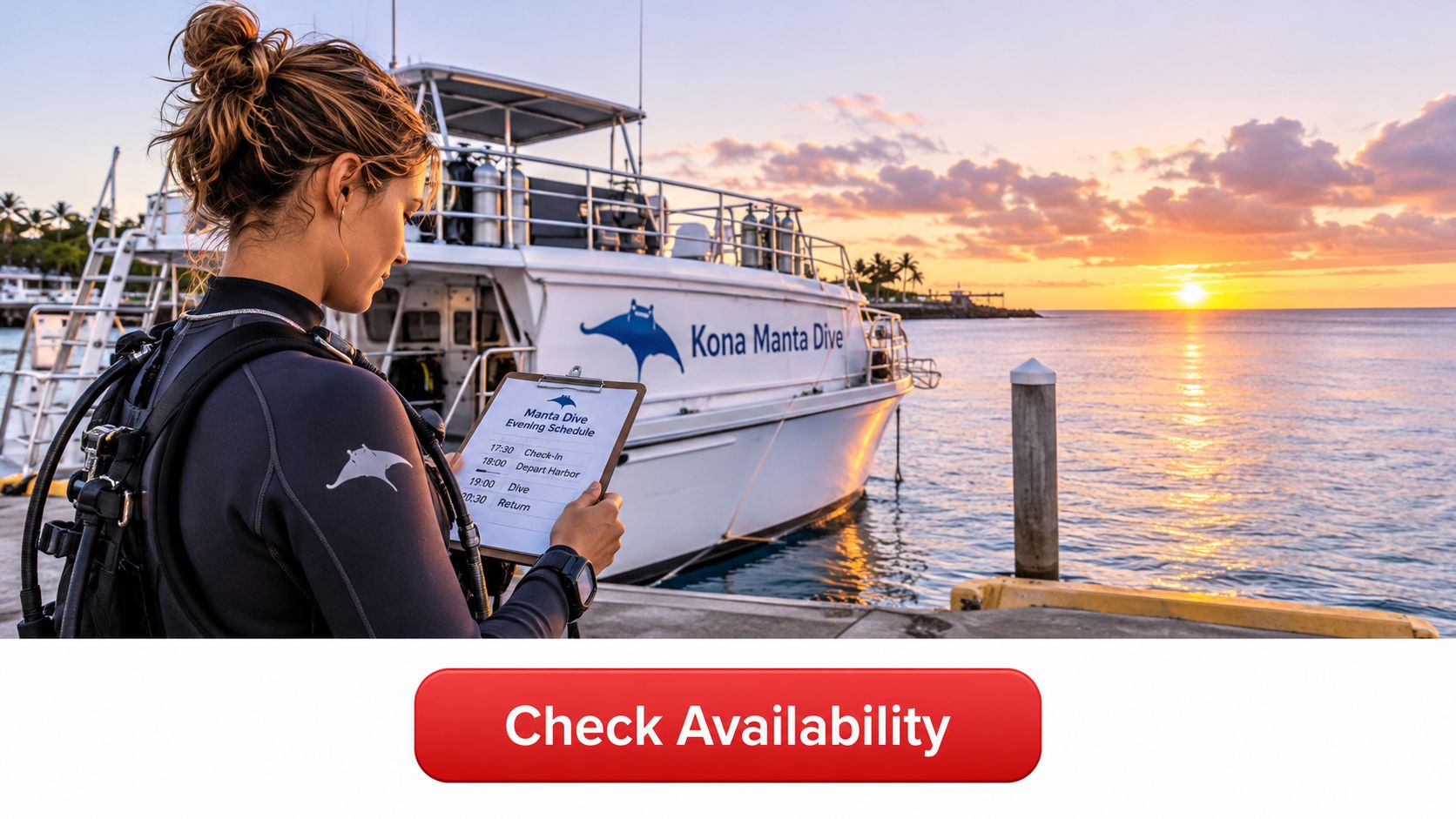
Honokohau Harbor is the departure point on the Kona Coast. Garden Eel Cove sits near Kona's airport on the west coast, so plan arrival and any transfer around both points, not just hotel checkout.
A 2025 summary of University of Hawaiʻi records from 2010 to 2022 documented more than 23,000 sightings involving 167 individually identified reef manta rays at two Kona sites. Read that as a track record of who uses these sites, not a promise for Tuesday. We see manta rays 80% of the time on the manta ray night dive, and a single evening is still wildlife, not a timetable. Season and moon questions belong in the best time to see the manta rays in Kona.
Plankton drives nightly activity. Even the best site can't guarantee that rays appear, or that they stay for a set time.
This short clip shows the light column you're timing the boat around.
- Book a sunset-friendly slot: Late hotel check-in and a dusk boat don't mix.
- Pack a warm layer: The ride back feels colder once you're wet and the adrenaline drops.
- Keep a backup date: Wind, swell, or a quiet plankton night can move the plan.
Why Garden Eel Cove Is the Best Viewing Site
Garden Eel Cove, also called Makako Bay or Manta Heaven, is the site I want for this dive. It lies near Kona's airport on the west coast, and the cove itself does more work than the nickname.
Sand, reef, and one light zone
The cove is protected, with a defined sandy viewing area and reef around it. That layout beats an exposed open-water setting, which is why this Kona manta ray night dive guide treats the cove as the stronger choice. Divers can gather under the feeding lane on sand or rubble instead of standing on live coral. The adjacent reef stays habitat and scenery, separate from the main viewing space. Lights sit in one concentrated zone rather than a loose scatter across the bottom.
An exposed site fights you on all three jobs at once. Surge shoves people off station. There is no clean patch of sand, so knees end up on coral. Lights drift apart, and the plankton field goes with them. You can have rays in the area and still have a poor night, because nobody is holding a lane.
What the long record shows about the cove
A University of Hawaiʻi analysis of 2010–2022 observations found Garden Eel Cove produced consistently larger and more variable aggregations than Keauhou, the other site in those records, with a relatively balanced sex ratio. Site choice changes the encounter. A bigger, more mixed aggregation means more passes and a wider mix of animals, not a different species and not a guaranteed count.
A famous site name doesn't help if the bottom won't hold a group still.
We often take the manta ray charter to Garden Eel Cove because that sand-and-reef split is what makes the light circle workable after dark. Confirm the evening's site when you book. Conditions can move a boat, and a good call is the one that still gives you sand under the lights.
How the Night Dive Unfolds Step by Step
Picture the evening from the dock at Honokohau Harbor, not from a highlight reel. Steps 2 and 3 apply to the 2-tank manta charter only. A scuba night dive and a manta night snorkel skip the daytime reef dive and start at the harbor briefing.
The sequence is easier to hold in your head as a short board before you kit up.
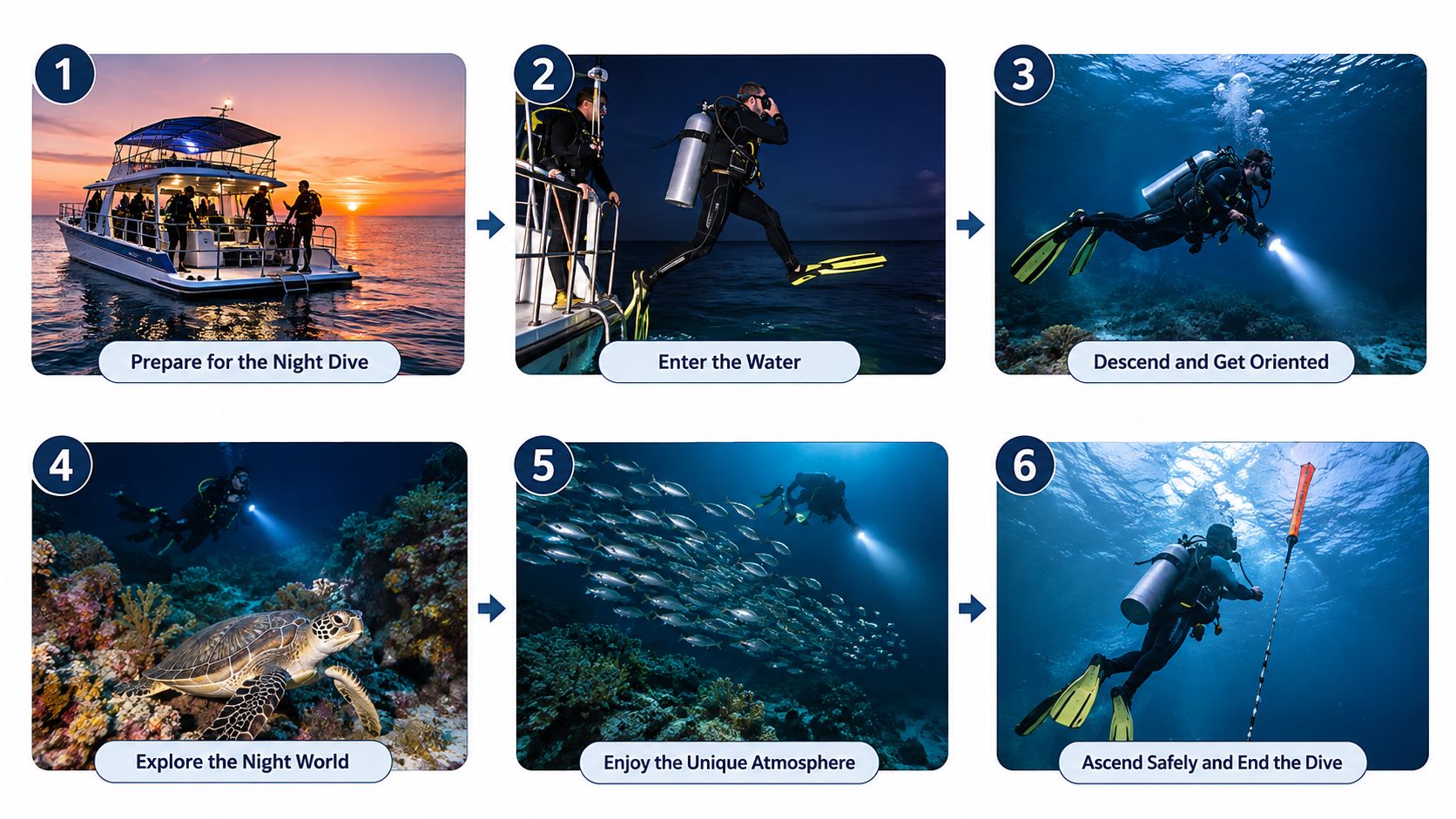
Check in and brief. You get the light circle, the no-touch rules, and the group count before anyone zips a wetsuit. People who half-listen here are the ones who drift later. The slip is treating the briefing as filler.
Daylight reef dive, charter only. Dive staff lead a reef dive so you can settle buoyancy and see the reef while you can still read it. Rushing depth or skipping a weight check shows up as a yo-yo on the night portion. The slip is saving your real buoyancy practice for the dark.
Surface interval, charter only. You watch the Kona sunset and eat a light meal. That pause is a reset, not a second dinner. A heavy plate plus a rocking deck is how people lose the night before the rays arrive. The slip is boarding already queasy and adding greasy food.
Night entry as a group. Gear up and enter together. A staggered entry splits lights and buddies across black water. The slip is hopping in early because your camera is ready.
Settle in the light circle. You rest on sand or rubble. Experienced divemasters and instructors are in the water with you on our Manta Ray Night Dive. The slip is kneeling high, then sliding onto coral when a fin catches you.
Watch the passes. Rays loop through the column while you stay still and predictable. Chasing the first animal usually means you miss the second, cleaner one. The slip is finning up "just to see."
Surface, debrief, harbor. Count heads, talk through what you saw, and ride back to Honokohau. The slip is peeling gear off before the guide finishes the head count.
A good night looks ordinary from the boat. Rays pass overhead, divers hold station, and nobody puts a hand on the reef.
Positioning and Etiquette That Keep Mantas Feeding
Rays feed in a predictable lane. Disturb that lane and the passes that made the trip worth booking stop. Stay put, and the animal does the moving.
The NOAA-supported voluntary wildlife-interaction standard for Kailua-Kona spells out where each person belongs. Divemasters place divers in a designated light circle over sand or rubble, with enough room that nobody sits on live coral.
Position and light rules by role
| Role | Where to Stay | Light Direction | Avoid |
|---|---|---|---|
| Diver | On or near sand or rubble in a semicircle, with no contact with live coral | Hold light above the head and shine it upward into the water column | Touching coral, sea urchins or marine life; kicking up sediment |
| Snorkeler | At the surface, never diving down | Shine light downward | Diving down to chase rays |
| All guests | Keep the open water column clear for ray movement | Follow the guide's light signals | Chasing, touching or blocking a ray |
An open water column lets a ray turn without clipping a tank or a dangling fin. Contact with coral, urchins, or other marine life damages the reef you're using as a viewing floor. Big fin kicks lift silt, and silt both blinds the group and breaks a feeding pass.
Same habits, whoever is holding the light:
- Keep fin movement small: Ankles, not full kicks, once you're on station.
- Hold neutral buoyancy: Hover or rest. Don't piston up and down through the lane.
- Stay predictable: A still diver is easy for a ray to miss. A swimmer who keeps repositioning is not.
- Never chase or touch a ray: Your hand doesn't improve the pass. It ends it.
Fewer disturbances mean longer, clearer passes and cleaner photographs. The etiquette isn't a lecture taped to the boat. It's the responsible diver etiquette that keeps the feeding lane open for the next group in the water, including yours.
Photography and Filming the Manta Night
Light placement and buoyancy shape the picture more than the camera body does. A housing on a diver who won't hold still just records silt.
- Test the housing in the shallows before the night portion. Check seals, latch, and focus while you can still bail out.
- Set white balance manually. The dive light colors the water, and auto white balance jumps between passes.
- Use a wide-angle lens so the ray sits against the light column. Get close by being already in the right spot, not by chasing.
- Hold still and let the ray come to you. Fin movement stirs silt that fills the frame and the lane.
- Shoot short bursts when a pass starts. Passes arrive and leave without a warning count.
- Keep the light off the lens so plankton doesn't blow back as backscatter.
Good frames come from the same rules that protect the rays, so the photographer and the group share one goal. A camera is not a reason to leave the semicircle, block a pass, or drop onto the reef. If you want a sense of what a held position looks like, look through these manta ray dive photos from Kona before you pack a second strobe you won't have time to aim.
Safety, Conditions and Crowded Water
The risk most visitors miss isn't the ray. It's a crowded night, with boats, snorkelers, and divers sharing low light. Mantas are filter feeders working a light column. The hazards sit in the traffic around them.
A Hawaii County safety assessment found that vessel and participant numbers increase accident likelihood, and that effective capacity controls were lacking. That's an operations problem, not a wildlife surprise.
- Boat traffic in low light: Hulls move among people who are hard to see once they leave the light circle.
- Swimmers outside the group: A drifted snorkeler becomes an unlit target between boats.
- Poor visibility: Lines, reef edges, and other divers disappear a few kicks away.
- A forecast that goes stale: Morning chop and the evening sea are not the same sea.
Our manta operation is smaller and more personal, which lets us place guests where the rays are feeding instead of stacking everyone on the same square of sand. A tight crew keeps people together, runs buddy checks, and counts heads in and out. Lights stay on purpose, not as decoration.
What you control is smaller, and it still matters:
- Stay with the group: The circle is the safe shape, not a suggestion.
- Carry a working light: Spare batteries belong in the pocket, not in the room.
- Stay in sight of the guide: If you can't see the crew, you're already the problem.
- Speak up if the sea feels wrong: Pride is a bad dive plan after dark.
Before you book, ask the guide ratio. On the day, check the actual conditions, not yesterday's screenshot. If the evening looks rougher than the trip you signed up for, say so on the dock.
Frequently Asked Questions
Do I need certification?
Scuba, including the night dive and the 2-tank charter, takes Open Water or higher. If you don't have the card yet, start with Open Water certification on a different day, not on the manta boat. The manta night snorkel needs calm comfort floating in open water after dark, and no diving down.
Can I touch the rays?
No. Contact with rays, coral, or other marine life isn't allowed. Chasing a ray breaks the feeding passes for everyone in the circle, including you.
Will I definitely see rays?
No. Plankton drives the night, so you can do every step right and still surface without a ray. Book the operation, not a guarantee.
What should the rate cover?
Before you pay, confirm the equipment, the dive light, the guide ratio, and whether tax and fees sit on top of the listed price. A low headline number that skips the light or the guide isn't the cheaper night once you're on the dock.
Confirm Your Night and Book Your Manta Dive
Choose a format from the table, put Garden Eel Cove first on your list, and check that the evening still has space. The 2 Tank Manta Ray Dive Kona is listed at up to $299, plus tax and fees, and prices vary with demand, so confirm the current rate on the booking page before you assume last month's number.
We run the manta ray night snorkel every night. If the format is unclear, or the schedule needs to move, call 808-324-4668.
- Format: Dive, 2-tank charter, or snorkel, matched to your card and your comfort after dark.
- Departure: Honokohau Harbor, timed around sunset.
- Conditions: The day's sea, not a screenshot from yesterday.
- What you bring: Light with spare batteries, a warm layer, and a camera only if you already know it in the dark.
Book the format that matches your certification and how calm you are in dark water. A steady guest sees more than a nervous one with a fancier setup.
Kona Honu Divers runs guided manta nights from Honokohau Harbor, with the dive built around a managed light circle at Garden Eel Cove rather than a chase across the reef. If your card, your swim comfort, and your sunset line up, visit Kona Honu Divers and reserve the format that fits the night you want.